Navigating a new geopolitical landscape
There has been an unprecedented political response to the invasion of Ukraine. To a greater or lesser extent, much of the world has disengaged from Russia and seeks to isolate the country from the global economy. The mass walk-out by over 100 diplomats during the Russian foreign minister Sergei Lavrov’s speech at the UN General Assembly was a powerful illustration of Russia’s ostracization by the international community.
Not all nations have condemned Putin’s actions outright or imposed sanctions against Russia, however – some countries, notably China, appear to be more aligned with him. Russia holds a permanent seat on the UN Security Council, affording it veto rights over any vote or UN sanctions. Consequently, efforts by other permanent members to adopt a draft resolution calling for Russia’s immediate withdrawal from Ukraine have been blocked. A similar resolution was passed by the UN General Assembly, despite Belarus, Eritrea, North Korea and Syria voting against; 35 others – including China and India – abstained.
One of the thorniest issues for the future of multilateralism is how the G20 functions under the Indonesian presidency. Calls from some members, such as Australia, for Russia to be expelled from the G20 are unlikely to be met.
This disparity in political stances towards Russia is likely to have a long-term geopolitical impact and will influence how European nations adjust their resource strategies to improve resilience. Even in the event of a ceasefire, it is highly unlikely that economic measures introduced in the energy sector will be unwound in the short to medium term, even in the event of an imminent ceasefire in Ukraine. Instead, these measures suggest a structural shift in global energy markets: first, with agreements between Western producers and consumers being quickly struck as a means of reducing Russian oil and gas imports (for example, the US commitment to supplying additional LNG to the EU over the period to 2030); and second, with Russia’s pivot to Asia accelerating, and the longer-term implications for the transparency and governance of oil and gas markets. In addition to developing energy strategies that are less dependent on oil and gas from authoritarian states, some governments are also likely to move away from ‘unfettered globalization’ to regional and local supply chains and production of food.
One of the thorniest issues for the future of multilateralism is how the G20 functions under the Indonesian presidency. Calls from some members, such as Australia, for Russia to be expelled from the G20 are unlikely to be met. Nevertheless, it is hard to imagine that all 20 countries will be represented when the group meets in Bali in October 2022, and in early April the US stated that it would boycott some G20 meetings if Russia is represented. A series of ministerial meetings in the run-up to the summit – including on agriculture and energy transition in September, and on the environment and climate in August – will offer an earlier test of how members intend to engage with the summit.
Given the political fractures within the G20, the G7 – and its German presidency – is likely to focus its attention on the conflict in Ukraine, and on the ripple effects on resource pricing and the global economy. A joint statement from the G7 foreign ministers on 4 March 2022 reiterated the group’s ‘profound condemnation of Russia’s unprovoked and unjustifiable war of choice against Ukraine’, while a statement from an extraordinary meeting of G7 agriculture ministers on 11 March expressed deep concern over the implications of the conflict for food security worldwide, noting the importance of Ukraine to global supply chains.
A joint statement from the heads of the European Bank for Reconstruction and Development, European Investment Bank, Council of Europe Development Bank, the International Monetary Fund (IMF) and the World Bank stated that ‘the entire global economy will feel the effects of the crisis through slower growth, trade disruptions, and steeper inflation, harming especially the poorest and most vulnerable’, and outlined emergency support packages in Ukraine and its neighbouring countries totalling over $8.9 billion. At the 2022 Spring Meetings, the IMF and World Bank are likely to concentrate efforts on keeping the wheels turning as they did through the COVID-19 pandemic, enhancing liquidity, financing working capital and expanding trade finance.
For Russia, signs of a fragmented Europe and weakening US influence will undoubtedly have been factored into the decision to invade Ukraine. Early responses from governments around the world indicate that the conflict in Ukraine, while posing challenges to the future agenda of the UN, G7 and G20 and increasing interest in resource independence, will also afford a renewed sense of urgency and commitment to multilateralism in the face of a common adversary. What remains to be seen is whether new blocs will emerge, aligned either with the Euro-Atlantic community or with Russia.
Conclusions
Food and energy are the lifeblood of any society, and their continued availability and affordability is essential. Over time, many countries and regions have become more reliant on imported resources as demand has increased and, in some cases, as domestic production has declined, either for economic reasons or due to depleted resources. Other countries have become significant global suppliers – and, consequently, global price setters. This is the case for Russia and Ukraine: Russia, as a supplier of natural gas to Europe and of fertilizer to international markets; and both countries as suppliers of grain and oilseeds.
Before Russia’s invasion of Ukraine, and as global economies recovered from the consequences of the COVID-19 pandemic, markets were already tightening, with supply struggling to keep up with rising demand. Climate change was threatening yields in a number of key producing regions and increasing food price volatility. High energy prices were spilling over into food markets by driving up the price of fertilizer. Societies in all parts of the world were facing a cost-of-living crisis.
To this existing state of vulnerability, the conflict in Ukraine and its impacts on energy and food markets have added both direct threats – high energy and food prices and the prospect of reduced supply – and cascading risks, with the potential for resource market impacts to ripple out and deepen economic insecurity. The current situation has thrown light on the interconnectedness of crises in a globalized world. It highlights the importance of addressing disruptions to markets and supply chains not in isolation but as interrelated systemic risks.
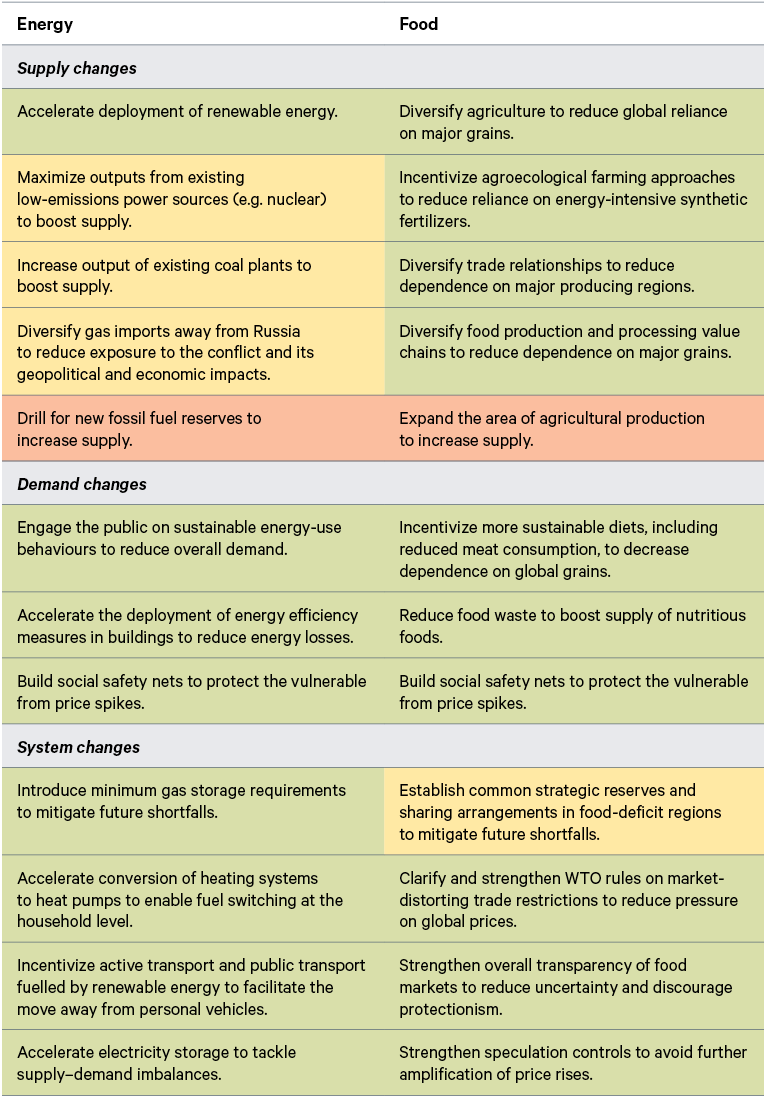
Already, the scale of price rises will have significant global impacts. Governments will need to intervene to support the most vulnerable in their own countries and, where possible, internationally to help rebalance supply and demand. Decisions taken now will be formative in either entrenching existing structures or setting countries around the world on a path towards more resilient economies. Short-term measures to reduce exposure to international markets and to boost resource ‘independence’ – at the expense of the energy transition and sustainable reform – risk heightening the vulnerability of societies and economies in the longer term.
While the circumstances of the current crisis are extraordinary, the direct impacts and cascading risks to which it contributed – high resource prices, supply-chain disruptions, market volatility, economic conflict, energy and food insecurity, displacement and migration, and geopolitical uncertainty – are likely to be the new normal in a climate-changed world. Building long-term resilience to shocks of this scale is not an optional extra for governments as they respond to the fallout from the conflict in Ukraine, but an urgent necessity.