2024: Road to partial reconciliation
Modi’s return to power for a third consecutive term in June 2024 raised expectations that tensions would de-escalate. Fuelling this perception were conciliatory remarks by Modi and other members of his government on the ‘need to urgently address the prolonged situation on our borders so that the abnormality in our bilateral interactions can be put behind us’. Beijing’s appointment of an ambassador to India after a gap of 18 months further fed expectations of a pending improvement in the bilateral relationship. Behind the scenes, several rounds of engagement at political and military levels were taking place.
The conclusion of the border deal in October 2024 confirmed those expectations. The timing of the deal could be attributed to the BRICS summit in Kazan, Russia, and to efforts by Russia to demonstrate unity among the group’s founding members. However, economic and strategic considerations for China and India also played a role. In the case of China, it is likely to have wanted to stabilize relations with other countries in preparedness for a more volatile relationship with the US under Donald Trump’s second presidency. Tighter foreign investment restrictions in the West have also prompted Beijing to deepen its engagement with the Global South (of which India is a key part). For India, the border deal reflected a recognition that it had backed itself into a corner by making de-escalation of border tensions a prerequisite to engagement on other issues, including the economy. India’s ambitions to become a global manufacturing hub come with a growing dependence on China for its component and raw material supply chains. India also has its own tensions with the West – including over its relations with Russia and allegations of Indian complicity in assassination plots in Canada and the US. From New Delhi’s perspective, the latter tensions have reaffirmed the need to maintain a multidimensional foreign policy, which includes engagement with Beijing.
The October 2024 border agreement was accompanied in December by the resumption of the Special Representatives framework (last convened in 2019), as well as dialogue mechanisms at the foreign ministerial level. Both countries have also discussed the revival of ‘people-centric’ initiatives, including direct flights and religious pilgrimages. This has been accompanied by positive rhetoric with Chinese foreign minister Wang Yi referring to improving bilateral relations as the ‘only right choice for both sides’ and Prime Minister Modi talking about ‘working to restore conditions to how they were before 2020’.
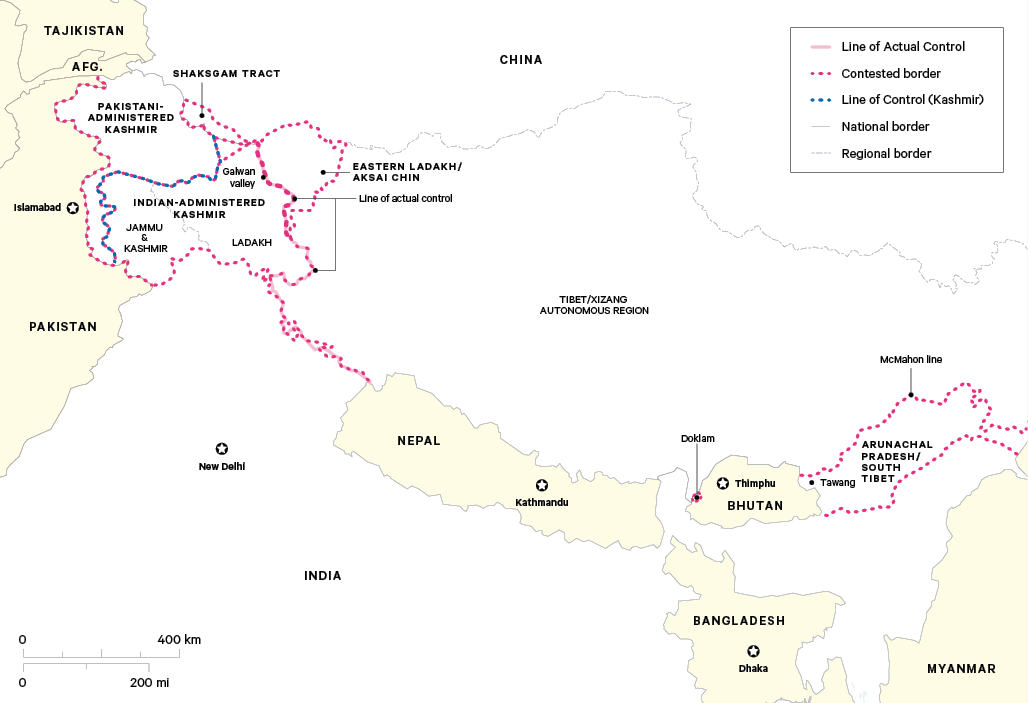
Reconciliation remains a work in progress. The border deal does not mean a return to the pre-2020 status quo. Since the Galwan Valley clashes, both countries have consolidated their positions, with each deploying some 50,000 to 60,000 troops along its side of the border and upgrading civilian and military infrastructure. The border deal makes no reference to other parts of the disputed border, notably including Arunachal Pradesh (which Beijing refers to as South Tibet). Nor does it address other contentious issues such as water disputes, which threaten to flare up amid plans by Beijing to construct the world’s largest hydroelectric dam along a river that traverses both countries.
Political considerations on both sides will also impose limits on the pace and process of rapprochement. Modi returned to power on a weakened mandate in June 2024, making him more beholden to coalition partners and opposition parties. That has made his government more sensitive to accusations of appearing weak on China – allegations that the opposition had already been making following the 2020 border clashes. This means that efforts to de-escalate tensions with China will proceed alongside efforts to burnish Modi’s credentials as a nationalist and being tough on security.
President Xi did not send a congratulatory message after Modi won his third term in 2024 (unlike after Modi’s 2019 re-election, when Xi was among the first to publicly congratulate him). To add insult to injury, Xi did congratulate the leaders of Pakistan and Bangladesh following elections in 2024. Xi was also notably absent from the G20 summit in New Delhi in September 2023, held under India’s chairmanship.
At a more fundamental level, the 2024 agreement resolved none of the underlying grievances in the long-standing border dispute. Neither side has rescinded its claims to disputed territories, nor has a mutual agreement been reached on the exact delineation of the Line of Actual Control that demarcates their borders. Confidence-building and verification mechanisms (supported by strengthened intelligence, surveillance and reconnaissance capabilities) will be necessary to ensure sustained momentum moving from disengagement to de-escalation and beyond to a possible de-induction of forces along the border. An eventual demilitarization of the border will be easier said than done, given the frequency of border transgressions taking place as Beijing tests New Delhi’s resolve on the border. The possibility of future stand-offs and skirmishes cannot be ruled out.
A lasting solution to the border dispute will require a grand bargain that entails meaningful concessions on both sides, including a final resolution of the border issue alongside other geopolitical and economic concerns. While a comprehensive rapprochement is unlikely in the near term, so is large-scale conflict. Either country, or both, would need to cross the other’s red lines to trigger wider hostilities. China’s red lines would be signs that India is providing more overt support for the cause of Tibetan separatism or Taiwanese independence, or for other claimants in the South China Sea, backed by a more formal military alliance-type of relationship with the US. India’s red lines would be China providing more direct support to Pakistan in the event of a future conflict over Kashmir or more overt signs that Beijing is undermining regional security in India’s neighbourhood.