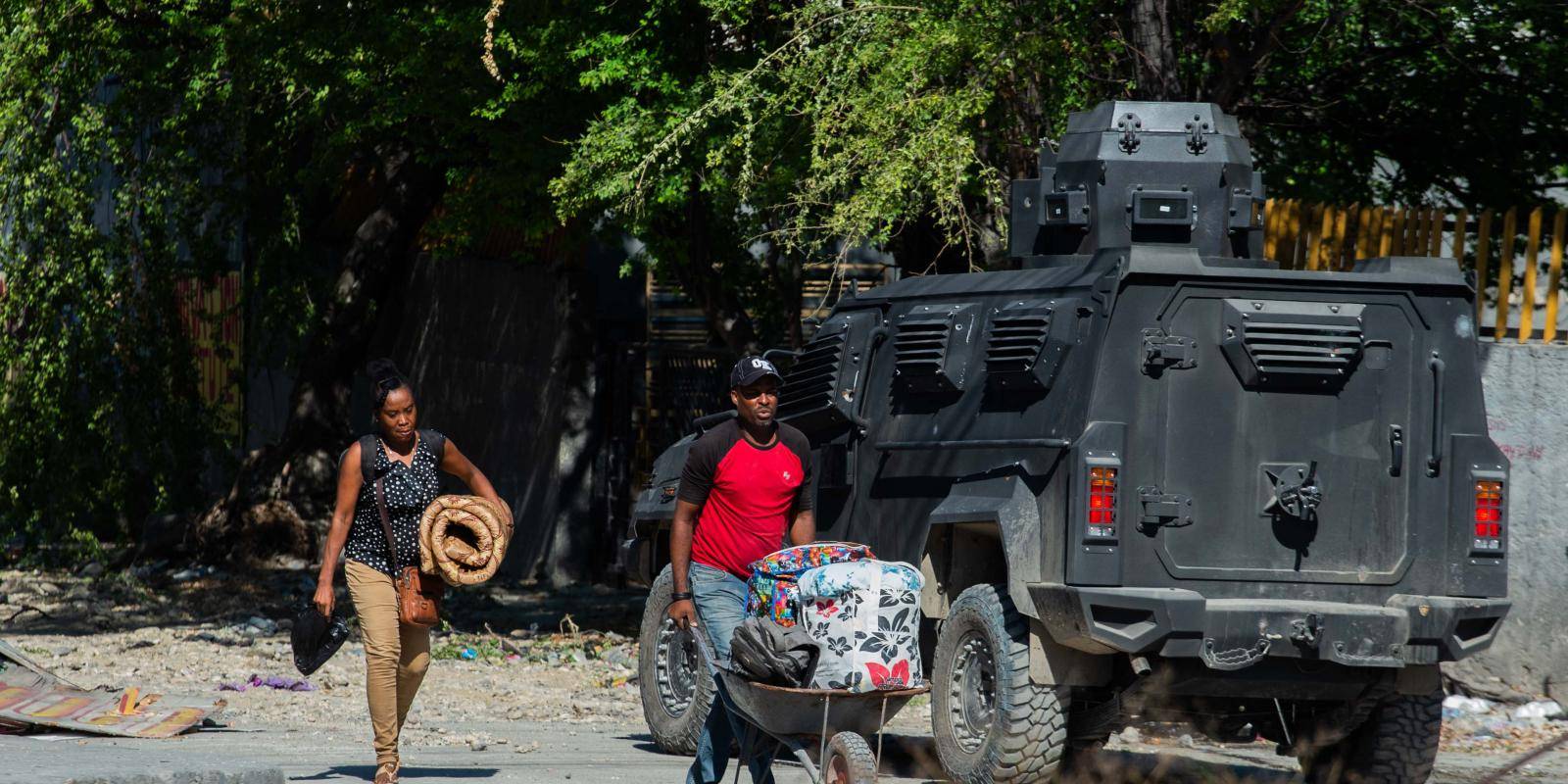
The assassination of President Jovenel Moïse on 7 July 2021 marked the tipping point in a long-running governance crisis in Haiti, and deepened the country’s constitutional vacuum. In April 2024, a Transitional Presidential Council (TPC) was sworn in to restore security and organize overdue elections, but it inherited an eroded state apparatus and limited territorial control. Even today, Haiti still has no elected president or legislature, and executive power is exercised by unelected transitional figures.
This vacuum of governance and government legitimacy has accelerated the collapse of security. Armed gangs and militias now control large areas of Port-au-Prince – the Haitian capital – and major transport corridors. These groups often use kidnappings, extortion and targeted killings as tools of predation and political leverage. Their hold over infrastructure and neighbourhoods allows them to act as de facto governing authorities: imposing rules, offering selective protection to residents and businesses, and negotiating with the political and economic elites. Vigilante movements have emerged in response to this situation, adding yet another layer of violence to Haiti’s security crisis.
The multilateral response has struggled to match the pace and complexity of Haiti’s challenges. In 2022 the UN Security Council (UNSC) adopted a sanctions regime targeting gang leaders and their enablers. A year later, in October 2023, the UNSC authorized a Multinational Security Support (MSS) mission – made up principally of non-UN, Kenyan-led security forces – to assist the Haitian National Police (HNP) and establish sufficiently secure conditions for elections to be held. Those conditions have not been met, however. Security is still tenuous in the extreme. International engagement with Haiti has for too long remained cautious and dependent on voluntary contributions in funding and forces. All the while, gangs have evolved into more entrenched economic actors and are increasingly asserting themselves politically too.
This paper is published at a moment when Haiti stands on the cusp of a period of heightened uncertainty. An attempt to mobilize UN member states under a new 2025 resolution means that the MSS – widely acknowledged as unsuccessful – has been superseded by the Gang Suppression Force (GSF). The GSF, unlike its predecessor, is designed to be supported through UN-managed funding mechanisms for its operations and logistics, allowing for more direct and sustained international action. At the same time, significant political change is looming as the end of the TPC’s mandate on 7 February 2026 approaches. Amid all this potential for turbulence, the UN and its international partners face the challenges of planning for the restoration of constitutional order through elections, and of mobilizing international funding and forces to support the new GSF security commitments.
Publication of this paper is deliberately timed to inform policy discussions between Haitian authorities and their international partners in the run-up to the expiry of the TPC’s mandate, and in the initial months thereafter. Rather than set out a fixed blueprint, the paper outlines a set of analytically grounded options for reaching the first phase of stabilization, and presents a detailed, three-year roadmap designed to be a Haitian-led endeavour. The presented options draw on the findings from a forthcoming, longer research paper – based in part on focus groups and interviews with security experts, multilateral officials, diplomats, and members of Haitian civil society and government – that is due to be published for limited circulation in mid-2026. In addition to briefly analysing gang dynamics in Haiti, and their impact on the broader social and state security infrastructure, we aim in this shorter summary document to sketch out options for transforming today’s emergency responses into a coherent strategy and foundation for security and governance reform.
Haitian citizens and community leaders consistently identify insecurity as the primary barrier to sustaining livelihoods: violence and the threat of violence shape people’s everyday mobility, access to employment and ability to carry out basic economic and social activities.
Haitian citizens and community leaders consistently identify insecurity as the primary barrier to sustaining livelihoods. This is unsurprising: violence and the threat of violence shape people’s everyday mobility, access to employment and ability to carry out basic economic and social activities. To understand this reality it is necessary to begin at the non-state level – that is, with the system of gangs and their associates, as these actors have effective control over key territory and thus most impact on ordinary citizens’ safety and freedom of movement.
In Haiti, the provision of security is transacted through a dense marketplace in which public authority is fragmented and protection is priced, brokered and frequently weaponized. The reorganization and consolidation of large gang coalitions and the systematic outsourcing of protection by households, firms and even public bodies to security groups – including private security agencies and gangs – have resulted in effect in the monetization of the public’s access to roads, ports and basic services. In this marketplace, security functions more as a negotiable commodity than as a public good enjoyed by all.
In the ecosystem of Haitian gangs, the central actor operating at present is the Viv Ansanm coalition. Formed in September 2023 through the fusion of former rivals G9 and G-Pèp, it has emerged as the primary price-setter in Port-au-Prince’s parallel economy. The coalition controls or heavily influences an estimated 80 per cent or more of the metropolitan area and its immediate periphery, a dominance repeatedly demonstrated through coordinated attacks on prisons, police stations, transportation hubs, the international airport, and fuel and port facilities.
Viv Ansanm taxes movement, rations services and adjudicates in disputes. These de facto powers allow it to determine the selective distribution of food, cash and ‘public order’ instrumental in consolidating its local legitimacy while stabilizing rent streams from corridor tolls and logistics chains. Recent human rights reporting underscores the heavy toll this model takes on civilians: many of those recruited or coerced into working for gangs are reported to be children, while evidence suggests women and girls in gang-controlled neighbourhoods face sexual violence, exploitation and forced pregnancy.
The coercive power of Haitian armed groups rests increasingly on a combination of military-grade weaponry, commercial drones and siege-style operations. Reporting by the UN Office on Drugs and Crime (UNODC) points to frequent use of assault and battle rifles, alongside a growing fleet of commercially available drones, by armed non-state actors. Gangs have reportedly deployed drones for intelligence, surveillance and reconnaissance, and for real-time coordination of attacks, including on prison facilities. This combination of capabilities and tactics has raised the risks and costs associated with ground operations by the HNP and the MSS mission, in turn increasing private demand for armed convoys and static protection services.
Tactically, gang coalitions have moved from the use of fragmented hit-and-run attacks towards more deliberate siege warfare and urban envelopment. The January 2025 attacks on the commune of Kenscoff near Port-au-Prince, for instance, illustrated the more organized, offensive approach gang coalitions are deploying to seize territory; this approach includes multi-axis advances (involving, worryingly, the apparent deployment of minors in lookout functions) to cut off access routes and service nodes, and the systematic burning or overrunning of police outposts. Beyond the capital and its environs, similar territorial advances in Haiti’s central region, particularly in Artibonite, have disrupted agricultural production and food supply chains of national importance, underscoring the direct link between gang expansion, territorial control and worsening food insecurity.