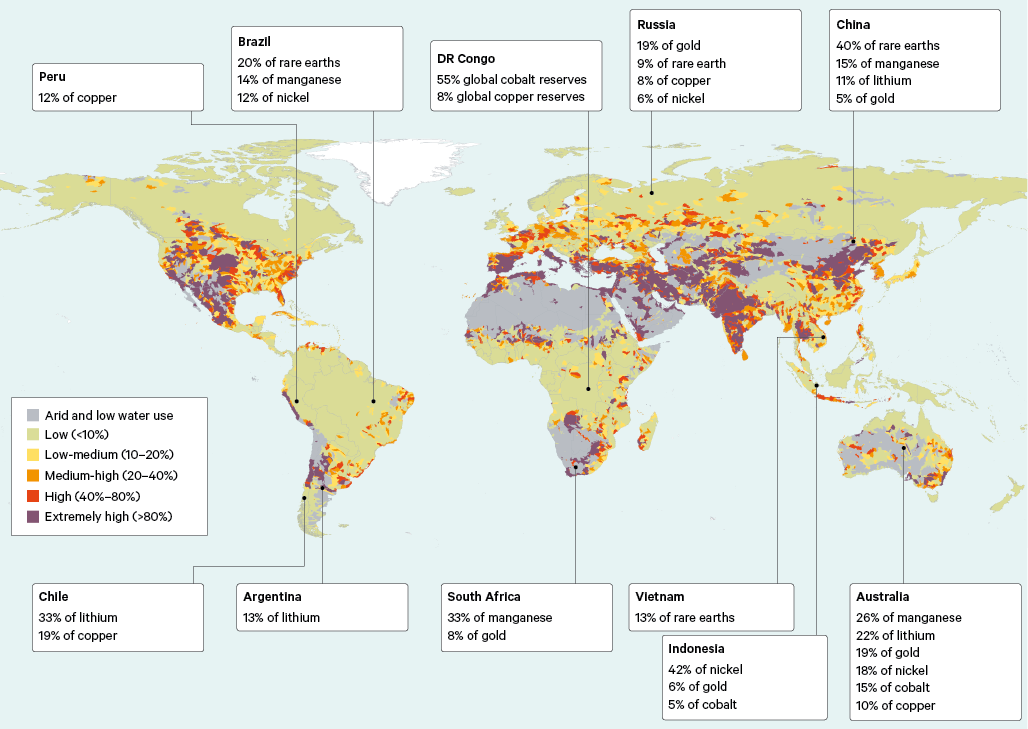
According to data from the United States Geological Survey and the WRI Aqueduct Water Risk Atlas, at least 16 per cent of global critical mineral mines, deposits and districts located on land are in areas facing high or extremely high baseline water stress. The growing demand for these minerals is expected to lead to a 20 per cent increase in critical mineral mines located in areas with high or extremely high water stress by 2050.
The water footprint of critical minerals
Water footprints are not extensively monitored in the mining sector, which limits assessments of risks to populations, businesses and supply chains, as well as comparability between mines and mining practices. As a measure of the water consumption and pollution of a product across its life cycle (Box 2), water footprints could be beneficial in the mining sector to keep track of and account for the environmental, social and economic impacts that stretch across complex and often opaque supply chains. Understanding the water footprint of minerals production and processing, and the basin characteristics of mining locations, is necessary to accurately assess the sustainability of minerals production and the stability of supply.
Consider the supply chain of a lithium-ion battery, which has several applications most notably in EVs and electricity grid operations. A lithium-ion battery contains at least nine key minerals, among them are nickel, graphite, cobalt, lithium and manganese. An average lithium-ion battery for an EV with a 60 kilowatt hour (kWh) capacity can contain 6 kilograms (kg) of lithium, 20 kg of copper, 8 kg of cobalt and 52 kg of graphite, this is in addition to another 99 kg of other critical minerals, including nickel and manganese – all of which have significant water footprints.
Some of the most economically viable deposits of lithium are found in Argentina, Bolivia, Chile and Australia, where water resources are under threat of over-abstraction. Water is used to extract, pump and process lithium from brine resources. A recent study in Argentina’s salt flats noted that the water footprint of battery-grade lithium carbonate can range from 50,000 litres (50 cubic metres) to 2 million litres (2,000 cubic metres) per tonne (mostly made up of grey water footprint and indirect blue water footprint). Large-scale extraction of brine from saline aquifers interrupts the equilibrium of groundwater supplies. Additionally, fresh water is typically drawn from ground and surface water sources that local communities rely on for agricultural and domestic uses.
Over 70 per cent of the global supply of cobalt, another key battery component, is produced in the DRC, where acid mine drainage (Box 4) has contaminated local drinking water and contributed to 14 mining-related water pollution incidents. Meanwhile, the single largest component in lithium-ion batteries, graphite, requires approximately 9,930 litres of water per tonne. These figures suggest that the water footprints of minerals and their final products are significant, but this does not paint the full picture. Water is also directly and indirectly consumed and polluted in the processing, refining and manufacturing stages in different geographies from where minerals are first extracted, further increasing the water footprint of the final product.
Variations in geography, water sources, water management and operational configuration, as well as the lack of comprehensive and standardized water inventory data make it difficult to apply the water footprint metric. It is important for mining companies to address these challenges to more accurately understand the sector and its water footprint – in terms of green, blue, grey, direct and indirect water use. Widespread application of the water footprint could inform decision-making about the sustainability of minerals, support the development of governance mechanisms and provide an evidence base that permits stakeholders to push for technologies and management schemes that reduce environmental and social impacts. However, this requires greater corporate transparency and political will at both the national and international levels.
In 2018, of the companies that reported to CDP, 91 per cent disclosed that they had encountered some form of risk from water-related stress, the financial cost of which was collectively valued at $24.9 billion.
So, who is responsible for the water footprint of commodities mined for use in technology? Globalized supply chains mean that the locations of the mining and processing of ores, and the manufacture of intermediary parts and end products can be spread out across several countries. A number of companies will be involved along this chain and demand for the final product may be thousands of kilometres from production. Failing to sustainably manage the consumption and quality of water along the supply chain can jeopardize the social licence of companies to operate, especially when mining and processing activities are taking place in water scarce regions. In 2018, of the companies that reported to CDP, 91 per cent disclosed that they had encountered some form of risk from water-related stress, the financial cost of which was collectively valued at $24.9 billion.
Responsibility for the policy, regulatory and enforcement context in which companies invest and operate chiefly lies with governments at each stage of the supply chain. Producer governments, in particular, face competing priorities of maintaining environmental and social standards and ensuring local climate resilience, all while making their resources profitable and attractive to global markets. There are, however, also risks for retailers and importer governments, in terms of both reputation and supply-chain interruptions relating to the social and environmental impacts of the misuse of water.