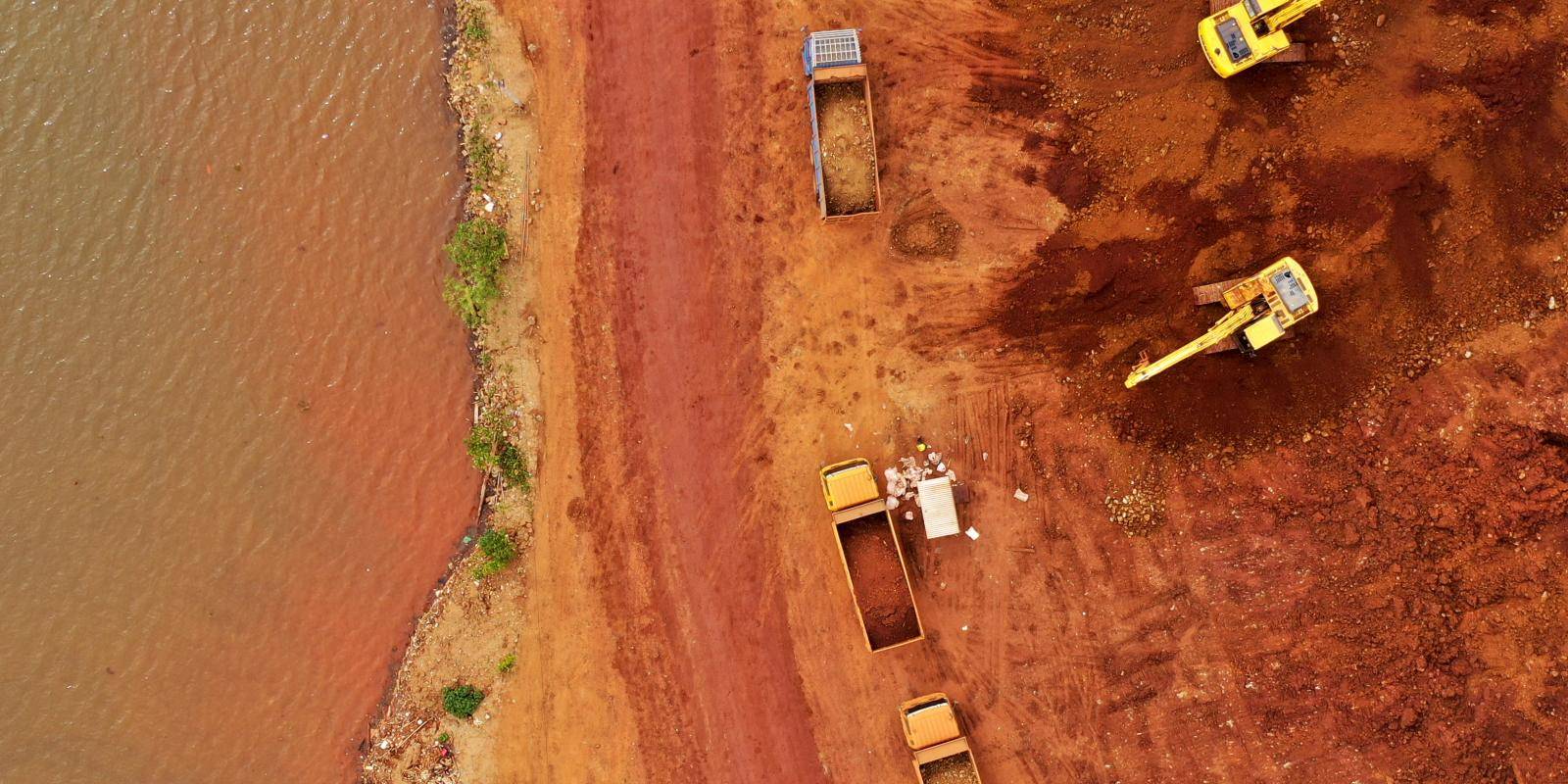
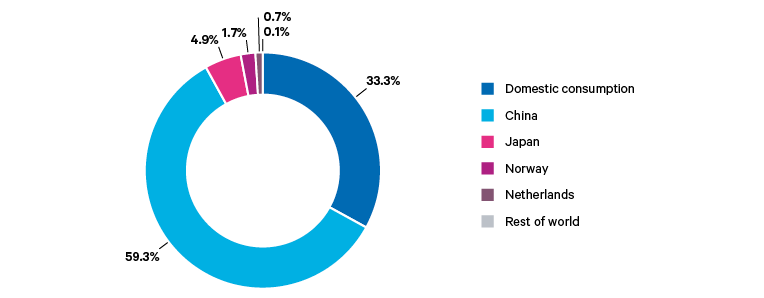
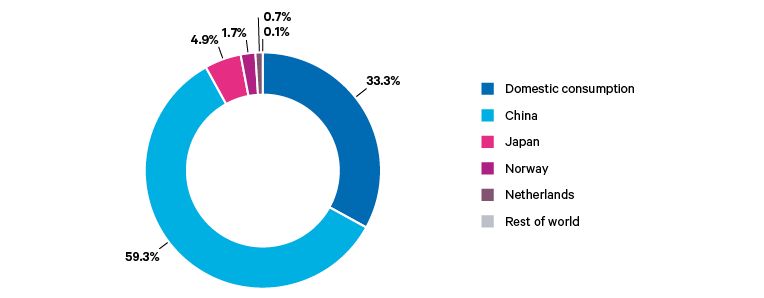
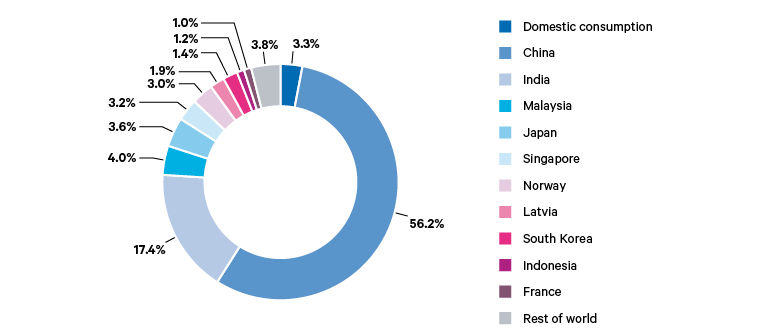
In its 2025 critical minerals strategy, the South African government identified manganese as one of the country’s five ‘highly critical minerals’. Manganese is used in the production of steel, which accounts for 90 per cent of total global manganese consumption, and is also used in battery cathodes for EVs and energy storage. The versatility of manganese and its application in high-demand sectors, specifically construction and energy-transition technologies, points to likely increased demand. However, at present, manganese is mined in one of the most impoverished and economically underdeveloped parts of South Africa, and its economic benefits are largely realized outside of the country.
Manganese mining takes place predominately in the Kalahari Basin of the Northern Cape where most of South Africa’s reserves are found. The region experiences water scarcity, and the local population has inadequate water access. Mining operations in the Northern Cape province have been found to contaminate water resources, reducing the quality of already limited water used for drinking and sanitation. Water demand from the mining and agricultural industries is frequently in conflict with communities for whom access to water is a legal right. This has led to a high level of politicization over the control and management of water, which is spread between national and provincial authority levels, often compounding the problems of water governance. These challenges exacerbate long-standing grievances against the mining sector around the process of gaining mineral rights, labour conditions and workers’ rights, and illegal mining.
Manganese is mined in one of the most impoverished and economically underdeveloped parts of South Africa, and its economic benefits are largely realized outside of the country.
Communities in the arid and semi-arid Kalahari Manganese Fields, specifically in Maipeng, Magojaneng and Vergenoeg, experience water quantity and quality issues. Field research conducted by the Centre for Research on Multinational Corporations (SOMO) and Action Aid found that these communities are deprived of their access to water and must contend with a reduced water supply, part of which is diverted to mining operations. Studies have found that ‘dewatering’ can compromise groundwater levels decades after mining activities have concluded. Chemicals have leached into underground water supplies and seepage from tailings dams has contaminated aquifers.
As currently managed, South Africa’s water resources are highly vulnerable to the impacts of climate change, over-abstraction and water pollution from urbanization, agriculture and industry. South Africa’s legislative measures to introduce integrated water resource management principles include specific requirements for water as part of the overall licence to mine. These principles affect the country’s water-pricing approach, which covers water pollution charges, the prioritization of non-mining water users and specific water and mining components.
However, detailed data-driven assessments of the impacts of mining on water resources are not possible due to a lack of capacity. As a result, the Department of Mineral and Petroleum Resources will often license mining operations without accurate data on water resources in the region. In SOMO’s findings, 62 per cent of surveyed community members expressed concern about water quality, while another 57 per cent said they had no access to water or had to travel long distances to source water, a task that is largely the responsibility of women and girls. Residents are often left to rely on the taste, smell and appearance of their water to determine if it is safe.
Contaminated water in the Kalahari Manganese Field has resulted in health issues for nearby residents, including respiratory, cardiovascular and, for women and girls, reproductive health issues. In addition to these health and safety issues, communities near mines often report not having access to water-based sanitation facilities.
The global market for manganese is expected to reach nearly 40 million tonnes by 2030, and demand is likely to outpace supply, in part driven by the increased demand for steel and the growing application of manganese as a material substitute for other metals like cobalt. Given the unsustainable nature of current manganese sources and rising demand, consumer countries may need to diversify their suppliers of manganese to avoid disruption, while following more sustainable practices. According to 2023 United States Geological Survey data, Australia, Brazil, Gabon and China are also significant producers of manganese.
Chilean copper and lithium
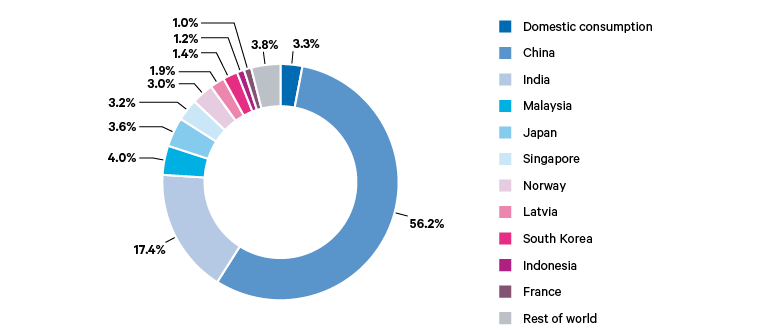
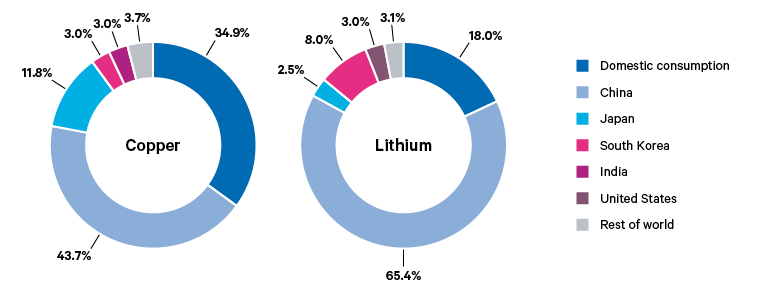
Chile is the world’s leading copper producer, holding about 19 per cent of global reserves, and the second-largest producer of lithium, with roughly 33 per cent of known deposits and around 23 per cent of global production. Mining already contributes about 12 per cent to Chile’s GDP (2023) and accounts for 57 per cent of the nation’s total exports. The main destinations for Chile’s mineral resources are China, Japan and South Korea (Figure 7), with new copper demand emerging in India and Vietnam. Demand for copper is driven by battery deployment in EVs and storage, along with construction and grid electrification. Similarly, lithium demand comes from the EV sector as well as battery storage.
Buoyed by historically strong copper prices and unrelenting demand for lithium in high-tech and battery applications, Chile’s mining sector is set to expand. Thirteen key copper projects are moving forward in 2026, seven of which aim to start operations and the other six will begin construction. The industry’s requirement for skilled workers is set to grow by more than 34,000 by 2032. Investment plans also reflect this momentum: between 2024 and 2033, companies are evaluating 51 projects worth a combined $83 billion, a 25 per cent increase from the 2023–2032 portfolio.
Chile also has copper refining facilities and aims to develop its midstream manufacturing capacity for cathodes and recycling technologies. Increased onshoring of manufacturing or processing before export might reap higher economic benefits for Chile per litre of water consumed and polluted, but will also put more overall pressure on local water resources.