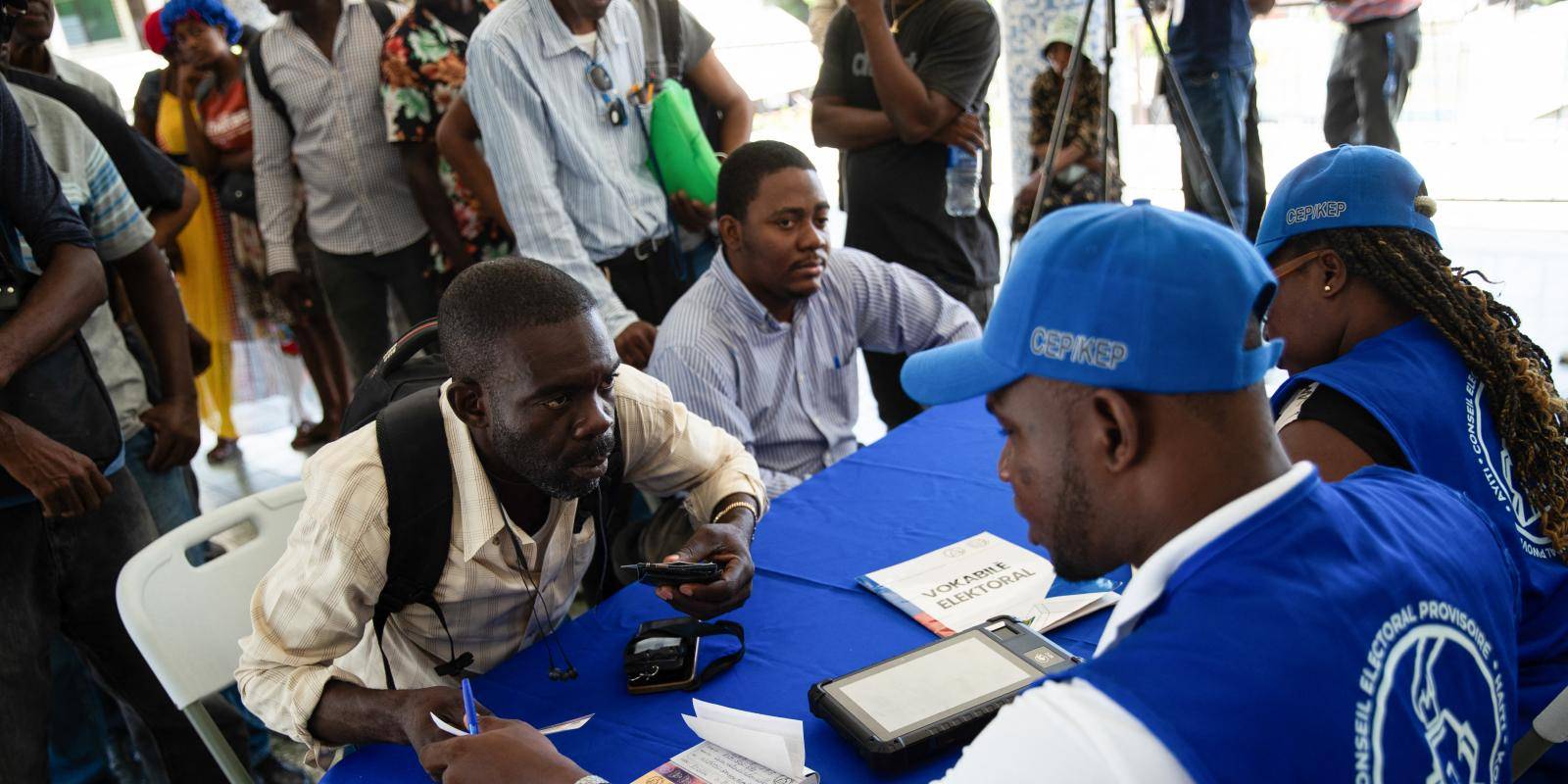
It has become almost rote for international diplomats to say that the solution to the Haitian crisis should be ‘Haitian-led.’ But which Haitians do they mean? And what do citizens actually want? There is no elected government, the party system is devastated, the interim government is distrusted and civil society remains weak. Moreover, until the mid-2026 survey presented in this paper, there had been no publicly released, nationwide, in-person opinion polling to determine Haitian citizens’ interests and demands since 2023.
Put another way, for too long discussions intended to shape the stabilization and reconstruction agenda have had to rely on guesswork when it comes to anticipating popular demand for a path forward to resolve the country’s humanitarian, security and political crisis. Oftentimes, that discussion has been mediated via a discredited political class. This research paper aims to fill this gap in the public policy debate. In doing so, it seeks in part to inform deliberations in the run-up to the 30 September 2026 UN Security Council (UNSC) vote on a resolution to renew the mandate of the Gang Suppression Force (GSF), and to feed into wider planning of development assistance and election preparations.
A survey of the sort presented here is not intended to replace formal, institutionalized channels of political participation and citizen representation. Delivering accountability still requires the holding of elections (a key demand of the Haitians surveyed in this study). It requires the interim Haitian authorities and their international interlocutors to consult with communities and civil society, and to develop channels for formal communication and representation that allow for structured political and civic participation.
About the survey
In May 2026 Chatham House and Q-Q Research Consultants, a Florida-based advisory firm, paired with Q-Q’s local partner in Haiti to conduct a national, in-person survey of 1,332 adult Haitians. The survey covered the following topics: Haitians’ perceptions of security; their approval/disapproval of, and expectations for, the GSF; their opinions on the justice system’s potential treatment of gang leaders and gang members; their priorities for social policy and economic growth; their faith in Haiti’s political class; and their support for (and intention of participating in) future elections.
The survey is intended to provide a national, statistically sound snapshot (with a confidence interval of 95 per cent) to feed into discussions among Haitians and with the international community.
The results provide an indication of Haitians’ opinions and priorities, and their policy preferences within different areas of possible reform. The conclusions and recommendations draw from those responses, and are intended to reflect the expectations and experiences of the public.
While there are many different aspects and nuances to the survey results, a broad policy-specific picture emerges. Haitians recognize the improvements that have occurred in their security recently, and are cautiously in favour of international security intervention, policy support and development assistance.
Haitians want credible, safe elections to take place in 2026 or 2027 so that the country’s political class can be replaced with more accountable and civic-minded leaders.
The survey indicates that Haitians expect gang leaders and foot soldiers to be brought to justice (rather than to receive amnesty for their crimes under some kind of political bargain). Haitians demand tangible improvements in public services. They also want credible, safe elections to take place in 2026 or 2027 so that the country’s political class can be replaced with more accountable and civic-minded leaders.
There is a narrow window of opportunity in which to act – narrow for the international community, the Haitian government, and civil and political society. Maintaining or increasing the currently slim margin of popular approval for the multilateral mission in Haiti and for future efforts to address the country’s multifaceted crisis will require visible improvements in security, improved delivery of public services, preparations for and the holding of credible elections, and the implementation of consensus-focused policies to ensure accountability, justice, job growth, and the reintegration into society of lower-level gang members.
Background
Haiti faces cascading challenges which present conflicting priorities for policymakers. With criminal gangs controlling approximately 90 per cent of the capital, Port-au-Prince, and with more than 1.5 million people displaced by violence, security is the number one priority for Haitians. Even though survey respondents feel that security has improved, the institutional, economic and emotional scars of the country’s recent violent history remain. Modest (and still fragile) security improvements do not alter the demands of a majority of Haitians for the restoration of justice, the introduction of social programmes, and legal economic opportunities.
The challenges to stability and economic progress span multiple policy domains: rebuilding the state security apparatus alongside the government’s capacity to provide basic public goods; rebuilding infrastructure; reviving the economy and creating formal-sector jobs; convening free, safe and sustainable elections (Haiti has gone more than three years without having any elected members at any level of government); determining the criminal accountability of gang leaders and select gang members, and bringing perpetrators of violent and other crimes to justice; organizing the disarmament, demobilization and reintegration (DDR) of designated gang members; and restoring communities and social bonds.
Such a complicated menu of urgent, interlocking needs requires international support and partnership with Haitians and the interim Haitian government. It requires coordinated, targeted funding from the international community of bilateral and multilateral donors, private philanthropists/philanthropic organizations, and business. Even if the GSF and the Haitian National Police (HNP) roll back gangs’ grip on much of Haiti and re-establish state control over contested areas, those gains will be short-lived without job creation, economic growth, the restoration of social services and – when the population is ready and the institutional mechanisms are in place – a careful, measured DDR process for a select subset of lower-level gang members (this latter process needs to be accompanied by safeguards to protect the international rights of children recruited by the gangs).