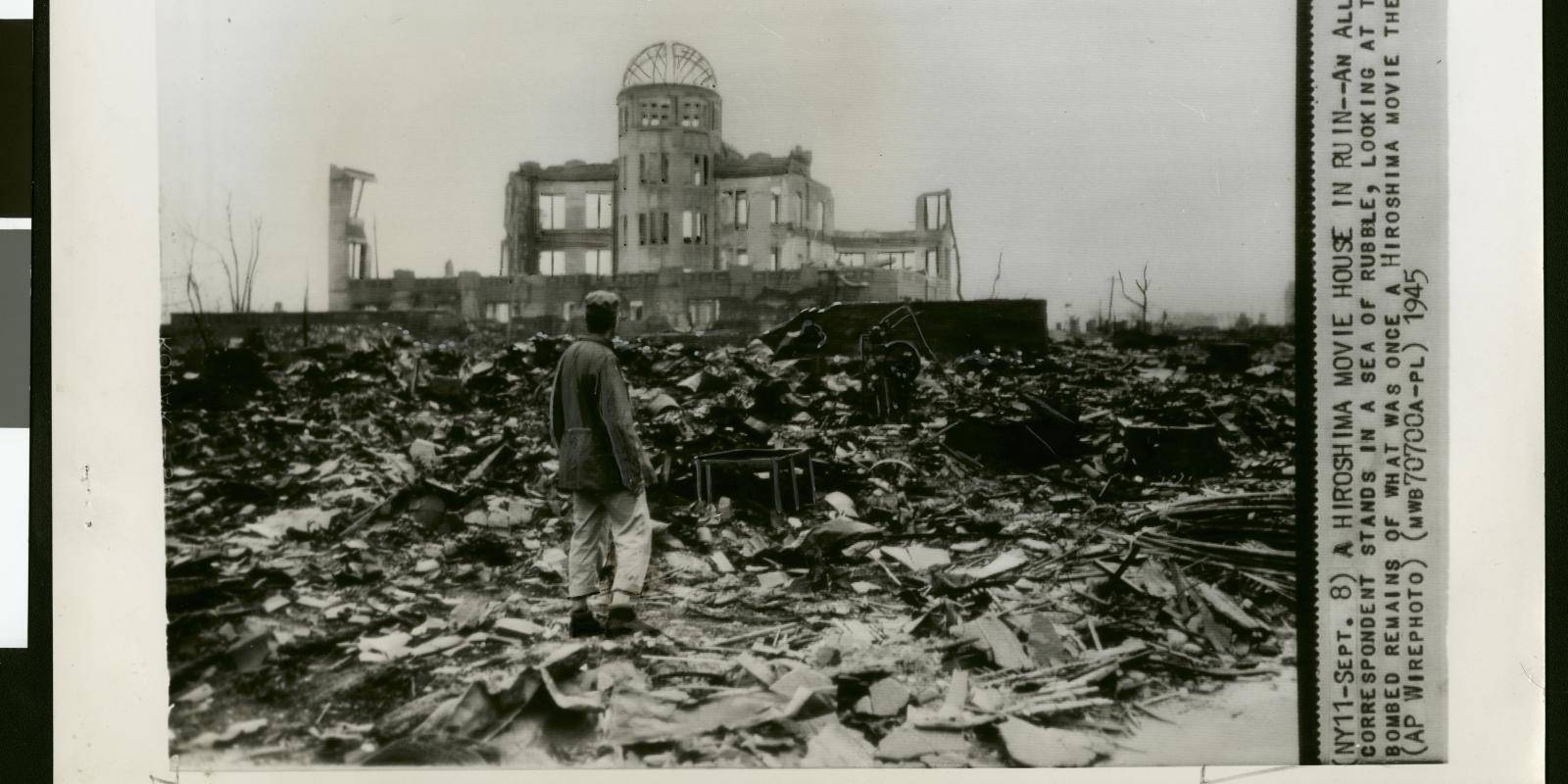

This year marks the 80th anniversary of the August 6 and 9 dropping of atomic bombs on the Japanese cities of Hiroshima and Nagasaki by the Allies. Between 110,000 and 210,000 people are believed to have died in the attacks and as a result in the ensuing months - the final death toll is contested.
The following is an extract from an article ‘The Impact upon International Relations of the New Weapons’, published in the September 1945 issue of ‘The World Today’ (its third issue). The piece is attributed to ‘H.E.W.’, believed to be HE Wimperis, who was part of Chatham House’s Atomic Energy Study Group in the years immediately after the Second World War.
It opens by stating: ‘With the release over Japan on August 6 of an atomic bomb the course of history was changed. Nothing in the relations between sovereign states can ever be quite the same again.’ The following extract is its concluding section entitled ‘The Grave Issue’.
What is at stake is the happiness and well-being of the entire human race. We have Mr Churchill’s grave words: ‘This revelation of the secrets of nature, long mercifully withheld from man, should arouse the most solemn reflections in the mind and conscience of every human being capable of comprehension. We must, indeed, pray that these awful agencies will be made to conduce to peace among the nations, and that instead of wreaking measureless havoc upon the entire globe they may become a perennial fountain of world prosperity.’
Mankind is like a child having in its grasp, for the first time, an exceedingly sharp knife. What the child will do with it will depend on his character and disposition, and even more on his maturity. If very young he may well do himself, and his fellows, mortal harm – unwitting of his own unwisdom. Is such a child more immature than mankind itself?
Sir James Jeans [the English physicist, mathematician and astronomer] thinks not, for he tells us how exceedingly youthful is the entire human race. Comparing the age of the Earth with the height of the Nelson Column, he has shown that the years of man’s existence would be no more than the thickness of a coin and his few thousand years of civilization that of a postage stamp.
There is little of maturity here. As to character and disposition, we have lately seen how little there was to prevent the rise of the Nazi type. Potential Hitlers probably still exist. Someday, it may be, eugenic control of population will minimize, or even prevent, the birth of such misfits: our present hit-and-miss arrangements if followed by racehorse breeders would surely bring them to speedy ruin.
This time, providentially, we have escaped, though the new tools that helped us can, without wisdom, create their own peril. And however lacking in maturity we may be, we ought surely to possess enough confidence in ourselves not to look to Providence to come to our aid every time we get ourselves into trouble. The most loving father thinks it wise to let his children essay the management of their own affairs once they are past infancy. And we are growing out of infancy: city states have merged into the group we call nations, and now it is for nations to group themselves, for certain vital purposes at least, into a world organization. To the latter end a heartening first step has been taken at San Francisco.
A World Security Organization
A first requirement is an all-embracing World Security Organization to control all such weapons and their sources of supply. No one must be allowed to prepare or construct such devices; it will be the duty of the Security Organization to keep meticulous watch that no such effort can escape detection. Mr Churchill has told us that the Canadian government has already undertaken new surveys and explorations in search of uranium ores, and that these on discovery will be government controlled, and ultimately used under whatever arrangements are made for controlling the release of atomic energy in the interest of mankind.
It happens fortunately that (for the present at any rate) huge apparatus, and workshops to match, are requisite for the construction of atomic bombs. President Truman estimates that those built in the USA, for use in the war, cost the huge sum of £500 million. So long as that is the scale of things, it should not be difficult to detect any attempt by a bandit power to build such weapons; once detected, they could easily be destroyed, not necessarily by calling in our new uranium ally, but by any flight of ordinary bombers, or even better – as causing less accessory damage – by landing troops from troop-carrying aircraft. Resolute paratroops would make short work of any such banditry and be a mode of deterrent action more agreeable to times of peace. But more drastic means would lie in the background.
This solution, involving as it does the surrender to a new extranational organization of a whole form of technical activity, though leaving the universities free to pursue their high task of widening the bounds of human knowledge, is bound to excite misgiving among those who cling to every aspect of national sovereignty. But the change is one to which we are driven by events. Small states, as we have seen, are quite unable to preserve their rights when their greater neighbours are at war; their existence as completely sovereign entities is, moreover, a hindrance to their neighbours’ powers of defence and in the end a menace to their own existence.
New inventions have made the whole world smaller and international boundaries as at present existing an anachronism. It is for statesmen everywhere to keep in step with these developments and not to behave as though we lived still in some by-gone age. As Sir Henry Dale, the President of the Royal Society, has lately said: ‘The release of atomic energy, now an accomplished fact, can either destroy civilization or immensely enrich its possibilities; the choice is clearly before mankind and those who guide its destinies. It is everybody’s concern and the statesman’s supreme responsibility.’
Is there any alternative to such a plan? Could, for instance, the Anglo-American world act alone if the rest of the world failed to agree? The answer is certainly yes, but the degree of security would suffer. And in the improbable event that even this limited action should prove not possible, could the British Commonwealth act alone? Again, the answer is yes, though rather more doubtfully, for the degree of security attained, though welcome, would be far from complete; schemes that extend to only a part of the world though better than nothing – very much better than nothing – cannot give us what we really require.
The only solution which can satisfy the world’s needs is a World Security Organization in control of fully equipped research establishments and factories – preferably in the USA, where they now are – at the service of all, as part of what would be in certain respects a sort of World Government. No solution short of this can really meet the urgency of the situation which the enterprise of scientists has created. Need statesmanship always lag behind the needs of this increasingly scientific age? Must it be for ever purblind, and leave the world exposed to alarm and doubt, and in the end to that irrational state of fear which so easily leads to insensate action?
The administration of these matters may, it is true, prove difficult owing to their technical complexity. But technical affairs, even if complex, can be understood, at the cost of some trouble; though naturally they are more easily followed by those who have sympathy with the scientific attitude to life. Perhaps this is due in part to the reluctance of our elected rulers to equip themselves with a sufficient measure of scientific knowledge. But if the world is to be wisely guided in the conditions which exist today, a change is necessary. If those in authority find such things hard, may they not be asked, with great respect, to give way to those who would not?