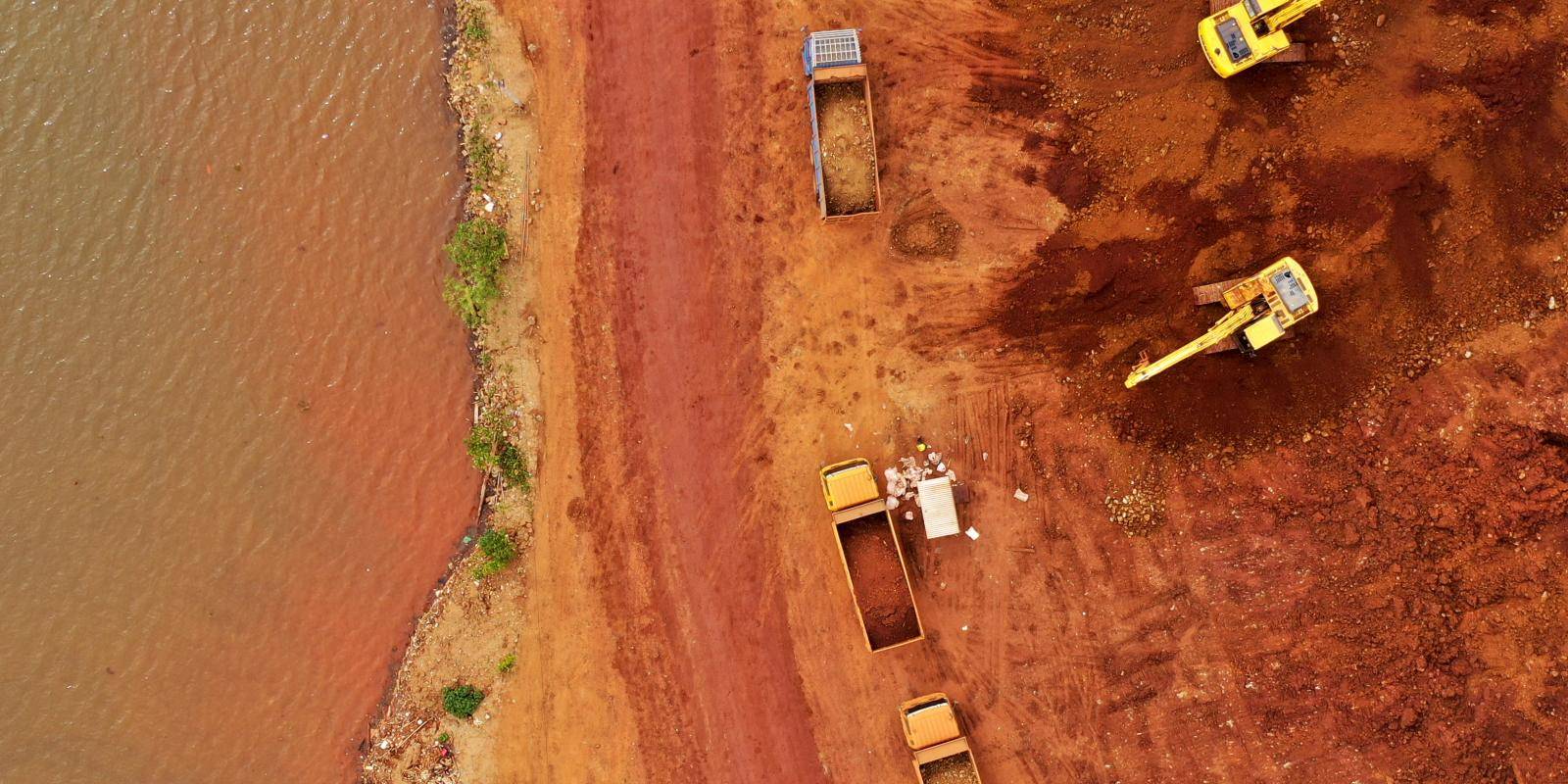
Voluntary and mandatory regulatory measures that can address governance fragmentation and increase transparency are necessary for secure global supplies of minerals.
In the race for global resources, recent trends have emerged that will impact future supply, demand and extraction of critical minerals, as well as where new or expanded mining and processing activity takes place. What might that mean for water use and water risks?
The West turning inward
Mineral supply chains are complex and, as described in this paper, can both drive and be vulnerable to water insecurity that transcends borders. The current geopolitical and trade environment is increasingly fractured, making shared global water security a greater challenge. Meanwhile, the issue goes unseen and is rarely discussed in political chambers or negotiating halls. New political imperatives for energy independence, economic competitiveness and supply-chain security are propelling efforts to increase self-sufficiency and protectionism, as well as eroding the space and political will for collaborative global governance. In the case of energy independence, even if achieved through clean energy sources, it is still contingent on infrastructure with increasing critical minerals requirements.
Nonetheless, as minerals needed for the green energy transition are increasingly central to the global economy, dependence on these vital resources will accelerate, expanding global supply chains of minerals and end-use technologies. Consideration of the virtual water embedded in these products is a key factor in protecting neighbouring communities, biodiversity and ensuring stable supplies. Addressing the risks that come with the production of critical minerals, particularly to water and by extension climate resilience and community livelihoods, necessitates collaboration between producer- and consumer-country governments, mining companies, the local population, investors, manufacturers and retailers. However, as countries prioritize national interests, looser policies and regulations are being adopted that hinder rather than support shared water security in critical mineral supply chains.
One manifestation of these dynamics is that more mining and processing activities are expected to take place to supply Europe. In 2025, under the Critical Raw Materials Act (CRMA), the European Commission stated that it will build up domestic supply of critical raw materials through 60 strategic investments. Forty-seven of these projects are in EU member states and 13 are outside the bloc (with projects located in Canada, Greenland, Kazakhstan, Norway, Serbia, Ukraine, Zambia, Brazil, Madagascar, Malawi, New Caledonia, South Africa and the UK). According to analysis from Watershed Investigations, referenced by the Guardian, half of the announced strategic projects are located in areas that have experienced increasing drought conditions in 2026 and a quarter of the projects are in highly water-stressed areas in Spain, Portugal and Greece. These strategic initiatives will receive fast-tracked and streamlined permits and financing. The processing period for minerals production permits now cannot exceed 27 months for extractive projects and 15 months for processing or recycling projects. The ReSourceEU Action Plan, announced in December 2025, sets the operational framework for the CRMA. The plan aims to mobilize €3 billion by the end of 2026 and increase mineral extraction for key industries like clean technology and defence.
The EU’s simplified and more streamlined process for new mining projects reflects an evolving set of priorities for the European Commission: supply-chain security. The omnibus package, announced in February 2025, aimed to simplify sustainability reporting requirements for large companies, specifically the Corporate Sustainability Due Diligence Directive (CSDDD), the Corporate Sustainability Reporting Directive (CSRD) and, more recently, the Water Framework Directive. The introduction of these changes has been critiqued by legal experts for weakening due diligence standards for mineral supply chains and limiting stakeholder engagement in producing regions. Weakened European environmental standards coupled with the regulatory gaps in some producer countries pose threats to environmental sustainability and the protection of human rights.
Similarly, the US is seeking to restore its ‘mineral dominance’ and has framed its ambitions through the logic of energy security. In 2025, the US administration engaged Ukraine in negotiations for a minerals security partnership and issued a series of executive orders to increase domestic production and fast-track deregulation. To establish the US as a leading producer and processor of non-fuel metals, the Trump administration is prioritizing job creation, ‘fuel prosperity’, defence capabilities and reduced reliance on the mineral production of ‘hostile foreign powers’.
Increasing overall production of minerals with large water footprints in water scarce regions is risky for mineral supply, social justice and environmental sustainability.
The US is simultaneously committed to lowering the barriers to entry for new mining actors and increasing the investment of existing ones, through weakened due diligence for the financing of mining projects and a pause on anti-bribery protections, which comes from a February 2025 executive order that paused the Foreign Corrupt Practices Act (FCPA). Executive Order 14154 instructed the Council on Environmental Quality to rescind all National Environmental Policy Act (NEPA) regulations (rescission of NEPA regulations, as of January 2026, has officially been finalized); federal agencies have been ordered to revise their NEPA regulations as well as prioritize permit issuance speed and the removal
of obstacles. The One Big Beautiful Bill Act also aims to accelerate domestic sourcing of minerals, for example, with the development of the Hell’s Kitchen lithium mine in California. Set to be one of the largest lithium mines in the world, the project is in one of California’s most water scarce and polluted areas, and it is already experiencing resistance from local environmental groups and Indigenous communities.
These changes to US policy severely weaken environmental laws by limiting public participation, transparency and accountability. As such, water use by the mining sector will likely be opaque, making monitoring and evaluation of water resource quality and quantity even more challenging.
In both cases, mining and processing industries in the EU and US would likely only add to global production rather than replace minerals production elsewhere. Increasing overall production of minerals with large water footprints in water scarce regions is risky for mineral supply, social justice and environmental sustainability. Demand reduction measures are largely absent from the CRMA, the ReSourceEU Action Plan and US executive orders. These observed trends in the policy and regulatory environment detract from much-needed commitments to the equitable, sustainable and efficient use of water in the mining sector – not only to protect communities and the environment but also to ensure stable supplies of these minerals. Without the commitment and collaboration of all stakeholders in the mineral supply chain, local communities will bear the brunt of water and livelihood risks due to unsustainable water use. Under such circumstances, it will not be long before the financial, reputational and economic risks are felt by companies, investors and consumers as well.
Moving towards sustainability
Sustainable mineral supply chains require balancing the urgent demand for minerals with the imperative to protect the environment and human rights. Public oversight tools such as multilateral environmental agreements, customary international law, human rights instruments, international trade and investment treaties, and non-binding policies, e.g. the UN Sustainable Development Goals, all contribute to the governance of the mining and minerals sector. Additional regulatory measures that are not specific to mining can improve the social, environmental and economic sustainability of extractive activities. These include strategic environmental assessments, environmental and social impact assessments, and pollutant release and transfer registers. In the EU, the Water Framework Directive, EU Extractive Waste Directive, Corporate Sustainability Due Diligence Directive and the EU Battery Regulation provide further examples of mandatory legal instruments for the sourcing of minerals and mining impacts.
The expansion of mining activities has been matched by the proliferation of sustainability standards and initiatives (SSIs) under various authorities promoting responsible practices and sustainability commitments, with more than 100 SSIs operating across minerals and metals supply chains. These SSIs can have a geographical scope from the international level to the mining site; address individual or groups of minerals; be focused on responsible production, sourcing or consumption; and include artisanal, small-, medium- and large-scale miners.
This diversity of SSIs creates a complex landscape of overlapping standards that can be a barrier for their uptake and implementation. Recognizing the limitations of multiple and disparate SSIs, the International Council on Mining and Minerals (ICMM), the Copper Mark, the Mining Association of Canada and the World Gold Council are working together to create a consolidated mining standard that will clarify responsible practices for mining companies of all sizes, across all locations and commodities.
Faced with almost an inevitable increase in mining for the minerals critical to technology, SSIs offer perhaps the most practical steps for improving water-use practices and reducing pollution (Table 2). However, the priorities of these vary. As an illustration, a review of 15 SSIs showed that most targeted social issues, followed by the environment, and water was only addressed in five schemes. The use of voluntary standards can and should be leveraged to drive sustainability improvements in mining-related activities. While ideally, such standards function in a complementary way to public governance instruments, in some cases they weaken and even conflict with public oversight by confusing the rules and leading to delay or displacement of regulatory reforms and enforcement.
Guidance, principles and disclosure mechanisms complement mandatory and voluntary measures. The OECD Due Diligence Guidance for Responsible Mineral Supply Chains supports assessment of risks associated with sourcing of minerals. The UN Secretary-General’s Initiative on Critical Energy Transition Minerals has produced seven guiding principles and actionable recommendations that focus on human rights, the integrity of the planet, and justice and equity in mineral supply chains. Meanwhile, CDP’s annual questionnaire addresses water security through questions about a company’s water usage, management of water-related risks and opportunities, water withdrawal and discharge, and impact across its supply chain. The CDP Water Watch Tool ranks over 200 industrial activities within 13 industry sectors including mining and minerals processing. In 2026, the tool categorized the water quantity and quality impacts of metallic minerals mining, smelting, refining and forming as ‘critical’. In another example, Global Reporting Initiative (GRI) is the most widely used sustainability reporting system and has standards for reporting on water (GRI 303), waste (GRI 306) and mining (GRI 14). Together, public governance instruments, SSIs, guidance, principles and disclosure should be leveraged to drive sustainability improvements in mining-related activities.