|
|
|
|
|
|
|---|
|
GDP (billion current $)
|
180.68
|
250.89
|
48.31
|
118.49
|
39.86
|
|
GDP growth (%)
|
2.8
|
5.31
|
7.83
|
2.95
|
2.5
|
|
GDP per capita (current US$)
|
4,278.85
|
2,549.14
|
7,235.03
|
3,237.88
|
3,446.61
|
|
Public debt (% of GDP)
|
32.88
|
92.52
|
N/A
|
64.41
|
70.5
|
|
FDI, net outflows (% of GDP)
|
-0.002*
|
0.08*
|
0.29*
|
0.56
|
0.14*
|
|
FDI, net (balance of payments, million current $)
|
-1,204.3*
|
-7,209.7*
|
439.5**
|
-2,961.4
|
-809.7*
|
|
Imports of goods and services (% of GDP)
|
33.50*
|
29.36
|
57.99
|
48.80
|
55.94*
|
|
Exports of goods and services (% of GDP)
|
22.64*
|
18.91
|
60.39
|
38.28
|
43.54*
|
|
Inflation, consumer prices (annual %)
|
4.27
|
29.5*
|
2.61†
|
1.91
|
7.31
|
|
Population, total (millions)
|
42.23
|
98.42
|
6.69
|
36.03
|
11.6
|
|
Unemployment, total (% of total labour force) (modelled International Labour Organization estimate)
|
12.14
|
11.44
|
17.28
|
9.04
|
15.48
|
|
Ease of doing business index (1=most business-friendly regulations)
|
157
|
120
|
186
|
60
|
80
|
Source: Data compiled from World Bank (2018), Open Data, https://data.worldbank.org/ (accessed 18 Nov. 2019); IMF (2018), World Economic Outlook Database, https://www.imf.org/external/pubs/ft/weo/2018/02/weodata/index.aspx (accessed 18 Nov. 2019).
Note: 2018 data shown unless otherwise noted.
* 2017 data, ** 2016 data, † 2013 data
Algeria’s economic performance has been seriously impaired by a protracted struggle over the succession to the presidency after the resignation of Abdelaziz Bouteflika. Investment in the oil and gas sector, which is central to the country’s economy, has been held back since the late 2000s due to infighting within the regime, a series of high profile corruption cases, and poor relations with international companies. This under-investment has resulted in falling oil and gas production, which has led to steadily declining revenues as domestic consumption has increased while international oil prices have remained relatively low since 2014. The contribution of the hydrocarbons sector to GDP has fallen in real terms in every quarter since the second quarter of 2017, according to official data up to the end of June 2019.
Overall economic growth reached 1.4 per cent year-on-year in 2018, as a good harvest and increased construction and industrial activity offset the 6.4 per cent contraction in the hydrocarbons sector over the same period. In the first half of 2019, mass protests called for deep political reforms in an attempt to avoid another establishment figure supported by the military replacing President Bouteflika, which would extinguish any hopes of potential changes to the political system. Against this backdrop, the oil and gas sector contracted by 7.7 per cent year-on-year in the first half of 2019, and overall economic growth stood at a mere 0.8 per cent, with a marked slowdown in the non-hydrocarbons sectors in the second quarter, as the protest movement gained momentum.
The government had used up its budgetary reserves by late 2017 and has since resorted to borrowing from the country’s central bank to cover its large structural deficit. Algeria maintains it still has sufficient foreign exchange reserves to cover about 15 months of imports, but reserves have declined rapidly since 2014. The country could potentially source finance from outside Algeria as it has little external debt, but both the political establishment and the protest movement are resistant to submitting to IMF conditions in exchange for external loans that could support long-term economic and political reforms. Towards the end of the Bouteflika era, a new hydrocarbons law was drawn up with the aim of improving terms for international investors. The law has been pushed through by the interim post-Bouteflika administration, but it has been criticized by the protest movement, and foreign companies are likely to wait for a political settlement before committing to major new projects.
Egypt, by contrast, has completed a three-year IMF programme that has yielded mixed results. After the 2011 revolution forced President Hosni Mubarak to step down having been in power for almost 30 years, the first interim government considered signing up to an IMF programme, but was overruled by the military administration. The Mohammed Morsi government of 2012–13 also came close to sealing a deal with the IMF, but backed away. The government of President Sisi eventually resorted to the IMF in 2016, after generous infusions of aid from Gulf Arab allies proved to be insufficient to stave off a balance of payments crisis.
A core element of the IMF deal was exchange rate reform. Facing an increasingly unrealistic official foreign exchange regime, Egypt opted for the most radical reform approach: the free flotation of the national currency. This triggered a devaluation of more than 50 per cent overnight, which in turn led to a surge in inflation to 30 per cent on average throughout 2017. Egypt’s income per capita declined sharply in dollar terms, and the poverty rate, based on a global metric devised by the World Bank, rose by five percentage points between mid-2015 and mid-2018 to 32.5 per cent.
On the fiscal front, the government phased out most energy subsidies from 2016 onwards, and generated extra revenue through the introduction of VAT as part of the IMF deal. The pressure on living standards was mitigated to a limited extent by two large-scale social safety net programmes, to which the World Bank allocated $900 million, and by the increase in spending on food subsidies by the state. When the IMF programme ended in November 2019, many of Egypt’s main annual macroeconomic indicators showed significant improvements: inflation was below 5 per cent; real GDP growth had climbed to 5.6 per cent; the government was running a primary surplus on its fiscal accounts, allowing for public debt to be reined in after having exceeded 100 per cent of GDP; interest rates were on a sharply declining trend, lowering the government’s debt-service costs; the Egyptian pound had appreciated by more than 10 per cent during 2019; foreign exchange reserves had reached a plateau of around $40 billion, sufficient to cover six months of imports; the current account deficit had fallen to 2 per cent of GDP, after reaching 7.5 per cent in 2016; and the official unemployment rate fell to 7.5 per cent from its peak of 13.4 per cent in 2013.
The build-up of Egypt’s foreign exchange reserves has been matched by a surge in external debt to about $110 billion as of mid-2019, double the level in 2015.
However, these positive economic indicators are hiding more troubling signs. The build-up of foreign exchange reserves has been matched by a surge in external debt to about $110 billion as of mid-2019, double the level in 2015. Much of this debt is long-term and on relatively concessional terms, representing a manageable figure of around 35 per cent of GDP; but a repayment crunch could be looming in the coming years. Another factor that may have a negative impact on the country’s economy is the heavy reliance on inflows of portfolio investment, and the relatively weak performance of FDI, apart from in the energy sector, which has benefited from the provision of enhanced conditions for international oil companies, including more streamlined contracting. Finally, the strong GDP growth performance of the past three years has depended heavily on external trade, which gained a boost from the currency’s devaluation, while domestic private consumption growth has averaged only about 1 per cent since mid-2017.
Tunisia also resorted to IMF support in 2016, and is set to complete a four-year reform programme by mid-2020. Tunisia’s obligations have included a less radical approach to exchange rate reform than the free flotation of the Egyptian pound, but the Tunisian dinar has depreciated in the framework of a managed float of the currency, and this has been a factor in pushing up inflation to just over 7 per cent in 2018 and 2019, compared with 3.6 per cent in 2016. Growth has remained subdued, at 1.9 per cent in 2017, 2.6 per cent in 2018 and an estimated 2.7 per cent in 2019. Increased taxes, cuts in subsidies and higher inflation have been reflected in a rise of the poverty rate to about 15 per cent. Like Egypt, the Tunisian government has sought to mitigate these effects through a World Bank-supported social safety net scheme. Tunisia’s underlying balance of payments position is more precarious than that of Egypt. External debt has risen from 72 per cent of GDP in 2016 to over 100 per cent in 2019, the current account deficit is running at about 10 per cent of GDP, and foreign exchange reserves are sufficient only to cover three months of imports.
Morocco’s economic policy has been subject to IMF monitoring since 2012, but not as part of a structured programme, rather as a condition for access to a precautionary liquidity line if required – Morocco has not yet drawn on this facility. As with other North African countries, the IMF has advocated exchange rate flexibility. Morocco has adopted a cautious approach. In 2017, it changed the weighting of the basket of currencies used as a reference for the exchange rate from 80:20 (euro:dollar) to 60:40, and the following year the Moroccan central bank widened the trading band for the currency. The Moroccan dirham has remained relatively stable, and the authorities have shown little inclination to follow the Egyptian route to a full flotation. The government has undertaken reforms to energy subsidies, and fuel prices are now indexed to international levels – a similar system came into force in Egypt during 2019. Economic growth has averaged about 3.3 per cent in recent years, with the main variable being the performance of agriculture, which is heavily influenced by rainfall levels. Morocco’s external accounts have benefited from the rapid growth of automotive and aeronautical exports, following the attraction of major international companies to special economic zones (SEZs). However, the overall growth rate has been below the level required to effect a significant rise in living standards, and dissatisfaction with socio-economic conditions has been reflected in persistent protests against corruption, inequality and police brutality.
The overall growth rate in Morocco has been below the level required to effect a significant rise in living standards, and dissatisfaction with socio-economic conditions has been reflected in persistent protests against corruption, inequality and police brutality.
Libya continues to suffer from intense volatility, with growth projected to stand at 10.8 per cent in 2019 but just 1.4 per cent in 2020. Libya is dependent on oil and production remains erratic, but rising international oil prices have buoyed the economy. Inflation over the past several years has also damaged consumer confidence and has fallen to a ‘manageable’ 13.1 per cent in 2018. Planned economic reforms, approved in September 2018, which would see fuel subsidies removed and the dinar devalued, could close the gap between the official and parallel exchange rates. But the implementation of the reforms is slow, and efforts are frustrated by the continued internal military conflict, which has fostered a pervasive war economy.
There are many common economic policy themes across North Africa that could be usefully shared by the various governments across the region and with their international counterparts. These include: exchange rate reform, as undertaken by Egypt, Tunisia and Morocco, which may pose more challenging to implement in Algeria and Libya; subsidies reform; social safety net programmes; policy towards international investment, whether in the structure of tax regimes and SEZs or in setting the operating framework for oil companies; pension reform – Egypt, Morocco, Algeria and Tunisia are all working on programmes to raise the retirement age and increase contributions; and reforms to healthcare and education.
Regional trade
Across North Africa countries are resigned to the fact that commercial activity is notoriously feeble. As a result, little effort is made to facilitate cross-border trade. The region contributes less than 1 per cent of global trade and has an average degree of openness compared to other regions of the world, but that figure is buoyed by Algeria and Libya’s oil exports. The share of all North African countries’ exports and imports vis-a-vis the region is very low. In aggregate, only 4.6 per cent of North Africa’s exports were destined for the region, while 2.8 per cent of imports came from within the region.
Countries differ in their regional openness. Tunisia appears to be the most oriented towards the region, whereas Morocco is more committed to trade with the entire continent. Egypt and Tunisia have the most diversified trading partners within the region. The limited integration of Algeria and Libya in the region reflect the low diversification of their economies. Tunisia and Morocco have the strongest bilateral trade ties, which demonstrates their industrial diversification. There is therefore potential for an increase in regional trade, especially among those with few bilateral trading relations.
Source: Compiled by the authors from the Harvard University (2017), ‘Atlas of Economic Complexity’, http://atlas.cid.harvard.edu (accessed 18 Nov. 2019).
Small and medium-sized enterprises
Small and medium-sized enterprises (SMEs) tend to form an important part of a country’s economic and industrial fabric, generating employment and economic growth and development. In regard to regional synergies in North Africa, SMEs are crucial to cross-border trade. They also stand to gain the most from improved coordination and regulatory harmonization in the region, which will expand markets, capital mobility and skills transfer, while simultaneously making these countries more attractive to investors and SMEs more competitive. SMEs also serve as an important entry point for informal enterprises to formalize and progress through the value chain.
As such, every country in the region has dedicated SME institutions and is engaged in reforms to develop the sector. For instance, Egypt, in which 97 per cent of all enterprises are SMEs, is engaged in investment climate reforms, which include reducing red tape and facilitating access to finance for SMEs. The central bank has encouraged banks to target allocating 20 per cent of their loan portfolio to SMEs and provide microfinance at preferential interest rates, in exchange for reduced statutory reserves requirements. Algeria’s 2017 Law No. 17-02 encourages the establishment of new SMEs and introduced measures to improve their competitiveness and export capacity, through the National Agency for the Development of SMEs. Libya’s national programme for SMEs, set up in 2008, has operated through the establishment of business incubators, providing training to entrepreneurs, and easing access to finance, with specific programmes tailored to university graduates, women, innovators, and residents of remote areas. Tunisia, where SMEs represent 99 per cent of all firms and employ nearly 60 per cent of all workers, has a specific ministry to support them, the Ministry of Industry and SMEs. Finally, Morocco’s National Agency for the Promotion of Small and Medium-sized Enterprises (ANPME), established in 2002, supports SME competitiveness through investment, financing and access to markets, and advocates entrepreneurship by assisting entrepreneurs and independent economic agents in developing their plans and formalizing their companies.
Regulatory cooperation
Definitions of SMEs vary across North Africa. Each country has its own legislative framework and institutional support for SMEs. Regulatory cooperation is an obvious area in which countries can improve the support they offer SMEs. Harmonizing SME definitions, legislation and support institutions would allow countries to benefit from the experience of other countries and lay the ground work for future cooperation.
Tunisia’s 2018 Start-up Act is a great example of a law that could form the basis for broader North African SME support legislation. Developed at the impetus of the business community and civil society, the Start-up Act is a viable model for the region in terms of its bottom-up construction and the subsequent adoption of the text by the government. The legislation defines start-up companies, and makes it easier to establish and close companies, to unlock funding, and to promote access to global markets. Among its key features, start-ups benefit from public support in the form of basic funding for founders, an eight-year tax exemption, access to foreign currency accounts, and public-sector workers are encouraged to take time to work on a start-up by guaranteeing their positions for twelve months. The act also went through the unusual yet constructive step of creating an educational platform for policymakers and engaging in a strong public advocacy campaign.
Sectoral opportunities: Country analysis
Each country has prioritized the development of SMEs in particular sectors, in line with national goals and industrialization plans. It is thus worthwhile examining each country’s plans to develop the sectors of greatest potential, these illustrate potential areas of cooperation, competition or synergy.
- Morocco’s Industrial Acceleration Plan (2014–20) lists a number of industrial sectors it deems a priority: automotive, aerospace, electronics, textiles, pharmaceuticals, construction materials and renewables. The plan also reiterates the country’s commitment to improving SME competitiveness, through the development of access to finance and markets, support to innovation, and by increasing company productivity.
- Algeria supports SMEs by investing in private-sector companies through the National Investment Development Agency. Meanwhile, the National Agency for the Development of SMEs is tasked with the development and modernization of the SME sector. In addition to fossil fuel and petrochemicals, sectors of interest include pharmaceutical, fishing, and agriculture (including arboriculture, olives, viticulture and animal husbandry). Furthermore, in 2017, Algeria launched a ‘solar energy cluster’ aimed at encouraging the participation of SMEs in this promising sector, in addition to attracting traditional energy players and research centres.
- Libya’s SMEs are in a particularly difficult position, operating primarily in the informal sector due to complex business registration procedures and the weakness of the legal, regulatory and administrative systems. SMEs are dominated by food production, construction material (such as wood, bricks and metal), and clothing; other sectors with potential include glass, leather goods, fisheries, and consumer goods and services.
- Tunisia’s SMEs have benefited from concerted local and international support since the 2011 revolution, which has allowed their growth in non-traditional sectors of the economy. For instance, SMEs have been successful in agriculture (including agribusiness, led by such products as olive oil); automotive and aeronautics; software; and health services. The textile industry remains important, but has been marked by a slowdown since the expiration of the Multi-Fibre Arrangement in 2005, which previously offered Tunisian textile firms preferential access to European markets.
- Egypt’s SME sector, representing 95–98 per cent of all industrial firms, is a key component of the economy. Whereas formalizing the informal sector remains an intractable challenge, SMEs are making inroads across various sectors and creating opportunities in transformation, information and communication technologies, infrastructure and construction, tourism, education and agribusiness.
Outlook: Potential areas of synergy
North Africa and the fourth industrial revolution
New technologies and North African readiness
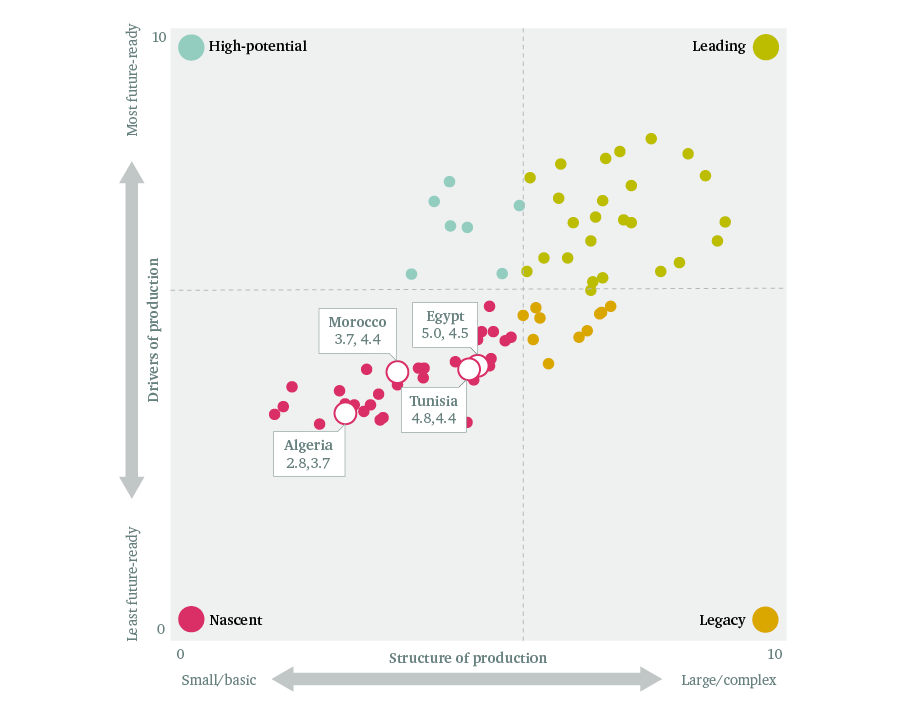
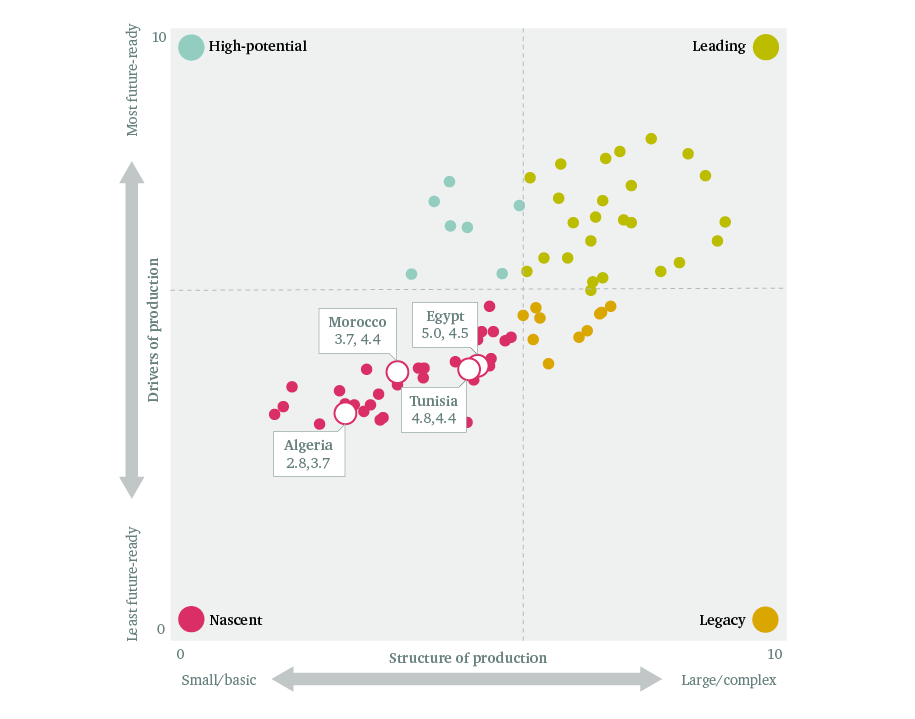
The rules of industrialization are rapidly evolving, with artificial intelligence and renewables becoming central to the fourth industrial revolution. While many governments are grappling with the challenges of automation, mainly the impact on employment, it would be more costly in the long run to not act. The only way forward is to move ahead of the regional curve, by building upon North Africa’s educational achievements and the private sector’s leadership. However, the transition will be painful and certain groups – notably university graduates – could face additional unemployment pressure if they are not adequately retrained and reskilled. Research by the World Economic Forum (WEF) on the relative readiness of different countries to upgrade their production systems to meet emerging challenges and opportunities demonstrates new ways of thinking about future economic development. The research looks at a host of factors and assesses the readiness of an existing production base (or ‘structure’), which includes its complexity and scale, as well as the drivers of production, such as human capital, technology and innovation, and institutional frameworks. The report found that all four analysed North African countries – excluding Libya – are not ‘future-ready’; Egypt leads the group, closely followed by Tunisia, with Morocco and Algeria trailing (see Figure 2).
The WEF highlights the importance of public–private cooperation in boosting a country’s preparedness for future challenges. However, such cooperation remains rare across the region. Furthermore, while the private sector in different countries has usually taken the lead in developing and integrating new technologies, institutional challenges remain. For example, if there are no clear regulations for online payments, businesses will suffer regardless of how enthusiastic they are about new technologies. Likewise, using artificial intelligence to develop better production or agricultural models will not be possible in the absence of regulatory frameworks for the collection and storage of data.
Legislators have been slow to realize the importance of new technologies. While each country is developing its own digital strategy, the often-optimistic goals of these plans are usually not supported by appropriate changes to regulatory frameworks that might free up capacity in the private sector.