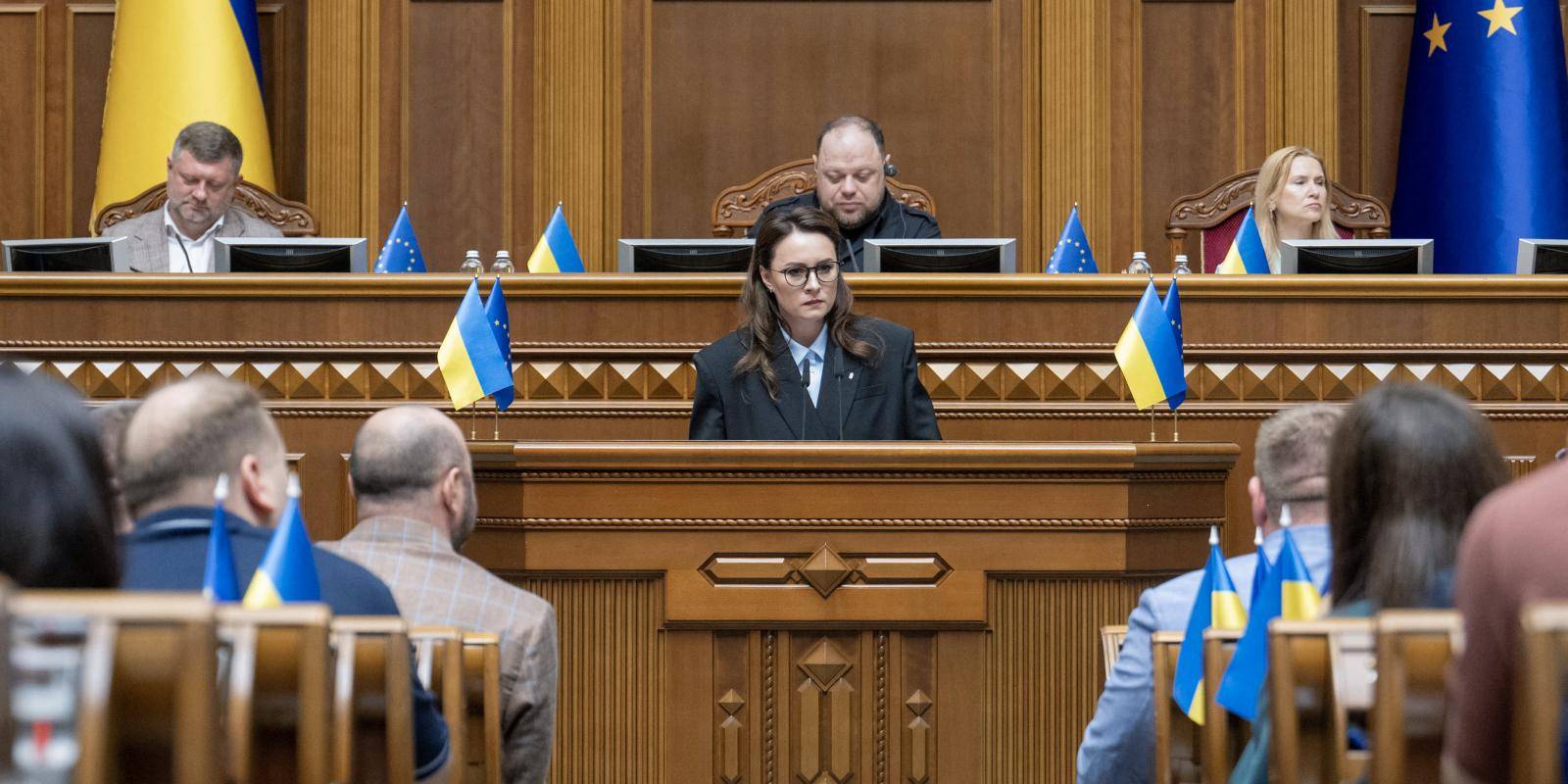

Last week Ukraine underwent its largest government reshuffle since the start of Russia’s full-scale invasion. On 17 July the Ukrainian Parliament approved Yulia Svyrydenko – previously first deputy prime minister and economy minister – as prime minister, alongside a new cabinet.
In part, the reshuffle is an attempt to maintain Western military and financial assistance and mend relations with US President Donald Trump, following February’s diplomatic debacle in the Oval Office and months of turbulent relations.
However, domestically the reshuffle is largely viewed as a continuation of the current political trajectory, with President Volodymyr Zelenskyy (and his chief of staff Andrii Yermak) making cosmetic changes and rewarding officials who have demonstrated loyalty and effectiveness during the war.
Zelenskyy’s Servant of the People party maintains a majority in parliament, giving the president significant influence over legislation. And the vast majority of ministers have retained the positions they had in the previous government. No new faces were added to the cabinet.
The intention of the reshuffle is to support a strategy to boost Ukraine’s defence production, strengthen its strategic relationship with the US, and revitalize its war-weary economy. But the government must be careful not to be seen to waver in its commitment to Ukraine’s democracy, regardless of wartime necessity.
Self sufficiency
Bolstering Ukraine’s self-sufficiency is essential to make the country less reliant on external military aid, which has proven volatile in the past. Kyiv understands that Europe’s defence industry faces structural weaknesses that will prevent it from replacing dwindling US armaments overnight.
Ukraine has already modernized and increased indigenous armaments production, currently delivering 40 per cent of its own weapons. But to help account for fluctuations in external aid, Zelenskyy has instructed the reshuffled government to boost domestic arms production to meet half of Ukraine’s needs within the first six months.
Key priority areas will include ammunition, AI-powered interceptor drones and long-range drones and missiles for deep strikes inside Russia. To support this effort, the Ministry of Defence has been merged with the Strategic Industries Ministry and will be led by former prime minister, Denys Shmyhal.
Yet, even as the reshuffle accounts for the possibility of reduced US military support, the appointments reflect a deliberate attempt to enhance cooperation with Washington wherever possible.

Svyrydenko led the negotiations over the establishment of the US-Ukraine Reconstruction Fund, designed to develop its critical mineral resources and finance Ukraine’s recovery.
She is respected by US negotiators and her leadership and understanding of the Trump administration’s approach may help drive new cooperation.
Indeed, she could be well placed to capitalize on President Trump’s recent pledge to increase US arms supplies to Ukraine, helping to ensure it produces concrete results and potentially leads to additional support.
Reportedly, Kyiv and Washington are already discussing a deal that would bring American investments in Ukrainian domestic drone production – a technology that has given Ukraine an important advantage against the numerically superior Russian forces.
Ukraine’s economy
Another key priority set by the new government is revitalizing the country’s economy. At the Ukraine Recovery Conference in Rome, European Commission President Ursula von der Leyen announced the launch of the European Recovery Fund, a €2.3 billion initiative to support Ukraine’s reconstruction efforts. Despite these ambitious future-oriented initiatives, Ukraine needs to plug a budget gap of $19 billion already in 2026.
The European Commission is exploring options with EU member states including off-budget military grants, advancing loans from the $50 billion G7 support package (backed in June 2024) and mobilizing frozen Russian assets held in the EU.
Ukraine also faces other significant challenges to its economy. There are huge labour shortages, arising from a dramatic reduction in the working-age population due to war-related displacement, mobilization, and casualties, compounded by long-standing demographic issues. Official estimates predict a labour shortage of around 4.5 million people over the next decade.

To address these issues, Kyiv wants to develop incentives for refugees to return, particularly by creating secure employment opportunities and addressing housing needs. Human recovery also involves efforts to reintegrate Ukraine’s growing veteran population, with a strong focus on rehabilitation services.
Svyrydenko’s cabinet is also expected to continue promoting reskilling initiatives and modernizing labour legislation – to equip the existing workforce, including internally displaced persons (IDPs), women, and people with disabilities, with the skills demanded by a changing economy.
