


It is easy to feel uninspired about the UN’s upcoming climate change conference, COP30, taking place 10–21 November in Belém, Brazil.
A key ask for governments ahead of the conference is to submit new national climate plans (Nationally Determined Contributions, NDCs) covering the period up to 2035. Countries had agreed this should be done 9 to 12 months before the COP, but as of 30 September 2025 only 64 countries – covering around 30 per cent of global emissions in 2019 – had submitted new NDCs.
A stocktaking report released by the UN on 28 October states that a ‘major acceleration is still needed in terms of delivering faster and deeper emission reductions’, but cautions against drawing global-level conclusions based on the small number of NDCs analysed.
Additional calculations by the UN, which take into account NDCs pledged but not yet formally submitted, project global emissions will fall by around 10 per cent by 2035. This is woefully inadequate: to limit warming to 1.5 °C, emissions would need to fall by around 60 per cent by that year, compared to the level in 2019. Indeed, the UN Secretary-General says it is now inevitable the 1.5 °C threshold will be breached, at least temporarily, with devastating consequences.
That the US – the world’s second largest emitter – is withdrawing from the Paris Agreement (again) does not help. At home, the administration of President Donald Trump is waging war on renewable energy, while promoting what the president calls ‘beautiful, clean coal’. As a result of these policies, the International Energy Agency has cut its 2030 forecast for growth in US renewable power capacity by half.
Moreover, extensive cuts to overseas development assistance (ODA) by the US – and by many other rich countries – could have a significant impact on the provision of climate funding. Before the US Department of Government Efficiency (DOGE) dismantled USAID, the US accounted for nearly 10 per cent of global climate finance.
The US is also increasingly deploying its economic might to prevent or delay climate action overseas. In mid-October, the members of the International Maritime Organization (IMO) delayed the adoption of their landmark ‘Net-Zero Framework’ by one year following intense pressure from the US, Saudi Arabia and other like-minded states. As part of its ‘all hands on deck’ lobbying campaign, the US had openly threatened economic penalties against countries backing the IMO plan.
Against this backdrop of inadequate NDCs, ODA cuts and difficult geopolitics, an obvious question is: what can COP30 realistically achieve?
COP30 as a galvanizing force
Firstly, it is important to note the global energy transition is continuing despite Trump administration policy. The International Energy Agency (IEA) estimates that investment in the electricity sector will reach $1.5 trillion in 2025 – around 50 per cent higher than the amount spent on fossil fuels. In the first half of 2025, renewables surpassed coal as the leading source of electricity globally.
China is the clear driver of the renewable energy boom, and renewable energy generation is actually growing faster in some of the world’s emerging economies than in some of the richest.
Building on this momentum, COP30 needs to demonstrate there are governments, businesses, and institutions that still want to take action – and which are taking action – to address climate change. As such, the conference can provide a rallying force in a difficult geopolitical context.
For this to happen, it is important world leaders show up and deliver ambitious statements at the Leaders’ Summit taking place just before COP30 formally gets underway. UK Prime Minister Keir Starmer’s decision to go to Belém is a promising step.
Brazil is working hard ahead of the conference to prepare declarations, for instance on carbon markets, methane, and forest fires. Such declarations, if key countries are included, could be important demonstrations of commitment.
Less negotiations, more implementation
Secondly, COP30 is not intended to broker a new international agreement. It’s about implementing commitments already made, including through the Paris Agreement and the outcome of the ‘Global Stocktake’ (GST) from 2023. This does not necessarily require consensus among the governments present.
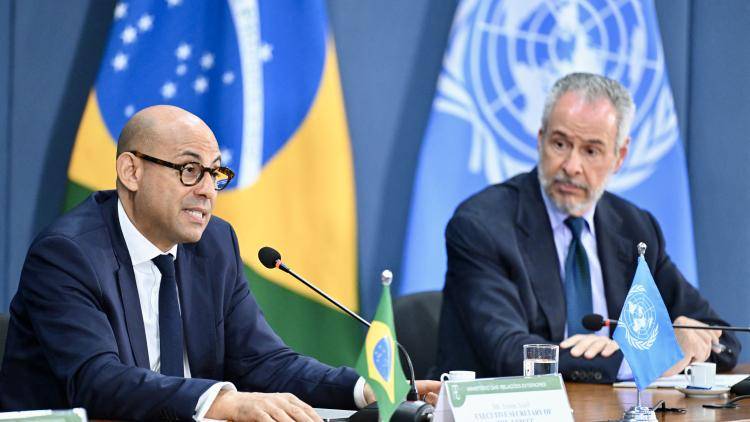
The Brazilian COP30 team is seeking to provide structure and direction to the ‘Action Agenda’, a process bringing together cities, regions, businesses, investors, civil society and governments to implement the Paris Agreement.
Hundreds of existing climate-related initiatives and coalitions have been grouped into clusters aligned with the themes of the GST to facilitate coordination and monitoring. Joint ‘implementation acceleration plans’ are also being developed within these groupings, which could speed up delivery.
Brazil hopes to create a model for the Action Agenda that can persist over time - enhancing coordination, strengthening accountability, and identifying bottlenecks and key next steps. If successful, these efforts would constitute important progress in terms of transitioning the COPs from focusing on negotiations to supporting implementation.