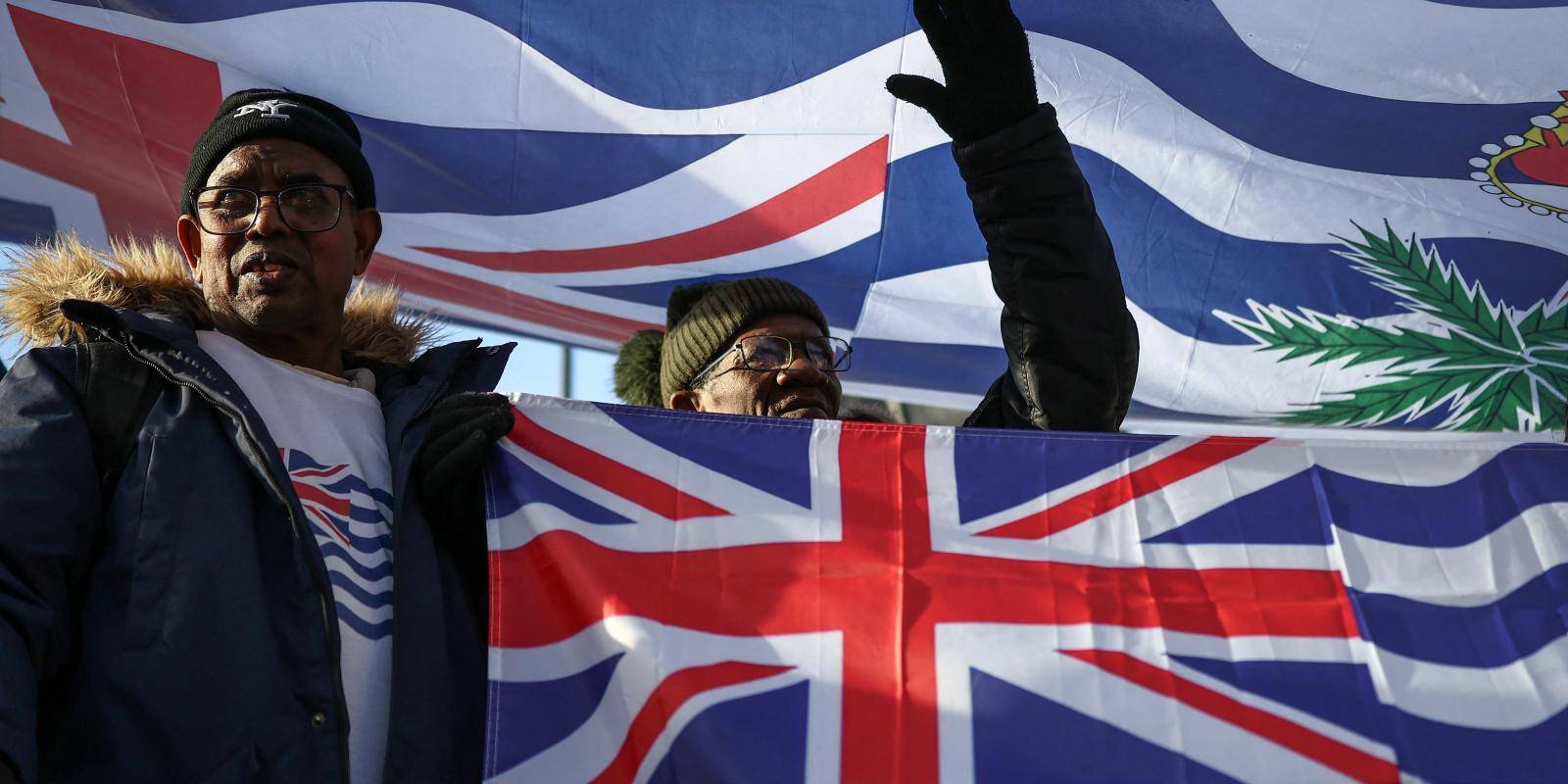

On 20 January, Donald Trump said that the UK’s deal to transfer sovereignty of the Chagos Archipelago to Mauritius was an ‘act of total weakness’ and ‘great stupidity’. He argued that such weakness on the part of US allies is a reason why the US must acquire Greenland.
Trump has justified his insistence on US control of Greenland in part by concerns about the encroaching presence of China and Russia in the north Atlantic and Arctic regions. Now this argument is being extended to the Indian Ocean over sovereignty in the Chagos Archipelago.
The strategic importance of the Indian Ocean
In a new era of great power ‘spheres of influence’, and as global warming opens up new trade routes across the Arctic Ocean, it is possible that the region could become a battleground between the US, Russia, and China as the president suggests. But these proposed polar routes are still not enough to sustain significant shipping volumes.
Indian Ocean shipping routes are far more significant. Today, two-thirds of the world’s oil shipments and one-third of the world’s cargo shipments travel through the ocean.
Over the past few months, maritime tensions have been mounting in the region. In November the US seized a ship traveling from China to Iran off the coast of Sri Lanka – months before Washington began its seizure of other oil tankers around the world.
Last week, Russia, China and others conducted a joint naval exercise off South Africa’s Indian Ocean coast. While some commentators described this as a BRICS Plus exercise, the reality is that this was a chokepoint powerplay.
India and Brazil opted out of the exercise, but several others were invited to join or observe: Egypt, Ethiopia, Indonesia, and UAE. Notably, these countries all sit near or along the Indian Ocean’s major chokepoints: Egypt (the Suez Canal), Ethiopia (the Bab-el-Mandeb Strait), Indonesia (the Malacca Strait), UAE (the Strait of Hormuz), and South Africa (the Cape of Good Hope). Iran also had ships in the area. Their role in the exercise is unclear, but the country also sits on the Strait of Hormuz.
Taken together, this naval exercise was a warning from countries like Russia and China that they too have the ability to put pressure on global trade routes and can put US shipping at risk.
Diego Garcia
Diego Garcia sits far outside the Western Hemisphere. But its strategic importance is not inconsistent with Trump’s ‘Donroe Doctrine’ – which seeks to assert dominance over strategic geography while tolerating great-power spheres of influence.
Diego Garcia is the only US military base in the Indian Ocean. It is equidistant from the Bab-el-Mandeb Strait as it is from the Strait of Malacca, allowing the US to project power across the region.
In the Indian Ocean, spheres of influence are diffuse and complicated. It is home to 33 countries and 2.9 billion people, stretching from the east coast of Africa to the Middle East, South Asia, Southeast Asia, and Australia. In the centre of it all (literally) is the Chagos Archipelago.
In the past Diego Garcia has been used to support operations in Iraq, Iran, and the horn of Africa. In 2024, the US deployed two B-52 Stratofortress bombers from the base on a deterrence mission across the Indo-Pacific, potentially aimed at the Houthis, Iran, and even China.
Diego Garcia functions as a defensive node, allowing the US to deter rival powers from leveraging the Indian Ocean’s critical sea lanes in ways that could undermine US economic and security interests. For Trump, hemispheric defence may require extra-hemispheric control in place like Greenland and the Chagos Archipelago.
The controversial UK–Mauritius agreement
Any discussion of Diego Garcia would be incomplete without acknowledging the Chagos Archipelago’s long history of incomplete decolonization and geopolitics.
Within the UK, Chagos has remained a controversial issue that cuts at the heart of imperial legacy: should the UK be able to maintain its territories abroad and under what circumstances?
In 2024, the UK government agreed to transfer sovereignty over the Chagos Archipelago to Mauritius in return for continued operation of Diego Garcia’s joint US–UK military base.
Since then, there has been pushback in the UK Parliament against the Chagos deal from those who fear that, in the absence of UK control, China will be able to establish its own commercial dual-use presence in Mauritius that would threaten Western security interests.
Additional concerns have been mounting about the indigenous Chagossian’s exclusion from the negotiation process, and the overall costs of the deal itself (estimated between £3.4 and £35 billion).

Amidst this mess is a deeper question about nuclear weapons proliferation. The Chagos Archipelago remains an issue within the African Nuclear Weapons Free Zone – an agreement to keep the African continent free of nuclear weapons.
Much like Greenland, the indigenous population of the Chagos Archipelago are seeking their own pathway to self-determination and resettlement. It has yet to be seen whether their interests will be included in the outcome of the agreement.
What most policymakers in the US and UK seem to miss is that it is possible to ‘have it all’. Politicization of the Chagos situation has prevented consideration of settlement outcomes that accommodate the interests of all those involved.