
‘Are you tired of winning?’
President Donald Trump isn’t, he said on Tuesday night in his 2026 State of the Union address, drawing smiles from Vice President JD Vance and Speaker Mike Johnson, seated on the dais behind him.
Despite the setback inflicted by a recent US Supreme Court ruling, Trump left no doubt that he intends to continue using tariffs aggressively – in his words, to win some more.
The Ruling
US trading partners have good reason to feel relief after the Court’s verdict. The Court invalidated the administration’s reliance on the International Emergency Economic Powers Act (IEEPA) as a basis for sweeping tariff action. This will reduce the speed and discretion of future tariff imposition.
Other observers will be relieved by the Court’s decision as a visible demonstration that America’s institutional checks and balances are functioning as designed. Court judges selected by President Trump were willing to reach judgements that angered the president and undermined his agenda. Some had doubted they would be.
But there is also bad news for tariff skeptics and America’s trade partners. In the State of the Union, Trump made clear that he has no intention of abandoning his broader tariff strategy.
Familiar strands
Within the speech, one could discern the familiar strands Trump has long used to justify tariffs.
First, tariffs as revenue.
‘I used these tariffs to generate hundreds of billions of dollars to make great deals for our country,’ he declared, crediting them as ‘one of the primary reasons for our country’s stunning economic turnaround’.
Trump went further, suggesting that ‘As time goes by, I believe the tariffs paid for by foreign countries will, like in the past, substantially replace the modern-day system of income tax – taking a great financial burden off the people that I love’.
Critics were quick to dismiss this claim. Income taxes account for the largest share of US federal revenue, and even substantial tariff increases would generate only a fraction of what income and payroll taxes provide.
Most economists therefore see tariffs as supplementary revenue tools rather than plausible substitutes for the income tax. Although the maths may not add up, the idea has intense political appeal: it frames tariffs as an external revenue source that could ease the domestic tax burden.
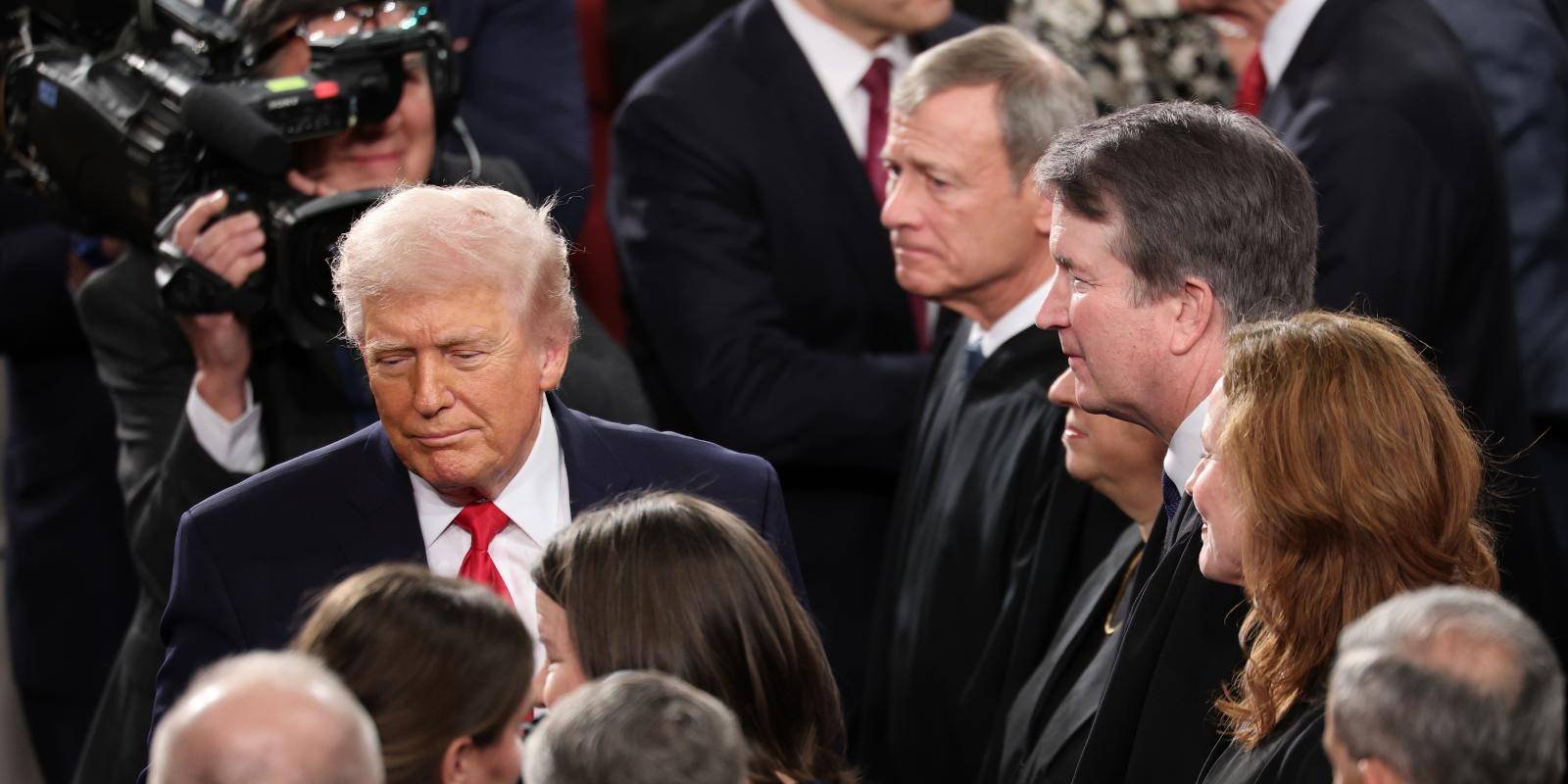
Second, Trump framed tariffs not merely as fiscal instruments but as tools of geopolitical leverage. In criticizing the Supreme Court’s ‘very unfortunate ruling’ – while four black-robed, stone-faced justices faced him from the chamber’s front row – Trump lamented that limiting presidential tariff authority weakens the executive branch’s power in foreign affairs. Tariffs, in this framing, are tools of statecraft – a way to coerce trading partners, extract concessions, and rebalance relationships without resorting to military force.
Indeed, Trump asserted that the threat of tariffs had enabled him to end ‘several wars’. He described tariffs as ‘peace protecting’, stating that ‘many of the wars I settled was because of the threat of tariffs’ and that ‘I wouldn’t have been able to settle them without [tariffs]’. In this telling, tariffs are a central instrument of US foreign policy influence.

US trading partners around the world can take from the State of the Union that tariffs are here to stay – at least for the duration of this administration. While the Supreme Court may have curtailed one legal pathway, it did not eliminate presidential tariff authority. It certainly did nothing to shake Trump’s broader faith in the tariff instrument.
Following the ruling, Trump indicated that his administration would continue using other statutory tools, including Section 301 of the Trade Act (addressing unfair trade practices), Section 232 (national security), and related provisions. In other words, while one instrument has been declared invalid, the broader tariff toolkit remains – as does Trump’s faith in its efficacy.