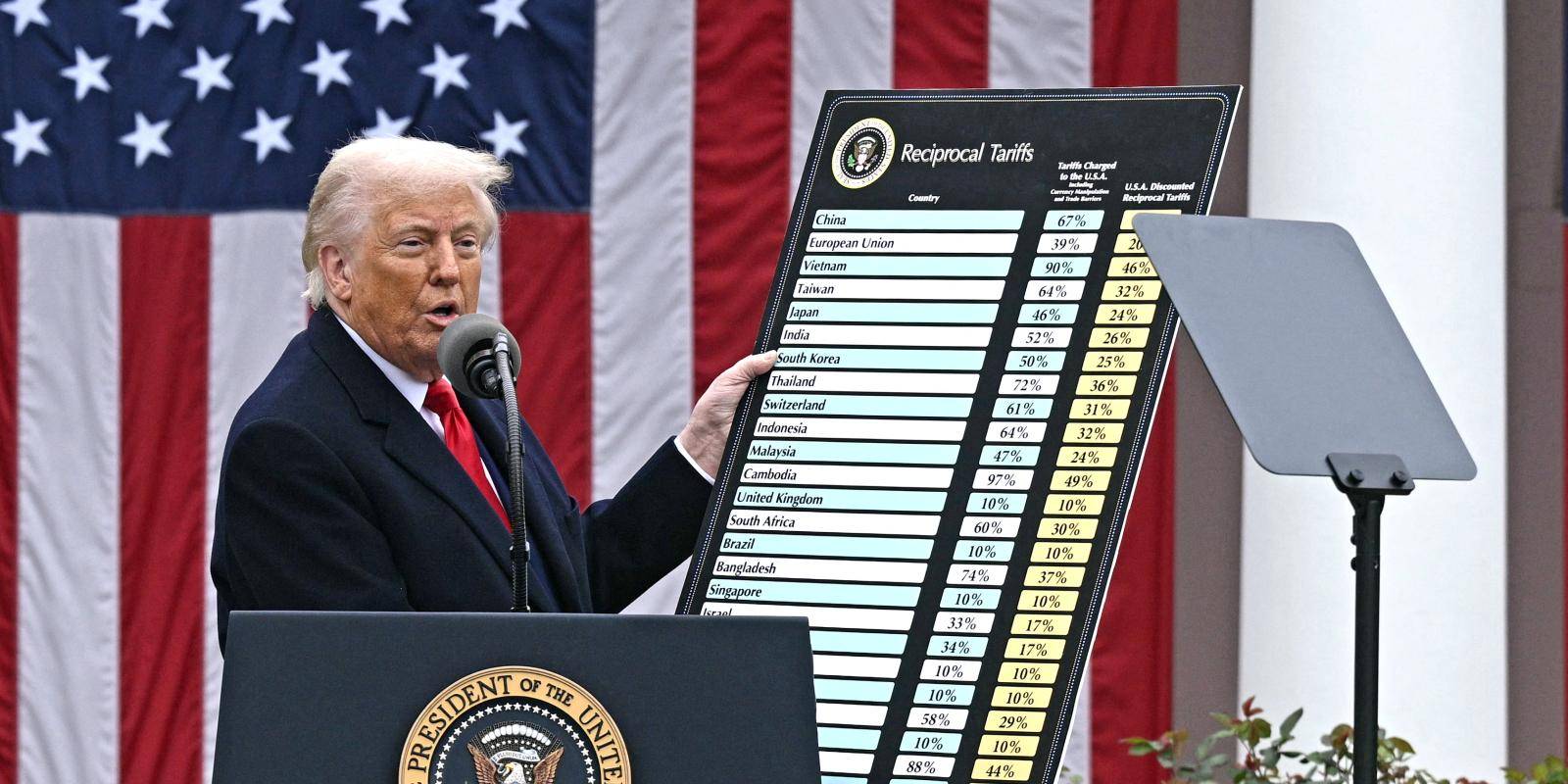


The US Supreme Court has ruled against President Donald Trump’s imposition of tariffs in a long-awaited ruling that will be seen as a blow for the president’s economic agenda.
By 6-3 the court found that President Trump exceeded his authority by using a law reserved for national emergencies.
Trump called the ruling ‘deeply disappointing’ and said he will impose global tariffs of 15 per cent. Here is early analysis from Chatham House experts, who are are monitoring developments.
Bruce Stokes, Associate Fellow, US and North America Programme:
The head-spinning changes in US tariff policy in the last few days – first the Supreme Court decision invalidating the Trump administration’s use of the International Emergency Economic Powers Act (IEEPA), then President Donald Trump’s imposition of a 10 per cent across the board tariff under Section 122 of US trade law, followed just a day later with the president upping that duty to 15 per cent – have left the American and foreign business communities, US consumers, and foreign governments with more questions than answers.
Any sighs of relief in the wake of the Court’s decision should be tempered by a new reality.
The effective global U.S. tariff rate was 13.7 per cent before the Court decision, according to the Yale Budget Lab. With Trump’s new Section 122 action duties will now be 8 per cent. But in January 2025, before the Trump administration came to power, the effective US tariff rate was roughly 3 per cent. More than a doubling of American protectionism is better than a quadrupling, but it is still higher than at any time in more than 60 years.
It is highly likely some affected party will challenge the use of Section 122, which has never been invoked by any president in its half century on the books.
The law stipulates this power is to be used for a balance of payments problem. But the Department of Justice lawyers claimed in the IEEPA case that: ‘Nor does [122] have any obvious application here, where the concerns the President identified in declaring an emergency arise from trade deficits, which are conceptually distinct from balance-of-payments deficits.’ This awkward statement may come back to haunt the Trump Administration.
For those outside the United States, a major question is how the many trade and investment deals Washington has imposed on countries around the world will be affected by the scrambling of US tariff policy.
The Financial Times was quick to opine that: ‘Analysts say the risk of retaliation is likely to deter countries from seeking to backtrack on already agreed deals.’
But the Japan Times saw it differently: ‘Trump’s treasured negotiating edge dulled by tariff defeat…With a stroke of a pen, the U.S. Supreme Court wreaked havoc on President Donald Trump’s favorite method of wielding leverage over other countries.’
At the very least, the uncertainty created by the Court’s decision may lead to more foot dragging by other nations as Washington attempts to finalize the details of its framework trade and investment deals with the EU, Japan, India and others. If they do, who knows what America’s hair-triggered President may do.
It is a fallacy to assume that Trump will play by the rules. The 122 tariffs expire in 150 days. To be extended, Congress must vote to do so. Congress has shown no appetite for tariffs, especially with Congressional mid-term elections in November.
The Administration claims they can use other trade powers – Section 301 that deals with ‘unfair’ trade practices and Section 232 that allows duties for ‘national security’ purposes – to replace the 122 tariffs.
But the scope of these sections is not as broad as an across the board 15 per cent tariff. Once this becomes apparent to the president, his past behavior suggests he may simply extend the 122 tariffs or use his 301 and 232 authority in unprecedented and arguably illegal ways, challenging importers to ‘sue me’. As the IEEPA suit showed, this could take months.
Finally, it is not clear that the invocation of Section 122 and its 15 per cent tariffs will help the president politically. Just before the Court ruled, the Washington Post and ABC News conducted a public opinion survey showing that 64 per cent of Americans disapproved of how Trump was handling tariffs on imported goods.
And in the wake of the Court decision a snap YouGov poll found that 60 per cent of Americans strongly approve of striking down the IEEPA tariffs.
So the bottom line is that US protectionism will continue, and it may be even more chaotic, unpredictable and disruptive.
Bruce Stokes is a US-based non-resident fellow at the German Marshall Fund. Read his full biography here.
Heather Hurlburt, Associate Fellow, US and North America Programme:
At first glance, this is a more comprehensive repudiation of the Trump administration’s tariff policies than many (including me) expected.
The language of the majority opinion appears to include an attempt to close off some of the other unilateral options that President Trump had said he had at his disposal.
I do wonder if the more recent rounds of purely geopolitical tariff threats influenced the decision. It may reflect both the breadth of corporate support for the lawsuit and concern with Trump’s recent rounds of tariff threats, including against Europe over Greenland.
The SCOTUS ruling covers President Trump’s ‘Liberation Day’ baseline 10 per cent tariff that he announced on 2 April 2025, higher tariffs on many countries, and fentanyl and other ‘national security’ tariffs.
However it does NOT cover steel/aluminum and many other product-specific tariffs issued as a result of a “232” or “301” investigation. (‘232’ and ‘301’ refer to specific sections of decades-old trade laws passed by Congress, which authorize the executive branch to impose tariffs in specific circumstances, after an investigation. 232 tariffs may include national security as a justification.)
President Trump still has lots of ways to impose tariffs. He’s not going to back down.
I’m very struck by this phrase from Justice Kavanaugh’s dissent: ‘So the Court’s decision is not likely to greatly restrict presidential tariff authority going forward.’
The court also did not mandate refunds of the tariffs collected to date, either to consumers or to manufacturers reliant on tariffed imports.
Does that suggest that Chief Justice Roberts identified an approach to the law that feels like a momentous defense of the Constitution but has relatively little practical effect?
Or will this ruling presage a vibe shift that gets the administration to change course?
Senator Bernie Moreno, the senior Republican senator from Ohio, has called on Congress to use reconciliation to enact the president’s tariffs.
This would presumably be challenging given that Republicans in both houses have joined Democrats in opposing President Trump’s tariffs.
Heather Hurlburt served as Chief of Staff to US Trade Representative Katherine Tai from 2022 to 2024. Read her full Chatham House biography here.
Ambassador Julián Ventura, Associate Fellow, US and North America Programme:
The 20 February US Supreme Court 6-3 decision on the International Emergency Economic Powers Act (IEEPA) is a significant fork in the tariff-driven trade policy road taken exactly 13 months ago by President Donald Trump when he announced his America First Trade Policy.
It does not, however, mark an end to his expansive use of Executive authority to shape his engagement with global trading partners.
In his combative reaction to the ruling, the president previewed alternative legal authorities that his administration will use as a basis for continued tariff action, including a new 10 per cent global tariff under Section 122 of the 1974 Trade Act, which allows for temporary import surcharges or import quotas to address balance-of-payments issues.
With details on scope, applicability and implementation of additional actions still unclear, US trade partners around the world will scramble in the coming days to determine the potential impact on their respective deals or framework agreements reached with Washington. Uncertainty will continue to be the name of the game.
The ruling comes on the heels of the release of the US Census Bureau’s 2025 international trade data confirming Mexico and Canada’s place as the first and second US trading partners, export markets and sources of imports, and as the three countries undertake the US-Mexico-Canada Agreement (USMCA)’s first joint review.
In North America, with intraregional annual trade at almost 2 trillion dollars and millions of jobs and investment decisions linked to the continuity of the agreement, a great deal is at stake.
In its initial reaction to the ruling, the government of Canada stated that it reinforces its view that the IEEPA tariffs ‘are unjustified’. Mexico’s Secretary of the Economy said he would be reaching out to his US counterparts and await more details on the announced 10 per cent global tariff. Both countries were subject to IEEPA tariffs (35 per cent on Canada and 25 per cent on Mexico) on non-USMCA compliant exports, in addition to various Section 232 sectorial tariffs which continue to apply.
It’s important to keep in mind that roughly 85 per cent of massive Canadian and Mexican USMCA-compliant exports – totalling approximately 780 billion dollars – maintains tariff-free access to the US market.
Beyond specific negotiating strategies with Washington, Ottawa and Mexico City will continue to focus on reducing uncertainty and preserving their current relative competitive advantages in a rapidly changing tariff environment.
Ambassador Julián Ventura is a career diplomat, currently on leave from the Mexican Foreign Service, with over 33 years in public service. Read his full Chatham House biography here.
Professor Roland Paris, Associate Fellow, US and North America Programme:
The Supreme Court’s decision to invalidate Donald Trump’s emergency tariffs may have removed one instrument from his tariff toolkit, but it has done nothing to make US trade policy more predictable. If anything, it may herald even greater volatility.
Trump retains several alternative instruments now that tariffs imposed under the IEEPA have been ruled unlawful. Each entails procedural hurdles, evidentiary thresholds, time limits and litigation risks. Yet, as Justice Brett Kavanaugh observed in his dissenting opinion, ‘the Court’s decision might not prevent Presidents from imposing most, if not all, of these same sorts of tariffs under other statutory authorities.’
That Trump, visibly angered by the ruling, quoted Kavanaugh’s statement not just once but twice suggests that he is not reconsidering his long-held belief in the benefits of tariffs. He has already pledged to introduce a new global tariff of 15 per cent, while signalling that further measures may follow.
For US trade partners – including several that negotiated agreements intended to reduce IEEPA tariffs on their exports – the outlook is unclear. The uncertain status of those arrangements, together with the prospect of new tariffs, now adds an additional layer of unpredictability to an already unstable picture.
Canada, for its part, gains little from the removal of the IEEPA tariffs, since goods compliant with the US–Mexico–Canada Agreement were already exempt. Meanwhile, the tariffs inflicting real pain on key Canadian sectors – including autos, steel, aluminium and lumber – remain in place because they rest on different statutory authorities. And any new US global tariffs may prove more damaging than the IEEPA measures if they eliminate existing exemptions.
The logic of Canadian prime minister Mark Carney’s speech at Davos, in other words, remains unchanged: the US is no longer a predictable or reliable partner, leaving its jilted allies with little choice but to diversify their trade partnerships and invest in their own resilience.
Canada-based Roland Paris is director of the Graduate School of Public and International Affairs at the University of Ottawa, and former foreign policy adviser to the prime minister of Canada. Read his full Chatham House biography here.