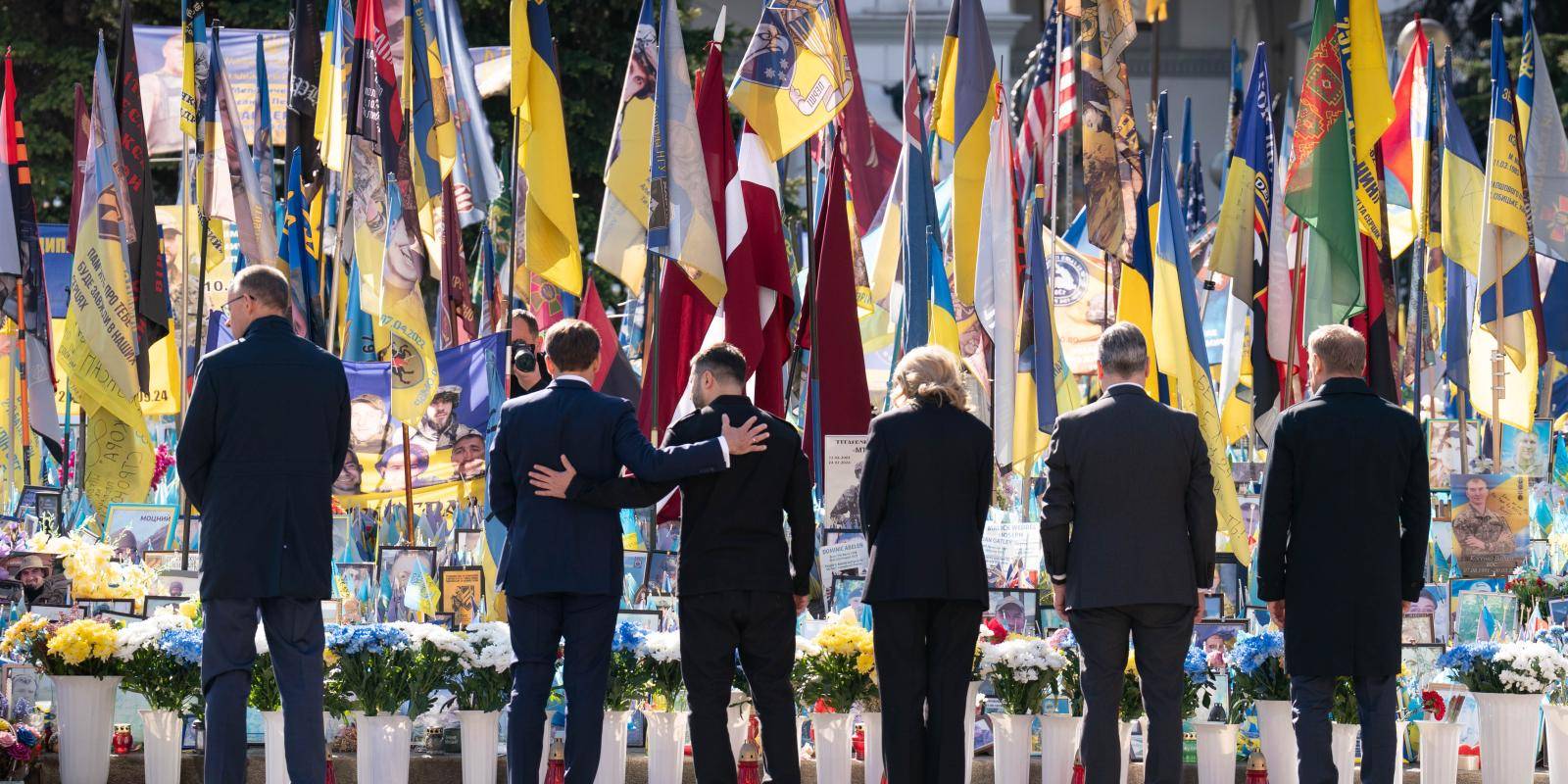
Problems facing the veteran community, which already constitutes in excess of 900,000 people, could be a flash point for tension. Current monitoring shows that many veterans struggle to find stable work, have higher healthcare needs – particularly related to mental health and severe war trauma – and some, especially women, experience tensions in their communities. These tensions are related to access to scarce resources that also come out of tight local budgets that must provide for internally displaced people (IDPs), veterans and local residents in need. Some of the issues are related to identity politics, where more Russian-speaking populations from the east have moved to the west of the country. The other level of tension is related to competition for local jobs between IDPs and veterans, both groups struggle to find steady and well-paid employment. Veterans are also at risk of becoming a target of special disinformation campaigns and recruitment by criminal groups or proxies linked to Russian intelligence.
Polarization could be compounded if parts of Ukrainian society, particularly veterans and their families, perceive an unstable ceasefire or a peace deal as a mistake and a betrayal. A common feeling that the sacrifices of Ukrainian society in this war have been wasted by politicians, as well as perceptions of Western weakness, could damage the body politic.
Compared to 2022, there is now wider societal support for freezing the conflict along the current frontlines, but with neither de facto nor de jure recognition of Russian rights to these territories. In January 2026, polling showed that 39 per cent of Ukrainians would reluctantly support the idea of retreating from Donbas in exchange for US and European security guarantees. Russian attacks that caused blackouts and forced citizens to endure winter without heating did little to change the public position in favour of surrendering its territory. Other propositions not favoured by the Ukrainian public include limits on the size of the national army, giving the Russian language official status, stopping legal cases for war crimes, and limiting claims for war reparations. Of those surveyed, 51 per cent are ready to protest if Ukraine is pushed to make unacceptable concessions.
Coercing Kyiv into a deal with little public support would offer the Kremlin a new frontline of attack. Russia has an interest in ensuring that any truce fuels polarization, possibly even a civil war. Under a ceasefire, Russian offensives will take other forms: non-kinetic, asymmetric tools to exacerbate divisions, encourage infighting and turn society against the political class.
The next election campaign might prove the most challenging in Ukraine’s history. Vicious internal competition risks creating a splintered parliament and an unstable governing coalition. Even now, during the war, fractures are emerging in Zelenskyy’s Servant of the People party and there is growing criticism from opposition parties about the government’s approach to mobilization, populist measures to provide various individual payments to citizens and the easing of travel bans for the male population. There will be a reshaping of Ukraine’s political landscape at the next elections, with new parties engaging more veterans to stand as candidates. Given that Ukraine is a parliamentary-presidential republic, the composition of a future parliament is critical. Parliament approves the prime minister and the cabinet, and the legislative body is key for Ukraine’s adoption of the EU acquis – the collection of common rights and obligations that constitute the body of EU law.
An electoral race will open the floodgates for Kremlin interference – including in online voting (if this approach is adopted), potential assassinations of candidates, the obstruction or buying of votes, or threats to the security of polling stations.
The next election campaign might prove the most challenging in Ukraine’s history. Vicious internal competition risks creating a splintered parliament and an unstable governing coalition.
If elections are organized prematurely and citizens do not trust the results, this could ignite widespread protests. Ukrainians have a long history of civic protest to defend democracy and elections, in particular. At present, if Zelenskyy once again runs for the presidency, the contest will likely be between him and General Valerii Zaluzhnyi, Ukraine’s current ambassador to the UK. With roughly the same level of support for both potential candidates, at around 30 per cent among voters, it would be a tight race.
Inadequate electoral infrastructure (in terms of funding, voter registration, the number of polling stations in Ukraine and abroad, and personnel) would threaten the legitimacy of an election. In Europe alone, Ukraine will have to organize voting for over four million citizens. Ukrainian embassies and consular sections would be overwhelmed due to high numbers of voters. Meanwhile, polling shows that Ukrainians do not support the proposal to allow online voting due to the high risks of voter fraud and external interference. With frontline regions susceptible to attacks and nearly one million voters in the army, the practicalities of organizing an election in which each eligible voter can exercise their right is incredibly complex. Not to mention the potential jeopardy for security and military units if army personnel are moved to vote at civilian polling stations. An election could also threaten cohesion among the military if soldiers choose to participate in electoral campaigns, particularly if support is split between different candidates.
Based on previous election experience in Ukraine and beyond, including in some Western countries, it is safe to assume that Russia will interfere to influence the results and disrupt the quality of the process. Putin has already demanded that polling stations be opened in the occupied parts of Ukraine and for Ukrainians living inside Russia. Claiming that 5 to 10 million Ukrainian citizens will not be able to vote in an election allows Russia to lay the groundwork for not recognizing the future electoral outcome. In parallel, similar to Moldova in 2025, Russia will likely attempt to boost candidates that promote reconciliation with Russia, spin anti-Western narratives, and stoke revanchist emotions around an inconclusive outcome of the war. The Kremlin could push the narrative of futile losses and fuel sentiments to restart the war, especially among the Ukrainian veteran and military communities.
Economic and governance failure due to uncertainty
Continued instability will make it more difficult to advance economic and social reforms and attract foreign capital. Ukraine recovery and reconstruction is estimated to require around $588 billion over a 10-year period, with urgent rebuild costs thought to be around $200 billion. For recovery to succeed, Ukraine will need a blend of public and private funding. Private investors could cover around one-third of the capital needs assuming that key legal and rights reforms take place. Similarly, investors will be wary of ambiguous security arrangements for Ukraine, so dependence on sovereign funding and international financial institutions (IFIs) will remain high.
In the case of a potential hung parliament and dysfunctional coalition government after an election, there will be little progress in reform efforts. Completing the ongoing rule of law reform, including protecting property rights – to create a more reliable investment environment – and decoupling the judicial system from political high offices are all critical for Ukraine’s economic growth. New vested interests that form around the defence and energy sectors as well as reconstruction funding could perpetuate the old closed-access economic system, which held Ukraine back for decades and enabled significant corruption.
Even with a ceasefire, the Black Sea could remain unstable. Russia will likely aim to obstruct the navigation of Ukrainian vessels in the area and try to reinforce the Russian fleet in Crimea, which has been severely degraded in the conflict. Ukrainian ports in the city of Odesa could be at serious risk. Due to the occupation of Ukraine’s coast in the Sea of Azov, Odesa is the location of the country’s three functioning deep-water ports (Pivdenny, Chornomorsk and Odesa). With land crossings disrupted by the war, 90 per cent of Ukraine’s exports in 2025 were shipped by sea.
Depopulation crisis
Ukraine’s dire demographic situation could deteriorate even further. The sharp decline in the population because of the war is a problem for both economic recovery and the defence of the country. The population has declined from 40 million in 2014 to an estimated 31.1 million residing in Kyiv-controlled territories now. The government further estimates a decline to 29 million by 2041.
If current trends are not reversed, Ukraine may have an active workforce of about 12 million people when a ceasefire is agreed, a decline of nearly 40 per cent from the 2021 level. Structural unemployment – due to internal displacement, a lack of skills and the shadow economy (activities concealed from public authorities) – currently affects around 8 million people. The workforce crisis is already impacting the economy, with 61 per cent of Ukrainian companies reporting that the number one productivity issue is the shortage of human resources due to emigration or mobilization. The next major problem to resolve in order for refugees to return is the security and disruption of critical resource supplies, such as water and electricity.
The lifting of travel restrictions with the end of martial law represents another potential risk that may lead to a new outflow of emigration. Indeed, only 19 per cent of Chatham House survey respondents believe Ukrainians currently abroad will return home, and 27 per cent think more will leave the country after a ceasefire. In July 2025, liberalization of travel for men aged between 18 and 22 led to the outflow of nearly 100,000 people in two months.
A declining population and increasing demand for social assistance will lead to enormous public funding pressures. Currently nearly 30 per cent of the population receives a state pension, the next largest proportion of funding goes on disability payments. Not all veterans will be able to move into the civilian economy, and many will require social support for life.
Division among Ukraine’s European allies: decline and possible collapse of funding
For the foreseeable future, Ukraine will be dependent on external funding. To date, this has not always been consistent. Even during the hottest phase of the war in 2025, military aid decreased 43 per cent due to discontinued US assistance, and by the end of the year the level of aid had still not bounced back, despite increased pledges from some European partners. The vast recovery needs to rebuild housing and critical energy infrastructure are daunting. Most of the current funding instruments (the EU Ukraine Facility and the Extraordinary Revenue Accelerator – ERA – the new €90 billion loan from the EU) expire in 2027. In the scenario of a ceasefire, it is estimated that Ukraine will still need $68–105 billion annually from partners for defence spending. The proposed long-term EU budget for 2028–34 allocates €14 billion ($16 billion) per year to Ukraine, meaning funding available for Ukraine’s defence spending risks falling significantly short unless other supporters come forward.
Even during the hottest phase of the war in 2025, military aid decreased 43 per cent due to discontinued US assistance, and by the end of the year the level of aid had still not bounced back, despite increased pledges from some European partners.
The absence of stable long-term financing would threaten Ukraine’s defence posture and endanger army reconstitution and the ambition to build a strong Air Force (using Rafales and Gripen fighter jets). The mounting tide of right-wing populism in Europe may also jeopardize funding for Ukraine. If active fighting is paused, the perception of the threat from Russia will widen between Eastern and Western Europeans, impacting the consensus to finance Ukraine. By the end of 2025, within the ‘coalition of the willing’, public support for peace terms that would preserve Ukraine as a viable independent state was falling, especially in France.
Implications
It is dangerous to assume that Ukraine’s resilience since 2022 means that it can be a successful state living in the permanent shadow of war. Long-term insecurity may normalize poverty, and this adaptation could lead to sustained deprivation. Ukraine is at risk of being trapped in a ‘grey zone’, characterized by unstable and chaotic governance, corruption, high levels of poverty, mortality and emigration, as well as a decline of civil society and the perception of crisis as normal. Any normalization of war and failure to establish a solid security framework against Russian reinvasion, will have a profound negative impact on society. It is important to avoid social shifts that might paralyse Ukraine’s capacity to consolidate democracy and continue its integration into the EU.
Ukraine will have to remain mobilized
Given that Russia has failed to achieve its key political objectives in the war, a ceasefire will require Ukraine to maintain a high level of mobilization. Ukraine’s armed forces will have to defend the country for an extended period of time, until major systemic change in Russia brings about a shift in policy. This will require the retention of the best leadership talent in the armed forces and the mainstreaming of the best practices of adaptation and innovation learned in wartime. As a result, this may limit the workforce talent available to the civilian economy. A defence industry that can tap into this talent stream and attract investment could become a significant engine of economic growth and export revenues.
Kyiv will struggle to assemble the necessary military force to defend itself in a society tired of a war that has now lasted over a decade. Ineffective mobilization, especially in 2025, pushed vast numbers of people into the shadows. The Ministry of Defence reports that 2 million citizens are evading the military draft, and 200,000 soldiers are absent without official leave. Preliminary calculations suggest that for Ukraine to defend its line of contact and operate in land, air, sea and cyberspace, it will need a force of around 1 million people, comprising 450,000 active duty military personnel, 150,000 conscripts and 450,000 high readiness reserves. Considering all the risks laid out earlier in this chapter, Ukraine might struggle to staff, finance and effectively operate such a system. For this reason, the presence of international forces could alleviate pressure away from the front and free up Ukrainian troops to defend the line of contact.
Military-technological innovation could fall behind Russian developments
A pause in fighting may weaken cooperation between Ukraine’s defence start-ups and battlefield unmanned systems units, which could slow down defence innovation. Private investment in Ukraine’s defence sector remains limited. Despite nearly doubling the country’s own drone production between 2024 and 2025, total private investment in defence technology companies from 2023 to 2025 stood at $105 million. Low FDI, patent hoarding and non-competitive markets – a wartime ban on weapon exports – could lead to stagnation and an outflow of the most advanced technology for production abroad.
Despite available production capacity, the inability of companies to sell weapons abroad makes planning and the outlook for the defence sector extremely difficult. If sales contracts are not arranged while the war continues, companies will struggle to maintain operations, grow and generate revenue, potentially leading to job cuts and the loss of a valuable economic driver for Ukraine.
The appointment of Mykhailo Fedorov as the new minister of defence in January 2026 might be an effort to mitigate these risks. He spearheaded domestic drone production, enabling the sector to grow from seven to around 800 arms companies, and has announced his intention to further increase domestic arms production, including high-tech systems. While Ukraine’s defence sector has expanded through the production of drones, electronic warfare equipment (growth from two to 200 companies) and missiles, the country lacks the financing to scale up production and struggles with remnants of the old Soviet system, mainly related to bureaucracy in the Ministry of Defence and top level command. This risk could be diminished if Ukraine establishes active collaboration with its European partners and preserves the innovation ecosystem of production capabilities, trained engineers, data centres and training facilities.
Competition for scarce human and financial resources
Ukraine’s precarious demographic trend will lead to fierce competition for workers among defence, healthcare, agriculture and technology sectors. The solution could come through legislative reforms, the reduction of corruption, increased productivity and the use of advanced technology. The issue of confiscated Russian sovereign assets will return to the forefront, especially if, as seems certain, Europe struggles to finance Ukraine’s military reconstruction and equipment. The EU Council’s decision to apply its emergency powers to indefinitely freeze Russian assets until Russia pays reparations to Ukraine protects the sovereign assets from being used as a bargaining chip in negotiations. Thus, the US will not be able to offer these assets back to Russia and then pressure the EU to comply. The frozen status of the assets is now protected by European law and would require a vote by a majority of EU members to return the money to Moscow.
The labour force will be Ukraine’s Achilles’ heel. Given the likely fragile security situation, Kyiv will struggle to attract Ukrainian refugees back to the country, especially those settled in Western and Northern Europe. UNHCR projects that about 2 million people might return under a scenario of ‘fragile peace with concessions’. In terms of human resources, it is estimated that the country needs 4.5 million more working citizens to enable the necessary social and economic recovery and growth.
Employment levels among people with disabilities in Ukraine have been traditionally low, at around only one in six in work. Approximately 21 per cent of veterans self-identify as having a disability.
This will require innovative labour and demographic policies. Efforts to encourage Ukrainian refugees to return from Europe, as well as attracting migrant workers from other countries in Eurasia and giving them a pathway to citizenship might help dampen the crisis, as could improved conditions for people with disabilities to enter the workforce. Employment levels among people with disabilities in Ukraine have been traditionally low, at around only one in six in work. Approximately 21 per cent of veterans self-identify as having a disability. More broadly, poor efforts to reintegrate about a million veterans into civilian life could lead to increased homelessness, prison and mental health crises, leading to growing violence and crime. Alternatively, with the right policies, veterans could become a new, powerful force for democracy and a productive workforce.
There will be an acute need for a smart national cohesion policy and outreach to the occupied territories. This must strike the right balance between space for political pluralism and civil society freedoms, and also entail conflict management and the monitoring of flash points. With Russia targeting Ukrainian society more broadly, Ukraine should focus on strengthening defence of its information space, developing cognitive resilience and paying special attention to veterans and their families, as they are often targets of Russian ‘grey zone’ efforts due to trauma, isolation and disillusionment.
A ceasefire will lock more than 6 million Ukrainian citizens into Russian occupation. This means they could be drafted into the Russian army and forced in future to fight Ukrainians and Europeans. In Crimea alone, Russia has drafted 55,000 conscripts after its annexation in 2014. There is a systematic effort to militarize young Ukrainians in military camps in Russia. Many are likely to be resettled to ethnically cleanse the population of the occupied regions or contribute to addressing Russia’s population decline in Siberia. The new $9 billion Siberia development programme requires the authorities in the occupied territories to provide lists of people that could be approached for such ‘resettlement’.
The longer the de facto occupation of areas of Ukraine continues, the more effective Russia will be at erasing any differences in culture, governance and economies. The so-called ‘legal harmonization’ (imposing Russian law on these lands as part of the Russian Federation) is an effort to make any future meaningful reintegration into Ukraine impossible. These tactics include forced passportization, when citizens cannot access public or financial services without a Russian passport; a ban on the use of the Ukrainian language; and changes of the educational curriculum to eliminate any information about the history and culture of Ukraine. Russia’s actions in the occupied territories of Georgia (see Chapter 5) provide ample evidence of how this approach may be implemented.
Holding elections (presidential, parliamentary and local) will be extremely complex and will take place in a highly contested environment with weak security
Parliament will have a key role in deciding when security conditions are right to lift martial law. This will merit a careful debate before the chamber votes. Zelenskyy declared in December 2025 that Ukraine would need four to six months from the moment a ceasefire is agreed to organize an election. But this could be too optimistic given all the risks. External pressure should not dictate this timing.
Unity in Ukrainian society to resist Russia’s aggression has denied Putin the easy victory that he imagined. William Burns, a senior US diplomat, describes Putin as an ‘apostle of payback’, a person who stores and assembles grievances and lashes out when the moment presents. Zelenskyy’s potential re-election would be a personal humiliation for Putin. If Zaluzhnyi were to come to power, Moscow would have little to celebrate. But either way, an election would be an opportunity for Russia to undermine Ukraine and its unity. The Kremlin will do everything to disrupt the election process and use it as a diversion from the urgent needs of Ukraine’s rearmament.
An openly pro-Russia party, if such is created, has no chance of winning, because Ukrainians see Russia as the enemy, but pro-peace, pro-sovereignty and anti-Western parties could tap into popular feelings of resentment that Europe has not supported Ukraine enough to win the war. In late 2025, 76 per cent of Ukrainians believed in the possibility of effective resistance if Europe supplied more weapons to Ukraine and put more sanctions pressure on Moscow. The Russian disinformation machine would see this as an opportunity to blame Europe for Kyiv’s inability to get a better outcome in the war.
A fragile ceasefire may prevent Ukraine from holding elections altogether. Parliament may simply not agree to lift martial law. In this case, Zelensky’s challenge would be how to renew his administration’s legitimacy without elections. The narrow circle of highly trusted officials that lead the government have already been reshuffled twice and no new individuals have emerged as effective ministers. Zelenskyy will face the challenge of revitalizing his team with people that society trusts to infuse new ideas, policies and energy into the system.
An inconclusive ceasefire with weak security guarantees will impede economic and societal recovery
Investors will be very cautious about returning to or entering Ukraine. The prosperity plan for Ukraine proposed by the EU and the US will take time to materialize and, given the transactional nature of the Trump administration, it is unlikely to bring rapid capital investments, especially if a ceasefire is unstable. From a Ukrainian perspective, the promise of attracting $800 billion of investment for the reconstruction of Ukraine looks more like a pay-off for Kyiv to surrender the rest of Donbas in exchange for a funding pledge and fast-track EU membership. Neither of which would be guaranteed. The new US–Ukraine Reconstruction Investment Fund (URIF) is expected to accumulate only $200 million by the end of 2026. The disparity between the amount of funding required and what is available means Ukraine will continue to rely on sovereign assistance, debt and IFIs – the European Bank for Reconstruction and Development (EBRD), the European Investment Bank (EIB), and the World Bank – for macro-financial assistance and capital for reconstruction.
On the EU side, there is no indication of any fast-track possibility for Ukraine to get membership. During the prosperity plan discussions, German chancellor Merz stated that it would not be possible for Ukraine to join the EU before 2027. If EU accession stalls or Ukraine fails to push through reforms, the EU may struggle to remain united on the issue, in light of growing popularism. Informal discussions of a two-stage approach for Ukraine’s membership indicates that Brussels is unsure it can maintain cohesion to finalize Ukraine’s EU integration. The idea is that the EU opens its market and allows access to some funds, especially for defence, but does not grant Ukraine full voting rights and access to agricultural subsidies and other benefits. This is presented as ‘reverse engagement’ and could also apply to the Balkans and Moldova. However, for example, if Ukraine gets access to the single market, but has no political voting rights or members of the European Parliament, this will likely be perceived in Ukraine as a betrayal, as second-class membership, and may undermine the wider European project.
Black Sea security will remain fragile and impede fast recovery. Before the full-scale war, Russia actively weaponized inspection and shipment checks in the area to increase costs of trade. In the three years between 2018 and 2021, Russia performed 110 detentions of commercial ships. If this practice continues during the ceasefire, Ukraine will struggle to ship oil, grain and metallurgical products. Without reliable trade logistics, strong growth will be hard to achieve.