
In President Donald Trump’s talks with China’s President Xi Jinping this week, rare earth elements are likely to be high on the agenda. Rare earths are essential to the technologies that underpin both economic competitiveness and national security: electric vehicles, wind turbines, smartphones, data centres, advanced electronics, missiles, radar systems and fighter jets.
Beijing’s dominance of the rare earths supply chain means it currently holds all the cards. Yet in the long term, the US does have an alternative route that could help it redress this imbalance: recovering and recycling crucial rare earth magnets from the vast amount of electronic waste it produces every year.
Self-inflicted over-dependence
The US’s vulnerability to its dependence on China for rare earths became painfully clear in 2025, when Beijing introduced export controls on several rare earth elements and related magnets. Those restrictions sent shockwaves through automotive, defence and technology supply chains. A one-year trade truce was later agreed after the Trump–Xi meeting in South Korea in October 2025. But that did not solve the underlying problem. It merely postponed it.
The uncomfortable truth for Washington is that the US will continue to depend on China for rare earths for the foreseeable future. Chinese mines produce around 70 per cent of rare earths, but the real chokepoint lies in processing, separation and magnet production. China accounts for around 90 per cent of global heavy rare earth processing, producing most of the world’s rare earth permanent magnets, which are crucial for many electronics.
How did the US, the world’s largest economy, end up in this precarious position? The answer is a combination of strategic drift, blind faith in free market economics, and the convenience of cheap resources and outsourcing environmental impacts.

For decades, Western countries were content with the complex and polluting stages of rare earths mining and processing taking place in China, while they imported processed rare earths and finished components such as neodymium magnets at low cost. China, meanwhile, recognized the importance of controlling these supply chains. It invested, scaled, and absorbed environmental and social costs.
But the deeper failure is systemic: The global economic system has never properly priced the minerals and metals it consumes. Rare earths have been treated as cheap inputs, not as strategically valuable materials, albeit ones with high environmental and social costs embedded in their extraction and processing. The result is a linear system: valuable materials are extracted from the ground, built into devices with increasingly short lifespans, and then mostly lost to landfill or waste streams.
The Department of Energy (DoE) projects that US demand for neodymium permanent magnets could reach around 37,000 tonnes per year by 2030, and up to 68,600 tonnes per year by 2050 under a high-growth scenario. This projected growth in demand is driven largely by clean-energy and electrification technologies, including electric vehicles, offshore wind and industrial motors.
Yet current US production of rare earth permanent magnets remains tiny by comparison: MP Materials, which owns the country’s only operational rare earths mine, only started domestic neodymium magnet production in 2025. It has a current production capacity of around 1,000 tonnes, but is aiming to ramp up to 10,000 tonnes once it opens a second facility in 2028.
Untapped potential
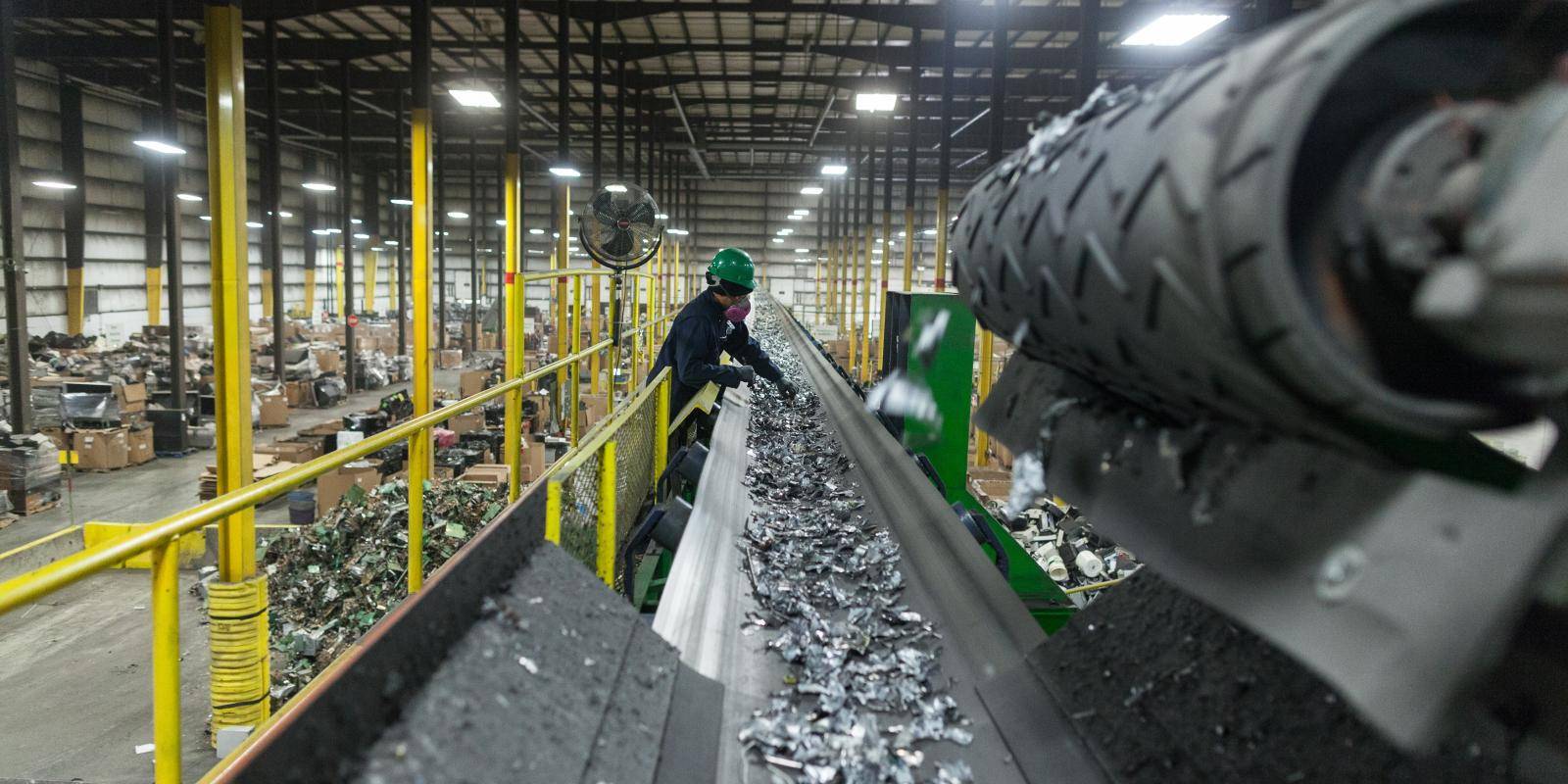
However, the US does have other sources it could tap. These are not only from new mines and processing capacity, but also the large quantities of rare earth magnets embedded in discarded electronics, motors, hard drives and other electronic waste, known as e-waste.
Rare earth elements within e-waste can often be recycled and reused. According to the UN’s Global E-waste Monitor, the US generated around 7.2 million tonnes of e-waste in 2022. Estimating that 0.25 per cent of that annual e-waste consists of neodymium magnets (based on the available evidence from multiple studies), US e-waste therefore likely contains approximately 18,000 tonnes of magnets each year – an amount that would meet almost two thirds of the DoE’s projected US demand for 2030.
However, much of this potential resource ends up in landfill. Although 25 states have implemented some form of state-wide e-waste recycling programmes, these vary in scope, and the lack of a uniform federal law has led to regulatory patchwork and created challenges.
A major issue is collection. Current recycling practices in the US are patchy and do not focus on recovering rare earths, which requires specialized separation technologies and targeted collection systems.
Large quantities of valuable US e-waste are also being shipped to and dumped in Asia. While Washington worries about Chinese dominance over rare earths, valuable materials embedded in US products are leaking out of the domestic economy.
Other sources
Coal ash, mine waste and industrial residues also contain rare earth elements and other critical minerals that could be recovered. Research suggests there could be as much as 11 million tonnes of rare earth elements in accessible coal ash in the US, nearly eight times the amount that the US currently has in domestic reserves.
The US DoE has supported work on extracting rare earths from coal by-products such as ash and slag since 2017, while other US agencies have also moved to prioritize the recovery of critical minerals from mining waste. However, these approaches are yet to reach scale, and without stronger policy support, investment incentives and clearer market signals, they will remain promising but marginal solutions.
A circular future
Washington is spending far more on mining and processing new rare earths than it is on recovering the rare earths it has already imported, used and discarded. That is a missed strategic opportunity: the fastest route to mineral security may not only lie in new mines, but in the waste streams the US has so far neglected to treat as national assets.
This solution requires innovation in engineering, designing products for repair and easy disassembly, building domestic collection and recycling infrastructure, creating standards for recycled rare earth content, and ensuring that magnets and other components can be recovered at scale. It also means using public procurement, tax incentives and producer responsibility rules to make recovering magnets economically viable.
