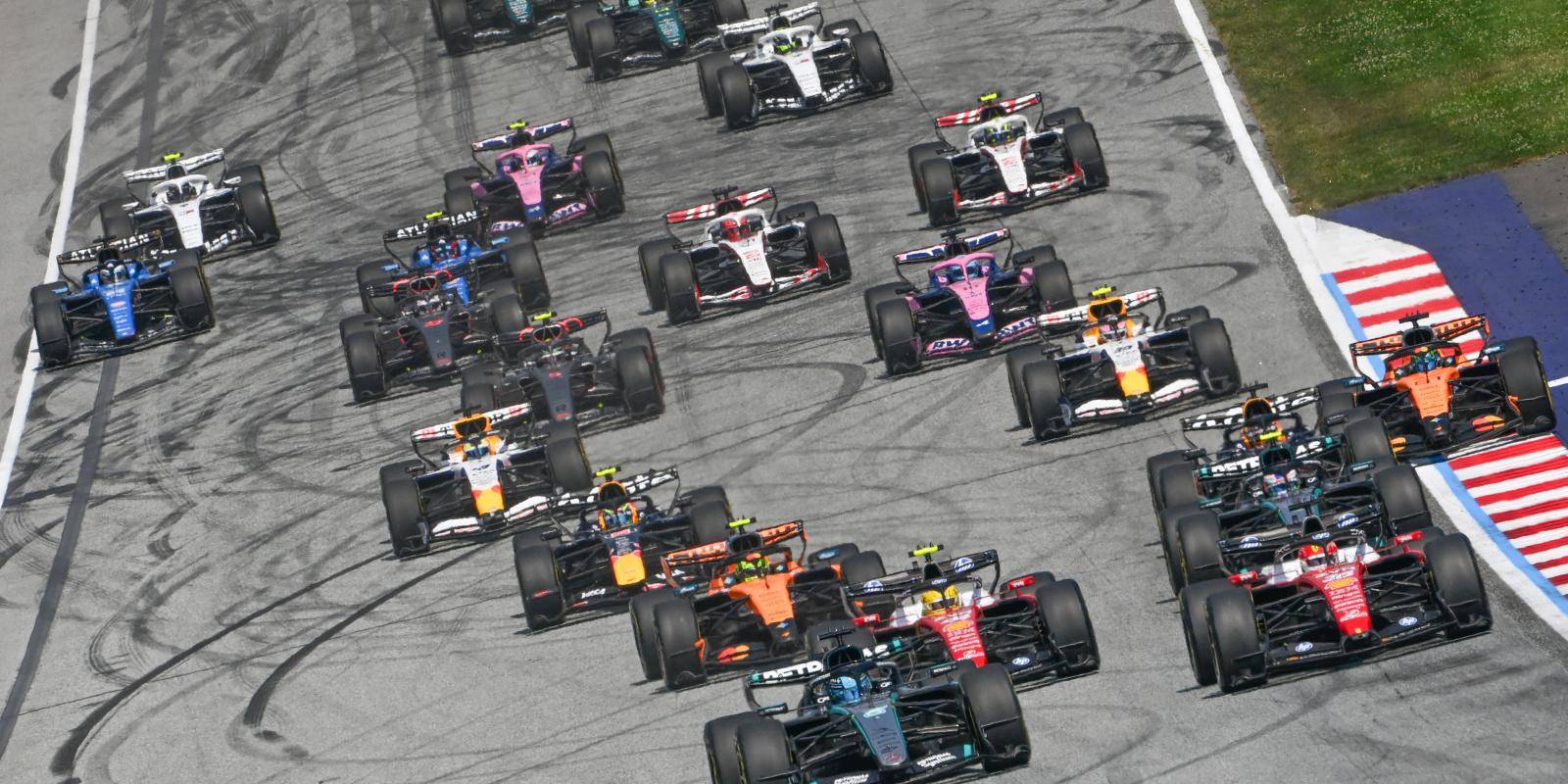

Formula 1 (F1) racing is arguably the most complex sport in the world – and one of its most successful. This weekend’s British Grand Prix at Silverstone will attract around half a million spectators and 80 million TV viewers, while F1 commercial rights alone are valued at $23 billion. The F1 movie, released last June, is the most successful sports film ever made.
F1 governance is not without its critics or its controversies, both historic and present day. But at the core of the sport’s continued success is the way it is regulated by the Fédération International de l’ Automobile (FIA). The FIA’s approach to regulation may offer the world’s national and international financial regulators some valuable pointers on how to meet current challenges.
F1 regulation
Liberty Media, a public company, is responsible for F1 ’s commercial exploitation. However, the FIA controls almost every aspect of F1. It sets the technical standards for the cars and the racetracks. It determines how races are run, how much each team can spend on competing, and even what media activities the drivers should undertake.
F1 regulations are designed to achieve multiple goals – from ensuring the safety of drivers and spectators to creating the spectacle that underpins the sport’s commercial success, to driving technical innovation with potential benefits across the entire automotive sector.
While they are highly detailed, F1 regulations also deliberately leave scope for teams to compete through driver skills, race strategy and technical innovation. Thus, while F1 cars are very fast, with a maximum speed of around 230 mph, they are not designed to be the fastest possible. Nor in some areas do they use the latest available technologies. Electronic driver aids were banned in 1994 for safety reasons and because they reduced the role played by the driver.
F1 technical regulations are frequently tweaked and periodically go through a major overhaul. The 2026 regulatory update was one of the most far reaching ever, eliminating complex systems for recovering engine heat and assisting overtaking through drag reduction.
In their place is a larger electric engine and smaller internal combustion engine within the hybrid system, creating a roughly 50:50 split between petrol and electric power. To overtake, drivers can draw on a power boost from the electric engine, but having exhausted the battery are vulnerable to being overtaken themselves.

The changes have not been popular with some. But it is hard to dispute that races have become more exciting, featuring frequent changes of position among the leading cars. Meanwhile the rule changes have focused the teams’ technical skills and resources on advancing the design of hybrid power units, and in particularly those that use 100 per cent sustainable fuel – a new requirement in 2026. The intensely competitive innovative environment in F1 is one of the main reasons that major car manufacturers such as Mercedes, VW and Renault own F1 teams.
Regulations are developed through close consultation with F1 teams. But once in place they are rigorously enforced. Some penalties are applied in real time while the race is running. There are also frequent inquiries into possible breaches of technical standards, sometimes resulting in a team’s demotion or disqualification. Investigations are usually quick and teams and drivers do not hesitate to report on each other.
Financial regulation and F1
F1 is by no means the only sport with enormous viewing figures, an evolving rule book and vast financial resources. But it is arguably unique in three respects: the central role played by technical innovation; the high importance of safety regulation; and its relevance to growth in the wider economy. It also stands out for the diverse range of objectives that F1 regulators seek to satisfy and the complexity and sophistication of its regulation.
These features underpin the parallels between the role of the FIA and that of national and international financial regulators: The FIA must keep F1 drivers and spectators safe while promoting exciting racing, technical innovation and commercial success. Similarly, financial regulators must protect bank depositors – and indeed the whole economy – while promoting improved financial services, employment and economic growth.
Lessons for financial regulators
So, what insights could financial regulators take from F1? Here are two suggestions.
First, safety. F1 cars frequently crash and sometimes overturn, but in modern F1 drivers are very rarely hurt. Highly detailed regulations combined with innovation – such as the titanium ‘halo’ which was made mandatory in 2018 to improve cockpit protection – have made an enormous difference in reducing driver deaths. 12 drivers died during races from 1970 to 1999, while only one has been killed since 2000.
Financial regulators seek to prevent losses to retail consumers of financial services and/or the governments that provide insurance. But they typically do not seek to eliminate all risk on the grounds that the level of regulation required would be so high as to prevent the financial system delivering on its core functions. However, the experience of F1 suggests policymakers should test this assumption.
For example, digital communication and artificial intelligence could allow regulators to collect and process much higher volumes of data on what financial institutions are doing with minimal cost to those being regulated. This appears highly intrusive, but it may also improve identification of illegal practices or excessive risk-taking without reducing the value the financial system can deliver to society.
A further possible step, echoing F1’s enforcement regime, would see financial regulators imposing more varied prudential penalties more swiftly and with fewer grounds for appeal.
The second insight is on innovation. The FIA does not think all innovation will necessarily benefit F1. Instead, it uses detailed regulation to block innovation in some areas and drive it forward in others. By doing so it focusses constructor competition and resources on areas that it judges to be of most benefit to the sport (for instance driver safety) or the wider economy (such as sustainable fuels).
By contrast financial regulators tend to start from the assumption that innovation is likely to be of general benefit to the financial system and only seek to limit it when they see evidence of substantial risk. A key lesson from F1 could be that regulators should be more willing to block innovation by financial institutions in some areas, such as stablecoins, where the benefits to society are hard to demonstrate, and instead focus it even more proactively on areas like cybersecurity, where the benefits are clear and the risk of slow progress is high.
More broadly, a regulator inspired by the FIA’s approach would find decisions on, for instance, whether to address perverse incentives through ‘bonus caps’ a lot more straightforward. Similarly, central banks and financial regulators would not hesitate as much as they now do to use regulation to force the financial system to support the transition to net zero. And competition authorities might be more willing to use size caps on financial institutions to drive competition and broader economic growth.
Of course, financial regulators might reasonably say that they already do many of the regulatory things that the FIA does. They might add that international competition, political lobbying and resource constraints prevent them from taking a more proactive approach in some areas. But the experience of Formula 1 suggests that a more complex, intrusive and ultimately directive regulatory approach can sometimes produce the best result not just for safety, but also for innovation and growth.