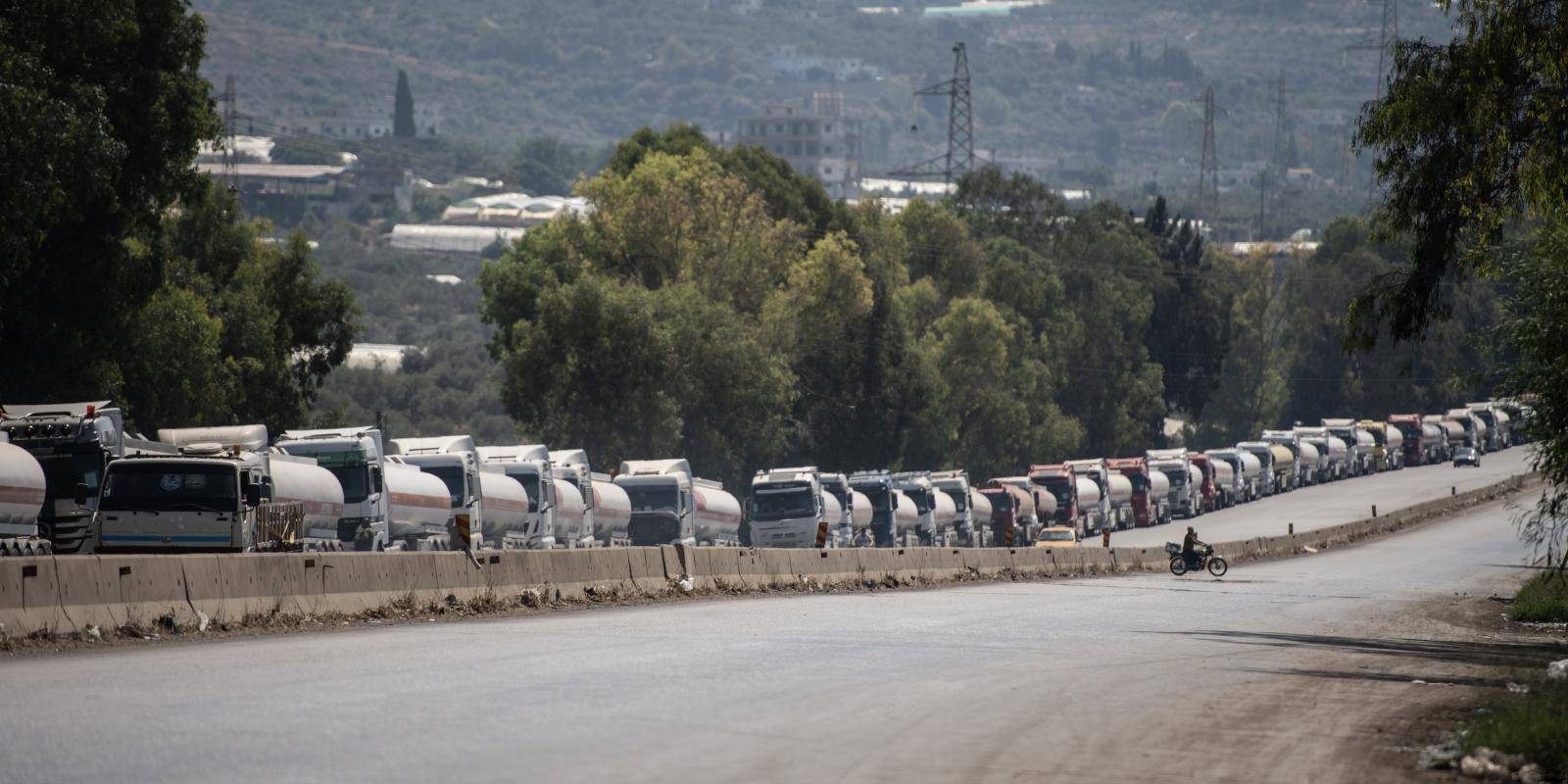

The war on Iran and the resulting disruption to the Strait of Hormuz has exposed the vulnerability of existing trade and energy routes and unsettled the old balance of power across the Middle East.
In this context, Iraq, Syria and Lebanon are seeking to capitalize on their position between Europe and the Gulf and improve their connectivity via oil and gas pipelines, roads, railways and digital corridors. Once central to an Iranian regional order, all three governments are now aiming to achieve greater sovereignty by diversifying their economic ties, a shift supported by the Trump administration.
Yet they are attempting to do so while facing foreign occupations and military action, and while also confronting domestic endemic corruption and fragmented political systems that empower armed groups.
Whether they can seize this opportunity to become more connected – and more sovereign – will therefore depend not only on the infrastructure they build, but on whether they can reform their states to govern it.
Changing energy routes
The effective closure of the Strait of Hormuz has caused severe disruption to regional energy flows, including from Iraq.
Pre-war, Iraq was exporting around 3.3 million b/d from its southern oilfields. By the second week of March, exports from southern Iraq had collapsed. Southern exports gradually recovered from mid-April, reaching 2.3 million b/d in August, aided by Iraq giving discounts for buyers and by Iran reportedly giving permission for Iraqi oil tankers to pass through the Strait.
Syria and Lebanon have been less directly impacted by Hormuz, given neither is a major oil exporter and they both have access to the Mediterranean. However, the crisis has spurred a potential wider reconfiguration of regional trade and energy routes, as countries like Iraq look for alternatives.
Both Beirut and Damascus have an opportunity to position their Mediterranean ports and transport networks as gateways between the Gulf and European markets in a reconfigured regional trading system.
Iraq–Syria pipeline
Iraq is already pursuing several ways to diversify its export routes. Baghdad is seeking to expand exports through Turkey’s Mediterranean port of Ceyhan, where Iraqi crude already flows, and is even discussing the revival of a long-stalled idea for a pipeline to Jordan’s Red Sea port of Aqaba.
Iraq and Syria are also pursuing a new pipeline that would carry Iraqi crude oil westwards to the Mediterranean. This would aim to give Baghdad another alternative to its overwhelming dependence on exports through the Strait of Hormuz.
This planned corridor is often described as a revival of the historic Kirkuk–Baniyas pipeline, which once carried oil from northern Iraq to the Syrian coast. But it entails new infrastructure to form a wider network connecting Iraq’s southern and northern fields to a hub at Haditha in western Iraq, from which oil could flow west through Syria to the Mediterranean port of Baniyas and north towards Turkey.
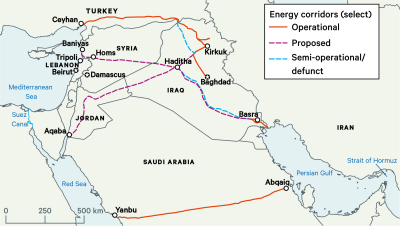
Base map made with Natural Earth data. Pipelines adapted from Global Energy Monitor dataset, accessed 22 September 2026, CC BY 4.0. Only select pipelines shown. The proposed new Iraq-Syria pipeline requires new infrastructure and may not follow the exact route of the badly damaged historic Kirkuk-Baniyas pipeline that is shown as the proposed route here.
Estimates put the cost at around $15 billion, with construction likely to take around four years. The Trump administration is reportedly supporting the plan as part of a strategy to reduce Iran’s regional leverage by diversifying away from Hormuz.
The new network, which has a proposed initial capacity of around two million b/d, would allow Iraq to divert a substantial share of its exports away from Hormuz, reducing Iranian leverage. But it would diversify rather than replace Hormuz: most Iraqi crude exports go to Asian markets, particularly China and India, which are far quicker to reach from the Gulf than the Mediterranean.
New East–West corridors
Lebanon and Syria are also exploring the restoration of railway links that could eventually connect the Lebanese coast through Syria to Iraq, Turkey and the Gulf. This month, Lebanese and Syrian officials inspected a potential rail route connecting the Lebanese port of Tripoli to Homs in Syria. This could be the potential first step in re-establishing Syria as a transit state, with Tripoli as a potential Mediterranean gateway.
Yet while rebuilding the short Tripoli-Homs railway may seem feasible, establishing a wider regional corridor will require much more infrastructure and faces challenges. Lebanon’s previous plans to revive the same railway stalled before work began, in part over financing and mismanagement. Syria’s railway system is badly damaged by war, with the government estimating that its rehabilitation could cost around $5.5 billion.
The same pursuit of connectivity is extending into the digital realm. New fibre-optic networks through Iraq and Syria are intended to give Gulf states alternative land routes for the vast quantities of data that currently travel through vulnerable submarine cables.
Energy under attack
For now, there is a considerable gap between ambition and reality. Iraq, Syria and Lebanon are pursuing these infrastructure projects in the shadow of a war they cannot control and while facing external occupations or interference.
In Lebanon, Israeli forces occupy a self-declared security zone in the south, with more than a million people displaced. In Syria, Israel seized the demilitarized buffer zone in December 2024 and has maintained a military presence there since.
Across the Middle East, energy infrastructure has become a major target, with over 100 attacks on energy assets in the first six months of the war. Iran has attacked energy facilities across the Gulf, while Israel has struck fuel storage depots and gas infrastructure within Iran.
Iran retains influence through its political and armed networks across the region. This includes groups embedded within Iraq and Lebanon that have repeatedly demonstrated their capacity to threaten critical infrastructure.
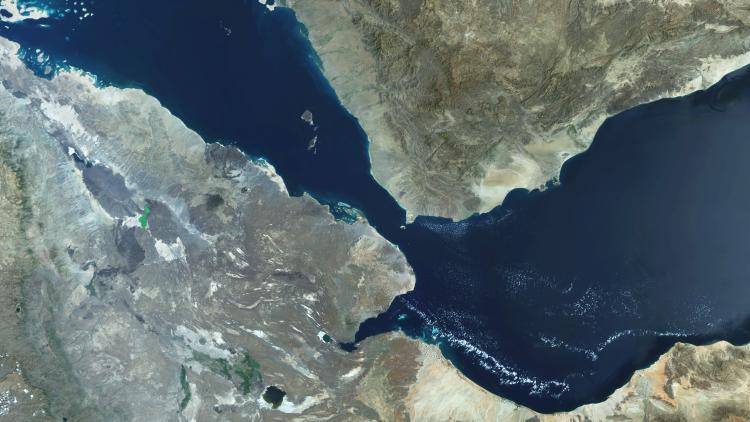
In Iraq, for instance, the Khor Mor gas field has suffered repeated rocket and drone attacks blamed on militias. More recently, attacks launched from Iraqi territory forced the temporary closure of Saudi Arabia’s East–West pipeline, which is also designed to reduce Riyadh’s dependence on Hormuz. The Houthis have attacked Saudi oil tankers and seized the Bab al-Mandab Strait coastline this month.
The threat to infrastructure is not limited to Iran-aligned armed groups. Israel has repeatedly targeted transport infrastructure during the current conflict, including in Lebanon, demonstrating how the conflict can disrupt the physical networks on which greater connectivity would depend. And in eastern Syria, through which the proposed new Iraqi energy corridor would pass, armed groups including ISIS have attacked oil wells and tanker trucks.
Internal obstacles
Another obstacle is entrenched corruption. Iraq, Lebanon and Syria all sit near the bottom of Transparency International’s corruption perceptions index.
In political systems where public contracting is a principal means of distributing rents, mega-projects can create opportunities for political parties to potentially profit from contracts, often at the expense of their delivery.
Linked to this is the fragmentation of these states themselves. Infrastructure on this scale requires institutions capable of coordinating decisions over years, enforcing contracts, protecting assets and binding competing interests to a common project.
Yet authority in Iraq, Syria and Lebanon remains fragmented among political factions, competing institutions and armed actors. This leaves governments unable to guarantee the security or financing of projects, with multiple actors able to obstruct their completion or extract rents. This creates a fundamental mismatch between the scale of ambition and the capacity to deliver it.
Connectivity doesn’t guarantee sovereignty
The war has increased the strategic value of Iraq, Syria and Lebanon’s geographical position. As states and companies search for alternatives to Hormuz, the three countries offer potential alternative corridors connecting the Gulf to the Mediterranean and Europe.
Whether Iraq, Syria and Lebanon can take advantage of this opportunity will help determine whether they can shape the post-war regional order, or whether it is once again shaped around them.
But connectivity is not the same as sovereignty. New pipelines, railways and trade corridors can offer these states alternatives to the dependencies of the old order, but alone they cannot produce sovereignty. That requires institutions capable of delivering and protecting these projects.
If Iraq, Syria and Lebanon want to seize the opportunities of the changing regional order, they will need to do more than build new routes across their borders. They will need to build states capable of governing these new connections, while ensuring that their benefits extend to their populations, not just elites.