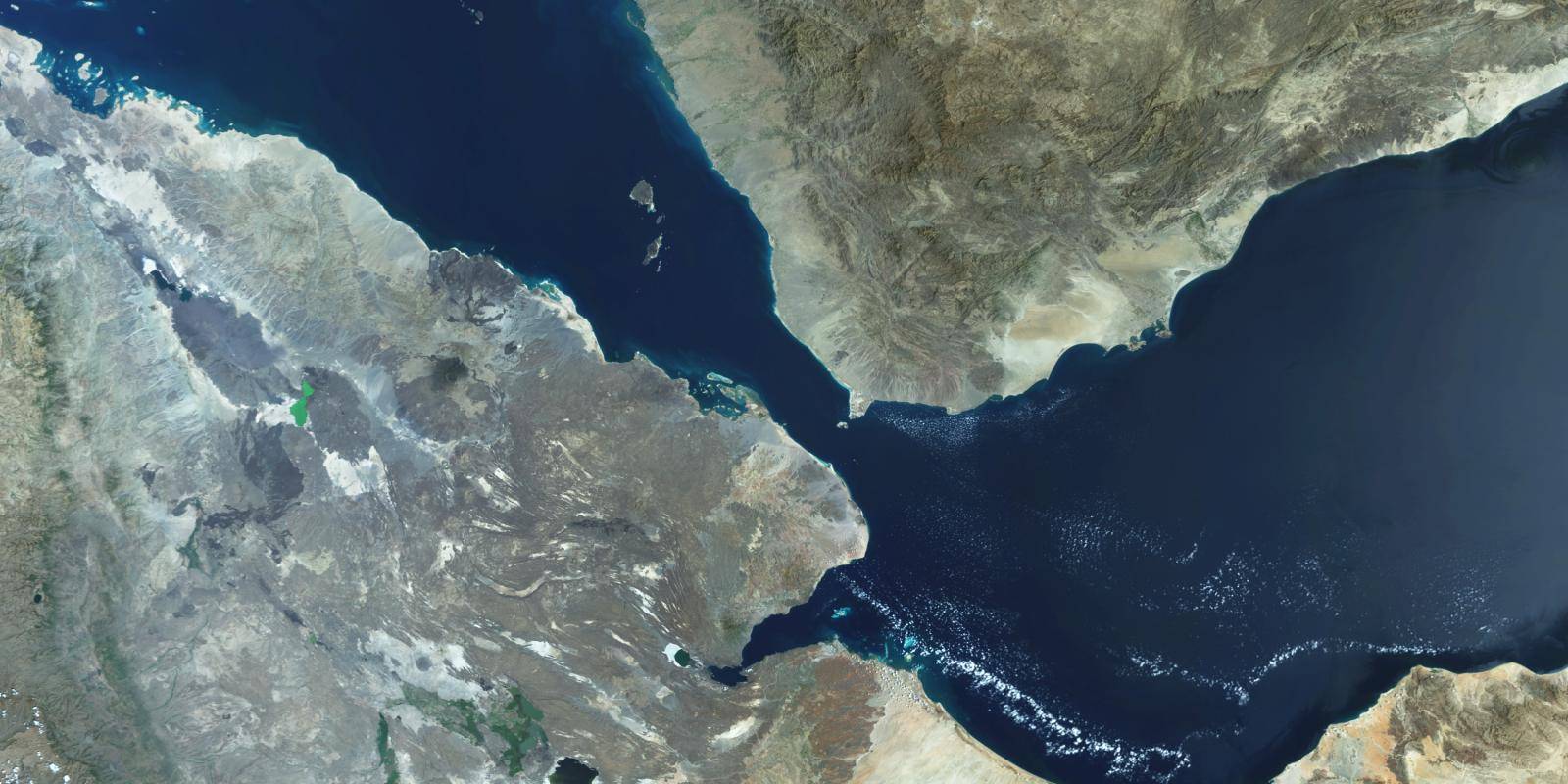

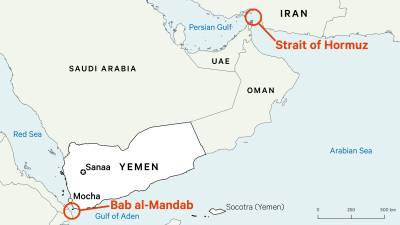
The Houthi armed group recently captured the strategic port city of Mocha in southwestern Yemen and advanced along the coast of the Bab al-Mandab Strait. This represents the most consequential change in territorial control in Yemen for years.
For Yemen, the offensive risks reopening a war that never formally ended but had become significantly less violent since the UN-mediated truce of 2022. For the wider region, the implications are also massive.
The Houthis’ new territorial position gives them much greater ability to influence maritime shipping through Bab al-Mandab, the narrow passage connecting the Gulf of Aden to the Red Sea and ultimately the Suez Canal.
Together with Iran’s disruption of the Strait of Hormuz, Iran and its allies now have the capacity to exert pressure on two of the world’s most strategically important maritime chokepoints.
The Houthis have also launched attacks into Saudi Arabia, including against energy infrastructure, that have reportedly injured civilians. This also constitutes an escalation in the conflict and poses questions for Riyadh and its US ally.
Made with Natural Earth data.
The fragmentation of Yemen’s anti-Houthi camp
Houthi forces, who control most of western Yemen, made a rapid push down the Red Sea coast last week. Government-aligned forces withdrew as the Houthis seized Mocha, surrounding areas and nearby islands.
The Houthis benefited from surprise and military preparation. But the offensive also exposed the fragmentation of the anti-Houthi camp.
Government-aligned forces face coordination problems. The anti-Houthi forces include a variety of autonomous armed groups who were previously supported by different regional patrons and had competing political ambitions. Saudi attempts to bring them under a more coherent command structure since early 2026 have not erased years of fragmentation.
Meanwhile, the Houthis used the period of relative calm following the 2022 truce to recruit and mobilize personnel, improve domestic weapons production and expand their missile and drone capabilities. As a result, the Houthis now have more advanced capabilities than government forces in several areas.
Bab al-Mandab, the Red Sea and the Horn of Africa
The immediate international question is what the Houthis intend to do with their strengthened position around Bab al-Mandab.
The Houthis previously claimed they do not intend to impose formal transit fees on vessels passing through Bab al-Mandab. These assurances should be treated cautiously. There are indications that, since beginning their attacks on Red Sea shipping in 2023, the Houthis have been extracting informal payments from some shipping agencies in return for safe passage.
The Houthis have also said that they are only attacking Saudi-linked ships in the Red Sea. However, a ship carrying Saudi oil may be owned, operated, financed, insured or chartered by companies in several different countries. It might also be delivering goods, or oil, to various countries.
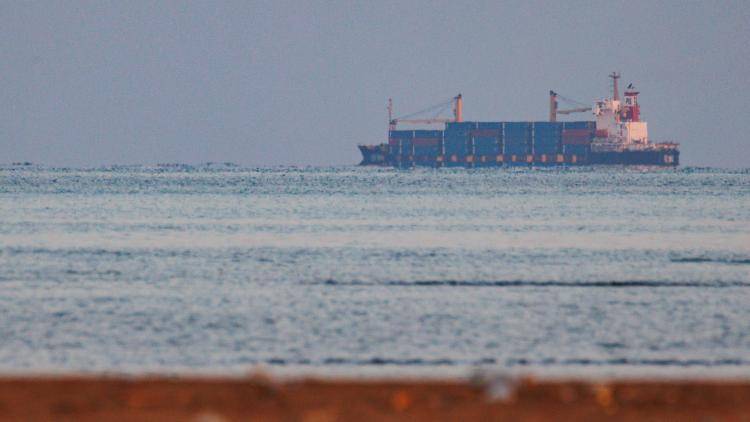
Houthi attacks on Saudi shipping therefore affect commercial interests far beyond Saudi Arabia, including in Europe and China.
The Houthi advance also changes the security calculations of states with strategic interests in the Horn of Africa.
Djibouti is just around 20 kilometres from Perim Island, which the Houthis now reportedly control. That places an armed movement with increasingly sophisticated drone, missile and maritime capabilities extremely close to a country that hosts US, Chinese, French, Italian and Japanese military bases. Other countries including Turkey and the United Arab Emirates also have significant security and commercial interests in the region.
For now, the Houthis’ calculation is likely to be one of controlled escalation: converting military momentum into political and economic leverage without provoking an international response large enough to reverse their gains. But Yemen can no longer be treated as a distant theatre.
Trump faces difficult choice
Saudi Arabia has vowed to respond to Houthi attacks on its territory. Riyadh recently signed a mutual defence treaty with Turkey and Pakistan, but does not appear to have publicly called on either for assistance.
The US, a close Saudi ally, reached a truce with the Houthis in May 2025, after conducting air strikes against the group following its attacks on shipping in the Red Sea.
For US president Donald Trump, the recent Houthi advance creates a difficult dilemma. Trump has a close relationship with Saudi Crown Prince Mohammed bin Salman, and the US retains a fundamental interest in Saudi security. At the same time, Washington has strong incentives to avoid reopening a direct war with the Houthis.
The existing truce gives both sides reasons for restraint. For Trump, preserving that arrangement helps keep the US away from another costly Middle Eastern military confrontation while it remains engaged in the Strait of Hormuz.
The Houthis have equally strong incentives to not be drawn into conflict with the US. The 2025 US air campaign against the Houthis caused serious damage. They have little interest in inviting a repeat.
This creates a peculiar situation: Washington and the Houthis both have reasons to avoid attacking one another, even while the Houthis increase pressure on one of the US’s closest regional partners.
That equilibrium, however, may not hold. If the Houthis escalate attacks on Saudi territory, especially if they attempt even limited ground incursions across the border, Washington could find itself pulled towards confrontation.
Yemenis pay the greatest cost
Lost beneath the geopolitical consequences is the most predictable outcome of renewed war: Yemenis themselves will suffer most.
The country enters this phase of conflict with divided institutions, an economy devastated by more than a decade of war and declining international humanitarian support.
In Taiz alone, almost 50,000 people have reportedly been displaced since 3 September. In Mocha, the humanitarian consequences are particularly alarming. With health facilities collapsing or becoming inaccessible, local media reports indicate that more than 240 pregnant women in the region face the looming prospect of giving birth without access to functioning medical care.
Further disruption to ports, roads and supply chains will also drive up food, transport and fuel prices in a country heavily dependent on imports.
While this new international dimension of Yemen’s war makes the country strategically more important to the world, it should not overshadow the plight of ordinary Yemenis.
The need for a coherent international approach
Governments have tended to treat Saudi-Houthi negotiations, maritime security, humanitarian access to Yemen, Iran negotiations, the Yemeni government and wider Red Sea maritime security as separate issues. That approach is becoming increasingly difficult to sustain.
The Houthis are now able to influence global shipping, energy markets, Gulf security, the Horn of Africa and the calculations of major powers. A more coherent international approach is therefore needed.
For Gulf Cooperation Council (GCC) states in particular, the latest escalation should be a warning. The GCC has not formulated a coherent policy on Yemen, influenced by disagreements between Gulf states and their different relationships with Yemeni factions. But the Houthis’ recent advances impact the entire GCC, so a Gulf-wide approach is needed.
Recent developments should also challenge the idea that the Houthis can be contained through a collection of transactional arrangements. Bilateral maritime security deals may protect one country’s ships, while negotiations may temporarily calm one frontline. Military strikes can degrade individual capabilities.
But these approaches operate in silos. The Houthis do not. The movement simultaneously functions as a governing authority, an armed non-state actor, an Iranian regional ally and an increasingly important influence on maritime security.
The main policy challenge is therefore whether regional and international actors are prepared to develop a coherent approach to Yemen that connects the country’s political settlement with wider security issues in the Gulf, the Red Sea and the Horn of Africa. Ultimately, ignoring a crisis in Yemen does not contain it. It is only a matter of time before it becomes an international crisis.