

On 30 September the UN Security Council will vote on renewing the Gang Suppression Force (GSF) for Haiti.
Now is not the time to pull the plug on GSF and its security effort. If anything, the Security Council vote should be an opportunity to swiftly renew the force and then confront an additional uncomfortable issue: How can development assistance be mobilized for Haiti, among a fractured international donor community?
‘Haitian-led’
After the 2021 assassination of President Jovenel Moïse, a mantra took hold among diplomats that any solution to the country’s spiral of chaos and crime needed to be ‘Haitian-led’. It’s a nice phrase, intended to reassure sceptics that a solution would not be imposed on Haiti.
But how are Haitians supposed to lead?
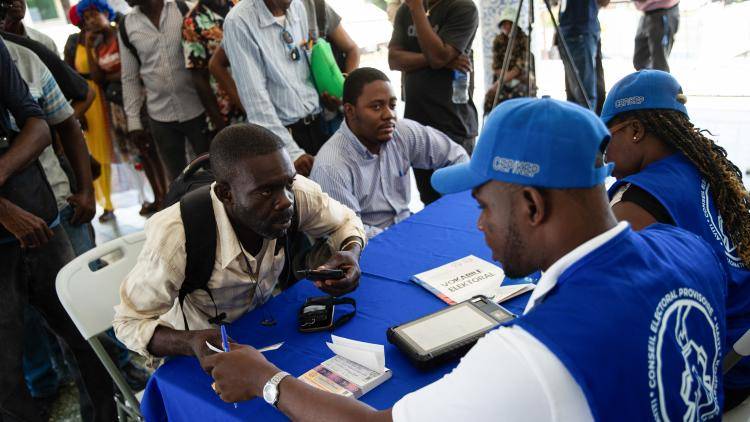
Haiti hasn’t had an election since 2016. There is no elected government at any level – local, departmental, parliamentary or presidential. Political parties are in disarray. Many are still controlled by the same distrusted leaders that have dominated Haitian politics for decades.
Indeed, according to a Chatham House-QQ survey, more than 75 per cent of Haitians don’t trust their political leadership. And civil society remains fragmented, weak and often distant from political power – despite years of international development support.
That leaves the international community with continued responsibility to help get Haiti back on its feet. And that means doing much more than funding the vital GSF.
Respondents to the Chatham House-QQ survey identified education and healthcare as priorities in re-establishing security: 69.1 per cent and 67.3 per cent respectively. Development assistance will be needed to deliver these basic services. But where will it come from?
Fragile progress
Chatham House’s survey was conducted in May 2026. That was a month after the first GSF contingent of 400 Chadian troops arrived in Haiti and following operations by the Haitian National Police (HNP) against the gangs that control almost all of Port-au-Prince. An estimated 1,300 gang leaders and members were killed in those operations. Those efforts were assisted by divisions within the coalition of gangs that had come to dominate parts of Haiti and its economy.
At the time of the survey, a slight majority of Haitians (50.7 per cent) were starting to believe that their communities had become safer. But support for the GSF was mixed: 49.5 per cent of voting age respondents said they approved or strongly approved of the multinational force.
Unsurprisingly, that support was greater among Haitians living on the front lines of the insecurity, in or close to gang-controlled areas, where more than 67 per cent approved or strongly approved. 58.4 per cent of Haitians between the ages of 18 and 29 – a key demographic for Haiti’s recovery and future – also showed strong support for the GSF.
Yet 54.2 per cent of Haitians polled don’t believe the GSF can accomplish its mission.
At best, Haitians are modestly optimistic. But the window of opportunity to channel even this limited support may close quickly. The Security Council must act to build on what fragile progress has been made.
The development need
The importance of effectively addressing Haiti’s failed state and humanitarian disaster goes beyond Haiti and the security risks it presents to the Caribbean. Much is at stake for the United Nations, and the future of international cooperation.
The GSF resolution of 2025 was a rare victory for the UN after past resolutions had been vetoed by China and Russia. And it sets a model for how the international community, including many countries from the Global South, can still collaborate to respond to humanitarian tragedies.
Kenya and Chad contributed troops. Canada committed funding and was instrumental in pushing the GSF approval over the line last year. Germany, Qatar and the US have also contributed funding. Mexico, Colombia, El Salvador, Jamaica and Brazil have made in-kind contributions through training, materiel and advisors.
The Haiti resolution demonstrates that the international community can come together, even in this semi-ad hoc fashion, to respond to humanitarian crises – even when faith in the international system is waning. The courageous work of UN officials and diplomats posted in Haiti coordinating this effort is a testament to the enduring belief in global institutions and the principles under which they were founded.
But the work is only beginning. If the GSF can establish itself, the next phase will bring new challenges, mainly related to development. Without the US Agency for International Development (USAID), who will step up to coordinate the next essential stage of Haiti’s recovery? The US now lacks the resources, commitment and moral authority to convene a donors’ conference and mobilize resources and commitments for Haitians’ needs. Are solutions still possible without the might of the US to drive them?
Who will step up?
When the Security Council gathers to approve the renewal of the GSF, the hope is that their discussion will progress beyond security to the broader challenges of how to restore a shattered and brutalized country. Reaching agreement on a security force is a beginning only. New commitments must be made to invest in Haiti’s education, healthcare, and economic future.
The US’s commitment to focus on security and ‘gang suppression’ first was necessary. And its pushing through of a Security Council resolution that would focus on protecting Haitians was both successful and laudable.
But there is now a need to work in parallel on social and economic development and the rebuilding of Haiti’s battered physical and institutional infrastructure. That will take funding by a broad group of donors and agreement on where and how to invest to the best effect.
It will also require more than the kind of concessional loans normally offered by development banks. Haiti’s interim government is too broken to commit to such debts. Instead, those banks should work with supportive governments to develop an incentive-based, conditional partnership with the interim government – or its successor. That would involve agreeing to release funds when Haiti’s government reaches benchmarks in security, fiscal, healthcare, education and macroeconomic reform.
The US Development Finance Corporation (DFC) must also play a key role. The well-bank-rolled DFC can provide investor insurance and concessionary loans to encourage private investors to fill the gaps left by the elimination of USAID. Frankly, they will probably do it better than USAID because of their focus on investment, trade and results.
However, that will require a more concentrated effort by the DFC to focus on Haiti. The DFC’s mandate to ‘mobilize private capital to advance US foreign policy’ can equally apply to other donors, including government development agencies, private foundations and multilateral development banks.
Rebuilding Haiti and protecting the security of Haitians by battling gangs is not just a US foreign policy interest. Haiti has already become a vector for gun smuggling, narcotics trafficking and other illicit activities. Further state collapse would only bring greater insecurity, and not only to its neighbours in the Caribbean (including UK Commonwealth countries), Mexico and the US. The longer the crisis goes on the greater the risk that Haiti becomes a stateless hub for transnational crime – affecting every country with an Atlantic coast.