

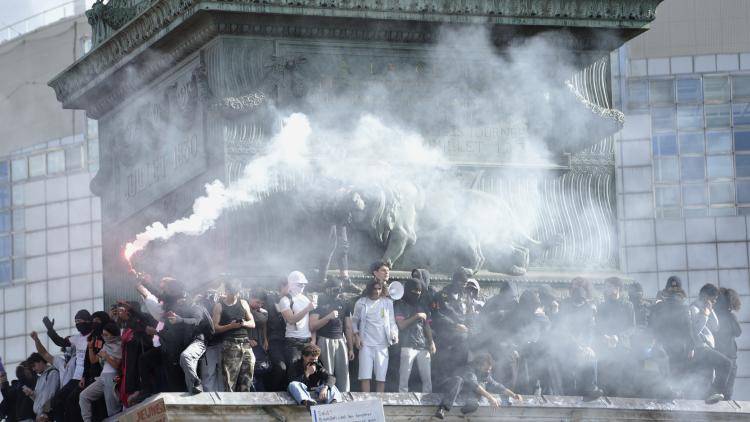
Only three weeks after the peaceful celebration of Pope Leo XIV’s visit, France offered an altogether different spectacle over the weekend: burning cars, looted shops, violent clashes with police and the historic town hall of Limoges engulfed in flames.
The contrast between the two events is stark. But they may both point to something deeper: a profoundly divided society, facing a crisis of self-confidence, hoping to recover a sense of direction and purpose. Beneath France’s political anger lies an anxiety about the future, in a world increasingly shaped by algorithms and faceless technology.
Although this anxiety is not unique to the country, the timing is particularly bad for France.
A hijacked social protest
It all started with high-school students protesting deteriorating teaching conditions and staff shortages. University students soon joined them, followed by trade unions and veterans of the ‘yellow vests’ movement, as grievances expanded to encompass living costs and declining public services.
By 17 October, some 550,000 people had demonstrated, according to the ministry of the interior; organizers claimed 800,000. In any case, it was one of the largest mobilizations since protests against the government’s pension reform bill in 2023, which has since been dropped.
Most participants protested peacefully, although some young demonstrators were severely injured in clashes with police. Their demands were also quickly overshadowed by rioters who looted shops, attacked police officers and set public buildings alight. The French government imposed a curfew in the most sensitive districts of Paris and other major cities, bracing for further escalation this coming weekend.
Such violence is hardly unique to France. Milan also suffered protests and looting last weekend, and the Italian government has just passed new anti-riot laws. Britain too experienced widespread rioting as recently as the summer of 2024. But the timing is exceptionally damaging for France. Its public debt is approaching 119 per cent of GDP, while weak growth, a persistently high deficit (the fourth highest in the eurozone) and soaring borrowing costs have placed France’s public finances under mounting pressure (it has been subject of an excessive deficit procedure by the European Commission since 2024). Meanwhile, the parliamentary stalemate that followed President Emmanuel Macron’s ill-fated decision to dissolve the National Assembly in 2024 has made it almost impossible to restore financial discipline and has pushed France to the brink.
With the public purse under such strain and the destruction caused by the riots projected to exceed €1.2 billion, the question of who will eventually foot the bill is politically extremely sensitive. A new riot insurance scheme, planned for 2027, could push up premiums for small shopkeepers. For those whose premises have been vandalized or looted, being made to shoulder the cost of public disorder (and criminal behaviour) risks deepening the sense of injustice and resentment that has helped fuel social unrest.
The images of disorder reinforce the impression of anarchy and a country without a clear political direction – if not a failing state. They spurred a bond sell-off, heightening pressure on the French debt even further. This could be seen by malign foreign powers as an opportunity for destabilization, although there is no clear established evidence at this stage that external actors interfered and fuelled the unrest. But former prime minister and presidential candidate Gabriel Attal’s proposal to allow temporary restrictions on social media platforms during riots illustrates the growing concern over their capacity to amplify violence and threaten public order. The Italian defence minister went a step further, openly declaring that the Milan riots were the result of a ‘hybrid war against the West’ waged via ‘TikTok, social media and YouTube’.
France’s political centre no longer holds
With the 2027 presidential election only six months away, the political stakes couldn’t be higher. Marine Le Pen, leader of the far-right National Rally, has already used the violence to strengthen her discourse on law and order, while hard-left leader Jean-Luc Mélenchon has sought to capitalize on the social anger to denounce institutionalized police violence and rally the left-leaning electorate. Their political projects differ profoundly, but both are taking advantage of the dissatisfaction with a political centre that has struggled to demonstrate that it can still deliver – or hold at all. In polls, the two leaders are still the favourites to reach the second round of the presidential election.
It is difficult to address France’s current predicament without drawing a parallel with Europe’s other major economy, Germany. The far-right Alternative for Germany (AfD), which won 20.8 per cent in the 2025 federal election, now polls at roughly 28–30 per cent. Germany, of course, has seen nothing comparable to France’s weekend of rioting, and the sources of discontent are not identical. Anger mostly stems from a deterioration of Germany’s industrial model in the face of rising energy costs, more restricted expert markets and growing competition from China, alongside disputes over immigration and the feeling of a loss of identity. But the French and the Germans are asking the same question: can established political parties still protect living standards and offer a credible future? The success of the National Rally and the AfD suggest they don’t think so.
Europe’s weakening social contract

These are signs of a broader European socio-political crisis, further highlighted by recent protests in several European countries. For decades, the continent’s social bargain rested on the expectation of growing prosperity, economic security and a better life for one’s children. That expectation has clearly weakened just as Europe faces intensified global competition and the prospect of AI transforming entire professions for which young people have spent years preparing. The sense of social demotion and purposelessness is becoming personal. France offers a graphic warning of the political risks when such anxiety isn’t properly addressed by governments, constrained by an ever-shrinking fiscal space.
But the risks are high for the European Union (EU) too. As political anger directed at national governments grows, pressure on EU institutions and the compromises on which European cooperation depends will likely mount as well. Le Pen has confirmed that she wouldn’t fear a confrontation with Brussels over the EU budget if elected president. And the AfD has repeatedly called for an end to the support for Ukraine, a reset of Germany’s relations with Russia and the normalization of economic relations with Moscow, especially on gas imports. At a moment when Europe needs to show a united front to bolster its defence, deter Russia and revive its competitiveness, further political fragmentation in Paris and Berlin would severely undermine the continent’s resilience.
During the May 1968 riots in France, Prime Minister Georges Pompidou was asked by journalists to summarize the mindset of President Charles de Gaulle. His reply: ‘reform yes, chaos no’. With only six months to go before his decade in power comes to an end, President Macron has little time left to ensure that his legacy won’t be summed up by the opposite: reform no, chaos yes.