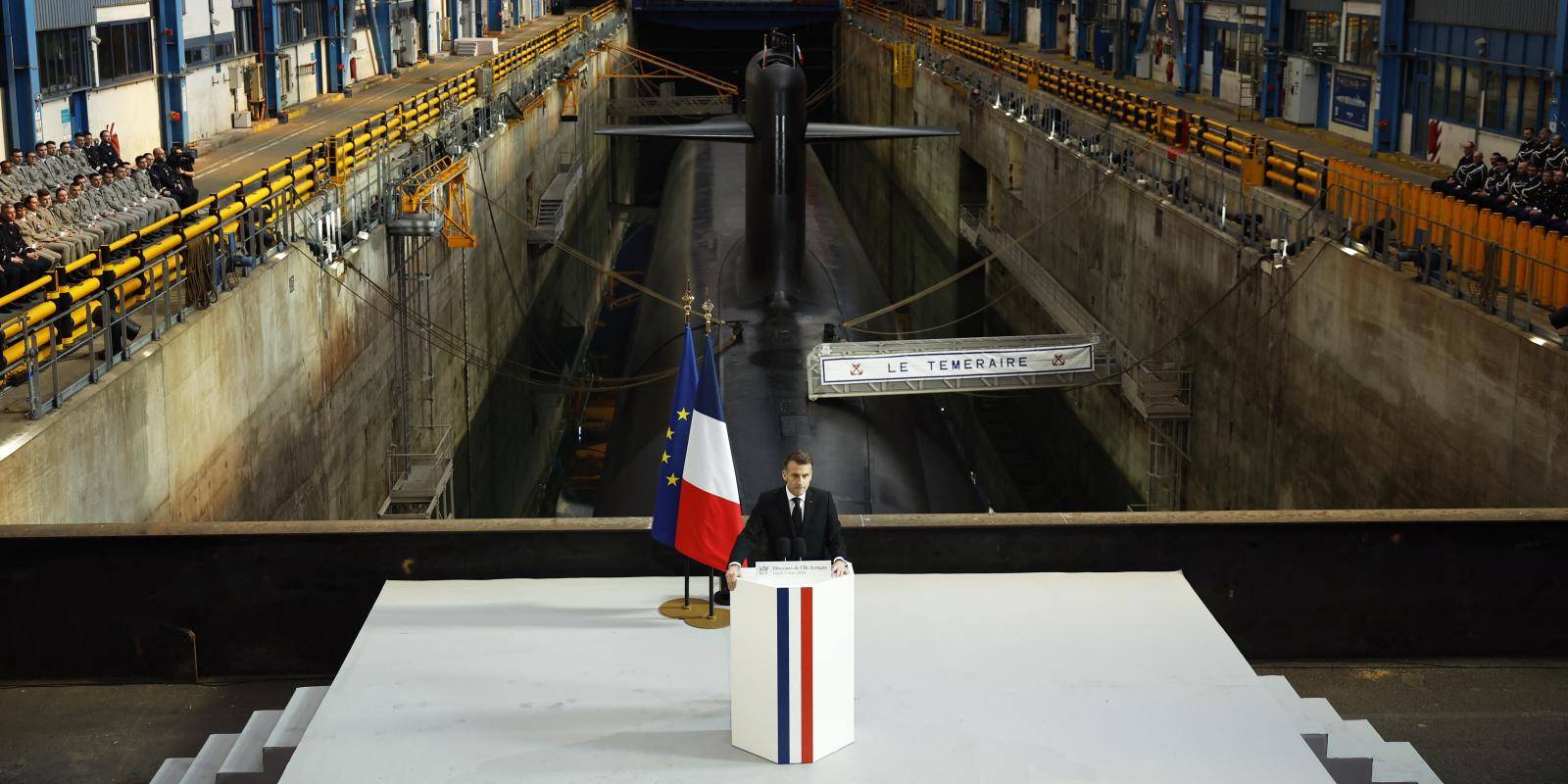

President Emmanuel Macron’s speech on 2 March, on the future of French nuclear deterrence, is already being framed as a watershed moment for European security.
The announcement that France will expand its nuclear arsenal for the first time in decades and create a new framework of ‘advanced deterrence’ cooperation has triggered intense debate about Europe’s strategic future.
Yet, for all its political substance, the speech is better understood as a strategic clarification rather than a doctrinal revolution. Macron mostly reaffirmed long-standing French principles of sovereign nuclear control and deliberate ambiguity – while attempting to adapt them to the new European security environment. That clarification is welcome at a time of Russian revisionism, uncertainty about US commitments and renewed nuclear competition, especially from China.
A Gaullist logic revisited
The conceptual foundations of Macron’s speech are deeply rooted in the original Gaullist doctrine of French nuclear strategy. That conceived deterrence as not only a shield for the national territory but also a guarantee of France’s political independence.
De Gaulle deliberately kept the definition of France’s ‘vital interests’ ambiguous. In 1964, he emphasized that French nuclear forces were designed to deter any power capable of threatening the country’s survival, without specifying geographical limits.
The doctrine was intentionally flexible. It allowed France to signal that developments affecting the European strategic balance could fall within its vital interests. Subsequent French nuclear planning assumed those interests could be engaged by a Soviet attack in Central Europe, particularly in the Federal Republic of Germany, Belgium or the Netherlands, since such an advance would rapidly threaten French territory.
Michel Debré, one of the principal architects of French nuclear doctrine, articulated this logic clearly. In 1972, he observed that ‘France lives within a network of interests that extends beyond its borders’, adding that French deterrence inevitably benefited Western Europe as well. The implication was straightforward: although the French deterrent was strictly national in its command and control, its strategic consequences were never purely national.
Macron’s speech therefore reflects continuity rather than rupture. When the president insisted that nuclear deterrence must remain ‘a French intangible’ while proposing a more European strategic posture, he was essentially updating Gaullist principle: the ‘force de frappe’ is sovereign, but its political effects extend beyond the Hexagon.
A more assertive nuclear posture
The most notable element in the president’s speech was the announcement that France would increase the size of its nuclear arsenal, currently estimated at around 290 warheads. For decades, France has maintained a strict ceiling and emphasized transparency about its stockpile size. Macron indicated this would change: as the arsenal grows, France will no longer publicly disclose its exact number of warheads.
This shift reflects a broader international trend. Nuclear arsenals worldwide are expanding or modernizing (if not both), and strategic competition between major powers has intensified. By abandoning detailed transparency, France is reintroducing strategic uncertainty as a component of deterrence.
Macron also suggested that France could temporarily deploy nuclear-capable Rafale aircraft to allied bases for exercises or signalling missions. Importantly, this would not amount to NATO-style nuclear sharing. The nuclear weapons, the command chain and the decision to use them would remain strictly French. In this respect, the French president largely undercut nationalist critics who had warned that closer European cooperation would amount to a surrender of French nuclear sovereignty.
This principle lies at the heart of what Macron calls ‘dissuasion avancée’: advanced deterrence that is more forward and more European in posture, yet entirely French in control.
Advanced but not shared deterrence
The concept attempts to reconcile two objectives that have long been difficult to combine: preserving national control over nuclear weapons while giving European partners a greater stake in the strategic environment surrounding them.
Under Macron’s proposal, European allies could participate in the broader ecosystem of deterrence without sharing operational control of nuclear weapons. This could include participation in exercises, strategic consultations, and contributions to conventional capabilities that reinforce nuclear signalling.
Such contributions might involve air and missile defence systems protecting strategic infrastructure, intelligence and surveillance capabilities, or long-range conventional strike assets that would strengthen Europe’s overall deterrence posture.
In practice, this would create a European political framework around a French nuclear core – a structure designed to enhance deterrence without fundamentally altering the national character of the French force.
A shift in European strategic culture
The deeper ambition of Macron’s speech lies in the realm of strategic culture. For decades, European nuclear deterrence has been largely delegated to the US through NATO. Even after the Cold War, most European states avoided engaging directly with nuclear strategy.

Macron’s initiative implicitly challenges that posture. By inviting European partners into a more structured dialogue around deterrence, France is encouraging them to internalize the logic of nuclear strategy: escalation management, signalling, survivability and resilience.
Macron made clear that the US will continue to play a central role in European security.
The initiative is not intended to replace the American nuclear umbrella but to complement it, as US strategic priorities evolve.
The proliferation dilemma
Yet, the debate also reveals a deeper strategic dilemma for Europe. If the credibility of collective deterrence is questioned, individual states may pursue their own nuclear capabilities.
Recent statements by Poland’s Prime Minister Donald Tusk about acquiring nuclear weapons illustrate this risk. A nuclear armed Poland would challenge the EU’s commitment to nuclear non-proliferation and undermine the cohesion of the European security architecture.
Emmanuel Macron’s proposal can therefore also be interpreted as a preventive initiative. By offering European partners a role within a broader deterrence framework centred on the French force, Paris is trying to discourage the emergence of new national nuclear programmes.
The missing conventional dimension
Macron’s speech has left an important question largely unanswered: the role of conventional military power in European deterrence.
Most contemporary conflicts unfold below the nuclear threshold – as the Russian war on Ukraine reminded us all. Effective deterrence therefore requires a strong conventional military layer capable of responding to aggression without escalation to nuclear weapons.
Europe still has limited ammunition stocks, insufficient air and missile defence systems, and logistical constraints affecting large-scale military deployments.
Without substantial improvements to such conventional capabilities, the political significance of Macron’s speech may exceed its practical impact. Macron may intend to work towards agreement on a strategic division of labour, where France has full control of nuclear deterrence while European partners boost the conventional forces that underpin its credibility.
A test for Europe
Ultimately, the speech at Île Longue was less about nuclear weapons than about Europe’s capacity to act collectively in a more dangerous world.
The French president framed this challenge starkly during his Sorbonne speech in April 2024: ‘Our Europe today is mortal,’ he warned. ‘It can die simply because our decisions are insufficient or too slow’.
His initiative is therefore both an offer and a test. Whether this vision succeeds will depend on Europe’s willingness to assume greater strategic responsibility – through stronger conventional forces, deeper political cooperation and a shared understanding of deterrence in an increasingly unstable international system.