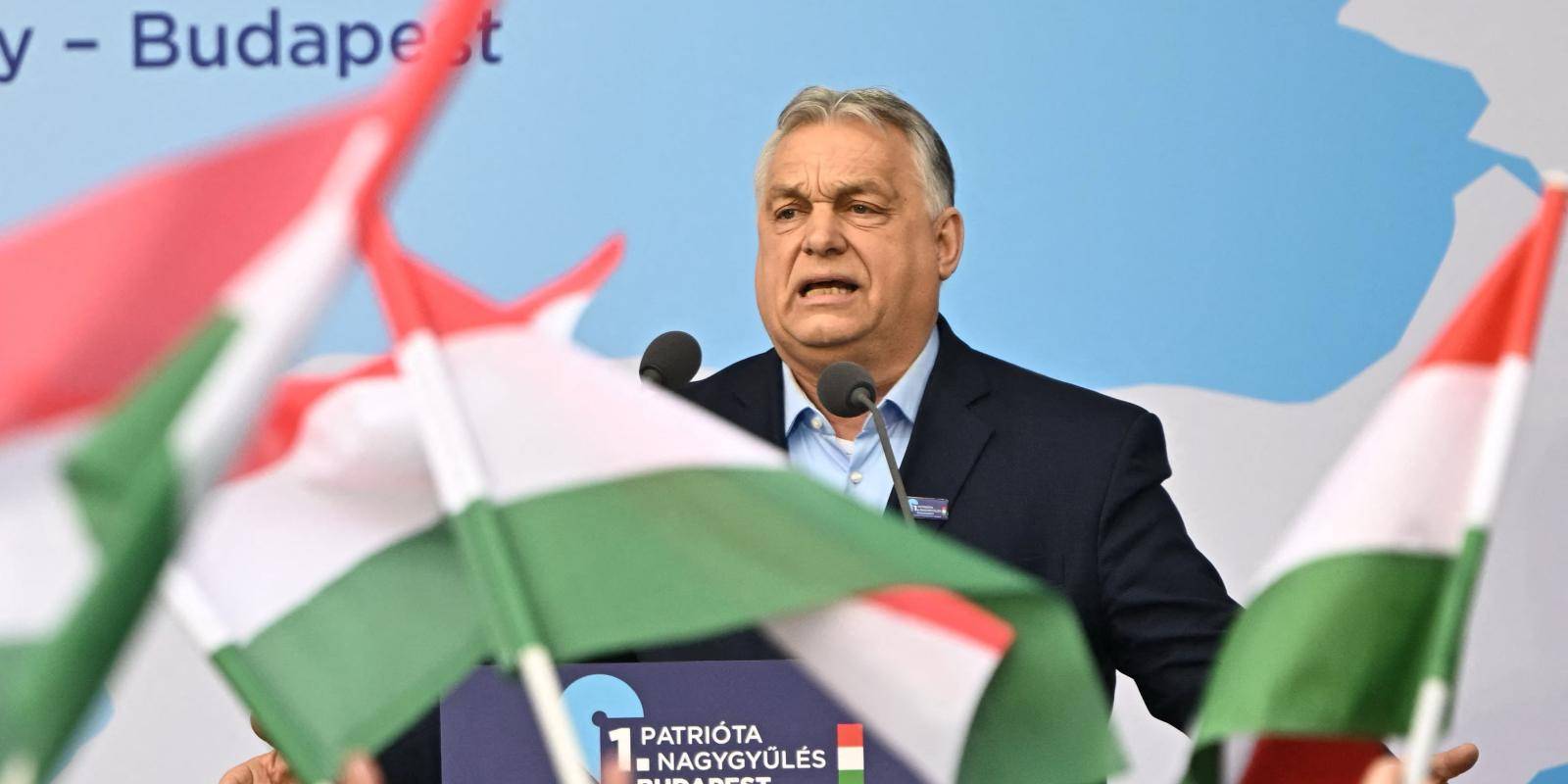

Hungary’s parliamentary election on 12 April has implications reaching well beyond Budapest. After 16 years in power, Prime Minister Viktor Orbán is facing a sustained, credible challenge from Péter Magyar, whose Tisza Party is ahead in most independent polling (though it is not beyond reach).
The outcome of the contest will shape Hungary’s internal trajectory, the European Union (EU)’s ability to act cohesively, and the balance of influence between Russia and the West in Central Europe. It will also stress test President Donald Trump’s emerging network of like-minded political allies in Europe.
Vice President JD Vance’s visit to Hungary this week, in open support of Orbán, marks an unusually direct form of US political engagement in a European election – and deepening division between Washington and its traditional transatlantic allies.
Much more than a government: a system
From a purely domestic perspective, this election is less a simple choice between continuity and change than a test of how deeply a political system has been embedded.
Over the past decade, Hungary has developed a model characterized by strong centralization and an active role for the state in the economy.
This has translated into concrete policies: caps on energy prices, direct support schemes for households, and a state-led approach to strategic sectors. At the same time, economic pressures have become more visible. Inflation has eroded purchasing power, and public finances are tighter than in previous electoral cycles.
Another crucial aspect of Hungary’s model is a political narrative centred on sovereignty and resistance to external constraints. Órban’s relationship with the EU has been one of continuous, deepening dispute: over issues ranging from the rule of law and migration to the war in Ukraine.
Nearly €20 billion in EU funds remain frozen as a result. Delays or conditions attached to EU funding are now visible in Hungary: infrastructure projects have been postponed. Fewer development grants are being issued to businesses. And there is more limited room for public spending.
Having made confrontation with the EU a central point of its project, the Orbán system now sees that strategy turning back on itself – manifesting in delayed funds, tighter budgets, and fewer policy options. The political price could be deadly.
Hungary and the EU: towards greater friction or more alignment?
The election matters for the EU’s internal dynamics. Hungary has repeatedly used its position to delay or reshape collective decisions, particularly on financial support for Ukraine. This has created friction within the EU, where unanimity remains necessary on key foreign policy issues.
Election victory for Orbán would likely intensify calls by Germany and others to introduce qualified majority voting in the EU – to minimize Budapest’s spoiling power.
A change in leadership could reduce Hungarian blockages. However, it would not automatically align Hungary with all mainstream EU positions. On migration, for example, popular opinion within the country would likely remain cautious.
On Ukraine and Russia, Hungary has maintained a distinctive position within the EU, combining formal alignment with sanctions and NATO commitments with a more cautious – at times opportunistically pragmatic – approach towards Moscow. This has included continued energy cooperation with Russia, and a more restrained stance on military support for Ukraine.

Recent unverified reports that Orbán told Vladimir Putin, during a 2025 telephone conversation, that ‘I am at your service’, will reinforce concerns in European capitals about Hungary’s relationship with Russia, and its implications for EU cohesion. So too will a Politico report of government efforts to deepen ties with Moscow through a 12 point plan.
A government led by Péter Magyar might recalibrate this balance. But the underlying constraints any Hungarian government will face – geographic, economic, and political – would not disappear overnight.
An inevitable part of continuity
The prospect of change needs to be framed with caution here. Péter Magyar is not an outsider seeking to dismantle the system from the ground up, but a political insider who understands how it operates.
His campaign has deliberately avoided presenting the election as a clash between two irreconcilable ‘Hungarys’. That positioning matters. It points to a scenario in which any change is likely to be selective and progressive rather than systemic and outright.
Some areas could shift relatively quickly. Relations with Brussels may stabilize, unlocking parts of EU funding. And the tone of foreign policy may adjust, not least towards Kyiv and Moscow.
But other elements are more deeply embedded: the central role of the state in the economy, or more importantly, the significance of large-scale energy projects.
On energy policy: change at the margins
The war in the Gulf brought energy security back to the forefront of the campaign.
Energy policy choices are often presented as purely political, but they are also shaped by structural constraints.
Hungary’s Paks nuclear power plant generates around half of the country’s electricity. The construction of new reactors relies on Russian technology and financing through Rosatom, the Russian state energy company. And Hungary’s gas infrastructure has historically been oriented towards Russian supply routes.
Recent events have underlined the vulnerability of this infrastructure. At the weekend, explosives were discovered in Serbia near a pipeline that supplies Russian gas to Hungary.
Ukraine claims the incident may amount to a Russian false-flag operation. Although not improbable, that remains unproven. But the episode illustrates that energy dependence is not only an economic issue, but a strategic one.
Diversifying away from dependence on Russian energy is possible. But it requires years of investment in alternative pipelines, grid upgrades, and regional coordination – limiting any government’s room for manoeuvre in the short term.
EU expectations should be calibrated accordingly. Under a Magyar government the likely trajectory is not a clean break with Russia, but a gradual rebalancing shaped as much by practical constraints as by political intent.
A campaign turning rogue?
The conduct of the election campaign itself has also attracted attention. Journalists and NGOs have alleged practices that blur the line between policy and political mobilization – particularly in economically vulnerable areas.
The government is accused of distributing material benefits and public employment schemes to secure the votes of key voters, and organizing transport to polling stations to facilitate their support.
This is often described in political debate as ‘vote buying’. But the more substantiated pattern points to localized patronage networks and forms of dependency, rather than systematic cash-for-votes schemes at scale.
This might not be enough to invalidate the electoral outcome. However, it does indicate that competition is taking place on an increasingly uneven playing field, shaped in part by clientelist practices – in which Orbán is likely to mobilize all available resources until the very end
The moon may rise, but will not simply replace the sun…
What emerges from all this is a picture of constrained choice rather than clear alternatives. Hungary’s economic policy is shaped by limited fiscal space and conditional external funding. Energy strategy is influenced by long-term infrastructure and existing dependencies. Foreign policy sits at the intersection of EU membership, NATO commitments, and pragmatic considerations.