
In a world full of geopolitical tension and war, it is worth pausing to consider the few signs of hope that have emerged these last few months in China’s relations with the US and the EU.
Last month’s deal between Beijing and the EU to limit Europe’s imports of plug-in hybrid electric vehicles (PHEVs) is the most recent notable example. It represents an easing of trade tension and could help to defuse the threat of some very hostile trade tools that the French and German governments are now willing to deploy.
This EU-China agreement also comes in the context of President Xi and President Trump agreeing to a period of ‘constructive strategic stability’ during Trump’s visit to China in May. While this apparent embrace of stability is welcome, China’s economic relations with its global trading partners remain contentious.
Self-serving stabilization
China has some very good reasons of its own to seek a period of stabilization. Just about the one thing that the US, the EU and many parts of the Global South can all agree on, these days, is their shared view that China should import more and export less. Beijing is immensely lucky that its trading partners can’t turn that common view into a common policy, and so they remain entirely uncoordinated in their response to China’s rapidly increasing share of the global market for manufactured goods. Beijing should worry that this luck may run out, and so it makes sense for the authorities there to offer some help.

China’s reaction to the Hormuz crisis is another example of the ‘strategic reasonableness’ that Beijing seems to have adopted. China reduced its oil imports very sharply after Iran closed the Strait of Hormuz in March and threatened the world with the loss of some 12 million barrels per day of oil that couldn’t find alternative routes out of the region. In June this year, China’s oil imports were down by about 5 million barrels a day. This reduced stress in the world’s oil market, which both supported economic activity and helped minimize global inflationary pressures.
It should go without saying that self-interest was at work here. China’s intensely export-oriented growth model requires Beijing to make sure that the chokepoint leverage that it is amassing through its manufacturing dominance doesn’t lead to a catastrophic loss of trust on the part of its trading partners. And at a more basic level, China’s economic model requires its customers to stay afloat. Whatever Beijing can do to stabilize global demand conditions, it should do. And that’s not to mention the chance that rising populism in the West might take on a more explicitly anti-China hue in the future.
Fragility
It has to be said, though, that this stabilization is very fragile. For example, China’s agreement to limit its exports of PHEVs to Europe, albeit through a WTO-compliant ‘safeguard measure,’ runs several risks. One is that China’s other trading partners might wonder why Beijing offered export restraint to the EU but not them, potentially leading them to push for their own arrangements.
And within the EU, there seems to be a strong sense that now Beijing has agreed to restrain vehicles exports, the same kind of pressure could be applied to sectors like pharmaceuticals, chemicals and machinery. China’s tolerance for this might be very limited.
Moreover, Europe and China’s other trading partners have ‘whack-a-mole’ problem when it comes to Chinese manufactured exports. The main reason that a rise in PHEV exports became so visible is thanks to the tariffs that the EU imposed on battery electric vehicles two years ago: China simply boosted its exports of PHEVs which weren’t subject to the tariffs. Now that these will be constrained, it probably won’t be long before another kind of manufactured exports surge next.
Currency concerns
Another reason to curb one’s enthusiasm is the way in which the debate about global trade imbalances is likely to evolve.
Beijing’s commitment to its manufacturing-led growth model seems, for the time being, unshakeable. What’s more likely is that China will agree to let its currency strengthen.
Last month, France and Germany made it clear in their unofficial ‘non-paper’ on trade that an appreciation of the renminbi would be a tolerable substitute in the short term for a more meaningful economic rebalancing of the economy that would boost China’s spending on imports. More pressure on China might grow when the US Treasury publishes its next report on potential ‘currency manipulators’ early next year.
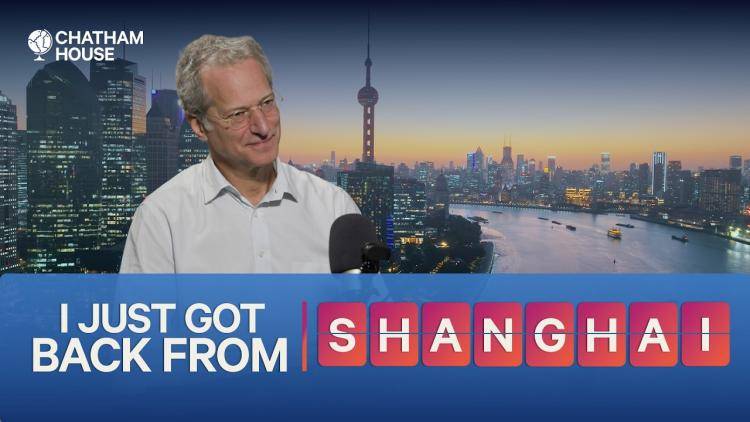
Watch: David Lubin on what the 2026 Bund Summit in Shanghai tells us about China’s economic engagement with the rest of the world.
It is difficult to argue against the idea that the renminbi remains highly undervalued. CF40, a distinguished Chinese economics think-tank, recently suggested that the underlying equilibrium exchange rate of the renminbi against the US dollar – adjusting for the fact that the cost of living in China is much lower – is around 2.5 CNY per USD. The current market exchange rate is just below 6.7.
In this respect, though, China’s trading partners should be careful what they wish for. A more expensive renminbi will inevitably boost inflationary pressures among China’s trading partners. The European Central Bank has shown how cheap imports from China have kept goods inflation more moderate than it would otherwise be. At a time when anxiety about inflation is especially acute, given the surge in prices seen since the Iran war started in February, a renminbi-induced inflation shock in Europe and the US may not be very welcome.
‘Safe’ FDI
Economic relations between China and its trading partners in the EU and the US suffer from a familiar security dilemma: my pursuit of security leaves you feeling less secure, and vice versa.
The most hopeful way out of this might be for everyone to agree that China should increase its flow of ‘safe’ foreign direct investment (FDI) to the rest of the world.

This issue is now at the centre of talks in Europe about the European Commission’s proposed Industrial Accelerator Act. Bigger FDI flows would help to lower China’s trade surplus by generating production in host countries, along with all the benefits of local job creation, technology transfer and tax revenues.
China has a long-term incentive to park industrial assets offshore, not least because they will generate a flow of cross-border investment income in the future.
Finding a way to increase China’s FDI flow to Europe without causing conniptions about national security risks is a worthy task. Set against the $350 billion trade deficit the EU will run with China this year, China’s FDI annual inflows of around $10 billion are tiny.
But boosting Chinese FDI will require tolerance of some minimal level of insecurity on Europe’s part. Otherwise, the pursuit of absolute security will come at an economic price that is just too high, and will, in the end, be self-defeating. FDI may well be the best way to build on the economic peace that is trying to break out.