

The world is closely watching today’s China–EU summit in Beijing. Could US President Trump’s unorthodox approach to transatlantic alliances offer an opportunity to reset China’s ties with the EU and some of its member states?
For now, that seems unlikely. The meeting is meant to mark 50 years of diplomatic ties but China and Europe remain divided over trade and the war in Ukraine. Meanwhile, de-risking from China remains the continent’s leitmotif.
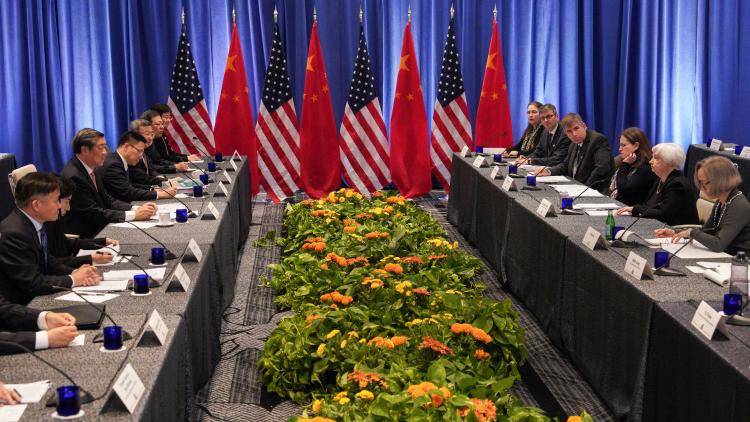
Today’s summit was originally planned to be held in Brussels but Chinese leaders declined the invitation, a clear sign of Beijing’s hardening stance towards the EU. Judging by their words and actions in the run up to the summit, neither Beijing nor Brussels appear to have the political will or policy flexibility to reset their relationship.
Although the Trump administration’s approach to the EU and Europe had raised expectations of a rapprochement between China and Europe, China’s relationship with EU institutions – and with several key member states – remains locked in stalemate. In fact, the relationship has in many ways deteriorated due to ongoing trade frictions and Beijing’s stance on Russia’s invasion of Ukraine.
Trade tensions
In contrast to talk of a potential rapprochement, Chinese policymakers have responded firmly to ongoing trade disputes with the EU, including on electric vehicles (EVs), cognac and medical equipment. It has not shied away from responding tit for tat nor has it been subtle in its communication with EU institutions and European governments.
Both China and the EU have increasingly relied on trade dispute mechanisms to defend their markets from each other’s products. Since 2020, Beijing has launched seven trade investigations and World Trade Organization (WTO) disputes targeting European products, while Brussels has initiated eleven cases against China – three of them since the start of President Trump’s second term.
At the heart of these trade frictions lies a structural economic challenge: China and Europe produce similar goods and are competing for global manufacturing dominance. China’s current economic approach to the EU stems from its new economic model, which is driven by domestic innovation and upgrading its manufacturing exports.
Products such as EVs and renewable energy equipment are part of the so-called ‘new productive force’ which China views as a key driver of its economy. This upgraded export-led model has become a key source of tension with Europe, in contrast to the stabilizing effect its old economic model had on the relationship.
Key divides remain amid Europe’s push to de-risk from China
Europe’s ongoing grievances with Beijing also derive from Europe’s push to de-risk from China. This strong belief among European leaders is driven both by economic security and Europe’s geopolitical fallout with Beijing. But there is a key difference in how the two sides view the relationship. European leaders predominantly view their ties with China through the lens of the war in Ukraine. Beijing, however, sees its relations with Brussels and Europe in general primarily through the prism of the US containment strategy against China.
China’s position on the war in Ukraine has been a catalyst for growing hostility towards Beijing in Europe. As Russia’s assault on Ukraine continues, China’s every interaction with Russia seems to deepen European anxiety and suspicion. This has led to a diplomatic impasse between Beijing and much of Europe. Neither side believes it has acted wrongly, something which continues to shape and complicate decision-making on both sides.
This dissonance has created a negative spiral. Chinese diplomats and scholars have attempted to explain the Chinese position further, but Europeans have only become increasingly frustrated, in turn triggering a sense of fatalism within the Chinese strategic community. Chinese leaders have made several trips to Europe since Russia’s full-scale invasion of Ukraine to prevent further damage to ties with the continent but they have largely been left in the cold. The divide remains: Beijing insists the war in Ukraine is a European matter that has nothing to do with China, while the Europeans believe that China is justifying its wrongdoing.
As a workaround, China has devised dual-track tactics to deal with the EU and its member states. On the one hand, Beijing continues to exchange war of words with the EU. On the other, it is engaging with European countries, such as Hungary, that are less concerned by Russia’s military assault and China’s economic competition.