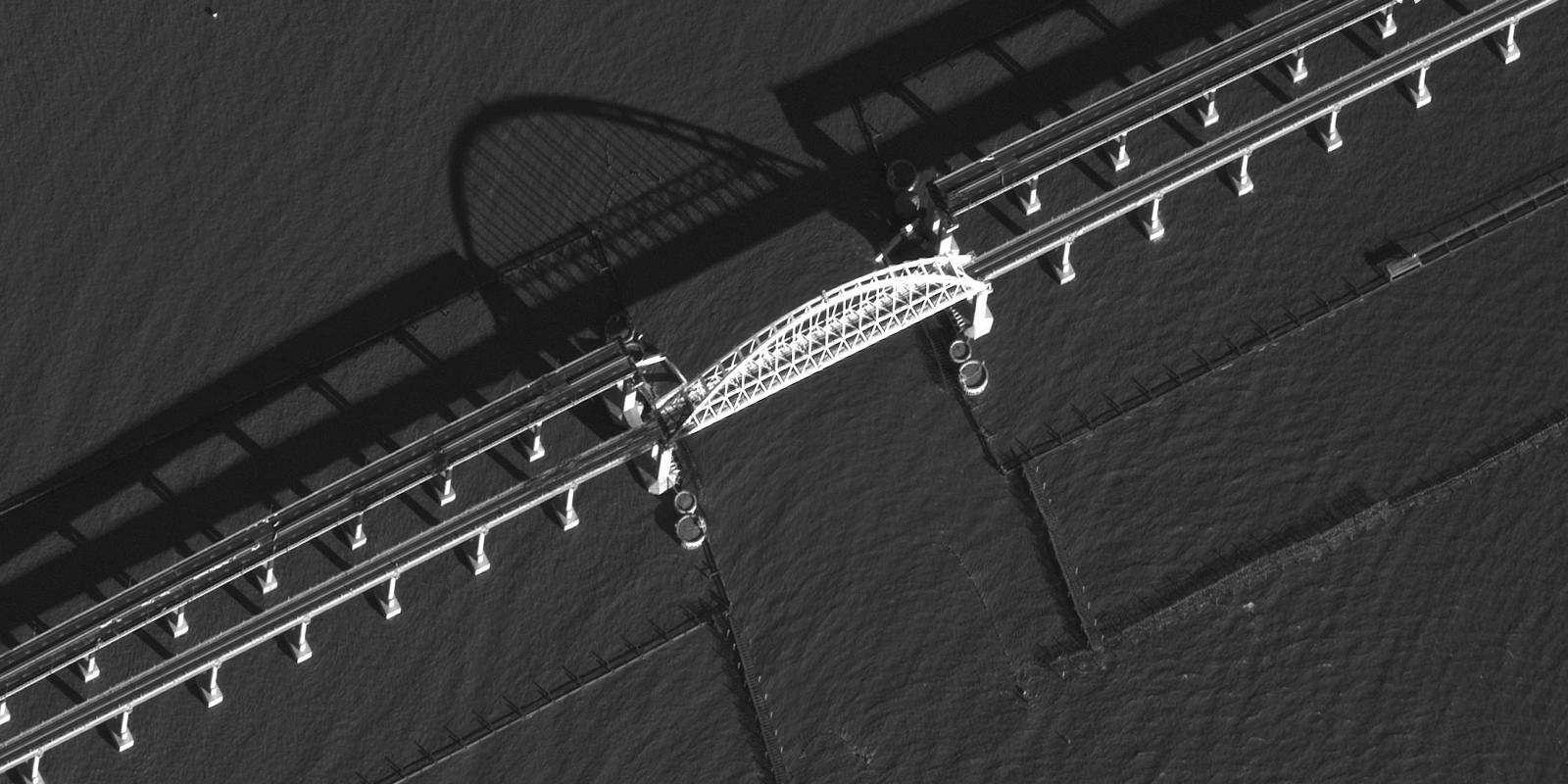

In mid-November, Ukrainian forces destroyed a road span of the Kerch Bridge, linking occupied Crimea to mainland Russia. The strike used jet-powered drones and cruise missiles reportedly guided through an airborne relay network rather than Starlink. President Volodymyr Zelenskyy described the bridge strike as the seventh phase of an operation that had first targeted the air-defence, radar and electronic warfare systems protecting the crossing.
Sequencing of that kind, combining several weapon types using communications under Ukrainian control, owes much to Ukrainian military planning. But the weapons and the relay network themselves reflect a Ukrainian defence sector that has learned to design, field and adapt systems in months, rather than the years typical of European procurement.
The strike package was not wholly Ukrainian: Destinus, a Dutch-headquartered company, says its systems were the only foreign-made weapons used. Russia’s embassy in The Hague responded by asking publicly whether the Netherlands had joined the war.
Days later, on 22 November, Kyiv said seven Ukrainian-made sea drones had successfully sunk the Russian corvette Merkury at the Benghazi Naval base in Libya. Unlike Kerch, this attack appears to have involved no foreign weapons, showing the kind of low-cost maritime capability Ukraine has developed and can exercise at range.
Ukraine’s innovation advantage
Ukraine’s defence industry has developed under conditions that no European procurement system faces. Weapons and systems are tested in an active warzone, providing immediate operational feedback and demanding compressed procurement cycles. Its production capacity has grown from around $1 billion in 2022 to an estimated $35 billion in 2025. EU member states together spent €418 billion on defence that year, so Ukraine’s edge is the speed of its innovation.

The tempting conclusion is that a country able to produce such technology under these pressures can build anything Europe needs, including air defence, if the money is there. Indeed, Kyiv has called on partners to help build ‘the arsenal of the free world’ with Ukraine. However, operational effectiveness should not be confused with industrial capacity.
Know-how is not the main constraint: Ukraine inherited much of the Soviet Union’s missile-design base, and its companies are now developing ballistic and anti-ballistic missiles alongside unmanned systems.
The binding constraints are instead access to capital, production capacity, industrial facilities that are vulnerable to Russian attacks, and the availability of specialist components, particularly advanced electronics and seekers.
Of these, finance is the most immediate concern. The head of Ukraine’s Council of Defence Industry has said that manufacturers are operating at around 40 per cent of their potential capacity because the government is not placing enough orders. That suggests that additional funding could quickly unlock production potential.
However, Europe’s requirements go beyond volume. Advanced air defence, particularly against ballistic missiles, depends on complex radar and sensor networks, high-end interceptors and industrial supply chains that require substantial investment and sustained development. Ukraine’s experience can inform European capability development. But it does not remove the need for Europe to build and maintain such capabilities itself.
The limits of a supplier relationship
There are other limitations on purchasing from Ukraine. Kyiv’s export framework is designed to protect its own forces. Companies may export only if they can also fulfil Ukrainian government contracts. Exports carry no intellectual property rights. And re-export requires Kyiv’s approval and attracts a 20 per cent tax.
Even the drones built at the first Ukrainian joint venture in Germany are currently allocated to Ukraine’s armed forces. These are rational choices for a country fighting for its survival. But they mean that in a crisis, European governments could not assume Ukrainian output would be available for their own requirements, at least until Kyiv’s rules adapted.
A ceasefire would raise a different problem extending beyond supply-chain security. Ukraine’s advantage is tied to the operational environment in which its firms develop and test equipment. A settlement would necessarily reduce the operational feedback, procurement incentives and pressure that drive innovation. European planning should not assume that the wartime model will persist, or that Ukraine’s production priorities will stay aligned with Europe’s.
Closer cooperation also carries political risk: Moscow’s reaction to Destinus fits a pattern of embassy statements labelling Dutch support for Ukraine as participation in the conflict. European governments should anticipate diplomatic coercion and hostile activity directed against facilities, personnel and supply chains associated with Ukrainian defence production. Russia has already named European firms producing drones for Ukraine as potential targets. In August, an explosive-laden drone was found beside a Ukrainian cargo aircraft at Leipzig/Halle airport, an attack Germany has since attributed to Russia. Such hybrid attacks could make some European governments more cautious about hosting joint production, underlining the importance of protecting facilities, personnel and supply chains.
From procurement to partnership
The European Commission’s proposed €45 billion loan to Ukraine for 2027, the second half of the EU’s €90 billion Ukraine Support Loan, including €31.7 billion for defence, provides an opportunity to shape cooperation. The allocation of these funds will have long-term consequences beyond Ukraine’s immediate military requirements.
Funding can support Ukrainian production for domestic use, establish joint ventures on European territory, or, where EU rules allow a derogation, finance procurement from established suppliers outside Europe, including the United States.
Buying Ukrainian output sustains Ukraine’s defence. And buying from outside Europe fills immediate gaps. But only joint ventures build enduring capacity across Europe. Ukraine’s immediate needs, particularly for air defence this winter, must remain central to European assistance. But joint ventures are where support and European industrial development can converge, and where a meaningful share of the package should be directed.
The partnership should rest on a division of labour that draws on what Ukraine’s circumstances have produced. The war has given Ukraine’s defence industry what European nations cannot match during peacetime: urgency, a tolerance for failure, and feedback loops that are measured in days.
Reinforced by Kyiv stripping out procurement, testing and regulatory barriers, Ukraine’s industry benefits from low-cost mass production and rapid iteration under pressure. That has delivered interceptor drones and long-range strike at a pace and cost that European procurement has, to date, struggled to match.
Partnership offers the rest of Europe a way to learn from Ukraine’s experience of rapid development and operational feedback, while reinforcing the need to reform Europe’s procurement systems. Ukraine is already offering foreign firms the chance to test equipment in near-combat conditions alongside frontline units, through its state-backed Brave1 defence-tech cluster, and to pair with Ukrainian manufacturers for co-production. European states should take up that offer as partners rather than customers.
European states and companies, in turn, bring radar and sensor technology, high-end interceptors, sovereign space-based communications, capital, and production sites beyond the reach of Russian missiles.
Joint ventures and licensed production can bring these together, but only if they involve genuine technology transfer, shared research, integrated supply chains, and appropriate allocation priority when the future security picture shifts. Ukrainian reporting has described the German joint venture as closer to a showcase than the start of a systematic process, whereas Destinus reports output approaching 300 Ruta missiles a month.
Moving from individual projects to an enduring framework will require predictable multi-year financing and agreements on intellectual property that give Ukrainian and European manufacturers the confidence to invest together.
European leaders should therefore ask not only how much to spend on Ukraine, but how that spending can future-proof collective European security and capability. Treating Ukraine as a source of weapons risks creating a dependency that becomes visible only when European security is next under pressure. Building shared industrial capacity would strengthen Ukraine’s defence and Europe’s resilience at the same time.