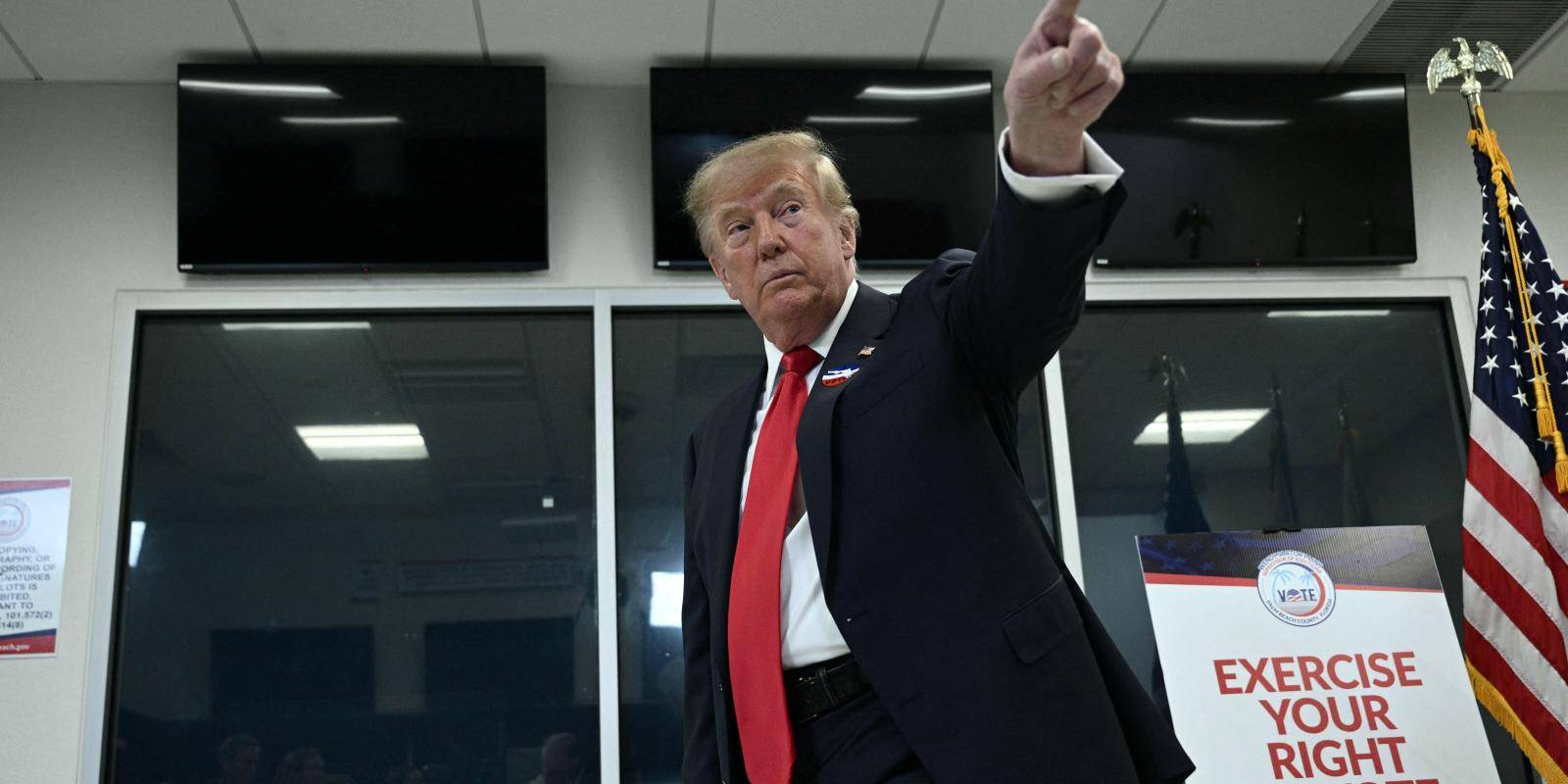

Although Donald Trump’s name was not on any ballot this week, American voters viewed the 2026 midterm election cycle as a referendum on his presidency. With the votes counted the message Americans delivered to the president is clear: they do not approve. They don’t approve of the cost of petrol at the pump, they don’t approve of the state of the US economy, and they don’t approve of the war with Iran.
Having lost control of both congressional houses, conventional wisdom would dictate that the executive branch should be hampered for the remainder of Trump’s second term. But the president has never operated by the rules of conventional wisdom.
We should not expect Trump to recede into the background. And this is not (yet) the end of the Trump era. Like so many facets of American politics over the past decade, Trump is set to redefine the lame duck presidency. With midterm elections behind him, the president can now (re)turn to what he cares about most: his legacy.
A foregone electoral conclusion
It has been clear for months that Trump was resigned to the prospect that the midterms would not go well. Republicans hoped the president would demonstrate discipline on top issues for US voters: the economy, affordability, and the cost of living. Instead, he spent the run-up to the elections preoccupied elsewhere.
He picked a fight with Canada that very few at home understood. He found no exit ramp for a conflict in the Middle East that has driven up global energy pricing and hit American pocketbooks. And he reached a deal with Russian President Vladimir Putin to purchase millions of tons of Russian diesel, ostensibly to ease the pressure valve on energy costs at home but in practice befuddling many.
As a result, and to some extent due to Democratic party momentum, Republicans found themselves adrift for much of the midterm cycle.
The scope of congressional constraint
History and US political norms suggest that a divided government should constrain a president’s second term policy agenda. Both President George W. Bush and President Barack Obama saw their aspirations for immigration reform fall short during their final years, opposed by hostile congresses.
President Trump has already had some experience with adversarial congressional dynamics. During his first term, his ambitions around border wall funding, infrastructure investment, and changes to the US immigration system failed to materialize, after Democrats regained control of the House of Representatives in the 2018 midterms.
That experience informed the Project 2025 agenda that helped shape Trump’s second administration. The president re-entered office in January 2025 and adopted a flood the zone strategy, signing two dozen executive orders on his first day.
The administration moved quickly to secure Republican-led congressional approval for Trump’s major legislative priorities including the One Big Beautiful Bill, the Laken Riley Act and the Secure America Act. But Trump’s plan was always to lean heavily on his executive authority, to rely only selectively on Congress, and to be undeterred by inevitable legal challenges.
Over the course of his second term, the president has issued 292 executive orders, 90 memoranda and 192 proclamations. Much of his remaining domestic policy priorities – including on artificial intelligence, immigration, deregulation, and energy – will be funnelled through the president’s office in his final two years.
Democrats know this. Now back in control of Congress, they intend to use their oversight authorities including power of the purse, approvals over presidential appointments and investigations to slow President Trump down. This approach has precedent – though the recent record is mixed.
On the one hand, congressional Republicans successfully blocked Obama’s 2016 nomination of Merrick Garland to the Supreme Court. Likewise, during the second half of Joe Biden’s presidency, Republicans used debt ceiling negotiations to secure concessions on government spending.
On the other hand, impeachment investigations during Trump’s first term expended a lot of congressional energy but ended with two Senate acquittals. Indeed, both the Trump and Clinton impeachment efforts demonstrated there are limits to the bite of congressional oversight.
Congressional Democrats may pursue impeachment investigations again (including against Secretary of War Pete Hegseth). But they won’t have the two-thirds majority they need in the Senate to ensure a conviction. And recent polling suggests that Americans believe it will make no difference for the president or his agenda. In fact, a quarter of those polled believe that renewed impeachment efforts will embolden the president and make him more popular. They may be right.
Despite the best intentions of the founding fathers, the US political environment has shifted over the last decade. Extreme polarization has created a politics in which Americans no longer share facts, eroding the system of checks and balances. Politicians across the political spectrum are no longer working together. The likelihood that the next Congress will be able to achieve a veto-proof supermajority on any legislation remains minimal. And Trump has already made clear he intends to be Mr. Veto.
Rather than constraining the president, the next Congress may therefore end up constraining itself. That will leave Trump to pursue the ambitions left on his to do list.
The final countdown
Atop Trump’s agenda is his legacy.
During his second term, the president has sought to remake the world in his image. He pursued a policy of ‘reciprocal’ tariffs and a global rebalancing on trade. He treated allies like Canada and Mexico as competitors and adversaries. He roiled global markets and European leadership with talk of taking over Greenland. He flattered China’s Xi Jinping and chastised Ukraine’s President Volodymyr Zelenskyy. Trump replaced ideology with transactionalism, and consultation with unilateralism.

With the days now winding down on his presidency, and so many moves on the global chessboard made, President Trump will now seek a memorable endgame.
He has long hoped to pull a rabbit out of the hat in Ukraine. But brokering a lasting ceasefire in the conflict theatre has thus far eluded him.
In his frustration, Trump’s preference has recently swung back in the direction of President Putin, much to Europe’s dismay. For Trump the war is about access, energy and critical mineral resources, and proximity to power. He will hope that next week’s planned trilateral meetings in Abu Dhabi offer a first step towards momentum to end the conflict under his stewardship.
Trump is also desperate to manufacture a resolution to the deepening quagmire in Iran. Nearly nine months into an intended multiweek operation, the realities of a war that may alone have cost Republicans the midterms are not favourable.
With diplomacy stalled and economic leverage taking time, there have been growing indicators in recent weeks that the US and Israel may soon renew military action. Regardless of this midterms result, that remains a real possibility. As it stands, Trump owns another war in the Middle East that threatens a frustrating or humiliating outcome. In his quest for victory, he will be tempted to give kinetic conflict another try.
Historic recognition
Speaking before America and the world at his second inauguration, Trump laid out his presidential vision: ‘My proudest legacy will be that of a peacemaker and unifier,’ he said. ‘That’s what I want to be: a peacemaker and a unifier’.
However, Trump’s greatest goal is securing his legacy. That influenced his claims to have ‘successfully ended’ eight long-standing conflicts, his plans to erect monuments in Washington and remake the White House ballroom, his decision to go to war with Iran, and, of course, his desire to one day finally be recognized with the Nobel Peace Prize.
The president has every intention of realizing this legacy. He will not let inconveniences like domestic politics, divided government or the US political system constrain him. Trump intends to fly like a free bird, not sink like a lame duck.