Olivia O’Sullivan
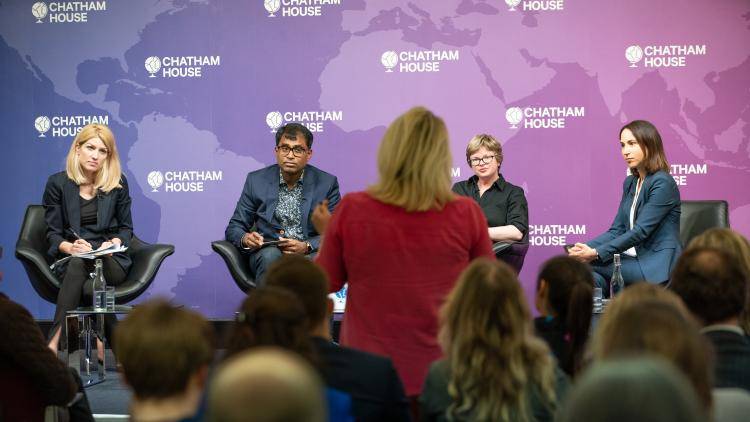
Hello, everyone, and a very warm welcome to this discussion on “Aid in an Age of Security,” a reflection on what the UK’s global priority should be at a time of aid scarcity. My name is Olivia O’Sullivan, I direct the UK in the World research Programme here at Chatham House, and I’m delighted to have our panel with us today. Major-General James Cowan, Chief Executive Officer of The HALO Trust, a humanitarian organisation that works in conflict and post-conflict zones. Baroness Catherine Ashton, former High Representative of the Union for Foreign Affairs and Security Policy and Vice-President at the European Commission from 2009 to 2014, among many other things. And The Right Honourable Clare Short, former UK Secretary of State for International Development from 1997 to 2003.
And shortly I will more fully introduce our discussion, but just before I do, a brief word about how today’s event will run. I will put an opening question to each of our panellists, and then we’ll have some discussion amongst the panel, some follow-up questions from me, but then we will open up for audience Q&A. So, do be thinking about questions that you would like to ask while we’re in conversation with the panel. And when it comes to that section of the event, please do ask a question rather than make a comment. It would be much appreciated on our part, and if you’re comfortable, do tell us your name and organisation when you ask a question, just so everyone in the room knows where you’re coming from.
A reminder that this event is on the record and is being livestreamed today, and just finally, a very warm thanks again for joining us at what is a critical time for considering the UK’s global priorities for aid and development. The past year has been marked by dramatic aid spending cuts from the UK, France, Germany, other European donors, but perhaps most significantly from the US, which shattered USAID in early 2025. By some projections, global aid spending from the 17 largest aid donors will fall by over $60 billion between 2023 and 2026. And I think to some degree, equally as importantly, this US administration has shown an increasingly indifferent, if not adversarial, attitude to many of the multilateral institutions, international organisations, that are central to global development and humanitarian response. So, we are in a time of funding scarcity and also institutional uncertainty.
At Chatham House, we’ve been looking at the consequences of these changes and shifts for some time. In our latest issue of The World Today, our quarterly magazine, former Minister Anneliese Dodds has written about the need to better explain British aid and its role, and there’s some copies of that magazine on the side here. But also in the UK in the World Programme, the impetus for today’s events – for today’s event we’ve been researching for several months, particularly the security and geopolitical consequences of such a dramatic fall in aid spending. We published our research briefing on those issues, “Rethinking UK Aid Policy in an Era of Global Funding Cuts,” at the end of last week, so there’s also a QR code at the side if you’d like to click through to read that piece, and it is on the front page of the Chatham House website today.
In the course of that research, we looked particularly at three big trends. The first is that changing patterns of aid spending and weakening multilateral institutions mean that it’s particularly the most fragile and conflict-affected states that are likely to lose out from new patterns of aid spending, particularly because aid is increasingly focused on climate finance, mobilising private finance, it’s likely that it’s those more fragile countries that will lose out. That it’s difficult work on conflict prevention and peacebuilding that will be neglected, and that those trends may well mean long-term consequences for international security, for migration patterns.
The second big trend we looked at is this reduction in resources for international institutions, particularly those responsible for global public goods, for example, containing pandemic risks, monitoring infectious diseases, climate action. With organisations like the WHO already warning of the effect of shortages on their functioning, and as many in this room will know, many UN agencies planning for radical restructuring in light of these changes.
And, finally, we also looked at the geopolitical consequences. While states like Russia and China are highly unlikely to fill the funding gaps left by Western retreat, those governments will seek to position themselves as purportedly more reliable security and development partners to states in the Global South, raising questions about how the UK and others maintain ties with countries in those regions growing in wealth and power. And we look in the paper at how the UK Government might respond in an era of funding scarcity. I’d like to get into that more with the panel, but I’ll stop there and open up this discussion to our panel members today. We’re delighted to have them to speak to those issues and more.
James, let me start with you. You became the CEO of The HALO Trust after a long career in the British Army. You served in Iraq and Afghanistan. You work now in conflict zones and in post-conflict zones. Start us off by telling us a bit about the consequences that you see from the dramatic reductions in aid spending in the past year, particularly the, kind of, wider security consequences where you work, and for global security, too. Over to you.
Major-General James Cowan
Well, thank you, and thank you for those opening remarks. Just by way of context, there were to have been three incredibly distinguished panellists, Eliza Manningham-Buller and the two distinguished people to my left, but she had to drop out. So, you’ve got me, so two distinguished women and one B team man, I’m very sorry about that. But what I do have, though, is this experience of having been a Soldier and now running an NGO, so a military life and a humanitarian life, and the consequences of what has happened to my NGO, The HALO Trust, as a result of these aid cuts is really very significant indeed.
A year ago, we employed about 12,000 people. We take great pride in the fact that we recruit locally, we have a tiny international workforce, and of the 12,000, only about 200 weren’t recruited locally. And the whole process of localisation, which the aid world is going through at the moment, actually, we’d done that 20 years ago, and our system is to empower people locally, train them to do three things. We do landmine clearance in rural areas, and many parts of the world are affected by landmines still, because they’re basically plastic, hermetically sealed weapons that are meant to kill Soldiers, but actually kill children or innocent civilians many, many years or decades after the event.
The second thing HALO does is urban bomb disposal, and war is moving increasingly from the countryside to cities, as people move to cities. And of course, the most acute example of that is the Gaza conflict, and HALO went back into Gaza only last Tuesday, and we are scaling up there in response to the situation, and it’s really very important that we can do that. I was recently in Syria and looking out over the south of Damascus, seeing just the scale of devastation there, there is this incredibly fragile country. Unless it can get a grip on its urban bombs – these barrel bombs that were dropped and destroyed about 30% of all buildings in Syria, then it cannot reconstruct. Gaza, it’s 82%.
Olivia O’Sullivan
Hmmm.
Major-General James Cowan
And the third thing that HALO does is weapon control. A well-run democratic state observing the rule of law ought to have a near monopoly over the means of violence, but in so many countries around the world, that’s not true. Weapons flow indiscriminately, they fall into terrorist and criminal hands and they create instability. So, that’s the three things we do, rural landmine clearance, urban bomb disposal, and weapon control.
But of those 12,000 people that I had last year, in January of this year, of course, the Trump stop order came into force and immediately one third of HALO’s funding ceased. Now you might think that is the big event for The HALO Trust during the course of this year. I’m going to actually be slightly counter-cultural, because HALO quite quickly was able to persuade the new American administration that our work is in the United States’ national interest and we have restored that funding. The HALO Trust’s problem is not with American funding; it’s actually with European funding. It is the second third of our money where we are now facing an existential crisis.
Will the British cut support to The HALO Trust? I don’t know that yet. I saw the Foreign Secretary only ten days ago and she came to my headquarters. She’s very, very keen to support us in Gaza, but is it about chasing the latest headline, or are we actually going to invest in things over the long-term? I don’t know that yet, and we’re going to wait for the budget and for the spending review decisions, but my aim is to try and persuade the British Government to stay firm and stay to the end. Because we work in countries like Cambodia that appear to be well beyond war, but only a few days ago, in fact, a border conflict broke out between Cambodia and Thailand because of landmines. And why would the British want to give up on a country like Cambodia after 30 years of clearance only to surrender it to the Chinese?
But the British I think I can persuade, we’re a British NGO, and I really hope we can make the power of our case and persuade Ministers that they should stay invested in what we do. It’s other European countries that are increasingly a concern for me. The Germans is the most obvious example, but the French, there is no functioning French Government at the moment, and so The HALO Trust is really watching a very significant reduction in its numbers. From the 12,000 I mentioned, we may be as low as 7,000 by the middle of next year.
Which means that I’m going to turn to the third third, the solution, and I believe that the NGOs should be looking to non-traditional state donors in the Middle East, last week I was in Singapore, and to private donors. Increasingly, HALO is investing in private investment, finding enlightened philanthropists who can see the power of what we do and know that conflict, perhaps after the climate crisis, is at the heart of our world’s problems today, and unless we address conflict, then our world is going to fall apart in front of our eyes. Thank you very much.
Olivia O’Sullivan
James, thank you, and thank you for opening the panel with such a stark report on how the events of the past year, the different choices by different governments, have affected your work. I would like to come to you, Baroness Ashton, now for some reflections on the geopolitical consequences and the consequences for diplomatic relationships of these cuts and of this wider shift in approach to aid and development. You’ve spoken and written in the past, including for Chatham House, about the importance of not taking relationships with the Global South countries for granted, and you have deep experience in diplomacy. So, can you speak to the geopolitical consequences of these shifts in aid spending, especially the role that we might see countries like Russia and China seeking to play, or purporting to play, in response to retrenchment from Western donors? Thank you.
Baroness Catherine Ashton
It’s lovely to be here, and James, you absolutely should be on this panel. What you do and what HALO – The HALO Trust does is absolutely incredible, so it’s wonderful to be sitting next to you and also, of course, with Clare.
When the Ukraine war broke out properly, it had been a conflict that I remember well from 2013 and ‘14, being in Maidan and seeing Russia’s invasion of Crimea. But when we saw this really big incursion into Ukraine, a number of countries were very clear that they were not prepared to automatically jump onto the bandwagon, if you like, of the West, and the reasons they gave to me when I asked many of them why this was happening was twofold. The first was that we were less interested in the issues of concern to them. One leader in an African nation said if I could name all the coups and civil wars there had been in sub-Saharan Africa that year then he might think about it. I couldn’t. There were 21, I think, coups and 16 civil wars in that one year alone. They felt, he was not alone in this, that we’d lost interest in what happened in their part of the world. We’re more interested in them supporting our part of the world.
And the second reason was that they were spreading their wings, in a sense, away from just assuming that the ongoing significant relationships would be with us Europeans, or us Americans, and thinking about what they needed to buy, how to grow their economy, what kind of investment they could get, and so on. In other words, we had stopped being the obvious point of reference, port of call, the obvious contributor to their success. And it brought me back to something that I felt for a long time, having spent six years working in the European Union, five of which I was partly responsible for the aid budget at the strategic level, about €2 billion a year. And in that, we were looking for ways in which we could not just solve the immediate crisis but moving to a much more strategic long-term vision of what we were able to do.
Too often we spend our time doing what I used to call the whack-a-mole approach, a problem leaps up at you, you beat it down, spend six months putting the sticking plaster, hold it down, another one pops up, and you move your resources around. Instead of really thinking through that if it takes decades for a problem to really bubble up and become a dramatic crisis, why do we think we can solve it in a year or two or three? A good example of that was Somalia, where the EU, when we were part of it, had been working there for over 20 years, trying to help build communities torn apart by civil war. So, that when we did get the fledgling government that we managed to see in about 2012/13, we were able to support it, able to continue to increase our support and aid in every possible way.
And it does bring me also to the fact that we understand very little, it seems to me, about what we mean by aid. We think it’s about – or people tend to think it’s about just giving out money that goes into this bottomless pit. Well, it’s really not about that, at all, it’s about the opportunities we provide for people to be able to live the kind of lives they want to, to be able to invest in their own families and communities and businesses and so on, as well as making sure that people stay alive long enough to be able to do that. And we should recognise, fundamentally, that the problems that begin somewhere don’t stay there, they move. They move and they reach us one way or another and become more expensive to deal with than if we had actually invested at the beginning.
And all that is a precursor to saying that if we don’t do this, if we don’t invest in those long-term relationships, we will not get the support that we need when we find ourselves with a conflict in Europe, as we’ve seen with Russia’s invasion of Ukraine. We will find 30 countries at the UN who do believe in democracy, do believe in sovereignty, but who are not prepared to support us just because we ask for it and who are prepared to think differently. And we will also find that where there is a vacuum, others move in, and they move in with different principles and ideas. They’re not looking to support the growth of human rights, to make sure that people are able to develop their own opportunities. They’re much more interested in what that means for what they can do within those countries in return for the support that they offer.
And I’ve seen that all over the world, where you see Russia and you see China in action, using the opportunity of countries feeling that they need support and they’re not getting it as a means of being able to get in there and do the things that they want to do. So, the geopolitical consequences are very clear and very obvious, and it does seem to me that when we think about all of this and reflect on aid for the future, that governments need to reflect that this is about our future as much as the future of the people that we’re supporting.
Olivia O’Sullivan
Baroness Ashton, thank you, and thank you for bringing that element of the, kind of, wider diplomatic consequences of these shifts into the discussion. Let me come to you, Clare, finally. You’ve written recently for the Fabians on their collection of essays on reimagining development, and you focused, in particular, not just on cuts in funding, but on what you called the “wider collapse of post-Second World War institutions.” And I wondered if you could reflect on that shift and the consequences of that shift but, also, I wanted to ask you if you see alternative models or coalitions that we could be thinking about now that could be built in the absence of this, kind of, traditional US leadership in these post-war institutions.
Clare Short
I think, I mean, both these important contributions that have been made talk as though things might collapse if we don’t go back to what we used to do, but I think they’re collapsing, and of course, in the case of HALO, if you get the money, someone else didn’t. You know, it’s – obviously it’s your job to do that, but of course, you can’t really do your job unless conflicts are brought to an end, and increasingly, we’re bad at that. So, they prosper and you can’t clear the mines until people stop laying them, and all of that. So, I think we’re in terrible trouble, and I think the UK has enormously lost reputation and is seen as this poodle of the US wi – this unreliable US.
I mean, we used to be highly regarded on development, ‘cause development isn’t just aid, it’s also trade and taxation arrangements and environmental agreements. So, you need – not – it’s not just dolloping out a bit of money here and there. It’s a, kind of, consistent view of how the world is made safer and more stable and sustainable, and we’re destroying that expertise within our own government. The collap – the destruction of DFID, I think, was a disaster but, you know, in the old days, in the Thatcher days and so on, there was a part of the Foreign Office dedicated to development which had experts and its own Permanent Secretary, and that’s gone. So, staff are all mixed together and all the leading development expertise is leaving Britain, and this is destroying, you know, a capacity that was very important.
That a country like us, which we can’t, sort of, be a leading military player, though we may be pretending that we can be in relation to Ukraine, but that’s another discussion, we could be a very significant player on development, ending conflict, prevention of future conflicts, relationships with the Global South. And you’ve only got to look at votes in the General Assembly now to see how alienated the Global South is, and it’s not just UK and Russia, it’s what’s been going on in Gaza. Total breach of international law, and we’re in there, you know, with the Americans not standing up for international law, so we’re besmirching ourselves in a really dreadful and terrifying way.
I can’t see any prospect in the short-term of us re-establishing our reputation, but I think we’re going to have more and more trouble, and then people will start reinventing developments and saying, “We really should do more to prevent all these conflicts spreading.” By 2050, one in four of the people of the world will be in Africa. It will be the youngest continent. I mean, if there isn’t development and progress, what is going to happen then?
The other thing is, I mean, on China, I don’t think you have to see them as, I mean, a threat to us. Developing countries are wanting to have relationships with all sides, not belong in one bloc or another, trade where they can and so on. And China’s capacity to produce solar panels and so on at enormously cheap costs can mean Africa can have the energy it needs to promote its development enormously cheaply fr – through China, and that’s going to change all the relationships. I don’t think any developing countries want to only be under China’s influence, but they will go where it’s helpful to them and China will become more and more influential.
So, I think we’re going through a tragedy, a diminution of the UK’s reputation and capacity to influence international affairs, and more and more conflicts that are not being resolved. We don’t have the capacity – the UN capacity to end conflict has been diminished by the undermining of the UN, as well. So, I’m sorry to be gloomy, but this is the reality, and it’s no good saying, “Oh, if we just went back to where we were five years ago, it would all be okay.” So, I think it’s going to get worse and worse, and then there’ll be a reinvention of a commitment to development, and all the things that you are advocating might well come back, but we’re going to go through an awful lot of mess in the meantime, I’m afraid.
Olivia O’Sullivan
Hmmm.
Clare Short
And on your fi – your second part of the question, are there others we could work with? Absolutely, yes. I mean, if we went back to the, sort of, outlook we used to have, as well as obviously the Norwegians and the progressive Europeans, ‘cause the EU is – isn’t doing as well as it was in your day, that is not being flattery. I mean, that’s just in standing up for international law, for example, it seems to have forgotten that part of its founding constitution. But also, then we ought to be able to work with Brazil. It shouldn’t just be progressive Europeans. We should be able to go across the line of Global North-South, and Brazil, South Africa for some things like Gaza, I would say, and build relationships of practical effort in the international system on development and ending conflict and so on, and reconstruction and DDR with countries of the Global South and some countries of the Nor – and that would change the atmospherics in a better way than the deterioration we’ve seen that Cathy just described.
Olivia O’Sullivan
Hmmm hmm.
Clare Short
So, sorry, folks, but I think that is where we are, and it’s a bad place.
Olivia O’Sullivan
Thank you, and I’m sure we’ll get into discussions about alternatives and ways forwards in questions. I wanted to just come back to you, Baroness Ashton, because…
Baroness Catherine Ashton
Can I be Cathy now?
Olivia O’Sullivan
You can be.
Baroness Catherine Ashton
Good.
Olivia O’Sullivan
I want to come back to you, Cathy, on – because a lot of what Clare was talking about involved alternative coalitions, alternative leadership responding to this, kind of, new unpredictability, to say the least, from the US. You – so much of your career was with the EU and thinking about the role, the, kind of, geopolitical role of Europe in the world. Do you think the EU is up to that, to, kind of, filling that gap? What do you think needs to happen? Do you think it’s a question of specific European states, donor states, stepping up? What would you like to see?
Baroness Catherine Ashton
So, I think there’s a really strong commitment within Brussels to the role of Europe, the European Union, in terms of supporting especially its own neighbourhood, to be able to grow economically, to strengthen itself democratically and so on. And though the whole nature of the way that Brussels operates is an enigma to most people, including many of us who lived there for quite a while, and is slow and difficult at times, the direction of travel is still pretty much in that way.
The challenge, though, is that it can get knocked off course because things happen. So, the war in Ukraine has certainly dramatically affected the way that the EU has had to think, and it’s perhaps not yet worked out this – what this really is going to mean for it for the future. But we have a war in Europe, and we have a war in Europe that is going to need European support, not just for the war, but especially for what happens after the war. Wars eventually end, and they rarely end with straight lines, they end with ragged edges, as I would say.
Clare Short
Or maybe a no – nuclear exchange in this one if we don’t do it right.
Baroness Catherine Ashton
There’s – I doubt that, but I take your point. I mean, I think that whatever happens, it’s going to be an extremely difficult conflict to find a resolution for and require an awful lot of work afterwards to rebuild a country. This is the – going to be the challenge. But you’ve also now got the difficulty that with the US and USAID disappearing, the expectation from so many countries, organisations, is that the EU is able to pick up at least some of the slack, and that’s incredibly challenging, because the way that USAID worked across the world was not just about aid and development, but all kinds of security questions that were built into that to make places safe, to be able to ensure that things could happen in countries that were either in conflict or coming out of conflict, or certainly extraordinarily fragile.
So, there are big, big challenges on the EU at a time when economies are running into difficulty, when people are more and more concerned that they want to see effort domestically and don’t make the connection between their own domestic security and what happens beyond it. And that’s, I think, a big problem that we have all over the world, is that we’re – there is a false understanding that if you want to be safe and secure, we can’t be until we make sure that everybody else is. Because the problems don’t stay where they begin, they come here, or we have to eventually intervene in ways we would prefer not to have to. And those are really big fundamental issues about the link between where you – what you’re doing on development, what you’re doing on defence, and the – everything that happens in between. The hard power, soft power spectrum is not something you can break up into chunks, it’s one spectrum.
Olivia O’Sullivan
Hmmm, and Clare, I wondered if I could come back to you on that theme, because Cathy is, kind of, talking about the indivisibility in a way of security and development action, but I wanted to ask you a bit about the domestic politics of this. Because this government very much framed their decision to cut aid spending as a decision to do so in order to fund an increase in defence spending, kind of, pitting those two things against each other. And I think, you know, if they were here, they might say that that polled well, that they have a difficult fiscal situation, that they have a security threat from Russia. I wondered if you had a rejoinder to that argument that we’re in a more difficult time, we need to spend more on defence and the aid budget is where we found the resources to do that.
Clare Short
I think the major explanation of the deterioration in British governance by the previous government and now, is government by focus group and polling. And in this case, it was briefed to the media that when they asked the public if they believed we should increase defence spending, they said yes, and if they said, should we increase taxes to pay for it, and they said no. And if they – and they then said, “Should we cut development spending to” – they said yes, and that’s – I don’t think you can govern a country like this. I think this is shockingly disgraceful. ‘Cause, as you know, polling is – what’s been in the papers the last few weeks, it’s not – well, here, she’s married to one of the world experts on this question, and indeed, he wrote about these matters.
So, I think that is really very frightening. If each thing the government thinks to do, it has to see what the polling is, no wonder we haven’t got any strategic story about our own economy and all the rest. And it’s not just here, and it’s not just this government, but it’s got worse. And when you look at this, Adam Tooze, if, you know, him, the German, American, British intellectual, did a piece in the FT back in June, the spending by Europe on defence is far, far greater than the spending of Russia. But it’s all broken up into little chunks and there’s no strategy and no – and that what – is what needs attending to and just throwing more money into the same pots is not going to give the, sort of, sensible defensive arrangements and so on and so forth.
And my own view is that the European, including the UK, position on the Ukraine-Russia war, just, sort of, fight on with every Ukrainian life that we can get our hands on, is very foolish. And I think on this that Trump is right, we need to bring it to an end and look for the best possible settlements, and maybe that’s now coming up a bit. But Britain’s been very militant in – and there are very serious American thinkers who think, of course, at the moment, Russia’s inching forward. If you pile more into Ukraine and they start to push Russia back, that’s when battlefield nuclear weapons becomes a danger.
So, anyway, I just think that the level of incompetence and the use of polling to make decisions is leading us into terrible trouble, and we need to stop that and have more sensible strategies of the kind that you’re – you advocate in your paper and that have been advocated here today.
Olivia O’Sullivan
Thank you. Let me come to you, James, because both those – both Cathy and Clare’s previous comments have brought up this link between development and security, and you have this experience in the military, as well as now with HALO Trust. When we were talking before, you were talking about, you know, your contact – when you speak to people in the military, what they think about these, kind of, cuts to development spending and these shifts in development policy. I wondered if you might just share a bit of that and reflect on how you see those two different sectors that – sort of, their interlinkages.
Major-General James Cowan
Yeah. In 2004, I was commanding my battle group, the Black Watch in Iraq, and we were sent from the British sector in the south in Basra to help the Americans around Fallujah, and the commander of the Marine Expeditionary Force at that time was General Jim ‘Mad Dog’ Mattis, later SecDef in the first Trump administration. And Jim Mattis said that “To cut aid, I’ll need to buy more bullets,” and he was right. Now, Jim Mattis fought a very distinguished fight around Fallujah, and his opponent at that time was the leader of al-Qaeda in Iraq, Abu Musab al-Zarqawi. Al-Zarqawi was a ruthless and horrific mass murderer and eventually was killed, but his second in command went under the nom de guerre of al-Julani. He is the same man under a different name, al-Sharaa, who is now the President of Syria.
I was recently in Syria and met with the new administration, and I applaud, I celebrate, I am grateful for the fact that a man of war can turn into a man of peace, but what Al-Sharaa is in charge of is a country that is extremely fragile. It’s come out of a prolonged period of conflict and of dictatorship. It has to some extent cast off the curse of Iran, although it was hit – my office actually in Damascus was not that far away from a missile, an Iranian missile, that hit it only yesterday. And without aid from the West, in all the various forms it comes, he will not make a success of his country.
In June this year, I went back to Afghanistan, I was the British Commander in Helmand, and – as a guest of the Taliban, and I toured Helmand. I went – I landed in Lashkargah, and I drove up the Helmand River Valley to Sangin and then on to Kajaki. And the last time I was in those places, I would have fought my way up that road at the cost of many lives, but I was able to drive up it this June. And the thing that The HALO Trust is doing there is clearing land for Afghans to live, and there are now four million Afghans living on land cleared by The HALO Trust. Because Afghanistan is an incredibly fertile country, but it can’t actually plant or harvest any crops unless its irrigation system is working, and it is that irrigation system that was highly damaged by the war and which we’ve helped clear.
There are four million Afghans who could have been migrants. The British Government funds us to the tune of about £2½ million a year in Afghanistan. It’s one of the few remaining projects the British have anywhere in Afghanistan. That’s keeping four million people gainfully employed. Compare and contrast with the £4½ million the British Government is spending every day on hotels in and around the Brighton area. Where is the balance of investment? Surely…
Clare Short
Paid for by the aid budget, the…
Major-General James Cowan
Paid for, exactly, by the aid budget. And this is a question of leadership, it’s about Politicians and our leaders making a coherent, persuasive case to our voters. And exactly as Clare says, not simply going with focus groups, but actually leadership is about being propositional, about showing the way forward. And if we cut ourselves off from the world by cutting aid, then we will be the people who, as Jim Mattis said, we’ll – we will be the ‘victims’ and the world may not love us, but the world will come to us and harm us if we do not continue to support our long tradition as a global nation.
Olivia O’Sullivan
Thank you, and thanks to all of the panel for the discussion so far. We’re coming up on about 20 minutes left and I want people to have plenty of time for questions, so I’m going to suggest that we open it up now. We’ve got some great questions online, but let me take a few in the room. I’ll take questions in groups, and just a reminder, do please ask a question, and if you’re happy to do so, do just let us know your name and organisation as you ask one. Let’s go to the lady here in the red first, and then I’ll come to a couple of others.
Lydia Paynter
Hi, I’m Lydia Paynter, and I’m with BB Partners. My question, I guess, is to all the panel, but Clare particularly, as someone who is such an advocate of development. Really appreciated what you said around the fact that the government needs to lead, rather than govern by focus group. So, how do we tell – how do we make the case to Starmer, to Morgan McSweeney, to Rachel Reeves, that actually we need to move away from this, sort of, reactive focus group idea and the country needs to show leadership if we’re to achieve any real change?
Olivia O’Sullivan
Lydia, thank you. Let’s take a few more and go to the woman in pink here, and then we’ll come to the gentleman at the front, and then I’ll, kind of, move further back as we go.
Sophie Fisher
Thank you. My name is Sophie Fisher. I’ve spent the last 20 years working for the United Nations, mostly in Geneva, but also in Asia. You have alluded to what is happening to the UN, both the security and the development arms. I wondered if you could expand on that and what you see as the new role, if there is one, for some form of United Nations, given that the de facto is 20% job cuts across the board and equivalent job cuts in budget and abilities. Thank you.
Olivia O’Sullivan
Thank you, and let’s take one more, gentleman at the front here. Thank you. I’ll come to the other folks with hands up. Thank you.
Harold Freedom
Thank you. Harold Freeman, I’m from the Independent Commission for Aid Impact, the UK’s aid spending watchdog. My question follows on from the previous one. I wanted to ask about the Sustainable Development Goals, now ten years old. We had for that time, you know, a set of shared, you know, idealistic, perhaps multilateral objectives, very useful for people like me looking at what are we trying to do? We never hear about them anymore. Is there still a place for those, kind of, shared objectives? Should we be fixing them for an age of security, or is it every country for themselves to explain to their taxpayers what they’re trying to achieve?
Olivia O’Sullivan
Thank you. Let’s start with those. So, we’ve got the continued relevance of the SDGs, or the relevance of the – of a framework like that, the question of UN reform and cuts to the UN, assuming 20% job cuts, and the question of if nothing changes at this time, and the question around how to make the political case to this government. So, I’m going to leave it as panellist’s choice which one people would like to respond to.
Clare Short
Well, on strategic leadership, I think the – all the serious opinion columns are saying this is the problem, and I think it just needs to be said more and more loudly by more and more people. It’s hard to think the present Prime Minister will stay there through to the next election, so there’s a chance there of learning the lesson of what’s wrong and getting some better strategy before the next election. The UN is being bashed, but it’s the only UN we’ve got. I don’t think it’ll be destroyed and I think, you know, in my scenario of everything getting worse and then suddenly needing multilateralism and needing to get people round, it’ll come back into its strength. I mean, it survived the Cold War.
The SCGs, yes, I mean, from 2000 – or 98 to 2005, was it, or – poverty in the world was reduced from a third of humanity to 10%, and that was a collaboration across the international system. And it’s a phenomenal achievement, and that’s been thrown away, that capacity to systematically reduce poverty and get kids into school and get some basic vaccinations working. So, we’re throwing that away too, but I think, again, we’ll come back to it, because you need some framework to get the whole international system to work together, and no country on its own can do this, but if the whole system works together, you can make enormous achievements.
Olivia O’Sullivan
Cathy, did you want to come in on this?
Baroness Catherine Ashton
I mean, all of the questions actually have one thing in common, which is you need a vision and you need a strategy. You need to make sure that if you’re going to have Strategic Development Goals you know what they are and how to hit them, and not that they disappear off the agenda, because you’re right, they have. If you’re going to have as a government a vision for the country, it’s also got to include an international vision that links the domestic to the foreign policy. Foreign policy is domestic policy. We keep thinking it’s foreign, it’s not, it’s here. It’s about making sure that the lives of people who live here are as good and as full of opportunity as possible, and you can’t do that unless you also have a foreign policy.
Included in that means that in order for the life of people here to be as safe and secure, you need safety and security across the world. If Syria is not safe, if it can’t survive, if it can’t grow and develop, that problem will not stay there, it will move. And when it comes to the UN, the UN is critical to this, but it needs to also of itself be ready for the 21st century. We know one of the problems with institutions is we don’t look after them. They’re like big tankers at sea and we let them get full of rust and barnacles and they keep going, but they need a new coat of paint. They need to be a bit more reorganised. They need to be shown the direction that they need to travel in.
And the UN itself needs to think about that, not just in terms of job cuts or reform of the Security Council, important though all that can be, but actually, what does it want to achieve in the next 50 years compared to the last 50 years? And if you pull all these things together, what you’re missing is a sense of the strategy that says, “This is what we’re trying to do.” This is a vision thing, and people mock the vision thing, but it’s really, really important.
Clare Short
And on the UN, the Global South is knocking on the door and saying, “We want our proper place here.” So, to get a revivified – you need a different Security Council with more players representing the whole world. That’s going to be part of the change that’s needed.
Major-General James Cowan
If I could add, and I’m go – I think there’s too much agreement here, so I’m going to try and be a bit of – play devil’s attitude.
Baroness Catherine Ashton
Going to disagree. Oh, James, how…
Major-General James Cowan
I…
Baroness Catherine Ashton
…exciting.
Major-General James Cowan
No, but for hopefully the right reasons, and my view is that the aid world is suffused by a, kind of, nostalgia death spiral. It is completely addicted to a worldview that sits somewhere in the post-1989/pre-2010 world. We now need to reinvent this for the world that’s coming, not for a world that’s passed, and things like the Sustainable Development Goals were extremely valuable in their time, but the reality is that actually we’re almost victims of our own success here. Lots of people have been lifted out of poverty, trade is actually succeeding better than aid in many parts of the world. What the Chinese do completely dwarfs anything that the West can do.
So, we need to rethink through this, and with the limited money at our disposal, and I’ve already touched on one part of this, do, in my opinion, two things. Refocus this on the crisis of our age, namely conflict, and think through how the most fragile, the most disadvantaged, the people in this world who suffer the most extreme poverty as a result of war, can be helped. As the Director of the World Health Organization said the other day, “The best vaccine is peace,” and how we bring peace and how we focus this on conflict prevention is something we should think about very, very hard.
And the second thing is the British Government isn’t going to have the money and therefore, the British Government can play a leverage role in finding other people’s money. The Middle East, Qatar, the Emirates, Saudi Arabia, Singapore where I was last week, we should be looking to the emerging economies to help us resource what needs to be done. So, it does need a complete reinvention. I think the UN itself, you know, as small as it is, it needs more than a lick of paint. I’m afraid, there are some really profound reforms that are required. It is highly bureaucratic, hugely expensive and a great deal of, sort of…
Clare Short
Costs less than New York, governing New York.
Major-General James Cowan
Yeah, and British…
Clare Short
It’s not as expensive as you think.
Major-General James Cowan
The British Government would rather put money through those multilateral instruments than through sometimes the assets it has on its own doorstep here. The work that my NGO does is in explosive ordnance disposal, it happens to be a uniquely British strength. 68% of all explosives removed in the world last year were done by two NGOs, The HALO Trust and the Mines Advisory Group, both British. We should invest in our own strengths first and think through how we can use the limited money at our disposal in the most efficient way.
Olivia O’Sullivan
Well, I might take that opportunity to pose some questions that have been put by folks joining us online, of which there are many great ones, and apologies that I won’t get – be able to get to all of them. And Mark Enstridge has asked – Henstridge, forgive me, has asked, “Given a smaller aid budget” – he’s essentially asking about this question of, do you invest in multilateral institutions, or do you focus on bilateral aid, direct aid from the UK to a specific country or organisation? And I just wondered if others on the panel would like to weigh in on that question. Cathy.
Baroness Catherine Ashton
Yeah, I mean, it’s not either/or, it’s both/and. I mean, you know, we can bang on about how marvellous we are at things, and we certainly do have a phenomenal track record, particularly in the kind of work that James does, but there are many, many occasions, and I saw this in the EU, where when you combine the resources and the capacity, of as it was then, 28 countries, you can achieve a lot more. Not least because you can actually work out who can offer what so that you’re not trying to all do the same thing, or you’re not trying to just do one part of the problem.
I talked a lot when I was in office about a ‘comprehensive approach’, that you can’t deal with one bit of a problem without thinking about all the other issues that go alongside it. So, the example I often cite is when we were dealing with piracy off the coast of Somalia, which was in 2009, the biggest problem we faced, we had 14 and 15-year-old boys who were the pirates because they’d been offered $10,000 by a warlord if they could go get a ship. And the option – the alternative was maybe $2, if they were lucky, if they could find a job that day, and so, of course, for a lot of young kids, this was worth the risk. Well, it’s no good just locking ‘em all up if we don’t actually find an alternative for them to the $2 a day.
So, you can’t just tackle one bit of it. You have to tackle all of it, or as much of it as you possibly can, and that’s when you need to be able to work through the international institutions, ‘cause they’re really good at that. And yes, they’re slow, and yes, they’re difficult, and yes, they’re often bureaucratic, but they get a lot done. And if you look at the history of the multilateral organisations, actually what they’ve achieved is quite extraordinary in many places. It doesn’t take away from what James can do as James of The HALO Trust, but James can’t do all the other things in that community that might be needed dealing with and wouldn’t pretend to, and that’s when you need to be able to work together.
Clare Short
Could I just say the ODI, Overseas Development Institute, did a consultation with practitioners in development about what’s the future, given that we’re get – got a collapsing order, and I agree the old development order is collapsing. And they said, at the moment, the development thing is supposed to be dealing with climate change, you know, undermining China, so many different objectives that it doesn’t give a clear message to people about what it’s doing. But it said – and I think, in my experience, there’s too many actors in development. People are tripping over each other with their flags and symbols, and you need to pool the money, help countries to build their institutions, not have little flags and emblems all over everything.
And the case that ODI makes is that maybe bilateral programmes should end and revamped multilateral agencies to achieve the big changes we need should look – the other thing is people in developing countries are a bit sick of the, kind of, charity and telling us what to do, and they want their own governments to stand up. So, there’s a sort of – they don’t like the old order. So, I think we have to take this chance to revamp the system, and I – looking at what ODI said, I recommend as a way of thinking through to the future.
Olivia O’Sullivan
Thank you. Let’s take another round in the room. Let’s go to the lady in the blue jacket here, right in the middle, and then we’ll get some from folks at the back.
Dr Anna Matveeva
Yeah, thank you. Anna Matveeva, King’s College London, formerly of the United Nations. Thank you very much, it was really fascinating to listen to all three of you. My question is, if we are witnessing a sunset of the aid and development, what’ll – what’s going to happen to the UK soft power the – in the world then? Yeah, BBC is not really having its heyday at the moment, so is it all too Harry Potter, then?
Olivia O’Sullivan
A lot to put on his shoulders. Let’s go right to the back if we can, to the – in the glasses there, and the person behind.
Laura Denham
Hi there. Laura Denham from Care International UK. So, when the government announced the aid cuts, they projected they would fall particularly heavily on gender equality and education. I do have some concerns that gender equality is often viewed as a, kind of, nice to have, soft issue, rather than within the, kind of, security lens that we’re talking about here. What do you think the UK’s role is in resisting the rollback to women’s rights and gender equality that’s underway, particularly in a more hostile world, i.e., increasing, kind of, funding and organisation of anti-rights movements? Thank you.
Olivia O’Sullivan
And the gentleman behind.
Rashane Pintoe
Hi everyone, I’m Rashane Pintoe, I’m a – I read for further studies at Loughborough University, and I’m also a Researcher on the Islamic State Khorasan Province in Afghanistan. So, my question is mainly to Major-General James, but it’s also open to other panellists. First of all, thank you very much, Major-General, for the work you do. I understand you do a lot of work in my home country, Sri Lanka, as well. So, my question is, I understand the need for aid to Syria to ensure the success of al-Julani’s administration, however, given that al-Julani once fought against Western and Western-backed forces in Syria under the Al-Nusra Front when he was aligned with IS Khalifa al-Baghdadi, how can we ensure that he won’t use the same aid to, you know, go back to these ways of terrorism? Thanks.
Olivia O’Sullivan
Thank you. Let’s take those, and if we can have relatively succinct responses, we’ll get another round of questions in. So, questions on the effects on UK soft power, what the UK can do to think about, kind of, gender equality in this new, much more difficult environment, and a question about the new leadership of Syria and concerns about, you know, diversion of aid or the uses of aid under that leadership. James, that question was to you, so perhaps…
Major-General James Cowan
Yeah, I mean, I think we have a long tradition. I had a great-great uncle killed at the Battle of Magersfontein in 1899 by General Jan Smuts. General Jan Smuts then became one of the British Empire’s strongest supporters and a great ally in the Second World War. I had an uncle killed in Cyprus in 1958 by EOKA, the Greek Cypriot terrorist organisation. Its leader, President Makarios, later led that country to a democratic future. My father was shot by the IRA, he survived. The Good Friday Agreement is a good thing. It’s a good thing when men of war come to peace. So, I think we have as a country to have trust in the possibility of a better future that doesn’t involve conflict.
To the gender issue, I think we need to be patient and persistent. I work in Afghanistan, a country – the only country in the Muslim world not to allow girls to go to secondary school. That’s a disgraceful state of affairs, but it’s not going to change by standing aside and wagging our finger from London. We’ve actually got to be there and do what we did, as in Saudi Arabia, a country that was incredibly conservative but is now evolving to a better future, and if we are patient and persistent and stick with countries, we can actually make a difference.
Olivia O’Sullivan
Thank you. I wondered if other panellists want to take that and the soft power question too.
Baroness Catherine Ashton
Yeah, I mean, there’s no question that in terms of what’s happening to women and girls all over the world, we’re seeing in many countries a retrenchment back to what they like to call ‘traditional values’ but actually just were about preventing women and girls from having the future they should have. And it’s illogical and stupid not to think about 50% of your population and what they can contribute to your society. Some of the greatest scientific minds, the greatest Engineers, the greatest Teachers, and so on, are within that group of the population who find themselves unable to go to school. It’s ridiculous and crazy, and it’s very, very important that we stand up and say that, and that we’re also prepared to continue to push as hard as we possibly can.
It will take great patience, and James is right, you have to keep going. It doesn’t happen overnight. This is drip, drip, drip stuff for some communities and some societies, but it’s also recognising too that some of the retrenchment, the moving back, is caused by other factors that we need to take into account, not least poverty. And if you can’t actually afford your children to go to school, then you will do something different. If you find yourself with no resources at all, then you will make choices that we find appalling and terrible. We’re not in that position, so we need to also think about what we can do.
And then finally on soft power. Soft power is the most fundamental thing that we do in order to be able to show who we are, but also in order to address the concerns of our own citizens, and the soft power covers a whole range of things, economic power, diplomacy, the work that you do on development and aid and so forth. And it’s really, really critical, because unless we have a stable, secure world, which is why you use your soft power, it’s going to be impossible to have stable, secure countries, and that will include us. It’s more difficult to deal with problems if you’re not looking outward but looking inward.
Clare Short
The single thing – you should never do a single thing, but if you take the single thing that brings the poorest countries to development, it’s getting girls to school and educated. It is – it uplifts the country, they – when they have their own children, they’re better at getting them educated and they’re better at getting income and so on, so it’s an example of the importance. The other thing I’d say though, big strides have been made. Of course, Afghanistan is its own terrible problem, but, you know, more girls than – or young women than – young – in Iran go to university.
Baroness Catherine Ashton
Hmmm.
Clare Short
So, it is an issue that is still making progress across – and if you look in Africa, there’s lots of strong African political leaders. So, it’s not hopeless, but we shouldn’t, of course, abandon the issue. Britain’s soft power, we’re doing everything we can to diminish it and it’s diminishing, and it’s a pity, and I think we’ll try and reinvent it when we’ve lost it.
Olivia O’Sullivan
Thank you. Okay, let’s squeeze a couple more in. So, gentlemen on the end of the row there with the glasses. Thank you.
Member
Thank you very much. We should also – we should obviously be spending more money on what we should be doing, but how do we save money on what we should not be doing? I’m thinking of Clare Short’s fantastic stand against the Iraq War. Thank you for that.
Olivia O’Sullivan
Thank you. Let’s go to the woman at the front here.
Dr Jehan Baban
Thank you.
Olivia O’Sullivan
Sorry, wait for the microphone, it’ll come to you. There we go.
Dr Jehan Baban
It’s Jehan Baban, CEO and President of the Iraqi Environment and Health Society UK. We work to improve the life of people regarding environmental and – pollution and water scarcity and drought. My question is, well, we talked about the models, UK models, so looking at alternative model that is more effective and responsive, if the aid is designed to align with local priorities, targeting most vulnerable and marginable communities threatened by drought or conflict, do you think focus on governmental – governance framework, partnership, social inclusiveness and environmental justice and sustainability are the solutions?
Olivia O’Sullivan
Thank you. We’re tight on time, so I’m afraid we’ll stop there, and I’ll – to the gentleman’s question about what we spend less on. And do less of, it also relates to quite a few questions online about, sort of, the predicament this government is in, what can they do less of, what can they spend less on, in order to focus on the priorities the panel has spoken about today? So, I wonder if I could get you all to just respond to those questions and also a, kind of, final word in the last few minutes as we wrap up.
Clare Short
You remember that ridiculous – I think it was Gordon Brown that commissioned it too, aircraft carrier that could – there were no British planes that could go on it, and it keeps breaking down, and then we send it round the South China Sea. I really think that’s not what we should be doing. In fact, I’ve heard some Americans saying, “Britain should focus on what Europe needs.” I mean – and we’re very bad at procuring weapons and we waste a lot of money and get tanks that make people’s – Soldiers’ ears deteriorate, etc. So, we need to come down to what strategically we should do and do it better, and I think spreading ourselves across the world and pretending we’re going to go to war with China is ludicrous in every way.
And on our Iraqi friend’s question, I think that lots of development work had too many actors, too many NGOs from the north going, “And what you should really focus on is helping countries build their own institutions.” Get behind their priorities, create the capacity of institutions, that’s how you get good government, and I don’t think we did that enough in the past, and in the future model, that should be the focus.
Baroness Catherine Ashton
So, I’ll just focus on what we shouldn’t do, and actually, I want to turn it round, because I think this is much more about what else we should do, and what we need to do is create the opportunities to grow the economy, and there are two things that I would say to you. One is a better relationship with Europe. We lost 4% of our GDP because of Brexit. We’re currently running at bringing back about 0.15% under the current plans for a reset. There’s a big gap; there’s a lot more we could do. It’s not about rejoining the EU at this point. It is about saying you could bring a better, closer economic relationship.
And the second is I’ve just finished chairing an inquiry into what we do in space, and there’s a really big opportunity. We spend 1% of the global market, if you like, on space, we get 5% back. We have a real opportunity to be able to do from manufacturing right the way through to defence and security, have a bigger slice of the cake of what will be an enormous cake in the future. So, I would say let’s not focus so much on stopping things, but actually let’s focus on growing the economy.
Clare Short
But you have to stop things to be able to afford the new things.
Baroness Catherine Ashton
No, you grow the economy and then you can afford the new thing.
Clare Short
Magic money tree.
Baroness Catherine Ashton
Well…
Olivia O’Sullivan
James, let’s give you the final word.
Major-General James Cowan
So, the historic dilemma facing Britain is its inability to decide whether it should have a blue-water maritime strategy or a continental strategy. It’s never been able to make its mind up on that account. We are increasingly, though, a medium-sized European power. We may not be in the EU, but we sit off the coast of Europe and there is no negotiating that geographic location. And we should reconcile ourselves to that reality, and projecting power into the Pacific in a military sense, I completely agree with Clare, seems to me to be pointless.
But investment in defence does matter. I’m not running an NGO because I’m in some way pacifist. Frederick the Great, it’s a grim statement, but it’s true, he said that “Diplomacy without arms is music without instruments.” And the United Kingdom’s capacity to do both hard and soft power, these are two things that share one word, it’s ‘power’ and unless you can exercise power, then you have no influence in this world. So, the United Kingdom needs to focus that power in the European theatre, and – but it does need to increase that power, and it can – could have done so quite readily by following the Germans to remove defence from its fiscal rule the same day as the Germans did. The markets might have borne it, and we should invest more in both defence and foreign policy and in aid, and we should not withdraw into ourselves to become little Britain. We’re better than that, we must look outwards because our fate, our future, is dependent on that outward strategy.
Olivia O’Sullivan
On that, we’re at time. So, let me thank you all for joining us and please do join me in thanking our panel.