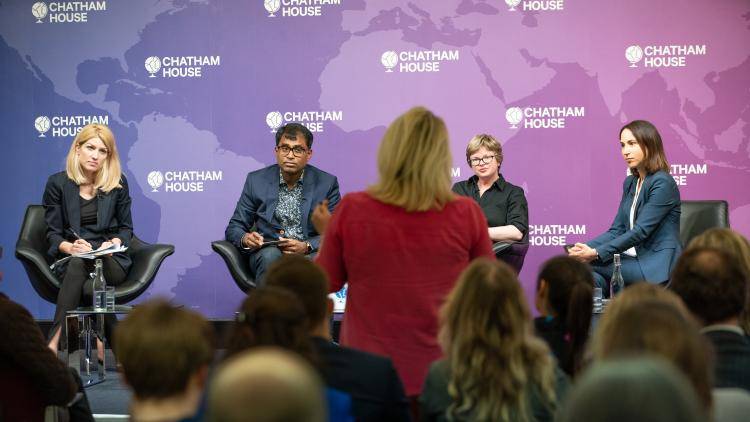
Alex Krasodomski
Good afternoon, everyone. I think we’re good to go. So, welcome everyone to this panel. I’ve got a bit of feedback there from somebody – oh, sorry, Mary. Good afternoon, everyone. Welcome to this panel tackling “Democratic Resilience in the Face of Global Disruption.” My name is Alex. I look after the Technology Programme here at Chatham House, where we have a lot of focus on the relationship between technology and democracy. This session, as a reminder, is taking place on the record, it is recorded, and I encourage you in the audience to submit questions for my esteemed panellists throughout the event using the Q&A function. We’ll come to them during and also after the discussion.
Now, we’re delighted here at Chatham House to be partnering on this event with the SNF Agora Institute at Johns Hopkins, and to introduce today’s discussion, I am delighted to welcome the Institute’s Assistant Director of Public Programmes, Mary Bruce>. Mary.
Mary Bruce
Thank you so much, Alex, and hello to everyone across the globe. I’m so thrilled to be here at the Stavros Niarchos Foundation Institute at Johns Hopkins University in Baltimore, Maryland. We are just outside of Washington, D.C. here in the United States. And the SNF Agora Institute is an academic and public forum, dedicated to strengthening global democracy through research, teaching and practice. We seek to foster understanding, encourage inquiry and support the conditions in which democracy can thrive, including through events like this one.
Today’s webinar is actually the final instalment in a series of engagements this year convened between Chatham House and the SNF Agora Institute, all focused on themes of democratic resilience. And I want to express first our deep gratitude to the Stavros Niarchos Foundation and to Chatham House for this remarkable partnership, in particular at a time of global disruption. I also want to thank the hundreds of individuals and organisations who have come together over the past few months to contribute to our shared learning and work of democracy and all of you tuning in today.
We convene these conversations – I thought it could be helpful to share a little bit about our why, we convene these conversations because democracy is at an inflection point. We know that around the world, yes, we are witnessing rising authoritarianism, growing polarisation and what many scholars call ‘democratic backsliding’ and we are also seeing extraordinary examples of civic innovation, youth-led movements for change, and communities all across the globe finding new ways to strengthen democratic culture from the ground up. So, the collaboration between Chatham House and SNF Agora Institute represents something really, really special, a participatory set of experience that model the democratic participation, learning and co-learning that our institutions seek to foster.
And just a bit more about how we got here. The partnership began with an online challenge between the SNF Agora Institute and the Chatham House Common Futures Community, where more than 100 young professionals in just as many countries shared their experiences and ideas about democratic renewal in their own communities. Where we brought together experts from – our institute and Chatham House brought together youth leaders who were bringing their expertise and experience where we could listen and learn, as well.
We continued this conversation in an online format like this for deeper dialogue and connection across borders and generations and then brought these findings to the Chatham House London conference this past June, where we, SNF Agora, served as the conference’s official insight partner and co-led a spotlight session and a Next Generation Futures Forum. And it’s this type of transnational, cross-institutional, cross-generational collaboration that democracy needs to thrive and is what we’re doing here today. So, today’s conversation continues this work, sharing strategies, grounding our work in research, building connections, charting pathways forward for democratic renewal in each of your contexts and around the globe.
So, to help kick us off, the question we are faced with isn’t whether or not democracy faces challenges, it’s how will we respond to these challenges? How do we work together to build resilience that helps democratic institutions, weather disruption? How do we foster renewal that makes democracy more responsive, inclusive, effective? So, again, thank you all for tuning in, for the work you do each day. Democracy isn’t just a form of government; it’s a set of collective practices that require constant cultivation in order to stand the test of time. So, with that, I’m turning it back over to our esteemed chair, Alex Krasodomski. Alex.
Alex Krasodomski
Mary, thank you so, so much, and al – thank you also for the partnership. Look, we are living through what many are calling a ‘crisis of democracy’, Mary called an ‘inflection point’, this period where democratic resilience is being called into question time and again. And while these numbers are real, democratic deli – decline, backsliding, youth disaffection, particularly among young men, which is perhaps something we might touch on, we do need more precision, both about the problem that we are diagnosing, but also in the solutions that we propose. Is this about democratic systems failing to deliver, jobs, security, dignity, or is it about something deeper? Economic precarity, wealth concentrations are obvious stressors, but democracies have weathered these crises before.
A subject close to my heart, the digital transformation of the, sort of, information landscape and the economy, has changed everything and concentrated unprecedented private power, yet young people are simultaneously more globally connected, often more civically engaged in certain domains than any previous generation. So, I guess my – the question that I will set to my amazing panel is what explains these paradoxes? Why do we see youth climate mobilisation, for instance, alongside youth democratic dissatisfaction? What differentiates democracies that prove resilient from those that don’t? And perhaps, most importantly, for those fighting for democracy and its values, what is working now and what will work tomorrow?
Our speakers, Hayder, Sabina, Anthony and Scott, bring radically different geographical but also professional perspectives. They may not agree on every diagnosis or prescription, but that, to my mind, is probably exactly what we need. So, listen, let’s get started. Hayder, I would love to turn to you first. Hayder is a Research Fellow here with – at Chatham House, with us, with the Middle East and the North Africa Programme at Chatham House. Hayder, over to you.
Hayder Al-Shakeri
Thank you so much, Alex, and thank you to SNF Agora, Chatham House, for hosting us today, great, amazing panel – set of panellists here. So, I will talk briefly about the, sort of, messy democratic process that we have in the Middle East and North Africa region, and how since the Arab Spring, there has been many attempts from different generations, but especially young people, to focus on bottom-up approaches and focus on pushing reform, pushing participation into the decision-making process. And this is what democracy is all about, it is the essence of the democratic process.
So, across the MENA region, many citizens have lost confidence in the political institutions, and that has been, you know, the trend across, you know, authoritarian regimes, and, you know, the region itself is a mosaic. It’s a different set of government structures, monarchies, republics, and you have different sets of structures. But to restore the trust in the political institutions, in the systems themselves, there needs to be some practical reforms, and so far, we haven’t seen this in particular across the region. And in response, citizens of the different region in 2011, and even until today, they’re protesting, and this – the protest movements have been one of the few ways where citizens can push for their voices to be heard.
And one of the examples is the protests in Morocco, the Gen Z protests, inspired by, you know, the Gen Z protests that are happening across different parts, different geographies of the world. And young people from the Gen Z are, sort of, working with each other, they’re getting inspired by each other, and they’re connecting with each other using technology, using Discord and other mechanisms. And this is something maybe we can talk about later, Alex, to mobilise, to work together, to, you know, get the message out there. And they’re, sort of, rebuilding these informal community structures, and this is allowing them to, you know, channel their anger, channel their frustration, into the lack of accountability, the lack of – you know, the ways that, you know, the government is not hearing them, the ways that, you know, the economy is not going into their direction, into, you know, channelling their demands out there into the sphere.
And the government initially responded with some, you know, top-down approaches, announcements. There were arrests of activists, but after a while, they realised, you know, they can’t stop the protests and that mechanism, and they need to actually address the grievances of protesters, and that’s when, you know, they began to do some real reforms. They began to address the protesters in a manner where, you know, they’re trying to implement mechanisms for participation, for young people to be included. And we saw this in Tunisia after 2011, where Tunisians were really included in their systems, in their democracies. for a few years, and this was, you know, a success story of the Arab Spring until, you know, it backslide – backslid again into authoritarianism as it is today.
So, now we’re seeing two clear policy lessons. One is engagement must be built into the pro – the policy cycle, and this is something that, you know, governments are learning. So, government – for example, the Gulf monarchies are trying to implement this and they’re trying to include their citizens in the – in participation in the democratic process, even though they’re not democracies, per se. And the second one is trust grows when reforms address the people’s daily needs, and this is when it comes to economic demands, for example. And in Morocco, we’ve been seeing that the government has been focusing on luxurious projects, on big infrastructure, luxuries, like stadiums, instead of, you know, building schools or hospitals, and this is something that citizens really needed. So, that’s what, you know, people were asking for in the protest and that’s what the government should do.
So, it’s simple steps, for example, transparent budgets, open selection processes, some accountability mechanisms where a community can have oversight over their, you know, decisionmakers. That’s what’s needed, and that’s something we can discuss later.
Alex Krasodomski
Thank you, Hayder.
Hayder Al-Shakeri
I would love to hear my fellow expert panellists. Thank you.
Alex Krasodomski
Thank you, Hayder. That’s a really, really useful perspective to, sort of, kick us off with, particularly – and this idea of, sort of, youth participation feels like – I can’t think of a better person to turn to there than Sabina. Sabina, who since October this year is the President of Naša stranka, Our Party, in the National Parliament of Bosnia and Herzegovina, as well as being a member of the Foreign Relations Committee and the member of the Parliamentary Assembly of the Council of Europe. Sabina, this sounds – maybe there are parallels to the story that Hayder is telling in your story.
Sabina Ćudić
To a certain degree, to a certain degree. However, what we’ve seen in my country is this contrast between the protests in neighbouring Serbia that have been going on for quite a long time against the regime of Aleksandar Vučić, and, at the same time, a complete absence of youth protest in Bosnia and Herzegovina. Not that there would be no reasons for protesting in Bosnia and Herzegovina, but we have completely different political systems, and in Bosnia and Herzegovina, essentially all parties, tens of them, are in different governments on different layers. But I will not bore you in the sense with our rather complicated system that contains 14 governments with a popula – in the population of – in a country with a population of less than four million people, or less than three million people at this point, close to 2.7 million.
But I will – I’m intrigued by something you said in the beginning, Alex, saying about the ‘efficiency of democracy’ and is there maybe time in the moments when we are experiencing severe democratic backsliding and a global crisis to wonder also – to look inwards as much as we look outwards and look for mistakes we’ve made and the failures of – on our end? Those of us who’ve been celebrating democratic transition for decades, I come from a very progressive political party that has benefited from democrat – process of democratisation in my country, undoubtedly so.
But there is question of failure of efficiency of democracy, and in that sense, I think I come from the right part of the world to discuss that, because the level of Yugo-nostalgia, for example, for the communist regime, for the socialist government of Tito’s Yugoslavia, comes not just from, of course, the nostalgia that comes with age, and we can go into the psychology of that, but a large part of that is the sense that democracy, yes, it brought freedoms, undoubtedly so. We have many, many, I would argue, too many political parties. Yes, we have freedom of speech and freedom of media. One can argue to what degree, but certainly to a higher degree than we had decades ago. But what we – but the perception is that we don’t have the efficiency of a system that was essentially a one-stop shop, because if you have one party, it’s a one-stop shop in terms of the decision-making process.
And which leads us then to did democracy in this part of the world deliver economic progress? Sure, depending on where – you know, what data, or how you cherry pick your data, but the overall sense of progress is lacking, is lacking in the sense that the revolution that we expected that will stem from a democratic tradition – transition did not give – did not provide the fruits that people generally assumed would take place. Because if in this is part of the world you’re thinking about democracy, you’re also thinking about the European Union and the European Union accession process, and you’re associating that with the democratic transition, that is entirely illusive to this part of the world, well, at least the Bosnia and Herzegovina and a good portion of the Western Balkans.
Which – and then not to take too much time, I will conclude by saying we are no longer just experiencing paradigm shift. I think we are experiencing a paradigm breakdown, in a sense, a complete reshuffling of priorities. Whereas before our priority was freedom to protest, freedom to have free and fair elections, freedom to choose and elect and be elected, I think we are in the process of rethinking those priorities. Not that they don’t matter, but do they matter more than economic progress? And people are starting – parts of the world is starting to associate absence of economic progress with the democratic transition, which is incredibly dangerous.
And finishing with a question, maybe, that we can discuss in the rest of the panel, the question is, why is this a global trend? We come, as you said, Alex, from vastly different backgrounds, from vastly different political systems. I grew up – I was born in one country, grew up in another. I’m hoping to join the EU, which will be a third structure within my not so terribly long life. But the question is, how come we are coming from vastly different parts of the world, such as Hayder, myself, yourself, we have UK, United States, and so on, but we are experiencing incredibly dangerous rise of populism and disillusionment with democracy? And perhaps we can answer that in the rest of the panel.
Alex Krasodomski
Sabina, thank you so much. Some really, really interesting points to pick up on there, particularly that connection between this perception of democra – the democratic transition being associated with tougher times. Anthony is a longtime observer of democracy, and as CEO of the Westminster Foundation for Democracy, this is obviously a subject that is both close to your heart, but also one that you’ve had, you know, a while to examine. Wha – are we at this, sort of, pivotal moment now? What do you make of it?
Anthony Smith
Thanks very much, Alex, and thank you so much to the panellists, just the first two have laid down quite a lot that I want to come back on. And just for those who don’t know, our organisation is the UK democracy support organisation, we basically, do three things. We support work at country level to embed democratic reforms. We’ve worked in both Bosnia, where Sabina’s from, and Morocco, where Hayder is speaking about, for a long time. Second, we do research into some of the practical knowledge to help people who are conducting reforms, and third, we work at international level to try and support standard-building and implementation of democratic standards in different way in parliaments, etc.
But I’m going to – I mean, there’s so much to come back on on what’s been said already, but I want to pause a bit on that just to go to the phrase ‘democratic resilience’, which is the title of this webinar, because I think just understanding what we mean by that is important for getting the right perspective. And there are three things I like about the phrase ‘democratic resilience’ but a couple of things I not so – don’t like so much, and I’ll just say briefly something about those, and you’ll see why.
I mean, first, I like the phrase ‘democratic resilience’ but it implies something that is definitely true, politics is a really tough field to work in. Politics is a serious business, people attack you. Sabina knows, we met at a conference about violence against women in politics, where we heard lots of examples of the incredibly horrible things that happen to women who take – are brave enough to stand up to be active in politics. People are killed sometimes, so it’s a tough field. So, resilience is a really important element to bring out in that, you know, this is something really difficult to work on.
Second, resilience implies to me that the work on this is underpinned by values. If you’re going to be fighting and being resilient and resisting backsliding and attacks on you, you’re doing it for a reason, and I hope we’re all doing it for the reason that we understand the importance of the freedoms and the ability of people to live lives they want, and the importance of accountability and inclusion in our politics. And third, I like the fact that when you talk about resilience, you realise you’re talking about more than just technical skills, because at the heart of resilience are really behaviours and culture, the things that you need to enable you to help build a community that you are part of that respects each other properly. And those behaviours take time to develop; it’s not like flicking a switch.
So, I like those things about the concept of democratic resilience, but there are a couple of things which I think could be misleading or you have to guard against. First of all, the resil – democratic resilience is a shorthand, and every shorthand might suggest that there are shortcuts, and there aren’t any. This is a long-term, continuous task, a work for all of us, it’s not a quick fix. It’s something that if we’re going to take it seriously, we have to recognise the complexity and the long-term nature of it.
The second thing I’m cautious about is the suggestion in the phrase that we just want to go back to where we were before. The status quo before was not good enough to deal with the problems that we’ve got now. Democracy clearly wasn’t perfect in the past in many countries, and everything that we see, the things that you’re interested in, Alex, in the digital area, suggests that democracy needs to change and adapt to the world that we are living in now and that is ahead of us. So, we have to recognise those shortcomings. It’s a shorthand, democratic resilience, it risks oversimplifying things, but on balance, I think it’s an important concept and one that we should work on.
And just to close on this, a couple of things which I have noticed about its use. I’ve been in the democratic support community for a while. This phrase has taken on – got a lot of traction recently. It’s got traction in the security area. NATO has work on a Centre for Democratic Resilience. That means that for us in each of our countries, we’re recognising that democratic governance is part of our national security agenda, our own democratic governance at home, but also the way in which other countries that could pose a threat to us are governed.
But it’s also a universal issue. As Mary was saying at the beginning, this is something which is important all around the world. You don’t have to be in NATO for it to be important. It’s a job which we all have to work at and that we can’t take for granted. And I think for our organisation, the point that Mary made about co-operation is critically important. How do we work together to resolve these problems? Unless we co-operate together, we won’t reverse the 15 years of democratic backsliding that we’ve seen around the world. We’re back at levels of democracy around the world that are those that were last seen more than 30 years ago. So, those are the things that I’m really looking forward to talking about, how do we co-operate together so that we can do better in the future than we have in the past? Thank you.
Alex Krasodomski
Thanks, Anthony, and yeah, it sounds from Anthony’s intervention that this is a long-term process. That resilience of that – and to some extent, it’s not necessarily in our hands, Scott, it’s in the hands of the generations that will come after us. And that idea of growing into democracy, and as – and growing – you know, the next generation of Democrats, I think, is clearly something that you have an enormous amount of insight on.
Scott Warren
Yeah, excited to talk through this. Thanks so much for having me. I’m a Fellow at the SNF Agora Institute. It’s been wonderful partnering with Chatham House. I want to – I appreciate being the only American on this panel, because I feel like usually, it’s the opposite way. Like, we have a lot of Americans and then bring in someone from the international perspective. I also just want to note to start, when we talk about ‘democratic resilience’ I mean, one of the best things Americans can do right now is to hear and listen from the perspective of others. And so, I’ll offer some thoughts, but I’ve been able to engage with folks like Sabina and Anthony in the past, and it’s great to meet Hayder.
I do think that there’s an opportunity here for Americans to offer some humility, just based on recent trajectories and what we can learn from the rest of the world, also recognising the role that the US plays in the rest of the world, I think we can’t minimise that. But I, sort of, just want to start with that, and something that potentially we can go into, but this is – I just really don’t want to be the, “Well, here’s the American perspective and here’s what everybody else should do,” not that perspective has ever come across before.
My background, I ran a youth civic education organisation in the US for a while, partially because youth civics education in the US has been de-emphasised a lot in recent years, and so, I have that perspective and can talk about some of the recent work that I’ve done at SNF Agora. I think, and this goes to some of the points that were made earlier, young people play a specific and important role right now across the world and in the US. They are clearly frustrated with – and I think it’s important to know, and maybe we can get into this, they are frustrated with the form of democracy that they are experiencing. I think sometimes that comes across as they don’t believe in democracy itself.
I think there’s a distinction between democracy as a principle and ideal and what they have been told is democracy and something that is not working for them. And I worry that that’s something that we fail to see the discrepancies, but there’s – you know, they’re awakening to the fact that these institutions don’t work for them and they’re trying to push – I think, the negative part of that could be a scepticism and a cynicism. The positive side is actually envisioning in other ways. And I think what you’re seeing around the world, I was in Kenya last year during the youth protests there, in the midst of the tax law, you’ve seen this as was talked about in Nepal, I think that there’s some interesting developments happening.
I want to actually just pull some specific data from the US. We’re releasing a report in the next few weeks that will actually go through generational differences, and again, this is a US-specific context, but this goes to show you the scepticism and cynicism that I think is happening in the US, but across the rest of the world, too. So, we asked the question, “Do you think that the design and structure of our nation’s government needs significant change no matter who we elect to represent us?” So, this is, sort of, going beyond the who’s in charge now, but we need to change structures.
62% of 18 to 29-year-olds think that the design and structure needs significant change. Only 46% of 65+-year-olds thought that. So, that’s 62% versus 42 – 46%. This – you could say that this, you know, maybe goes to specific political parties. The US has two main political parties. We asked the question, “Which of the following statement comes closest to your view, that your specific party is moving in the right direction, party needs to dramatically change?” 42% of 18 to 29-year-olds thought that their party was moving in the right direction, 64% of 65+-year-olds thought their party was moving in the right direction. So, most older people in America think that their party is moving in the right direction, and a plurality of young people do not think that their party is moving in the right direction. Party needs to change, 58% of young people think their party needs to change, only 36% of older people think their party needs to change.
One just – I’m going through stats, but one final thing, and this is a more optimistic point, but I think this is really interesting, and I’d be curious how this comes across in our national context. We asked the question, and again, I say this is a US-specific question, but we have effective polarisation. We have polarisation that goes beyond policy differences, to demonising the other party. We asked the question, “The opposing party is not just worse for politics, they’re downright evil.” So, if you’re a Republican, you got the question, “Democrats aren’t just worse for politics, they’re downright evil.” If you’re a Democrat, you got the question, “Republicans aren’t just worse for politics, they’re downright evil.” 61% of people over the age of 65 thought that the opposing party was evil. So, not just worse for politics, but downright evil. 61% of 65-year-olds, it was 52% of 45 – 60 to 64-year-olds, so it’s older people. Only 39 per – I mean, I say only 39%, 39% is still high, but 39% of 18 to 29-year-olds thought that the opposing party was evil.
So, this is where I actually see that there’s some optimism. My perception of this is that young people are, like, the systems are so broken that we have to fundamentally reimagine them. Where older people are, like, what’s broken is the opposite side, and so I’m going to demonise the opposite side. My side is right, because they have a specific tribal notion with their side, and so I’m going to defend my side. Where younger people are, like, screw the system. Pardon my vulgarity. I’m curious how that actually resonates with other countries, but I think that there’s a sense of optimism there and would love to explore that as we go forward, too.
Alex Krasodomski
I would like to put that actually, to the rest of the panel here, is in – the difference between perhaps more traditional engagement with political systems, particularly democracy, you know, in the local context that you work and those of the young and how they are different. We’ve heard about protests, we’ve heard about obviously technology, and so on. Hayder, if I can come to you, the –and then, Sabina, perhaps I’ll come to you afterwards. What is different about young people’s engagement with democracy vis-à – you know, as compared to their older generation?
Hayder Al-Shakeri
Yeah, that’s a very good question, and I think part of it is linked to the economy and jobs and, you know, how people survive daily, and young people, I think, globally are facing issues with their economies. It’s not the same as it was before, and in order to, you know, be included, I think that these economic pressures are driving demands for inclusion by many people, you know, many young people, especially. And, you know, and we see that whether it’s, you know, calling for reforms, calling to end corruption, calling to end, you know – calling to, like – to get more jobs. All of these, they are, you know, going back to the economy and economic struggles.
And, you know, I appreciate Anthony’s point. I am from Iraq and the US really tried to force democracy on the country. And now we have democracy in a way, so there are elections and we had elections in Iraq last week, but, you know, people still don’t feel included, and there were huge protests in 2019 where young people were demanding end of corruption and everything. So, we have the elections, and we have some, sort of, democratic process, but then the people still demand accountability. People still demand to be included in the political process; people still demand transparency. So, it’s, you know, a thin line, and I think young people today, because of technology, because of the awareness that’s being risen out there, they notice that and they demand it much more than, you know, generations before.
Alex Krasodomski
Sabina.
Sabina Ćudić
What I’ve noticed – first of all, let me start by saying that I think what Scott just described, as devastating as it is, is a global trend. Well, at least it’s a trend that our surveys here show resemblance to. For example, we did extensive focus groups. What we’ve noticed is that young people from the age of 18 to 25 are having a hard time articulating how political process at all could address the issue that they identify as important to them. So, when we say, “Housing shortage is important to young people,” we assume that from their description of the issues that they’re facing in their life and the – explaining, you know, the inflation and the cost of living and so on, but at the same time, they are much less worse in explaining how through policy process, their issue could be addressed than the older generation.
The older generation in Bosnia and Herzegovina is interesting because they are, I think, the only generation that follows all kinds of media. So, it’s not – so they’re the generation, 60+, who have their iPads, who have their smartphones, but are also – they tune in every night to news from, you know, five main channels. From 6:00pm ‘til 9:00pm, they’ll be following a news channel, news cycle, throughout, and then doublecheck it through their smartphones and electronic devices. While the young people have a much more narrow way of digesting political information, coming primarily from social media. Most of them don’t watch TV, whatsoever to get, for example, the news or watch news channels, and so on.
So, in that sense, I think it’s a dangerous trend. Excuse me, Scott, we have the same data, but my conclusion is not as optimistic as yours. Because I think what the parties, political parties, are getting at – my party is a member of the European Liberals Alliance, and just a couple of weeks ago, I was in Brussels for the European Liberals Congress. And, you know, you have different sessions besides the elector – elections of the new leadership and so on, and one of the most attended sessions was, you know, new ways of conducting campaigns, and so on. What I find disheartening, even among the people that I find most data-driven in policymaking, such as European Liberals, what we are seeking, and this goes to something that Anthony says, we look for quick fixes, and I think that’s a very dangerous element. Quick fixes and – that come in the form of gimmicky technological solutions, no offense, Alex.
Alex Krasodomski
None taken.
Sabina Ćudić
In a sense, how I see technological advancements helping us run campaigns is that we have data-driven policies that address real-world problems, and then we use technology to better explain it to various generations. But I think we have it the other way around, we operate based on not just assumptions, but impressions, I have the impression that what people want and so on. And then it’s this what I always call ‘politically incestuous relationship’ between my voters and me as hopefully, a political leader who’s, kind of, recycling what they want and me feeding it back to them and then they communicating it back. Whereas we are not then producing smart policy solutions and not actually getting to the root cause of the problem. So, that’s what I would like to reiterate.
Alex Krasodomski
I’d like to…
Sabina Ćudić
Quick fixes, gimmicky solutions, versus the older generation that thinks we just need to go back to status quo. We just need to go back to everybody fully respecting Congress, and generation of people who, you know, look more like hospice candidates than Congress candidates. It’s not working.
Alex Krasodomski
Anthony, this is a challenge that Sabina, and I think Hayder have spoken to, of democracy as a theory of change, it is a direct challenge to the idea that democracies can change the lives of the people who live within them. Is that something that you would, you know, would agree with that as an assessment, and one of the core things that re – that the – resilience is going to be required in order to overcome?
Sabina Ćudić
Absolutely, that’s exactly – because if we are advocating…
Alex Krasodomski
Sabina, I’m just going to go to Anthony on this one…
Sabina Ćudić
Yeah.
Alex Krasodomski
…and then I’ll come back to you if that’s all right.
Sabina Ćudić
Well, let me just – if we are advocating for status quo, that’s not…
Alex Krasodomski
Yeah.
Sabina Ćudić
…pushing us in the direction of democratic resilience, that’s all. That’s all I was going to say.
Alex Krasodomski
Thank you, Sabina.
Anthony Smith
Well, I second that, Sabina. So, I’m going to do a little bit of what I did a minute ago, just try to make sure we understand the terms we’re using, because I think the phrase ‘democracy isn’t delivering’ is used a lot these days. To me, that’s also a bit of misleading shorthand. I think what is absolutely clear is that many of our political systems are not delivering, even within a democracy. We can talk about, “What do we mean by democracy?” Democracy, to me, the key element that we want in democracy is stopping the abuse of power by elites, so it’s accountability and inclusion.
What we have seen in many developed democracies, even while there have been effective systems for representation, elections, etc., is that our politics have failed. You know, we’ve had since 2008, in the developed world and globally, a situation in which our children don’t believe that they will be as well off or better off than their parents. That’s certainly true of my children in the UK, and those things affect the way that people feel about what the political system is doing for them.
Going to the young people point, which I think is absolutely critical, it’s affected by demography. So, North Africa, most of the African continent, young people are the majority of the voting population these days, or near the majority of it. They’re the critical group that have to feel that they have a voice in decision-making. I think this issue of participation is absolutely critical. We do a series of research projects. We have a research project called “The Cost of Politics,” which does case studies. We’ve got about 30 case studies from around the world. The barriers to involvement in politics, involvement in political parties, being a candidate to run for office, for young people are absolutely huge. They’re absolutely huge for women as well and other disadvantaged groups. Money really matters; if you don’t have money, you can’t be involved in politics.
So, some of the countries that Hayder mentioned, where there have been protests, and Scott, I think, mentioned as well, one of the issues there is that so many people feel that the political system is unfair. I don’t want to tar the whole of democracy with that brush. We need democracy to have accountability to push inclusion and participation. We really have to think about enabling people to participate over the long-term in democratic processes to get back that confidence. I saw in the press in the UK today a poll that said that some large percentage of young people in the UK think that dictatorship or autocracy would be better than the situation we’re in now. I think that’s borne out of frustration for them, as well, and probably not understanding – there’s probably some spin of the implications of it, but it’s a real issue. We have to have people feel that the political system is fair.
Alex Krasodomski
Scott, to come back to you and, you know, forgive me for not doing you a, you know, a proper service in an introduction, but I think is testament to the fact that you are a serial, sort of, policy entrepreneur when it comes to meeting the challenge that Sabina and Hayder and Anthony have raised of the need for innovation here, of development, of something new when it comes to involving young people in democratic activity. How do you do it? What’s the – how do we do it?
Scott Warren
So, I mean, I think this is the question of the moment. One thing I would say, and this I think, goes to Anthony’s point too, there’s this notion that – it’s not a notion. there’s a reality that young people don’t trust institutions because they’re not delivering for them. Democracies can’t really work if you don’t trust public institutions. I think the way to get young people to trust institutions that they don’t believe in is not to tell them to trust institutions. You have to, sort of, meet them where they’re at, to some extent, and acknowledge that the institutions have to be reformed. So, I’ve been involved in efforts, you know, pertaining to what we might call action civics education, the distinction between civics education that’s focused on, here’s how government works, to, here’s how you can actually participate in government. So, I think that that’s an important potential intervention.
But I think that one of the things that elected officials have to do is, you have this vicious cycle, and again, I talk about this in a US context, although I think, as Sabina says, it has some global implications too. In the US – so I was going over the statistics before about how much more frustrated young people were about the state of politics. Older people also vote more than younger people. So, what happens is that this cycle happens where young people say they’re frustrated, but Politicians, probably logically, pay more attention to older generations. Older generations vote, Politicians pay more attention to older constituencies and, sort of, the cycle continues, and so, how do you break that cycle? Democracy is more than elections, but I think that that’s something that is happening.
The other thing, we touched on this a little bit, but to the point that I was making earlier on the frustration with parties, one of the things that I think is happening is parties are an imperfect vessel for articulating policy preferences, but they’re also a really important preference. And so, one of the things that I think young people are reconciling and grappling with around the world is the balance between expressing frustrations outside the system and recognising the importance of being involved in the system to some ends in terms of achieving change. And I’m curious how that – like, Sabina’s party’s dealing with that, but I just see that that’s a challenge.
The last thing I’ll say that was touched on, as well, which I think is really hard, is just the bifurcated information ecosystem right now. So, yes, young people are getting much more of their news on social media. Where I’m worried – so I’ve tried to, sort of, balance being more optimistic and potentially more pessimistic, I teach young people at Hopkins, sometimes I hear a little bit of the, “Yeah, we, sort of, know that everything coming across TikTok,” which is where they get a lot of their news, “or YouTube, is biased to some extent, so we just don’t really believe anything right now.” And I do think that sense of, like, we don’t really believe anything, or that there isn’t this coherent set of facts, I think the positive side of it is that they’re more discerning in terms of what’s true and not true, but because people – I mean, this is beyond young people, but young people are getting their news much more from social media than anything else, it does create this environment where it’s pretty challenging to actually participate in the process.
The last thing I’ll say, just to respond to one of the points that Anthony was making, I do also worry, ‘cause we can get into this, about the democracy not delivering framework, because I do think that – and for young people, especially, but for everyone, I do think that is true and economic outcomes matter, but democracy can’t just be about economic outcomes. There’s other aspects of the system that are important, you know, free speech, civil liberties, and I worry that we’re neglecting those because of this, like, well, the point of democracy is to deliver. Autocracies can deliver, they might not deliver as equitably, they might not deliver as sustainably, but if you’re just pushing on democracies delivering, I think you might get into trouble.
Alex Krasodomski
Who, Scott, is inspiring you here? Who should we be looking to? Who are the fellow travellers here? I’m going to come to Hayder and Sabina and Anthony on this, as well. I would love to know where our audience should be looking for hope and inspiration. Who are the people who really have an answer, their answer, to this question that you find compelling? And then I’m going to move to some questions from the audience. Keep these answers very short, please.
Scott Warren
I mean, I think that some of what I talked about before, I do think that you have young people, you know, in places, I mean, like, Nepal was mentioned, and places throughout the Middle East, that are just pushing on different systems of government right now. You’ve seen that in places in the US, too. I also – you – the other place I’d look to beyond young people, some of the work that I do in the US is with Conservatives, who you might not think are the most likely to participate in this type of work, but have been standing up in different ways. I, like – who are the unlikely actors that can show up for democratic resiliency right now? That’s – I think that you can find pockets of that, for sure.
Alex Krasodomski
Thanks, Scott. Anthony? The same question, who’s, yeah, who’s inspiring?
Anthony Smith
Yeah, thanks, Alex. I think, you know, we work around the world, even in the most difficult places that we work in, you can find inspiration. It can come at local level, so there are people in local civil society organisations that are working on things which don’t have a ‘democracy’ label, but they’re talking about, “Okay, what are the rights that women should have in helping to govern their community?” Or “How are we going about ensuring that there’s water for everyone in this community?”
And I would also say that generally we’re looking at places which are not the older democracies, the more mature democracies, but newer democracies, which are connecting to people in different ways. And thinking about how do we find a good solution for this problem by working together across lines, whether they be party lines or gender lines or tribal lines? Those are the places I find inspiration.
Alex Krasodomski
Thanks, Anthony. Yeah, Sabina, can I come to you? Like, who inspires you? Who are the people that we should be celebrating as part of the, kind of, the movement for democratic renewal?
Sabina Ćudić
Well, I can talk names, obviously, that you would recognise, even from the American spectrum. I don’t think that everybody on the panel would be delighted by me using those names. I’ve been following, of course, the what I think was a spectacular campaign by the New York Mayor and, of course, by his colleague, AOC, before that, and – but it doesn’t have to be that ideology. I’m not selling the ideology, necessarily. Like, look, I come from a social liberal political party, I don’t – I’m not necessarily a big proponent of state-owned grocery shops and so on. But I think the solution – for a long time, we assumed that the solution will come from some kind of political laboratory or the guidebook of a well-paid Political Consultant, and my answer is it will not.
The staff I have, I’m sitting in the headquarters, and I’ll stay long into the night in Naša stranka, has less people employed than our rivals have drivers in one municipality. But we have comparable results, because I think the solution is to lead with courage and hope and authenticity, which we are desperately lacking, and again, avoidance of gimmicky solutions, people who essentially talk to people. It’s not about, how do I pretend to be talking to people? It’s about, how do I go and talk to people and how do I have enough money to visit all the towns and villages that I want to visit?
But it’s not just about the leaders practising these three things, it has to come also from the business sector, from people who are invested in this idea that it’s not just about economic growth, that it’s also about evolution and human dignity. So, how much time are you willing to sacrifice coming from academia, from perhaps business sector, from NGO? Are you volunteering? Are you donating money? Are you talking to your neighbours? These are all the answers.
Alex Krasodomski
Thanks, Sabina. Hayder, let’s finish on – with you.
Hayder Al-Shakeri
Yeah, no, I really echo Anthony and Sabina’s points on this, and Scott as well, he mentioned it, I think. It’s all about communications, at the end of the day, and I think what Mamdani and AOC before that, they were successful at communicating with their constituents in such a clear manner. In the age of disinformation and, you know, all the social media, sort of, echoey information out there, they were able to communicate with their constituents in a very clear manner and that’s what, you know, got them out there.
But also, to the point of Anthony, I think in many countries where democracy is not a thing, it’s about participation, right? It’s about how the grassroots organise around a certain issue, around a certain point. And I think I see this in Iraq, I see this in Lebanon, I see this in many countries across the region, the Middle East and North Africa, where climate activists, where women’s rights activists and defenders, they actually take it into their hands and they start, you know, rallying that issue into something that they lead on in the future.
Alex Krasodomski
Hayder, thank you. Thank you so much. I would love to open this up now to some questions that we’ve received from our audience, and listen, I’m going to give you three. We have about ten minutes or so, and you can pick and choose which ones you like, because there are a lot of really good ones. So, the first is just around the institutions that sit around democracy, particularly concerns around the future of international law and the relationship that it might have with the future of democracy, from Cecilia. Meredith would love a perspective on the gender aspects of democracy and the rise of the, kind of, male strongman and whether or not this – the trends of democratic backsliding are linked to backsliding on gender equality.
And then, lastly, and good luck to who takes this one, I will quote from Michael, “What is the Trump Administration doing to promote democratic resilience in the world today?” So, three questions from Cecilia, Meredith and Michael on international law, on gender, and on the Trump administration. Would somebody like to jump in on those?
Scott Warren
So, I’ll take the hardest one to start and answer it a little bit obliquely. So, one of the things that I think is really important, and I think that this might be happening around the world, is that the Trump administration would say, and I’m not trying to, sort of, judge them in this context, that they are doing a lot in the US to promote a stronger democracy. And so what I mean by that, I think that we – one of the – I’m trying not to opine too much, but one of the forms of democratic backsliding that you’re seeing happening around the world is leaders weaponizing the use of democracy to erode democracy itself.
And that I think is what – I mean, I think that this has happened across the aisle in the US, but what I would say, the Trump administration specifically, if you would ask them what they’re doing right now, so, let’s say, for example, some of their immigration policies, where they’ve been pretty stringent and they’ve been frustrated with Judges and the judiciary that is pushed back, and an independent judiciary is obviously key to an effective democracy. What they will say is that they want a mandate from the American people and then unelected Judges are getting in the way of fulfilling that mandate, and so they are trying to carry out the wishes of democracy and they are being stifled. This is vertical accountability; they’re trying to increase vertical accountability and get rid of horizontal accountability.
So, I’m not quite answering – and I mean, the other thing to say is just it’s –the people that were storming the Capitol on January 6th, this is not to defend them, they would say that they were there to defend democracy because they felt that democracy had been taken from them. So, I just think that the weaponization of this word is actually really troublesome too, and you’ve seen this with folks around the world, with Orbán in Hungary, with other folks, in ways that I actually think we have to grapple with, is that no-one and saying that they’re being authoritarian. So, I’m not quite answering the question of what he’s doing, but I do think that the administration would say that they’re promoting democracy in the US.
Anthony Smith
Alex, can I jump in on…
Alex Krasodomski
Please.
Anthony Smith
…gender? Because I don’t want to feel that it has to be a gendered response to this. I mean, I think that for our organisation, the fact that there is unequal ability of women to participate in political systems in countries around the world is an absolutely fundamental challenge to democratic governance. And that ability to participate and the failings of political systems is not just limited to women. There are other groups who can be excluded. But it is patently clear that if women are not able to participate fully and participate in a way that they choose to participate, then the political system is not representing their interests adequately, they’re not participating fully in decisions that are important for all of society.
And we’ve seen evidence through research in many places, including some that we have published, that says that the more that women are able to participate in political systems and participate in the ways that they – that suit them and that they choose, the more effective the policymaking is in those countries. There is clear evidence that women who participate not just in what are sometimes called ‘women’s issues’ but are active in economic decision-making, security decision-making, improve the quality of the politics in those countries.
So, that is absolutely clear, and it is also clear that there are big risks to the advances that have been made in gender around the world, both directly in terms of ability to participate, but also on relevant other issues, including around pushback on sexual and reproductive health rights for women around the world. So, this is an absolutely fundamental issue for democracy.
Sabina Ćudić
I’ll take on the international law, but I will briefly address the second one, as well. I know many people say with wonderful intentions and coming with true respect for communities or people they encounter in various parts of the world doing wonderful things, and then we tend to describe them in terms, there are lovely people around the world fighting for important things, youth fighting for protection of the environment or gender rights, and so on. But the fact is, if we don’t have – if these people are not in power or empowered or don’t have access to power, then this remains – I think, the previous status quo that we already described is not working. Because then we treat it as a, kind of – I’m not going to say of – a zoo of wonderful examples, but in a way, it does become that, and I say this from a country whose NGO sector has been sometimes treated as lovely people doing lovely things.
So, in that sense, going back to the question of international law, again, if we don’t have people in power interested in enforcing and respecting and developing further international law, it’s not going to come – you know, it’s not going to fall from the sky in a sense. So, going back to my previous response, we need people, a), realising that we are in a severe crisis, and that that crisis requires extraordinary measures and involvement in peop – of people in ways that maybe go beyond what they are usually comfortable with in the ways of expressing their support for a democratic resilience. So, in that sense, I think we need to go back to the drawing board and say, “Okay, how do we respond to this crisis?” What does it take for me personally, my organisation, people I work with, the university where I teach? It will certainly require extraordinary measures.
Alex Krasodomski
Thank you, Sabina. Hayder.
Hayder Al-Shakeri
Yeah, just on international law, and I think Sabrina covered it well – Sabina covered it very well. I think one aspect that many authoritarian regimes are – it’s a strategy that they use is when they criticise international law and then they criticise, you know, the double standards that are happening globally right now between Gaza and Ukraine and, you know, some of the ways that international order is shaping up in the world right now. And they’re, you know, turning to democracy and, you know, stating that it is a Western way, it is linked to the international order, while in particular, democracy, it’s more about participation, it’s more about people having a say in the way that they’re governed.
So, I think by, you know – authoritarians are trying to have this backlash against democracy and in a big manner, and they’re trying to utilise and make use of, you know, the geopolitical order that, you know, the international order is going through right now, but, you know, they don’t realise that democracy itself is something that should happen everywhere. Communities throughout the world want to have transparent institutions, want to have accountability and want to have a say in where their country is going.
Alex Krasodomski
Hayder, a great note to finish on. Thank you so, so much to my four fabulous panellists. I think Hayder, Sabina, Anthony, Scott, a really rich discussion. One that I think makes the case for democratic resilience, but, also – and it’s important, but also its renewal, the idea that this is not a question of going back, but a question of going forward. Not old, but new, and the critical part that is to be able to communicate with your democratic participants, your constituents, and meet them at their level, which I think is a really important part of this, particularly when they are this next generation of democratic activists.
And as Sabina says, that’s going to be no mean feat and it will require things that might sometimes look extraordinary, and I hope those extraordinary things are the kinds of things that the folks in this panel will go onto lead and the folks in the audience, too. Thank you so much to all of you for joining us this afternoon, and we hope to welcome you to a Chatham House event again soon. Thanks, everybody.
Sabina Ćudić
Thank you. Thank you very much for having us.
Anthony Smith
Thank you very much…
Hayder Al-Shakeri
Thank you…
Anthony Smith
…for this exciting panel.
Hayder Al-Shakeri
…so much.