Sir Simon Fraser
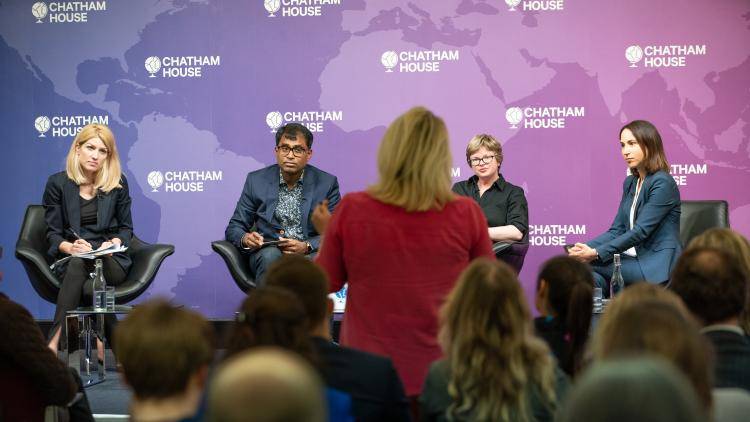
[Applause] Well, ladies and gentlemen, we have to fix, I think, some speakers. That’s it. I’m Simon Fraser. I’m the Chair of Chatham House, and I’m going to be – it’s my privilege to be chairing this event today, as well. Before we start, a couple of housekeeping announcements, if I may. Just to remind you that this event is on the record and it’s being livestreamed, and there are participants online, as well as those of us in the room. You are encouraged to use social media about this event if you wish to do that.
The way I’m going to organise this is I’m going to have a conversation with our distinguished guest for about half an hour, and then I will open it for questions from the floor. If you’re in the room, please just raise your hand and a microphone will come to you. If you’re online, throughout the session, you can put questions into the Q&A on your screen and hopefully, I will pick them up here, as well. Those are all the preliminaries.
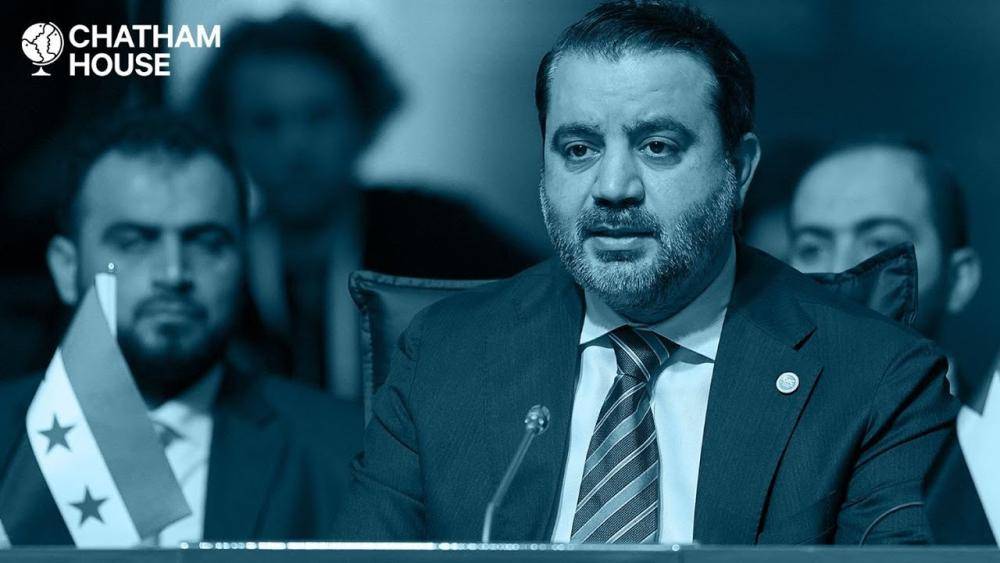
So, let me go straight in and say that it is a huge pleasure to welcome to Chatham House our distinguished guest today, who is His Excellency, Mr Asaad Al-Shaibani, who is the Minister for Foreign and Expatriate Affairs of Syria. He has been in that role since the overthrow of the previous regime, and the new government came into power at the beginning of this year. Prior to that, he was an active member of the opposition to the previous regime, working alongside the President of Syria, and he was responsible for the external affairs of the Islamist militia, which eventually overthrew the regime.
He has studied in Damascus University, with a degree in English language and literature, and also in Istanbul, with a master’s degree in international relations and political science. You’re very welcome here today, sir, and our conversation is about “A Foreign Policy for a New Syria.” So, perhaps I could kick straight off with the first question, if that’s okay. You’ve come to us from accompanying the President to Washington, which was an unprecedented visit there for a Syrian President to meet the President of the United States. And you have now come to London, you have put the flag up, I believe, at the embassy in Belgrave Square, and you’ve just come from a meeting with our Foreign Secretary. Could I ask you, perhaps, to start by telling us what happened in the meeting in Washington and what you take away from that and what has been achieved?
Asaad Hassan Al-Shaibani
First of all, I would like to thank you for giving me this opportunity to speak about Syria in this important phase. In addition, I would like to thank your audience for coming here to listen about Syria and its history in this important era. Of course, our visit to Washington, headed by His Excellency, President Ahmed al-Sharaa, is just part of the steps that we’ve been taking after the fall of the former regime. And it’s an attempt to reconnect the relationships between Syria and the world, based on a mutual respect and opening mutual opportunities in economics and politics, and familiarising the world with the idea that what represented Syria in the past does not represent Syria. It smeared the image of the Syrian people, the Syrian civilisation, and harmed the moral values and principles represented by Syria.
Our visit to Washington is a successful one. We focus on all the files that are important to Syria and including supporting Syria now. The position of the US now is a clear position, siding besides Syria, and they worked on halting the sanctions by President Trump. They supported Syria in all events, and then the American decision to remove the sanctions and the designation of the Syrian leadership last week in the Security Council. The Caesar Act is still there and it’s just a matter of time. Most of the obstacles has been removed so that this Act is removed once and for all. Syria is an important player in the region. The relationships between Washington and Damascus are on the right track, and I think they will affect the region entirely.
As for our visit to London and raising the Syrian flag and reopening the Syrian Embassy after being closed because of the use of chemical weapons by the Syrian regime against the Syrian people, their displacement, their killings and the destruction of Syrian cities, the decision to close it is a decision that we thank the British Government then for making, because it was a decision made for moral purposes and with the Syrian people. Syria is now back to its natural track. We reopened the Syrian Embassy to be repre – to representing Syrians, to be a platform representing them in diaspora, and representing Syrians here, and so that it’s not used as an intelligence agency against Syrians in diaspora.
We also had a meeting with Her Excellency the Foreign Minister of the – the Foreign Secretary of the UK, and I think our relationships with the UK are advanced. We’re not talking about opening a new page, we are talking about deepening these relationships because they are strong ones. The UK took an advanced position relevant to other countries. They have removed all sanctions, and they’ve opened relationships with the new Syrian Government first and they supported us in the UN Security Council, as well as in other problematic files and the heritage of the former Syrian regime, including the chemical weapons.
Our visit today to the UK is to enhance the relationship, strengthen them in investment and in all aspects to strengthen the ties between the British people and the Syrian people and to achieve the hopes of the Syrian people.
Sir Simon Fraser
Thank you very much for that. The British Government, I think, has said that the rela – “It is a pragmatic and cautious process of rebuilding the relationship.” What do you think they mean by that?
Asaad Hassan Al-Shaibani
In fact, we have not seen this personally, but we think that it represents a friendship that is deep on the humanitarian level, on the economic level, in the coming days, and it’s not a suspicious position to test it today. There are files that are very important for Syrians and for the British, and it is the duty of both governments to utilise the historical opportunity in Syria. Syria is not a marginal country. It is an important country, and there are a lot of files that were a worry for the world in the past, including migration, chemical weapons, the export of foreign militias, chaos in the Middle East, that is a concern for the entire world.
All of this has changed with the Syrian Government. There is no migration from Syria to the world now, it’s vice versa. Syrians were refugees because of the actions of the former Assad regime, and Syria needs reconstruction and needs people to go back. In these past 11 months, we have received more than one million Syrian returnees and more than one and a half million Syrian returnees from inside Syria who were displaced internally. The Syrian people would like to be a partner in the future of Syria, and the Syrian Government is keen to do this. So, we do not want to be different from the people, we want the responsibility to be shared by all of us, not to be the responsibility of one group or party.
The opportunity in Syria must not be lost. It’s an opportunity that all of Syrians dreamed of for this opportunity, and one – more than one million people were killed and martyred, and more than 250 people, Syrians, were lost, and for this moment, all of Syrians paid a heavy price. So, this is an opportunity owned by all of Syrians, so we are working round the hour to introduce to the world the importance of Syria and the opportunity that we must utilise. The position taken towards Syria is realistic, moral, pragmatic, and it believes in the future of Syria.
Sir Simon Fraser
Thank you very much. It’s obviously the case that there has been a dramatic change in attitudes around the world towards a relationship with Syria since the fall of the last regime, but I think, you know, the American, the British, and other governments, and indeed people, including people in this room, will want to know what sort of Syria are we engaging with? What confidence can we have that you will be able to follow up on your intent to create an inclusive society in Syria that represents all Syrians in which they feel secure and that their rights are represented?
It’s very important for people, obviously, to have confidence in that. There are people who are concerned that this will become a Sunni Islamist-led government in which other parts – other communities and some of the regions may not be represented. Can you give us more reassurance on that point, and whether, for example, you will be able to move towards universal suffrage and elections in Syria in the near future?
Asaad Hassan Al-Shaibani
In Syria, in the past 11 months, we have rectified all the preconceived concepts and ideas about Syria, the depth of the Syrian civilisation and its heritage and the Syrian elite. And what the Syrian people owns and experiences, be it civil society or politics, ensures that Syrians cannot accept something that they do not want to be imposed on them. The moments that we face now can be likened to a patient who is in the Intensive Care Unit, and we want them to get into a marathon on the second day. The Syrian nation is sick, and they want to represent themselves better.
What we are doing today is that we are raising up the hopes of the Syrian people that started with the fall of the regime and ending the regime in 11 days, and then 11 months of diplomacy and events in Syria, inside Syria, and events for Syria, outside Syria. Therefore, we can say that for the past 11 months, Syria has been the main event on media.
For future Syria, we aspire that the Syrian state is a state that Syrians believe in, not a state that is strange from Syrians or not a state that is exclusive, but an inclusive one, because the people need to believe in it. We have been marginalised and we have experienced sectarian governance in the country. Therefore, we aspire that the Syrian experience is an inspiring one in governance that is built on political multilateralism and that its economic experience would be inspiring a country that went through a 14 years of war, and then it’s an inspiring model to the world.
Today, what we have been able to achieve in these 11 months, maybe it is not a lot even for us, but it gives meaning to what we can do in the future. We have been able to fill the political vacuum in 11 months, starting with the national dialogue, the parliamentary elections and other events. The results perhaps are not ideal, but if we examine similar experiments in the world, we would find that our experience in Syria has been good, but when there’s a political culture and when the political discussion is allowed in the country, unlike during the time of the former Assad regime, the civil society would be active and present. And this will be allowed to people where there’s no secrecy or confidentiality or fear, this climate would result in a great development in government, parliament, constitution, and all aspects of life.
This will develop the form of government in Syria. We will not say now what will be the form of the state in five years, but we aspire to set bases for participation that will be developed with the experience that Syrians will gain in the coming period.
Sir Simon Fraser
So, thank you, but – so no commitment to the final the final model, but I think people are concerned to understand that the direction of travel is one that they have confidence in. So, for example, you have retained Sharia law as the foundation of the constitution, I believe. There are reports of Islamic training in the military forces going on, and so forth, and, you know, people notice that, and they, you know, not unreasonably, I guess, have concerns about that direction of travel. So, can you say anything more to reassure on that…
Asaad Hassan Al-Shaibani
No, no.
Sir Simon Fraser
…the inclusiveness of the institutions?
Asaad Hassan Al-Shaibani
The form of the state of governance is clear. It is a plural election-based state. There will be presidential elections and parliamentary elections, and this is clear for us. What we say now is that at this time, we are working within a timeline. For example, the parliamentary elections that took place took place while half of the Syrian people are abroad and there are challenges regarding the resources. So, the result of any experience of now will affect the future. Syrians will gain more experience; there will be political parties. This may not be happening now, but it will be happening in the future through the parties and the communities.
What I have mentioned is not a subject of discussion, it is the track that we believe in. In Syria now, we are dealing with what is possible more than of what we aspire to. We may have an ideal plan or an aspiration, but we do what we can do now. We may have succeeded in 30%, 50% or 70%, in some aspects. We do not want to stop, we want to keep going.
With regard to religious trainings, or what you mentioned, Syria is a diverse country that believes in the other, that teached the entire region how to live together as communities. I have received guests in Damascus ten days ago, and he mentioned that he visited the Jewish synagogue in Damascus, and he was surprised to see that it was protected by a Muslim family, and I told him that this is not strange for Syria. Syria does not have a sectarian problem. It is an issue that the Syrian regime wanted to deepen in Syria. Syrians are not used to this language of division. Even ideological, ethnic and other affiliations are not politically represented or factionally represented. It’s not regional-based or geography-based, because we want, or we believe that the success of the Syrian experiment or the Syrian Arab Republic at this phase is that we overcome the sectarian pile and that we need to live together.
We do not want to say that the Syrian people lives in an ideal utopia. There are problems, of course, because the former Assad regime left for us chemical weapons, and we are working with the Global Coalition now, and the British Government is a partner to us in many of our work aspects. We have unexploded ordinances and we want to ensure that this does not lead to a civil war, divisions or conflicts, or anything similar. We think that the Syrian Government works on enhancing pluralism and inclusiveness.
The Syrian Foreign Ministry, we – you might find it strange if we say that we are the minority in the Foreign Ministry in Syria. Most of the Ministries have kept their former capacities and resources, and we think that resources are accumulative and we do not want to lose them. We didn’t do the debartha – [de-Ba’athification – 21:15] in Syria or ending the institutions. We left the laws as they are until now because it’s related to the rights of the people, and we do not want to do anything that’s transitional, that’s unexamined or unstudied and that would affect people whose rights were hanged at some time.
Therefore, there are some aspects that are not ideal, but we have kept the culture of the institutions, despite the fact that those institutions are weak. We aspire to restore the aspects of law, constitution, gradually, and we do not want to deal with the reality in an emotional manner by removing everything that’s linked to the former regime. This may lead to a gap that will not be able to fill in the near future.
Sir Simon Fraser
Thank you. I understand that, you know, it takes time to make the transition. But, if I may, just before we go back to foreign policy, I have to just ask one final question on the internal situation, which is, of course, the obvious concerns that have been aroused by the events – the attacks that took place on members of the Alawite community earlier this year, and most recently, more recently, again in the south against some of the Druze, which were linked to militias, linked to the regime, many people believe. Obviously, that is a matter of great concern, and it’s not only, of course, the Alawites and the Druze, there are the Christians and there are the Kurds amongst this rich patchwork of Syria…
Asaad Hassan Al-Shaibani
Hmmm hmm.
Sir Simon Fraser
…that you’ve described. So, what assurance can you give that we are going to move beyond that, that retribution is not going to continue, if that’s indeed what it was? Because this is vital for the stability of the country, not least in the south, where in effect, you’re giving, you might say, an excuse to Israel to…
Asaad Hassan Al-Shaibani
Hmmm.
Sir Simon Fraser
…intervene through that – through the instability that’s been created there.
Asaad Hassan Al-Shaibani
For sure. Now, the context of what happened in the coastal area is different from the context of what happened in As-Suwayda. Each incident has a different context, so they are not linked with each other. But if we look at the landscape from a different lens and we look at these incidents as they are tests or a challenge that the government is facing, how does – did the government met these challenges or dealt with it?
At the beginning, after the liberation, immediately, the government made a promise, and it said that it was going to hold to account the perpetrators, and it allowed the COI, the Commission of Inquiry, the – of the United Nations, to get into there. And then it – well, the government established a Commission of Inquiry – a National Commission of Inquiry to investigate what’s happened, and these two inquir – commissions are in contact with each other. What happened in the coastal area was something that was fabricated, that it was made by the remnants of the regime in the coastal area, based on a conception that was made and the reaction that happened by the people there, who went there and the perpetrat – the violations that took place based on the conception that was made by the regime itself on the advantages that that community has taken.
The National Commission that was established to investigate what happened, which worked for over three months, and it collected over 1,000 testimonies, in – came out with the findings that I am just saying. And it was not against the Alawites there, because Alawites living in other areas, or those are living in different areas, not in the coast, they were – they are living in safety, and they don’t have any problem, and they are part of the Police Force there. So, what happened in As-Suwayda is different from what happened in the coastal area, because in the coastal area, there is a heritage that came – or in As-Suwayda, there is a heritage that has been long there between social problems between the Druze and the Bedouins.
The Syrian Government interfered to be the – to sort out the problem between these two parties, but it became part of the problem. Then Israel intervened and it supported one party over the other and so the situation escalated to the situation that we have seen in As-Suwayda. So, what happened in As-Suwayda, of course, is painful for the government, and today we are dealing with As-Suwayda as they are our families, and we are not dealing with them as be – based on the – that religious leader who put them in that position, and we are trying to help As-Suwayda community at all aspects.
So, for example, in the past three months, we enter – we delivered over 70 humanitarian aid convoys for one mill – [audio cuts out – 26:36] investigate what happened there. And we are communicating with some of the elites and some of the dignitaries in the area in order to find a solution, and there is a buffer zone between As-Suwayda and the areas east to As-Suwayda in order not to have any clashes with the people.
I believe one of the main issue to solve this issue is that we need to start building a trust between As-Suwayda and other communities. As-Suwayda is not composed o – solely by Druze. There are Christians and Sunni, and the problem is not only – or is not a problem with the Druze, because there are Druze who are living in Damascus and in other areas and there was no problem with them. It is a political issue, not something that is against – that is targeting Druze. There were also – because of that incident, some of the students of – high school students, who were from As-Suwayda, were unable to attend the exams and now we are going to compensate for them in order not to deprive them of an entire year. The int – there are some sides that are intervening and they don’t want the good for Syria and they intervene in As-Suwayda.
Now, in As-Suwayda, to give you a piece of information, there are 30 armed factions, and they have differences amongst each other, and there are remnants of the regime there. Today, there are abduction cases, and the government is not present in As-Suwayda. There is also looting of the humanitarian aid that is provided there. So, we are not dealing with As-Suwayda as the other. We are dealing with it as an – a wound in the Syrian body and we need to sort that problem and we need to recognise what happened there and – to find a solution. Whenever there is a problem within Syria, all will be losers if there is a problem, so we need to be – to overcome any such incident.
Sir Simon Fraser
Thank you. Thank you very much. There was a slight pause for the translation but that’s – so, look, I’m sure that maybe others in the room will have questions around that, but I would like to get us back to the foreign policy, of course, which is very important. Maybe a good sequence from that is to think about and to ask you how you intend to conduct the relationship with Israel, which is obviously active in southern Syria, but obviously that’s a much – there’s a much bigger question about Syria’s relationship with Israel. Could you – what is your vision for managing that?
Asaad Hassan Al-Shaibani
You started with a very difficult – with a difficult scena – question. The relationship with Israel, it is a side or it is a party that is present in the Syrian landscape, and it is an actor, and we believe that it is a negative actor right now for the future of Syria, and it is against the change that took place in Syria. What we have experienced since the 8th of December until today was very – a very negative message from Israel towards the Syrian people. The Syrian people, with the change that took place, removed all the threats that threaten us and that threaten Israel at the same time, such as the militias that were there.
Syria today wants to focus on rebuilding our country. We don’t want to have any side battles or any side clashes with anybody. We had a problem with the former regime, with a defunct regime, with the removal of this regime. Our main concern today is how to rebuild Syria and how to bring Syrians back, to bring back Syrians to their country, because we have half of the population outside, and we want to bring them back in dignity. We want also the sacrifices, the hundreds of thousands of sacrifices that were made, to have – to be for a point and not to be meaningless or pointless, and we don’t want to have a failed state in Syria.
We don’t want Syria to be – we want [audio cuts out – 30:54] that will compensate the Syrian people from – for the – what has – they have been lost – they have lost in the past years. Israel saved no effort to fight the new Syrian Government through the airstrikes, to ground incursion, and occupying some territories in Syria, especially the line – the borderline of 1974 and the areas under the control of UNDOF forces. We are trying to sort that out through diplomacy, dialogue and bringing more voices of the countries in order to push for that approach, the approach that we want to have peace with everybody, and we want to have natural or normal relations with anybody and calm relations with everybody. We don’t want to attack anybody. Syria represents the interests of the Syrian people, and we don’t want to be on the side of any agenda or to be just a messenger for other agendas.
Sir Simon Fraser
So, the agenda is peace with Israel. It’s not recognition, I don’t know where…
Asaad Hassan Al-Shaibani
This will comes gradually. Today we have a problem with Israel. Israel occupied new territories in Syria after the 8th of December. It’s occupied the borderline of 1974; it is threatening us with airstrikes. We want to reach a security agreement that revives the 1974 agree – disengagement agreement and to reach a level of de-escalation with Israel. Israel, which says that it is – it feels threats by this government, I believe that the time, the 11 months that has gone, proves them wrong. Because we have seen through those 11 months who attacks the other and who is provoking the other, who is conducting airstrike, and who is occupying the lands of the other. So, we can see that it is only one side who is doing all of that. We didn’t shot a single bullet against Israel throughout this period. So, we need to get into an agreement that puts Syria in a situation that is better for the future.
Now, if we look at – if Israel looks at what is happening in Syria in a logical manner, it will find that not to intervene in Syria and to have a unified Syria that can be inclusive for all Syrians in an – in a transition, it will be in the interest of Israel, not against them, because there is a mentality in Israel that they want to keep Syria divided, weak and full of problems for Israel to live in peace or security, and this is a wrong approach, I believe. What – the approach that we have is supported by [audio cuts out – 33:51] the south.
We, as a government, we want to have economic development in the south because – in the governorates of Daraa, As-Suwayda and Quneitra, because these areas are relatively poor. There are no major investment opportunities or industrial projects there. So, we want to encourage that there in order to improve the quality of life of people there, and to have investment opportunities there.
Sir Simon Fraser
So, one more question from me, and then I will come to the floor. So, prepare your questions, but I mean, not yet. When I was a young man, I was a Diplomat in Damascus, and it was always a truism of British diplomacy that Syria occupied a very strategic role in the region, in the diplomacy of the region, in the politics of the region. Now obviously that has changed to some extent, but what is your ambition for Syria’s foreign policy in the region now? Which are the states with which you seek to develop relations? Obviously, there was a close relationship with Iran, which has now changed. There is a relationship with Saudi Arabia and Turkey, amongst others. What’s the aspiration for Briti – for Syrian regional policy amongst the Arab states and Turkey?
Asaad Hassan Al-Shaibani
You are still young, by the way.
Sir Simon Fraser
If only.
Asaad Hassan Al-Shaibani
The aspiration today is huge, but we are also realistic and logical in the steps we made – make and the objectives, the gradual objectives, that we work to achieve. As you said, Syria today is – it has a strategic position, historically or economically or politically, but it needs to have good Marketing Officers in order to make use of this position that Syria enjoys.
Our aspiration today, at the beginning of this political phase, we were trying to solve the problems, the pending problems, with the countries in the region and in the world, because the Assad regime burdened us with the problems with everybody. He made Syria an exporter of threats, rather than having a country that has good relationships bills – based on respect with everybody. So, I believe that we achieved that point.
Now we re-identified Syria, we reintroduced Syria to the world. I believe we are in midway in terms of building trust, because after solving the problems, we need to restore trust with the countries, and then we move to building partnerships and getting into deeper issues, and we deepen the political relations, and not only politically, but also to deepen rela – humanitarian relations, cultural relations and social relations. And then we want Syria not to be only a place that begs for assistance and aid from the world. We want Syria, after this has changed, to be an inspiration for change, and also to be an actor, an active actor, for reaching peace and restoring relations with everybody, and to assist other countries that are suffering from what we have suffered from maybe in the future.
Sir Simon Fraser
Right, thank you very much. Look, I’m sure that there are many issues there that people, oh, yes, will want to pick up on. I’m going to come to questions. Can I please ask you to identify yourself, to ask a question, not make a statement, and to ask a brief question? And that way we’ll get through many of those. I’m going to do it one at a time to start with. We may accelerate it later on. I’ll start with the lady with the hand up there, with a white jumper, yeah.
Lauren
Hi, my name is Lauren. I grew up in the region, have a master’s in Middle Eastern Studies, specifically focused on gender. I wondered if you could talk a little bit more about what your aspirations are for including women in the future of Syria.
Sir Simon Fraser
The role of women in the future of Syria. Can we take that one?
Asaad Hassan Al-Shaibani
I will try to answer this question. With regard to women, there is aspiration and there is reality. The situation in Syria, we are not afraid of the situation or the role of women in Syria, because women in Syria are strong, educated, empowered, it is an active actor. It’s not something that we have a certain complex against women or the role of women, or we are afraid of the role of women. No, Syria is advanced in that field differently from other countries, maybe that [audio cuts out – 38:57] active in this regard. So, women are represent in all of the institutions, as within the family, and in the marketplace and in the institutions, but we need to improve the culture amongst the society.
Maybe the lack of representation of women in the current situation is not a systematic policy by the government, but it’s – we need to raise awareness of people to take their role, to take part in this period and to participate in the government. So, we need raising awareness about that. Our role as a government is to raise – to ha – participate in raising this awareness and to support women and empower women to take that role. We don’t consider women as half of the consituatu – the society. We consider women to be the entire society, and maybe as – myself, as a Foreign Minister, 60% of my Advisors are women.
Sir Simon Fraser
Then you will have very good advice, no doubt. There are questions coming in, and among the questions coming in are questions about reconstruction and investment and business relations with Syria, which I hope we could come to as well. And I know there are people in the room with interest in that, but I’m going to ask – I’m going to go to Jeremy Bowen, ‘cause I feel obliged to do so. Jeremy, if you – who is, of course, I’m sure known to you, sir.
Jeremy Bowen
Thank you. Jeremy Bowen, I’m the International Editor of BBC News. I wanted to ask a question about the chances of unity in Syria and the urgency of trying to ensure unity in Syria. You have the Kurds in the north who are used to running their own affairs. You have problems, as you’ve said, with – not least with the Israelis, but also internally on [inaudible – 40:51] with Druze. You’ve said it’s going to take time, a great deal of time, [audio cuts out – 41:02] forces moving and a lot of people looking hungrily at their position in Syria. I’m also talking about the Turks, who I know you are close to.
So, this is what it boils down to, how much time do you think you have, and how great do you think the risks are that Syria as a coherent and united polity can be revived? Thank you.
Sir Simon Fraser
So, Your Excellency, could I ask you to take that question, and maybe also to touch on the question about investment and what you’re seeking in terms of international support in that area, as well, both from business and governments? But let’s go first to the question of the timeline.
Asaad Hassan Al-Shaibani
In terms of the unity of Syria, Syria is like a painting, and its beauty and its brightness cannot be seen unless it is completed, so we cannot divide the east from the rest of Syria or the south from the east – from the rest of Syria. So, it is a mosaic that has specific characteristics of each region that inclu – that comes as part of the entire painting. So, we cannot consider any kind of division in Syria.
In the past ten or 15 or 14 years, there was a reality that we lived in the northeast of Syria and As-Suwayda in the last three years. The situation in Daraa that – which was different, and the northwest was different. So, we can understand that until we get into the integration in the current phase, but we are trying that this integration that – should be based on understanding, dialogue, and not to be in a hasty way that will lead to fur – more problems than solving the problems that we have. For example, Mr President Ahmed al-Sharaa signed with Mazloum Abdi an agreement on the 10th of March for the integration of SDF forces into the Syrian state, and this agreement was agreed or received the blessing of two countries that had differences on that issue, which are Turkey and the United States.
Ever since the agreement, we didn’t see implementation on that. We are trying to continue this dialogue. In the past 45 days, we conducted five meetings between the Syrian Government and the SDF in order to find mechanisms to implement this agreement. There is also American support for the implementation of this agreement. I believe that the time that we are talking about, we’re not talking about years or long periods, because any hindering in this track will obstruct the arrival of investments for the people, for the Syrian people, or receiving or the delivery of basic services. This situation was based on the situation that we had before in Syria under the regime, and we are trying to sort these things out.
I believe in a short period we managed – or we achieved some progress. I hope that we will achieve the progress in a short period, and this progress, I hope, will be through dialogue, not through any other tools. Syria understands all the reservations that is present today, and we are trying to sort the things out in a way that doesn’t lead to any division or to a situation that Syria doesn’t or will not be able to deal with it, whether we’re talking about confederation or federalism or decentralisation, that we don’t know how to deal with them. So, we don’t have – we know that we have certain peculiarities of certain regions, whether linguistic or cultural issues, and we need to rebuild the trust with those communities. So, this is something that we are open to have with those communities.
In terms of investment, this is something that we are focusing on currently, and the President have – is very interested in that, and he now raised the slogan of “Reconstruction Through Investment.” And now the – with the lifting of the sanctions on Syria, which might be all lifted by the end of this year, will open the space for the investment in Syria. Syria is a virgin in terms of investment, and I believe that we have a lot of investment opportunities, and it is behind so many of the countries around us, and all fields or all sectors need investment, whether in technology, agriculture, sports, tourism, health, education, all the fields, all the sectors, or in the energy. So, we, the people, are hungry for the reconstruction, and we have Syrian expertise that learnt outside or that grew outside, whether they have businesses outside or they learnt outside because of migration or because of the displacement outside Syria.
Also, in terms of the internal laws, we are revising, or we already revised the investment law in Syria in order to provide a legal framework for the investment. So, we are trying to treat or address the problems that we had before, because the defunct regime used to threaten investors and it was an environment not welcoming to investment, and there were certain people that benefitted from the investment inside Syria. We are trying to break that stereotype and we want to have a healthy relationship between investors and the investment opportunity, where the – we want the government to protect the investment, and we don’t want to have any troubles that will make investors escape.
Sir Simon Fraser
And – thank you, and I believe you’re meeting with business and investors here in the UK, as well, which is a very good thing. Of course, there’s a link between the two things, because if you don’t get the political confidence in the politics, then the investment will not follow and that – I’ll take another question in the room, and then I’m going to take one online. So, gentleman here with a hand up on the – in the aisle, yes.
Sanjay Gururaj
[Pause] My name is Sanjay Gururaj, and I do my master’s in International Relations from King’s. Firstly, thank you, Excellency, for taking your time to explain about the dynamics of Syria, and the question that I particularly have for you is how Syria should balance or navigate the regional turmoil that is emerging, particularly from Israel and Turkey, because these are revisionist powers who have their own geopolitical ambitions, who have respective, to a certain extent, far-right government, so how should Syria navigate past these far – turmoils? Thank you.
Sir Simon Fraser
Thank you. I think we’ve touched on that to some extent with Israel, but of course, there’s a lot of turmoil in the region. Can I add a question to that from online, if I may? My quest – it’s a ver – there’s a very interesting question online, which is to ask about the current state of – and it’s linked actually to the current state of Syria’s relationship with Russia. And in particular, since you’re not going to be acquiring arms from the United States, what is the state of the military relationship with Russia, Russian bases and the acquisition of arms from Russia? Can we link those two questions? Thank you.
Asaad Hassan Al-Shaibani
First of all, the chaos or the turmoil, as the gentleman described it, Syria is not a post box, and we do not want to be an arena to deal with any geopolitical aspirations or conflicts. In Syria, we have had enough. We have priorities to rebuild Syria. We do not – Syria to be a proxy state, to do proxy work for any party. This is not what we are working on. We wish that our region is living in peace and safety, and we want good relationships with everyone, be it the friend countries or the countries who are betting on the instability in Syria. We want to pass this stage smoothly.
As for Russia, it’s one of the things that are related to the past. Russia was a partner to the former regime, and it participated in increasing the sovran – suffering of the Syrian people. Our approach to Russia is pragmatic and we do not want to face this state. Russia has been in Syria for ten years almost, and the world has left Syrians alone, without any assistance. Syrian cities were being bombed, and the international communities was not vocal enough about it to stop it.
In brief, and to ensure keeping on the track we have with Russia, we want a calm relationship with everyone. We want Syria to be open to the world in a balanced way. Of course, the Russian role in Syria will not be that of the past. They used to control many aspects of the government, but at the same time, we do not want the relationship to be a relationship of enmity at this important phase. Syr – Russia is a member of the UN Security Council, a permanent one, so we do not want issues with them. We want to regulate the role of Russia in Syria. We want to regulate the relationship between them and us. We do not want to be distracted from the main purpose, which is the reconstruction of Syria at this sensitive phase.
Sir Simon Fraser
Thank you very much. I think we’ve got about ten more minutes, if that’s all right with you, so I’m going to take a couple of questions. There’s a lady who’s been very assiduously asking for the mic at the back there. Yes.
Member
Hi, thank you, Your Excellency. I’m also – I’m a doctorate student at King’s, I’m looking into transitional justice in Syria, so hopefully you’ll help me pass this one with my question. More than half a million Syrian dead, thousands are still waiting to know the fate of what happened with the disappeared and their families. Can Syria truly deliver on transitional justice, especially at a time where the international community is hoping for reassurances to re-engage with Syria? Thank you.
Sir Simon Fraser
Okay, I’ll take one up this side. This gentleman sitting here, yes. No, behind, sorry. Sorry. Yeah, no, on the end, on the end, sorry.
Ihsan Qadir
Ihsan Qadir from the League of Kurdistan Regions. Welcome, Your Excellency. You have got a lot of work to do. There are lots of support for you here in the United Kingdom and in America. We would like to see that the Syrian Arab Republic, will that name be changed to Syrian Republic to represent all the components of Syrian – a Syrian state? Secondly, there is a peace process going on in Turkey, PKK organisation has dissolved itself. There are talks that there are a number of PKK militants are going to go into Syria. They have been encouraged to go into Syria. Will that pose a problem? Also, Turkey’s military presence in Syria…
Sir Simon Fraser
Not too many questions please.
Member
…will that also be now under consid – reconsideration?
Sir Simon Fraser
I think you have two questions. Thank you very much. So, that’s enough for now. Let’s take the one on transitional justice, then the name of the country, and the issue with the Kurdish PKK. Over to you.
Asaad Hassan Al-Shaibani
First of all, as for transitional justice, we invite you as a Researcher to visit Syria to have first-hand experience closely there. We won’t have time now to discuss it as it requires. You would have the opportunity to meet people working on transitional justice there. Transitional justice is one of the bases we are working on to protect our society before everything else. We are keen to ensure that the victims and their families would receive justice and so that justice is not something may not be achieved. Because if there’s no justice served, it will lead to other results that we do not resire – re – desire.
The Syrian Government is working on this. There are those who perpetrated crimes, torture, bombings and other systematic crimes against the Syrian people. No-one has the right to forgive them or ignore it or turn a blind eye to it, because this is a basis towards, or a prerequisite for national reconciliation, because we need to ensure that all victims and all those who suffered during the time of the Assad regime, that there is justice so waiting for you in Syria.
With regard to the name of the Syrian Arab Republic, today, the name is already the Syrian Arab Republic. If there is a change, that will be through a Parliament and not other party. It needs a new law. This is a parliamentary authority and not a government authority or power to do, but for this to impede the reintegration of SDF in the Syrian Government and to be a partner in the future of Syria is not the right decision in my opinion. God forbid, if somebody’s hand is broken when they go to the Emergency Room, when they work on fixing the hand, they don’t talk about the colours of the cast. Let’s solve the problem first, and then we talk about the colours, the forms and relevant issues.
We want to ensure that the essence is maintained. We want all the Syrian society elements to participate in the process. We want to focus on how the Syrian people gain their rights in full, be it the Christian communities or other communities. When we talk about a community that suffered through the time of the regime, we need to ensure that the rights are safeguarded through the constitution. Therefore, I think we should focus on these things more than the formalities.
With regard to the peace process in Turkey, it is a Turkish issue. We’re not familiar with the details, but of course, we’re not ready to receive any destabilising element in Syria.
Sir Simon Fraser
Thank you. I’m going to take one more online, and then I’m going to go to this lady here in the red top, but the one online is as follows. We’ve had this interesting conversation, but we have not yet talked about the Palestinians and Gaza, and would you please say something about Syria’s position on Gaza, the next steps in the process, we hope towards consolidating the ceasefire and what comes after? That’s a very important question, and then this lady.
Zuhal Demirci
Zuhal Demirci, I am London Correspondent of Anadolu Ajansı, Türkiye. Sir Minister, will there be any changes in the personnel of the foreign missions of Syria in the new year? In addition, Türkiye has appointed an Ambassador to Syria, while Damascus has not yet done so. When do you plan to appoint an Ambassador to Ankara? Has any timeline been set for this step? Thank you.
Sir Simon Fraser
A very clear question.
Asaad Hassan Al-Shaibani
Just I want to use my advantages to give Mr Mark…
Sir Simon Fraser
Okay.
Asaad Hassan Al-Shaibani
…a question.
Sir Simon Fraser
Yes, very good. Do that.
Mark Cutts
Thank you, Minister, and it’s just…
Sir Simon Fraser
Can you use the mic, please?
Mark Cutts
…enormous pleasure to see you here in London, and not only that, but I must say that listening to you speak gives me a lot of hope for the future of Syria. And I think the whole world has been astonished at the speed with which you’ve built these incredibly positive diplomatic relations with the United States, the UK, European countries and countries in the region, and, you know, Russia and China, and all over the world. But my question to you is that although there are many countries that would like to see Syria succeed, you have such huge challenges right now with, you know, half the country having been…
Sir Simon Fraser
Can we get to the question please, if you don’t mind?
Mark Cutts
…forced to flee their homes and all the damage to infrastructure. So, what about the reconstruction process, how confident are you that you’re going to get the support that you need in the coming days? I loved what you said that “Syria doesn’t want to beg, it wants to be an inspiration to others,” and I truly believe you have the capacity to do that, but in the short-term, these are huge challenges, and would love to hear what you have to say on that. Thank you.
Sir Simon Fraser
Very good. So, the Palestinians and Gaza, the question of Turkey and diplomatic relations, and then reconstruction.
Asaad Hassan Al-Shaibani
First, regarding the Palestinian cause, of course, certainly the Syrians’ position towards – or Syria’s position towards the Palestinians is that of empathy. We demanded humanitarian aid access urgently, and we have suffered destruction in our areas, and most of the migrants to the world come from our region because we have conflicts. Today, the agreement that took place with American support, we hope that it will continue, still valid and lead to the reconstruction of Gaza and the delivery of humanitarian aid. That was Syria’s position.
With regard to the diplomatic missions, of course, there will be reconstr – restructuring for them. This is taking place according to a plan and not emotional reaction. For Turkey, certainly, we have opened a Consulate in Gaziantep to reduce the pressure of the Consulate at Istanbul. We have received the approval of the Turkish Foreign Ministry on that. As for the Syrian Embassy in Ankara, it was hired and the Syrian regime defaulted on rental payment and we lost the property. We are in discussions with the Turkish Government, and we are getting close to opening the Syrian Embassy in Turkey. Of course, our mission and Embassy in Turkey is important because we have distinguished relations with Turkey.
Mr Mark, you are very happy because you got rid of the cross-border and cross-line things because it was a complicated thing for you, Mr Mark, during the time of the regime. As for reconstruction, we’re not concerned about the will and the desire of the Syrian people to reconstruct the country. When the cities and public markets – sorry, we’ve lost the sound, we have lost the sound, we have lost the sound [pause]. Sorry, we have lost the input sound on both devices. It’s back now, it’s back now, it’s back now.
Sir Simon Fraser
It’s [inaudible – 63:17].
Asaad Hassan Al-Shaibani
Yes, it’s [inaudible – 63:18]. And this indicates that the Syrian people is a proud people, a respectful people, we have dignity. We do not beg, but the world must move, they must interact. They must support the Syrian people and support this phase. There are discussions about conferences by the Friends of Syria, and we hope that this time there will be real friends who will help reconstruct Syria. And there are countries who are supporting Syria, and according to the World Bank, it need hundreds of billions of dollars, and the Syrian Government doesn’t own even a quarter of that or not even close. So, the world must move fairly and justly to support the Syrian people in reconstruction because this will stabilise the Syrian people inside the country, make it an inspiring experiment, and bring back Syrians to their own country with dignity and respect.
Sir Simon Fraser
Thank you. Well, I’m afraid that we’ve run out of time, ladies and gentlemen. This is a fascinating conversation, and we could continue for hours, but I’m afraid His Excellency has to leave us. So, I just want to say thank you very much for joining us. There’s, as you will detect, a lot of interest and support for Syria, but also concern about the evolution for the future, but we’re very grateful to you for taking the time to join us today. Thank you very much [applause].