Emma Ross
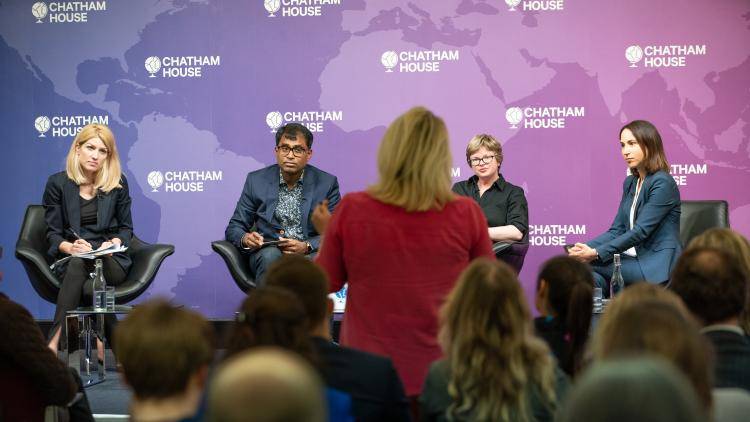
So, welcome everyone to this discussion on whether ‘Geneva’ is ‘Heading South,’ whatever ‘South’ means these days. This is partly about the status and the future of Geneva as a dominant seat of global governance and international diplomacy and whether the Global South is benefiting, or going to benefit, from any reshaping. But it’s also about something much broader, an exploration of the shifting architecture, competing offers, new alliances and potential future centres of power for international co-operation on the world’s most pressing problems.
With me today to discuss these questions are Sir Mark Lyall Grant, who is a Senior Adviser to Chatham House, immediately to my right. Next to him is Alberto Groff, Minister and Deputy Head of Mission at the Embassy of Switzerland here in London. And next to him is Dr Kathryn Nwajiaku-Dahou, Director of Programmes, Politics and Governance, at ODI, and to my far left is Dr Samir Puri, who is the Director of the Global Governance and Security Centre at Chatham House.
Before we start, actually, just a few housekeeping bits. This discussion is on the record; it’s being recorded and livestreamed. So, please do post on social media any nuggets you want, using the handle #CH_Events. When it time – comes time for the Q&A, after the initial discussion, if you’re joining us online, you must submit questions using the Q&A box that’ll be on your Zoom feed, and I’ll keep an eye on that and select and read out questions from there. If you’re in the room, please raise your hand and someone will bring you a microphone, and please remember to identify yourself before you ask a question, but don’t worry, if you don’t do that, I will prod you if you forget. So, with that, we will get started.
So, Mark, I’d like to start with you, with a – just a tiny little question of, what’s going on with the architecture of global governance? What’s shifting and where? Who’s making the biggest play, and for those who are jockeying, what’s in it for them? And is what’s going on as dramatic as it seems to be, and where do you think this is all going to land? Just a little question.
Sir Mark Lyall Grant
Well, there’s slightly more than one question there, Emma, but thank you. The – look, it’s not just about Geneva or New York. It’s clear that the UN system more widely, multilateralism, the post-World War rules-based international order, is in a certain amount of trouble. And President Trump’s arrival has accelerated a process that was already underway, and his dramatic funding cuts of a lot of the UN agencies and USAID has had a dramatic impact that we’re seeing in terms of the shift of individuals in terms of institutions, agencies, around the world, and we can come back to that.
But I want to just highlight a little bit this wider issue, because it’s perhaps not quite as dramatic as it appears. It’s easy to forget that in the 80 years of the multilateral UN system, there was a golden period of less than 25 years. You know, the whole of the Cold War the Security Council was paralysed, nothing really happened. Then you had the end of the Cold War and suddenly, you had a flowering of the Security Council peacekeeping missions, you had the arrival of the UN Human Rights Council, the – you had Responsibility to Protect, humanitarian intervention. You had the OPCW being set up, the International Criminal Court. You had all those sorts of things, like, women’s rights, LGBT rights, had all that flowering, that golden era, if you like, of multilateralism. Every single initiative was – went in a rights-based direction and was initiated by the West.
Since 2013/2014, we’ve seen a pushback, and a more systematic pushback, over time, and that’s what’s been accelerated by President Trump. So, I think that process was already underway, but it’s certainly been accelerated now, and that has given an opportunity to some of those who never really liked the rules-based international order championed by the United States. Russia, obviously, primarily, but increasingly, China. And that’s why we’re seeing a move not really to the South, in my view, but more to the East, with China taking advantage of a lack of American leadership, a lack of American champions of the rules-based international order.
Emma Ross
Just to follow up on that, there is lots of news about staff from various international organisations being moved out of Geneva and New York. Some of those are definitely confirmed, some is just talk at the moment, proposals. In the case of WHO, for instance, which has been hit pretty hard by the withdrawal of the US and the slashing of overseas aids by other – scores of other global health funders, and they’re under increasing pressure to enable more global equity in decision-making and resource allocation. The latest relocations, moves that have been announced by WHO, centre on headquarters-controlled hubs, mostly still in the Global North, rather than to regional offices or country offices, which are semi-autonomous and self-governing. It seems the status quo is fighting back, holding onto decision-making powers. How much of this shuffling in geography do you think is a real devolution?
Sir Mark Lyall Grant
Well, I think you can read much too much into this, to be honest, Emma. The relocations that are happening, and I have some personal experience, and my son is actually a Lawyer working in New York for UNICEF, and jobs are being cut by the thousands because of the American funding cuts, and they’re looking at relocating quite a lot of staff. But the decisions on relocations will be decided purely on economics, which country is offering the best deal, which city is offering the best deal. It’s not as part of a drive to greater equity in terms of influence around the world. So, I don’t think one should assume that that is somehow the rationale behind it.
Secondly, it’s really important not to confuse location with influence. I mean, the UN has a major hub in Nairobi, it’s got hubs in Bangkok and other places. That does not mean that Kenya is playing a more influential role because of it, or Thailand is playing a more influential role. There is a complete disconnect between the location of the agency and the influence of the host country. The host countries that will want to attract these agencies, they will do so for their own prestige, certainly, but also, economic benefit, and there’ll be lots of people scrabbling around for that. But it doesn’t mean that there is some, sort of, flow of global influence towards the South. As I mentioned before, I think the flow, if there is one, and we can come back to it, is flowing to the East, not to the South.
Emma Ross
So, there really isn’t much actual devolution, real devolution going on?
Sir Mark Lyall Grant
Not devolution of influence, authority and power, no.
Emma Ross
Okay, so Samir, I want to ask you how transformative do you think this is, then, how unprecedented? To what extent do you think Geneva, or the old seats of international diplomacy more generally, are, indeed, fading as opposed to having a bit of a wobble?
Dr Samir Puri
Yeah, so I’ll focus a bit more on the trend lines, and I do think locating this at this moment in history is really interesting. You know, we are at the dawn of a more multipolar era. It doesn’t really matter whether you think multipolarity is here or not, it is becoming more multipolar. So, there is an incongruity between global governance institutions being located in Western countries, in Europe, in North America, and the diffusion of power. Now, none of this is to say that – I agree with what Mark is saying, that there’s no functional shift that’s happening right at this moment. But I think that mismatch between where global governance institutions originated from, where they’re based, and where, sort of, the dominant weight of global demography, global economic power, will be in the decades to come, I think that’s going to become more glaring.
A couple of observations on this. It’s been a long time since I worked in Geneva. I was an Intern in the Palais des Nations, and I do remember at the time there was a little museum to the League of Nations, which is, of course, the point of origin for that building, and then it became the UN office of Geneva. And it’s just a good reminder, just over 100 years ago, to the 1920s, that that was an era when power was unquestionably centred in and around Europe and North America, unquestionably so. And we know just from the events in China last week that there are rival claims to differing, sort of, governance solutions, not for the whole world, but for subsets of the countries that want to tether closer to China.
So, I think there are some implications for Geneva. One of which is we take as a given that Geneva itself wouldn’t haemorrhage influence, it will retain the physical locality of these organisations, it will still administer government solutions globally, is that there are parallel offerings that become more compelling to some parts of the world, some regions. That’s something that could play out in the years and decades to come. The other implication is that for a country like China, it may serve its purposes to actually have the UN somewhat hollowed out but continue as a husk of an organisation. So, in other words, you’ve got the ability to pay lip service to global governance without it necessarily being that effectual. I think that’s much more concretely visible in the Security Council in New York. And I think in regards to the human rights agenda that’s been a bit more associated with activities in Geneva, discussions around arms control, as well, which also have taken place – if you remember, there’s that statue of the chair, I think, on – sort of, tipping on the side…
Emma Ross
Yeah, Ottawa.
Dr Samir Puri
…for the Ottawa Landmine Treaty from 1997, if memory serves correctly. Obviously, we’re at a stage where those sorts of arms control treaties are becoming in jeopardy because of rearmament, because of international competition, and at the same time, the human rights agenda is facing unprecedented challenge that it is excessively Western. Obviously, the defenders say that it’s not. So, I think the implication, therefore, is that Geneva could well continue to be an emanator of influence and, sort of, edicts and governance around these topics, but this be – actually has a lot less traction, and that actually does serve the interests of some parties globally.
Emma Ross
So, what do you think the prospects are for a real shift in power, and what role will legitimacy play? You talked about the ‘mismatch’ there, as this all unfolds, and what’s going to determine how far this all goes, and in which direction it goes?
Dr Samir Puri
Yeah, a really good question. So, the obvious point is when world order was reconfigured a century ago and then after 1945, that’s in the wake of world wars, and so there’s no, touch wood, no seismic impact of that scale that will force the reorganisation of global governance now. So, I think there’s going to be more of a piecemeal diffusion, and again, this is something that’d be might – worthwhile picking up as we carry on this discussion, is whether there might be certain aspects of global governance, certain regions in which it’s administered, that that is actually then diffused more globally.
But there’s never going to be a moment that would allow recrea – allow for the recreation of something like the UN. It comes from very specific historical circumstances around the Second World War, and so, as a result, it’s not going to cease to exist. It’s just the question of whether it continues to exist with fading relevance. The world changes around it, and arguably, its own discussions that are occurring within – it’s a bit of an echo chamber, that are amplifying its relevance globally as that relevance fades. That is a – it’s not an inevitability, but it is a possibility.
Emma Ross
So, just quickly, before – Alberto’s desperate to come in, out of turn, but it’s fine. If it’s going to become less relevant, so its relevance will change, should we be worried about – does it matter that all this change is going on then?
Dr Samir Puri
Yeah, enormously so, and indeed, as Mark said, in terms of the relatively short period of time that this rules-based international order functioned, and I think we’re taking, like, a false extrapolation from that, thinking it was from 1945, it wasn’t. And obviously, the world becoming less secure, with less possibility for international agreement around critical collective issues, that is not a good world to be headed towards. So, it is not a good thing that there may be a greater degree of irrelevance, or it might be harder for decisions and edicts and agreements from Geneva to find traction around real issues around the world. That is not a good thing at all.
Emma Ross
So, it’ll be, really, about navigating it safely without blowing up the whole thing?
Dr Samir Puri
And there’s a new Secretary General for the UN next year, I mean, that’s going to – top of their to-do list will be navigating a geopolitically complex world in which there’s greater diffusion, rather than centralisation around international solutions and responses.
Emma Ross
Okay, Alberto, I know you wanted to come in. Was it on something Samir said?
Alberto Groff
Well, in general, just to respond to what Mark and Samir said – and first of all, thank you again for an invitation, and as a Swiss representative, of course, Geneva is very close to our heart. I’m not going to challenge everything that is being said, but I just want to maybe just, sort of, touch on what Mark has said. It’s good to take a longer-term view on these issues. You know, we tend to be caught up in the, rightfully, disturbing news of the day, feeling, you know, there’s a power shift going on and we need to respond one way and another. But we shouldn’t forget, especially international organisations, you know, have to take a very long-term view on these issues.
And it’s good to separate, you know, the immediate necessity to cut cost, which is, as you’ve correctly pointed out, is one important issue, but then there’s a longer-term issue, right? And this longer-term issue of delivering the public goods that we all need, irrespective of whether you’re in the East, West, North, or South, still need to be delivered somehow. And I still believe that Geneva, with its expertise, is going to play a crucial role in the days to come and in the years to come, and I think that in itself, is also, I would argue, a notion which is shared by most powers. I mean, the pr…
Emma Ross
But does it have to be in Geneva? I mean…
Alberto Groff
Well, not every…
Emma Ross
…if it’s not, does that mean…
Alberto Groff
Of course not.
Emma Ross
…we won’t…?
Alberto Groff
Not everything has to take place in Geneva. There’s important political discussions taking place in New York, in Vienna, in Addis Ababa, of course. And it’s not about the – for – the way we see it, it’s not about the competition, per se, that we have to be fearful of discussion taking place elsewhere. It’s about retaining the value system that is embedded in the UN, that everybody – all countries have subscribed to, and that we all can build on in the future to address the issues which are very close to our all hearts.
Emma Ross
Kathryn, you’re…
Dr Kathryn Nwajiaku-Dahou
Yeah, I might…
Emma Ross
…nodding.
Dr Kathryn Nwajiaku-Dahou
…as well come in now. Indeed, indeed, I would agree with you, and I would add that in order to preserve the legitimacy of the UN in Geneva, in Vienna, in New York, the big questions around who is represented and who – and whether the UN is about power and for the powerful, I think, need to be answered. I think the changing geopolitical context is opening up a whole series of questions and, of course, it’s not just since January. I mean, these – there are trends in the demands for greater global governance that actually reflects the global majority as the present and future. And I think only once that is sufficiently grappled with can those institutions, norm-setters, on which there is consensus to be built and to be consolidated, will retain a rel – a legitimacy without that. I think things are – a lot will continue to be up for grabs.
Emma Ross
So, Mark said that Geneva is not moving South. If it’s moving, it’s not – doesn’t seem to be going South, but tell us what influence Global South players, however you define ‘Global South,’ and I’d love to hear…
Dr Kathryn Nwajiaku-Dahou
Hmmm hmm.
Emma Ross
…how you define ‘Global South,’ what that really means, are having on all this. I mean, what capacity do they have to compete? Are they even seeing that way as – seeing it that way as a competition?
Dr Kathryn Nwajiaku-Dahou
Hmmm.
Emma Ross
I mean, for instance, in Africa, how are they playing into all this upheaval? What are the opportunities for the continent in terms of increased participation and influence, and are they taking those opportunities? What are they…
Dr Kathryn Nwajiaku-Dahou
Yeah.
Emma Ross
…doing at the moment in this…
Dr Kathryn Nwajiaku-Dahou
In this…
Emma Ross
…game that’s going on?
Dr Kathryn Nwajiaku-Dahou
Hmmm, I mean, I would say, first of all, that the ‘Global South’ as we know, is a very contested term, and people use it meaning different things. Global South for me includes the BRICS+, and also, we can have a much more restricted notion of what we’re talking about. When you refer to Africa, I presume that you’re referring to a particular part of the Global South…
Emma Ross
Hmmm hmm.
Dr Kathryn Nwajiaku-Dahou
…that doesn’t have that big political agenda. And I say that because I do think it’s not just semantic, but it’s really important, as well, in thinking about, for example, how the continent of Africa sees itself in relation to global affairs, right? So, I would, kind of, emphasise the fact that, you know, if we are trying to answer the question as to, ‘Okay, how is Africa responding to this upheaval?’ I would say something like, well, Africa is part of configuration of countries, not just on the continent, that have for some time been engaging in a million minilateralisms, if you like, to – in order to open up space on – in this more traditional multilateral system.
And I give the example of the G20, for example, you know, as a case in point, where you’ve had Indones – you’ve had South Africa most recently, you’ve had Brazil previously, as the Chair, and those configurations also open up space for voice for Africa. So, for example, the quest to become – to have a seat on the Security Council, it was through these minilateral configurations Africa was able to have a voice. So, I would encourage us to put our focus on those long-term trends in terms of how Africa is positioning itself in relation to the BRICS, but also, those smaller configurations that are opening up space.
With respect to the question as – of, you know, ‘So, how is Africa responding to the UN’s, you know, current predicament, the cuts, the discussions, the moves, and so on?’ You know, it was said earlier that, you know, the fourth largest UN headquarters is in Nairobi, and Kenya is not visibly making moves to…
Emma Ross
Grab more.
Dr Kathryn Nwajiaku-Dahou
…grab more. That’s certainly the case, and I would argue that because Africa is also part of these other configurations, perhaps it’s less interested in this, you know, this, you know, current challenge that is facing us all. So, its attention is diverse and multiple in these other arena in which it sees its interests.
Emma Ross
Is it aligning with some of the alternative offers? Is it starting to align? Is it thinking about it? ‘Cause it must be in a difficult position not to be seen to be going to the other side, but…
Dr Kathryn Nwajiaku-Dahou
I’m not…
Emma Ross
…you know…
Dr Kathryn Nwajiaku-Dahou
I mean…
Emma Ross
…it’s all open for them.
Dr Kathryn Nwajiaku-Dahou
Yeah, I mean, I think, given – I mean, I can’t say with certainty, but I think given that Africa is also politically, geopolitically, economically, increasingly shaping its future with respect to those, you know, alternative hegemons, China, for example, you know, it wouldn’t be beyond imagination to think that Africa was also putting its eggs in that basket. But I think it’s – it – the questions need to be much more – the answers are much more open-ended, because even though we have seen – we saw last week, the performative presentation of an alternative around China, and we also have to acknowledge that it’s a very diverse group there, who in a, kind of, minilateral new environment will also see their interests in transactional ways on particular issues, rather than becoming part of a coalition forever on everything.
Emma Ross
Alberto – oh, go ahead, Mark.
Sir Mark Lyall Grant
Well, no, I was just going to say that we shouldn’t forget that minilateralism, as Kathryn said, has been around forever.
Emma Ross
Hmmm.
Sir Mark Lyall Grant
I mean, not all negotiations hitherto have taken place in New York or Geneva. You’ve got to think of the arms trade discussions, think of the, you know, arms limitation talks between the big powers, the E3+3 on the Iran nuclear deal, you know, many of these negotiations happen in separate fora, but often come back to the UN to be blessed. Because the UN is still, and will remain for the foreseeable future, the only universal forum where every single country in the world is a member, and it’s worth bearing in mind that that wasn’t always the case. Switzerland, ironically, was the last country to join the UN, I mean, that was an existing country, only in 1970s, maybe even 80s, the 1980s.
Alberto Groff
But we had a popular vote on this.
Sir Mark Lyall Grant
So – yeah, I know…
Alberto Groff
We have a, kind of…
Sir Mark Lyall Grant
…but Switzerland wasn’t even a member, but now every single country is a member of the United Nations, and the most enthusiastic about the UN are the smallest countries. I was very struck when I first went to New York that there was no animosity towards the G7, at all, in New York.
Emma Ross
Hmmm hmm.
Sir Mark Lyall Grant
They said, ‘Look, if the rich countries want to get together, have a fireside chat, that’s entirely up to you.’ But the animosity against the G20 was fierce in New York, not just between numbers 21 and 40, but for everyone else, because suddenly, the G20 was usurping some of the rights of the United Nations, and it didn’t include 90% – 85% of the world’s countries. And suddenly, some of the South’s champions, like, Brazil and Indonesia and South Africa, you know, were joining a completely different organisation. And we shouldn’t forget that over 75 countries in the world have less than five million people, a large majority of countries have less than ten million people, and it’s those who feel most strongly about the UN system, because, at least in the General Assembly and other bodies, it is one vote, one person. So, Tuvalu, with a population of 11,000, has one vote, and India with, you know, 1.5 billion has one vote…
Alberto Groff
Hmmm.
Sir Mark Lyall Grant
…and for them, that is really important. So, they don’t like this taking away into other, sort of, minilateral organisations.
Emma Ross
So, Alberto, does Geneva like what’s going on here? What is actually going on, on the ground in Geneva, and how are the plans and the definite, well, talk about UN agencies ‘downsizing or leaving,’ affecting the rest of the international governance ecosystem? Not just NGOs, but there’s also a lot of private sector lobby and others who lever influence by being in Geneva, are they all going to move, too, with them? What are you hearing on the ground? And what is Switzerland expecting will happen with this in the near-term, midterm and long-term? As you said, those are different.
Alberto Groff
Yes, thanks, Emma. Again, a whole area of questions. Let me try and dissect them a little bit. It – you know, I cannot comment on each and every organisation that is currently undertaking serious assessments of what they should do in the current environment. But the general picture I get from back home or from Geneva, is, of course, it’s a serious situation for many, because of cost cutting measures, but it’s also a sentiment that I get with new opportunities, and also, I would even say ‘hopeful’, representatives are also hopeful in terms of the future.
What do I mean by that? We’re often talking about the discussions taking place in fora that have been invented after the Second World War and the bodies we’re all familiar with, but we have the world moving on, not only in terms of paradigm shifts or centres of power, which are going eastwards or wherever, but we also have a huge development in science and technology, which is going to reflect on us all, and also our governments, immensely in the future. And I’m very pleased to see that Geneva has really taken enormous strides, also, to take in science and diplomacy as one of their future pillars that they want to effectively work on. Just to give you an example, right? This is also very important. They have to, in a certain way, reinvent themselves to be relevant without glossing over the difficulties, but again, I think they’re well positioned with the private sector, with the civil society, to do that.
So, I think that’s, sort of, where things stand right now. And again, I think it’s also a time for reflection, self-reflection, and again, we tend to portray cost-cutting, especially from an – from a organisation point of view, as something very negative, understandably, of course. But cost-cutting – and Mark, you might have experienced that as well, I cannot remember any UN discussion without having cost-cutting as one of its primary objectives in the Fifth Committee, for instance, in New York. So, this is nothing new, and organisations also have to consider, where do we stand? Can we cut some slack in what we’re doing? Can we deliver better? I think these are legitimate questions, which again, organisations are dealing with at this very moment in Geneva.
Emma Ross
So, I’m going to turn, ‘cause it’s relevant to this, one of the questions online, and I think this is for you, Alberto. François Nordmann, ‘How do you address the issue of the high cost of living in Geneva?’ So, has Geneva…
Dr Kathryn Nwajiaku-Dahou
What do you…?
Emma Ross
…become more expensive? Cost-cutting, yes, but, you know, it – how much of it – can Geneva do anything to make it less expensive for…
Alberto Groff
Yeah.
Emma Ross
…to keep this going? So…
Alberto Groff
This is, of course, a very good question from François Nordmann, which is not easy to dispel. But again, look, Geneva will never be an Addis Ababa, right, in terms of cost. That’s just simply not realistic, right? But again, you have to look at the bigger picture. It’s not just the cost that is relevant; it is also what you get. I mean, you have an ecosystem in Geneva, when it comes to civil society, when it comes to companies that are present in Switzerland, which I would argue is really worth its money, right? Talking about cost of living, if we would do a quick survey among those foreign colleagues who are stationed in Geneva…
Emma Ross
They get paid quite well.
Alberto Groff
They get paid – and they also…
Emma Ross
Not bad.
Alberto Groff
…very much appreciate, you know, their living standards, right? I mean, again and you shouldn’t underestimate, also, you know, all these UN workers, they do di – important work, sometimes in very difficult environments, right? And then they circulate back to Geneva, or to New York, and so, you know, this is their home base…
Emma Ross
Hmmm hmm.
Alberto Groff
…which is important, right?
Emma Ross
And some of them are fighting very hard to keep it that way…
Dr Kathryn Nwajiaku-Dahou
Yeah.
Emma Ross
…the unions are objecting.
Alberto Groff
Understandably so, understandably so, yeah.
Emma Ross
Another online question, this is from one of our own, dearly beloved, not departed, but still around. Oh, God, I’m going to stop there. Patricia Lewis, and her question is, ‘How can we change the framing and the narrative regarding conflict prevention, good governance, humanitarian action, etc., to achieve a world we want for the benefit of all, rather than the dog-eat-dog world we seem to be creating?’ This is for all of you, pearls of wisdom on that, please. Mark.
Sir Mark Lyall Grant
Well, maybe we should have the touchy-feely answer first, and then I can give the real politics.
Emma Ross
Okay, we’ll save you to last. Who wants to do the touchy-feely?
Dr Kathryn Nwajiaku-Dahou
Wow, it’s an amazing question. Let me give it a go, but I don’t know – let me try here. I would say that a lot of the conversation that we’re having now tends to situate itself at a certain level. We’re talking about global governance, essentially, global governance between elites, okay? Wi – that’s kind of a backdrop, you know, we’re talking – and perhaps, this tumult we’re in can give us also an opportunity to think about that in a critical way. Why do I say that? In listening to my neighbour here talking about Geneva, for example, and everything it brings, in response to the cost of living question, I think that that, whilst that may be true, I think it reflects a certain, ‘cause with all due respect, blindness, with respect to the moment we’re currently living in. A moment where extreme inequality is driving the populisms that create scope for the lack of peacefulness that underlies that question.
So, I would suggest at this moment we’re in, perhaps give us, you know, cause for some pause to think about how inequality drives where we’re are – where we are, and also think about, you know, questions that are being raised, you know, amongst ordinary people who can’t afford to live in Geneva, perhaps, or elsewhere…
Alberto Groff
Hmmm, hmmm hmm.
Dr Kathryn Nwajiaku-Dahou
…and are asking real questions to their leaders, their leadership, about the kind of world we want to live in. I know that’s a very roundabout way, but I do think we need to, you know, stand on the ground somehow, even in talking about these ‘global governance’ questions. Because everyone outside this room, you know, as soon as we walk out, will perhaps have a different take on the importance of the conversations that we’re…
Alberto Groff
Hmmm.
Dr Kathryn Nwajiaku-Dahou
…having here.
Alberto Groff
Maybe…
Emma Ross
Samir…
Alberto Groff
Samir, yes.
Emma Ross
…and then Alberto.
Dr Samir Puri
I think I will go for the medium pessimism option here, before Mark, I think, we’ll take the more pessimistic view. But I think the thing we have to be really conscious of is that it’s not only the unipolar moment, it’s a century or so of US-led, sort of, leadership in the world that has undergirded a lot of what we understand multilateralism to be. Obviously, it’s also provided a lot of the funding, which is part of what brings us to having the conversation here today. And you know, the US is not vanishing – the way I frame it is the US has gone from being the undisputed heavyweight champion of the world to the disputed heavyweight champion of the world. So, no-one’s dethroned the US in many aspects of power, but that transition period as it moves forward does then start to create a shakiness around many of the things that were outcomes of that preponderance of US power, and that preponderance of US power, of course, followed that preponderance of European power from previous centuries.
So, you know, when you think about, sort of, discussions in BRICS, when you think about discussions in SCO, when you think about discussions in other parts of the world, and I spent, you know, nearly half a decade based in Asia before coming to the – here for this role, there is an enormous sense of situating this moment as a grand turning point in history. Not because there’s a, sort of rejection of Western things. It’s just that, well, this is actually a few centuries of accumulated Western power in different incarnations. Now things are changing, and this is actually quite exciting.
And I think we should also, just as a closing, capping off comment to this, is these are global institutions with universal aspirations and mandates that have been signed up to by governments across the world. To the extent they are perceived as Western, at least either from their point of origin, because of that preponderance of power when the rules were written, or because of the symbolic point of the geographical location of the offices, those are things that are going to come under more scrutiny now than ever before, I think, and I think that is where my pessimism comes from.
Emma Ross
Alberto.
Alberto Groff
Yeah.
Emma Ross
And, Mark, you’re going last.
Sir Mark Lyall Grant
Oh, okay.
Alberto Groff
Just very briefly, because I think Kathryn raised a very good point regarding ‘inequality’, and that’s a hugely complex issue, and I just, if I may, just want to relate back to Geneva and give, sort of, a UN response to this. We often talk about how the WHO is affected now due to budgetary cuts and all the discussions that are going on. We talk a little bit less, to my understanding, about the WTO. The WTO has still fr…
Emma Ross
World Trade Organization.
Alberto Groff
The World Trade Organization has still, as its basic premise, to enable free trade for the world. And, you know, you can have one or the other opinion on the United States or their trade policy, but the reality is that the vast majority of global trade is still under most-favoured nation status, are still, sort of, subscribing to free trade principles that we have all – that we all subscribe to. And I think that’s one of the answers to address inequality in the world. So, that’s, sort of, the – on the element – on the discussion of inequality.
Just a last thing, because the question is so complex, I think, again, it’s important to – I know this sounds maybe very, you can call it Eurocentrist, but it’s important to think about the values that have created the system that we have today. And these values, at least at some point, or at some stage in history, were shared values, and these values are values that I would say get most traction. You can incentivise people to join one group and another, financially, politically, and so forth, but, Mark, you said it brilliantly, there’s nothing more compelling for a member state, a group, to join, if they have a voice in the process, and the UN assures that everyone has a voice in the outcome. I think that’s really a strong argument.
Emma Ross
Okay, but I want to go ask Samir, are those values still shared? Alberto talked about ‘shared values’, are we still facing that same situation now?
Dr Samir Puri
This is obviously an enormous area of contestation, more so now than ever before. It’s actually something in our Centre for Global Governance and Security we’ll be considering quite carefully. Because there’s – there is obviously value for those who want to challenge the West in arguing that they’re not, and, sort of, always pointing to Western hypocrisy, and there’s plenty of case studies and instances in the world that give a, sort of, empirical substance to those accusations.
I do think, though, and I’ll push back slightly to Alberto’s point, because it’s the moment in history when these rules were written. So, they may have had a wide level of inclusivity, certainly, you know – and there’s a Chinese thinker, whose name escapes me right now, who actually fed into the, sort of, the UN Charter, and this is something that is brought up, that ‘This is not a case of,’ you know, ‘only the Western European and North American countries writing these rules for the world, but the preponderance of power sat with the West at the time the rules were written.’ And that doesn’t mean to say anyone was coerced into, you know, abiding by things they didn’t agree with. It’s just that if you were to write rules with the power balance as it is headed towards, they would look different.
One very concrete example, which is in Kevin Rudd’s book on Xi Jinping thoughts, which is actually – there’s a good chapter where he talks about the ‘changing content of mandates for UN peacekeeping missions,’ he interviewed a bunch of UN officials in New York, anonymised them, but is talking about the fact that greater numbers of Chinese officials in DPKO peacekeeping, might then start to influence the removal of human rights-related features in the, sort of, the mandate of the peacekeeping operation. And that is apparently happening in terms of it’s – but we’re at the start of a proce – it’s not only – I don’t think it’s only China, that’s the other thing.
We’re thinking about the world in which, you know, the Qataris, Gulf states, other states where, you know, different democratic – different domestic political systems are being practiced, having a greater share of influence in the world. And it’s very hard to now, at this moment, to start to account for how that will change global governance, if indeed, it is globally representative of differing start points and vantage points.
Emma Ross
Okay, Mark, you can give us your downer now. Let’s hear it.
Sir Mark Lyall Grant
No, no, I agree with a lot of what has been said, but it’s important – and I’m going back to Patricia’s original question, is the frustration…
Emma Ross
Yeah.
Sir Mark Lyall Grant
…she feels, and we all feel, that the UN has not been able to resolve some of these big crises, big conflicts around the world. But blaming the UN is wrong, it’s the member states. Unlike the European Union, the UN is an intergovernmental body, it has no legal personality, and the reason that it can’t solve conflicts, or it can solve conflicts, is because of either the disagreements between individual countries or the agreements between individual countries. You can change the governance system, you can move the headquarters to another place, doesn’t change the reality of those relationships between the major powers in the world.
Look at the African Union. African Union set up its own Peace and Security Council based on the UN Security Council and saying, ‘We will have African solutions to African problems.’ Has that solved the problems in Sudan? Has that solved the war in the Congo? No, of course, it hasn’t, because those big differences between the individual member states, in this case in Africa, still exist.
You know, we are moving to a slightly different world, a multipolar world, that’s absolutely right, and China is pushing that quite hard, but let’s look at the Shanghai Cooperation Organisation summits. The 20 – it was the 28th Summit ten days ago, the largest one they’ve had. There were 25 countries represented, 43% of the world’s population. Big, very big, huge rhetoric there. Symbolism, saying, ‘We’re – now this is the start of a new governance system.’ Is it? No, there’s nothing behind the rhetoric, because the only thing that those countries agree on is opposition to American hegemony. They can’t agree amongst themselves on a governance system and other countries won’t agree to that, even if they were able to do it.
So, I think what we’re going to be seeing in this more multipolar world is some countries taking advantage of the opportunity, and I would point to pla – countries, like, Turkey, to Qatar, to UAE. Those are the countries that seem to me to be playing a bigger role than they used to, say, 20 years ago. I don’t see India playing a bigger role, I don’t see Brazil playing a bigger role, I don’t see South Africa playing a bigger role. Those are the big powers in the Global South; they’re not doing anything. So, the idea that it’s, sort of, moving South, I think, is quite wrong. Moving East, though, certainly, because China is saying.
So, what we’ll end up with is lots of minilateralisms, as others have been saying, on specific issues, little alliances to deal with space or the far North or AI or whatever, and then you’re going to get a G2 – a, sort of, overrunning G2, with China and the United States. Because whatever else happens, it’s China and the United States and that relationship that’s going to determine both our prosperity and our security for at least the next 30 years. So, even though it’s not a formal G2, informally, that’s going to be…
Emma Ross
The driver.
Sir Mark Lyall Grant
…the dominant driver.
Emma Ross
But to Patricia’s question, are we going to be able to see benefit for all, or is it going to be more ‘dog-eat-dog’?
Sir Mark Lyall Grant
Well, I think it’s going to be ‘dog-eat-dog’, certainly in the short-term, because that is what the small countries that I mentioned at the UN are most worried about. That a return to the law of the jungle, which, you know, essentially, ‘might is right’, which is what both the United States and Russia and China actually want, ironically, is maybe good news for them. It’s less good news for Britain, for other European countries, and even worse news for the minnows who are going to get flattened in the stampede.
Emma Ross
Lovely, thank you. Kathryn.
Dr Kathryn Nwajiaku-Dahou
Yeah, I just wanted to add that – you mentioned earlier, Mark, that the minilateralism has always been with us.
Sir Mark Lyall Grant
Hmmm.
Dr Kathryn Nwajiaku-Dahou
Point taken. However, I do think that given what you just described, you know, these two hegemons really being able to create a dog-eat wor – dog – environment, those minilateral middling power – middle powers, are going to be the vehicles through which those countries that stand most to lose can somehow temper the effect and even create new possibilities. So, I don’t think it’s all bleak. I think minilateralism can come into its own in a new context.
Emma Ross
Okay, that sounds a bit better. I’m going to go to the audience now and start with this gentleman here who caught my eye, and then we’ll go over there to the white shirt. So, just here, third row. If you could please, I’m going to remind you, please say who you are, or you…
Michael Harvey
Michael Harvey, Chatham House member. There’s been a lot of debate about the structure of the Security Council for many years and nothing has happened. And really, picking up from the recent discussion, has the Security Council had its day? What could replace it? Should it be replaced?
Sir Mark Lyall Grant
Well, I mean…
Emma Ross
Go ahead.
Sir Mark Lyall Grant
…the Security Council could be reformed, but it won’t be reformed. The discussions, as you say, have been going on for 25 years. The biggest blockage is two things, one, China, and two, the Africans. We used to just sit around the table, the five permanent members, Ambassadors, just the five of us, and discuss these issues in New York quite regularly. And it was very interesting, ‘cause Britain and France would say, ‘We support reform of the Security Council. We need to move forward on this.’ America would say, ‘Well, you know, wake us up when it becomes a real issue, but it’s not on the agenda for the time being, so we’re not fussed either way.’ The Russians would say, ‘Well, you know, we’re not absolutely against it.’ The Chinese would say, ‘No.’
You know, one of the most undiplomatic things I heard at the UN was when we were discussing in the General Assembly the reform of the Security Council, and the Japanese Ambassador had made a eloquent pitch about why Japan deserved to be a member of the Security Council, and the Chinese Ambassador stood up and said, ‘Let me be very clear, you cannot change the result of the Second World War in a General Assembly resolution.’ And that is the reality.
I mention the Africans, as well, because they cannot agree amongst themselves about which two countries would actually be represented on the Security Council. Because you have the Anglophone – you know, the obvious two are South Africa and Nigeria, but they’re both Anglophone, so, the Francophone countries won’t accept that. And the one thing that the – every one of the P5 agree on is you can’t have rotating permanent members, which is what the Africans would like.
Emma Ross
Thank you. In the white shirt, please. Thank you.
Neal Skinner
Hi there. Thank you for that. This is – I’m Neal Skinner from Fiduciam. It was mentioned earlier that the specific locations might not be that important, but it seemed to me that Switzerland’s historic neutrality might have made it a very desirable location for some of these bodies, particularly to appeal to, you know, in what – that its role might develop in a multipolar world as a great forum for these bodies. So, I was just wondering what your thoughts were on that and whether Switzerland’s adoption of some of the international sanctions might be a challenge to that neutrality. Thank you.
Emma Ross
Alberto.
Alberto Groff
This is for me, right?
Emma Ross
Yeah, I think so.
Alberto Groff
Yeah, okay, glad to respond to that. You’re right in the sense that neutrality has been, I think, fairly frequently discussed in Switzerland, outside of Switzerland, given the current political developments in and around Europe, Ukraine war and so forth. But at the same time, I’d just like to point out that, you know, neutrality is often misunderstood, in a way, that it’s seen as set in stone, a means in itself, and it’s – it was never designed as that. It has always been an instrument to achieve a certain objective. It is how we go about certain issues to achieve a certain outcome.
Having said that, you know, Switzerland will adhere to neutrality. We do offer our good services to all warring parties around the world, and we do, you know, behind the scenes, we do get different kinds of responses when it comes to offering our service that you – than you might perhaps read in the newspaper. So, the – I would argue that, even in today’s world, even in a multipolarised world, there is room for the neutral, be it Switzerland or others, to provide venue, to provide good services and to provide just, you know, the kind of place where parties who have differences can discuss beyond and not in the limelight, but outside. I think there’s room for that, and there will be room for that.
Emma Ross
Just here in the front, second row, and then front, and then there was someone in the middle. Yes, there, and then I’ll go to this side of the room.
Dr Arif Azad
Hi, my name is Arif Azad, I am, you know, yes, a Medical Doctor by profession, but my question is about international order. We have discussed the reordering of it, like, in the centre of powers will shift to China or other, but we haven’t discussed the threat of far-right to international order, because they don’t accept, like, international institutions. Even in this country, there is, like, you know, I mean, talk of walking out of EHCR. I mean, in America, you know, I mean, Trump has, you know, walked out of the WHO, and in Argentina too, under the right-wing. So, how does the panel think about the threat of, you know, the far-right, you know, everywhere, or the hard-right, to international institutions, you know, broadly?
Emma Ross
Thank you. I just – if one of you could answer that, ‘cause there’s quite a few questions we’d like to get through. Who feels a burning need?
Dr Samir Puri
I’ll give it a quick go.
Emma Ross
Samir, go ahead.
Dr Samir Puri
I mean, obviously, the threat is real if they’re in power. If they’re not in power, but influential, they can shape domestic debates, but they can’t make decisions. So, I’d say unless they’re in power, it’s unlikely. But they would probably add a different level of critical scrutiny over budgetary commitments made by national governments, and the argument they would make is at the expense of your own people at home. But I think that in terms of different forms of international activism, de – just depends on how strong those – but obviously, in the US, it’s – they’re in power, so – which is where you get WHO withdrawal and other things.
Dr Kathryn Nwajiaku-Dahou
And the threat is very real. I live in France and we’re – we just – there’s no government anymore, and it’s possibly likely that there will be elections, snap elections, wait and see. But the result of those elections, any observer will tell you, the very strong likelihood the far-right will come to power, and I think France is not alone. So, I do think it’s a very, very real threat that you put your finger on, and I think we cannot discuss international relations, global institutions, without discussing politics, because politics is going to shape the possibilities we have on offer. Thanks for the question.
Emma Ross
Thank you. Right at the front here, please.
Marc Weller
My name is Marc Weller, University of Cambridge, and soon also Chatham House. First, a declaration of interest. I still have, I think, an office on the sixth floor of the Palais des Nations, or at least I have the key, but nobody has realised it over the last decade that I haven’t been there for that period. Is Geneva moving South? I think there is a strong emphasis for things to stay for a while as they have been, due to pedigree. It’s a sign of status to have your big multinational conference in a place like Geneva, performance, the wonderful service the Swiss Federal Government gives to those organisations and others who have meetings and things going on.
But over time, I think what you mentioned will perhaps work against that trend, which is that there are more and more functions devolved to regional centres, or regional groupings, or transcontinental functional groupings. Sort of, once they start to institutionalise regional institutions attached to Asia, Africa, Latin America, more than we have at the moment, obviously, they will move to a place in those regions, or if you have, sort of, BRICS institutions or some such, I would imagine that they will not necessarily locate themselves to Geneva. So, that the function of Geneva might more become a, sort of, co-ordinating point between these different nodes that start to develop through these various different networks. Would that be an explanation, I ask the panel?
Emma Ross
Who wants to take that? One person. We’re five minutes out.
Alberto Groff
Maybe just a quick response, and I think your – you present a very good analysis on – of what’s going on. I think the strategy, at least from the Swiss Government, is exactly to reach out to these nodes around the world. I mean, our position would never be to say, ‘Look, we’re Geneva and we’re going to do things as we’ve always done, and your key is safe with us and you’ll get it back anytime you want it.’ But look what’s going on, reach out to others and see what can be done jointly, right? I mean, that will be, sort of, the thing we aspire to, and that be the task ahead of us, undoubtedly, yeah.
Emma Ross
Hmmm.
Marc Weller
Thank you.
Emma Ross
Thank you.
Dr Kathryn Nwajiaku-Dahou
Get his key.
Alberto Groff
Yeah.
Emma Ross
Yes…
Sir Mark Lyall Grant
Wouldn’t mind having a spare office in Geneva.
Emma Ross
…the lady over there, third row, and then in the middle.
Carrie O’Brien
Hi, I’m Carrie from the Arribada Initiative. I also wanted to comment on the ‘location doesn’t mean influence’ thing by the realist on the panel. Because we work in humanitarian, we create technology for conservation and humanitarian purposes, and I went to the Geneva Humanitarian Networking and Partnerships Week back in October and was, kind of, struck by the fact that everybody there, even though it was for everybody, everybody there was European or North American.
So, I think maybe you’re talking about the ‘global governance’ level, but obviously, then, this was a network of UK-based, European-based, North American-based NGOs. They’re the people who can afford to fly to Geneva and they can get visas, and I, kind of, felt quite uncomfortable. And I made the comment there, as well, that ‘There’s a lot of lip service to talking about, ‘Let’s involve local voices,’ whatever that means, and, ‘Let’s include local NGOs,’ but nobody’ had ‘actually put up any funding or made the effort to actually bring those people along.’ So, I think there is influence – I think your location does affect your influence, as well.
Emma Ross
Thank you. In the middle, the gentleman there. Thank you.
William Wallace
William Wallace, now in the House of Lords. I used to teach the introductory course on international relations at the LSE, and I wake up at 2:30 in the morning and think, what would I – earth would I say now? I just wanted to ask, I mean, the structure and the agenda for global governance is not at all the same as it was in 1945. We have a whole host of new issues on the agenda, and I would say to my students that they would not have arrived at the LSE without a whole set of international rules which have been created in the last 40 or 50 years. And they cover everything from organised crime, a huge issue now, to, of course, climate, to satellite regulation, to internet regulation, which is very incomplete. And the question as to how far governments are finding themselves – are going to find themselves caught between a refusal to recognise that one really does need all this stuff and the recognition that if you get rid of some of it, they, as well as the rest of us, are going to be up the spout in terms of things that we’ve all taken for granted for much of our lifetime.
Emma Ross
Hmmm hmm.
Sir Mark Lyall Grant
Yeah, I…
Emma Ross
Good question. Go ahead, Mark.
Sir Mark Lyall Grant
William, I think you’re absolutely right. I mean, civil aviation is a good example, you have to have international agreements on civil aviation. They’ve been in place, no-one’s questioning them, throughout wars, etc. But having those agreements today, I think on some of these new issues, is extremely difficult, and we’re seeing it under AI, because countries perceive they have fundamental differences. Everyone agrees there needs to be some co-ordination, some negotiation, some convention, maybe, but it’s very difficult because of the difference.
I was very struck when I was at the UN, the fact that there is still no agreed definition of terrorism. Why? Because countries have different interests. And so, if you can’t even agree on the definition of the thing that you’re trying to regulate, then how difficult is it going to be to do it? And I’m afraid one of the victims, the – you know, the damage that’s going to be done by this breaking up of the rules-based order is that it’s going to be virtually impossible to get these sorts of agreements in the future.
Emma Ross
Thanks. We’re at time now and I want to end with – I’m sorry we couldn’t get to all the questions. There are loads online, as well, but after this, we invite you to join us in the Square for drinks, and please do approach any of the panellists. But just one parting shot from each of you to, in your opinion, if you could have one key determinant of how this is all going to pan out, what do you think it would be? What’s going to determine what we end up with here in medium to long-term, not short-term now?
Sir Mark Lyall Grant
Well, for me, it’s…
Emma Ross
What’s it going to depend on?
Sir Mark Lyall Grant
…simply quite simple, it’s the relationship between China and the United States.
Emma Ross
Okay.
Sir Mark Lyall Grant
Everything depends on that relationship.
Emma Ross
As to where this goes.
Sir Mark Lyall Grant
Yeah.
Emma Ross
Alberto.
Alberto Groff
Agree with that, but I would say it’s – I would like to put it a bit broader. It’s actually what governments want beyond the G2, what governments want from the multilateral system. Because again, the UN is a reflection of what the governments want. If they want multilateral solutions to an issue, there’s things on offer. If they want to do it differently, they can do it differently.
Emma Ross
So, it’s how interested governments…
Alberto Groff
Yes.
Emma Ross
…will be in this?
Alberto Groff
Yeah.
Emma Ross
Kathryn.
Dr Kathryn Nwajiaku-Dahou
An idea that we ha – I haven’t raised is the symbolic. So, the extent to which there will be not – there won’t be a, kind of, shifting South, i.e., a, kind of, destruction of the system, is, kind of, acknowledgement of the symbolic value of where institutions are located and who they represent. Though that symbolic question is something that we can’t just ignore, and the configurations that are having influence, I would say, again, the minilateral spaces, looking at, you know, the Gulf states and so on, are because they’re taking those symbolic values very seriously. So, the linkages are not just economic or political, but they’re also religious and ideational. I think it’s important that we acknowledge those factors, too.
Dr Samir Puri
Yeah.
Emma Ross
Samir, last word.
Dr Samir Puri
Yeah, I thoroughly agree with the point about ‘symbolism’. I’ll give a slightly different interpretation to Mark about the single significance of US-China. I think there’s going to be lots more collaboration, co-operation and groupings among non-Western states in different configurations, including at the, kind of, cultural and softer levels. And that is actually historical novelty for the last 100 or so years of the, sort of, state – sovereign state system as we understand in its modern form. And I think that means Geneva will continue to exist, but other things will exist around it, and it may lose some of its singularity that it enjoyed in the past because of the way the world is changing. This is around the whole world.
Emma Ross
Okay, so with that, thank you all to our distinguished panellists. If you’d all join me in giving them a nice hand. Hmmm hmm, and thank you all for joining us and for your great questions and participation, and as I said, if anyone’s thirsty or maybe hungry for a bit of nibbles in the Square, we shall meet you there.
Dr Samir Puri
So, I agree with you…