Emma Ross
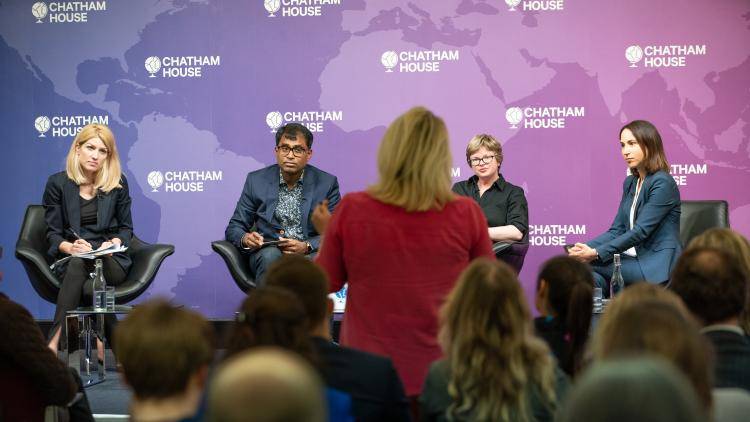
Okay, the room has spoken that we’re starting, so the silence, that’s my queue. So, thanks for joining us this evening for this discussion on “Global Drug Policy.” My name is Emma Ross, and I run the Global Health Programme here at Chatham House. This event, just some housekeeping first, is being held in partnership with the Global Commission on Drugs Policy, it’s being held on the record, recorded and livestreamed. So, that means it’s not under the Chatham House Rule. Please do use the social media hashtag, #CH_Events and @ChathamHouse, when posting, and please do post, post away.
We’re going to start with a moderated discussion among the panellists, and then I’ll open it up to the floor for questions. If you want to ask a question, please just raise your hand. When a microphone is brought to you, please say your name and affiliation before asking your question, and if you don’t do that, I will stop you and say, “Sorry, who are you and who are you with?” So, please do, do that. It gives us all a perspective of where you might be coming from. So, if you think of something before then, you can submit a question through the Q&A function in the Zoom feed, but if you’re in the audience, probably better to just pay attention to what’s going on, rather than be buried in your Zoom, but you can, if you’re desperate, to get a question in through the Zoom feed. And I will be fairly, you know, going between the room and the computer, and just so you know, there are no questions so far on the computer.
Illicit drugs are a massive health issue, of course, but it’s also a societal, political and an environmental issue. We’ve been fighting this as a global community for over 50 years, and approaches are evolving in some countries and regions as we’ve understood more, but in key indicators, the problem’s getting worse, not better. So, according to the latest report from the UN Office on Drugs Crime, UNODC, which was only released a few days ago, drug use is increasing at a faster rate than the population growth. It’s about 6% of the population aged between 15 and 64, and that’s up from 5.2% ten years ago, and, on top of that, only one in 12 people who have a drug problem are getting any sort of treatment for it. Meanwhile, on the supply side, global cocaine production hit a record high in 2023, up 34% over the previous year, supplying a burgeoning cohort of cocaine users, estimated to have risen from 17 million to 25 million in ten years to 2023.
It’s the fastest growing illicit drugs market, and traffickers are breaking into new markets across Asia and Africa, while the violence and competition that used to be confined to Latin America is now spreading to Western Europe. Methamphetamine production and trafficking from the Golden Triangle, where Thailand, Myanmar and Laos meet and – is on the increase and traffickers have taken advantage of limited governance. It’s higher than ever and heroin production is also up. There’s been an explosion in synthetic drugs in this period, with large manufacturing sites uncovered in Syria after the fall of the Assad regime. Rates of addiction have also increased, and as if we need any more bad news, the geopolitical situation, this new era of global instability, is bringing unprecedented challenges to the drug problem. The drug trade across all regions is adapting rapidly to the geopolitical and economic changes, transforming their business models and pol – and practices to stay ahead of the game.
Even some of the changes in policy that we’re hoping would make the situation better don’t seem to be panning out as hoped. As of January 2024, Canada, Uruguay and 27 jurisdictions in the US had legalised the production and sale of cannabis for non-medical use, while a variety of legislative approaches are being tried elsewhere in the yearl – elsewhere in the world. In these jurisdictions in the Americas, the process appears to have accelerated harmful use of the drug and led to a diversification in cannabis products, many of the – with high THC content. Hospitalisations related to cannabis use disorders and the proportion of people with psychiatric disorders and attempted suicide associated with regular cannabis use have increased in Canada and the US, especially among young adults. And I’m sure we will hear about some successes, and I hope we’ll hear about hope, but it does seem that whatever we’re doing, in the main, it’s just not working.
So, on that happy note, I am now going to turn to the distinguished panel we have with us today, and with me today to delve into these issues are three of the Commissioners on the Global Commission on Drug Policy, which was created in 2011 and is run as a programme of the Graduate Institute in Geneva, to foster an honest and realistic debate on drugs, and advocate for profound reform of the drug control system. The Commission is in the midst of reviewing the drug control system right now, so let’s see where we are with the response to the situation honestly, and where we go from here.
So, our panellists are, to my immediate left, Juan Manuel Santos, Former President of Colombia, Louise Arbour, former UN High Commissioner for Human Rights, and to my far left is Ernesto Zedillo, Former President of Mexico. So, to start off with, let’s try and understand why we are where we are today, and then let’s get off the downer a bit. Why aren’t we getting on top of this? What role is the Global Commission playing in this response? And can you give us any glimmer of hope by sharing something concrete on where intervention is actually working? Let’s start with some hope. Who wants to take that on…
Louise Arbour
Can I?
Emma Ross
…first?
Louise Arbour
Can I?
Emma Ross
Yes…
Louise Arbour
I’d like…
Emma Ross
…Louise.
Louise Arbour
I’d just like to take on a couple of numbers, because you’ve given us a picture from the UNODC, the UN Office of Drug and Crime, but first of all, let me just say at the beginning, if that office had been called the UN Office of Drug and Health, we would be in a very different place today. And I think it’s really important, because I’m going to give you just a couple of numbers from the WHO, the World Health Organization, and I think it may give a little bit of context for what UNODC called the ‘drug problem’.
According to WHO, seven million people die every year from tobacco use, seven million, plus 1.2 million from secondary exposure to tobacco. 2.6 million die from alcohol consumption every year, mostly men, half a million – and that’s confirmed by UNODC. Half a million people die from, as UNODC calls it, ‘other drugs’, recognising that alcohol and tobacco are drugs, but not the kind of drugs we’re supposed to be talking about.
Emma Ross
And they’re not included in the figures I gave, at all. That’s excluding alcohol and tobacco.
Louise Arbour
Yes. So, seven million from tobacco, 2.6 million from alcohol, half a million from other drugs, not alcohol and tobacco, zero from cannabis. Hello?
Emma Ross
Can see…
Louise Arbour
Now, doesn’t that…
Emma Ross
…where this is going.
Louise Arbour
…give a little bit of context to what we’re talking about? Okay, let’s go back to UNODC figures. In the world today, according to this Office of Drug and Crimes, there’s 316 million people who consume drugs, 316 million. Of that, 244 million are consuming cannabis, you know, the stuff from which you don’t die, just remember. 64 million, 64 out of 316, have what UNODC called a ‘drug use disorder’. So, the 250 million or so who consume drugs, mostly cannabis and don’t have a disorder, what is their drug problem? There’s only one problem, illegality.
Emma Ross
So, are you saying this is…
Louise Arbour
There’s no other problem.
Emma Ross
…a bit blown out of proportion as far as how worried we should be?
Louise Arbour
Well, no.
Ernesto Zedillo
No, no, no.
Emma Ross
It’s ruining…
Louise Arbour
I think…
Emma Ross
…the world.
Ernesto Zedillo
Not in the [inaudible – 09:58].
Louise Arbour
No, no, no, no, we need to be, we need to be very worried, but we need to have context, and part of the context, first of all, the very first thing, is that cannabis has nothing to do with the other controlled substances that cause a great deal of harm. Then we could get into, you know, harm reduction strategies, and so on, but the – I think the elephant in the room of this entire conversation is the…
Emma Ross
The lack of…
Louise Arbour
…criminal prohibition of cannabis. And then we could get into, and what happen to these people who consume cannabis but don’t have a ‘drug problem’? It’s the illegality and the fact that they may end up in jail. Most people who are in jail, in drug related offences are not the organised crime traffickers. It’s for possession, simple possession of a prohibited substance, of which cannabis is one. That’s, I think, the picture that we have to keep in mind.
Emma Ross
And you two, do you agree with Louise about the lack of wisdom in lumping this all together? Does cannabis belong? And it is in there with it, and there’s a live debate as to whether it should be, this has been going on for a while, and a bit of divergence in policy over this, but do you agree that it shouldn’t be lumped together?
Ernesto Zedillo
Oh, no, but it’s…
Juan Manuel Santos
Well…
Ernesto Zedillo
…not the issue.
Juan Manuel Santos
…I’ll tell you my personal story here, that maybe shows how wrong we have been in our approach to this problem. During the 90s, I was a Journalist covering the atrocities of the drug cartels in Colombia, the Medellin Cartel, the Cali Cartel, and also, how the drug production was stimulating the war. So, later on, I became a public officer, Minister of Defense, and I said, “If my country wants a future, we have to right these cartels and the drug production with everything we have.” So, we use the traditional approach, I sprayed more hectares of coca crops than anybody in the world, more hectares of coca crop than anybody in the world. We eradicated forcefully more hectares than any other country, or in Colombia, anybody who did that before.
I signed 1,452 extraditions of drug lords, or drug mafia chiefs, to the United States, at a very high cost, because the forceful eradication met with the snipers or bombs that were put in the plantations, so it was a very high cost. At the end of that exercise, more spraying, more forceful eradication, more drug lords extradited, we were in the same place in terms of production. So, I felt like that I was in a static bicycle, pedalling, pedalling, pedalling, we look to the right, look to the left, we were the same place. And I said to myself, “This is simply not working. We need to approach this problem with a completely different approach.” And that’s why I became a Commissioner of the Global Commission on Drug Policy, I – the punitive, hardline approach simply does not work.
And we are now – you mentioned the report that was published last week, well, Colombia is there in the front page. We are producing more cocaine than ever, and what is worse, in the whole of Latin America, from Mexico to Argentina, all of Central America, all the Caribbean countries, the number one problem is the expansion of organised crime. The control that organised crime is having in many different countries is increasing and putting many of the democracies in danger, and not only in Latin America. We were discussing how this has been transferred to Africa, and the problem is growing and growing. So, the approach, the punitive approach that has been in place for 50 years, is the main problem that we’re having right now, and the so-called “war on drugs” simply failed, and that’s why we’re trying to promote a completely different approach.
Emma Ross
Okay, but ‘punitive approach’ to the cartels, do you mean?
Ernesto Zedillo
No.
Juan Manuel Santos
No.
Emma Ross
What should we do about them?
Juan Manuel Santos
It’s two…
Emma Ross
Or punitive approach…
Juan Manuel Santos
It’s a…
Emma Ross
…to the users.
Juan Manuel Santos
…two approaches.
Ernesto Zedillo
At the same…
Juan Manuel Santos
One is with the cartels, you need to fight them…
Emma Ross
Yes.
Juan Manuel Santos
…and you need co-operation among countries to fight them, because the countr – the cartels are becoming stronger than the states of many countries. So, the approach to fight the cartels has to be a punitive approach. However, you cannot treat the peasant who is growing coca as a criminal. You cannot treat the person who possesses a 1g or 5g of marijuana as a criminal. You need to fight the illicit trade, but you need a completely different approach on the rest of the chain.
Emma Ross
Ernesto.
Ernesto Zedillo
Well, I think everything that my colleagues have said is right, but I think we have to look at the big picture, and the big picture is what you said, what has been done is not working. And it’s not 50 years, it’s 100 years. The Narcotics Act of the United States was approved in 1914, you know, where this umbrella for criminalisation of drugs started and has been ‘improved’ over 100 years. And the news is that it hasn’t worked and now we have, since the early 60s, an international regime that has made, for practical purposes, mandatory for every country on Earth to have this punitive approach to dealing with the drug problem.
It’s a drug issue, it’s not even a problem for many people, and what is the problem? That it’s treated as a criminal problem, it’s not treated as it is, a public health problem. You’re an specialist on global health and you know about it. And the issue is that instead of looking at the scientific evidence of what is this problem, how do Doctors – all the life sciences say that this problem should be dealed with? And it’s not there. This is a criminal problem, you have to go after consumers, you have to go after producers and you have to go after a market, a market that has been created by public policy. This is incredible, estates have created black markets, and who goes to black markets to take advantage of those black markets?
Emma Ross
Criminals.
Ernesto Zedillo
The worst people in societies, people that are willing to violate the law, people who are willing to kill people, people who are willing to bribe government officials, but all of that was engineer by government themselves.
Emma Ross
So, we have the UN Conventions that govern this. Are they – are you saying they’re not fit for purpose, and how do we…
Ernesto Zedillo
That’s an under…
Emma Ross
…dismantle them?
Ernesto Zedillo
That’s an understatement.
Emma Ross
Can…
Ernesto Zedillo
I think the three UN Conventions – and I…
Emma Ross
Are the problem.
Ernesto Zedillo
…I declare myself guilty as charge, because I was also, when I was a kid, President of Mexico, you know, and I tried to follow along with the Conventions and co-operation with the United States, and that was a terrible mistake. Because an a – as an Economist, I knew that it was bound to fail, and I tried to convince my colleagues, you know, “This is wrong, this is stupid, we are creating a black market. Who’s going to take advantage of the black market?” But it’s, “Oh,” you know, “but politically is radioactive, we cannot change that.” But in private, every Politician at the time, and probably today, we said, “Yes, we know it’s wrong, but I don’t want to make that first step.”
Okay, we are trying now to push Politicians to acknowledge that for 100 or more years we have been quite stupid and have created a crime against humanity by embracing these three Conventions and saying, “This is the law of the land.” And that’s our main purpose as Commission, to say, “This is not a criminal problem, this is a public health issue,” particularly a severe one for those who become addictive, who is not everybody.
Emma Ross
Yeah.
Ernesto Zedillo
But we treat people, you know, in the worst way. It’s not only a public health problem, it has terrible consequences on human rights.
Emma Ross
Yeah.
Ernesto Zedillo
That’s how…
Emma Ross
And Juan…
Ernesto Zedillo
…we should be dealing with it.
Emma Ross
…Manuel, can we just dismantle these treat – these conventions?
Ernesto Zedillo
Hmmm.
Juan Manuel Santos
Well…
Emma Ross
Can we just undo them…
Juan Manuel Santos
I’ll…
Emma Ross
…or ignore…
Juan Manuel Santos
I’ll tell you…
Emma Ross
…them or…?
Juan Manuel Santos
I’ll tell you another specific example. Back in 2012, the Summit of the Americas, President Obama was there, and in his book about his campaign, he was saying about the need to legalise marijuana. So, I said to him, “Are you serious about this?” Because I had already gone through the experience I just mentioned, and he said, “Yes,” and I says, ““Can we start a movement to change the world model?” And he said, “Yes.” And we started doing a multilateral work with the rest of the region, the whole of Latin America, and we managed, after a series of exercises and contacts, to get the whole of the OAS, not one single country against it, from Canada to Argentina, proposing a change of the Convention.
So, a special session of the United Nations was convened in 2016, and we were very enthusiastic with the support of the US at that time, that this is – was going to work, and we underestimated the terrible opposition that we found from China, from Russia, from the Middle Eastern countries, for different reasons. Some…
Emma Ross
What were they?
Juan Manuel Santos
Well, some are religious, some are political, some are simply that they will not allow any sort of flexibility there because that goes against their ideology or their way of governing, different reasons, but there was a tremendous opposition. We only managed to introduce the concept of health and human rights in the conventions, but not anything further…
Emma Ross
Not humanitarian.
Juan Manuel Santos
…and since then, no progress has been made.
Emma Ross
What do you think the prospects, all of you, are for making progress, given the state of international co-operation?
Juan Manuel Santos
Well, that’s a problem because the more the multilateral system is weakened, the less co-operation, and if there is no co-operation, any approach to the problem, which is a multinational problem, will be futile.
Emma Ross
Okay, so if it’s not feasible in terms of multilateral co-operation to do it, how do we get around the fact that that’s not really realistic?
Juan Manuel Santos
We have to start convincing the countries that are against it how irrational their position is, and how the whole world is going to be affected if they don’t change their attitude, and I think that needs perseverance, needs to continue…
Emma Ross
Have you tried it yet, or are you saying that’s what we should be doing in the future?
Juan Manuel Santos
No, I think we’ve been trying that – to do that for many years, with not very much success. The opposition is still there, but we are starting to see more flexibility, and I think we have to persevere there, otherwise we’ll be in big trouble because the problem is increasing instead of being solved.
Ernesto Zedillo
But, in this case, I think it’s important to emphasise that the criteria for countries and governments should be, do what your national interest dictates. And I think some countries, like, Uruguay, to some or great extent, like, Canada, and others, have done what is in their own interest. Even the United States, at the state level, they are doing what is in their own interest, for many reasons. I mean, the Federal Government said, “Okay, you do it, but I have not the capacity to enforce the federal law, so do as you wish.” You know, and what are they doing? They are doing their nation – pursuing their national interest.
So, I think this is a case in which if you put the national interest and you put your own values, your own health objectives, your human right abiding behaviour, then you are going to end up with very different national policies. And the more countries show that way, then it will be more likely to go the other way and to say, you know, “These international Conventions is a crime against humanity, so let’s change it.” But we have to create the example, the application, multiply what has happen over the last decade, in many countries. But I think we have to acknowledge, very clearly, that the existing Conventions are totally wrong, that they were created for the wrong reasons.
You have to read the history of how these international conventions were adopted, basically under the impulse of the United States. And when you look at the details of the history, and this is not anecdotical history, this is history produced by serious Scholars, you see that all the wrong reasons, racism, local political reasons, ideology, even religion, was used, never scientific evidence. And many times, the scientific communities have said, in the United States and in other parts of the world, “This is wrong.” Precisely when the United States was criminalising marijuana in the 1930s, the medical establishment was saying, “This is wrong, we shouldn’t do that,” and they did it. and they did it because the guy who was appointed Head of the Narcotics Department at the Treasury, of the US Treasury, you know, suddenly got no job because Prohibition was ended, and then he said, “What do I do?” So…
Emma Ross
Hmmm hmm.
Ernesto Zedillo
…oh, yeah, you know, “I don’t like Mexicans and the Mexicans like marijuana a lot, yeah, that’s true, that’s well documented, let’s make prohibition of marijuana,” right? And you see in the 1940s, at the end of the 40s, Mayor La Guardia of New York was appointed head of a commission and said, “You know, we should end prohibition of marijuana,” and this was supported by medical evidence, and what did they do? No, no, because politically it will be inconvenient in some parts of the States. And the history is a history of racism, discrimination, stupidity, not consistency with science, and of course, neither economics.
Emma Ross
Louise, how much traction does the human rights argument and the humanitarian argument get in your bid to change things? Does it…
Louise Arbour
I would say…
Emma Ross
…get traction?
Louise Arbour
I think it does more at the local level than at the, kind of, taking on the, kind of, international narcotics architecture. But at the local level, let me just maybe tell you a little bit about – as, you know, Canada has now fully legalised marijuana. This was, in my opinion, the non-event of the 21st century. When people ask me, “So” – well, so, now you buy it from a government store as opposed to some guy who tells you what you’re buying, and you don’t really know what it is. There’s a lot of anecdotal ev – the stuff in the UNODC report about the legalisation of marijuana, my opinion, is absurd. I mean, you could replace the word ‘cannabis’ when they talk about the “terrible health consequences,” you could put the word ‘sugar’. You’d have – it creates diabetes in people who abuse it, yeah, we know that, and yeah, we know that, you know, abusing cannabis, if you’re 14 years old, it’s not great, abusing alcohol’s not great either or tobacco, or sugar for that matter.
So, it’s – in that report, I mean, the question about the danger of cannabis, you just have to look at what happened in Canada. In fact, some of the anecdotes in Canada are quite interesting. You see articles in the newspaper that, you know – well, one of the good things about the legalisation of cannabis is that it has reduced the consumption of cannabis by smoking. Smoking is bad for your lungs, but chewing a jujube it’s not such a big deal. So, it comes now in cookie forms, in…
Ernesto Zedillo
You sound like…
Emma Ross
…bonbon.
Ernesto Zedillo
…an expert.
Louise Arbour
Yes, and it has allowed a lot of people like me, who quit smoking tobacco a long time ago, and I swore to myself, I will – if I ever put a cigarette between my fingers, I risk to start smoking again, so I wouldn’t even smoke a joint, ‘cause I don’t want to get re-addicted to nicotine, but I could chew a few jujube if I want.
Ernesto Zedillo
I see that.
Louise Arbour
But the other benefit of it too is you see, I see a lot of people, a lot of my friends, people of my generation, who go to the cannabis store to buy CBD, not THC.
Emma Ross
Yeah.
Louise Arbour
A lot of people think it’s really helpful to help sleep…
Emma Ross
Sleep.
Louise Arbour
…and – so now we have a variety of products. You know exactly what you’re buying, you know the quantity of THC in the product, you know it’s not contaminated with rat poison or other substances. Now, sometimes in the newspaper, you see this, kind of, worrisome effect of legalisation because in some provinces – well, first of all, you can’t smoke anything in an office building indoors and so on, so the question is, well, still people smoke joints outside. So, sometimes you see this terrible concern that a few dogs picked up a joint on the floor…
Emma Ross
And got stoned.
Louise Arbour
…and were high. Yes, and that’s very worrisome as a, you know, a – the ill effect of legalisation.
Emma Ross
Societal problem.
Louise Arbour
Some are a little more real, these jujubes or these biscuits – not biscuits, but cookies, and so on, it’s true that if it’s now more freely available in households, sometimes children accidentally will consume cannabis-related product, that’s true. Crossing the street is very dangerous, having a swimming pool in your backyard, if you have a three-year-old, is very dangerous. But in the grand scheme of things, the first time that this issue came to me, which eventually led me to join this Commission, is when I was a Judge in the Supreme Court of Canada, we had a constitutional challenge that was brought – in those days, cannabis was prohibited, including simple possession. The argument was that – in Canada we have constitutional protection for fundamental human rights, including the general right to life, liberty and security of the person. The argument was that “For the state to threaten imprisonment for a conduct that causes no harm, or minimal harm to self or to others, is an unconstitutional violation of the right to life, liberty and security of the person.”
The challenge failed, the Supreme Court said, “That’s a matter of policy, but it’s not a matter of constitutional law,” and I wrote a dissenting opinion, in which I felt that the government cannot threaten to imprison people for conduct that causes no harm. When, what was ten, 15 years, 20 years later, cannabis was legalised, it was a matter of public policy, but it goes, in my view, to the heart of what the rule of law is about. The rule of law is about being governed under just laws that are justly enforced. Cannabis consumption was so widespread, an illegal activity, so widespread in the community that, in my view, it erodes the rule the law. To keep in the books a law that is – that has no social acceptability anymore, and actually that is very unfairly enforced.
You just have to look at who’s picked up by the police, who is convicted, who ends up in jail, it was invariably not the kingpins of the mafia drug traffickers. Although once every couple of years there’s a big seizure of, you know, 200 kilos and a couple of people go to jail. But again, you look at UNODC, 60% of the people who get con – will get charged and convicted for drug offences worldwide, 60% are there for simple possession. So, again, unjust laws, laws that have – that don’t have social acceptability, particularly in the case of cannabis, in the middle class. You know, people would see their 18-year-old having a criminal record, a kid in university who has a bright future, is going to become a professional, now he has a criminal record because he was stopped for – that goes at the heart. But when Canada – this my point to connect it internationally…
Emma Ross
Yeah.
Louise Arbour
…when Canada decided to legalise, one of the concerns was not, you know, whether politically it would – it was that it put Canada in contravention of its international obligations under the Narcotics Convention, and Canada likes…
Emma Ross
Did it anyway.
Louise Arbour
…to be a good international citizen, that was a problem.
Emma Ross
Okay, so that’s all about cannabis, and we’ve already discussed that it’s a different thing, cannabis…
Ernesto Zedillo
No, no, might I…?
Emma Ross
…to the other drugs…
Ernesto Zedillo
Sorry, sorry.
Emma Ross
…or not?
Ernesto Zedillo
The criticism is not only about cannabis. I mean, the whole model…
Emma Ross
Yeah.
Ernesto Zedillo
…is for everything…
Emma Ross
So, you…
Ernesto Zedillo
…that is prohib…
Emma Ross
…think that goes for everything? So, is the…
Ernesto Zedillo
Well…
Emma Ross
…answer…
Ernesto Zedillo
…the criteria, I mean, you – why do you treat an addict…
Emma Ross
Hmmm hmm.
Ernesto Zedillo
…as a criminal, addict to whatever you want? Do you treat a cancer patient as a criminal?
Emma Ross
But are you…?
Ernesto Zedillo
It’s a non-curable disease probably…
Emma Ross
But should you…
Ernesto Zedillo
…in most ca…
Emma Ross
…let cocaine be sold in shops? Is this all about…
Ernesto Zedillo
No, that – I didn’t say that.
Emma Ross
…taking it into the system…
Ernesto Zedillo
I didn’t – that’s a…
Emma Ross
…regulating it?
Ernesto Zedillo
Well, ‘regulating’, yes, I think is a state responsibility to look after the health of people and the human rights of people. And the way to do it is not to make addicts, or people who consume any drug, a criminal, and least of all, to give the criminals the business to provide those people, and that applies for marijuana, and applies for any drug. Actually, the state regulates thousands of things that can kill you, and they are sold in pharmacies or in industries, things that can kill you. And the state intervenes to say, “Okay, you cannot provide this unless you ha – meet these requirements.” So, what’s the difference with other drugs? I mean, it’s a matter of principle, it’s a matter of logic, it’s a matter of sa –science, it’s a matter of knowledge.
Emma Ross
So, for this whole problem, issue, is it being driven mostly by demand, and the producers and the cartels are meeting that demand…
Ernesto Zedillo
No, it’s driven by the government.
Emma Ross
…at the normal market, or is it driven by…
Ernesto Zedillo
Hmmm.
Emma Ross
…supply that are stimulating the demand? What’s going on here?
Ernesto Zedillo
As Doctors…
Emma Ross
Who’s driving this?
Ernesto Zedillo
No, but as Doctors, and Doctors said, there will always be people who would try drugs. I haven’t tried them…
Emma Ross
Sure.
Ernesto Zedillo
…by the way, other than alcohol, but I don’t drink now for many years, I was never an addict. But anyways, there are people that will always be tempted to try any kind of drug.
Emma Ross
But this whole scale escalation, is that just a natural thing, or is there something – what is driving it?
Juan Manuel Santos
For example…
Emma Ross
Is it supply, demand?
Juan Manuel Santos
For example…
Emma Ross
What?
Juan Manuel Santos
…the cartels stimulate production and consumption, because it’s their business. So, you find that there, yes, there is more demand. What Ernesto has just said is history, everybody, in some way or another, has been prone to consuming whatever, but that’s part of the history. The supply, of course, this is stimulated also by profits, and the profits are much larger because of prohibition. So, it’s like a vicious circle, you can…
Emma Ross
So, you may alleviate some of the interest in it if you make it less profitable?
Juan Manuel Santos
Of course, of course.
Emma Ross
Is that an assumption that it would make it less profitable, or are you talking from an evidence base here?
Juan Manuel Santos
No, I am definitely convinced that the regulation will make it less profitable for the…
Emma Ross
Bring it…
Juan Manuel Santos
…whole chain.
Emma Ross
…into the light.
Juan Manuel Santos
Yeah. So, that’s – part of the consequences of prohibition is the strengthening of the drug cartels, and the drug cartels, therefore, are very stimulated to enlarge the business and to enlarge demand and to enlarge supply.
Ernesto Zedillo
And we have spent too little on prevention education…
Emma Ross
Sure.
Ernesto Zedillo
…because we should spend more.
Emma Ross
Like everything with health.
Ernesto Zedillo
Yeah.
Emma Ross
Can I just go to – this is a topic that crops up in almost everything at Chatham House these days, and that is AI. So, how concerned should we be about the advance of technology, like AI, the risks and the opportunity, but first, the concern? So, to what extent are governments preparing themselves for AI assisted drug design and trafficking, and what should they be doing? And on the other side, what are we doing, or should we be doing, about trying to use AI on the other side, so to help tackle this problem, issue? Basically, are we on top of this?
Juan Manuel Santos
Well, that’s a big problem, because the cartels are already using AI. They are very sophisticated organisations, multilateral, and they are using the most modern techniques to enhance their control and enhance their business. On the contrary, the states are way behind. As I mentioned, the states are trying to fight these cartels with the wrong instruments and with the wrong approach. To fight a multinational organisation, you need a multinational co-operation, and that is not happening. Therefore, also in the application of AI, the states are way behind, when you see what is happening with the cartels and what is happening at the state level.
Emma Ross
One last question before I go to the audience, and that is, as an approach, should we be treating the cartels like we do Big Tobacco? You don’t sit down with Big Tobacco and try and negotiate and try and work out a way forward. With the cartels, how should – what should our posture be towards the cartels? Should it be smash them, smash them? Should be bring them to the table, find out is there a way forward? What should be the engagement, or lack…
Juan Manuel Santos
My…
Emma Ross
…of engagement?
Juan Manuel Santos
…experience is that you can fight the cartels if you have the correct approach and the corre – and the co-operation that you need. You probably remember when the Colombian cartels were invincible, they were beaten and the drug lords were put in jail or killed. The cartels, you have to fight them. What you have to change is the whole structure that makes those cartels every time more powerful, and that’s where I think we have to concentrate our efforts.
Ernesto Zedillo
You have to destroy their business, and you destroy their business by decriminalising consumption and regulating…
Emma Ross
Reducing profits.
Ernesto Zedillo
…the supply of drugs [applause], that’s it. I mean, it’s true what Juan Manuel says, you know, the Colombians’ cartels were diminished. They just – the Mexicans’ cartels took their place, so it’s the same business, [applause] right? And the Colombians have taken the place of the American cartels, right? And I don’t want to make ethnic references, but there were ethnic, you know, groups of citizens in the US, their place was taken by the Colombians and then the Mexicans, and some others are now playing the game. But the root cause is the creation by the estate of a black market that is too attractive…
Emma Ross
Yeah.
Ernesto Zedillo
…it’s too attractive, you have to destroy that. You will never finish it, because there will always be people who think that marijuana sold by a pusher is better than marijuana sold in a formal store. But the market will be this size as compared to this size, and the incentive to use that criminality to commit other crimes will have been reduced significantly. So, I think that’s – if we keep playing the same game, we will be…
Emma Ross
It’s me.
Ernesto Zedillo
…having this…
Emma Ross
Ooh.
Ernesto Zedillo
…discussion. Make sure that is not a call for me, please. No?
Emma Ross
I’m sorry, I should have said, “Everyone, turn off your phone.” I’m the worst offender.
Ernesto Zedillo
Okay.
Emma Ross
Sorry.
Ernesto Zedillo
Yeah, so we have the root cause, destroy the black market…
Juan Manuel Santos
And the…
Ernesto Zedillo
…period.
Juan Manuel Santos
…experience shows that, exactly what Ernesto is saying, you dismantle the cartels, you take the heads of cartels to jail, or they’re killed, immediately they’re replaced, immediately. I mean, this is…
Ernesto Zedillo
They multiply; they multiply.
Juan Manuel Santos
And sometimes they become, yes, they become…
Ernesto Zedillo
Competing.
Juan Manuel Santos
…fraction and they start growing again, and you see…
Louise Arbour
I think…
Juan Manuel Santos
…that all over.
Ernesto Zedillo
Yeah.
Louise Arbour
…if you just come back again to the UNODC numbers, I think it speaks for itself. There is not only a constant, but a growing worldwide demand for non-medical use of drugs. That’s just the reality, and these are people who are prepared to access these products at tremendous risk…
Emma Ross
Personal risk.
Louise Arbour
…to themselves because it’s illegal, and yet, the dema – it’s hard to tell whether the demand is really growing because they say, you know, ten to 13% growth in ten years, but I don’t know what the world’s population is. Anyway, they have all these numbers with no comparison…
Emma Ross
Context.
Louise Arbour
…based – in any event, there’s a constant or, if anything, a growing demand for recreational use of these kinds of substances, and according to UNODC, the organised crime base is several hundred billion dollars a year. Well, as Ernesto said, if governments can’t see the absurdity of keeping that…
Emma Ross
That system.
Louise Arbour
…market going, it’s absurd on its face. And I think the other obvious thing is doing a lot more of the same is very unlikely to produce a different result. This is now – this effort, this so-called “war on drugs,” there are more drugs today on the market that are more lethal, cheaper than ever before. This is after, what, 70 years of effort to eradicate. So, the idea that we’re going to make…
Emma Ross
Crack down harder.
Louise Arbour
…more efforts, this is completely absurd. The fault line is in the original assumption that you can – in the same way with alcohol in the United States, Prohibition, it stopped when you stopped Prohibition.
Emma Ross
Yeah.
Louise Arbour
And it’s exactly the same model, but there are lots of vested interest to keep the model in place, including the drug enforcement…
Emma Ross
Community.
Louise Arbour
Well, more than community.
Emma Ross
Machinery.
Louise Arbour
Yeah, machinery.
Emma Ross
Okay, great. So, I’m going to go to the floor. Where are the mics? Who’s got mics? One, two. Okay, we’ll go one over there, and one in the middle in the yellow. Thank you, and could – please remember, say your name, where you’re coming from and then a question. Not sharing an anecdote, but a question to the panellists, please.
Elin Roberts
Perfect. So, my name’s Elin Roberts. I’m a Latin American Analyst at Janes, and I’m the Executive Director of the Political – of the Latin American Political Observatory at Sciences Po, Paris. So, you mentioned that we need to have a multilateral approach to this challenge, but my question is, how can we have a regional approach in Latin America to conquer this issue? We see in Latin America that we’re facing pendular politics, and there’s challenges when it comes to regional corporations, so how can we deal through that lens? And secondly, as you mentioned, if you take the lead of the cartel down, we then see a power vacuum to fill that up. But my question is, if we’re going to legalise drugs, will then the organised criminal groups, will they then adapt and change their business models to other products, and how can we put barriers in place to ensure that that doesn’t happen? And, also, [mother tongue]. Thank you.
Emma Ross
Sorry, could you just say that in English, what you just said?
Elin Roberts
Si, sorry, I was just saying thank you very much, to the speakers, it was a very interesting discussion.
Ernesto Zedillo
In a beautiful language.
Emma Ross
Thank you, I’m sure it was. I’m sure it was, but we’d all like to share in that.
Ernesto Zedillo
Ah, lovely, hmmm.
Emma Ross
So, the gentleman in the yellow, please go ahead.
Peter Hurst
Peter Hurst, the UK. I just wondered what the speakers thought about putting a bit more attention on demand, because public education with the internet and social media, is it not possible to educate people sufficiently that they will not want to experiment with these drugs?
Emma Ross
Okay, thanks. So, I’ll take one more. Yes, at the very back, there on that side. Oh, sorry, and then I’ll come here.
Tom Fleming
Hi, Tom Fleming, [inaudible – 47:54], I’m an alumni of OCE. I’m also Canadian, so I wanted to ask this question about Canada. You recently, in the past couple of years, have had movement in decriminalising – decriminalised a lot more drugs in parts of the country, including British Columbia, and afterwards you were turned on by a lot of Politicians. I just – and I think it’s widely accepted it’s a bit of a failure. I just wanted to see why you thought that this – that that happened, or that it played out in that way.
Emma Ross
Thanks. We’ll take these three questions, and then I’ve got some from online. So, we have, how can you have a regional approach for Latin America, an adaptation of the cartels, how to shift demand, and the last Canadian question, so…
Juan Manuel Santos
I’ll take the first question about ‘regional approach’. That’s the ideal, to have a regional approach, because one of the problems is precisely the growing power of organised crime in Latin America is, in my view, the number one challenge that we have right now of any challenges. And in this world, where the multilateralism is falling apart, Latin America, if we were able to speak as one voice, we would be much more relevant, not only on this issue on any other issue, biodiversity or climate change, whatever.
The problem, unfortunately, is that we have never been so disintegrated as we are now. You take the countries, Ecuador does not speak to Mexico because the Mexican President hates the Ecuadorian President, Peru and Colombia, they don’t speak to each other, Argentina and Brazil, they hate each other. So, what happens there is that there’s no willingness to co-operate on any issue, and that is a very, very difficult problem that we have right now. I hope that this in some way could be overcome when they realise that in this specific example of co-operating against the drug cartels about the mafia, is an indispensable way to go about this problem, otherwise everybody will suffer. If they realise that and they leave their personal animosities to one side, then we could have a completely different approach, and of course, be effective.
Ernesto Zedillo
Can I clarify something? You use – and thank you for your question and your comment in Spanish, you use the word ‘legalisation’, and that is not what we propose, a blanket. We say, “decriminalise consumption and regulate the supply of these substances,” and obviously, depending on the, let’s say, health or medical danger of every substance, you are going to have a differentiated regulation. You are not saying just, you know, laissez-faire, let’s make a free market for drugs. That will be highly…
Emma Ross
Dangerous.
Ernesto Zedillo
…stupid to do. I mean, we do regulate, as I mentioned before, many substances, many elements that exist, you know…
Emma Ross
So, why is it…
Ernesto Zedillo
…produced by industry.
Emma Ross
…so hard? Why is it so hard then, to convince, let’s just bring this under the tent?
Ernesto Zedillo
Well, you know, today, we had a presentation on the UK, so maybe I should ask the UK people, you know, why it’s so hard that you have this very wrong…
Emma Ross
Is…
Ernesto Zedillo
…headed policy for 100 years? And the reason is political. You know, we were explained that this London Commission, you know, created by the Mayor, you know, produced a report, and the great step is to say, “Okay, you know, possessing marijuana will not be considered, you know, something that will take you to jail.” So, okay, you decriminalise with serious limitations, possession and consumption, but who is going to supply the marijuana that these people want to have? And the business is given again by the government to criminals, those who want to violate the law. And that, a decision by very enlightened people that were chosen to be part of that Commission. I think there was not a single Economist there, because he would have said, or she would have said, “Wait a minute, if we, sort of, decriminalise demand but don’t say anything about supply, we’re going to have a black market, surprise.” You know, as it…
Emma Ross
Sounds like…
Ernesto Zedillo
…has happened.
Emma Ross
…a compromise.
Ernesto Zedillo
Yeah…
Emma Ross
Sounds like a compromise.
Ernesto Zedillo
…but I mean, and that is true for every substance, for every drug, you don’t want to have a black market. You want to have a market that is regulated by the state, because a primary responsibility of the state, as it is well understood in this country and not in other advanced countries across the Atlantic, is to protect and provide health for the people.
Emma Ross
So, Louise, I wanted to see if you would take on the focusing on shifting demand and put it together with a question online from Ayesha Bangdawala, who’s asking, “How effective are national policies based on decriminalisation, regulation and public health in addressing the challenge?” Have we got an evidence base that that approach works, and if we put that together with, how do you shift the demand?
Louise Arbour
Okay, well, I’d like to maybe respond briefly to what I understood was the question from my fellow Canadian.
Emma Ross
Oh, and the Canad…
Louise Arbour
He’s from British…
Emma Ross
Oh, yes, sorry, the…
Louise Arbour
…from British Columbia.
Emma Ross
…Canada question.
Louise Arbour
And I’m not sure that I really heard the question very well, but I’ll take the opportunity to celebrate the efforts that were done in British Columbia on harm reduction strategies. We haven’t talked a lot about that, but I think this is really critical. But again, I want to come back to numbers to put that in context. Remember 316 million drug users in the world, of which 64 million have a drug disorder of sorts. So, when we talk about ‘harm reduction’ and so on, we’re not talking about a large number of people who consume illicit substances, that have not created any kind of long-term dependency, are not committing any crime except purchasing illegally this product. So, we’re talking here about a niche, a part of the drug consumer community, that need help.
Of these 64 million people in the world, in the world, who have a drug ‘problem’, a drug disorder, only 8% have access to any form of treatment. That’s, I think, our calling. That’s where, in addition to working to decriminalise and so on, at the macro level, we need to be out there in our communities to look after people who need help. And when I say ‘treatment’, I’m not talking about…
Emma Ross
Ma…
Louise Arbour
Qu’est-ce que c’est? Going into rehab.
Emma Ross
Rehab.
Louise Arbour
A lot of them have been ten times in rehab. I think we have to acknowledge, you just have…
Ernesto Zedillo
Okay.
Louise Arbour
…to visit some of these overdose prevention centres or safe consumption sites, whatever you want to call them, to see that there is a population of people who have a lifelong recourse to self-medication. We just need to make sure they don’t die and they don’t suffer unduly, and they’re not unduly stigmatised. And that’s – and in British Columbia, this was in Canada, the leading efforts to have these safe injection sites, it starts with, you know, needle exchanges. You have to do that in prisons to prevent the spreading of communicable diseases through exchanged needles, and so on. But the – one of the big impediments – well, there’s several, one of the impediments to the full success of these sites is they don’t have access to safe supply. People have to show up with the junk that they bought in a back alley.
Fortunately, in some of these sites, they can actually test. The one I visited with some of my fellow Commissioners in New York City, a fantastic place, and they said people show up every morning with a little bag that they believe is heroin. And the guy said, “We haven’t seen heri” – they test, it’s all fentanyl. That’s not what they think they’re buying. They’re people who used to consume heroin, they come in, and when they test, they can then tell them how much they can safely inject that day without killing themselves. They’ve not had a single overdose. Why can’t they have a safe supply? Why do these people have to come from having bought on the street a product that they will now consume?
So, harm reduction, this is critical, what are the impediments? ‘Cause now there’s a pushback in British Columbia, in Ontario, against these sites, is that they are often not properly funded. They are poorly situated, sort of, too close to a school and then the parents get agitated. You need a comprehensive, well-funded, well supported facility to get more than 8% of people, of these 64 million, a small fraction of drug consumers, who need help, and who need assistance. And in some cases they don’t need to be converted to a clean life, they need to be supported for the rest of their life in the consumption of a product that they use to self-medicate, or for whatever reason. That’s the issue.
Emma Ross
Okay, thanks, [applause] thank you. We have lots more questions, and unfortunately, not the time. It’s been great the level of depth you guys have gone to. I had a slew of more questions that I wanted to grill you on, but we’re running out of time. So, as a kicker to finish this off, I want to ask each of you to give me your take-aways. This Commission has been around now for nearly 15 years, and let’s talk about the impact. You’re all very passionate and feel very strongly about what should be going on, what should – you know, what the reforms should look like. What impact have you had so far as a Commission? So, to what extent and where has it moved the dial? So, tell me your best achievement that you think the Commission has got, its best win, and the biggest challenge it has yet to resolve.
Juan Manuel Santos
Well, the Commission started in 2011, and we are not better off…
Emma Ross
Yeah.
Juan Manuel Santos
…right now than when it started. So unfortunately, our efforts have not had a real impact. What I think we have done, as Commission, is to stimulate the discussion, because the discussion, the more you analyse it and the more evidence you get, the better arguments you have to change what is happening. So far, the change has been minimal. Some change has been made because of other reasons, it was mentioned, ideological, political. And one worry that I have right now is this trend of populism and the right wing trend that we’re seeing, to have a hardline position is what is popular, and that goes completely against what I think should be done in the war on drugs. So…
Emma Ross
So, that’s your biggest challenge.
Juan Manuel Santos
So, I think we have to continue, persevere, it’s not easy, but we know that we have the evidence in our side, the truth in our side, and what we have to do is be more effective in transmitting the message, especially to the decisionmakers.
Emma Ross
Okay, Louise, your biggest wins for the…
Louise Arbour
Yeah.
Emma Ross
…Commission and…
Louise Arbour
Yeah, I think I disagree…
Emma Ross
…unfinished business.
Louise Arbour
…a little bit. I remember the early work of the Commission, our big hope and our big mandate was break the taboo against having a public conversation about drug reform. Well…
Ernesto Zedillo
We did.
Louise Arbour
…look at us.
Ernesto Zedillo
We did.
Louise Arbour
I think that [applause] we have now opened. And I think the Global Commission was an important actor in that, in, kind of, opening the field. But another, I think not negligible aspect of our work, and I won’t speak for myself, but my two colleagues and many of the other members of the Commission who are here, is that if you look at the membership of the Commission, I think it has given an air of – an aura of legitimacy to a lot of people who were either Academics or drug users, militant, who needed to see former Heads of State stand up on their side. And I think that’s not negligible, as I said, I’m not speaking for myself, but you just have to look at the composition of the Commission, because it helps – it provides, sort of, a channel between what I would call, like, ‘street militants’ and so on, who do the heavy lifting, and those who can then accompany them to speak to the UN and in other venues.
Our challenges, well, I think we’ve broken the taboo. We’re having the conversation, the evidence is on our side, you know, we just still have to work both at the local level on these harm reduction initiatives, and at the macro level, trying to shake the entire UN system to move in the right direction.
Ernesto Zedillo
Well, a little bit…
Emma Ross
Last word.
Ernesto Zedillo
…of intellectual history of this Commission…
Emma Ross
A little…
Ernesto Zedillo
…is…
Emma Ross
…tiny bit, ‘cause…
Ernesto Zedillo
Yeah, yeah.
Emma Ross
…we’ve gone over time.
Ernesto Zedillo
It started as the Commission on Drugs and Democracy in Latin America.
Emma Ross
What, this Commission?
Ernesto Zedillo
That was – yeah, yeah. It was President Cardoso, President Gaviria, I don’t know whether he came to this session, he’s attending the meeting. Myself, people, like, Mario Vargas Llosa, Carlos Fuentes, you know, from all over Latin America. And we produced a first report saying, “Watch out, this is not only threatening public health and human rights. This could undermine democracy in Latin America,” as actually has happened. Out of that – and that was a great influence to the outcome of that Cartagena meeting that President Santos was mentioning, because the Commission managed to take the results to Obama’s main Advisor on Latin America. And we also produced a report at the Brookings Institution, where our Secretary was Mauricio Cárdenas, eventually Minister of Finance of President Santos.
So, we started there, then we created the Global Commission, and I would say the Global Commission did what Louise said, we broke the taboo. We got people, like, Clinton, like, obviously Cardoso, but you know, who were the two American members of the Commission? Yeah, George Shultz and Paul Volcker. I mean, they are not hippies. I think they never smoke pot or anything like that, and they were, you know, very, you know, culturally conservative individuals, and many people like that.
And we got great support for the OS – from OSF, the Open Society Foundation, Branson, people who said, you know, “This is a social, human, basic problem that needs to be addressed.” And I think we have been able, as Commission, somehow able not only to connect with civil society organisations who have done their work very alone, sometimes almost individually, and we said, “You know, I am behind you, and you are behind me, and now we make a group to fight for this good cause.” And I think that has made a difference.
Do we have the results that we want to have? No. Somebody was mentioning, I think Maria today, Yogi Berra, I don’t know which one you use, well, I will use another one, “The game is not over until it’s over.” And this game is not yet over, and we will keep fighting until the world has a rational, human policy on drugs. And I think [applause] probably not me, but our successors will achieve that, and I think at some point, we will be remember that this group of idealistic, but I will say also realistic, people, you know, were fighting for this, we’ll get it.
Emma Ross
That’s a really lovely way to end, and I really wanted to press you on what was your biggest disappointment, but I don’t want to be a downer. Started with a downer, I’m going to let that go, but I really – you didn’t, kind of – yes, it’s not finished, but I’d love to know what you think is the biggest unfinished business, not the whole thing, but – or maybe…
Ernesto Zedillo
Well, let me give…
Emma Ross
…your biggest disappointment.
Ernesto Zedillo
…you the figures, half a million, a number. My friend behaved like an Economist, gave a lot of figures, so I should give what, some, half a million. Half a million what?
Emma Ross
What?
Ernesto Zedillo
Half a million people killed in Mexico because of violence stemming from organised crime. Half a million people displaced, and almost half a million, you know, people that have disappeared. I mean, if that is not the human face of a big mistake, I don’t know what else. Mexican democracy, who used to – was young but vigorous, now has disappeared. Does it have a relationship with organised crime? Who knows, but the financing that has been used to provide for political campaigns that now have resulted in the dominance of one party in Mexico and the destruction of the judiciary in Mexico, the control by Congress by a single party, and the creation of a police state, I would suspect that eventually, or even now, is in the interest of organised crime. So, who knows what’s going on there?
Emma Ross
Okay, thank you. I hope you guys think it was worth the extra eight minutes. Been a bit naughty to go on, [applause] but so much out of them [applause].