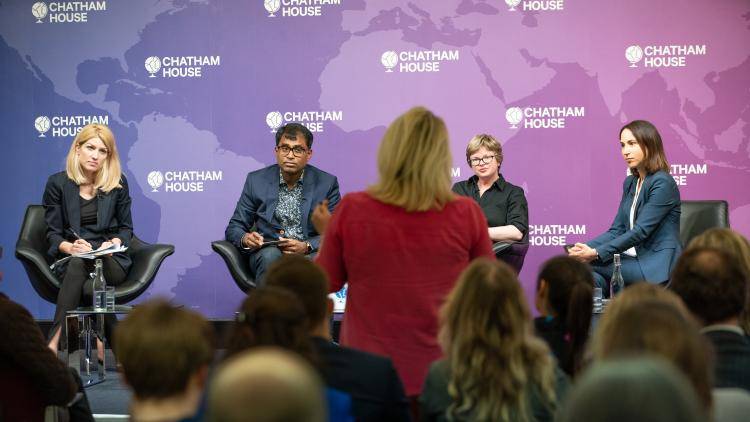
Dr Leslie Vinjamuri
Welcome to Chatham House, post-Bank Holiday weekend. It is a pleasure, it’s always an honour to speak at Chatham House, and it’s especially an honour to welcome one of the most outstanding membership – group of community of members that exists, I think, in the world, when it comes to leading international affairs’ think tanks. So, thank you for being here and thanks for turning up. We’re on the record today, we’re livestreaming and we’re recording, which is – means that it’s a tremendous opportunity to ask a great question, to put your position out there succinctly with great passion and focus. And so, I encourage you to think about what you might wish to say when the time comes, and make sure that you hold your hand up high.
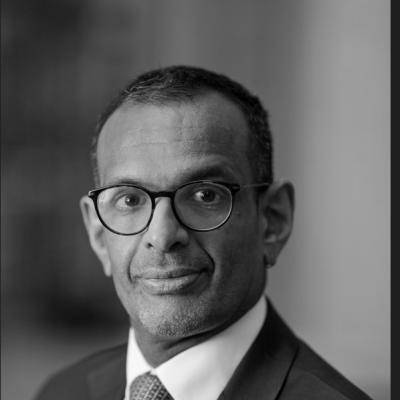
I’m Leslie. I feel like I know many of you, maybe not all of you. I direct the US and Americas Programme here at Chatham House. I am very happy to be amongst colleagues. Julián Ventura is joining us online, he is an Associate Fellow, based in Mexico City, became associated with Chatham House – obviously had been associated with Chatham House for a very long time. But when he was Mexico’s Ambassador to the UK, he became an integral part of our broader engagement. And then after his position as Deputy Foreign Secretary in Mexico’s Foreign Service, and after, I think, more than 30 years of service, he has paused that service and is an Associate Fellow on our programme. He’s previously served as Mexico’s Ambassador to China, as the DCM in the United States and in many other posts, the G20 Sherpa. So, is tremendously well qualified, although not an Author of the report that we’re talking about today, but is tremendously well qualified to join us.
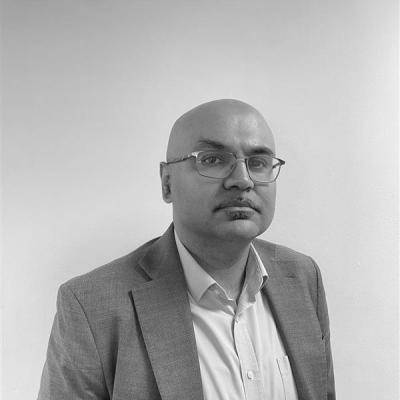
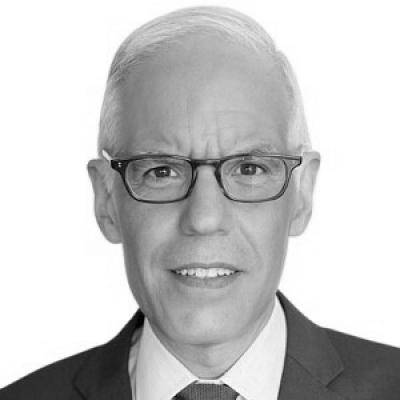
Dr Chietigj Bajpaee, my colleague, we’re also alumni of the same undergraduate university. I won’t say which, we’ll leave them guessing, but met here at Chatham House. Is Senior Research Fellow for India on our Asia-Pacific Programme, and has been speaking and writing extensively about India, India’s global role, India’s domestic policy and politics, but really India’s position in the world, which as we know, is a very significant one right now. And Professor Anand Menon, well known to anybody who follows the UK. Brexit, Europe, Director of the UK in a Changing Europe, a tremendous friend of Chatham House, and has been, to me, a great supporter and intellectual interlocutor and friend. And so, it’s really – it’s great to have everybody here.
The paper that we’re here – we’re really here – we’re never here to talk about, you know, a published paper, ‘cause that was then and this is now, but it is a really wonderful springboard into the most fundamental question of our time, for those of us who are engaged in international affairs. The title of the paper, ‘Competing Visions: Responses to US Power in a Fracturing World.’ Let me say by way of introduction, that it has been a very longstanding commitment by the US and Americas Programme here at Chatham House to engage. You know, we’re not like most US programmes because we’re not in America, and so we have a very specific place and position in our research since it was founded as a project with Mick Cox. Professor Mick Cox of the LSE, really taking a leadership role in the aftermath of 9/11, there’s been a real focus on how the rest of the world is engaging with American power.
My predecessor, Xenia Dormandy, now Xenia Wickett, led a whole series of research initiatives that looked at elite perceptions of American power, elite perception across the world, not elite perceptions in the United States, and how they were viewing and thinking about and positioning themselves with respect to American power. And a lot of that work was supported by the United States National Intelligence Committee, as was this initial research paper, which we then developed further and published with Chatham House. But the initial impetus to turn and look at a next, sort of, variety of this question, which for us was to look at states, leading government posi – officials and their positions on this broader question of America’s power and how it should drive their strategic thinking, but also, elites who were in the opposition or out of – or had been in government previously, but the foreign policy expert community.
And we took 11 states, and we took them for a variety of reasons. Some of the reasons were because we hadn’t done as much on these states as we’d done, for example, on the United Kingdom. So, the United Kingdom is not in the paper, but it’s clearly core to the work of Bronwen and Olivia O’Sullivan and across the institute, so it’s always there. And there are many other colleagues across the institute that are asking questions from the perspective of different countries, that are, again, very much related to what we were looking at.
And in this paper we asked, you know, how are these states looking not only at Donald Trump in the current moment, but as America’s changing structural position at the rise of China, at America’s domestic dysfunction. Not everybody sees it that way, but a lot of people certainly do, and I think there are some empirical measures to justify that position – facts. And, also, you know, that broader question of whether there’s something that’s inherently valuable and can or should be preserved about multilateralism, either at the global level or at the regional level. So, these are, sort of, our starting off questions.
I did want to say, though, that the institute – you know, Chatham House is – as a institute has also been invested in these questions since its founding in 1920. 1920, the year of the League of Nations, was, you could argue, you know, somewhere around there, the beginning of a three decade process of order building. If you, sort of, start with the League of Nations and you go all the way through to the founding of NATO in 1949, the League of Nations, the UN Charter, the Genocide Convention, all sorts of things, three decades that it took to begin to be able to identify the features of what we now refer to as the ‘post-war international order,’ didn’t happen overnight.
And even then, it changed a huge amount in the 1970s, at the end of the Cold War, the 1990s. There’s a book that just came out by Professor John Ikenberry and Professor Peter Trubowitz, Peter’s an Associate Fellow here, that’s looking entirely at the 1990s and the questions about international order and America’s role, in that moment when America had preponderant power relative to every other state in the world, and what choices it made and how they’ve affected the situation that we find ourselves in today. It’s an edited book with a lot of contributors. So, there’s been work across the institute on these questions since our founding, and obviously, they’re embedded and invested right now in the Global Governance and Security Centre that’s been launched in the last year. So, watch this space.
But watch this space, most especially for the world, and we, you know, we’re jumping into this debate and taking a snapshot at a moment when I think President Biden thought that he was, as did President Obama and as have other Presidents, but especially beginning with Obama, they thought that something was not right. That China was growing, and that America was changing, in relative terms, and that the order needed to be re-imagined, adapted, reconfigured. And arguably, that was the start of something bigger than any one of these states, but right now, it feels like, I’m not sure if it is or isn’t, but it feels like a moment not of a long-term project of order building, but it feels like a moment of demolition and destruction. But what – I can see people’s faces, but what it might actually be is the beginning of something that in – when we get to the end of three decades, or however long it takes, we, kind of, go, ‘Well, Chatham House at 2020, the 100 year anniversary, was at the beginning of something that took a very long time.’ So, we don’t know where we’ll end.
So, with that in mind, I would turn first to you, Chietigj, and say, you know, we don’t always – on global panels or in reports where you’ve got, you know, 11 countries plus the US, we don’t always start with India. So, that’s not only because of who’s here – and by the way, we were going to have Sanam Vakil, she’s unwell, she’ll be back, but she’s lost her voice and is – so is not here tonight. But she wrote a brilliant chapter on Saudi Arabia, on its 2030 – Vision 2030, which I encourage you to read.
But Chietigj, starting with India, I asked you before we came in, ‘How are you feeling about the world and about the international order?’ And you said, ‘From the perspective of India, fabulous,’ which is, you know, just not normally the words that we hear – that I hear from most people, with the exception of India. So, tell us what you wrote about, and what you – how you understand India’s response, not only to the Trump 2.0 moment, but to what its ambition is, what the limits, but also the possibilities in that vision, what is it trying to do as it thinks about, to the extent it does think about, this question of international order building?
Dr Chietigj Bajpaee
Yeah, thank you, Leslie. Yeah, so I think India, like many other emerging economies, sees it – you know, seeks a more equitable distribution of power in a multipolar global system. It’s aspire – I mean, it’s labelled as a ‘middle power’ often, but it sees itself as an aspiring great power. I think just last week, it surpassed Japan as the world’s fourth largest economy, so on course to be the world’s third by the end of this decade. And I think what we’ve seen by India is a constant quest for greater status and recognition on the world stage. So, whether it be its never-ending quest for a permanent seat on the UN Security Council, its very high profile G20 Presidency in 2023, its bid to host the COP Climate Change Conference, it wants to have a seat at key rulemaking institutions. And in doing so it wants to be a leader, or what it refers to as a ‘voice of the Global South.’
Again, we’ve seen several examples of this. Through its G20 Presidency, it facilitated the entry of the African Union into the G20. It’s tried to offer so-called ‘Indian solutions’ to global problems, so whether it be on global health, digital public infrastructure, on climate, I think that has, you know, been its ambition. At the same time, I think it has a slightly more nuanced approach than other countries, you know, emerging economies, or countries in the Global South, in the sense that it wants to offer a more benign worldview which is non-Western, but not explicitly anti-Western. It’s tried to promote itself as a so-called ‘bridging power’ between the West and the rest, in the sense that it’s you know, trying to promote this idea of a reformist rather than a revisionist power. So, I think that is the image that it’s trying to promote. Whether it, you know, stands up to those credentials, I think there is a gap between the rhetoric and reality which we can, of course, discuss.
Dr Leslie Vinjamuri
And would you say – I mean, this is a very interesting comment that you make about ‘leader of the Global South,’ investing in certain things that one would associate with being a leader, public goods provision. One of the things that I thought we found in the report, that I, sort of, read from the report of all these very different chapters, was that there aren’t really – you know, we think of the liberal international order as being characterised by multila – commitment to multilateralism, a commitment to free trade, a commitment to democracy and the rule of law by its member constituents. But also to a commitment to bub – public goods provision, right? Thinking beyond the needs of one’s own nation.
And so you mention ‘public goods provision.’ We didn’t really see that many states, and maybe, you know, I wanted to say only China, really, but maybe – and the United States, but – although we know it’s complicated right now. But China, India, do you think that the resources that India is actually materially putting into that vision, is there a gap? How would you assess that gap?
Dr Chietigj Bajpaee
I think the ambition…
Dr Leslie Vinjamuri
Aspiration and…
Dr Chietigj Bajpaee
…co…
Dr Leslie Vinjamuri
…delivery.
Dr Chietigj Bajpaee
Yeah, the ambition or aspiration quietly – clearly outweighs the ability to some degree, and it’s – I think it’s selective. So, for instance, India’s contribution to UN peacekeeping operations, it’s a significant player there. In it – in providing support to – for freedom of navigation along the Indian Ocean region, it’s also a prominent player. Digital public infrastructure was a very prominent initiative during its G20 Presidency, where it was essentially trying to promote the democratisation of technology or digital inclusion. So, that was, I think, a key initiative. So, I – you know, vaccine provisions to countries in the Global South during the COVID pandemic. So, I think it’s been selective.
Then there are other areas where I think India’s role has been less prominent, most notably with respect to when we look at global flashpoints, such as, you know, the developments in Ukraine or in Gaza, we see other countries, countries like Turkey or Saudi Arabia or Qatar, have played a far more prominent and hands-on role. I think India’s actions on those issues have been far more driven by self-interest. So, I think it is a very selective approach in terms of a provision of public goods. There’s obviously an issue of capacity and capability. So, I think, yeah, I think, for now at least, the ambition outweighs the ability to a large degree.
Dr Leslie Vinjamuri
It’s good to set the aspiration high. Ambassador Ventura, I’m going to come to you next. You have written and thought about these issues. We, in the paper, we have a contribution by Oliver Stuenkel on Brazil. We don’t have Mexico in the paper, but we have a speaker who not only is well versed in the G20 and many global issues, political economy and trade, but also in Mexico and across Latin America. So, your thinking on these broader questions.
Julián Ventura
Thank you very much, Leslie. It’s a pleasure to join everyone from Mexico City. I really encourage everyone to have a look at that research paper, because it does give us a very good template of how key countries’ global vision fits in or points the way to how they’re going to address a rapidly changing intervi – international environment. Things are moving in various directions. They’ve been moving even before the new occupant in the White House entered into office, of course. But I think that, you know, four months into the new US Presidency, we can safely say that we’re still very much in a US centric world, or at least one in which it is decisively shaping or accelerating broader unfolding geopolitical trends. So, that’s the basic baseline from which key players highlighted in the report, but beyond the report, as well, are trying to navigate. There are some broader long-term trends, but the immediate urgency is to engage and stabilise relationships with the US.
We’re seeing this to different degrees of success, whether it’s in Beijing or in South Africa, most recently in Latin America, the case of Mexico is quite eloquent. There’s no set playbook in terms of how to deal to this changing international environment, but I think that it can be summarised as, sort of, a four-step approach. Engage and stabilise, negotiate with a clear sense of red lines and from a pragmatic, practical approach, strengthen your domestic resiliency, and diversify. But this last factor is, of course, a longer-term process, it’s not an instant situation. Anand was recently in Mexico City, and he was very eloquent about the weight of geography in, for example, in trading relations. So many years after – five years after Brexit, 50% or more of US – of UK trade is still with the European Union, and recent moves by the Starmer Government to engage with Brussels should be seen in that line.
In the case of Mexico, we’re seeing a, you know, a highly interdependent relationship with interlocking pieces related to massive trade. Mexico is the US’ wor – largest trading partner. Immigration, security issues, the process has been moving forward and wrapped in a relatively fluid way, and I think a cool-headed approach. And showing results to the White House on issues, and very complicated issues, such as, migration and fentanyl, have been paying off. But the key objective, for example, has been to protect USMCA tariff-free trade, which is huge, and that is, so far, paying off.
And this leads into Brazil. Oliver’s chapter is very good in this regard. He talks a lot about Brazil seeking ‘strategic flexibility.’ It has, in a way, more leeway than Mexico, because its economy, it’s a huge economy, but it’s less US-centred. The US is still the main foreign investor in Brazil, but of course, the commodity market in China is a key determinant and a key limitant in its overall engagement strategy. Both countries are very important multilateral stakeholders, they’re rule makers at key times, and of course, as we all know, the multilateral system and the multilateral approach is under severe stress.
So, what to look out for Brazil in the coming months is that they’re going to be in the firing line leading to the fall. Because they’re going to be hosting the COP 30, the next big climate change conference, in which US positions, current US positions, are antagonic to any, kind of, enhanced collaboration on climate change. So, we’re going to have to see how Brazilian diplomacy deals with this very difficult issue. South Africa, which is mentioned in the research paper, has to do this in the case of the G – in case of the G20. There’s a directive from the US that it will boycott the G20 process. It’s scheduled to chair the G20 in 2026. President Ramaphosa in the White House press – in the press conference he gave after meeting with President Trump, said that he talked about this to President Trump and President Trump agreed to consider the possibility of attending the G20 this year. And this is important because when you don’t have many spaces that are cross-regional for engagement, like the G20, the US is crucial in this regard.
So, one thing I’d like to put out there before ending is how is the rest of the world, the EU – Europe, the UK is a key stakeholder in this. They talk the talk very well, India does it, China does it, in terms of upholding a multilateral approach. But in the emergency that we’re in now, who’s going to put their money where their mouth is? They can’t do it by themselves, India can’t do it by itself, we talked about a little bit just now. So, that’s why it’s so urgent to develop very practical issue-centred, cross-regional approaches, that are not devol – that do not devolve us into a North-South confrontation or focusing too much on big ticket international structural issues that are not going to be solved or addressed in the short-term.
Dr Leslie Vinjamuri
Thank you. You’ve gotten us on to a really important issue. I just want to – two things. One is you’ve raised the question of ‘strategic autonomy,’ which many states are seeking, I think across the entire paper. Not every Author who is de – and these are people who are phenomenally expert on the countries that they’re writing about. They’ve been writing about these countries for decades. The very best people in the world contributed, and so it’s really – it was a marvellous project to be able to lead. And they didn’t all use the word ‘strategic autonomy.’ but they all, in different forms, said that across the board, countries are trying to invest internally and diversify their partnerships externally, in order to avoid having to choose a side, either being too closely aligned or subject to the United States, especially now, or to China. And this is something that you’ve really nicely picked up on. Did you want to say something here?
Julián Ventura
Yeah, I mean, I hesitate to comment on these things with three experts sitting on the stage on international geopolitics, but we all know there is no such thing as complete strategic autonomy. Countries, depending on when they’re sitting, they’re trying to maximise opportunities for doing this, but the web of interdependence is just too thick, and it narrows the policy bandwidth. Brazil is dependent on its commodity exports to China, but also on US investment. India needs Russia military equipment and technology, but US – but co-operation with the US on innovation, technology, education, a whole range of issues, is equally vital. Japan, Korea, Australia, strategic military partners of the US, are highly dependent on the Chinese market, for their exports and for their manufacturing platforms. We’re seeing how Russia has become more dependent on China.
So, all these factors limit the extent to which you can strategically plan at such a high-tension moment in international relations. The cogs and gears may not be moving smoothly right now, but the engine is there, and I don’t foresee radical changes as to the drivers of what the existing international order is. So, there’s limitations to what each country can do, depending on their geographical and geostrategic positions.
Dr Leslie Vinjamuri
Absolutely, and I thank you for outlining that. But you also do help us draw the contrast with, you know, previous orders, where you didn’t have dependencies across all sides of the major geopolitical conflict, if we take that to be the United States and China. And it is something that differentiates this period of international relations and the international order, from the Cold War, for example. But I’m going to come back to the multilateralism question, but first I want to come to you, Professor Anand Menon. It’s not often that in debates about international order and strategic autonomy at Chatham House that the UK and Europe go last, but here we are. Tell us about your part of the world. I know you are obviously deeply expert on the UK, but also – and Europe, more generally.
Professor Anand Menon
I mean, as ever, European reactions are divided, and so there are chapters in the report on France and Germany. And what you see is countries start from very different starting points. I mean, the last ten years have been an utter unmitigated nightmare for every aspect of the German model, whether it’s trade, whether it’s security, whether it’s domestic economy. You can’t imagine a world that has developed in a worse way than it has for the German model. So, the Germans are struggling to keep up and to catch up with a world in which they’re going to have to start thinking about deploying military force. They might have to wean themselves off their export-orientated trade model with dependence on Russia for energy, China for trade. So, the starting point means that Germany is panicking slightly more than some other countries.
The French – I mean, bear in mind that across Europe, the other – there are two, sort of, baseline domestic factors that condition this. I don’t think in Europe at the moment, many statesmen or stateswomen are sitting down and thinking the international order is in flux, how do we respond in a medium-term perspective? I think Europe is full of statesmen and stateswomen who are thinking. Christ Almighty, how do I beat the populace in two years’ time? So, it’s very short-termist, it’s very tactical, it’s very reactive, and across Europe. I mean, if you look at the two countries in the report, France and Germany, there are severe threats to the centre ground of politics, mixed with a fundamental issue, which is no-one in Europe has the first clue how to generate growth. So, that’s the context in which you’re confronting all these global challenges.
So, part of the European response is to, kind of, think about hedging against the unreliability of the United States, while fervently praying that they can be relied upon again soon. Because the degree – because Europeans have allowed themselves to become so fundamentally dependent on the United States for their security. You know, they’ve been free riders for decades and all of a sudden, in the harshest possible way, that is coming back to haunt them now. In a context where not only is the United States saying, ‘Look, you people need to be spending more in defending yourselves, but we have a war raging on our border and a war in which, or after which, we might be called upon to play some role in securing the peace.’
So, Europe is panicking, I think there are no two ways about that. I think at the moment, we’re at the, sort of, rhetorical phase of the panic, with people – all these meetings of the Coalition of the Willing, about how much money we’re going to spend and so on and so forth. The fundamental fact is for – you know, the Ambassador was absolutely right, there’s no such thing as absolute strategic autonomy. For Europe it’s going to take a decade before we have even partial strategic autonomy when it comes to the area of military capabilities, because we’ve left ourselves at the mercy of the Americans for so long.
A final word on the UK, just ‘cause we’re in the UK. To date, I think Keir Starmer has played a, you know, an appalling hand quite well, in the sense that, you know, outside the European Union it’s quite isolated being the United Kingdom at the moment. But he has managed, as we’ve seen in the last couple of weeks, where we have these trade deals. We have a trade deal with India, we have a pretend trade deal with the United States, and we have an agreement with the European Union, that actually, that is perfectly sensible policy and politics. The problem, I think, for the United Kingdom is whilst we want to be able to be friends with everyone, you know, have a good economic relationship with China whilst working closely with everyone else, some of those choices are going to impose themselves sooner rather than later. And at that point, I think the politics and the foreign policy becomes incredibly messy for us.
Dr Leslie Vinjamuri
So, Anand, in 1943/44/45, there was a war raging…
Professor Anand Menon
Hmmm hmm.
Dr Leslie Vinjamuri
…and there were a lot of – there was a lot of attention focused on urgent and immediate issues. But there was also a very serious conversation, certainly by 1944 and even earlier, going on between the United States and the United Kingdom and others, about what should come next? It didn’t just start in 1945.
Professor Anand Menon
Hmmm hmm.
Dr Leslie Vinjamuri
And there were urgent problems then. So, surely, surely we haven’t just thrown out the broader question of strategy. And, you know, when I, kind of, read and reread, and when we all talked with each other about these chapters, there were some countries – I mean, India, you articulated it very nicely what the vision is. There’s a question about resources and a gap between aspiration and delivery, but the aspiration is there and that matters, although it seems different now that Trump’s in power. There’s not as much focus on getting into the major multilateral organisations. I see at the Security Council, there’s not as much talk about that.
But Europe, I mean, surely even at a period of low growth, a UK-European Union reset preoccupying the conversation, a war that’s been going on for several years now, surely still there’s an opportunity, and frankly, given where China is and where the United States is, an imperative and a necessity to be thinking about the international order. To be thinking more strategically about driving not only the urgent and the necessary but the medium-term conversation.
Professor Anand Menon
Hmmm hmm.
Dr Leslie Vinjamuri
And if it is taking place, where is it taking place, and, also, who’s at the table? ‘Cause we do now have this unusual moment where it’s hard to get the Americans who are in official positions around the table to have a strategic conversation, because there is a unilateral moment which is very…
Professor Anand Menon
Hmmm hmm.
Dr Leslie Vinjamuri
…disruptive and very dismissive. But surely, that is calling on others to come together to have a much more strategic conversation about what the international order should be. And what – I think what we found, and again, there are some Authors probably in the audience, Armida’s here, who knows deeply about Europe, there are other people who are, you know, at Chatham House who know these countries and these cases and know these debates, I think what we found was that China had a vision and a view…
Professor Anand Menon
Hmmm hmm.
Dr Leslie Vinjamuri
…and a strategy and tactics. That Iran and Russia knew what they didn’t want, and that was American leadership, and they’d like to disrupt it in different ways as much as possible. And that beyond that, it was, kind of, you know, strategic autonomy, diversification, some sort of regional order building. In some cases, you know, Turkey and Saudi Arabia had more of a vision for their regional position and certain ways that they could contribute to public goods, if you consider peace and stability negotiating, you know, having a negotiating role. But there – it was really hard to find where was the global or international or trilateral conversation?
Japan, brilliant chapter by Professor Jennifer Lind, who’s also an Associate Fellow here. She’s at Dartmouth College, she has a book coming out soon on China. She’s written extensively over the years on Japan, and her argument was, ‘Look, Japan’s just, sort of, relieved that when America – in this new phase that America’s not going to be pushing liberal values on the international stage,’ that it would welcome a more pragmatic, balanced US. We now know that there’s more concern, because this extended deterrence commitment doesn’t seem as…
Professor Anand Menon
Hmmm hmm.
Dr Leslie Vinjamuri
…you know, baked in. But surely somewhere there’s some very serious thinking, the – we’re just not being invited.
Professor Anand Menon
I mean, the striking thing about the countries, with the exception of Japan, that you just listed, is they’re not really functioning democracies, any of them. And it’s far easier in systems like that to think medium-term, to think strategically. Of course, it’s right Chinese have got a plan, because the way the Chinese Government works is you devise a plan, and you have unt – as long as you want to implement it. One of the chronic problems in Europe at the moment is short-termism that is borne from this political dissatisfaction at home. Imagine after the French election next time, if it’s the l’Assemblée nationale who are governing France, that will be a fundamental change in the nature of the country and its relationship with its partners.
The other complicating factor in Europe is, of course, that we’re not quite sure in Europe who we are. So, is ‘we’ your country? Is ‘we’ the United States of which your country might – the European Union, of which your country might form part, or is ‘we’ something slightly broader? Is it a bigger conception of Europe that might include the United Kingdom? For heaven’s sake, it might include Canada these days. And actually, one of the problems in Europe at the moment is we can’t quite figure out what our coalition is and who we should be working with.
Now, those conversations are ongoing and it’s going to take time. And I suspect that what we’ll get is a situation in which the European Union does some parts of this, other organisations, maybe even bilateral co-operation between states, does other parts of it. But it is incredibly complicated for Europe, perhaps more so than any other region of the world. Partly because of the levels of dependence, partly because of the levels of domestic insecurity and uncertainty, and partly because this is a region made up of lots of small states that have to figure out how to work together to have any heft at all in international politics.
Dr Leslie Vinjamuri
So, Chietigj, maybe you can comment on this broader question, but I mean, I want to throw a couple more things out there. I think, correct me if I’m wrong, you will have all read this as well. I think Sir Simon Fraser, our Chair, wrote a piece in the Financial Times, not too long ago, saying that, you know, ‘The UK should think about not only the UK and Europe, but now it should also have a strategy that involved working with middle powers.’ I don’t know if he meant Global South countries, but, you know, that there needed to be a look beyond. We have, in several months, it’s – I guess it’s still several months away, but, you know, come September the UN General Assembly will convene in New York. It used to – even if it was, you know, dysfunctional and chaotic and didn’t really necessarily produce anything, it still used to be seen as incredibly important from the point of view of conferring legitimacy on where the international global debate was, on whatever came out of it, at the General Assembly, at some level – obviously the Security Council more formally, but even the General Assembly.
I mean, is there – are we in an era where India still cares about the multilateral order? Or is just – are we moving towards – and in the last chapter I tried to, kind of, begin, you know, the very beginning of brainstorming, where are we headed? People talk about ‘spheres of influence.’ There is a question – some people, I mean, you know, not very many, but there is – there are people, there are signs, even, that maybe there will be a restoration of the West in another three, four, seven years, we don’t know how long. There’s also the possibility that China really does come to dominate, normatively and institutionally, as well as economically and in strategic and military terms, the international order.
But – or – and – but a lot of people just think we’re going to end up in this, sort of, patchwork, this, kind of, you know – a little bit of what Julián was saying, you have to work here on economic issues. You’re, you know, you’re constrained on political and military issues, but that there’s not a cohesive effort, or even desire or ambition, to set the terms of international order going forward. Where – I mean, is India – is this just sort of, you know, chatter or is this serious?
Dr Chietigj Bajpaee
Well, I think Asia is very used to dealing with this, kind of, patchwork system. I mean, we used to – for decades, we’ve referred to the ‘spaghetti bowl’ of regional initiatives in Asia. So, the – you have the more open and inclusive regional initiatives, those under the ASEAN framework. At a global level, you could talk about the United Nations, the World Trade Organization, the IMF. And then you have the more ad hoc minilateral initiatives, initiatives like the Quad. So, I think, you know, countries like India, obviously as I mentioned at the outset, it’s in this constant quest for greater status and recognition, so it still wants that permanent seat on the UN Security Council. What it will necessarily do with that seat is not entirely clear and will the – whether the UN will be as effective an organisation when it finally gets that seat is another debate.
But I think it increasingly engages more with these groupings with so-called ‘likeminded countries’ or ‘trusted geographies,’ or – I think that is the direction of travel. So, you know, India’s participation in initiatives like the Quad, the Initiative on Critical and Emerging Technologies with the United States, which has been renamed the Trust Initiative under the Trump administration, joining the Mineral Security Partnership, the Artemis Accords on the governance of space. So, I think it sees these more functionally driven initiatives between likeminded countries. I think that is the direction of travel for India.
Dr Leslie Vinjamuri
Julián.
Julián Ventura
Well, first, on the strategic planning, I think that for democracies, especially liberal democracies, which are subject to the tyranny of political calendars and domestic developments, you know, it’s kryptonite for strategic planning. Among democracies, I think India is in a unique position, because you have a combination of around a decade in power of Prime Minister Modi, and a very strategically driven foreign policy apparatus led by its Foreign Minister, that gives consistency to that approach. But that’s not the case in Europe and in other parts of the world. In my neighbourhood, it happens, you know, Mexico changes every six years. We had a very radical change with Lula’s return to power after the Bolsonaro Government, without the commodity boom to give it muscle in the international arena. So, that’s another limiting factor that we have to keep in mind.
On this, you know, commitment to whether we’re going to have a broader thrust multilateral system or more of a ‘patchwork’ mechanism, as you call it, I think it’s – we’re entering an age of diminished ambition, where the goal is not winning World War II, but Saving Private Ryan. It’s a micro-focus approach to salvage different pieces of multilateral co-operation. The UN might be ineffective in some big ticket peace and security items, but it’s absolutely fundamental to the humanitarian agenda. I was just looking at some statistics this morning. The World Food Programme is losing 25% of its budget and it’s probably going to cut down 20% of its staff. Almost 400 health clinics being closed in Afghanistan. Funding ended with the World Food Programme for Yemen and Afghanistan. Critical situations, big spending cuts at the WHO, that need those kinds of likeminded or cross-regional approaches that my colleagues are talking about. Not introverted, not BRICS-centred, not EU-centred, not ASEAN-centred, but reaching across the table.
If we talk about, for example, the – like, the difference between capabilities and aspirations, what could a country like India and Turkey and the EU and some of the big players in international co-operation in Asia, Japan and Korea, be doing to, at the very, least align their humanitarian co-operation and climate change agendas at a critical time? Those kinds of piecemeal efforts might be limited, it might not satisfy our wishes for a brave new world that changes radically, in which there is no double standards and more fairness in the system, but which I guarantee will make a practical difference here and now for millions and millions of people that depend on this kind of co-operation.
Dr Leslie Vinjamuri
Thank you. I’m going to come to the audience in just a minute. I guess I would just add that, you know, the liberal international order was ostensibly, in the wor – I think Ike – John Ikenberry, who also spends a lot of time here, is a Professor at Princeton, would argue, and I would agree, was in part, designed, multilateralism, free trade, commitment to democracy and the rule of law, was designed to create a world that was safe for democracy. And it was also designed at a moment of extreme urgency, not – perhaps there’s not enough extreme urgency at the moment. But it might be the case after – are we at 18 or 19 years of decline in democratic freedoms according to Freedom House measure? That the – that, sort of, investment and commitment to creating structures that protect our societies to be democratic, that that basic commitment is not one that is as widely held as it once was. Anand, and then…
Professor Anand Menon
I was going to say…
Dr Leslie Vinjamuri
…I’ll come out to…
Professor Anand Menon
…it was also…
Dr Leslie Vinjamuri
…audience.
Professor Anand Menon
…designed to protect the interests of its designers.
Dr Leslie Vinjamuri
Of course. Undoubtedly the case…
Professor Anand Menon
Yeah.
Dr Leslie Vinjamuri
…absolutely, undoubtedly the case.
Dr Chietigj Bajpaee
Yeah, just to add a point, you know, building on that, I mean, in the West, you know, the 1990s is often looked at as the golden Age of globalisation, the peak of the liberal international order. This was the dark decade for India.
Professor Anand Menon
Hmmm.
Dr Chietigj Bajpaee
It suffered from a balance of payments crisis in 1991 in the aftermath of the Gulf War, subsequent collapse of the Soviet Union. It was essentially a pariah following its nuclear tests in 1998, faced economic sanctions. You had a string of unstable, weak coalition governments in the mid-1990s, terrorist attacks, religious unrest, a war with Pakistan in 1999. So, this is why I think from India’s vantage point, the current period is seen as, you know, the critical period, or India’s Amrit Kaal, and which is why it looks at the current period, you know, it is not as sceptical or – of the current state of the global order, from its vantage point, given the position that it’s in. You know, it just emerged as the world’s fourth largest economy, on course to be the third world’s fastest growing major economy, in that context. That’s why, you know, as you said at the outset, you know, India maintains a far more positive view, not only of the current global order or disorder, of whatever we want to con it – call it, but also of the Trump administration. It’s among the most positive countries about the second Trump administration.
Dr Leslie Vinjamuri
And I think – I mean, I don’t want to speak for her, and you will have heard her speak many times, but I think with respect to certain parts of the Middle East, that Sanam has argued that that is also the case. That there is more – that there is a – there’s a perception that there is more possibility in the willingness of Trump, and the Trump administration more broadly, to not just follow convention and, you know, still to be seen. But I take your point very much, and yours as well, Anand, and also, remember that many, many states were left out of it.
Professor Anand Menon
Hmmm.
Dr Leslie Vinjamuri
The 1990s weren’t just bad for India. They were bad for Rwanda, they were bad for Bosnia they were bad for Somalia. The list is extremely rong – long, and we tend to romanticise and sensationalise, and all the rest of it. And, you know, throughout the so-called, you know, ‘liberal international order’ period, there was mass himoc – hypocrisy and many people were – and states were on the wrong side of it. So, with that in mind, maybe we need to aim for something more inclusive and that creates more – a better basis for more widespread prosperity, as well as peace and stability and many other things. Questions or interventions from the audience, oh my goodness. Okay, I’m going to take two to begin with here, and if you’re – if you say who you are, and I’ll take three just to…
Rob Macaire CMG
Thank you. Rob Macaire, I’m a member of the Council of Chatham House. Thank you for the excellent paper and the excellent discussion, both of which hold out the prospect, or the possibility, for this fragmentation of – in the global order not being indefinite, but somehow coalescing in future into a reversion to some form of global order, although it would look very different. But you’ve talked about that possibly taking decades, and as we see more and more populism, you know, technology enabled populism, and change in the relationship between people and governors, do you think that maybe by that stage people’s view of the nation state as being the main vehicle by which they are – their needs are satisfied has rather changed and that the new – any new global order might look a bit different?
Dr Leslie Vinjamuri
Great question, thank you for asking it. Right at the very, very back here, somebody has their hands up.
Karen Page Bel Khadem
Hello, Karen Page Bel Khadem, SOAS. Bearing in mind the relative – well, complete ineffectiveness of the UN, is it now time for restructure, particularly in regards to the Security Council, and how might that be achieved?
Dr Leslie Vinjamuri
Thank you, great question, and then right here.
Caroline Smith
Hello, Caroline Smith, a student of SOAS. With the very open desire of the Trump administration to annex Canadian and Danish territories, where does that leave the future of NATO?
Dr Leslie Vinjamuri
I think we’re going to find out in a handful of weeks. Great question. Let’s come back to – who would like to take – who would – Anand, I’ll let you jump in. Where would you like to jump in?
Professor Anand Menon
On the populism of the nation state, I think it’s really, really interesting, because we have this paradox, don’t we? Which is, you know, as Ambassador Ventura said, ‘We’ve never been more interconnected or interdependent’ on technology, on the economy, on, you know, weapons and warfare because of nuclear proliferation. And yet, we increasingly, in the West, at least, have populations that, in part, are turning their back on the world outside. And that’s partly what populism is, it’s saying no to globalisation, it’s saying no to the movement of people. It’s a reaction in some countries. Like, in this country, I’m convinced that the, sort of, the anti-politics mood is partly a delayed reaction to things like Iraq, foreign adventurism.
And I think, in a sense, what we need – this is almost a vacuous thing to say, is we need Politicians who can sell globalisation and its dependence and make it work for everyone. And, you know, thinking back to the opportunities we missed ten years ago to share the spoils of globalisation better than we did, my God, that was an open goal that we missed. One of the things that has upset me recently has been listening to members of this government, sort of, parrot lines from the Trump administration. So, ‘Yes, President Trump is quite right to say that trade imbalances are bad,’ no, he’s not. It’s absolu – you know, it’s just a false reading of economics.
But – and I fear that actually we’re not going to be able to square that circle. That at the moment politics is leaning into, yes, globalisation is bad, yes, we should be more closed. And actually that does nothing to resolve either the problems we have at home, because it – in the end, that makes us poorer, or the problems we have as a world, because it makes it politically a lot harder to engage diplomatically with other countries. So, I’m not confident, I’m afraid, so, I think it is a real issue.
Dr Leslie Vinjamuri
Julián, do you want to jump in here?
Julián Ventura
Oh, on the UN question, I think, you know, the UN gets a bad rap a lot of the time and we tend to forget that it’s driven – its board members are countries. And if there is no consensus among countries, it is very difficult to reform and to adapt. And that’s a reality that it’s not going to change in the sort – in the short-term. Anything that has to do with reform of the Security Council or the big peace and security premises require, you know, consensus and ratification by, you know, legislators, by member states. So, I don’t see that happening in the short-term.
We also forget that – you know, we’re also focused on the big peace and security issues, but the US does a great – the UN does a great deal of work that is vital to millions of lives. And they’re not sexy issues a lot of the time, they’re not in the headlines, in the newscast, but you will certainly feel if they stop working and if there is an absence. So, that’s where the focus should be. I think, you know, India understands this, I think Brazil understands it, as well. There’s a realist approach as to how, you know, soon those changes could come up in the pipeline, but the focus needs to be on more limited actions. We’re not going to see far-reaching change, and we’re not going to see a different structure replace what we have now. We have to make what we have now work as best as possible in very difficult conditions.
Dr Leslie Vinjamuri
Please.
Dr Chietigj Bajpaee
Just to add on the issue of the nation state. I mean, in some ways countries like China and India have already, in some way, transcended the nation state. They regard themselves as civilizational states.
Professor Anand Menon
Hmmm.
Dr Chietigj Bajpaee
So, they’re not merely defined by their geopolitical boundaries or their political system, but by their cultural, historical influence that they’ve held over centuries. I mean, they’re obviously – they’re strongly committed to the concept of territorial integrity and sovereignty, but they also see their influence extending beyond their territorial boundaries. You know, India has, under – particularly under the Modi Government, has really promoted this idea of India as a Vishwaguru, as a country that can promote or has something to teach the world or as a Vishwa Bandhu, or, you know, a friend of the world.
So, I think there’s this idea, I think both held in Beijing and New Delhi, that these are countries that are perhaps, you know, looking at the world in a more hierarchical system. I wouldn’t necessarily want to refer to it as a replay of the tribute system that we saw previously, but I think that they do see themselves, to some degree, in that way. That they see themselves to be, you know, higher up the totem pole because of their civilizational status.
Professor Anand Menon
Can I just add to that? That I think over the next ten years, one of the really interesting things we’ll see is the more strategic deployment of the Indian diaspora by the Indian Government, and my God, is that a political asset if they use it well.
Dr Leslie Vinjamuri
Very powerful in the US…
Professor Anand Menon
Yeah.
Dr Leslie Vinjamuri
…for sure, and increasingly so. Okay, more questions. Right at the very back.
Calvin
Hello, Calvin, private sector Consultant. My question is to the gentleman on my far right, the European professional man. So, you spoke about Europe a bit and maybe you did mention it and I was distracted, but Poland. So, Rafal Trzaskowski seems most likely to win the Polish presidential election, second round on Sunday. Is Poland presenting a shift in the European hegemony? What we think about that?
Dr Leslie Vinjamuri
Don’t answer that yet. Here.
Mariana
Thank you. My name is Mariana, I’m from King’s College. I’m going to try to get my head in order. So, whether this is like the destruction of the international – the rules-based international system, or the creation of a new one, I think we’re seeing that a bunch of, like, rules and institutions and, sort of, agreements that have been, like, longstanding, are being violated constantly. Even those that had, like a, sort of like, universal agreement, like, humanitarian missions, and we’re now seeing, for example, what Israel is doing with a so-called ‘humanitarian mission,’ despite the UN’s protest. My question is, if we are negotiating, like, piece and bits of the structure that we’ve built and that we have been operating under, what’s going to be the role of, like, human rights, media freedom? Is this something that Europe or other countries are going to defend, or is this, sort of like, a bargaining chip? I would like to hear the panel’s thoughts on that. Thank you.
Dr Leslie Vinjamuri
Thank you, and right here, in the second row. We’ll come back.
Heidi Zamzow
Hi, Heidi Zamzow, from the London School of Economics, and I’ve been coming for seven years, I have to say this is the best Chatham House event I’ve been to yet. So, thank you very much.
Dr Leslie Vinjamuri
They’re all great.
Heidi Zamzow
They are all great, but I really – I didn’t know what to expect and you’ve exceeded anything I might have. So, my question, I study behavioural science, and I’m very interested in narratives, so I’m wondering about the emerging political narrative. Because a couple of things came out tonight that concerned me, and one of which you said, Professor, relating to perhaps a nostalgia for this idea of the United States being the leader of the free world, and for a return to those days. Which I found very concerning, because I see this as a country that is also, in some respects, turning against its own people.
Professor Anand Menon
Hmmm.
Heidi Zamzow
So, I was wondering if there’s any truth to that. If so, do you have any thoughts on how we should approach that and whether that’s wise going forward, giving – given the constant caprices of the United States?
Dr Leslie Vinjamuri
Okay, final question right up front, and then we’ll come back, and we won’t answer absolutely everything, but we’ll get to the core of the issues.
Samuel Gussans
Samuel Gussans, member of Chatham House. I will follow the – my question with this lady’s where she left in relation to United State. How can Europeans – what – or what can Europeans offer Trump to save NATO? If not, has NATO come to the end of its cycle? And once United States decides to dissolve NATO, what can Europeans do?
Dr Leslie Vinjamuri
Okay, I am going to hope that Armida eventually puts her hands up on this one. Come back to the to the panellists. Who’s going to come – okay, I guess, Poland.
Professor Anand Menon
Yeah, I mean, there’s several things. I mean, Poland has become a bit of a poster boy in European integration, because it’s shifted back to the, sort of, Tusk-led government, and because it is leading the way in terms of defence spending. I think Polish defence spending now is hovering around 5% of GDP. And there is a sense in which the balance of power in the European Union has shifted eastwards simply because of the War in Ukraine. It’s far, far harder to ignore the views of Central and East European and Baltic member states because they are literally on the frontline.
I think it speaks to a bigger problem, as well, which is that the European Union has become far harder to govern now that it is a union of 27 member states. I think the, sort of, Franco-German partnership, which used to, sort of, lead the way in a smaller European Union, struggles to do so in a bigger one, and I don’t think we’ve yet figured out how to make the Union work effectively. So, I mean, Poland is one of a number of countries, you can say the Spanish, you can say the Italians, that are, sort of, rising powers within the European Union, if you like. And I just don’t think the EU and its member states have yet figured out how to work most effectively in a more diffuse union.
So, there are challenges and there are opportunities there, and I have no idea how this will eventually work out, but one of the ways to look at it is if you look at the discussions over the Coalition of the Willing, there’s a fascinating pattern of member states who are and are not invited to the various meetings. That speaks to the fact that we really don’t sure who matter – we’re really not sure who matters in these conversations as yet and we need to figure it out.
On NATO, you know, on NATO and Trump, in a sense, it’s the same question. NATO, the US guarantee, the US, sort of, focus on Europe has been diminishing for a significant amount of time. The ability of Europeans to delude themselves is absolutely clear from the fact that we had Trump 1, we were very aware of the dangers with Trump 1, and as soon as we got Biden, we said, ‘Ah, the United States is back, they’re back where we wanted them. This is absolutely fine we can continue as if nothing has changed.’ So, our capacity for self-delusion is endless in that respect, but I think you’re right, it would be shortsighted.
The Europeans need to start thinking about what to do in a world where Americans will not guarantee their security, and that raises a lot of really difficult questions. One, about money, the IFS, the Institute for Fiscal Studies, do a wonderful chart, which is basically defence and welfare spending post-Korean War. So, defence spending goes like that, welfare spending goes like that, basically, we’ve paid for our welfare state rates by letting the Americans pay for our defence. There are really difficult political decisions to be made about that, about institutions to be used. Can we trust NATO if we don’t trust the United States anymore? We’re just starting to scratch the surface of those decisions, but I would like to think that the Europeans are serious about it this time round and that those conversations will lead to something more practical than last time. I think that’s…
Dr Leslie Vinjamuri
Would you like to come in on any of these…?
Dr Chietigj Bajpaee
Well, there was not really a specific – but I think somebody had made a point about the question of ‘narratives,’ and I think from an Indian perspective, it’s almost flipped on its head from, sort of, the European perspective. I mean, I think India sees itself very much to be in a geopolitical sweet spot of sorts…
Professor Anand Menon
Hmmm.
Dr Chietigj Bajpaee
…under the Trump administration. You know, it’s in the unique position of neither being a US ally nor being a US adversary. So, it neither faces, you know, allegations that it’s not pulling its weight, like NATO member states, nor does it face allegations or claims of posing an existential threat to the United States, like, say, China. It’s a beneficiary of tensions in the US-China relationship, it – which it seeks to leverage. And then it also believes that a more insular US, which is less interested in exercising global leadership, would potentially offer more space for countries like India to step up. So, I think that’s the narrative from the Indian perspective and why it sees the current state of the global order and the current role by the United States as beneficial to it.
Dr Leslie Vinjamuri
Julián, I’m going to come to you right after I come to Armida and one online, and then we’ll – I’ll let everybody have a final word, ‘cause I think we are coming to the end. But Armida please, since I’ve put you on the spot.
Armida van Rij
Thank you. Thanks very much, Leslie. It’s hard to ignore that callout. Thank you very much for the panel. This has been a really excellent discussion, and I appreciate your insights. One just quick comment before a question. Anand, I hope you don’t mind, I take slight issue with the ‘free rider’ term, which – in which you described Europeans earlier on, in terms of their reliability on Americans for security. Because obviously the flipside of that coin is that it worked for the Americans too. It was a contract by which it essentially meant that European governments bought defence equipment from Americans, therefore supplying jobs, growth and lots of other economic benefits in the US. So, it was a two-way discussion that benefited both sides, which the Americans keep forgetting about, most notably.
I want to ask about – Julián, you made this point that we can’t currently, in the current environment, we can’t solve the ‘big ticket issues,’ which I agree with. I guess, my question and my concern is that given some of the challenges that we face are global, but are so urgent, like climate change, like security, and I’m not just talking about Russia’s War in Ukraine, which is very – a European centric approach, but hostilities in India and in Kashmir over the Taiwan Strait, we need to think about how we prevent go – global conflict. We need to think about the role of technology. We need to think about the fracturing of the internet. All of these are major global issues, which are also really urgent.
And I think, for example, the way in which the EU has now chosen to respond about the challenge to raise defence spending, it’s like a piecemeal approach where, ‘Oh, we’re going to, you know, trigger a national escape clause,’ and, ‘Oh, if we do this and we can do this.’ And you’re tinkering at the edges, rather than addressing the challenges head first. So, how do we actually cha – address these global urgent challenges at a time when we can’t do it, perhaps, and the international fora for that are reducing very quickly?
And then perhaps that’s a very quick point on the transatlantic – transatlanticism on – and NATO. What I think is particularly difficult this time is that governments in Europe are slowly waking up to the need for a Europe go it alone approach, but that’s really uncomfortable, because those who are the most supportive of Ukraine are also the most transatlantic in their outlook. And that is something that actually quite a few governments in the east and in the north of Europe are not willing to face with just yet. So, again, this goes to my point about we face an urgent situation, but the – Anand, what you were saying in terms of we’re not – we’re deluding ourselves, continues. Thanks, Leslie.
Dr Leslie Vinjamuri
Thank you, great points, and as I suspected they would be. There’s one question that I’ll draw from online that hasn’t really been addressed in quite this form, ‘What are the chances of China preventing a multipolar order?’ There’s a lot here on the table, a lot of very powerful questions and interventions from the audience. We did find in our research paper that nationalism is so powerful right now and, you know, we might all have a range of views about John Mearsheimer and his position on Ukraine and the West’s responsibility. But one thing he has said for a very long time, and I think there’s a lot of truth in it, which is that ‘nationalism is incredibly powerful’ as a ideology in comparative terms, and we’re certainly seeing that in the current moment.
I would also put one quick argument on the table, and then I’m going to come to each of you to conclude on whatever dimension you’d like. Don’t try to be comprehensive, since we’re at time. I believe that there is strong reason to believe that if the threat were urgent enough, if it went above a certain level, that the United States would absolutely come to the defence of Europe’s security, but that anything below that is now forever going to be uncertain and subject to question. And that, of course, leaves open a very big question, which is, where is that level and what would it require? We’re not there, but I don’t think that if we hit that level that the United States would remain absent. Okay, so with that said, let’s go Julián, Chietigj and Anand for closing.
Julián Ventura
Thank you. I think there’s a couple of key issues. On the ‘bits and pieces’ question, and I think this is mentioned in the section on India in the research paper, this distinction between the liberal order and the rules-based international order. What the person who asked this question, talking about, you know, universality of human rights, promotion of democracy, a more assertive intervention in humanitarian situations, those are hallmarks of that liberal international order in which Europe has been a key proponent and a stakeholder. So, the jury’s out on how Europe, with so many competing priorities, can recalibrate that important part of the agenda in its international engagement. I think that we’re more going toward trying to preserve a basic model of a rules-based order, which is more pragmatic. It’s more in tune with some of the key players in the Global South, such as India, Brazil, Mexico, to some extent, and that’s, sort of, the highway that we have to drive down.
On the question on the ‘big ticket issues,’ it’s important, I think there’s a distinction to be made between structural changes to the system. Are you going to increase or change the membership of the Security Council? Are you going to change the way you elect a Secretary-General of the UN? Are you going to change the way you can drive budget and finance decisions? That’s something that is very difficult to tackle in the current environment. But on the global challenges, climate change, humanitarian assistance, we’re going to see what happens in Brazil. We run the risk, with US absence or US disruptiveness, in breaking some basic agreements on this issue. So, that is something that we can sink our teeth into to get some results. If you go into the internet, you can find all kinds of information on the amount of resources that countries have pledged in Europe, in the US, in Canada, other developed economies, for various climate change agreements. But you will find nothing on compliance with those pledges, and I think it’s safe to say that very little contribution has been made.
And, lastly, on the US role, I encourage everyone to look at the recording of Leslie’s conversation, recent conversation, with Stephen Walt. I think trust is an issue that we have to think about. Is trust permanently broken? Is this a passing stage like many people thought during the first Trump administration? And that’s going to factor into the way countries make decisions going forward.
Dr Leslie Vinjamuri
Thank you very much. Chietigj.
Dr Chietigj Bajpaee
So, very briefly, I think – I would think India’s approach is essentially keep calm and carry on. So, I think, I mean, its foreign policy priorities are very much focused on creating a more enabling environment for foreign investment. That’s why we see the string of FTA agreements currently under negotiation, the recently concluded agreement with the UK, ongoing negotiations with the UK – with the EU, the United States, last year with the EFTA countries, Australia. And why we see India having a limited role on global flashpoints. You know, aside from Modi’s much quoted statement that, you know, ‘Now is not the era of war,’ India’s actions have been largely driven by self-interest.
Just briefly on the point that you noted about ‘strategic autonomy.’ I mean, India has a long-standing commitment to strategic autonomy, it’s evolved from non-alignment during the Cold War, and now it’s this idea of Vishwamitra that India will be friends to everybody. So, I think it – but I think there is a – there’s a Trump specific aspect to this. I mean, strategic autonomy obviously predates Trump, but I think the angle here is there’s a degree of strategic hedging on the part of India. So, for instance, the border agreement that it concluded with China last year, I think that was driven in part by concerns on – in both countries, that you’re facing a more unpredictable geopolitical environment with the emergence of the Trump administration. So, I think that and plus, you know, the string of FTAs that India is pursuing, it also reflects this attempt at hedging.
And finally, just one last point is I think that although India is relatively confident about its relationship with the US, there is an underlying fear of strategic abandonment, that, you know, what if tomorrow Trump decides to ‘do a deal’ with the Chinese, and, you know, we see the return of some, sort of, G2 type great power condominium? So, I think that is a underlying concern, so it’s not that everything is, you know, rosy from the Indian perspective.
Dr Leslie Vinjamuri
Thank you. Anand.
Professor Anand Menon
I may just quickly – I take your point on ‘free riding,’ though I think, you know, if you’re looking back with perfect hindsight, subcontracting your defence and security to another country is perhaps not the widest – wisest course. And, you know, going back to 2011 when European militaries weren’t able to defeat Libya alone, it shows the extent of that dependence. So, we can quibble about the wording, but I think there was a hint of irresponsibility about it.
And finally, just to say, I agree absolutely with Ambassador Ventura that actually, in the absence of a system that can deal with the big ticket items, ‘cause I think we don’t have a system that can, having a functionally based, sort of, variegated multilateral system for dealing with some of the functional challenges, whether it’s health, whether it’s the environment, is a very sensible step in the right direction, I think.
Dr Leslie Vinjamuri
This has been tremendous. What I’m really glad about is that the questions that we asked in the report – on the research paper are not – you know, they’re, like – as I said at the outset, it’s where we started in 1920. It’s certainly where we were at the centenary when we published ‘Anchoring the World.’ We now have a Global Governance and Security Centre that is asking these question. If our leaders aren’t doing it because they are constrained in multiple ways or lacking in ambition or just, you know, subject to pressures beyond our imagination, it is our role to be thinking very strategically about these questions. And so I am extremely glad that under the current leadership, that vision is carrying forward, and it requires your participation. Thanks very much [applause].