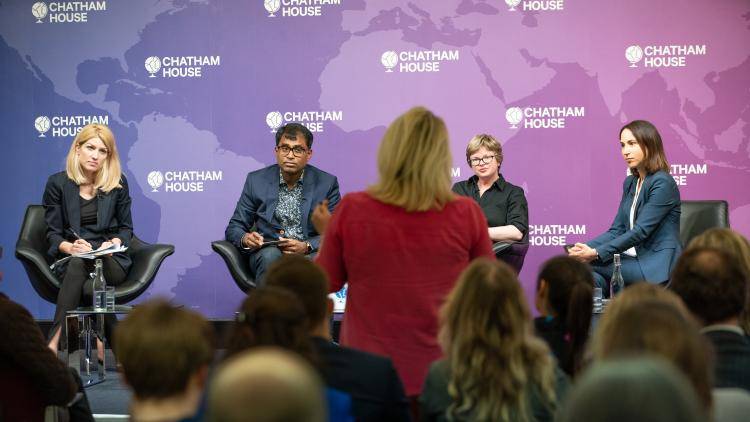
Simon Smith
Right, the lights have dimmed, so it’s time for me to say good evening to you all and welcome to Chatham House. Whether you are a member of Chatham House or associated with it, or whether you are a member of the British Korean Society, very nice to see you all here this evening. I have to say right from the start, just to make clear that this meeting is on the record, it is being recorded and livestreamed, so let nobody be in doubt of any of those three conditions, and I’m very, very briefly going to introduce our speakers. We’ve got an hour together, so I want to use all that time as efficiently as we can. I’ve already apologised to our speakers for not going through the immense full list of accomplishments that they have to their name.
Most of you will already know who they are, anyway, but let me very briefly just say we have with us this evening Colin Crooks, who at present, is His Majesty’s Ambassador to the Republic of Korea. Colin is, as yet, still unique in having been the British Ambassador to both North Korea and South Korea, not I hesitate – and I hasten to say, concurrently, but consecutively.
On Colin’s left we have Karen Maddocks. Like Colin, Karen is someone with whom I worked many years ago and through long years in the Foreign Office. Karen, I think, is also unique in that I don’t think anyone else combines the jobs of – or has combined, in their career, the jobs of Head of the North East Asian Department of the FCDO and the British Ambassador to Montenegro. So, there you are. You want any tips on Montenegro, Karen is your woman.
And then, last but not least, we have Edward Howell, who is both a member of the British Korean Society and a Fellow of Chatham House, and is also – and probably, I think, primarily, lectures in politics at the University of Oxford.
So, with that, with thanks to our speakers, with thanks to you for sparing the time with us, I’m going to ask Colin to kick off with a perspective from Seoul. I’m then going to ask Karen to talk to us a little bit about the UK-North Korea relationship, and then we’re going to hand over to Edward, who will come back with a few questions. And then, at that stage, that – this is the moment where I’ve – I have to learn to think and chew gum at the same time, because I have the laptop with some questioners online, but it will also be your chance to fire questions at our speakers from the floor. So, with all that, I will ask Colin Crooks to kick us off with how things look. Colin is now in his fourth year, I think, as Ambassador in Seoul. How does it look?
Ambassador Colin Crooks LVO
Well, thanks very much, Simon, first of all, for that warm welcome and, of course, for all your support over the years, as – not least as my immediate predecessor in Seoul. And great to see so many friends and indeed, other distinguished predecessors here in the audience this evening. I will restrict my opening remarks to South Korea, but very happy to answer about anything else later on.
It’s a very good moment to be looking at South Korea. We’ve had six months of some turmoil, constitutional confusion, and I’m very pleased to say that is now at an end. We have constitutional and political clarity in South Korea. Lee Jae-myung won the Presidency last month with a clear mandate. He controls – his party controls the National Assembly. He’s probably the most powerful President we’ve seen in South Korea for a generation, and I think that the – through the turmoil, through the difficulties we’ve seen in the last six months, I was always pretty confident that you should never bet against South Korea, that they would get through, and so it is proven. I think we have seen Korea’s institutions hold since that weird night of martial law. We’ve seen the country pull through, we’ve seen Korean democracy triumph and that’s a very good place to be starting with.
So, I’m very much hoping that we will see Korea, therefore, continue its trajectory of success. I like to think of Korea – of South Korea, as having grown in confidence over the decades, first of all, gaining in economic confidence, confidence in its own economic prowess, it achieved that already some decades ago. In more recent years, we’ve seen Korea achieve a great deal of self-confidence in its culture, with K-Dramas and K-pop. I think we can now safely say that Korea can show a lot of confidence in its democracy, and I would like to see Korea also continue to develop the confidence in its place on the world stage.
Which brings us perhaps to UK-South Korea relations. It’s also a very good time, I think, to be looking at that. We have a very positive trajectory through our bilateral relationship. Simon, I think laid the latest part of the foundation for that with the Moon administration and the Bilateral Framework. We were able to build on that through the Yoon administration, especially with his state visit, the Downing Street Accord, our Global Strategic Partnership. And we’re hoping to build on that further with the Lee Jae-myung administration. I should say we got off to a very good start, well, very soon after the election and Lee’s inauguration. Lee attended the G7, where he was able to have a bilateral meeting with our Prime Minister, Keir Starmer, where they reaffirmed the Global Strategic Partnership. So, a very good start. Of course, we have to now sustain that momentum as we go forward.
I will talk a little bit about what’s in the Global Strategic Partnership, where we want to take our bilateral relationship, and how – and as I say, first of all, it is a Global Strategic Partnership. So, I will not talk so much about Korean’s role on the Korean Peninsula or in its region, because we see Korea now as a global player, and that’s why we have a Global Strategic Partnership. But one of the big strands of that partnership is in the area of security, defence, foreign policy. We see South Korea as a natural partner of the UK. We have a string of high-level dialogues in various aspects of strategic stability, defending democracy. We have a very strong partnership on cybersecurity, just to give a few examples of where we’re working together.
On the military side, we have a healthy rhythm of joint exercises, joint patrols. We will have the Carrier Strike Group, HMS Prince of Wales, coming to Korean waters later in the summer. Very vibrant relationship, founded, I think, on shared interests, shared values and also, I would suggest, a shared threat perception. And the co-operation that we’ve seen over the last year or so between North Korea and Russia, in support of Russia’s illegal invasion of Ukraine, I think is a very vivid example of how Indo-Pacific security and Euro-Atlantic security are intertwined, also something that has brought the UK and South Korea closer together in strategic terms, and something we’re keen to build on.
One of the reasons I think why our current government, as indeed the previous government, sees South Korea as a natural partner, I think, Simon, when you were Ambassador, we invited President Moon to the G7 and we continue to believe that Korea’s a natural partner of the G7 and has a natural role in co-operation with that gathering, too.
Very briefly, just many other aspects to the relationship. Trade and investment are very healthy. We’re engaged in negotiations to upgrade our FTA. The fifth round of negotiations will be taking place when I’m back in Seoul next week and that’s looking to build on, again, building on Simon’s work. So many things are building on Simon’s good work during his time.
Simon Smith
You’re too kind, Colin.
Ambassador Colin Crooks LVO
When Korea…
Simon Smith
You’re too kind.
Ambassador Colin Crooks LVO
…was the first country in the region with whom the UK concluded an FTA after Brexit was – we were – we rebadged the EU-Korea FTA. But this is now upgrading that to something that will suit our two economies, rather than the Korean economy and the whole of the EU economy. So, that’s going well. A strong trading relationship, very strong investing relationship. During the state visit a year and a half ago, we secured £21 billion of Korean, mostly portfolio investment, in the UK, a very substantial package there. Last week, I was up in the North East, among other things, visiting the amazing monopile factory which has been built by SeAH Wind, which will be starting operations, I think, in a very few weeks’ time. Half a mile long, absolutely immense investment there, showing Korea’s confidence in the UK and in our energy sector, in particular.
Which brings me onto climate and energy, another important sector that we’re looking to develop, and I think with the Lee Jae-myung administration, we’re quite optimistic that we will see a forward-leading progressive position on climate. We’ll be looking to see an ambitious Korean NDC commitment, looking ahead to the next COP. We know President Lee has talked a lot about investment in offshore wind, as the direction he wants to take Korea’s own energy supply. So, we’ll be looking at that. That offers opportunities, I think, to the UK, as well.
Sticking with the economics, from what I should’ve mentioned earlier, of course, the defence industry, one where we’re very keen to develop UK-Korea co-operation. We want, of course, to sell things into Korea. We want to buy things from Korea. Looking at the way in which defence budgets are going up at – in the UK and across Europe, I think there’s a real opportunity for the Korean defence industry, which is ambitious and growing, to be part of the Arsenal of Democracy. And having that strategic links with – having the strategic links with Korea, building those with industrial links, and we see joint exports been the Korean and UK defence industries as the future there.
Very briefly, ‘cause I suspect time is moving on, other areas that we’re working closely together on, science and technology, the digital area, AI, quantum, many complementary strengths between the two countries there. We have a strong strategic development partnership. Korea ambitious in its attempts to foster development in the Global South, an area where we can partner very closely. And even sitting outside our – the Downing Street Accord, the whole area of soft power, one that I’m personally very keen to continue to develop.
I was – had the joy of going to The O2 Arena last Saturday evening. I’m not sure if any of you were there, actually, at that. You weren’t there, Simon. So, we had a very big K-pop concert with SM Town. I have never heard a crowd of British people screaming as loud as they were for the Korean K-pop stars and so, I’m very keen to work with that. We’ve done a few things with some K-pop groups. I would like to see the K-wave in the UK matched by a UK-wave in Korea. Well, we’ve got a little bit of work to do on that. I will raise that.
Simon Smith
Super slogan to finish with, Colin. Thank you very much, indeed, for that very nicely brief roundup. We’ll come back to you with, I think, a lot of follow-up questions on that. I’d like to turn to Karen Maddocks now and just to – but before I do, I’d just say how delighted I was to be reminded by Karen a few minutes before we came into this room that she and I attended together the official opening of the North Korean Embassy in London. And it’s still there, out there in Ealing.
Karen Maddocks
In Acton.
Simon Smith
But – in Acton, I’m sorry. But – I thought it was Ealing. Anyway, no, but it – how we describe the assist – the situation around the British Embassy in Pyongyang is slightly more complicated, as I think…
Karen Maddocks
Hmmm.
Simon Smith
…Karen will tell us now.
Karen Maddocks
Yeah, absolutely. So, I recognise, actually, that there’s an awful lot of North Korea expertise in the room, not least previous Ambassadors. So, I’m now going to compete with that, but what I can talk about is the UK’s, sort of, current position towards North Korea, why it actually matters to us, and also, what the UK’s role might be. And as part of that, of course, is the question of our own presence in Pyongyang.
So, why do we care about the Korean Peninsula? Well, regional security is important to us. So, peace and security on the Korean Peninsula is a priority for us and we recognise that any kind of conflict on the Korean Peninsula would be complex. It could potentially have a nuclear or a chemical dimension. It would threaten tens of thousands of Brits in the South, potentially also in other parts of the region, as well. It would – you know, any conflict involving South Korea would disrupt our supply chains and hugely damage the global economy. So, it really matters to us, peace on the peninsula, but we recognise because it would be such a complex situation, it would be really hard for us to respond to. And because of that, and perhaps we would say the same about any potential, sort of, conflict situation, our focus needs to be on prevention at all costs. It needs to be at de-escalating tensions on the peninsula and so, that is what we are all about.
But unfortunately, at the moment, the channels for de-escalation on the Korean Peninsula have diminished in recent months, in recent years. You know, previously, the – during the times when – you know, Simon is talking about when we established the – they established the Embassy here, you know, previously, there was a hotline between the North and South. It wasn’t particularly well used, if at all, but it existed. And then, of course, in more recent years, there was the Comprehensive Military Agreement, which was an agreement between the North and the South not to take provocative actions near the border. So, you know – and that doesn’t exist now, either, because both the North and the South have suspended their commitment to it.
So, we find that these – the channels of de-escalation that existed before are just not there anymore, and the fact that there are now fewer embassies present in Pyongyang, there’s less of an international voice that could be heard in Pyongyang, is another factor that removes some of those channels of communication and de-escalation that existed before. So, it’s really important to us that we try and get back into Pyongyang. We – you know, we do want to be part of the, sort of, international voice in the region. We want to keep channels of dialogue open with the North Koreans.
So, in the Foreign Office, actually, we – on a, like, a monthly basis, I think, we track indicators and warnings of what’s going on in the Korean Peninsula, as you would expect. And I have to say, actually, since the ROK elections, we have seen a reduction in tensions. So, perhaps this is a bright spot for us in our overall objective to de-escalate tensions. You know, so we’ve seen expressions from the South, sort of, suggesting that – well, I think they’ve actually stopped the broadcasts into the North and an intention to, sort of, reinvigorate the form of Comprehensive Military Agreement. So, you know, our – it’s good to see that, you know, sometimes we do see a reduction in tensions. But the risk of miscalculation has not gone away, and those de-escalation channels are so not there again yet, so we do have to be alert to the risks.
So, aside from the risk to regional security and all the, sort of, knock-on effects that has to the UK, we care about it for a couple of other reasons, as well. There’s the impact on global order. So, the Non-Proliferation Treaty, for example, we don’t want to see nu – other states developing nuclear weapons. And, you know, obviously, the – you know, North Korea’s weapons programme is a real threat to that, particularly if it encourages the development of weapons in other areas, as well. And the UK does remain, of course, committed to denuclearisation on the peninsula, as, you know, as an objective. Although, obviously, as you can see from the fact that we encourage – we want to have more dialogue with the North, it’s not a precondition for us of dialogue.
And we also care, of course, because there is sometimes also a direct impact of the North’s actions on the UK when you look at cyber – their cyber activity and the threat to UK and other partners’ assets. So, lots of reasons why the Korean Peninsula might be at the other end of the world, but it is actually – you know, it’s important for our own security. And as Colin also said, you know, with the reminder that the DPRK-Russia agreement provides us, that the Indo-Pacific and the Euro-Atlantic arenas are indivisible, you know, that that’s another reason for us why, you know, that the Korean Peninsula is important.
So, where can the UK play a role? I have to say we don’t have a huge influence on DPRK. We do maintain our diplomatic relations with them. They have, as Simon said, they have their embassy established in Acton. They currently have a Chargé there, who we do engage with regularly from the Foreign Office. And reopening our embassy so that we can have a reciprocal diplomatic relationship, reopening our embassy in Pyongyang, remains a top priority, for the reasons I’ve mentioned, for communication with North Korea, to keep open channels of dialogue. But also, so that we can really understand the country better and, you know, what’s going on, on the ground, as we would in any country where we have a diplomatic relationship.
So, the UK is the only P3 country, the only Five Eyes country, also, to have diplomatic relationships – diplomatic relations with DPRK, and, you know, this means our presence is valued by our partners, by the US, by Japan, by South Korea. And it does – you know, it gives us that direct channel so that we can play a role in communicating, you know, the messaging from the international community. And it gives us a role, then, in talking to other players who don’t have a presence on the ground and keeping them actively engaged on the issues on the peninsula.
So, in terms of where we are on reopening. So, actually, Colin here, was the last British Official to set foot in DPRK. Pandemic restrictions meant that we had to close our embassy in 2020 because of the travel restrictions imposed, and Colin had to leave, sadly for him. And we do make regular contact with the DPRK Embassy to keep in touch with them on, you know, on our request to return. It’s not really possible for us to speculate when they might make a decision to, you know, to allow us back in, so, you know, it’s difficult for us to put a timeframe on it, but it continues to be a priority and it’s something we continue to raise. It’s a bit difficult to know whether it’s just down to diplomatic – so, bureaucratic process on their side or whether it’s, you know, a real, sort of, fundamental objection to the UK’s, sort of, policies and position in the world. But, you know, either way, we do continue to see establishing the other half of our diplomatic relationship as soon as possible and will continue to, sort of, reassess our options on that as we continue that process, but thank you.
Simon Smith
Thank you very much, Karen. I’m now going to ask Edward Howell to, sort of, kick off our questioning session. Edward has kindly joined us on the platform with some ultra-penetrating questions for – to set the tone for the questions that we shall discuss between now and the end of the meeting. Edward.
Dr Edward Howell
Thank you very much, Simon, and thank you, Colin and Karen. And I’ll just start the discussion by asking perhaps just a couple of questions. Colin, you repeated this idea of South Korea as an ‘ambitious’ power and one of the things that we saw under the Presidency of the now Former President, Yoon Suk Yeol, was the idea of South Korea as a global pivotal state. Are we going to – are we likely to see much continuity in that level of ambition, moving forward, particularly now, at a time when there seems to be questions about the durability, the direction, the resilience, perhaps, of the US-RKO alliance under a second Trump administration?
And just to Karen, you’ve spoken a lot about the impact of North Korea on the global order. We know North Korea, ever since it withdrew from the Non-Proliferation Treaty in 2003, really, global attempts to try and get Pyongyang back into the treaty have not borne much fruit, but it’s not just about that. We have North Korea’s relations with Russia, as both of you have mentioned, and now there is this broader question about what’s often known as the CRINK, China, Russia, Iran and North Korea. Is this a new authoritarian alliance, perhaps, or is it something else?
So, just a couple of questions, easy questions, I know, to kickstart the discussion.
Ambassador Colin Crooks LVO
Shall I begin with saying something about South Korean foreign policy? Forgive me if I can’t talk about it in great depth, as I think their Foreign Minister isn’t yet in place and I think we will see how things develop. I think it’s probably unlikely they’ll want to use the ‘global pivotal state’ motto or strapline, because it was associated with the previous government. But we have had that initial summit meeting between President Lee and Prime Minister Starmer. They both reaffirmed our Global Strategic Partnership. We’ll see how that – what – how South Korean foreign policy develops under the new administration, but I think it’s very clear that they do have global interests. They’re a global trading nation, they’re a member of the United Nations Security Council, and you – and it – Korea now has a soft power reach and a confidence in itself, I think suggests that they will not see their role limited to their immediate region. Of course, the immediate region will tend to dominate South Korean foreign policy, as it has tended to.
You mentioned the US-ROK alliance. That remains – it’s not for me to talk for – speak for the South Korean Government, that, seems to us, remains the bedrock of South Korea’s security. There will be pressures, of course, to negotiate on tariffs. There’s still an ongoing debate around the role and the status and the financing of the US forces in Korea. That, I think, will undoubtedly take up a lot of bandwidth for the new administration. They’ll also be looking at their relations with China. But I think our expectation is that we have so many interests and values pushing us together, that we were expecting we will continue to have that global co-operation with the Koreans.
Simon Smith
Karen, do you want to comment on the CRINKs?
Karen Maddocks
Yes, absolutely.
Simon Smith
You can remind people what it stands for, yes.
Karen Maddocks
So, China, Russia, Iran and North Korea. So, yeah, I mean, that’s a term that seems to be becoming alarmingly more common recently, and, you know, it – I think in the Foreign Office, we don’t see the so-called CRINK countries as a grouping, as – certainly not as an alliance. I think it’s – we can all see that there are growing relationships between different members of that grouping and obviously, I mean, you know, the most visible one for DPRK is their, sort of, deepening partnership with Russia, which, you know, we obviously have deep concerns about. And we have, you know, we have condemned Russia for destabilising the situation on the peninsula, but also, of course, you know, DPRK’s support – we have condemned their support for the – you know, Russia’s illegal invasion of Ukraine. So, I mean, that is a very worrying partnership, but it’s not a symbol – a, sort of, indication that there is a wider grouping coming together.
So, I think the way we would see it is that they are actors who are opportunistic in their partnerships when they have overlapping interests. And certainly, with DPRK and Russia, you know, clearly, DPRK feels that there is benefit in strengthening that partnership and having a, sort of, you know, a Big Brother partner and Russia is gaining from that partnership in terms of troops and ammunition at the moment. So, it’s very much overlapping interests and it’s opportunistic. And they both, of course, share values and perhaps all the CRINKs share values in terms of a wish to disrupt the existing world order, but they might not share the approach.
So, yeah, so we don’t see them as a fixed grouping, and I think also another visible example that would back that up would be looking at what’s happened in Iran recently. Where it was – you know, it’s very clear that I don’t think Russia has, sort of, rushed to Iran’s support. DPRK has been – you know, has – its – actually, its response has been quite interesting in that it’s been very critical of Israel, but not very critical in comparative terms, with – of the US. So, you know, so it – there obviously is not a, sort of, watertight agreement there. So, yeah, so that’s my view, really, that we don’t see it as a fixed grouping, but opportunistic partnerships where there are overlapping interests.
Dr Edward Howell
Okay, excellent. Happy to hand over to Simon, I think.
Simon Smith
Can I just briefly follow up with perhaps Colin staying on this Russia theme? ‘Cause we have – one of the questions from our – one of our online participants, who’s asked about South Korea and Russia. I think you wrote a op-ed piece about Korea and Russia at some point in the recent past, Colin. How do you see that changing? And of course, we remember now that the – that there was now a Russian expert is installed as Lee Jae-myung’s National Security Advisor. Is that going to change anything?
Ambassador Colin Crooks LVO
The – we’re appreciative of the South Korean position since the illegal invasion. It’s been very clear that Korea, South Korea, and we are on the same side, you know, opposing the Russian invasion. I think that in helping to isolate Russia, South Korean companies, that South Koreans said, has taken quite a hit and Russia is very big and very close to South Korea, so it doe – is something that looms very large on South Korea’s horizon. We know that some of their firms are hurting and of course, they would love to see some sort of normalisation to get beyond that. I – again, hard to say with great certainty, because their foreign policy is still forming, but I think they would see it as quite a risk to re-engage with Russia when all of their allies and friends are maintaining this strong position against Russia, and, you know, and the US is included in that. The US has not yet re-engaged with Russia and in fact, I don’t expect to see South Korea getting ahead of allies and partners in that respect.
We, of course, will be encouraging them in that position. It’s very clear that Russia has positioned itself as the enemy of South Korea. It is assisting North Korea; it is destabilising the Korean Peninsula. Russia is undermining stability in North East Asia, just as it’s undermining the stability of Europe, and we will be seeking to establish, to maintain that clear common front with the Korean administration. Wi Sung-lac, the new National Security Advisor, someone I’ve had many conversations with, someone I know very well, I think has, you know, has a few things to say about Russia, but will be looking to stay closely in touch.
Simon Smith
Very good, thank you. It’s now time, ladies and gentlemen, to take some questions from the floor. I will do this probably in an arbitrary, rather than very ordered way, but the first hand to go up is over here. Please.
Iain Sheridan
Thank you. Can you hear me okay?
Simon Smith
Yes.
Iain Sheridan
Oh, good evening. Thank you very much, very interesting. My name is Iain Sheridan. I’m a Barrister at Mountford Chambers, and my question concerns technology co-operation and I’d like to address it to Colin. And it’s this, you said earlier that both AI and quantum were areas for potential co-operation, there are ‘complementary strengths’ there. Would you agree that you could equally say that applies to semiconductors? Because the underlying hardware, the technology underlying all these other cutting-edge things, including defence, is semiconductors, and we can all say without controversy, South Korea is, you know, I don’t know, a world leader in memory chips and the UK in design. It just seems an obvious marriage. What do you think?
Ambassador Colin Crooks LVO
I think you’re right. Indeed, I should probably have mentioned semiconductors in the same breath, ‘cause it is very true. We have a good policy dialogue going, we have a digital partnership going, with Korea. They’ll be a digital chapter in the FTA, once it’s agreed. We also have a semiconductors partnership as well, and you’re absolutely right, there is that complementarity between UK design and Korean manufacturing prowess. Which I would say is probably replicated across a number of sectors where the Koreans, the South Koreans, are very good at commercialising science, at turning cutting-edge developments into saleable propositions and products.
They admire the UK, which has probably not always been quite as good at that, but they greatly admire the UK’s prowess in pure science, in basic science, in allowing Researchers to think broadly. And I think that is, kind of, em – is symbolised in what we see on – in the semiconductors space. So, I would absolutely agree, yes.
Simon Smith
Yes?
Caroline Smith
Hello, my name’s Caroline Smith and I’m a student at SOAS. Both South Korea and North Korea are both facing a demographic crisis due to low fertility rates. What is each country doing to combat this, what does this mean for their economic futures and what does – how does this impact its relations with other countries?
Ambassador Colin Crooks LVO
Shall I take that one on? I’m not sure I can say a great deal about the North Korean…
Karen Maddocks
No.
Ambassador Colin Crooks LVO
…demographic crisis, to be honest, or indeed, what they’re doing to address that. In South Korea, yes, it’s a serious issue. The – I think the – what is estimated that the replacement rate of a population is about 2.1 children per woman, is that right? I may have got the terminology slightly wrong. Korea’s down to something 0.7/0.8, so way, way below that. I think there have been some slight upticks in the last few months, but nonetheless, it remains a serious issue. It’s one that I think Korea has probably yet to truly grip. There are various that – measures that they’ve talked about, so of incentivising marriage and helping to subsidise childcare and different things.
I think it’s something that will probably have to move eve – ever more to the centre of Korea’s policy agenda and I think it’s something on which we’ll be keen to talk to them. Because the UK also, you know, we’re seeing – and indeed, not just the UK, but right across the West, we’re seeing birth rates dip and where Korea is today, we may find that many Western countries are in a few years’ time. So, we’ll be looking to learn from Korea’s experience and see how they continue to tackle this. But probably has yet to be truly gripped as an issue, I would say.
Simon Smith
And I’d just say, it always struck me that there very rarely seemed to be any substantive mechanisms for, kind of, co-operation between North and South Korea on some of these issues where one might’ve concluded that there was some, kind of, common interest in looking at issues that would affect the future of both countries. But as I say, I was always struck at how little mechanism, or how flimsy were any mechanisms for there to be any, kind of, sort of, if you like, relatively less controversial areas…
Karen Maddocks
Hmmm.
Simon Smith
…of, kind of, dialogue, policy dialogue, between the North and South. But another dimension here, obviously, is that Japan is looking at the same sort of problems. I wonder if I could just, sort of, slightly broaden that out into a broader question, as to what we see for developments in the relationship between South Korea and Japan under a new Presidency. And maybe Karen, as you also carry responsibility for our relations with Japan in the Foreign Office, maybe you’d like to share a few thoughts on that.
Karen Maddocks
Well, I mean, obviously, Colin is the expert on what the new President in South Korea might think, but having spoken to officials in both Japan and in South Korea in the last few weeks, they have both, sort of, expressed their satisfaction with where the relationship is between their two countries at the moment. They have told me it has got off to a very good start, so that’s promising. We don’t know where it will go as President Lee’s term progresses, as, sort of, challenges arise, as the, sort of, traditional historic landmark moments come up throughout the year, when they might – there might be some actions taken that could annoy one side or the other. And we will, you know, we will watch with interest how that goes, but at the moment, they say themselves that it’s been a good start, but…
Ambassador Colin Crooks LVO
Yeah, let me first come – very quickly come back on the demographic question in South Korea, ‘cause I think the other question that we need to look at in South Korea is the role of women in South Korean society. And so many young women that we talk to still really happy to make a choice between a career or a family and to have both remains very challen – remains challenging in many societies, but still an issue that South Korea can perhaps grip more forcefully.
On South Korean-Japan relations, echo what Karen said. I think the – it would be fair to say that the instincts of many in the Democratic Party, the now ruling party, are more suspicious of Japan than in the party that’s just left office. So, there are risks there that, you know, the Korea-Japan relationship is prone to bumps in the road and the next time something comes up, it’s quite easy to imagine that this could spin into a rhetorical battle, at the very least. But as Karen has said, the early signs are promising. I think there are forces that are pushing Korea and Japan together.
The assertive position of the Trump administration is one, and they’re very much in the same boat when it comes to things like tariffs. The also assertive position of the Chinese, on the other side, is another, and I think this – these forces will be among things which will be, I think, leading the South Koreans and the Japanese to think about, well, actually, you know, there are many things that suggest why they should be trying to maintain a good relationship and building on the progress of the last couple of years.
Simon Smith
Very good. Edward.
Dr Edward Howell
I guess just very briefly on the Japan-South Korea relationship. The Biden administration seemed to prioritise this idea of reassuring allies over deterring adversaries. So, we ho – we saw a lot of focus on the US-Japan-South Korea trilateralism, the Camp David summit, for instance, which was a very important critical juncture in, sort of, git – in setting momentum for moving these ties forward at a time of heightened regional and global threat. So, I echo what Colin and Karen have said. I think the importance of strengthening these historically frosty relations is greater than ever, particularly given that the idea of an interconnected world, where the Euro-Atlantic and the Indo-Pacific theatres are not mutually exclusive and affect Japan, South Korea and the US, is taking place. And I think, obviously, we’ll have to wait and see as to how the South Korean – the new South Korean foreign policy develops in that regard.
Simon Smith
Thank you. Let’s have another question. At the back, there.
Robert Dongsung Kim
Yeah. Thank you very much. Yeah, it’s a wonderful talk, I learned quite a lot. My name is Robert Kim, a Councillor for the New Malden, the largest hub for the Korean community in Europe. Before I, you know, ask the question, I’d like to say the thank you for your all work and I’d like to share the several information about the situation of the Korean town, New Malden. We…
Simon Smith
Robert, could I plea – I’m sorry to cut you off, but could you make that very, very short…
Robert Dongsung Kim
Yes, yes.
Simon Smith
…and can we cut…
Robert Dongsung Kim
Okay.
Simon Smith
…to your question as soon as you can?
Robert Dongsung Kim
Okay. The – Ambassador Colin, earlier you mention and explain about the K-pop concert last week and we also tried to organise the some more in cities in the future. But I like to ask the – just one question, if there is the any chance to increase or introduce the some visa scheme for young Korean or UK student, especially some Korean student struggling to find some way to stay and study in America after the Trump administration anti-immigrant policy kicked in. So, I wonder whether Korean Government and UK Government organise the some visa scheme for both countries use to collaborate the some K-culture or UK culture, I will say K-U-culture, K-U-wave, and to help them to make the some creative collaboration together? That’s my…
Simon Smith
Thank you, Robert.
Robert Dongsung Kim
…question. Thank you, yeah.
Ambassador Colin Crooks LVO
Fir…
Simon Smith
Is the government thinking imaginatively about visas…
Ambassador Colin Crooks LVO
We…
Simon Smith
…South Korea, UK?
Ambassador Colin Crooks LVO
…absolutely are and indeed, we already have, because we have a working holiday scheme…
Robert Dongsung Kim
Yeah, yeah.
Ambassador Colin Crooks LVO
…under which I think it’s 5,000 young people, up to age of about 30/35 I think it…
Karen Maddocks
35, yeah.
Ambassador Colin Crooks LVO
I should have the, you know, sort of, the details at my fingertips – can take advantage of that every year in each direction. And the take-up of that, I understand, has been pretty encouraging. So, I think that that’s an example of where we’re trying to go. And student numbers in both directions are pretty healthy, as well. I’m not sure we could do more.
Robert Dongsung Kim
Is it also possible to introduce some student exchange programme in between two country?
Ambassador Colin Crooks LVO
I would need to look at that, I think. I think we have the British universities, many of them being quite active in recruiting for students, not just university, but also schools, large numbers of young Koreans going to study at secondary schools in the UK. So, I think there’s a lot to build on there.
Robert Dongsung Kim
Oh, thank you very much, Ambassador Colin.
Simon Smith
I think – yes, you, sir.
Member
Thank you. My name’s [inaudible – 45:31], and I’m a Research Fellow at Korean Peace Institute. I have a question to His Excellency Colin, and Karen. Karen, you typically mention how the UK has a critical positions among the Five Eyes and G7, with the remaining relationship with DPRK. And my question is, how the UK remains a good relationship with the UK [means DPRK] while pursuing a core democratic values, such as freedom of belief, expression and human rights? Thank you.
Karen Maddocks
So, I think you’ve described exactly why it’s important that we do have a relationship with DPRK, because we are in a position to be able to convey those messages about what’s really important to us, and we have opportunities to do that in multilateral fora. So, you know, in the Human Rights Council, or in the UN Security Council or in other UN General Assembly meetings, we, you know, we will always make an intervention to call for, you – human rights to be respected in North Korea and the full range of human rights, because you – because that’s important to us. So, we do – we will always do that in these multilateral occasions, but our diplomatic relationship gives us an additional channel to try and convey those messages and to influence that way, as well.
And certainly, you know, there have been occasions when I’ve met – when there was a DPRK Ambassador here, they now have a Chargé, but – because the Ambassador left. But when there was an Ambassador here, I, you know, was meeting him regularly to make sure that we were conveying messages that we needed to convey, including on human rights, including on Russia and their partnership with Russia. So, you know, so we certainly don’t see it as a contradiction that we have a diplomatic relationship. It’s a really important channel for us to be able to convey those messages, rather than just doing it on the, sort of, public stage.
Simon Smith
Karen, can I just ask whether – I mean, I’m assuming that also, any concerns we have about latest developments in North Korea’s nuclear programmes also figure on that list of absolutely, kind of, regular things that we talk to the North Koreans about, that we express our concern about them, etc. I would hate to think the impression had been given that this has been going on for so long, that each, kind of, new report of a new facility is something we go, “Oh, well,” you know, it’s, sort of, “what’s new?” sort of thing.
Karen Maddocks
No, absolutely not. Any time there is a development, you know, of – you know, or a weapons test, for example, in North Korea, we will make a statement at the right level, and – because I think it would send the wrong message if we suddenly didn’t do that. It’s very, very important that we continue to say this is not acceptable. This has not been normalised. This, you know, this continues to be a problem for us. So, you know, you will see that, you know, on every occasion when there has been, you know, a test of, for example, an ICBM, from North Korea, our Minister will make a public statement, you know, setting out why this is illegal under international law. So, yeah, absolutely that we continue to, you know, to maintain the diplomatic relationship and to re-establish our presence in Pyongyang. And that’s not an end in itself, it’s a means to improve the relationship and to be able to, you know, convey these messages, because those principles remain very, very important to us.
Simon Smith
Thanks, Karen. Now, we had a question online which was in that area, as well, so thank you for answering that one. Let’s have a next question. Over there in the back, you, madam.
Member
Me?
Simon Smith
That’s right, yes.
Member
Thank you.
Simon Smith
The mic is just…
Ambassador Colin Crooks LVO
Mic is there.
Simon Smith
…to your right.
Xie Wan Chan
First, I’m Xie Wan Chan, working at the European Bank for Reconstruction and Development. First, thank you for your insights and first, I think Colin, you can be the leader of the UK-wave, since you’ve been on the UK’s show, the top one over here, only the top K-pop stars are on. My question is regarding the North Korean defectors. I know that there are a lot of – not a small population of North Korean defectors settle it – settling in the UK, and I’m wondering how this affects the approach to South Korea and also, the North Korea?
Simon Smith
Hmmm, do you want to…?
Ambassador Colin Crooks LVO
Do you want to go with that? It’s – I’m not sure that it has a great impact on our policy. I mean, our policy towards the Korean Peninsula is determined by UK interests. We’re pursuing co-operation with South Korea in a range of fields. We are trying to promote de-escalation with North Korea and pursuing our security interests in various fields there. The – there are a number of North Korean defectors who have settled in the UK, some of whom have been through asylum procedures. I’m not sure I could comment a great deal on that. Those are decisions that are taken, I believe, on their own merit and it would be wrong to link that, perhaps, to the wider political situation on the peninsula.
Karen Maddocks
Hmmm.
Ambassador Colin Crooks LVO
Would you add anything?
Dr Edward Howell
I guess just more broadly, you know, the North Korean defectors who are in the United Kingdom, many of them are quite active in sharing their stories, in sharing their experiences of living under North Korean regime. I think it’s also important to note that the number of defections from North Korea has declined under Kim Jong Un, and particularly in the last four/five years, we’ve – within North Korea, we’ve seen a noten – a notable heightened sense of societal control. You know, laws being passed with respect to what I would call the information virus, which at least in my view, is something that Kim Jong Un fears far more than any kind of medical virus. And so – and that has, obviously, meant that fewer and fewer people have been able to defect.
But I think on the part of North Korean defectors in the UK, many of them have been very active in the local communities, but also, more broadly, in alerting audiences previously unfamiliar with North Korea, perhaps, of their own experiences under the Kim dynastic regime.
Simon Smith
No, I think we’ve all been inspired by the stories of some of them, so that has been an important role. Let’s take a question from the middle, here, you, sir.
Richard
Alright, thank you. My name is Richard [inaudible – 52:54]. Alright, my name is Richard [inaudible – 52:55]. I’m a diplomacy, international politics and trade student. And Karen, you touched something on the establishment of diplomatic, kind of, you know, relations, and you also made – we touched on their nuclear, you know, programme issues. And with that, I want to ask that – ask you, you know, having this diplomatic strategy to ensure you fostered some kind of continued relationship with Korea, how – and with regards to the nuclear weapon programme, that is a, kind of, challenge to most of – I mean, which is also a threat and a, kind of, challenge to most of countries, how are you going to use this diplomacy to, kind of, get away or, you know, mitigate or maybe for a better word, work around denuclearising North Korea’s, you know, nuclear weapon programme to ensure that it prevents the further escalation of, you know, the tension in their regime?
Karen Maddocks
So, I have to say I don’t think the UK can do that alone and so, we have to recognise the limits of our influence and impact. I mean, we will continue to make sure it’s very clear what our principles are and exactly what we’re condemning and why, and that’s what we do in those multilateral fora and it’s what we do in all the statements that we make in response to tests and things like that. So that it’s very clear what the expectations are of the international community, and I think that is important. And, you know, and we can continue to, you know, raise the issue, when needed, at the UN Security Council and to support calls for resolutions in response to certain tests and things like that, as well, when we need to. But we have to recognise that our influence is limited and certainly in the UN Security Council, when Russia is not going to, you know, support a resolution against DPRK at the moment, you know, it’s even more limited.
But – you know, so it – our role, really, is to – you know, is to encourage DPRK to return to dialogue, but recognising, again, our limited influence. But, you know, to – and to add value where we can with partners who do have influence, you know. So, for example, the US, you know, we don’t know what the Trump administration’s approach to DPRK will be. I’m – you know, I think they’re still working out what that will be. But, you know, the UK has a certain level of experience of working with DPRK and expertise in working with them, you know, that is useful and valuable in that situation. So, we add value, even though we recognise that we can’t single-handedly, you know, bring about a process that will change the situation in the peninsula.
Simon Smith
Thank you, Karen. I’m conscious that time is running out. We’ve got – I think we’ve got a few more minutes for questions. Let’s have Stephen.
Sir Stephen Brown KCVO
My name is Stephen Brown.
Ambassador Colin Crooks LVO
Is there microphone?
Sir Stephen Brown KCVO
Sorry?
Ambassador Colin Crooks LVO
Microphone coming.
Sir Stephen Brown KCVO
Thank you. My name is Stephen Brown. I used to be Colin’s boss, and he was quite a good learner. Could I ask two questions? The first is, what do we know, or perhaps what can you tell us, of the links between North Korea and Iran in terms of nuclear enrichment and nuclear technology weapons development? That’s the easy question. The second question is, when the current Korean political and business leadership look at the principal countries of Western Europe, how do they differentiate them in terms of pluses and minuses? Thank you.
Simon Smith
Do you want to try North Korea-Iran?
Karen Maddocks
Yes. So, I mean, certainly, we wouldn’t comment on, sort of, the details of your first question, but I would say that – I mean, as we’ve mentioned earlier, you know, we don’t recognise that there is this, sort of, you know, systematic relationship between the countries of the so-called CRINK. But, you know, DPRK and Iran clearly have a relationship, and I think – I mean, we – you know, we’ve seen, you know, public reporting of DPRK weapons turning up, having been used by Iran. But I think those were, sort of, you know, a historical defence sale from a few years ago. So, we know that there’s a defence sale relationship and, you know, and I suspect that is what those two partners will get out of that relationship between them, you know, that it will be about defence sales and military equipment, you know. But I don’t really have any comments at the moment on the – on co-operation on the nuclear side.
Ambassador Colin Crooks LVO
On Western Europe, of course we want to position the UK as Korea’s gateway into Europe, for people, for ideas, for capital. I think we have done pretty well in the last few years. In some ways, being outside the EU has given us more channels, because we are negotiating an FTA directly with Korea. We’re discussing those interests direct. We’ve done well with invest – we’ve done well at the political level, as well, with political contacts, and of course, we have strong people-to-people links with the students.
But to quite a large extent, of course, all of us in Western Europe are trying to achieve similar things with Korea. We share similar values, we would like to see Korea continuing to, you know, support Ukraine. So, there’s a healthy element of competition, but also a lot of co-operation between the – me and the other European Ambassadors.
Simon Smith
Thank you. Another question. Let’s go over here.
Hussain Murad
[Pause] Well, my name’s Hussain Murad. I study European politics at King’s College London. My question’s a little more unorthodox, but my question is, how is the success of individuals, such as Heung-min Son of South Korea at club’s like Tottenham, fostering social relationships and cultural interconnectivity between the United Kingdom and South Korea?
Ambassador Colin Crooks LVO
It’s not an unorthodox question, at all.
Dr Edward Howell
That’s a…
Ambassador Colin Crooks LVO
It’s a great question and I think that the answer is it’s done quite a lot. And when I think to 30 years ago, when I was first learning Korean, people thought I was crazy. “Well, why on earth would you want to learn Korean?” These days, Korean is the fastest growing foreign language studied in the UK, and I’m constantly meeting people who say, “Oh, I watch – I listen to K-pop, I watch K-Dramas and therefore, I’ve been trying to learn Korean so I can understand slightly better what’s going on.” Son Heung-min, Sonny, has very much been part of that, part of the K-wave. The 20,000 young people who were screaming at the O2 on Saturday are another great example of that, and I think these soft power connections have transformed the way in which Korea is seen in the UK. I think it’s also helped to drive the political relationship, the commercial relationship, in all sorts of other ways. So, something that gives us a very strong foundation to build on.
Dr Edward Howell
And it also has generated a lot of interest in studying South Korea and broader Korean Peninsula dynamics from a, sort of, student perspective, as well, at universities, which I think is another benefit.
Simon Smith
I’d just add to that that I remember going to what I thought was going to be a very, very earnest and quite complicated hearing at the National Assembly in Seoul to talk to the Trade and Industry Committee of the National Assembly about the UK-Korea Free Trade Agreement. The first question I got was, “Mr Ambassador, can you reassure us that nothing that happens in this Free Trade Agreement will affect the ability of Koreans to receive broadcast from the UK where they can watch Son Heung-min play football every week?” So, I slightly smirked, as people have done, and then I realised this was a very serious question.
I think we have time for one more question. Where are we going to go? Let’s go here.
Member
[Pause] Thank you very much. I – if I could abuse my holding the mic to have – one question to both the Ambassador and Karen. Ambassador, thank you for your time. My question is on defence industry collaboration between the Republic of Korea and the UK, and whether the new President’s remarks on pragmatic relations with Russia will inhibit the Republic of Korea to invest in the UK following RSDR and the NSS identifying Russia as our force leading threat?
Regarding Karen, thank you for your time, as well, my question is on whether we are knocking on a door that won’t be opened when we’re asking to reopen our embassy in Pyongyang and whether the UK will need to change its position regarding condemning nuclear testing and supporting Ukraine in fighting against North Korea?
Simon Smith
Right, you have…
Ambassador Colin Crooks LVO
Do you want to go?
Simon Smith
…one minute each. Colin.
Ambassador Colin Crooks LVO
On defence industry, now, I may – as I’ve outlined, I think that Korea will not want to get out of line with its partners and allies with regard to Russia and their approach to Russia’s illegal war in Ukraine. And the other, I think, economic incentive that they have, is to look at how Europe is rearming itself. And I think to be part of the Arsenal of Democracy, also, I think suggests that Korea has strong interests in remaining strategically aligned with Europe. So, I’m not too concerned on that score. I think that the potential there is quite promising.
Karen Maddocks
And yeah, very quickly on your question about whether we would change our, sort of, you know, moral positions and, you know, firm principles, you know, to try and shift things in Pyongyang, the answer is a straight no. We have very, very firm positions based on respect for international law and that’s not going to change, and we wouldn’t even pretend to understand the process of decision-making, I think, sort of, in the heads of decisionmakers in Pyongyang. We’ve, you know, we’ve had a longstanding relationship with, well, Pyongyang sin – well, since 2002, or whenever it was, when we…
Simon Smith
2000.
Ambassador Colin Crooks LVO
2000, 2000.
Karen Maddocks
2000, that’s it…
Ambassador Colin Crooks LVO
Yay.
Karen Maddocks
…sorry. And, you know, and we have continued to make those, you know, strong principled statements and positions very clear throughout our diplomatic relationship, while we’ve had Ambassadors in Pyongyang, you know. So, our – we certainly have no intention to change that policy.
Simon Smith
Thank you very much, and thank you, all three of you, for animating this discussion. Thank you very much for your questions and my apologies to those whose questions I didn’t get to, both here and online, but we could have probably spent another hour doing this. I dare say a lot of you have other plans, so we’re not going to do that. Once again, thank you very much and a round of applause for our speakers, please [applause].