Bronwen Maddox
…House. I’m Bronwen Maddox, the Director. I’m delighted, though not one bit surprised, to see an absolutely packed hall here tonight for this conversation with the Senior Minister of Singapore, Lee Hsien Loong. Very good to have you here.
Lee Hsien Loong
Hello.
Bronwen Maddox
I’m going to leave it to Dr Samir Puri, who is Director of our Global Governance and Security Centre, and we took him out of Singapore, where he’d been living for some years, so – to take up that role. I’m going to leave it to him to give the Senior Minister a full introduction, as such a lively and long parliamentary and ministerial career deserves, but as you know, who’s 20 years Prime Minister and through some of the pivotal years.
And we’re now coming to this point when so many countries, as we discuss on this stage, are trying to work out how to position themselves in the world, how to deal with the rivalries of the US and China and find their own way through, find new alliances, and indeed, how to find some resilience in all that. And we’ve been discussing, even in our morning meeting this morning, the resilience that much of the world is finding, despite the shocks that keep coming at it. So, these are some of the questions I suspect we’re going to hear thoughts about this evening, but with that, I’m going to get off the stage and leave it to the two people on the stage. A very warm welcome.
Lee Hsien Loong
Thank you.
Dr Samir Puri
Great [applause]. Well, thank you very much, Bronwen. Welcome to all of you in the hall. Welcome to the many more joining us online, as well, and of course, to Senior Minister Lee Hsien Loong. Welcome back to Chatham House.
Lee Hsien Loong
Happy to be here.
Dr Samir Puri
I’m going to tell you a bit about the event, then of course, introduce our speaker. We’re going to hear from Senior Minister with some opening comments. That’ll be followed by a discussion between he and I on stage, before we open up to questions in the audience. We’ll have plenty of time for questions in the audience, by the way, so do get thinking about what you’d like to ask.
Just on the event itself, this event is on the record, it’s being recorded and it’s being livestreamed, as well. Please do tweet about this event, if you like, using the hashtags @CH_Events and @ChathamHouse. And when you are called upon to ask a question, if you put your hand up, please make sure you introduce yourself, please make sure you ask a concise question. Those of you who are submitting your questions online, I’ll be able to capture some of those here, as well. But do introduce yourself when – if and when the microphone does come to you.
Now, I’m going to introduce our esteemed guest, Senior Minister Lee Hsieng Loong. Lee Hsien Loong was appointed Senior Minister after stepping down as Singapore’s Prime Minister. He was Prime Minister between August 2004 and May 2024, and Mr Lee was the Secretary-General of the People’s Action Party, PAP, from November 2004 to December 2024. As Secretary-General, he led the PAP to win four consecutive general elections, 2006, 2011, 2015 and 2020. He was first elected MP in 1984, and he has been re-elected nine times, most recently as an MP for the Ang Mo Kio Group Representation Constituency.
Mr Lee also chairs GIC, which is Singapore’s sovereign wealth fund, and the Research, Innovation and Enterprise Council, an international panel that provides strategic direction for Singapore’s research and development efforts. Earlier in his career, Mr Lee held various ministerial appointments, including Deputy Prime Minister, Minister for Finance, Minister for Trade and Industry and Second Minister for Defence. He was concurrently Chairman of the Monetary Authority of Singapore from 1980 – 1998 until 2004, and before entering politics, Mr Lee had served in the Singapore Armed Forces, retiring as a Brigadier General.
Mr Lee, let me hand over the floor to you for your opening comments. We’re really looking forward to hearing from you.
Lee Hsien Loong
Thank you, Samir, happy to be back at Chatham House. The last time I was here was 2014, more than a decade ago, and as Samir reminds me, soon after the invasion of Crimea. In the last ten years, the world has changed a great deal and the multilateral global order, led, guided, and shepherded by the United States, has come a long way towards unravelling. It’s something which has been underway for some time, partly because the trade imbalances and tensions which have built up between countries, and partly also, to a substantial degree, because of strategic tensions and rivalries between the US and China, as China has grown stronger and contradictions have emerged in their relations.
It’s been brewing for some time, but this last year it has come to a boil, with a new US administration, and it’s something which affects all countries, small countries particularly. Singapore looking out at the world anxiously, trying to avoid the storm all round us. But even other – all other countries are trying to ask how to navigate through this storm and avoid any rogue waves hitting them unawares. And I would just say there are two areas which we can think about, and we can discuss later, first on trade and secondly on security.
On trade, we used to talk about most favoured nation, win-win, free trade, co-prosperity, interdependence. Now we talk about security, resilience, tit-for-tat and a bilateral transactional win-lose approach, at least in some circles. Where do we go from there? I think for many countries, the answer is the direction it’s going, we have great forebodings and we will – we are not sure how to make a U-turn, but we will try our best not to go in the most disastrous directions. Because we have to go – whatever the difficulties, whatever the security or resilience considerations, you have to do business with each other. We can’t go back to autarky. The best – the only example of autarky we have is not a very encouraging one and that’s just North Korea. It’s not where most countries want to be. You have to do business.
How do we do business? And I would say there are three things which we could do, given that a very important player, the United States, has decided that they will no longer hold the ring. They will no longer be the champion of free air trade. They will no longer stand for multilateralism and MFN rules. In fact, they want to go bilaterally. They want to go – they want to use trade, fully weaponised, as an instrument of power and they also look askance sometimes when other countries come together and want to promote trade and co-operation with one another. What do you do with this reality?
And I would say there are three things. First, don’t give up on the WTO. There’s life in the old dog yet, right? It’s got many shortcomings, it’s ugly, it’s inefficient, it can’t make decisions because u – consensus means unanimity and that’s paralysing. But there are things you can do within the WTO umbrella, and you do want that umbrella because it represents a certain ideal, a certain conception of the way we should work together, which we do not wish to give up, for good reason. So, I give you two examples of the things which you can do in a practical way.
One is something which they call a J – the JSI, Joint Statement Initiative. It’s to do with e-commerce, a JSI on e-commerce, and it’s a group of countries came together, led by Singapore and Australia. And it doesn’t cover all the countries in the WTO, but a fair number of them, and we came together and agreed on a set of rules which would govern e-commerce and which would help to promote e-commerce amongst ourselves. And while it’s – so, it’s not universal, it’s consensual, but these are all consenting adults. We know what we are doing and we hope that others will want to join us and well, if that’s a contribution to the global system, that’s a plus.
A more recent example, still on a very nascent scale, is what we call FITP, the Future of Investment and Trade Partnership. It started as, I think, 14 small countries, Singapore again there, with New Zealand, with the UAE, with Switzerland and a few of the, I think AFTA countries. And the idea is to agree amongst ourselves on broad rules for engagement when it comes to investment, to trade, to dispute resolution. So, even if the WTO mechanisms don’t work, we have some idea how we can work with one another and avoid ending up in a war of all against all. And again, if other countries would like to join, well, that’s a plus.
There is some precedent for small things growing big. For example, the CPTPP, the Comprehensive Partnership on Trans-Pacific Trade, started off as a very small and improbable thing, four of us, Singapore, New Zealand, Chile and Brunei. We called it the P4, and the hope is not that there was any significant volume of business, but we hoped that by creating this, it could be the nucleus around which some crystal would form. And it did form and we negotiated, and we had Japan join the party, we had the Vietnamese join the party, we had Peru join the party, Mexico, Canada. Even the United States joined the party, which is a really – we thought we had hit a six. And it nearly got across the finish line, but unfortunately, Obama couldn’t get it through Congress and didn’t want to try, and he ran out of time. But we salvaged it and today, you’ve got the TPP minus the US, and we called it the CPTPP, it’s 11, and last year UK joined and it’s 12 again. And it shows that small things can grow and it may not be – it may not closed cover the world, but it makes a significant contribution, and I think we should work like that in the WTO.
Secondly on trade, within regions we ought to work to enhance our own co-operation and bring down the obstacles which we have erected to ourselves. Every region has these. Even the EU, which is supposed to be a single market, is not really a single market in many aspects, finance, investments, for example, regulations. And so too in Southeast Asia, we have an ASEAN, Southeast – Association of Southeast Asian Nations, and we have a free trade agreement, but there’s more we can do to bring down the obstacles to trade and integration amongst ourselves. I think you can do that with few of the strategic and the security concerns and it’s something which is well worth doing. There’s no shortage of ideas and plans. The Europeans have a – Mr Draghi has a very comprehensive plan published last year and within ASEAN, we have lots of ideas, too, and we hope some of them will have more legs now, now that the necessity is greater.
The third thing you can do is to link up between different regions of the world, because the easy path of least resistance is to end up with regional blocs, and you have your area of influence and I have mine and between us, things are difficult. But you really don’t want to go there, because that way leads to more friction and I think, less prosperity, and you want to link up between blocs so that you can work together and have a network – a web which collectively encompasses the world.
So, I see the EU is talking again with renewed energy with – to Mercosur. It’s been going on for a long time. Now perhaps it will cross the finish line. EU is also reviving its interest talking to the ASEAN group. That also has been talking for a long time, but there’s now new impetus. And it’s possible for the EU to talk to the CPTPP group, which is – which I think would be very valuable, because we – on the one side, you have, basically, a Trans-Pacific grouping, a dozen countries, on the other side, you have got the European countries. And we both have an interest in promoting trade and integration and subject to reasonable fra – safeguards and fair trade and all that. *And if those things can come to some fruition, I think that you can avoid a worst-case outcome on trade.
There is some reason for optimism. If you look at the response of countries since Liberation Day, or anyway, since the 2nd of April, it has not descended into a war of all against all. Countries have been mostly quite restrained in their responses and amongst themselves it’s quite clear that they want to preserve as much of the framework as possible so that you don’t end up mutually impoverishing each other. And if that can be held, I think that would be very valuable.
One key thing is how do you fit China into this picture? Because they are big, they are important, we have a lot of trade with them, you may want to grow your business with them. And at the same time, how do you resolve the imbalances which exist with China and how do you deal with the security and other aspects which are particularly salient in this relationship? And that’s something we can discuss later.
On security, I would – taking a Singapore perspective from Asia, I would just highlight the contrast between how it is in Europe and how it is in Asia. In both cases, we are confronted with a US policy which is radically different from what we had planned on and expected, but the situations are different. In Europe, you know pretty exactly what your strategic challenges are. You’re dealing with Russia now, successor to the Soviet Union, its situation, with a backdrop of the Cold War and that history very present in people’s minds, and you have NATO and you have a focus. This is a security challenge, at least. Many countries would say it is the first – the security threat, and you know you want to build up strength and capabilities and improve your collective defence.
In Asia that’s not the picture. China is a very important player. It has developed, it has grown stronger, it’s strengthening its Armed Forces. That’s one of their four mon – four modernisations, and it’s palpably growing more significant by the day, but most countries in Asia do not see China is the threat. Some, to varying extents, do. Japan, because they have a dispute with China over the Senkaku Islands, but also because of the history of the Second World War, which still hangs over us. Australia, because they are allied to the US, and also, they see the Chinese actions in the South China Sea as being inimical to their security interests and they’ve said so. Taiwan is a special case, is not a country, but it has – it’s watching very closely what’s happened and concerned about its future. And then you have South Korea, for whom the most serious preoccupation would be North Korea, but who, no doubt, look beyond North Korea and asked, “Where does China stand on this?” which is something which you can – you have to think about.
But most other countries do not take such a stance, because we see this – we see China as a big power in the region, present, a geographical reality. They are here; we do a lot of business with them. We have prospered because they have prospered and we want to prosper more, and it started with trade. Now it’s not just trade, it’s also investments, it’s also tourism, people flows, and there are bilateral issues. The South China Sea, there are claimant states in the South – in the ASEAN countries, who have – who come up against China, which is then also a claimant state. But even while you have the bilateral issues, you do not frame it as an existential thing. You want to do business, and you want to be able to manage the relationship, because overall, there are many – you have many, many different tongs in the fire.
So, that’s very different from Ameri – from Europe, and to go even – to take it a little bit further, I would say even US allies in the region want to maintain their equities with China. The Japanese have a lot of trade and investments in the – in China. The Australians, China is their biggest export market, iron ore, coal, all sorts of things. They also sell oysters and wine and from time-to-time, those get caught in great geopolitical disputes and get held up. But they want to maintain that relationship and I think that gives the strategic situation in Asia a very different colouration and tone from the strategic situation in Europe.
It doesn’t mean that the countries don’t want to maintain their ties with America, they do. They have always de – benefitted from Pax Americana. They have appreciated the US economic presence, certainly, but also the security presence, even as they have simultaneously grown their ties with China. It was a, kind of, Goldilocks situation. You could have both sides of the benefit. Now you have to make some more difficult choices, and we really don’t want the US to go – to lose interest in this and say, “Well, I’m only focused on Latin America and Asia doesn’t matter.” Asia does matter outside China. It does mean that if Asia matters to America, they will express their preferences on how you conduct relations with other powers, and all the powers will say, “I’m not asking you to choose, but I’d like you to be my friend,” and we accept that.
But I think for all the countries in the region, all the smaller countries in the region, we believe that it’s better to be pushed from both sides and yet, have manoeuvring room and freedom of action and autonomy in a region which is open, in a region where you have choices, where there’s a balance of power. And, you know, multiple players are here and therefore, we are all – well, we all – don’t all get everything we want, but we are able to prosper together and see – take the opportunities here. And that includes Europe and UK having an interest in the region and including on security issues, because the South China Sea is far away from you, but if you care about global trade, then these are critical lines of communications, and you have an interest in freedom of navigation around the world.
So, we are in this situation, it’s not ideal, we can find a way forward. It’s much better than being left to our own devices and the world being carved up into spheres of influence, and small countries having the choice of one for their best and biggest friend. And we hope we can sustain that. We have agency, but the outcome, well, maybe in ten years’ time, we’ll know what has happened. So, thank you very much.
Dr Samir Puri
Thank you. Thank you, Senior Minister [applause]. Senior Minister, with your opening comments, I think you’ve very concisely articulated your perspective and Singapore’s perspective on some huge issues, some of the biggest issues facing us in international affairs today. And it’s very timely, as well, to have you here because the ASEAN Summit has just finished in Kuala Lumpur, Donald Trump is now on his way, via Japan, to the APEC Summit, where he…
Lee Hsien Loong
In Korea.
Dr Samir Puri
In Korea, where he may meet Xi Jinping, and there may well be some stabilisation of the US-China relationship right now, but the trendlines are still speaking towards substantial change, and I wanted to start in Singapore’s region, if I may. There are some interesting developments already this year. Indonesia joined the BRICS partnership in January, I think somewhat forgotten because of everything else that’s been happening.
Lee Hsien Loong
Yeah.
Dr Samir Puri
Malaysia, Vietnam, Thailand, they’ve all expressed an interest, and I wanted to ask you, thinking ahead five/ten years, do you think Singapore’s region will be very, very different, and would you, for example, expect things like Malacca Ports to be developed much more by China in Malaysia? How different do you think Singapore’s region will be?
Lee Hsien Loong
Well, I think that the basic shape will not have changed because it is very difficult to say how a big power will calculate its interest, but I think between America and China, these are – there are very deep issues which are not going to disappear. There are the trade issues, they are being discussed, and I hope some arrangement can be worked out. The tee – the smoke signals seem to be encouraging. I think they had some signs that they had reached some arrangement and Mr Xi and Mr Trump will meet in Seoul, and it will be – something will be signed, or in South Korea, and something will be signed. And that’s – I think it’s – that’s not a bad thing to at least take the 100% tariffs off the agenda.
The fund – the more deep contradictions between the two powers, the US and Ch – I – U – and China, I don’t think are going to disappear, because the most fundamental thing is the Americans see China as a challenger. I think they call it the ‘pacing challenge’ and somebody who’s catching up with them in technology, in size, in secur – in military capabilities, even in nuclear arsenal, and they are determined to stay ahead of – and on als – and also in things like AI. And the US are determined to stay ahead and at – by all means, at its disposable – at its disposal, prevent the Chinese from overtaking them. On the other hand, the Chinese say, “Development is my right, and I want to grow, I want to progress, and my right to develop is a red line and how can you tell me that I’m not entitled to exceed you?”
So, I don’t see that as being a contradiction which is going to go away, because the Chinese may not be able to exceed the Americans immediately, but the potential for them to grow bigger and stronger and more advanced, they may not grow as quickly as they did over the last few decades when they had 8/9/10% growth in some years, but they will make 3/4/5% growth and they are 1,400 million people and they will be counted, they will count. So, that basic difficulty I don’t think will easily be overcome. Some modus vivendi will be necessary, because if there’s no modus vivendi and they – it really comes to a fight, both – each side can do a lot of damage to the other, and I don’t think either side really wants to go there. I hope they will be able to avoid it. Kissinger used to say, “The fight cannot be won and must not be fought,” and he is right, but whether it won’t be fought, we don’t know.
In the region, with that backdrop, I don’t see the US being able to say, “I pay no interest in the region.” I mean, it is important. ASEAN has 600 million people. It’s got considerable purchasing power, their middle classes are rising in Indonesia, in Thailand, Malaysia, Singapore, Vietnam, even the Philippines. There are troubled spots, like Myanmar, but it’s a significant economic entity, taken as a whole. And therefore, if the US is present and the Chinese continue to develop, and there will be investments, they may have Belt & Road projects, they may invest in ports, we hope that there’ll be – continue to be American investments, European, UK investments and the continuing links in all these different directions and therefore, a region which is open. And if we can maintain that say ten years from now, then, well, let’s assess there and take it the next step forward.
Dr Samir Puri
Yeah, and picking up these themes of navigating this particularly tumultuous period, I wanted to focus specifically on being a small state and the experience of being a small state. And just for those who don’t know Singapore, if you get in a taxi at Changi Airport and you’re going maybe to the other side, to NTU, National Technical [means Technological] University, If there’s no traffic, that’s only 45 minutes or so. It’s a very, very, very compact place, Singapore, and I think a lot has been said about punching above its weight, but I wanted to find out from you a bit more about what can practically be done by small states grouping together.
You gave the example of the future of investment and trade partnership, for example. Do you think that it will end up being small states clustering for safety in a difficult environment, or can they actually provide a positive example that maybe gathers momentum and preserves parts of this rules-based order that you’re talking about that needs to be preserved?
Lee Hsien Loong
Well, first, we – small states coming together for safety is useful, and minnows do tend to school together, and we are all minnows, some bit bigger than others. But it is possible that there will be bigger participants – sorry, let me have a sip.
Dr Samir Puri
Hmmm hmm.
Lee Hsien Loong
It is possible that there’ll be bigger countries which think it makes sense to follow rules which work and will join the groups and make the groups more effective, more significant and yet, without crowding out the little guys.
Dr Samir Puri
Yeah.
Lee Hsien Loong
And that’s quite delicate. You want to bring in bigger players, hopefully in a balanced sort of way, so that they, sort of, even each other out and there’s still room in their interests, this is what – for us little guys to continue to exist. I hope so and even if this particular initive – initiative doesn’t work, I hope other initiatives will come about and will provide some, at least partial, safety net for the world.
Dr Samir Puri
It’s such an interes…
Lee Hsien Loong
For the trading system.
Dr Samir Puri
Such an interesting collection of countries, UAE, Lichenstein and a few others, New Zealand.
Lee Hsien Loong
Switzerland.
Dr Samir Puri
Switzerland.
Lee Hsien Loong
Yeah.
Dr Samir Puri
And let’s move onto security, ‘cause you focused on that in your opening comments, and I think you rightly distinguish the security challenges that Europe faces as being, actually, fairly, arguably…
Lee Hsien Loong
Hmmm.
Dr Samir Puri
…straightforward to diagnose. Versus in the Asia-Pacific, where it’s very, very different set of circumstances and, you know, Australia and Japan, I guess, are two countries that could be, maybe, more forthright in how they articulate their concerns and their reactions to this. But from your perspective, now the balance of power is clearly changing. Even if there’s a desire to retain a balance of power, as you said, China’s military is modernising, it’s expanding. How does Singapore avoid feeling like a spectator as these changes take place? What are the, sort of, practical steps that could be made in terms of security, from a regional and from a national perspective?
Lee Hsien Loong
Well, what I discussed and described are some of the things we are doing. We are actively instigating co-operation on trade. We are very active at the UN. We have a Forum of Small States, which Singapore initiated and we continue to, sort of, help the group to convene and to discuss things with one another, which is very active. We are active in other forums, as well, such as the climate change, UNFCCC, where we contribute to the discussions and actually, we chair one of the groups which discusses the structure of carbon markets, which is one of the more contentious and significant issues. So, I think by active diplomacy, you can participate, you can help to shape the consensus, you can nudge things a bit this way or the other, if our critical interests are at stake. You can’t determine the outcome, because you’ve got to get everybody to come along, but we can pipe up and if we make sense and make sense for more than just ourselves, then I think we can have some influence. It has been so.
Good Diplomats make a big difference. You can be on Zoom, you can be on Twitter, or X now, but you would want good people in present exerci – und – making an appreciation, understanding what the issues are, making an impact, impressing people with your competence and your commitment and your reliability. And therefore, they can do business with you and therefore, well, you count for something, and I don’t – I never say we “punch above” our “weight.” Once you think that, you’re already going to be knocked out. We are just trying to do our best and to avoid being trampled on, ignored.
Dr Samir Puri
And one more question from me, before we go to the audience. I’ve already referenced Singapore’s size. Now, at the risk of being impolite with our guest, I’m going to reference age, as well, now. Now, age wise, Singapore turned 60…
Lee Hsien Loong
Yeah, that’s…
Dr Samir Puri
…this…
Lee Hsien Loong
…pretty young for a country.
Dr Samir Puri
Very, very young for this country – for a country, but it – nonetheless, it’s sufficient time to have experienced serious global transitions and periods of serious uncertainty in the past. And of course, when Singapore became independent from Malaysia in 1965, this is the time of the late Lee Kuan Yew, your esteemed father, and those periods of instability, obviously incomparable in terms of the geopolitical forces at play then versus now. But I just wanted to ask you, with the, sort of, the wisdom of Singapore now, clocking up a few more years on the clock, what are the insights that you might be able to share around the mindset of navigating unpredictability and uncertainty in potentially quite difficult situations?
Lee Hsien Loong
Well, first, I think you have to get your population girded up and aligned and you have to be upfront with them and to tell them, “We are in for a difficult time. This is what we can do. Let’s hang together, and there are things we can do, let’s do it.” In the early years, we used to talk about a ‘rugged society’, meaning one which is where people are able to take knocks and bumps and you fend for yourself and you’re self-reliant and you also hang together to deal with problems and to be able to make progress together. And with that philosophy, we came through and we made very steady growth over more than a generation and Singapore came from Third World to First during a period when we went through two oil shocks, later on a nation crisis and then we had a global financial crisis. And some of that – there was a war raging in Southeast Asia, in Vietnam, that came to an end. Then the Vietnamese invaded Cambodia and well, you know, considerable alarm because we saw it as a part of the Cold War in a proxy fight. But the region held and we came through that too, and today with have ASEAN and Cambodia and Vietnam are members of ASEAN.
So, I think the first lesson is you – level with your people, hold them together and then, we maximise our chances by not dividing amongst – being divided up amongst ourselves. I think the second one is what I said earlier, externally to be reliable, to be – to make a constructive contribution, to be a player, which people know will make a difference and can be helpful. Be relevant to others, relevant economically, so you can learn a living, relevant in other policy forums so that well, your voice is heard.
Thirdly, you must be prepared to fend for yourself. If your fate depends on somebody else’s blood and treasure, well then, you may have best friends, but push comes to shove, who’s going to be there fighting for you? You have to be prepared to stand up for yourself, which means investing in security, in defence, building up Armed Forces. In our case building up a national service armed force, which means the draft, and holding successive generations of young men and their parents to this mission and to this conviction that is worth defending. And I’m prepared to go, and I’m prepared to have my sons go and serve in the Armed Forces, spend two years of their lives, full-time, and then in the Reserves for many more years after that. And they are defending the country and it’s something we’re proud of doing.
And we’ve been able to sustain that for a long time. I think we will need it all the more. You need – it’s valuable to have friends, partners, people who can supply you weapons, people who can help you, in our case with training grounds, because as you say, we’re so tiny. If the taxi can arrive in 45 minutes, aeroplanes flying across take even less time, so where do my fighter jets train? And we need some place, and we do have them, but what you need is that will to defend yourself and to find the way forward.
Dr Samir Puri
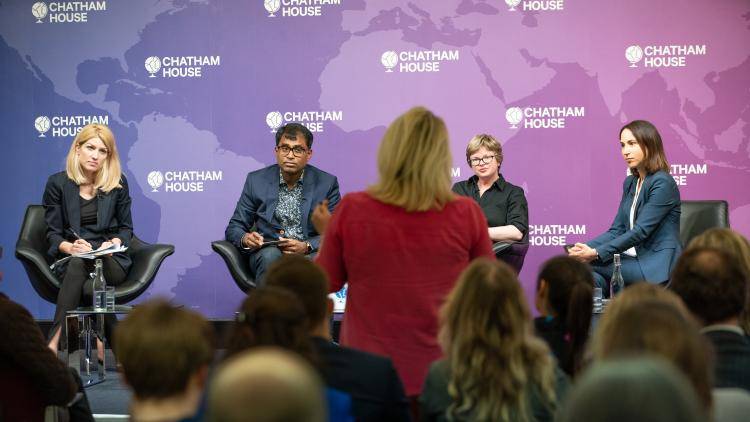
Fantastic to hear your insights. Now we’ve got questions coming in online, which I will come to in a moment, but I’m going to take some questions from the audience to begin with. We’ve got a few microphones coming by. I think I’ll start with, right at the very back, a gentleman with his hand raised standing at the back, there.
David Lubin
Hi, my name is David Lubin. I’m an Economist here at Chatham House. Thank you very much for your visit. I wanted to ask you what role you think Singapore should, or could, play in supporting China’s efforts to internationalise the use of the renminbi?
Lee Hsien Loong
Well, we are a financial centre. We trade whatever instruments countries want to trade in, participants want to trade in. Renminbi is one of them. We are a rendem – renminbi settlement centre, I think, and if people want to trade renminbi, we are happy to do that. How far it goes really depends on how far the Chinese are prepared to ease up on capital controls on the renminbi and to deepen their bond markets and their financial markets and to build up an ecosystem where the international investments, whether you are a sovereign fund or whether you are an NMC, or an individual high net worth, will feel quite comfortable to take, say, one third of your net – of your assets under management and say, “I put it in a Beijing bank,” or “in renminbi bonds.”
That depends not only on the economic policies and the financial rules, but also on your overall political system and on the political relationships between China and the other countries and on how China handles these financial obligations. Because the Banker may turn out not just to be the Banker, but he may take instructions from the government and the government may have other ideas. I mean, if you are carrying a US dollar asset and therefore, somewhere or other, you are linked to a US financial institution, or a financial institution which operates in the US, you know that there is de facto considerable extraterritorial influence, if I may put it delicately, by the United States, if they wish to, on the fate of your investment.
And the – people have to weigh that. Right now, you say [inaudible – 39:44], there’s no alternative, so people still use the US dollar. The Euro is one alternative, but then you are considering carefully what to do with Russian deposits frozen precisely for this reason. And the Chinese, if they decide to go on this path, they’ll have to decide to what extent they are prepared to allow this to be sacrosanct from other geostrategic considerations. I think they haven’t quite reached that point yet.
Dr Samir Puri
Let’s take a question from the gentleman who’s got his hands up right there in the middle of that row, yeah.
Sanjay Gouraj
Thank you, Senior Minister, for taking your time to get through this great topic. My name is Sanjay Gouraj and I’m doing my master’s in international relations at King’s. So, my question is, given Singapore’s diplomatic experience, how should Singapore strengthen ASEAN members to act as a regional bloc, similar to the EU, and which sector should it strengthen the partnership with? Thank you.
Lee Hsien Loong
I think Singapore is the second smallest member of ASEAN. So, we work with our partners and where there is common interest, we align and we work together. On trade issues at the WTO, we often were able to do that, because it – there were not – we did not have seriously contradictory perspectives. On strategic issues, it’s not so easy to do, because strategic situations defer and therefore, the security and strategic outlooks are very different and therefore, you fundamentally have not quite aligned views. If you talk about freedom of navigation, for example, in the South China Sea, everybody says, “Yes, I agree, freedom of navigation.” Some countries have maritime fleets, some countries don’t, some countries are landlocked.
Laos is a member of ASEAN, is landlocked. Its immediate – it has a – it shares a border with China. Will it take the same interest as – same perspective as Philippines, which is an archipelagic state and has a claim in the South China Sea, overlapping with China? I think that’s very difficult to bring about, however skilful your Diplomats may be. And if you are Indonesia, which is the biggest country in Southeast Asia and with a significant domestic market, your perspective will be different from Singapore. Small, prosperous, no doubt, but very dependent on the external world, very conscious that we are a price taker.
So, these are differences which we have to accept and so, ASEAN, unlike the EU, we don’t have a supernational set of institutions and a place like Brussels, where allegedly, anonymous bureaucrats make decisions which are not always popular, and I think that’s by design. Even the EU, with all its institutions, doesn’t find it very easy to make qualified majority decisions, so much less ASEAN. I think we proceed at the pace we are capable of and that pace will vary, depending on what subject we’re discussing.
Sanjay Gouraj
Thank you.
Dr Samir Puri
Thank you. I’m going to take a question from the very front row, here, if we can get a microphone to our Singaporean Chatham House colleague, Aroni. Please go ahead.
Aroni Sarkar
Good evening, SM Lee. It’s a privilege to welcome you here. Your time is…
Lee Hsien Loong
And tell us, who are you?
Aroni Sarkar
I’m Aroni. I’m with International Affairs here at Chatham House…
Lee Hsien Loong
Yes.
Aroni Sarkar
…and a fellow Singaporean that’s very happy to see you here.
Lee Hsien Loong
Happy to see you.
Aroni Sarkar
Your time as leader of Singapore is – has been almost my entire life, and so, my story…
Lee Hsien Loong
I haven’t been PM for quite that long.
Aroni Sarkar
So, my story and understanding of Singapore is inextricably linked to you and your family and what vision you had for Singapore and its role in the world. Considering now that we’re moving into new generations of leadership and also, a new fragmented world order, based on your experience, what are some of the key foreign policy achievements that have had the most lasting impact on Singapore’s global standing, and what lessons do you think Singaporean leaders can take from those, moving forward?
Lee Hsien Loong
I can only say that we are in reasonably good standing in the world and joining ASEAN and encouraging the formation of ASEAN was certainly one of the formative decisions of our first Foreign Minister, Mr Rajaratnam, because without ASEAN, you may be successful, but you are little participant. But as a member of ASEAN, well, you speak with a collective voice and that’s very valuable. Beyond that, I would – I explained some of the principles earlier, which I think help us to do well. We have been consistent in maintaining a foreign policy which is principled, calculated based on our national interest and clearly determined by us and not on behalf of somebody else. And this is absolutely fundamental, because then, they may like you, they may not like you, and you sometimes have a run-in with one power or the other, but you are speaking as Singapore and you’re not speaking on behalf of – you are not the cat’s paw for somebody else. I think that’s – that has always been fundamental and that remains a critical requirement.
I – it’s very difficult for us to do that, because we are multi-racial, majority Chinese, signif – 15% – 75% Chinese, 15%-ish Malay, 9%-ish Indian or South Asian. So, each one of our populations has a bigger same race population outside. China, one thousand three – 400 million, India even more, 1,400 something million and the [Malays stop – 46:25] in the region, in Malaysia and Indonesia. And with that composition to be able to say I’m speaking as a Singaporean, not as a Chinese or an Indian or a Malay, I think it’s absolutely crucial and yet, very difficult. It causes a lot of confusion. I once explained this to a Japanese Prime Minister. I said, “We are – we have Singaporeans, Chinese, Indians, Malays and Singaporean Chinese are different from Chinese Chinese and we are different from Indian Indians and Malay Malays. And he turned to his Interpreter and says, “What is this Chinese Chinese?”
Well, we are different. We are different because our national interests are different and also, because amongst ourselves, we have made accommodations and adjustments and compromises, and we know how to get along with one another. And if we walk along the street in London or New York and you spot a Chinese, you look at him carefully and you can guess that that chap probably came from Singapore. Well, maybe the way you walk, the way you dress, the way you interact with your family or with other people. There is a certain identity which is emerging and that’s very important. If you lose that because there’s some influence operation or you have some – a bot network which has persuaded you that you should be standing on one side or the other, well, then you are gravely compromised.
The other thing which makes it – makes our Diplomats’ job easier and it’s very important is that domestically, you are successful and you are united. If you are domestically not successful, you can have the most eloquent Diplomats, but you are representing a country which is not working. “Why should I listen to you? What can you do for me?” But if domestically your system is working, your – you’ve got solutions to your own problems, mostly, you are working on things and trying to make it better, and furthermore, there is consensus on where the country stands in the world, then it’s much easier for our Diplomat to make a consistent pitch and to say – and to convey without having to say it, that “If you deal with us in five or ten years’ time, it may be my successor, but he will be of cognant [means cognizant] mind. It will not be the opposite of what I’m doing.”
There is consistency, there is rationality, there is long-term direction. We adapt as we go along, but we do not chop and change, and it’s not easy for many countries to do that. It’s a very precious thing. I don’t say that we can do that forever, but so far, we’ve been able to sustain it and my successor, I think, is carrying it forward quite well.
Dr Samir Puri
So, I think we had a question from the gentleman just on the end here, please.
Sir Robin Niblett KCMG
Minister Lee, Robin Niblett, former Director of Chatham House. You talked at the beginning, in your third solution to this difficult world we’re in, should be greater intraregional co-operation. Looking at the ASEAN Summit that just took place, there’s one big example of intraregional co-operation, which is the Regional Comprehensive Economic Partnership.
Lee Hsien Loong
Yes.
Sir Robin Niblett KCMG
Which, obviously, China, I think, inspired at least – well, okay, one which – in which China plays a big part, should we say?
Lee Hsien Loong
Which China is a member.
Sir Robin Niblett KCMG
Of which China is a member, but as you said earlier, you’d have to – you’d come back later on, you said in your talk, how do we accommodate a China…
Lee Hsien Loong
Yeah.
Sir Robin Niblett KCMG
…that has acknowledged large overcapacity, but where it may be leading the intraregional aspect of co-operation? How do you deal with that dilemma?
Lee Hsien Loong
Well, the RCEP is quite a diverse group. I’m not sure, I suppose now that it exists, multiple people may claim parentage, but I thought Singapore had something to do with the initials, anyway, because originally, it was meant to be an East Asia Summit, kind of, partnership, basically, of the economies which are on the Asian side of the Pacific. And that included China and the Northeast Asian countries, Australasia, the Southeast Asian countries and also India. And in that configuration, we thought you brought the major economies in and there was a good balance, China, India, although India really is one quarter the size of China’s GDP. And then you have Australia and New Zealand, who are, well, treaty allies of the US, and if they’re in the group, the group can’t be that anti-US. So, we thought we had a good configuration and it came quite far, but you never know until you reach the marriage altar, who’s there. And quite late in the process, the Indians decided that they did not want to participate in this and therefore, we now have – I – well, ASEAN plus Northeast Asia plus Australasia.
I think it’s a useful grouping to have. I hope one day the Indians will be ready to participate. Certainly, if they are going to grow and – on projections, one day, they will catch up with the Chinese, maybe even overtake them, but – because they have a much younger population and the Chinese population’s already declining. But I think within that framework, there is room for significant economic co-operation. It’s less substantial that the CPTPP, which has – which covers many more areas and more deeply, but it does bring these countries together and it is a signal that these – we want to trade with one another, and we do not want to beggar thy neighbour, with one another.
So, that’s, I think, one package. Your broader question, how does China fit into the system? I think the answer is, somehow or other, China does want to fit into the system because from their perspective, they are not wanting to go and to wreck the WTO system. They have benefitted from this. They joined the WTO, they had – it was at a time when Zhu Rongji was the Premier and he had a clear view that this was the way to force his own companies, including SOEs, to become internationally competitive. Because you have to follow the WTO rules, and therefore, you have to open up your markets. I mean, some negotiated arrangement, but business has to be done and therefore, you have to measure.
And in the early years, anyway, there have – there were disputes which were brought to the WTO, and they sometimes went on – in favour of the Chinese, sometimes went against, and when they went against the – quite often, the Chinese actually complied and fulfilled the judgments. I’m not sure that’s the situation now, but it was how it started up. But now what they say, and have said quite consistently, is that they uphold a multilateral trading system and they would want to go by a rules-based order. But the rules-based order, in which one participant is a lot bigger than the others, calls for forbearance and restraint and certain self-enlightened magnanimity, which doesn’t come naturally to any great power. And even powers which have done it for a long time, sometimes relapse. There are few examples that may come to mind.
So, in that situation, for China to participate is not so easy, because you’ve not only got to express the right attitude, you’ve actually got to convince people that this is how we are going to behave in real life. And there have been situations where you’ve had disputes with countries, between China, I talk about Australia, where you – oysters and wine get caught in the dispute with Philippines. Bananas and things like that run into phytosanitary problems. Each one of them has some technical explanation, but taken together, the question is, are we absolutely sure that trade is trade and politics is politics? And that is something which I think does need to be addressed, as does the question of the imbalance and how to restructure the Chinese economy so that it is less dependent on exports and can – or at least – so that it has a smaller export surplus and has a greater degree of domestic consumption.
It’s not a straightforward matter to do. It’s not just a matter of issuing coupons to buy new cars or refrigerators, or of paying everybody more money. You’ve got to have quite a fundamental restructuring of the economy to make this happen, and it is very difficult. And yet, you do want to bring the Chinese into this inkblot of a rules-based trading system, because if you keep them out, then you’ve taken the two big piece – biggest pieces off and you are playing chess without the King and the Queen.
Dr Samir Puri
Hmmm.
Lee Hsien Loong
It’s – which is still roaming around the board on its own. That’s very difficult.
Dr Samir Puri
I’m going to take a couple of questions in a – in one go. Let’s take a question from the gentleman here in the green jumper, just down the middle, please, if you can bring the microphone.
Michael Mo
Thank you. Sorry, thank you. My name is Michael Mo, a PhD candidate at Newcastle University, which we have a campus here, in Singapore, actually. So, my question to Minister Lee is that – it’s about the people in Singapore. For instant, your insight on immigration/population policy, to do it right as a very small country, given that – specifically how to mitigate security risks associated with immigrations, for instance, espionage, disinformation and the consensus of Singapore, and at the same time, not to do it quite in a discriminatory manner. I think this will be quite beneficial to UK Politicians.
Dr Samir Puri
Okay, great. So, we’ve got one question there. I’m then going to take a question from gentleman in the row – second row from the front, in the brown blazer, please.
Ravi Prasad
Thank you. Ravi Prasad, I work in the financial ser…
Lee Hsien Loong
And where are you, sorry?
Ravi Prasad
Just over here.
Dr Samir Puri
Over here, right where…
Lee Hsien Loong
Hello.
Dr Samir Puri
…by my hand, standing there.
Lee Hsien Loong
Yes.
Ravi Prasad
I work in the financial services sector here, but up until recently, was with the UK Foreign Office, including a very enjoyable four-year stint in Singapore. Singapore, of course, stands out for how you’ve managed to maintain such positive strong relationships with a whole range of powers, large and small, over the decades. I guess my question, Senior Minister, would be around in those rare – perhaps rare instances where Singapore has come under pressure from some of those bigger powers, I’m thinking for example, US tariffs or US talking points around currency, or whether that be around, you know, some of China’s responses towards Singapore’s economic relationship with Taiwan. I recall when you were DPM, there was quite a strong reaction to one of your visits to Taiwan. How have you personally dealt with those situations when Singapore has come under a little bit of pressure from those big powers and ensured those situations didn’t balloon more than they needed to be? Thank you.
Dr Samir Puri
Thank you. So, we got pressures from outside, pressures from inside. Take them in whichever order you like.
Lee Hsien Loong
I will solve the immigration problem. It can be solved. These are trade-offs. You need immigrants, you need migrant workers, you need professionals to come, and you need them in quite large numbers. Some countries need them in huge numbers. In the UAE, they are 90% of the population. We are not quite at that point. Two thirds of our workforce, roughly, are Singaporean, but a very important part, one third of that, which is more than a million numbers, are foreigners, all the way from CEOs of banks and MNCs, to skilled professionals of all kinds, to Construction Workers and unskill – not so skilled but desperately needed people to man our whole system.
And you’ve got to manage not just the security risk, because some of them, I mean, may bring in their foreign disputes and issues, and we have had some of those. You also have to manage the social issues which arise because the numbers are very substantial. I mean, one – it’s one third of our population. In the case of Britain, with – you have 70 million, that means maybe 30 million foreigners being here. But we need them and we have got to accommodate them, and we have got to get them to understand what our rules are, at the same time as the Singaporeans, we hope, will forebear and be gracious and know that they are here and helping us. And they, too, have family and children back home and we have a responsibility for them while they’re here.
It’s not an easy balance to strike. It’s one which is very easy to politicise and to workup and there have been Politicians who, throughout the last few terms of government, have been making this a hot issue, and sometimes it has been a hot issue during an election campaign. But if you send everybody home, well, there are some examples of countries which have done that and it – they have not had happy outcomes. I can talk about Huguenots and Louis XIV, that’s long ago, now, but there are some more recent examples, too. And so, we have to manage them, and they have to know that if you are in Singapore, please keep the bling down. Don’t go around popping champagne, which is $20,000 a bottle, with sparklers, and don’t zoom your Ferrari or Lotus, or whatever, down the middle of the road in the middle of the night just to let everybody know that you have arrived. You would have not thought that that was something you needed to tell anybody, but sometimes it’s helpful to remind them.
But on the question of being non-discriminatory, I think that’s, kind of, difficult to define exactly what you mean, because realistically, you must know what the social impact is and the social impact depends on where they come from. And some countries will create more social impact – people from some countries will create more social impact than others. They integrate more easily or less easily. So, we can’t be completely omnidirectional and bli – direction blind in taking either immigrants or transient workers, but we try to manage the overall package so that overall, I’ve got a – not just an economy which has the people it needs, but we’ve got a society which can maintain identity and cohesion. You are coming to Singapore, you are not yet Singaporean, maybe you don’t intend to be, you’re going to finish working and go home, I understand that, but this is Singapore, please comply with our rules. And there are some basic norms and it’s not so hard, if you want to be in Singapore, you can do that, but we will look after you.
So, during COVID, we had, oh, tens of thousands of foreign workers who were in the dormitories, and they were at great risk, because in the communal living, with a highly infectious disease, it can go through and who knows what the consequences are? And we told them, “Don’t worry, we’ll keep you safe. You’ll be fed, you’ll be housed, you’ll be sheltered, you will be paid, you will have internet connection so that you can keep in touch with your families,” which is very important, “and you will be safe.” I – and fortunately for us, many of them did catch COVID, but very few of them died, and it was a great load off our shoulders, mine particularly, I was the PM, that we got through that without a human tragedy. So, I think you have to do these things, then people know that if they come to Singapore, that’s the way Singapore works. The rules are strict, but this is not an inhumane system.
Now, what do I do about pressure from powers on Singapore? Once in a while, it does happen. We treat it with – we – there’s a sign which says, “Keep calm and carry on,” and that’s what we try to do. It happens from time-to-time, you don’t want to escalate matters unnecessarily and just add fuel to the fire, but neither can you compromise if there is fundamental interest at stake. If it’s a matter of face and some face saving is necessary, well, maybe we can do something. And I don’t know if you will remember Michael Fay, this is from a previous generation, but he’s a – he was an American teenager then. He’s not a teenager anymore. But he was a teenager, he was in Singapore, he went around vandalising people’s cars, and in our – in Singapore, our rule – our law was if you are convicted of vandalism, you get caned.
And so, he was charged in court, and he was sentenced to some jail term and six strokes of the cane, and it became a cause célèbre. Bill Clinton was the President. I was not yet Prime Minister, my predecessor was, and Bill Clinton personally got involved. Wrote to our Prime Minister, I think to our President too, to ask for clemency and pa – compassion for this poor young man who had, completely unintentionally, done something not very good. So, what do you do if a US President asks you for a small favour and you want to remain friends with the United States of America? So, after some very serious consideration, we commuted the sentence from six strokes of the cane to four strokes of the cane, and a lot of Americans cheered us, but we remained friends with the US and also, with Bill Clinton.
And from time-to-time other issues have happened, more recently, and well, it – you can’t help it. You must decide where your red line is and if you don’t want to be steamrolled, well you just have, quietly, to stand your ground and “I’m sorry, we don’t agree. You have your view, we have ours, but I hope notwithstanding that, we will be able to continue to work together.” So far, that has been a formula which has worked for us. I can’t say that it will always work. At some point the pressure may become overwhelming, but that’s why we are all in favour of the United Nations and a rules-based global order.
Dr Samir Puri
I’m going to come back to the room in a moment. We will have time for a few more questions in the room. I’m going to go online. Very interesting pair of questions from Ayodeji Alaka asking about Africa and Singapore.
Lee Hsien Loong
Yes.
Dr Samir Puri
The first part of the question is “Singapore navigating and developing its trade and investment relationships with Africa’s 54 states,” but the most interesting point is this phrase that sometimes comes up of “creating a new Singapore,” when you’re looking at another country. Comes up in different parts of the world, but with regards to the challenges around infrastructure and jobs in governance in parts of Africa, what, in your opinion, is the one thing from Singapore’s experience that you believe could truly make a difference if applied to parts of Africa?
Lee Hsien Loong
I – well, we have a lot of friends in Africa. I think we are very chuffed than many of them see us as a model and would like to pick up something from what Singapore has done. I would hesitate to recommend policy solutions for other countries which I really don’t understand well enough, and which vary enormously from one to another. If you are South Africa, that’s one situation. If you are Ethiopia, that’s a completely different one. If you are Rwanda, well, maybe that’s a bit more comparable, but that all has its own very tragic and complicated history.
But what does matter – what I think has been very important to us, and without which we could not have succeeded, is a sense – is a group of people who feel a certain sense of mission to take the country forward. Maybe in the government, maybe in politics, maybe in the private sector, but you do feel a collective responsibility that this is not just a society which is going to take care of itself. Someone has to step forward, take charge, take responsibility and do your best as a steward to say, “I’m carrying it the next step forward and I hope by that time, there’ll be somebody else who will take it from me and carry the baton on.” And I think that’s something which is necessary in any country and if you can have that, then you can have efficient government, you can have honest government and you can have government which is trusted and good things can happen.
Dr Samir Puri
Right, we have time for just a couple more questions, so we’ll take a question from the gentleman right here, second row from the front.
Moez Hayat
[Pause] Thank you Mr Senior Minister. My name is Moez Hayat. I’m a PhD candidate at Cambridge University in politics. I had a quick question on ASEAN. You mentioned how important ASEAN is, especially at this time. Do you think part of that would require strengthening ASEAN’s institutions and specifically, growing the funding and the capacity of the ASEAN Secretariat to have a, maybe a more stronger organisation that can respond to some of these challenges? Thank you.
Dr Samir Puri
And there’s a gentleman who’s been waiting very patiently, with a red tie, just there.
Member
[Pause] Thank you. Hi, Senior Minister. I’m from Cambodia myself and I realise that Trump plays an important role in ASEAN’s future, I guess, relationship with the US. And my question is, given ASEAN’s export-driven economic models, how do you think, I guess, ASEAN as a whole could leverage the relationship with the US right now, as Trump has been particularly interested in, I guess, ASEAN as a bloc? Thank you.
Dr Samir Puri
Oh, very neatly paired questions there for you.
Lee Hsien Loong
I think it’s always helpful to strengthen institutions. The question always is, how much will it cost and who will pay for it? ASEAN has got a Secretariat. The Secretariat does a lot of projects. We have a lot of meetings and a very wide range of co-operation. Now, it’s become not as intense as the EU, but very regular and a very valuable habit. So, we deal with each other repeatedly and therefore, you know that you want to maintain that relationship and you don’t go to war on one issue, because the fi – there are a dozen others which matter and which we need to still work together on.
I don’t think that the constraint on ASEAN right now is the strength of the institution. I think the question is first, the degree to which the countries have a consensus on issues. Do they agree on the basic issues or not? And secondly, if you are going to have stronger institutions, to what extent you are going to give them powers to override what governments want to do. And that’s a very hot subject even when you were in the EU and still is in the EU. So, I think that the priority is not so much on building up further the institutions. You want them to work well, but really, the priority is continuing the pra – habit of co-operation and expanding the areas where we see eye-to-eye so that we can do more together.
How does ASEAN take advantage of its good relations with Trump in order to export more to the United States? I think right now, every country wants to take advantage of its good relations with the US President in order to maintain a stable relationship with the United States, and for ASEAN, that’s probably a realistic objective. The ASEAN countries are not all on the same level with the United States. Some of them – some of us have a trade deficit with the Uni – US has a trade surplus against us, like Singapore. Other countries have a trade surplus on the US, for example, Indonesia or Vietnam. Some of us are trading goods which are mainly made by US MNCs in Singapore, for example, pharmaceuticals or electronics. Others are selling the US raw materials, minerals or even rare earths. So, the situations are different, and I think each country will work its own arrangement with the US.
It has not been so easy for the EU to negotiate as one a trade agreement with the US. You have to decide whether you are going to take the hit on parmesan cheese or Mercedes cars or cognac wine. And that’s one of the reasons, not the only reason, but one of the reasons why you are not taking as aggressive a line on trade, or the EU is not taking an aggressive a line on trade as the Chinese have been with the US. So, similarly with ASEAN, but I think if we can just maintain an equable relationship and we just – we accept that sometimes these things happen and you may or may not be able to justify it in terms of abstract principle or either principle of economics or principle of ethics and just rewards, but that’s just the way the world is.
Dr Samir Puri
Senior Minister, we have come to the end of our time with you, but I want to just say how enlightening it’s been to hear, on the one hand, your pragmatism, on the other hand your optimism, I think, in terms of navigating this particularly difficult era in global affairs and that unique Singaporean perspective and your perspective that you’ve articulated. Thank you so much for spending this last hour and 15 minutes or so with us, and I think let’s all join and give the Senior Minister our thanks and appreciation for his time here. Thank you so much [applause].
Lee Hsien Loong
Thank you.
Dr Samir Puri
Thank you very much [applause].
Lee Hsien Loong
Thank you very much [applause].