Rima Maktabi
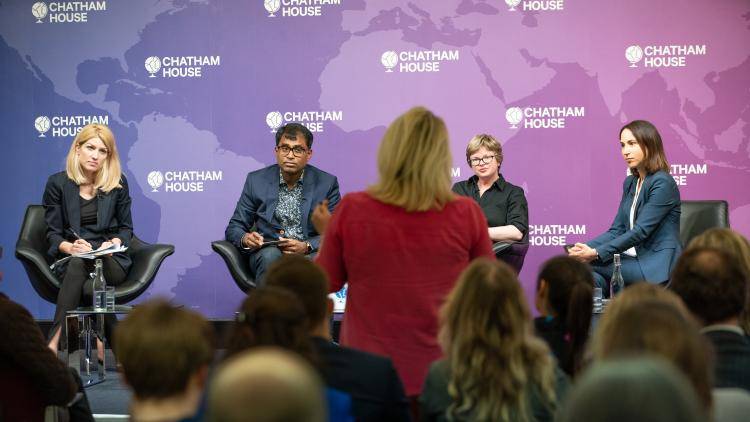
Hello, and welcome, everyone. Thank you for joining us today. Thank you for all the participants and for Chatham House and everyone who’s joining this discussion, “Israel-Palestine – Assessing the Impact of Regional Instability on Syria.” We will be discussing Syria, the region and the latest developments in Israel and Iran.
Joining us today is Joseph Bahout. He’s the Director of the Issam Fres Institute for Public Policy and International Affairs at the American University in Beirut. Dareen Khalifa, she’s the Senior Advisor for Dialogue Promotion at the International Crisis Group, and Haid Haid, he’s Consulting Fellow at the Middle East and North Africa Programme at Chatham House. Thank you, and I’m hoping we will have a very lively discussion today. We’ll try to cover everything, but I don’t know how much time we will need for – to discuss the Middle East. It’s going to be, like, a 30-minutes discussion and then, I’ll open the floor for questions. Please feel free to write your questions on the Q&A box below.
I’ll start with you, Haid. Amidst the Gaza War and Iran’s planned retaliation against Israel, and just a few streets away from the bombed Iranian Consulate, the image of President Bashar al-Assad celebrating Eid al-Fitr in the streets of Damascus, looking very good with his family, was quite revealing. What was the message conveyed? What’s beyond that photo?
Dr Haid Haid
Well, thank you, Rima. Before answering that, let me thank you and Dareen and Joe on behalf of Chatham House, for participating in this webinar. Indeed, the photo was not accidental. It was part of a wider media campaign in order to send a message to everyone that business is proceeding as usual. We saw Assad and his wife attending a public al-Fitr in Tartous. We saw them also celebrating Eid on the first day, with children, in Damascus and then, as you said, he was walking casually in the streets of Damascus with his wife and kids in order to say that – I think that the message is two parts. One is that Syria will not take part, or be part, of Iran’s response to the attack on – Israelis’ attack on the Iranian Consulate and the other one is Syria will not be a theatre, or a main – the main theatre for that response.
Now, what’s important here is to highlight that this is – this was not surprising, because Assad, from the, basically, beginning of the War on Gaza, has been distancing himself from the regional escalation, and we will be happy to talk about why in the following, basically, questions. Thank you.
Rima Maktabi
It’s – let’s explore more Assad’s regime’s perspective on the events of October 7th and what followed the Hamas-Israel conflicts, especially considering the strained relationship that was going on between the Assad regime and Hamas during the Syrian uprising, so 2012 and on.
Dr Haid Haid
Yeah, indeed. I think that the main position, as mentioned earlier, is that the regime wants to stay out of it, for different reasons. One of them, that it – one of the reasons is, basically, as you mentioned, the rift and conflict that started with Hamas in 2012, when Hamas sided with the uprising and withdrew its officials from Damascus. Then, you have, also, other aspects related to the domestic, basically, situation in Syria. The economy is suffering. Assad military is ill-equipped and is spread thin in – basically, throughout Syria, and then, on top of that, you have regional countries who have, basically, advised Assad to stay out of the, basically, regional conflict.
However, Assad balanced that by allowing, or tolerating, the launching of attacks from Syria against Israel, as well as the US forces in Syria and also, allowed, or tolerated, the channelling of weapons through Syria and via both Jordan and Lebanon to Palestine. And I keep saying ‘allowed or tolerated’ intentionally, because we are not sure to what extent he had, basically, say over those decisions. Over to you.
Rima Maktabi
Yeah. Joseph, the Israeli targeted strikes on Syria are longstanding. They’ve been happening for years. They – let’s analyse the Syrian response. Why is there no visible reaction or counter-reaction from the Syrian regime? Is this due to the deficiency of the Syrian Army or military capabilities of Syria, or anything else, or lack of political will to reciprocate a hostility with Israel, maybe?
Joseph Bahout
Hmmm hmm. I think it’s a blend of all of the above. First of all, thank you, Haid, for that webinar and thank you for Chatham House to invite me and thank you, Rima, to moderate it. It’s a pleasure to see you. So, it’s a blend of all this, I think. Of course, the military capabilities of Syria, today, the ones we know, this is also a, sort of, regime that is ruling over a very tiny portion, probably, of the country, in its own capacity. The rest is relying on the backers, be them Iran and Russia, and this is a couple that we need to interrogate, probably, later on.
Second, as you said it also, it’s an ongoing, let’s say, course of action or inaction of the Syrian regime for the last ten years, to take the blows and to answer, if any answer, very minimally, or not answering at all. Because the priority so far for the Assad regime was to take care of its own survival internally. It was not to open up a front with Israel. Israel was not exactly, except for a few occurrences, targeting the regime itself. It was targeting either Iranian proxies or Iranian operatives directly in Syria, very rarely assets of the regime itself, and when it happened, the regime used to answer, let’s say, cosmetically, with a few ammunitions.
I think the second reason is also, as you’ve mentioned, both of you, I mean, the coldness of the regime towards what’s happening in Gaza. I think there was – I’m not sure about the info, but when the Iranians came to Damascus in the beginning, after the aftermath of October 7, and asked Assad to join the front, Assad’s answer was very cold. Because I think that he still holds a very high, or strong grudge, against Hamas for what Hamas has done during the uprising in Syria, and I think it was a way, also, to show that this is something of no concern for him. Thus, the picture that Haid was commenting a few minutes ago.
Last but not least, but this is an open speculation and we’ll talk about it, there is even the suspicion that the Assad – part of the Assad regime’s security apparatus maybe providing some intelligence or some info for such a surgical strike, which also raises a lot of interrogations on – and this is more, let’s say, serious and potentially something to be enquired, about this notion of unity of fronts, in fact, which is probably the weaker or the more fragile in Syria itself. We can see it operating, or operational in Lebanon. We can see it working in Iraq, in Yemen and elsewhere. But in Syria, this unity of front has been to say the least, very, very relative so far.
Rima Maktabi
Interestingly. Probably we’ll discuss this further later, if it has to do, also, with the Iranian-Russian rivalry there. We’ll come back to that. Knowing that if Israel wants to carry on an assassination in Syria, probably then Assad is also capable of this. Dareen, Syria has uniquely become a geopolitical battleground for the US, Russia, Iran, Turkey. Which entity dominates? Who calls the shots? Under what condition might these forces leave Syria, do you think, whether the Americans or the Turks?
Dareen Khalifa
Yeah. Thank you so much, Rima, and thank you Haid and Chatham House for putting this together and for having me today. I think, Rima, you’re asking a very crucial question, the million dollar question when it comes to Syria, which external party calls the shot? I mean, the Syrian War has seen four major military interventions. The Russia and Iran military intervention that saved the fall – saved the regime from collapse, US military intervention or US-led coalition that defeated ISIS, or at least ended the territorial control of ISIS and various Turkish military interventions, the last of which, basically, created a long-lasting ceasefire, one of the longest lasting ceasefires in the Syrian conflict.
Now, one thing these external actors have in common, or may I say two things they have in common in terms of the military intervention in Syria, is, one, they don’t have an exit strategy. That applies to Russia and Iran, but it also applies to Turkey and the US. We’ve seen with various election cycles, the chatter about a potential withdrawal from Syria and then, followed by a realisation that the cost of withdrawal might be much higher than a cost of remaining or keeping troops in country.
And the second thing that they have in common is that they are reliant on local actors, partners, allies, proxies, whatever you would like to call them, that also hold significant leverage and hold significant ability to act as spoilers when need be. So, while these four major international and regional actors continue to hold a lot of sway, all in the course of events in the Syrian conflict, and they have managed to create a balance of power and an equilibrium that, basically, has held the frontlines somewhat stable since 2020, they still rely on local partners that have a say on the course of events. And that can really push the limits and can test things and can create a lot of headaches for their international backers. And yeah, then, I’ll stop here.
Rima Maktabi
So, if Trump is elected, he will not withdraw the American forces from Syria?
Dareen Khalifa
Oh, that’s another million dollar question. I mean, Trump is a wild card. I think it is a fool’s errand to try to predict what Trump is and is not going to do. But what I can say is during the last Trump administration, we’ve seen Trump try to pull out of Syria three times, one of which was on Twitter. The second was over a phone call with the Turkish President Recep Tayyip Erdoĝan. And what we’ve seen is that he was overrun by the bureaucracy, so he tried three times and failed three times to implement the decision to try to withdraw from Syria. That is, again, because when the US intervened militarily against ISIS, as I mentioned, they did not have an exit strategy. There was not a plan – they never put a plan in place saying that “This is how and when we’re going to be able to pull out,” without creating a massive free for all that is going to come at a huge cost, including to the US itself.
I think Trump really wants out of Syria. I think he’d try to get out of Syria, but it’s a decision that is really, really hard to implement without incurring a huge cost and without causing a violent free for all that will, basically, it will impact US presence on the ground. But it will also impact a lot of US interests in the region. And with the last – with the most recent escalation between the US, or tit-for-tat attacks between the US and Iranian proxies in Syria, we’ve seen, again, some argue that US presence in Syria is a liability, it puts American troops and servicemen in harm’s way. But we’ve also seen voices from Washington saying, “You know what? Our presence in the region militarily is more important than ever, and we need to be there and able to protect our interests and troops elsewhere.”
So, I think this debate is going to continue to be whether or not Trump is re-elected, but that doesn’t take from the fact that Trump is a wild card and…
Rima Maktabi
Even if he’s re-elected, it’s going to take a while before this decision is taken. I’ll pass onto – I’ll move onto Haid. GCC country is trying to normalise with the Assad regime prior to Gaza War and why – where is this reproachment now? Has it been suspended, and how much can they do in the – and considering the Caesar Act, which really ties the hands of any country wanting to rebuild in Syria or pump in any dollars?
Dr Haid Haid
Thank you, Rima. Just before I answer that question, I wanted to quickly comment on what Dareen was saying. I agree with what Dareen has said so far, but that’s, basically, represent the views from the US. Now, I think what would be important to flag here is that – what I mentioned earlier about the increased, at least up until February, the increased attacks against US forces in Syria, aimed exactly in order to increase pressure, make the course of their engagement or, basically, their presence there, higher in order to push them up. Whether that will be successful or not, it’s a different story, or at least the answer is still not clear. However, it’s another factor that we need to consider when assessing the eventual withdrawal of US forces from Syria, because it might not only be related to domestic issues, but might be pushed from, or be influenced by, outside factors.
Now, going to the question. Now, I think that personally, I see that Assad has been able to take advantage of the War on Gaza in order to reactivate normalisation efforts with, basically, Gulf countries in particular and Arab states in general. We have seen the appointment of the first Emirati Ambassador to Syria since 2011 and six years after the UAE reopened its Embassy in Syria in 2018. And many people assume that there was a reward for the Syrian regime because it listened to what the UAE was telling him, or was telling Assad, in terms of, basically, not taking part directly in the regional escalation.
Now, we saw, also, movement when it comes to the meetings held by the Arab Committee with Damascus. Those meetings that were – which were – the first meeting of this initiative started in August, but then paused, because there was lack of response or, basically, concessions from the Syrian regime. However, in March, we saw the Syrian Foreign Minister visiting his counterpart in Saudi and that led to the reactivation of the meetings which will be – will take – basically, the second meeting is announced to take place in Baghdad in May. So, in general, I think it would be important to highlight that when it comes to political normalisation, those efforts have continued, at least they were not terminated and that means that the Caesar Act, those sanctions, have mainly been impacting economic normalisation.
And one last thing, I know I’m running out of time to flag here, is that while sanctions is, basically, is a major factor when it comes to making other actors hesitant to provide financial support for the Syrian regime, or to the Syrian regime, it’s not the main or the only factor. You have to remember that those actors have changed their mentality, and they don’t provide money for free, and the Syrian regime has not been co-operative at all. Has not been, basically, fulfilling any of the demands asked of Assad during the meetings I refer to.
And a last thing, when it comes to business and investment, Syria does not really provide any good environment for that. You have high costs, high risks, absence of rule of law, low purchasing power. So, no businessman or businesses in general will not be tempted to go and open businesses there because the gains are low. Thank you.
Rima Maktabi
But some of it, the regions, sometimes, it’s political money. It’s a political decision to pump in money in certain countries for rebuilding or the revival of a certain country or society. Joseph, what about the West – the international community? After October 7 and the recent Iranian retaliation on Israel, do you think that the West needs to talk to the Assad regime, or maybe now the decision is to topple the Assad regime, which was not done during the uprising, or allow more of a margin for that?
Joseph Bahout
Wow. So, that is a very complicated question. I mean, to put it very directly, I mean, I don’t know exactly if there was a unanimous Western will to topple the Assad regime. Probably there were moments where dispersedly, the US or this or that European country or government, maybe had the hope, but not really the action, to topple the regime. This is different.
I’ll answer that in a different manner, if you’ll allow me, Rima, to come back to a few points that were raised. I think first of all, very quickly, the point of the US withdrawal, that Dareen has mentioned, I think it’s – of course, it’s related to Syria, but it has a wider scope, also. There is a long discussion in Washington about the pertinence or the relevance of staying in the region, and do you know that it is now open in Iraq? I think the visit by Prime Minister Sudani to Washington last week had this on the agenda, the idea that maybe the overall presence in the region should be reassessed. Now, withdrawing or not, I think it’s too black and white, but there is a reassessment of the necessity and the validity of these troops, especially if there is this option of some American-Iranian, let’s say, talks after Gaza. But this is, of course, very far-fetched today, but just to keep in mind that this is not only Syria.
The second point about the normalisation. I think that in the beginning, of course, mainly the Gulf states, Saudi Arabia and the UAE, have probably the idea that any reproachment with the Assad regime, or opening, slow or fast, would be a way to keep Iran at bay and to maybe put a wedge between the regime and Iran. Today, I think this calculus has very much lowered and I think that there’s much higher cynicism, at least in Abu Dhabi, towards that question. Meaning that okay, the Assad regime has survived, we have to accept it and to talk to it again. Bearing in mind, as Haid was saying, that Syria is not a very interesting, let’s say, financial asset to invest in. But as you said, Rima, this is political money.
The problem is that there are impediments there and this is where we come close to the Western issue. The impediment is mainly the Caesar Act, of course, but even with that, we have seen the Saudis and the Emiratis ready to risk playing with the Caesar Act and circumventing it in a way or another. And I would say, and this is becoming more complicated here, that there was also an internal Arab nuance or let’s say tension, on the opening within the famous Amman meeting that Haid was mentioning. I think that Jordan and Egypt were advocating much more caution towards the Assad regime, asking for a step-for-step policy, whereby we’ve seen the Saudis and the Emiratis rushing, again, in a more hastily way, towards Damascus. For Saudi Arabia, it was mainly driven by the Captagon issue and the smuggling of drugs. But I think that today, everything is now on hold with the Gaza affair.
On that point, a last observation. There is a thought that maybe Assad’s coldness towards the Gaza issue is a way, maybe, to pay an advanced price to the Gulf states by saying, “Look, when it comes to global” – I mean, “to regional affairs, I can stay calm and cautious, so you have to rewind me – to reward me after that.” This is something that is looming, but I don’t know if it’s true.
On the Western…
Rima Maktabi
And if you…
Joseph Bahout
…side – last word. On the Western…
Rima Maktabi
Yeah.
Joseph Bahout
…side, I think that when you talk to European governments, they’re the – we’re far from having a very strong consensus on the Assad regime. There are European governments that are starting to talk discreetly, if not secretly, with the regime, on intelligence levels. Others are starting even to visit Syria, increasingly. I think everybody is waiting for the American decision after the election, whether the Caesar Act will be enforced and reconducted and in which conditions, and all this has to do with the international context, i.e., the War in Ukraine, the post-Gaza situation and many other issues.
So, I think that for now, the regime is very happy to have mended fences with X, Y and Z, maybe the Gulf states, some European actors. And it is anymore not on the radar today of the international attention, because the international attention is either focused on Ukraine or more lately, in Gaza. And the Assad regime and Syria is becoming, today, a more or less forgotten conflict or a frozen conflict.
Rima Maktabi
And here, I want to clarify something. There was, like, a certain conviction at the beginning of the uprising, or towards the first couple of years, that there was an Israeli interest in preserving the Assad regime, or probably a Western interest in having the devil you know and the other that you don’t under that context. And this is what I meant by regime change. Of course, this didn’t happen with a massive uprising, so not sure how this might happen in the future, but there was, like, a common interest of preserving Assad regime.
I move to Dareen. She has a comment on all the, probably, questions you raised, and I also want to say, we have, so far, received questions. We’ll be answering them towards the last half hour of this panel. So, I will be taking your questions a little bit later. Dareen?
Dareen Khalifa
Right. So, you know, would you like me to comment on the US military presence aspect of things, then?
Rima Maktabi
Yes, and you also wanted to comment, probably, on something else. If you want to comment on any of the other topics mentioned, the political money or…
Dareen Khalifa
Right, absolutely. Just very briefly on the US presence, I don’t disagree with Haid or Joe at all. I mean, it’s one thing to say that this is a topic of debate, be it domestically in the US or regionally. It is something that’s always going to be on the table when and if the US is going to pull out of Syria. I think this creates a lot of uncertainty and it really is – causes a lot of damage.
That said, my point was to emphasise that the most erratic of US Presidents, the most erratic of the White Houses that we’ve seen in the last decades, tried to pull out and couldn’t. Because again, when you enter a fol – in a full-on war and military deployment into a country absent of military exit strategy, or without investing the required diplomatic heft, it becomes really, really difficult to do so. And what we’ve seen in Afghanistan, I think was, kind of, a lesson learned in that sense, that it’s often the case that pulling – ending the ‘forever wars’, to quote the Americans when they put that forward, comes at a cost. And I’m not sure that this administration or a Trump administration would be willing to bear that cost.
Now, I think it’s also important to talk – to stack up on other significant actors in Syria, right? The US is one of many. As I mentioned, Turkey is a huge actor in Northern Syria. Actually, it’s the actor that wields the most influence over northern Syria. Like, today, if you look at the control map of the country, Turkey has over 10,000 troops on the ground. The US, in comparison, has less than 1,000. At least, that’s the official numbers that they put forward. So, Turkey’s a key actor in the Syrian conflict and I think if we talk about regional normalisation, Turkey also is a significant player that Damascus is always keeping an eye on, because it controls large swathe of territory. It con – it backs thousands of paramilitary forces on the ground.
And it is an actor that has a lot of – at stake in Syria, which is a little bit different than the US and others in curtaining Syria. It shares a massive border. It hosts over three million Syrian refugees. So, what it does in Syria and what it wants in Syria really matters in that front. And we’ve seen a lot of talk about a potential, also, reproachment normalisation between Ankara and Damascus, and I think it’s – I mean, I’ll comment on that very briefly. I know that we’re going to get questions on that, anyway, so just to, like, be ahead of the curve a little bit.
I think what was really – what happens between Damascus and the Arab states matters to an extent, but it also – there’s a ceiling, as Haid pointed out and as Joseph pointed out, to how – what these Arab countries can actually do in Damascus. For a number of reasons, including sanctions, but also a lot of other geopolitical reasons that we can get into. But again, Turkey has a lot at stake and that is going to continue to be a major obstacle facing a full-on normalisation of relations between Turkey and Ankara – between Turkey and Damascus.
And what Damascus wants of Turkey is a full withdrawal, is Turkey leaving and moving all its troops from Syria. What Turkey wants of Damascus is preventing a new wave of refugees, is crushing the Kurdish-led YPG forces and so on and so forth. It wants things from Damascus that Damascus can’t really deliver on. So, I think that deadlock is going to continue to be the case and we’re going to continue to see Turkey continuing its presence in Syria. Yeah, so, again, I’m just pointing that out because it is key to keep in mind where the balance of power will matter.
Rima Maktabi
It’s interesting that we’re talking more about Turkey. I want to remind everyone, I don’t know if you’ve seen it, but Bashar al-Assad met the Foreign Minister of Abkhazia and he said that he considered the US an “occupying force in Syria,” and that there – he admitted some talks happening between the US and Syria. That they are needed talks, but they’re not getting anywhere so far.
To come back quickly and briefly to Turkey, Dareen, before we move on. The reproachment, or the good relationship, seemingly, between Turkey and Egypt, to what extent it affects Syria, also?
Dareen Khalifa
Right. I mean, the reproachment between Egypt and Turkey is part of a broader regional shift in Turkey’s foreign policy, in the sense that Turkey has decided in the last few years that it is going to remedy relations with regional countries that it had a break with in the last few years. This includes Egypt, includes the Emirates, included Saudi, among others, right? Again, Egypt is different than a country that it shares a border with. So, there’s less at stake, it’s a low cost repairing of relations from a Turkish perspective. It’s more so from an Egyptian perspective, for sure, but – because Turkey’s involve – military involvement and maybe a – but I don’t want to get into the weeds of that.
But again, it – we’ve seen these major U-turns in Turkish foreign policy and bec – pointing at Egypt and pointing at the Emirates and pointing at Saudi, leads people to think, oh, if Turkey has done – or if Erdoĝan has done these major geopolitical U-turns, why not – why wouldn’t he do the same with Bashar al-Assad? And again, that ties back to the point I was making about the fact that the cost is too high for Turkey to do so. It’s much easier and much cheaper for them to do that when it comes to countries that are far off and still significant for the relations in general.
Rima Maktabi
I want to stay on the topic of regional and international players, there are 14 questions so far, the topic of the Captagon came up also with one of the questions we’ll discuss later. Joseph, we mentioned the Russian-Iranian relationship. Russia is embroiled in the conflict in Ukraine. Iran is active in the Middle East currently. But prior to October 7, the Russian-Iranian relationship wasn’t at best inside Syria. Can we elaborate more…
Joseph Bahout
Yeah.
Rima Maktabi
…on where it is now?
Joseph Bahout
Rima, probably this is one of the most fascinating questions, I think, not only pertaining to Syria, but as such. I mean, the Iranian-Russian relation globally is something that is really puzzling, because it’s a blend of a very high level of co-operation and very high level of suspicion. A Diplomat once told me that “Maybe if Iran fears one or two countries, or distrusts one or two countries on earth, besides the US, of course, it’s probably Great Britain and Russia.” And this is – this has to do with history, of course. We won’t delve into that.
But let me say that the Iranian-Russian tango in Syria is a very interesting one. Both countries needed, very much, each others to support the regime for at least five/six years after 2015. If you remember, it was Iran that called Russia to intervene, if we believe the stories. Russia saved the regime by the air and Iran saved the regime on the ground, and they couldn’t have done it the one, the – without the other. It was, really, a joint operation. So, as long as the regime was under threat, the relation was good.
Now, after that, once the war started to end and we entered in a different, let’s say, situation, the competition became very, very obvious. I think those who follow Syria closely know how obvious it was. It was at – on many levels, on the level of security apparatuses, nominations, appointments, eliminations, sometime. It was obvious on the level of business. I think the entire competition on the business sector and the Mafia sector in Syria, has to do with Russian-Iranian competition over whom is controlling the ports, the phosphate, other mining industries, who is controlling this or that business network. Including the wife if the President, Maher al-Assad and etc. So, this was obvious.
Now, everything on that level, I think, came to be frozen because of two things. First of all, the – let’s say the focus of Russia in Ukraine and there were moments, if you remember, a year and a half ago where we had questions on the diminishing number of Russian troops stationed in Syria, the involvement of Russia in Syria because of Ukraine and then because of Gaza, where Iran became, on the contrary, distracted by Gaza. And at each moment, when Ukraine was, let’s say, distracting Russia, Iran tried to take advantage of that and push its own, let’s say, cards. And when now, Iran is much more playing a huge game where Syria is the soft point and the fragile point, Russia is trying, probably, to take advantage of that, mainly because, also, the Ukraine War is starting to take a different direction. So, I think to put it in a nutshell, once the Ukraine War will probably see, I won’t say a Russian victory, but a Russian non-defeat, and the sort of peace situation and a peace treaty on Ukraine, and once we get into a post-Gaza War situation, I think this competition will start again to rise.
And the most important point, last issue, is that so far, the regime and Assad, personally, and his clan, is playly – brilliantly playing on the competition between both. Taking advantage of this situation, surfing on the competition in order to maximise his own advantage and his situation. But this is a very, very risky game. We mentioned the raid on the Russian – on the Iranian Consulate before. It’s really the Iranian’s come to a conclusion that Assad is cosying to Russia and other actors by sending intelligence against them in Syria. I think Assad will – could probably face certain real problems, and we’ve seen other examples in the region…
Rima Maktabi
Yes.
Joseph Bahout
…of that.
Rima Maktabi
Joe, I’m going to come back to you, also, with topic, the major topic, also, here on the table, which is Hezbollah. But Haid, first of all, do you have any comments on what has been said? And between Iran and Russia, what’s more crucial to the Assad regime’s survival?
Dr Haid Haid
Thank you. I think that Assad’s dependence on those two main allies has changed over the past decade. Iran was there from the beginning and was supporting Assad, but that was not enough. As Joe mentioned, there were reports that the Iranians were actually the ones who – Qasem Soleimani, in particular, who is the one who actually went and advocated for Russian intervention. And that actually led to tipping the balance in favour of the regime. Even that I think that the Russian Foreign Ministry – Foreign Minister mentioned that Assad was weeks away from collapsing before that intervention and whether that is true, or they were just exaggerating, I think that shows how important that Russian military intervention was at the time.
However, right now, as Joe also mentioned, the Russian intervention in Syria is not as crucial for the survival of the regime as before, for many reasons. One of them is that because Assad is not militarily threatened by its opponents, one. Also, on top of that, Russia is not as militarily active in Syria as before they withdrew some of their forces, and they are not providing as much air cover and support for the regime as before.
Now, that cannot, basically – that does not mean that Russia is not important for the regime, but it’s strategically important. However, you – Iran is essential and that is still the case for the regime’s survival. Assad, on top of relying on Iranian backed militias to secure many areas, depends financially on Iran to, basically, keep its economy afloat. But also, relies heavily on the fuel and oil that is being channelled on a monthly basis from Iran to Syria. And for that, I think that the role that Iran has been providing for Syria, especially now, is way more crucial for the day-to-day, sort of, survival of that regime.
Now, when it comes to financial support, who else will, basically, pay the money, or at least replace Rila – Iran if we’re talking about this particular issue here? That what you mentioned earlier about ‘political monies’, for sure, there’s investment and there’s political money. However, for the political money to be, basically, channelled to the Syrian regime, the Syrian regime has to provide concessions, and the Syrian regime has been reluctant to provide those concessions, whether those concessions are related to the return of refugees or related to, basically, stopping the trafficking and production of Captagon especially to the Gulf region.
So, political money is an option. However, there’s a cost that has to be paid by the regime and the regime, so far, is not willing to do so. Over.
Rima Maktabi
Joseph, before I wrap and open the floor for questions, Hezbollah, Iran’s most formidable military proxy, was long thought to be a strategic reserve for Tehran’s regional confrontations. Why was the militia not activated in Iran’s retaliation against Israel?
Joseph Bahout
I think the answer is very simple, because after the blow of the Iranian Consulate in Damascus, it was necessary and unavoidable that Iran had to answer directly from Iran. I think it was meant very specifically from the beginning. For me, there was no doubt that this was the case, because Iran was attacked for the first time directly, the Consulate was, for wrong or right, considered as an extension of Iranian soil. So, Iran had to answer, and Hezbollah was answering, anyway, from – I mean, their way, from Lebanon, on the other front. But this strike, in particular, had to be done by Iran and I think that if there is another blow to Iran’s asset in the region, directly by Israel, I think that Iran will retaliate directly, also, again, this time.
Now, the war that Hezbollah is waging in the south of Lebanon is enough. I mean, is enough to show that, as you said and I completely agree, and I think no-one disagrees, that Hezbollah is, let’s say, the jewel in the crown of the Iran proxy network in the region. That said, we all know, also, that Hezbollah is acting with a limit, which is not to engulf Iran and itself and Lebanon in a wider war, because this is not the calculus. And I think that Iran is, of course, a crucial part of the network of proxies for Iran, but Hezbollah has also, in a way or another, at least on certain Lebanese affairs, its own leeway and its own margin of manoeuvre and its own, let’s say, way of appreciating the situation.
But for me, there was no – I mean, at least for me, modestly, I would say that there was no – any – I mean, I never doubted that Iran would answer directly and that Hezbollah would not make something else than what it is already doing in Lebanon, which is already huge. I mean, we have a daily exchange of fires between Israel and Hezbollah. Today, for example, we had two or three Hezbollah operative killed. So, it – Hezbollah is active on that front, but on that occurrence, the tit-for-tat or the exchange of fire between Iran and Israel, was an exchange between Iran and Israel. And I think the messaging here was much more – much wider than the Gaza War. It was really a strategic geopolitical region and messaging to Washington, to others and etc.
Rima Maktabi
I’m going to start with the questions. There are many important questions and please, if I pass the questions to one of the panellists and the other feels that they can weigh in, feel free. Dareen, this one question probably you can help us with, “Why Russia tolerates” – this is from Roj Ranjbar, “Why Russia tolerates Israeli strikes on Iran-linked targets in Syria, and to what extent this could be related to back-alley tensions between Iran and Russia and Syria.”
Dareen Khalifa
Well, I think another way to ask that question is, what is it that Russia can do, exactly, to stop these attacks on Syria? I think the conventional wisdom among various policy circles, both in Moscow, that you see into Tehran and elsewhere, is that attacks in Syria are low-cost. In that sense, I assume we’re going to continue to see Syria being a launchpad for attacks from Iranian backed proxy militias. It’s also going to continue to be the rear base for them and as such, Israel is going to continue its attacks on Iranian assets in Syria.
Again, I say that because it’s been ongoing covertly for so many years and overtly for the past, I think, two years, and it’s widely tolerated that these attacks on Iranian proxies – I mean, of course, to a certain degree, I think Israel pushed the limits when it attacked the Consulate or the Embassy in Damascus. And they might’ve miscalculated on that one and overplayed their hands, but as long as they’re targeting assets, facilities and specific personnel, I think they’re going to manage to get away with that, because there isn’t much Russia can do. There’s definitely not a lot the Syrian regime can do, and I think the Iranians have their hands a bit tied when it comes to retaliating for proxies operating in Syria.
Rima Maktabi
I move onto the next question by Stephen Andrews, and this is probably for Haid. Haid can weigh in. “Syria is at the heart of a regional drugs problem.” I think the Captagon. “The Syrian – the Government appears to have lost control to regional warlords, with the results that it is reported,” that is Jordan may have taken direct action against the drug runners on Syrian territory. Does the Syrian Government have sufficient control of Syria in order to be, truly be able – to truly be able to negotiate a Syrian position on such activities with other Arab states?
Dr Haid Haid
That’s a really complicated question, because it has so many factors and layers to it. Let’s start with the beginning. Does Assad have – I think instead of saying, “Will Assad be able to actually do it?” Let’s start with, does Assad have the willingness to do it? Because I think that will be an easier bit to answer. Due to the level of involvement from the regime side, and by regime side, I’m talking about not only about militias or groups that are affiliated with the regime.
We’re talking about military and security factions and agencies that are directly responsible for managing the flow of Captagon to Jordan. Because of that, the regime has been able to gain a lot of money and I think the regime has really no, sort of, motive to stop that. Especially that what we talked about earlier, about the lack of financial rewards from the Gulf states, or others, in exchange for something that reduces its – basically, the region’s willingness and appetite for a move like that.
Rima Maktabi
Yes. There’s another important question, which I think, Haid, you also can weigh in, “What” – by Dominique Pratt. “What are the implications of the recent shake-up of the military and intelligence services in Syria” – this is an internal question, “both on domestic, poli – and political stability and on Syria’s ties to Iran and Russia?”
Dr Haid Haid
This is also, I think, difficult to answer. My own assessment of the recent changes, and especially within that security and military apparatus, is to increase Assad’s control over those institutions, not to merely fight against Iran’s influence or Russia’s influence there. You have – I’m not going to go into the details, but the restructuring is not only about removing individuals. They are restructuring the security apparatus in order to increase the central combat over it.
Now, how will that impact the situation in Syria? In principle, or theoretically, it should stabilise the situation in Syria because it will limit the ability of local security branches from being involved in illicit activities, drug-related activities, even criminal activities. However, what we have seen so far is that a) it did not really have a direct impact on that, b) it led, in some areas, to direct or increased competition between those actors. So, in a sense, what we were seeing, for example, in Southern Syria and Daraa in particular, there is more assassination happening against regime-controlled areas. There is more car bombs, basically, being launched in Damascus than there is around Damascus. And there is an assumption that some of the security agencies or armed groups are actually beyond – behind those oper – behind those attacks in order to increase their influence and ability to control those areas.
Rima Maktabi
And I have another question by Hamad al-Hattab. I’ll pass it onto Joe and maybe he has other comments, too, on other topics discussed. “Are the connections with the Arab countries a new liability, rather than gains on Assad responding to Arab countries once means – but means stopping drugs, for example, which is critical financial resource for him?” There’s also another question by Hamad al-Hattab. “Do you see Assad less engagement in regional events means he does not control the country as he used to be focused on Ba-ath Party related mundane activities, more one – more, which is new from him?” Probably we answered this in general, but…
Joseph Bahout
Yeah, I think we answered the second one. The first one, I mean, you know, we all know how transactional this regime can be, with issues like drugs, security, even refugees and – etc. It would – it will trade this card for a substantial amount of reward, be it political, financial, etc. Now, when – and this is where, probably, there was a, sort of, disillusionment by the Saudis on the Saudi part, after, you know – I mean, Haid was mentioning some of the intelligence security figures. I think one of the most prominent Head of the Intelligence Services spent a week in Riyadh to negotiate the curtailing of the Captagon trail maybe a year ago, and things were apparently promising. And then, we all discovered that the regime could not, or did not want to stop that trade, because this is a much more complicated issue. It has to do with, also, Jordan, with tribal affairs, with other issues and etc.
But as for all these issues, and here I can give examples from Lebanon with the refugees and etc., the regime is ready to trade anything, any fight for a reward and opening up, be it from the Arab community or the international community. Today it is sending signals, for example, that it is ready to talk about the refugees in Lebanon if there is a relative, or more than a relative, opening up from Europe or some European states towards Syria. And this was hinted at by President Macron himself when he received Prime Minister Mikati yesterday. So, this is the way the regime acts, usually.
Now, if you allow me, Rima, very quickly on the question you asked Dareen on, how long can Russia admit, or allow, strikes against Iran in Syria? I completely agree with her, but there’s a limit, also, to that, and there are three points, I think, to highlight. One is that if you remember a few years ago, Russia was very keen in highlighting its military capability in Syria in order to sell its weaponry to other Arab states and regional states. I mean, we talked a lot and there were many articles on the capacity of the S-400 and the S-300s and etc. If these missiles, if this – these toys are not used at one point, it will be a selling argument that is completely brought to a ruin for Russia. I mean, what can it say? “I deployed S-400 systems in Syria, but in fact, I cannot even shut down, or attempt to shut down an Israeli plane?” No-one will buy these weapons again. So, this is an important argument for Russia in the long run.
More than that, I think, also, what Russia cannot admit in the long run is the persistent humiliation of a regime that it wants to float again as a legitimate regime and etc. Now, of course, Russia has other bites to chew elsewhere, and Ukraine and elsewhere. But once this is done, I think Russia’s behaviour could witness, or could show a change, especially if the relation between Russia and Israel are continuing to degrade in the wake of the Gaza War, in the gay – in the wake of other international factors. And this has to do, also, with the very strange, again, relation between Russia and Iran that is much more than Syria. We only look at this thing through Syrian lenses and eyes, but Russia and Iran share and entire web of issues that are positive and negatives, be it in the Caucasus, be it in the region, be it in Ukraine. Today, part of the Russian weaponry used in Ukraine is done and manufactured in Iran and this is very important for both country.
Rima Maktabi
Yes, of course. There’s another question for you, Joseph, but before that, let me pass on Andrew Turpin’s question to Haid. “How can Syrian diaspora assist normalisation and peace process from abroad? In the US, UK and Germany, Syrian civilian interests are not given a voice or amalgamated in general asylum or newcomer issues, but are never taken seriously, etc.” Any civil society remedies?
Dr Haid Haid
Just before answering that question, I want to quickly touch upon the issue of the role of Russia in what’s happening right now. We – I think we have to be clear not – in order not to overestimate what Russia can do inside Syria, for sure. On the one hand, they benefit from the attacks against the Iranians because they will waken – those will waken the Iranians. But on the other hand, any direct confrontation with – or with Israel, will lead to catastrophic implications for Russia. I’m not talking about direct military confrontation only, but political and diplomatic ramifications, as well.
Now, Russia also, it’s important to highlight, that Russia since the October 3rd – 7th has been very critical of Israeli attacks on – basically, in Syria and on Iranian-related groups in Syria. And that’s not only related to what’s happening in Syria. It’s mainly in order to take a different position from the US and distance itself from what it refers to as the hypocrisy of the West, and in order to gain more support from pro-Palestinian governments, whether those are in the Arab region or, basically, in the Global South at large.
Now, going to…
Rima Maktabi
I…
Dr Haid Haid
…the – sorry?
Rima Maktabi
Civil society, please…
Dr Haid Haid
Yeah.
Rima Maktabi
…of course.
Dr Haid Haid
Exactly.
Rima Maktabi
Another one.
Dr Haid Haid
When it comes to the role that civil society, or diaspora, Syrian diaspora, can play, I think mainly, they have been – and I’m aware of many different initiatives and efforts that were implemented and led by different groups outside of Syria in order establish a direct, sort of, channels to Arab states in order to say, one, what are you trying to achieve in Syria? And let’s talk about it because just giving that normalisation or normalising with Assad without clear plan is not going to work and it will only reflect badly on us. And that has not been really successful. The other one is, and this is the role of civil society group, is to merely try to influence what’s happening in Geneva, because that’s the international led political process that is led by UN. So, they’re trying to shape the outcome of that, directly and indirectly. Over.
Rima Maktabi
I will wrap with a question from Kathrine Shier, which probably is – or Shah, I don’t know how to pronounce the name, wraps the – what we want to end with. But quickly, Joseph, if you can answer the question from Karwan Tahir, “What is the main driver for Iran and Russia’s collective support in saving the Assad region from the sky and the ground? Is it the rivalry with the US?” Quick answer, please.
Joseph Bahout
Yeah, it’s obvious. It’s – of course, it’s a strategic asset for both. It’s a – of course, it’s preventing Syria to fall in rival’s hand and it’s – for Iran, it was keeping or saving the corridor from Iran to the Mediterranean, which is probably the most strategic artery for the Islamic Republic.
Rima Maktabi
Yes. Katherine had a couple of long questions, but to wrap the question and end this with a minute, every panellist, please. I’ll start with Dareen. Further escalation and between who and who in the region?
Dareen Khalifa
Right. I think Katherine’s question is really important and it’s my bad if I didn’t highlight the fact that the margin of error, there is so much room for things to go wrong and for an escalatory cycle of violence between multiple parties. It’s very highly likely. I mean, what we’ve seen so far is the US has been trying to do objective unconditional support to Israel, while trying to avoid an all-out regional war, right? That’s a very delicate balancing act they’ve been trying to do. But – so, what we’ve been seeing is an incremental escalation regionally between all actors. Every actor has quantitatively and qualitatively escalated their tit-for-tat attacks.
While them thinking that these are low cost doesn’t necessarily mean that the other parties are going to see it this way. There’s so much room – so much margin for error. Again, I do think the attack on the Iranian Embassy in Damascus falls into that category. I think the Iranian attack on the Jordanian border, killing US servicemen fall – also falls into that category of things getting out of hand and miscalculating in a way that provoked reactions from the other side, that could’ve easily escalated. And again, a different administration in Washington, a different Iranian reaction could really…
Rima Maktabi
Yeah, I’m running…
Dareen Khalifa
…definitely…
Rima Maktabi
…out of time, Dareen. I’m sorry to interrupt. Haid, to wrap, please, what’s next?
Dr Haid Haid
I think more escalation, most likely, because we are hearing more about the, basically, operation in Rafah, but also, we are seeing increased confrontation between Hezbollah and Iran. And as, basically, Dareen mentioned, the margin of – for error here is big and we – basically, the assumption is now that the worst has come because the regional war was not triggered by what happened with the direct attacks on Israel and Iran is over. I don’t think – I think the main cause of the problem is still the War on Gaza and for as long as that conflict is not solved, that more escalation is expected.
Rima Maktabi
Joseph? You’re muted, and please in less than a minute.
Joseph Bahout
Yeah, plea – no, I don’t know what should I comment on? But if the question is where Syria stands to…
Rima Maktabi
What’s next?
Joseph Bahout
What – yeah.
Rima Maktabi
…for these escalations?
Joseph Bahout
Exactly. No, I think that…
Rima Maktabi
I mean, and what’s seen as defiant by people?
Joseph Bahout
Look, before the War in Gaza, I think I would have characterised Syria as a, sort of, frozen conflict for a while, maybe a long while. Today, I think it’s even more frozen, but I think that as soon as the War in Gaza will take a new direction, probably we’ll see new developments in Syria. Mainly two or three things to watch, probably first of all, the position of Iran and what remains of Iran, let’s say, grip on Syria.
The second one is Russia’s return after the War in Ukraine and the third one is the relation between what remains of the American policy in the Middle East after the US elections. So, I think that the next step is to watch after November, October or December next year.
Rima Maktabi
Of course, one hour is not enough to discuss Syria and the Middle East. I’d like to thank Joseph Bahout, Dareen Khalifi, Haid Haid, Chatham House and all the participants. I tried as much as I can to take all your questions. Thank you for this conversation and let’s keep on talking about it on Twitter, social media and among each other, once we are off this panel. Thank you all so much.
Dr Haid Haid
Thank you.
Dareen Khalifa
Thank you…
Joseph Bahout
Thank you…
Dareen Khalifa
…everyone.
Dareen Khalifa
…so much, everybody.
Joseph Bahout
Thank you.