Dr Alex Vines OBE
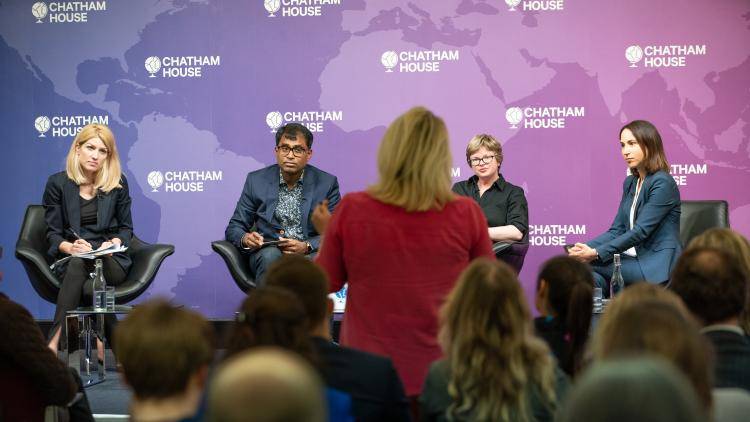
Good afternoon, everybody. My name’s Alex Vines. I’m the Director of the Africa Programme here, and I’m chairing this session on ‘Nigeria’s Evolving Foreign Policy and Global Aspirations.’ We’re very lucky to have the Foreign Minister of Nigeria here, Minister Tuggar, and he’s going to outline Nigeria’s foreign policy priorities and his government’s strategy for international engagement. This meeting is obviously on the record, there is media in the room, and we are livestreaming, but before we continue, I want to invite our Chief Executive Officer, Bronwen Maddox, to make some opening remarks. Bronwen.
Bronwen Maddox
Alex, thank you very much, indeed, and, Minister, thank you so much for joining us. We last met on a panel I was moderating at Davos. It seems a very long time ago, although just weeks ago, and we were then having an excellent conversation about Nigeria’s aspirations and its foreign policy. And I was delighted then to think that we might have a chance of continuing that at Chatham House. Many things have happened since, so I’m sure you will have excellent questions.
Let me just say a few things. I’m really excited about this discussion and about our work on Nigeria in general. I’m going there in ten days’ time, a trip I’ve organised my year around, because I so much wanted to be there at the climax of a block of five years of work that we have been doing on social norms and accountable governance, and that work comes to a head this year and I’m going there to launch our report on that.
But our partnership with Nigeria goes back a long way, much, much longer than the two and a half years I’ve been here. It goes back, in fact, to 1961, when Chatham House assisted with the establishment of the Nigeria Institute of International Affairs in Lagos. Its library is modelled on ours, and we continue to have very strong ties. Alex is an Honorary Fellow at it, and I’m going to be visiting it, as well, so I’m looking forward to that, as well. I’m not going to intrude anymore into the time that the two of them are going to have in discussion. Please get your questions ready because I’m looking forward to the answers. Again, a second welcome from me. Thank you.
HE Ambassador Yusuf M. Tuggar
Thank you.
Dr Alex Vines OBE
Thank you very much [applause]. Minister, if you go to the podium. This is not a Q&A with me.
HE Ambassador Yusuf M. Tuggar
Okay.
Dr Alex Vines OBE
And we’ll have your presentation, and then we will open up for questions and discussion [pause].
HE Ambassador Yusuf M. Tuggar
Alex, Bronwen, Your Excellencies, distinguished guests, ladies and gentlemen, it is an honour and a privilege to stand before you today. I was speaking with a friend earlier, I think the friend is even in the room here, and he said, ‘You picked a hell of a time to be a Foreign Minister.’ And so, while I’m billed to speak on Nigeria’s evolving foreign policy and global aspirations, I’m fully aware of what we might call the ‘evolving nature of the international scene.’
So, I’m delighted to be at Chatham House, with its deep resop – repository of knowledge and understanding, as well as we all seek answers to familiar questions in a setting that appears to be changing so quickly and with such drama. I say ‘appears’, because I think it is very important that we do not lose sight of the fundamentals amid the bonfire of what we used to call newspaper headlines but must now think of as viral clips. Because, actually, some of the alarm and uncertainty that we’ve seen in recent weeks in the Middle East, Europe and the Americas is already a little familiar to us in Africa, in general, and in Nigeria in particular.
The existential threat to multilateralism and the rules-based international order, is it really as new as it might seem? Consider the wars in Sudan, Eastern Congo, the Sahel and beyond. The UN is barely able to manage humanitarian support, still less, solutions to end the fighting or prevent the next conflict. We know that clubs are only as good as their members. We’ve led calls for decades for reform and renewal to meet challenges that are so very different from that which the UN and other international bodies were created. We need to be honest about the rules-based international order.
For more and more people, it is working less and less well. Memories may fade, but the response to the COVID-19 pandemic showed that some partners were very much more equal than others. Ever since I was a student, we were told Africa should liberalise markets, privatise and deregulate. Now those same countries are talking about tariffs and restricting access to markets and capital. It is why Nigeria, to give one example, has expressed our concern over the polarising implications of the Basel IV regulations and continues to push for reform of the global financial architecture. We know the playing field is not level, and we know the limits of partnership. Every country puts their interests first, but we believe there are many areas where those interests overlap with common interests. We see other countries now making very similar arguments, because sometimes it is still possible to run what Robin Cook called ‘an ethical foreign policy,’ and at the same time, protect more immediate, tangible national interests.
Nigeria contributed to peacekeeping emergencies in the aftermath of independence in the 1960s. To date, I would say we have participated in 61. We supported liberation movements far from our own borders, to end the racist regimes in Southern Africa in the 70s and 80s. We helped end the appalling wars in Liberia and Sierra Leone in the ‘90s. Because of our hea – wealth and our size, we had the capacity to do so. It was also in our interest to do so when it was clear that no-one else was going to intervene. The Technical Aid Corps in my Ministry sends out volunteers to African, Caribbean and Pacific nations for free, and yet, we get a lot in return, in terms of trust, knowledge and partnerships. We support efforts to deliver a peaceful settlement in the Middle East through a two-state solution, and we’ve supported the Palestinian people. We think that is the right thing to do and we think it is the best way forward.
As the debate swings back and forth, and now, at least in some quarters, back again, on climate change, we understand only too well the contradictions and the challenges. In Nigeria, we sometimes have droughts and flooding in different parts of the country at the same time. We don’t need to wait for future generations. Lake Chad, that used to be a vast inland ocean, is a tiny, damp shadow of what it once was. And there are real world consequences. Combined with demographic change, competition for resources has fuelled tensions and violence between herders and farmers in Nigeria and across the region, and fertile ground for violent extremists to exploit a lot of young people with very little in the way of legitimate opportunity. And yet, as everyone in Europe and beyond has learnt since 2022, energy security is also a national security and an economic security issue and the foundation of a stable international system. Tell a country like Nigeria, which has now, finally and painfully, abandoned fuel subsidies, something we don’t know. Unmanaged, these are some of the most significant triggers for violent extremism and irregular migration. Our problems are everyone’s problems.
Africa knows that if the transition to a more carbon-neutral energy equation is to be effective, there has to be a transition that is fair and equitable. That is why we have called for more flexible interpretation for the use of those instruments agencies like the International Monetary Fund have at their disposal. Instruments established long before the climate energ – emergency, like special drawing rights, which can be adapted to allow the IMF to deliver its mandate to provide the financing for growth, opportunity and prosperity.
And democracy itself, as Churchill so famously said, ‘The worst form of government, except for all others.’ In Africa, we used to look to Europe and America for a model for peace, freedom and prosperity. Then we look to Asia. Now, we find Europe and America following us in seeking solutions from that same direction. The cycle is newer in some of our wealthier partners, but for us, the challenge is familiar. What should we do when the gap between expectation, capacity and delivery becomes too great? What happens when the foundational bond of democracy, a system that works well when it makes us broadly feel safer and better off than before, begins to break down?
A hypothetical example, a candidate wants to get elected. He or she, I guess, they, is less in vogue today than it was yesterday, knows there’s no mileage in levelling with voters about how hard it will be and how long it will take to fix problems papered over for years. So, instead, you make extravagant promises about how people just need to trust you. You win and when it all goes wrong, make sure you know who to blame, and spoiler alert, not you or your people, and make sure your associates do okay along the way. We’ve been watching that movie for years; it doesn’t end well.
I would say this, I was born the year a civil war started in Nigeria, I was in my 30s before I got the chance to vote and have any kind of say in who should form the government that ruled my country. I look at the cheerleaders for military rule in other parts of West Africa now, or those, more broadly, who try to use the rule of law to break the rule of law. And I’m reminded that we can take democracy too easily for granted, right up until the moment that it is taken away. Even before the advent of AI, between the massed ranks of social influencers, keyboard warriors and bots, at the command of the new tech oligarchs now dipping their toes directly in political waters, it’s been clear that lies and disinformation are out and toxically about long before the truth even got its trousers on.
In Nigeria we saw the lives lost and lives ruined by unfiltered hate speech and were told it was ‘the price of freedom.’ We knew exactly why the UK Government was right to come down so hard last year on those who spread hate and violence with a few clicks of their phones. We think that with rights come responsibilities. This is especially true in the new world of aggregated data, which impacts so many and yet, is understood by so few. We think there’s a common interest in establishing a framework that protects the balance between the two, in the best interests not only of community, but of those platforms themselves. In my own experience, before joining government, what the private sector fears most is uncertainty. Certainly, it can live with regulation that is effective, targeted and fair.
So, perhaps one of the lessons of the last few weeks is that the world is genuinely a smaller place than we imagined and that some of the problems we face in Africa may look a little more familiar here, now, than might have appeared the case until very recently. Actually, in my job, I’m fairly lucky, I have very clear terms of reference laid out in a document called the Constitution of the Federal Republic of Nigeria. As a matter of law, Nigeria’s foreign policy serves five principles, promotion and protection of the national interests, African integration and support for African unity, promotion of international co-operation for peace and mutual respect, respect of international law and treaty obligations, and promotion of a just world economic order. What we have to do is clear. How we do it is the job of diplomacy, the talented Ministry that I have the privilege to lead and the bold government of which I am a part.
President Bola Tinubu is the first career Politician Nigeria – in Nigeria that has become its leader in a long time. In a country where Politicians typically get a bad rap, I find myself sometimes having to state the obvious, real change requires the assembly of a, to borrow a phrase, ‘coalition of the willing.’ We need the right policies and the means to deliver them. This is, first and foremost, a political task. And this is why the Tinubu Government has been able to tackle really difficult, potentially volatile, issues with the success that is – it has had, because of a leader that knows both what needs to be done and how to get it done. There cannot be a trade-off between reform and stability, between politics and the economy. What we’re doing, and we’re nearly two years in, is to strengthen political accountability, discipline and capacity, in tandem with the sacrifices inevitably associated with the reform of a failed and unsustainable economic model.
Our job in the Foreign Ministry is to explain the delicacy of this process and the risks associated with it, for us, the region and our partners, but it is also to point out the much – that much greater risks of failure, or worse still, trying to continue with a system that is tried, tested and failed. For a long time, this seemed a condition very particular to Nigeria. The more I travel, the more I hear colleagues saying similar things.
We also believe in strategic autonomy, our ability to independently make decisions and implement policies that safeguard our national interests, free from undue external influence. This means maintaining sovereignty in political, economic and security matters for Nigeria, while engaging in international partnerships that align with our goals. This is, effectively, a reimagining of an old idea. Tafawa Balewa’s commitment to the non-aligned movement was a manifestation of strategic autonomy. It acknowledges that no-one has as much of an interest making Nigeria work as Nigeria, and that means helping to make the region work and championing Africa on the wider stage.
It is also to uphold the principle of non-interference in the affairs of sovereign states. Again, this is not as much of a balance or a contradiction as it might seem. This summer, we celebrate 50 years since the foundation of the Economic Community of West African States. Burkina Faso, Mali, and Nigeria and Niger will not be there. The military rulers of those countries chose to leave the community, rather than commit to a timetable for the restoration of constitutional rule. That’s the choice of three men in uniform. In Britain you had a referendum and two elections before exiting the EU, and even then, I’m hearing the decision still remains somewhat controversial.
The point is, it’s not up to Nigeria to decide who forms the government of countries in our region, but we can compromise only so far on the values of democracy and the vision of community that we share with other ECOWAS countries. We have reached out to Burkina Faso, Mali, Niger, on many occasions. Every time we offer an olive branch, they use it as a stick with which to beat us, but we’ve shown that ECOWAS has a distinct identity and that, for all its faults, it has made progress that will leave those on the outside literally and figuratively poorer for it.
We’ve seen the departure of French and US Forces from the region, with varying degrees of reluctance. There’s no security backstop that we, as Nigeria and the region, will not provide for ourselves. And that may not be a bad thing, but don’t for a moment think that the Russian private security companies, or the jihadist groups in the Sahel, that are taking the place of the French and the Americans, lack ambition. Nigeria is fighting on everyone’s frontline. We take our responsibilities seriously. Irregular migration is a doorstep political issue in Europe, but it is a huge challenge, also, for those countries that are haemorrhaging talent and those for whom they pass through. That is why we urge a balance in resources deployed to keep people out and programmes and policies around trade and financing that might encourage people to stay in.
The first principle of medicine, since ancient times, is ‘do no harm.’ This would be a good place to start. Let me give you an example of the EU in this regard. Brussels wanted to stem the flow of migrants north. Fair enough, they pushed a partnership framework that linked aid deals to a reduction in people travelling north. Nigeria was not a party to the agreement, but look at what happened in Niger, which did everything that the EU wanted, in 2015. They passed laws that criminalise ancillary activities of the migration economy, such as, providing transport or accommodation to foreign nationals anywhere north of Agadez. This was in direct contravention of the ECOWAS protocol on free movement of people and long-established peripatetic traditions. Tyranny, as we call it in Hausa, where Tuaregs might be found working as far south as Lagos and Port Harcourt in the dry season and then return home. The result was a catastrophe. The government that obliged the EU is no more, replaced by a military regime that has an altogether different relationship with Europe, with Russia, with Libyan factions and with people traffickers.
And as a last word on the issue, there’s a common interest in a resolution of the Libyan imbroglio. Failed states are a cancer, if they’re allowed to metastasise, the risk of instability, corruption and violence grows exponentially. Wouldn’t it make more sense to fix it now, before matters deteriorate further still? Our tactical toolbox for policy implementation is built around what we call ‘4-D Diplomacy’, democracy, development, demography and diaspora. I’ve already touched on democracy. I should add that development for us means making economic diplomacy a priority. We actively seek foreign investments, promote trade and foster partnerships that drive job creation, infrastructure development and technological advancement. Initiatives such as the Nigeria International Partnership Forum and establishing trade desks in our Embassies are testaments to this focus.
We know there’s not a lot of money in Europe. It’s no accident that we are in the Middle East and Asia so often. We’ve discussed Nigeria’s size and standing in Africa and in the world, but consider the demographic forecasts. By 2050, and that’s not so far away, Nigeria is said to be the third most populous country in the world and much younger than China and India. This gives us considerable clout. People used to say, ‘When Nigeria sneezes, Africa catches a cold.’ If we’re able to harness the energy and talents of a young, healthy and ambitious population, Nigeria has the potential to be a hugely important market. As Politicians were acutely aware of the risks of failure.
Lastly, diaspora, which seeks to amplify the excellence and exceptionalism of Nigerians worldwide. Remittances from the diaspora are an increasingly significant component of the national economy. We see people of Nigerian origin succeeding in every walk of life and, at least almost always, to our credit, in terms of helping to shape perceptions and challenge prejudices.
Ladies and gentlemen, I know our time is short and that there may be some questions that you would like to ask. As I said at the beginning, me too. But before we close, one final thought, it may have sounded as if I was bashing multilateralism and the established rules-based international order. I’m not, quite the opposite. Nigeria sees so much to be gained by working together to promote common values and common interests and tackling common problems, but we have to face up to the cracks we can no longer conceal.
It’s not working like it used to work, or as it should work. That’s a statement of fact. Nigeria has been arguing that we have to adapt systems, agencies and rules if we’re to stay true to the values and principles that underpinned those systems so successfully for so long. We now need to find new ways to make them relevant to a complex and changing world. I have outlined some of the changes that we’re working towards and with some success. But let’s be clear, if we’re not bold enough to rise to the challenge, others with much less sympathy for and knowledge of what might make for a stable and more prosperous world will do it for us. I thank you very much [applause].
Dr Alex Vines OBE
Thank you very much, Minister. So, the Minister’s going to take questions sitting down. He’s fasting, so we also want it to be a easier process. Minister, there’s a number of questions that have come in, and are still coming in virtually, with our live audience that are unable to be with us in the room. And I mean, you’re responsible for a really large, robust diplomatic network, 109 diplomatic missions of all sorts of sizes, High Commissions, Embassies, Consulates, Permanent Missions. And the question that is coming through is that since September 2023, I believe that there hasn’t been any appointments of Ambassadors or High Commissioners. So, how are you going to service your machinery of government?
Are you cost saving, because you don’t need Ambassadors and High Commissioners in that level, that you think what you have is okay already, or are you – have you got a pipeline of things that you’re going to do to, kind of, inject into your Foreign Ministry? So, that’s one question that is coming through, through all sorts of people, including Babatunde Arogunmati has asked that question. Not sure where Baba’s exactly from on this, but yeah. Another question that is – many questions coming through, including [Bachan Mescal Nega – 32:43], is, ‘With the turbulence from the United States, how do you believe Africa should reposition itself in these evolving gold – global trends?’ So, how are you going to do that?
And then a third one is, more broadly, I was reading about Nigerian foreign policy over the last – I mean, Nigeria’s 65 years old this year, if I remember right, and there was all sorts of metaphors, like, ‘the slumbering giant,’ ‘the sleeping giant,’ ‘the awakening giant.’ You know, what’s your optimism for the next couple of years of the Tinubu administration? We had Bola Tinubu exactly here on this podium expressing his vision to be where – to be elected, when he was Presidential candidate. What do you think at the end of the first term of a Bola Tinubu administration, for that’s what it’s going to be, are your key accomplishments for Nigeria, both in terms of foreign policy, but also, you know, your domestic priorities? So, those are the three questions, and then we’ll open up more broadly.
HE Ambassador Yusuf M. Tuggar
Okay, so I could go ahead and answer these now?
Dr Alex Vines OBE
Please, go ahead.
HE Ambassador Yusuf M. Tuggar
Okay, well, to begin with, the appointment of Ambassadors is above my pay grade.
Dr Alex Vines OBE
Okay.
HE Ambassador Yusuf M. Tuggar
What I can do is recommend. I have already done that.
Dr Alex Vines OBE
Yeah.
HE Ambassador Yusuf M. Tuggar
A committee was constituted by the President, which I chaired. My Permanent Secretary was the Secretary, and we came up with our recommendations and passed it on. But suffice it to say that when the administration came in, the financial situation, the books for the country, were in a dire situation. So, it’s understandable and it has become some sort of tradition in Nigeria, rightly or wrongly, that when we feel the economic pinch or bite, then the appointment of Ambassadors – because quite frankly, posting them out becomes something of a nightmare in terms of our costs, yeah, because they have to go with their families, and, you know, all sorts of [inaudible – 35:12].
So that is part of it, but I know that the situation has ameliorated, and I’ll give you an example of myself. I was appointed Ambassador under Buhari. Buhari came into office in 2015. I went out in August 2017. So, I’m not justifying it, I’m not saying every government should follow suit, but, you know, this is regrettably the situation we find ourselves. On the issue of what Africa should do to reposition itself, I think Africa is already doing that. Situation in the US, you can see that one of the effects is the, I don’t know what to call it, whether it’s been scrapped completely, the USAID…
Dr Alex Vines OBE
A-I-D.
HE Ambassador Yusuf M. Tuggar
…for instance, some of the good work that USAID does, PEPFAR, medication for AIDS patients…
Dr Alex Vines OBE
Yeah.
HE Ambassador Yusuf M. Tuggar
…and all of that. What we have to do is step up, and for us, we can turn it into an opportunity. We don’t have to rely on development aid. A country like Nigeria is fortunate not to rely on development aid. When it comes it comes. You know, sometimes countries actually complain that we are not keen on accepting the $5 million that is meant to go into our agricultural sector. Because it might have an effect on a small country, but what effect is $5 million going to have on Nigeria’s agricultural sector, with maybe 100 million/150 million farmers, for instance? So – but, apart from that, we also need to look out for each other, so we need to help each other.
And I think we’re also doing that, you can see what we have done, for instance, with the issue of a Standby Force, the Peace Fund to fund it, so for peacekeeping offera – operations, where we have pulled funds together to support each other. So, these are the sort of things that we need to do also with regards to social services and anything that takes up the contributions from development aid. So, with President Tinubu, what he is doing, I didn’t quite understand what the…
Dr Alex Vines OBE
So, I suppose…
HE Ambassador Yusuf M. Tuggar
…question was meant to be.
Dr Alex Vines OBE
…the question is – so, let’s narrow it.
HE Ambassador Yusuf M. Tuggar
Hmmm.
Dr Alex Vines OBE
For you, as Foreign Minister, at the end of your term, what would you see as mission accomplished? What would you be happy about?
HE Ambassador Yusuf M. Tuggar
Well, I know I might end up being held to my word. I’m not saying it’s going to be possible, but what I would like to see is Nigeria represented in, first of all, the highest decision-making bodies of the planet because we deserve to be there, because others bestow us with fiduciary responsibility, if you will, to represent them, because we – they know we are non-threatening.
Dr Alex Vines OBE
Yeah.
HE Ambassador Yusuf M. Tuggar
They know that we’re well-meaning. Look at our neighbours, they’re much smaller than us, you don’t see us invading anyone. We actually even, you know, just for the sake of peace, give up territory to them. So, being in the United Nations, as a permanent member of the UN Security Council, with a veto, that would be something. G20, yes, that would, again, be something, because then we would be able to champion the reform of the global financial architecture that we have been advocating for.
Dr Alex Vines OBE
And in – I mean, in January, you became a BRICS partner.
HE Ambassador Yusuf M. Tuggar
Yeah, we became a…
Dr Alex Vines OBE
Would you like to be a full…
HE Ambassador Yusuf M. Tuggar
…BRICS partner.
Dr Alex Vines OBE
…BRICS country?
HE Ambassador Yusuf M. Tuggar
Yeah, well, that’s in the pipeline. You know, it’s all about timing…
Dr Alex Vines OBE
Yeah.
HE Ambassador Yusuf M. Tuggar
…and with the BRICS partnership, we get all the benefits of being a member without being a member. So, you know, it’s – we’re sweet and cheerful, and we’re in good company with Saudi Arabia and a few others, so, yeah.
Dr Alex Vines OBE
Okay, well…
HE Ambassador Yusuf M. Tuggar
Hmmm.
Dr Alex Vines OBE
…that’s enough of me and some of the virtual audience for now. So, I’m going to go around the room. So, the lady with the longest arm that I’ve seen in the room, please go ahead. It’s you, yeah, microphone coming your way. Do tell us your name and introduce yourself, yeah.
Tochi Iyke
Minister Tuggar, thank you very much for your very insightful speech. My name is Tochi Ike and I write strategic policies for companies.
Dr Alex Vines OBE
Okay.
Tochi Iyke
My expertise lies in equality, diversity, and inclusion, because I believe that London’s biggest asset is its diversity, and I can’t find many people who disagree with me. So, my question for you today is, what strategies is Tinubu’s regime implementing to address the instability of the economy and attract foreign investors, as well as uncovering the untapped opportunities in Nigeria? And, also, considering that, as you mentioned in your speech, Nigeria is set to become the world’s third lar – third most populous country, how will it harness the talent and energy of its very vibrant and young population? Thank you.
Dr Alex Vines OBE
Thank you very much. I like succinct questions. So, the gentleman just down here, with the purple tie, yes, sir.
Samuel Gussans
Thank you.
Dr Alex Vines OBE
You’re welcome, go ahead.
Samuel Gussans
Samuel Gussans, member of Chatham House. Minister, the question is straightforward and I want – like to make a couple of points in relation to you personally. Next week is your birthday. May we wish you happy birthday on the 12th [applause]. Now, the question is really, directly, where will you see yourself in this divided world? Which direction will you go? Although you are a member of BRICS, and I see your ambition to become permanent member of UN, as well, so, the question is shortly, where will you be seeing yourself, which direction?
Dr Alex Vines OBE
Thank you very much, great question. My goodness. So, the gentleman with the cap here, yeah, just there, the cap, one that – round, yeah, go ahead.
Godson Azu
Thank you very much. My name is Godson Azu, the CEO of Cater and Merger Consult, and BEN Television UK. Your Excellency, it’s my pleasure seeing you again. I know we met when you were the Ambassador of Nigeria to Germany a couple of years ago. My question goes this, I’m happy to see a High Commissioner and the High Commissioner of Britain to the – to Nigeria sitting together this evening, which shows the true relationship between Nigeria and the UK and, kind of, shows the natural bond between the two country. But I want to ask you, what is the effort that Nigeria is doing to manage the relationship between the Nigerian diasporas in the UK and the way the UK Government is dealing with the issue of Nigerians? For example, what is your thoughts with regards to the couple of statements by the Conservative Leader against Nigeria and the UK?
Dr Alex Vines OBE
Ah, okay, thank you. So, we’re going to – so, the lady there, yeah, that lady there, please, and then we’ll get you to answer.
HE Ambassador Yusuf M. Tuggar
Sure.
Dr Alex Vines OBE
Yeah.
Member
Good eve…
Dr Alex Vines OBE
Please go ahead.
Member
Good evening, thank you for speaking with us today. My name is [Eyasha Kour – 43:12], and I’m a final year law student at King’s College London. You mentioned about twice how Nigeria would like to see some reforms in the global financial architecture. I just wanted to clarify what kind of reforms would Nigeria like to see in the global financial architecture that you think would benefit us, our country, and where we’re trying to position ourselves in terms of foreign policy? Thank you.
Dr Alex Vines OBE
Thank you so much. Minister, over to you.
HE Ambassador Yusuf M. Tuggar
Okay. So, what strategies to attract business, I think was the first.
Dr Alex Vines OBE
Uh-huh.
HE Ambassador Yusuf M. Tuggar
There have been several measures that have been taken. We can look at different sectors. So, if we look at, for instance, energy, or power, electricity, one of the things that the administration did was to push through the Electricity Act, which allows, for the first time, for private sector, as well as sub-nationals, state governments, to set up businesses, operations in power generation and transmission or distribution, without recourse to what used to exist, which was controlled by the Federal Government. So – and then you also have Feed-In Tariffs, so you can generate and sell back to the grid.
So, this was a measure to encourage – to, sort of, to decentralise power generation, power distribution, power transmission, because one of the major challenges that we have in terms of attracting business is electricity, you know. So, this was part of it. Of course, the Siemens Electrification Project is still ongoing, even though it’s no longer the, you know, the size that we started out with, but, you know, this is something that’s – and there’s several other measures. And then we’ve got gas pipelines that are being constructed, not just within Nigeria, where you have the Ajaokuta-Abuja-Kaduna-Kano Gas Pipeline, you have the Obi-Obri-Oben, that is also still being constructed to deliver gas from the south – southernmost part of Nigeria, where you have gas fields, to the western part of Nigeria, southwestern part, and then north.
We also have the African Atlantic Gas Pipeline, which seeks to deliver gas through 15 countries to Morocco and then to feed into the Maghreb line, that could ultimately deliver gas to Europe. And then only two weeks ago, one of my colleagues, Minister for Gas, was in Algiers meeting, believe it or not, with not only the Minister of Energy for Algeria, but also the Minister of Energy for Nigeria Republic, you know. Then infrastructure, what we’re doing with the Chinese, the railroads, you know, roads, seaports, all of that is to pro – you know, make Nigeria more attractive to businesses.
The Enabling Business Environment initiatives still continue, with startups. You’ve got a Startup Act to support startups, because, as you know, we’re churning out unicorns, you know, Moniepoint I think was the more recent one. So, it’s all of that. And then, of course, for the youth, you’ve got several initiatives, you’ve got the 3MMT – you know, trying to – MTT [means 3MTT] , I don’t know if I’ve got it right, to train young people in technology. We have collaborations with countries such as France, for instance, where we have iDICE and the expansion of broadband and fibre optic continues. I can go on and on and on, you know, there’s so many different things, education, as well. So, that, I think, takes care of youth employment.
Direction, what direction is Nigeria going to go? Which bloc is it going to align with? None. We are aligning with strategic autonomy, which is what I was talking about in the speech. We will deal with whoever we deem fit. Nigeria has never been one to be dictated to who its friends should be, and it will remain that way. We have our national interests and the interests of Africa and other considerations that guide our decisions, but one fundamental thing to always remember is that we’re guided by moral precepts and ethical considerations when we take positions. If you see what we did with South Africa, we’re not neighbours with South Africa. It takes – you know, you have to fly six hours to get to South Africa, but we stood by the ANC back in the day and fought for – fought against the racist regimes in, not just South Africa, Mozambique, Angola, Namibia and so forth.
So, you know, this is what we’ve always been, and that is why, when it came to the issue of Palestine, we stood firm and said, ‘We’re for the two-state solution and we’re in support of Palestine.’ And actually, behind the scenes what I was doing was arranging for babies to be flown out of Gaza, to Egypt, to Jordan and other places. Initially, the consideration was to see whether we could actually fly those babies whose lives were at risk, heart conditions, sometimes, you know, the effect of the bombing, whether we could fly them to Nigeria for treatment. But then we thought, okay, if anything goes wrong, that would be a huge PR blunder, let us engage tho – the countries that we’re friendly with that are in the neighbourhood, and we did that. And, also, look at the recent vote. We voted along with Europe and others when it came to the issue of Ukraine, because we are very, very sensitive when it comes to the issue of territorial – the territorial integrity of countries, because we are a very diverse country. We’ve been through a civil war in the past, so we feel that that should be respected.
Global financial architecture, what should be done? More funding, recalibration, reconfiguration of this whole concept of risk, political risk, financial risk and ratings that are quite often unfair and are not related to any realistic evaluation or consideration of developing countries. Global financial con – architecture also has to do with what I talked about in the speech, the – in the paper I should be saying. The Basel IV regulations that calculates risk weighted assets for lending, it’s going to affect lending to businesses, trade, investment and so forth, in developing countries, in Africa, in particular. We want to see that change. We also want to – again, I refer to it in the paper, the issue of how to apply the SDRs, the special drawing rights, of IMF.
Debt relief is another issue. Technology transfer that was promised during the Rio Earth Summit by developed nations, or the rich countries, to the developing or the poorer countries of Global South. We haven’t seen that, nobody is even talking about it. These are the sort of things we want to advocate for when we have that permanent seat in the UN Security Council and when, eventually, we join the G20. For now, we are just invited guests.
Dr Alex Vines OBE
Okay. Oh, my God – my goodness, sorry, and we’ve got ten minutes left. Sorry. Okay, so I’m going right at the back there first, please, you, sir. Yeah, there’s a microphone.
Dr Gabriel Obokon
Okay, protocol duly observed. My name is Dr Gabriel Obokon. I’m a Fellow in University College London. So, I’ve taken time to listen to your presentation, so my question is, on the 26th of January, the world received a shock from the Pri – the government of Donald Trump, global funding for HIV, AIDS and other essential services was cut, and it was a great issue. Patients were running helter shelter. At some point, people were permutating that for you to be able to get a cup of ARVs would go as long as three million. Nigeria was hugely affected within that period before the waiver came up.
So, my question is, what is the administration currently doing in order to build health resilience, and also build local capacity that in the future, when these kind of occurrence happen, the country will be able to respond accordingly, having in mind that health is both national, subnational and international? Thank you.
Dr Alex Vines OBE
Thank you very much. I have a number of questions here that came in online about ECOWAS. You mentioned 50 years of ECOWAS and your sadness that there are three AES countries no longer part of ECOWAS. So, the question is, what is Nigeria doing to effectively maintain the rest of ECOWAS together? So, how are you trying to consolidate it? Alright, so the lady right in the front here, and then I’ll take two more questions, and then that’s, unfortunately, it, we will have run out of time. Yeah, the lady just here. There’s a microphone coming to you. Please be short and succinct so we have time for other questions, go ahead.
Dr Aderonke Tomori
Okay, thank you. I’m Dr Aderonke Tomori, the Chair of the Nigeria Think Tank Group Worldwide, I’m a Strategy Consultant. Thank you for that submission, succinct. Your question, Honourable Minister, how do you intend to drive leverage in Nigeria’s talent pool from outside of Nigeria, please?
Dr Alex Vines OBE
Perfect length of question. The gentleman with the pen. I like that pen, please, yeah.
Byron Cabrol
Your Excellency, thank you for your remarks. You spoke of African…
Dr Alex Vines OBE
Do tell us who you are, please.
Byron Cabrol
Sorry, my name is Byron. I work for Dragonfly Intelligence.
Dr Alex Vines OBE
Okay.
Byron Cabrol
You spoke of African unity as one of your – the five core duties of your Ministry, and with the events unfolding in the DRC, I think the continental response has been less than unified, so – with competing priorities between SADC, the EAC and the African Union. I was wondering whether you could tell us what role you think Nigeria has to play, if any, in addressing regional crisis like that one and finding peaceful resolutions to conflicts across the continent?
Dr Alex Vines OBE
Okay.
Byron Cabrol
Thank you.
Dr Alex Vines OBE
And then third row back, the gentleman there, yes.
Patrick Smith
Thanks very much. Patrick Smith from Africa Confidential. Thanks very much for coming us – to speak to us during Ramadan.
Dr Alex Vines OBE
Yeah.
Patrick Smith
I wanted to ask, what is the next step after your delegation to the UN General Assembly last year managed to push through an amendment giving the G77 group say-so over tax rules and regulations around the world? It seemed to be quite a significant victory because you – arranged against you were the united forces of the rich man’s club in Paris, the OECD. So, now you’ve established that win at the General Assembly, what are you going to do, in terms of changing the tax rules? And what chance do you stand, given the, kind of, geopolitical shift with the government in the US, which now says it’s putting Foreign Corrupt Practices Act on hold, are we really going to see action on getting shot of the illicit financial flows? Thanks.
Dr Alex Vines OBE
Right. That’s it, I’m – my apologies, we’ve run out of time, but we have time for your answers, Minister, obviously.
HE Ambassador Yusuf M. Tuggar
Okay, thank you. So, I think I touched on, or even addressed, the issue of the PEPFAR and medication for AIDS patients. With Nigeria, the Minister of Health announced soon after, that they had identified the funds that they were going to use to bridge the gap. So, with the USAID pulling out and PEPFAR coming to the – sadly, an end, the – Nigeria was going to step up and make the difference. So, I think we’ve addressed that, but of course, Nigeria since the COVID pandemic has been working assiduously to develop capacity for local production of not just medication, but also vaccines. Because we saw what happened, the vaccine apartheid that ensued and, you know, became a problem, so we are developing that capacity. We can give you more information. I think that the mission even has some information here that they can provide.
With regards to ECOWAS, how are we consolidating ECOWAS? Oh, wow, the three countries are the landlocked countries. So, even while they were actively members of ECOWAS, we had been working on the Abidjan-Lagos Corridor, which is a vital corridor. So, you can see that it never included – it – the – it didn’t go through the three Sahelian states. So, that is one project that has gone very far. It’s one of the most important trade and transport corridors in Africa. We have also gone far, in fact, almost it’s done, SIGMAT. SIGMAT is an automation, a digitization of the movement of containers, of goods, within the ECOWAS region.
I also talked, I think, earlier about the African-Atlantic Gas Pipeline with Morocco. We have dev – it’s been adopted by ECOWAS. It has also developed – ECOWAS has developed the – what they refer to as ‘the intergovernmental agreement,’ which is like the treaty that all the countries are going to sign, 15 countries, or thereabouts. As well as the host country agreement that each country also is going to sign individually. And you see what this does is – and don’t forget that there already exists the West Africa Gas Pipeline, from Nigeria to Ghana, through Republic of Benin and Togo. And we have a situation where Ghana is now producing into that pipeline the other way. When, in the beginning, it was Nigeria producing to Ghana.
So, that is going to be extended, where you have a subsea gas pipeline that would go all the way to Morocco, and which means that Senegal, with its new gas discoveries, can also produce into that. And Morocco is already linked to Europe through, as I said earlier, the Maghreb pipeline. So, that is going to – and mind you, this is the fastest growing region in the world in terms of population. So, there’s a domestic market for energy and this is where we’re also engaging big techs – big tech companies, we’re engaging with the Americans, if they’re interested, big tech and AI and datamining and data storage, all of that takes up a lot of electricity. So, it’s there, it’s ready, it’s available.
And there’s several other projects that are ongoing that seek to link ECOWAS even further, but beyond that, the bond really is the community, and we have – ECOWAS has one of the most advanced self-funding mechanisms. It’s the ECOWAS Community Levy. In fact, other regional economic communities are looking to emulate us. So, talent pool from the diaspora?
Dr Alex Vines OBE
Yes.
HE Ambassador Yusuf M. Tuggar
Or to export – because we have a National Talent Exports in Nigeria, and then with the diaspora, of course, what we are also doing is – in fact, even on this trip, I came with a young lady that is in – that is one of the leaders in business process outsourcing. So, we’re looking to engage in that regard, we’re looking to engage in terms of AI, also, artificial intelligence, because you’re the guys that are here, you have all the talented people that can work either remotely from here, linking us in Nigeria, or the other way round. So, we’re looking at that, and we are also, of course, supporting startups. We’re – that’s why you have that Startup Act that I referred to
And – basically, because we don’t subscribe to this idea of everybody who is doing well out here must go back to Nigeria to do it. It doesn’t make sense, you know. We need you here. We need you to do what other countries have gotten from their diaspora. They’ve gotten the support, they’ve opened doors, they’ve, you know – the remittances, but it shouldn’t just be all about remittances. So, in terms of technology, that’s one key area [pause].
Dr Alex Vines OBE
DRC.
HE Ambassador Yusuf M. Tuggar
Yes, DRC, what are we doing with regards to resolving the problem in Eastern DRC? We’re doing a lot. Two weeks ago, I attended a meeting of the African Union Peace and Security Council. President Kagame was in attendance, Congo was also in attendance, and so the Peace and Security Council continues to make those efforts. But beyond that, we’ve had a merger of the Luanda process and the Nairobi process, so that it’s now one and the same, and none other personality than President Obasanjo has been included, also, as one of the Mediators in that process.
But apart from that, Nigeria is still making efforts on its own as – and also within the African Union Peace and Security Council. And I will be happy to inform you that Nigeria was successfully re-elected first round as a member of the Peace and Security Council, it has almost a near permanent status in the Peace and Security Council. And then Commissioner for Political Affairs, Peace and Security, Bankole Adeoye, a Nigerian, was also…
Dr Alex Vines OBE
Re-elected.
HE Ambassador Yusuf M. Tuggar
…re-elected. So, I assure you, you will hear good things coming out of all of that.
And then the UN framework convention on taxation. I would be lying to you if I told you that we did not face a challenge there, because there has clearly been a paradigm shift. It’s not going be easy, but we will continue to work at it, and I think it’s going to be more challenging now, because part of the prob – the – one of the issues that we were hoping that was going to tackle was the transfer price system, which allowed for these huge multinationals to move funds around, you know, in op – an opaque manner, because they would claim that it was moving from within their system, and all of that. So, it’s going to be difficult, but Nigeria will certainly continue to champion it, and it’s, again, part of the reform of the global financial system that we have been advocating for. So, I…
Dr Alex Vines OBE
Well…
HE Ambassador Yusuf M. Tuggar
…hope that answers.
Dr Alex Vines OBE
…you have, excellently, and again, I would like to thank you for finding time to come to Chatham House, particularly during Ramadan and a busy schedule. The only thing I’ve got left to do is to ask the audience and myself to give you the customary appreciation for being here [applause]. Thank you.
HE Ambassador Yusuf M. Tuggar
Thank you, thank you.