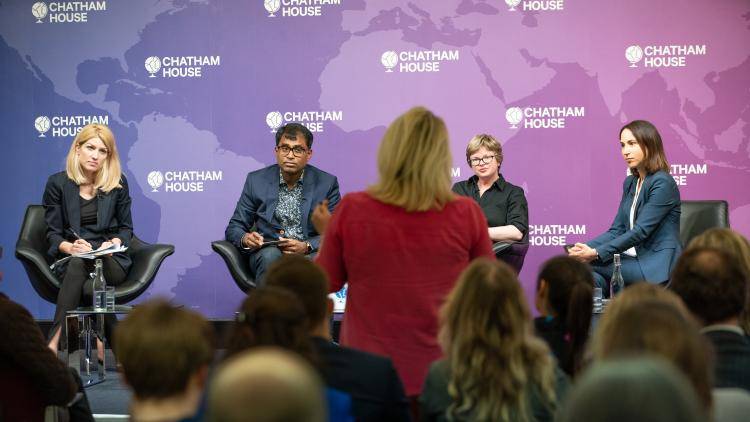
Bronwen Maddox
Welcome, everyone, welcome to those of you online not benefiting from the air conditioning. I’m Bronwen Maddox. I’m Director of Chatham House, and I’m delighted to be chairing this discussion on “One Year of Labour.” There has been lot of one year of Labour analysis around, but we are taking, as part of this at least, a – quite a heavy foreign affairs angle on this and have set ourselves the title, “Is the government right on this triangle of relationships, Europe, the US and China?” And we will talk particularly about that, but that triangle of relationships is very much what our UK in the World team, led by Olivia O’Sullivan, has been working on, of trying to get that right, and it was indeed, the focus of the report that Martin O’Donnelly [means Martin Donnelly], former Civil Servant, wrote to David Lammy before Christmas, how can you get those right? And the dilemmas of that accentuated by some of the decisions that Donald Trump has made since arriving back in The White House.
We – it would be remiss, though not to spend a bit of time on the contrast between what the government has been doing and some of the successes that it has had in foreign policy with the domestic travails which have been much occupying the nation this week. So, we’ll come to that more at the end.
I’m delighted to welcome Emily Thornberry, Dame Emily Thornberry, who’s Chair of the Foreign Affairs Select Committee in the House of Commons, and herselves brings a great stream of foreign leaders and Politicians and British Politicians to quiz there in that committee. And Lawrence Freedman, Professor Sir Lawrence Freedman, who’s a Professor of War Studies at King’s College London, has a long association with Chatham House, for which we are very appreciative. And Olivia O’Sullivan, as I said, on many, many sides leading our UK work.
So, let’s start, each of you, with this question, taking the essay question as it is put, “Is the government right on what it’s done on Europe, the US and China?” Lawrence, could I start with you?
Professor Sir Lawrence Freedman
I’ll give it seven out of ten. I think it’s doing okay. It’s an extraordinarily difficult time…
Bronwen Maddox
Hmmm.
Professor Sir Lawrence Freedman
…and I think that, you know, that’s a good starting point. You’ve got an administration that’s testing in every sense of the worl – word, and it’s producing problems, some of which we just can’t do anything about, or even where we think we’ve mitigated, a good example is tariffs. I think the Prime Minister, you can argue, has done a decent job in trying to mitigate the effect, but the overall impact of Trump’s economic policy, including the ‘big, beautiful bill’, is going to be, I think, pretty catastrophic for the international economy. And if it’s catastrophic for the international economy, then that will have knock-on effects and headwinds, whatever you want to call it, that we’ll be living with for some time. The fact that we still talk so much about the impact of the recession of 09/010, means we have to be aware of the consequences of what comes next.
So, I don’t think – I mean, I think the government has done what it can to deal with a difficult administration. I don’t particularly blame them for finding it difficult to have clarity on China, because you’ve got competing objectives, and so it’s bound to be a fudge with China, whatever you say. On the one hand, you need to be on your guard because they mess about with things. On the other hand, they’re an important player in the international economy, and you’ve got to recognise that. And Trump hasn’t made that any easier, because in fact, a lot of what Trump has done has given China opportunities, which by and large, they’re able to exploit. On EU, like others, I’d prefer they went a bit faster, but again, they’ve set that in motion, and I think they’ve used the security issues, which in the end, is the biggest issue. I mean, I think…
Bronwen Maddox
Biggest issue in Europe or biggest – in relations with Europe or biggest issue overall?
Professor Sir Lawrence Freedman
I just think Ukraine dominates everything, that if we get that wrong, then we’ll be – that, along with the, sort of, the economic troubles, we’ll be living with that for a long time. So, Ukraine for me, is the – in that sense, in terms of things that we can do something about, is the biggest priority, and I think they’ve done a reasonable job on that.
Bronwen Maddox
And let me just pick up what you said about China, ‘cause you put it marvellously bluntly and directly, “Look, it has to be a fudge on China,” and I’m thinking of really quite a long stream of Foreign Secretaries, including the current one, but his predecessors, as well, who’ve gone round that triangle of their own, of saying, “Well, we got to protect ourselves, but we want to trade with them and we want to talk about – with them about big stuff, like climate change,” and going round and round. In that fudge, do you feel the UK has got it right?
Professor Sir Lawrence Freedman
I don’t think they’re re – I mean, ‘getting it right’ suggests, you know, that there’s a, sort of, checklist of things, you know, we’re doing pretty well here, not so – you know. I think it’s just very difficult because China’s a big actor and you’re always going to be reactive, to a degree. And also the, you know, the – part of the issue with China is that on the big crunch questions, we’re a small actor.
Bronwen Maddox
Hmmm.
Professor Sir Lawrence Freedman
I mean, there’s a big US-China question, which looms large over everything that’s going on in international affairs, and we’re a bit player in all of that, as are other European countries. Now – so, I come back to the fact that it’s going to be a fudge. I don’t think there is a right answer. There’s answers that don’t make things worse, and I think so far, we’re more or less in that area, but the big tests have yet to come…
Bronwen Maddox
Hmmm hmm.
Professor Sir Lawrence Freedman
…and I think, and they may never come. But how – so, at the moment, I don’t think we know. I don’t think the situation has worsened with this government, but, as I say, I think it’s a question of how US-China relations develop and how we fit in with that.
Bronwen Maddox
Emily Thornberry, you got – it was a seven out of ten on your left. What do you think?
Rt Hon Dame Emily Thornberry
I think it’s different depending on what we’re talking about. So, I think that Lawrence’s analysis is absolutely right when it comes to the United States. It’s very challenging and very difficult, but I think that we couldn’t be doing better than we are, actually.
Bronwen Maddox
Hmmm.
Rt Hon Dame Emily Thornberry
And I – is it, you know – obviously it’s a difficult relationship with President Trump, and – but, I mean, if we can influence for good, then it’s worth it. I mean, just, you know, do not forget the scene in The White House with – you know, about Ukraine, and how awful that was. And how in a way, I think, Britain, sort of, negotiated the offer for Ukraine and then negotiated the response and, you know, played an absolutely pivotal role at that really, really important moment. So – and I think, also, we underestimate the level of affection that actually Republicans do feel for the UK.
Bronwen Maddox
Hmmm.
Rt Hon Dame Emily Thornberry
Sorry, I was telling you about this earlier, but I’ll repeat it. I was at a social event with some Republican Congressmen, and they’d all been in the military, and one of them was saying – and the fact is, is that, you know, I had a couple of people from my Select Committee who are from the military, who were was sitting there too. One of them was talking about being a Marine and they said – and then, you know, “We have a Marine,” and they go, “Oh, which fields were you” – you know, and it’s, like, practically every battle that they fought, because they’re all, you know, they’re all, you know, of an age, they’d fought next to a Brit.
Bronwen Maddox
Hmmm.
Rt Hon Dame Emily Thornberry
And there is, therefore, this, kind of, well, of course, you’re allies, of course, we trust each other, of course – it’s just very interesting that, kind of, affection, which is – I’m not saying there isn’t affection from the Democrats, but it’s slightly more guarded.
Bronwen Maddox
Hmmm.
Rt Hon Dame Emily Thornberry
You know, I was just very, very interested in that, and just very – it was just – but yeah, so that’s – you know, it’s difficult, but I think we have to do everything that we can to try to influence in the right way.
I think that when it comes to the European Union, it’s great to have an opportunity to do a reset. I think that there is space for being more ambitious. I think that, you know, we could get many of the things we’ve already got on our list negotiated by next year, so, you know, what’s next? I mean, you know, if we can do SPS, then what’s next? What about medicines? What about chemicals? What – like, are we getting our act together? Are we ready to – are we starting to, you know, to give them notice that actually, we’d like to talk about these other things next? I don’t think we are necessarily, and I don’t think there’s a problem with the British public in relation to this.
Bronwen Maddox
Hmmm.
Rt Hon Dame Emily Thornberry
I don’t think – I think they just don’t want to talk about Brexit anymore and, you know, and if we can come to a relationship with the European Union that helps with growth and helps with the economy, then they – people are just completely cool about it, and I just think we should take more advantage of that. I think it’s a really important moment, and I think the Europeans need to understand it’s an important moment and not be so difficult sometimes. So, I do think that we should push on that.
On China, I mean, there’s – it’s very difficult to know what our policy is in relation to China. I mean, we’re supposed to have a China audit, but we’re –that’s not being shared with Parliament. I mean…
Bronwen Maddox
Has it been done, in your understanding, just not shared?
Rt Hon Dame Emily Thornberry
Yeah, I’m told it’s done, but I mean, you know, there were three paragraphs in the National Security Strategy and just – there’s one line here which I just think is – “Instances of China’s espionage, interference in our democracy and the undermining of our economic security have increased in recent years.” Well, wow. So, what’s our strategy in relation to that? We – I don’t know.
Bronwen Maddox
Do you think we should give the, ‘we,’ the UK, give the okay to the Chinese Embassy at the Royal Mint which they very, very much want?
Rt Hon Dame Emily Thornberry
I don’t know. I mean, I really don’t know. I think that what we should – I mean, so let me put it this way, right? I think that it’s important that we have a strategy for dealing with the Chinese that people understand and they are informed by, you know, because I think that it needs to be thought through. We can’t say, you know, “Oh, well in Westminster, we’ve thought through a strategy, but it’s a secret strategy and we’re keeping it to ourselves.” I mean, it’s ridiculous, you know, because local authorities will need to make decisions, because they will be approached.
Bronwen Maddox
This is what I’m getting at, that everyone has to make decisions and in a way, I absolutely understand what Lawrence is saying of, this has to be a fudging, there are all kinds of compromises. On the other hand, there are real decisions, whether they are about that Embassy…
Rt Hon Dame Emily Thornberry
Hmmm.
Bronwen Maddox
…with the city’s cables running underneath it, or Scunthorpe, or whatever, there are decisions which the – this government, any government, has to make.
Rt Hon Dame Emily Thornberry
So, I think – personally, I think that the guiding light should be security advice.
Bronwen Maddox
Hmmm.
Rt Hon Dame Emily Thornberry.
I think that’s where we should start, and so, I think that that needs to be available to, you know, the City of Manchester, or, you know, or businesses who are being approached. I just think that there needs to be a much more open discussion about, you know, the risk which is attached, as well as, you know, all the opportunities and everything else. But I think we need to be pretty clear about defending ourselves and our – defending our interests. And, you know, I mean, we’ve announced that we’re spending all this money on it, but, you know, how much of that is being spent on, for example, I don’t know, stripping out Chinese parts from our communications industry? I mean, I – and once it’s in, it’s really expensive to get out again.
Bronwen Maddox
Olivia, what do you think? You’ve been writing extensively for us on this, papers – or one paper about to come on the UK’s relationship with Indo – the Indo-Pacific, and another one on the UK and China. What does – is there even a notion of getting it right that we can answer?
Olivia O’Sullivan
Well, I think I agree with Lawrence that, in general, with these kinds of relationships and in the position the UK is in, right, which is very different from the position it was in 14 years ago when Labour was last in power, all of these relationships have shifted very significantly. There won’t be a static right answer. But I think there probably should be a bit more long-term thinking about where each of them is going, and about which alignments with one point of that triangle foreclose alignments with the other.
So, I agree that tactically, so far, the government’s played a fairly tough hand quite well. If you take a look at the three recent trade deals, Keir Starmer’s hat-trick, the EU-UK reset, some ticks in the box there in terms of the agri-food settlement, that reduces friction with our closest market, reduces some of the most difficult barriers for the, kind of, biggest group of small businesses that were disadvantaged by some Brexit frictions. And starting the conversation on closer security and defence partnership, and particularly joint spending and planning, is the right approach to take to our closest trade market and the group of allies with whom we share the most proximate security risk.
The US deal wasn’t a trade deal, it was a pact to get some relief on tariffs that was – in the end, we didn’t get them, they’re not secured on steel and aluminium, but some relief for the automotive sector, right? Quite short-term, quite tactical, but maybe the best way at the moment to deal with a President like Trump is to make some initial concessions and hope he gets distracted, because he does. And the concessions that the UK made, yes, there was some market access on things like ethanol and beef, but some of it was quite vague and that’s, you know, all still to be negotiated. And after all, they’re trying to negotiate these apparently amazing trade deals with lots of other countries, right? So, there’s the way the UK is playing, not particularly elegantly, but maybe effectively at the moment, that partner in Trump on this.
Rt Hon Dame Emily Thornberry
But – and also, Olivia, the – we trade a lot with America anyway.
Olivia O’Sullivan
Yeah.
Rt Hon Dame Emily Thornberry
I mean, we’re their biggest – we’re the biggest investor in the US and, you know, there’s a million jobs in the US dependent on British money and vice versa. So, actually without a trade deal, it’s, kind of, going well, and so having a tactical agreement to get through a local difficulty in the short-term, I think is right, you know.
Bronwen Maddox
I mean, it sounds as if you’re all three in the same space on the US, look, as good as it could be at this point in the circumstances.
Rt Hon Dame Emily Thornberry
Hmmm.
Olivia O’Sullivan
I think there are some bear traps coming, though.
Bronwen Maddox
Yeah.
Olivia O’Sullivan
I mean, one of the things noted in that prosperity deal was this idea of having a –what they call a “transformative technology partnership with the US.” And I think one of the things the UK Government values in that relationship is they have this idea that, you know, in five/ten years’ time, in order to be an influential power in the world, you need to be on the cutting edge of tech and that a relationship with the US is the way to do that. That – I think that has – you know, much as we might be frustrated and worried about the way the US is changing, I think there is something in that argument.
Bronwen Maddox
Hmmm.
Olivia O’Sullivan
But the risk is getting close to the US on tech forecloses, or reduces, our scope to tax, to regulate, to control, the kind of tech partnerships and tech investment that we have here, and potentially foreclosures getting closer to Europe on that issue. And that’s where I think there might be a pinch point coming.
Bronwen Maddox
Well, that is a really important reminder. And China, ‘cause we’ve had, I mean, some agreement here on Europe, look, good to get a bit closer, more room to play for in pursuit of growth. Really important remind – I mean, or focused on the dynamics of the Prime Minister’s relationship with Trump, which he’s, my view, I agree, handled well, but you’re right to remind us of the real decisions and compromises coming up. On China, where we’ve got two different points that I all – I agree with, the fudge from Lawrence and the put security first from Emily.
Rt Hon Dame Emily Thornberry
Hmmm.
Bronwen Maddox
What do you think?
Olivia O’Sullivan
You – I mean, again, I think there’s no, kind of, right answer, and if you look at other countries, they don’t have – that are very similar to us, and in a similar position to us, they don’t have this, kind of, crystal clear, elegant strategy on China. It’s not going to be like that. But I do think we need a bit more thinking about if we don’t have – as you rightly bring up, we keep being distracted by these immediate decisions where we’re put under significant pressure from the US, often, on things like supply chains, on things like the Embassy, on things like our approach to industrial strategy and Chinese investment. If we don’t have a clearer sense of what we do about a power in the world that is our – that is – acts in an adversarial way towards us but dominates economic inputs we really need, which I think is a ver – quite a new challenge, it’s not like the Cold War challenge or other challenges, we’re going to consistently be forced to make quite panicky, last minute decisions of this nature.
So – and I think when you speak to officials in government, they’re often quite open about the fact that we don’t have a good enough esta – understanding of these risks in the way we do with the US.
Bronwen Maddox
I’m going to come back in a second to Ukraine and defence, which Lawrence has mentioned and I want to dig into, but, Emily Thornberry, just on that point about ‘industrial strategy’, what do you think – what would you like to see from the government, for example, on a decision about whether to try and build up a native industry in wind farms and solar panels, or whether to accept lots of cheap Chinese stuff with a kill switch, or whatever, attached?
Rt Hon Dame Emily Thornberry
It isn’t just a ‘kill switch attached’, it’s also increasingly, where those things are being made. So, there’s this challenge about the Uyghur, and the, you know, and…
Bronwen Maddox
So, the human rights element, as opposed to the destruction of a native industry, which is what the Germans…
Rt Hon Dame Emily Thornberry
Yeah, so it’s both.
Bronwen Maddox
…are very concerned about.
Rt Hon Dame Emily Thornberry
Both.
Bronwen Maddox
Yeah.
Rt Hon Dame Emily Thornberry
But it’s also just, sort of – it’s as if, from what I understand, you know, increasing amounts of that industry is being put into a part of the world where there are such huge human rights abuses and where there have been big campaigns.
Bronwen Maddox
Yeah.
Rt Hon Dame Emily Thornberry
And it’s almost as if the Chinese are going, “So, what you going to do now then?”
Bronwen Maddox
Yeah.
Rt Hon Dame Emily Thornberry
So, you know, for that and many other reasons, I think, of course, we should have our own industry, if we’re not…
Bronwen Maddox
Hmmm.
Rt Hon Dame Emily Thornberry
We talk about a green industrial revolution, if we – so, you know, it’s pretty basic, you know, if we – that this is where we should be going, and, you know, and we haven’t, and both wind farms and solar have been – the industries have been blown off, blown out by cheap Chinese imports, I know.
Bronwen Maddox
I mean, I think it’s one of our biggest decisions…
Rt Hon Dame Emily Thornberry
Absolutely.
Bronwen Maddox
…to make, specifically, that one on wind. Lawrence, can we come back to Ukraine and defence? ‘Cause I was very struck by the way you put it, as that this is a place where you feel the UK has made a difference…
Professor Sir Lawrence Freedman
Hmmm.
Bronwen Maddox
…around those very difficult conversations between Trump and Zelenskyy, but, also, that it can still make a difference…
Professor Sir Lawrence Freedman
Hmmm.
Bronwen Maddox
…and that it really, really matters what the outcome of this is. What do you think the UK can now do, and should do?
Professor Sir Lawrence Freedman
Well, first, carry on doing what it’s doing. I mean, I think the relation – I mean, I think those couple of days after that awful meeting that Emily described were really very important. And it was perhaps fortunate that the London meeting at Lancaster House had already been agreed and all those nations were coming, because that was a very positive way to demonstrate solidarity with Zelenskyy. And I think it was quite – also the, sort of, restraint that was shown by Starmer in the immediate aftermath of the meeting, when there was lots of performative stuff about, you know, solidarity on – being tweeted, whereas, you know, conversations with Zelenskyy and Trump were more useful. A lot of effort went in with the French and the Germans to, sort of, draught the letter that Zelenskyy wrote to the administration, all of which was really at a critical time, which could’ve gone very badly, even worse than it was. And within a week or so, the position was recovered. So, that was really very important. So, it’s – it – the problem you’ve got…
Rt Hon Dame Emily Thornberry
Sorry, at the same time as the Prime Minister’s, sort of, running down the street to give him a hug. I mean, it was like…
Professor Sir Lawrence Freedman
Yeah.
Rt Hon Dame Emily Thornberry
…it was just – the whole thing was just…
Professor Sir Lawrence Freedman
I thought…
Rt Hon Dame Emily Thornberry
…really cleverly done.
Professor Sir Lawrence Freedman
I thought it was well done, without…
Rt Hon Dame Emily Thornberry
Yeah.
Professor Sir Lawrence Freedman
And I think it’s quite a good model for other things…
Rt Hon Dame Emily Thornberry
Yes.
Professor Sir Lawrence Freedman
…as well. You don’t have to say to the Chinese you know, “Stuff you, you the terrible,” our interests require doing this, and we’re acting here in our interests, and the European interest is very clear on Ukraine. And, you know, I think the –and again, it’s something that…
Bronwen Maddox
But is that sufficient? I mean, it doesn’t cost anything to give Zelenskyy a hug…
Professor Sir Lawrence Freedman
No, no, no, it doesn’t, but we are – I mean, we are spending.
Bronwen Maddox
…but it does to support Ukraine, which is obviously an important…
Professor Sir Lawrence Freedman
But it is costing, and it will cost, and it’s going to cost more. And I think this is the area – I mean, the thing that worries me now with the US, and we just had an announcement overnight, on – which is Bridge Colby and The Pentagon essentially, doing what he’s wanted to do for the last three years, which is divert resource away from Ukraine towards building up US stocks. And one – just a caution on what Olivia says, I’m nervous about AUKUS for the very same reason, Colby’s doing the review of AUKUS and looking at what is…
Bronwen Maddox
We’re all, kind of, waiting for the confirmation, which hasn’t quite come.
Professor Sir Lawrence Freedman
And I would be very nervous about the outcome of that. So, I think the – and yeah, and just a – and sorry, another thing you have to remember about the States, how few people are making policy.
Rt Hon Dame Emily Thornberry
Yes.
Professor Sir Lawrence Freedman
You know, you one negotiator…
Rt Hon Dame Emily Thornberry
Yes.
Professor Sir Lawrence Freedman
…Witkoff…
Rt Hon Dame Emily Thornberry
Yes.
Professor Sir Lawrence Freedman
…who’s doing Iran…
Rt Hon Dame Emily Thornberry
Doing everything.
Professor Sir Lawrence Freedman
…Gaza, Russia and…
Rt Hon Dame Emily Thornberry
Yeah.
Professor Sir Lawrence Freedman
You’ve got one – the Secretary of State is also the National Security Advisor, is also the head of USAID, and I believe Chief Archivist, as well. You know, there’s not a lot of people making policy at the moment, which is why it often has this, sort of, haphazard and, sort of, jerky quality to it, so it doesn’t make it easy. So, I think we have to work on the assumption that the US is there, but that Europe have to do more and more to keep it going. And at some point, this is going to come over to diplomacy as well. I saw that Macron had been speaking to Putin again, and obviously, a totally unproductive conversation. But I think Europe has got to work out what its role is in future diplomacy, because we’ve, sort of, just assumed – or again, not just on this, but in all areas, you leave it up to the Americans to do the heavy lifting on the diplomacy, and I’m not convinced that over the longer-term, that’s going to work.
Bronwen Maddox
So, can I ask the three of you about the nature of Britain’s influence? And I’m just looking at a question from Prashanie Dharmadasa. Prashanie, will you forgive me if I just simplify this? But just to say – you’re asking about the nature of Britain’s influence, if it doesn’t have something it can uniquely lead on, or are we at risk of becoming diplomatically polite but strategically peripheral? And this goes to the heart of, you know, what can Britain do? Olivia.
Olivia O’Sullivan
In general, in the world?
Bronwen Maddox
In general, in the world, yes.
Olivia O’Sullivan
I think they’re – actually, to come back to what I was saying about those three deals, right? The third one was the UK-India trade deal, which was started by the previous government, but I think great that it was – it’s been resolved. And I think that and other efforts to deepen diplomatic and trade ties with powers, emerging powers, outside of this triangle, Europe, the US and China, is a sensible move in the circumstances. On a whole range of areas where the volatility of the US and the, you know, aggressive behaviour of China is not good for other countries, other middle powers in similar positions, either, there’s an interesting role to play, for example, as part of the wider group of countries who benefit from and continue to do trade in a predictable, open, relatively rules-based way, right?
So, that includes European allies, but includes a lot of countries in the Indo-Pacific, the UK has acceded to the CPTPP, the Indo-Pacific Trade Agreement and has a closer trade relationship with the EU. It’s in a good position to potentially be an interlocutor between those groups and to think about what kind of vision for global economic governance does that collection of countries want? Because, you know, we don’t want one where everybody is at the mercy of, kind of, app – blanket application of tariffs on one side of the Atlantic and choking off supply chains and inputs from China, right? There’s a lot of countries who are increasingly influential and powerful in the world with whom the UK shares some interests, and for a long time, it has actually been a feature of the UK strategy to try to get closer to whatever term we want to use, “middle powers, swing powers,” but I think maybe putting a bit more energy behind that strategy might be a helpful approach in a very difficult environment.
Bronwen Maddox
And I think that’s right. We…
Olivia O’Sullivan
Yeah.
Bronwen Maddox
…it’s something we very much feel at Chatham House, and people don’t come…
Olivia O’Sullivan
Yeah.
Bronwen Maddox
…through the blue door saying, “I represent a middle power,” but all the same, you do feel the – palpably, the direct contacts that the UK is building. Emily, what is your sense of British influence at this point?
Rt Hon Dame Emily Thornberry
Well, I mean, I don’t want to sound like a Labour apparatchik here, but I think we’re doing really well. I mean, I do think we’re doing really well, and if you think about – compare it to a year ago, I mean, it’s amazing. I mean, we came out of a period where the world were looking at us going, “What are you doing? Why are you doing such a huge bit of self-harm? Why are you leaving the European Union in such a ridiculous way? Why are you all fighting each other? Where are you? You know, what is go” – you know, and so we’ve, kind of, come away from that, and we have a, you know, sensible Foreign Secretary, I’m sorry, but, you know, we have a sensible Foreign Secretary. I was around when people were laughing at Boris Johnson. I mean, it was just, like – it was shameful. You know, so we – you know, we obviously had a long way to come from.
Bronwen Maddox
He didn’t stop at Foreign Secretary.
Rt Hon Dame Emily Thornberry
Well, no, and he wasn’t the only one that people laughed at either, but, you know, there was – there just – we had a series of Foreign Secretaries who did not do us proud. And, you know, and I think things are turning around and I think that people are so pleased to see us back.
Bronwen Maddox
Alright.
Rt Hon Dame Emily Thornberry
That the, sort of, sensible country that Britain can be in foreign policy is back, and they do – and people do want to know what our views are, and we have a convening power and we are able to be a – you know, someone who’s trusted and who doesn’t have a, kind of, an agenda a mile long.
Bronwen Maddox
So, finally, just before we go to audience questions, let me come to the point that I mentioned right at the beginning, what should we, and what should the world looking at Britain, make of the difficulty that the Prime Minister is having in getting some key bits of his domestic policy through? Why is that a year after winning a huge majority, what is it – what is he going to do about national finances?
Rt Hon Dame Emily Thornberry
Hmmm.
Bronwen Maddox
Emily.
Rt Hon Dame Emily Thornberry
So, I think it’s – I think in a way, it’s – I mean, it’s a clear contrast, isn’t it? You know, as I say, I don’t think – I think it’s difficult to find, you know, a great deal of fault with our international policy and the way that we’ve been behaving in the – in – on the world stage. And as I say, when I was at the UN recently and I was, you know, trying to winkle out criticism of Britain’s role at the UN, I could find nothing but people saying, “We’re so pleased, you know, this is great,” you know, “it’s wonderful to have you around, you know, and it’s so helpful.” So, that was a bit annoying ‘cause I’m trying to do a report on it, and I think if you can’t find any criticism at all – but – so I think that’s a, kind of – that’s – and that is in contrast to the difficulties that we’re having.
But I think in a way, it’s because it is much easier to repair our international policy than it is after 14 years of underinvestment in public services, you know, bringing up taxes to the highest level ever and bringing our debt to the highest level ever…
Bronwen Maddox
Okay, now you are…
Rt Hon Dame Emily Thornberry
…and trying to get out of that.
Bronwen Maddox
…sounding like a Labour apparatchik.
Rt Hon Dame Emily Thornberry
No, no, I’m just…
Bronwen Maddox
But…
Rt Hon Dame Emily Thornberry
…saying, it’s a very different problem to “Okay, EU, sorry about leaving the European Union, we’re now going to try and sort out a grown-up relationship with you.” You know, it’s much easier to do that than it is to do a fundamental…
Bronwen Maddox
The point – and the point I’m getting at is that it really is fundamental, isn’t it?
Rt Hon Dame Emily Thornberry
Hmmm.
Bronwen Maddox
You and colleagues can go – can mention the ‘14 years’, but these are deep problems of the UK economy and society, which many governments have been wrestling with. One of the questions I’m interested in, you know, is…
Rt Hon Dame Emily Thornberry
Hmmm.
Bronwen Maddox
…and your view on…
Rt Hon Dame Emily Thornberry
Hmmm.
Bronwen Maddox
…is whether it is just a very hard time to run a country, in terms of there not being much money, you have to persuade voters to take it from here and now put lots of it into defence.
Rt Hon Dame Emily Thornberry
Hmmm.
Bronwen Maddox
We have had something of a peace dividend in Europe for 30 years. That money has gone into health and welfare and things, and there’s the very difficult political job of trying to persuade people to rebalance priorities. And it – I would just…
Rt Hon Dame Emily Thornberry
Yeah.
Bronwen Maddox
…would like your feeling about the scale of this political challenge.
Rt Hon Dame Emily Thornberry
So, we’re not alone…
Bronwen Maddox
No.
Rt Hon Dame Emily Thornberry
…in the debt that we’re in. I mean, post-COVID, most countries of our nature, the na – the sort of country we are in, are in the amount of debt that we’re in, and they’re – and those countries are dealing with it differently. And the course that we’ve taken is to look at it in five-year chunks, which is particularly…
Bronwen Maddox
Hmmm.
Rt Hon Dame Emily Thornberry
…challenging. And I think that may be something which will need to be looked at with some care, to see if other countries perhaps have a different approach that is maybe working better. But I think that the most important thing, and I’m not saying anything new, everybody knows this, is that in order to bring the country with you, you have to be clear about what it is that you’re trying to achieve, and explain to people, you know, that it – that, “Just because it’s difficult now, does not mean that it’s going to be worse in a year’s time. Actually, it will be better because we’re doing this and this and this, and come with us.” I mean, you need – we need to be confident and clear about why we’re doing what we’re doing and explain it to people. And I think that, you know, people don’t expect us to be perfect, and there is a lot of cynicism about politics, and we have to we have to break that down by being, as you’re saying, “Look, you know, we’re just human, but we’re making these decisions because we think this is going to work and it’s going to take us here, and this is why.”
Bronwen Maddox
Olivia, what do you make of this contrast between comparative surefootedness that we’ve been describing in foreign policy and the struggles at home?
Olivia O’Sullivan
I mean, I think that in a way, they’re very different and it perhaps, to some degree, it suits almost the approach that when people interview Keir Starmer or talk to him about his approach to government, he’s often fairly averse to the idea of having a big, broad, overarching vision, and tends to be focused on solving the problem in front of us. And in foreign affairs that, particularly because of this position the UK is in between these three powers outside of a big trade bloc, a lot of challenges, that approach can work relatively well. But domestically, in a way, the government has its hands on more levers and is almost more responsible for a long-term plan of what to do about some of these challenges than just being reactive.
I think the – there is obviously a challenge when the government – Labour went into government, saying it would not raise three big taxes, saying it would stick to certain fiscal rules. So, the space they have in which to make choices is quite limited, and then we’re in a context where, like other countries, they have demographic challenges and ageing population, the cost of the welfare state and now significant pressure to spend more on defence, that that circle is very difficult to square.
One of the ways that I think long-term, both the UK and European allies might need to think about this, is some of these innovative ideas about spending on defence together, so that we’re not each developing, sort of, bespoke cottage military industries, right? We have to – and I think the Strategic Defence Review was interesting on this, and the whole experience of Ukraine has been interesting on this, but we have to think very differently about the costs of defence.
Bronwen Maddox
So, I think that is a really important point, and as people ratchet up the numbers, two, three, four, 5%, and so on, that it is spent really well. But Lawrence coming back to this, you know, question, is the government struggling in a way it needn’t have done at home, or is it just a very hard time to run a country?
Professor Sir Lawrence Freedman
Both, I think. I mean, it’s a very hard time to run a country, and there is that, I mean, every European country is facing pretty similar sets of problems, dealing with them in different ways, not always better than us. I think we box – the government boxed itself in. It made commitments before the election that it needn’t have made in so definitive a way and it’s…
Rt Hon Dame Emily Thornberry
It was a hard election.
Professor Sir Lawrence Freedman
It was a har – well, you won pretty easily in the end, and I think – but it…
Rt Hon Dame Emily Thornberry
Yeah, but it was hard.
Professor Sir Lawrence Freedman
No, yeah, but the fact is that if you say that you won’t do certain things, make this a definite commitment, when you’re moving into an international situation and a international economy as difficult as this, to completely rule about doing the simplest thing, which would’ve been to raise income tax, has left you in making worse decisions than would otherwise have…
Rt Hon Dame Emily Thornberry
We tried that before and we lost.
Professor Sir Lawrence Freedman
Yes, I know, but…
Rt Hon Dame Emily Thornberry
And we really had to win.
Professor Sir Lawrence Freedman
All sorts of things happened in the past and you lost, and it doesn’t necessarily mean to say that there’s the wrong decision this time. I mean, the problem is, and this is the difference between international and domestic, most of the time the government is dealing – is negotiating with, not with foreigners, but with its own people.
Bronwen Maddox
Hmmm.
Professor Sir Lawrence Freedman
And that’s the challenge that you have, and it’s not a unique challenge to this government.
Rt Hon Dame Emily Thornberry
But it’s also not negotiating directly. It’s negotiated through the lens of a media, which you may remember before the last general election was not necessarily 100%, you know, friendly.
Professor Sir Lawrence Freedman
This was a government that was going to lose beforehand. I mean, I’m not – I – fortunately, I’m not a Politician, fortunately for the country and myself, but that the fact is that the commitments made then have limited the government’s flexibility since. And you’re caught between the problem of cynicism, when you made promises and you’re not keeping them, so you – having made the promises you stick with them, but that limits what you can do to cope with a very difficult situation. Internationally, people are more – it’s more a question of responding to a series of challenges as they emerge, which suits Starmer’s style.
But he’s not the first Prime Minister to find it really quite a relief to get away from dealing with all these people who are supposed to be your supporters, who are cau – giving you nothing but grief. To going to go and talk to other countries where you’re given a bit of respect, there’s a guard of honour to meet you when you arrive, you can go on a helicopter there. It’s so much more interesting and fun than the hard grind of domestic politics. And, you know, I’ve been around a while, and I think one Prime Minister after another found foreign polity – foreign policy almost a relief from the intractable problems of trying to transform…
Bronwen Maddox
I think that is…
Professor Sir Lawrence Freedman
…the country.
Bronwen Maddox
…indisputably true, and yet, as we’ve seen, standing abroad for Britain and its influence can’t progress without a degree of…
Professor Sir Lawrence Freedman
Oh no, you need…
Bronwen Maddox
…smooth running at home ‘cause the whole world can see that…
Professor Sir Lawrence Freedman
You…
Bronwen Maddox
…what’s going on in Westminster.
Professor Sir Lawrence Freedman
In the end, if we don’t get it right at home…
Bronwen Maddox
Yeah.
Professor Sir Lawrence Freedman
…then you can’t do all the thing – I mean, you know, if you want to reach 3.5% of GDP, the easiest way to do it is to have a massive recession.
Bronwen Maddox
Yes.
Professor Sir Lawrence Freedman
You know, you’ll soon hit 3.5 by spending no more.
Bronwen Maddox
Yeah, at which point we descend into arithmetic, not politics, but you’re absolutely right. Let’s go to questions, ‘cause I think there will be quite a lot, and I’ve got two excellent ones, at least, I’m going to take online. Alright, let me take three at a time. Go ahead. Microphones, if you can wait for the microphone so that people online can hear you.
Ben Bloch
Thank you very much. Hi, I’m Ben Bloch. I’m a Chatham House member and from Sky News, as well, a bit of a conundrum there. My question is for…
Bronwen Maddox
Not for us.
Ben Bloch
…Dame Emily Thornberry. The Prime Minister, as Professor Freedman said and you’ve all said, has been very visible on the world stage and has almost found a refuge in foreign policy, but at home both the Prime Minister and the Chancellor stake their reputations on hard decisions, iron fiscal grip, etc. Now, the last week, in the words of many Labour MPs, has been something of ‘shambles’, the savings from the Welfare Bill have been absolutely wiped out by the concessions the government’s been forced to make. Now, while we’ve been sitting here, at PMQs, the Prime Minister refused to rule out tax rises in the autumn, nor the Chancellor’s future. So, I want to put to you, what’s your view of the last few days? What’s been the effect of the – on the PM’s authority of these concessions, and should he be making changes, including changing his Chancellor? Thank you.
Rt Hon Dame Emily Thornberry
I don’t think…
Professor Sir Lawrence Freedman
No, I think…
Bronwen Maddox
Packed a lot of questions in there, including the last one. Let me go straight behind you, on the aisle, the woman on the – yes, you.
Aysu Biçer
I would like to…
Bronwen Maddox
Could you say your name, please?
Aysu Biçer
…first of all – yeah, I am Aysu, from Turkish news agency, Anadolu. I would like to slightly change the title of the event, and asking you, is the government right on the UK? And Emily, you – on the Middle East, Emily, you have been one of the most consistent and outspoken British Politicians in support of Palestinian rights, and lately, you just, like, brought up the issue of recognising the Palestinian state.
Rt Hon Dame Emily Thornberry
Hmmm hmm.
Aysu Biçer
So, do you see any the developments on this, and do you think that the UK Government is failing its moral obligations under the international law? And now…
Bronwen Maddox
Just…
Aysu Biçer
…just a…
Bronwen Maddox
No.
Aysu Biçer
…like, very short…
Bronwen Maddox
No, I’m really – you’ve really – you’ve made a really good point. I’m really glad you made it…
Aysu Biçer
Thank you.
Bronwen Maddox
…because I was going to bring up the Middle East, but forgive me, could we stop there?
Aysu Biçer
And maybe Lawrence can answer that question as well, thank you.
Bronwen Maddox
I’m going to ask all of them, and then I’m going to take a third one from Geraldine O’Callahan online, saying, “How can the UK maintain its influence while cutting development aid?” Emily Thornberry, do you want to start?
Rt Hon Dame Emily Thornberry
So, hello, Ben. Yes. So, I was asked at an early stage, you know, what’s my view about the changes that were being made or the bill and how we were going to reform benefits? And I, to began with – just said, and it was an honest truth, you know, I’ve been so preoccupied with, you know, potentially, the war that, you know, I’ve been, kind of, quite busy looking at that, but I will and I did, and I looked at it as best I could. And actually, the more I looked at it, the more I realised that, you know, we are in a hell of a mess when it comes to benefits. I mean, the fact is, is that the baseline benefit that people get is Universal Credit and that’s about £100. You cannot live on £100. I mean, we just can’t, how do you do that? You know, and if you’re a poor family and then you get, like – I mean, you only get benefits for two kids, it’s just – it’s, like – this is where we are, this is why we have to change the system. Because obviously, people are desperate to scramble onto other benefits in order to be able to live.
I’ve had people come to see me who’ve been lobbying on, you know, the disability benefits, and, you know, and you can get this benefit where so long as whatever condition you have affects you in a particular way, you get a sump – lump sum of money and you can spend it on what you want. Well, you know, people coming to see me are spending it on their rent. Whereas – you know, and I’m saying, “Well, I understand, and it’s not fair that you have this disability and” – but, you know, but the people next door, who are really poor and living on – just on Universal Credit and Chi – you know, it’s, like, they have to pay their rent too. So, like, we do need to look at this, we need to look at this.
And – but what we need to do is we need to look at it in a way whereby we have looked at it properly, we have done a thorough review and then, once we are confident about what we’re doing and why we are doing it, we then go ahead and do it.
The difficulty is, is that the – obviously, the way it looked for so many people was it looked like the Chancellor needed to save five billion, and lo and behold, the reforms to the benefit system were going to save, oh, look, £5 billion, you know. So, it’s difficult in those circumstances to sell it as a reform in – of the nature that is needed and of the – and addressing the problems that are there. I mean, you know, you can be 66 years old and be on £100 Universal Credit and then the next day you’re 67 and suddenly you’re retired, you get twice as much money.
I mean, it just – like, we need to, kind of, pair this back and actually start looking at this, ‘cause what I think that fundamentally, the problem is, is that we’ve not been increasing UC, you know, in line with inflation, let alone increasing it, and that has been undermining the benefit system. And then we have the problem with rent being as high as it is and people not getting the benefits they need in order to pay their rents and a cap being put on that, so people are needing to use their benefits in order to pay their rent. So, I mean, like, that’s before we even get onto disability benefits, so…
Bronwen Maddox
So, you think in a way the Timms Review is not wide enough?
Rt Hon Dame Emily Thornberry
So, I think that he’s going to find it difficult to keep it restricted, you know, to the parameters in which he’s been given. I think that we need to have a wider look at this. So, you know, that’s my view on it. And I think that, you know, it’s obviously put us into quite a lot of difficulties. It – as I say, it does rather depend on how we are looking at the financial situation. If we do it just in terms of in the next five years we must do this, in the next ten years we must do that, without any flexibility, then we get ourselves into some difficulties and, you know, and therefore it’s difficult to know how we’re going to square this without putting, you know, an increase in taxes on.
I mean, I personally don’t understand why capital gains tax isn’t at the same level as income tax. Why is that? It’s, like, why’s that? I don’t understand that. And they go, “Oh, oh, businesses.” Well, put a carveout for businesses then. But why can’t we do that, kind of like, easy tax on wealth? I mean, it’s quite clear that as time has gone on, the rich have got richer and the poor have got poorer in this country, and we’re a Labour Government and we should be addressing that. I mean, I’m not an Economist, but I mean, that seems to me to be the point.
Bronwen Maddox
No, and some Economists would take issue with those figures, but I’m…
Rt Hon Dame Emily Thornberry
Yeah, no, I understand that. I mean, I agree with you, but that’s – just moving quickly onto the Palestine issue. I do think that we should – so the government’s position is that we should recognise Palestine as part of a process that will result in a Palestinian state. Obviously the difficulty is, in reality, is that the West Bank is essentially being seized by the current far-right Israeli Government, and there’s not going to be a Palestine left to recognise, unless we get on with it.
And so, I think that it’s quite clear that that’s – that for me, that’s what we should do. We’ve always said that we should we should act in – or we haven’t always said, but we recently said that we should “act in sync with the French,” and I think there is some, kind of, political strength in the two countries, from Sykes-Picot, who carved up the Middle East originally, recognising Palestine at the same time. And I think that, you know…
Bronwen Maddox
Even if it’s just a symbolic point, I was in Jordan last week, where there was a lot of support for this point, but even acknowledging the – as you know, it may have no effect on what the Israeli – this Israeli Government is doing on the West Bank.
Rt Hon Dame Emily Thornberry
So, we have an ally in Israel that just won’t listen. You know, this far-right government just won’t listen to us, and I appreciate that the only country that will listen – that they will listen to is the Americans, and so I think that we should be using our influence with the Americans to in turn, ensure that they lean on the Israelis Government.
Bronwen Maddox
So, you’re saying we should recognise Palestine now, and…
Rt Hon Dame Emily Thornberry
We should be le – we should be recognising Palestine in order to – as a gesture of good faith, as a beginning of a process in which we do need to involve countries such as Turkey, as Saudi Arabia, as Egypt and Jordan, you – the big players in the area. We all know what peace in the Middle East looks like, we all know what a two-state solution looks like. We’ve been talking about it for decades. There may of course be some changes that need, but I think that it – the – it is time for the – for there to be…
Bronwen Maddox
Hmmm.
Rt Hon Dame Emily Thornberry
…a, sort of, multilateral agreement, building on the Arab Accords, and taking it to Trump, and saying, “Mr President, you have the strength of 20 Presidents. No President before you has been able to sort out peace in the Middle East, but you could, and we want you – we need you to do that. And the Norwegians are behind the door and they have a Peace Prize for you. Could you please just ensure that you lean on the Israelis and get them to understand that the only way we can have regional peace is for there to be a state of Palestine?” And then they will – Israel will be able to live at peace with its neighbours, who will have its back, and Israel’s position will not be enforcing its will on the region, but instead, will be in a much more secure place, and that’s the only way in which we can go forward. And if the Israelis have a better idea, then would they like to tell us?
Bronwen Maddox
Thanks. I’m going to go to Olivia on the aid question, maintaining influence while cutting aid to – Olivia used to work in DFID, if you don’t mind me mentioning it, DFID as was, and would love your views on this question of Geraldine’s, of how Britain can maintain its influence while spending less money on development aid.
Olivia O’Sullivan
Yeah, and thank you for that question. And I mean, the cut to the aid budget, nominally, in order to fund defence, you know, we have written papers, I have said in the past that I think the UK, from where it was, should have spent more on defence and to Governors to choose. And that – I think it is – but it is hugely regretful – regrettable that they made those cuts at a time when the US has shuttered US aid, and when a number of other G7 countries have cut aid too, to the point that across G7 donors it’s going to be – all aid spend is going to be down by about a third this year, compared with a couple of years ago.
And I think the risk is that, having done so, and having made a commitment to spend more on defence, the NATO targets, now even higher than previous targets set, set the wrong political incentives around spending. That we, among European NATO allies, rush to spend more to hit a particular percentage of GDP figure as a political signal to Trump and are not thinking carefully about the pitfalls that spending very quickly on anything, let alone defence, can hold. So, I think it’s really critical that there’s tough scrutiny.
Bronwen Maddox
Let me ask you one thing quickly, of whether you think – ‘cause we know the Foreign Office is wrestling with this at the moment…
Olivia O’Sullivan
Hmmm.
Bronwen Maddox
…whether it would be better to spend the money we are spending through bilateral deals with countries and having the relationship there, rather than multilateral organisations…
Olivia O’Sullivan
Hmmm.
Bronwen Maddox
…like the World Bank or the EU, or whatever.
Olivia O’Sullivan
The issue is that given – it’s not just the US cuts, but the U – as people will be aware, the Trump administration is undergoing this review of their membership and support for all kinds of international institutions, which they’re due to conclude in, I think in August. And that system, although it’s mightily flawed, is the one that we have for handling a lot of global challenges. So, I think, regardless, actually, of what the UK does, it’s going to have to undergo quite a big transformation, probably quite significant simplification and cuts. I think the UK should be part of that process and try to co-ordinate with others on what should be prioritised in that multilateral system. The benefit of spending aid bilaterally is I guess you have more control, but I think the…
Bronwen Maddox
Can we have the…
Olivia O’Sullivan
…risk is….
Bronwen Maddox
…relationship, I’m thinking of Nigeria or Pakistan or something?
Olivia O’Sullivan
Yes, although I think sometimes we’re a bit simplistic about the – we might see that relationship as transactional, or the person on the oth – the state on the other side of it might not. And equally, if we don’t maintain a global system for dealing with global challenges, we can frustrate potential partners to look at how poorly vaccine distribution was handled in COVID, for example. So, I’m aware I’m not giving you a straight answer, but I do think shoring up the multilateral system is – it’s not about saying it’s perfect, but is about saying it’s at really high risk at the moment. And there are probably quite limited things the UK can do with a smaller budget distributed bilaterally among a range of countries. So, I think that’s a very tough choice, but on balance, I might say we need to invest in some form of reformed multilateral system.
Bronwen Maddox
And so, this is the week when the Ambassadors are back, British Ambassadors are back and debating this kind of thing…
Olivia O’Sullivan
Yeah.
Bronwen Maddox
…and I think they’re feeling that the bilateral has been squeezed in favour of the multilateral.
Olivia O’Sullivan
Yeah.
Bronwen Maddox
We have to continue. So, Lawrence, briefly on the Middle East, and I want to get in some more questions, is the UK right on the Middle East question, and meaning by really Israel and the Palestinians?
Professor Sir Lawrence Freedman
But it’s much bigger question than just Israel and the Palestinians.
Bronwen Maddox
Yes.
Professor Sir Lawrence Freedman
You know, we’ve just come through quite a historic moment, I mean, given the way that we’ve presented threats and the nature of the international system, and this isn’t disagreeing at all with what Emily said. Iran set itself up in a particular role in the Middle East, set up its axis of resistance, and if you’re going to call yourself an ‘axis of resistance’, you better be able to resist…
Rt Hon Dame Emily Thornberry
Yeah.
Professor Sir Lawrence Freedman
…and they haven’t. And that is a major shift in the power balances in the Middle East, and the implications of that will be felt through. And I think, you know, we come back to this question of the role of the Americans. The way that Trump handled the, sort of, 12-day war, in which at one moment, he, sort of, joins in, ‘cause he thinks the American – the Israelis are doing rather well and he might as well get some benefit from it, but then having done his thing, called it to an immediate halt, before the Israelis really wanted to. Now, news this morning is they’ve agreed a Gaza ceasefire. We’ll see if that survives better than the last one. The Americans do have influence.
Now, I think the difficulty on the particular – on the Palestinian question is the – just look at the Ambassador, US Ambassador to Israel, is an outright supporter of the extreme right, on this particular….
Bronwen Maddox
So, the US is no longer…
Professor Sir Lawrence Freedman
So…
Bronwen Maddox
…pursuing a two-state solution.
Professor Sir Lawrence Freedman
So, no longer with it…
Rt Hon Dame Emily Thornberry
Although he’s then been – it’s then been said that it’s his private views…
Professor Sir Lawrence Freedman
That’s his private view.
Rt Hon Dame Emily Thornberry
…it’s not the view of the…
Professor Sir Lawrence Freedman
So, you’ve got this inherent tension in the US position. Meanwhile, you’ve, you know, you’ve got this big counter to Israel, which is looking very weak and we don’t know what’s going to happen. You’ve got Trump embracing a former ISIS member who’s now running Syria. There’s so much going on in that part of the world, it seems to be open to a really active foreign policy, of which the Palestinian issue is a critical part, but not the only part.
And the U – you know, the UK, going back to Sykes-Picot, which is not our greatest moment, has – knows the region. I mean, one thing it does know is know the region. Just perhaps a – just a final point generally…
Bronwen Maddox
And they know us.
Professor Sir Lawrence Freedman
And they know – well, they know us, but they have mixed views about us.
Bronwen Maddox
That is…
Professor Sir Lawrence Freedman
And the – but part of foreign policy is knowing with whom you’re dealing…
Rt Hon Dame Emily Thornberry
Hmmm hmm.
Professor Sir Lawrence Freedman
…which almost takes us back to the point I wanted to make about the China thing as well, is you’ve got to have a view of these countries. Not just a question of, you know, are they hostile, whether they’re challenging our interests, but how are they likely to develop? One of the things that – why we know what we’re doing on Ukraine is we’ve got to view on Putin. We’ve been dealing with this man in this way for some years now.
Rt Hon Dame Emily Thornberry
Hmmm hmm.
Professor Sir Lawrence Freedman
It’s much harder in these other situations to have the clarity of view…
Rt Hon Dame Emily Thornberry
Hmmm.
Professor Sir Lawrence Freedman
…of the entity with which you’re dealing.
Rt Hon Dame Emily Thornberry
Hmmm hmm.
Olivia O’Sullivan
Yeah.
Bronwen Maddox
Let me take a couple more, on the aisle here.
Dr Anna Matveeva
Thank you. Anna Matveeva, King’s College London. My question is to Emily Thornberry. Is Labour essentially, following the same approach as Conservatives did on Ukraine of no negotiations and bullets only, or is it prepared to engage in more difficult and perhaps more controversial art of diplomacy?
Bronwen Maddox
Alright. Let’s have some more, here in the front. I’ll take three.
Leo Gardner
Leo Gardner. I’m slightly startled by the panellist’s view that foreign aid isn’t particularly useful for defence either. Surely if we’re looking to leverage in emerging powers across the world, we should be using foreign aid to push out the likes of Russia, Iran and China, who are gaining hold of the information space there.
Bronwen Maddox
Okay, and in the middle here. Yes, the woman with – who is looking puzzled, as – yeah.
Claire Hickson
Thank you. My name’s Claire Hickson. I’m a Consultant. Given all the things that we’ve been discussing, if you were in charge of reorganising the Foreign Office, what would you do? Where would you put more resource and where would you put less resource?
Bronwen Maddox
Okay. Labour and Ukraine, foreign aid and the FCDO. Olivia, do you want to start?
Olivia O’Sullivan
Sure. Yeah, I think on the aid and security question, I don’t disagree with you at all. I’m, sort of, trying to make the point that it’s fair to say that these are tough choices, given the government is relatively boxed in, right? But I think the – we sometimes don’t consider the wider set of things that aid does or funds, and the wider influence that we are giving up. So, it’s not just aid, there’s all kinds of ways in which China is clearly taking advantage of this moment, including offering, sort of, to reduce tariffs to zero to some developing countries, right?
There’s – we’re in a very competitive world, and we sometimes seem very distracted from that, and the choice that we made to cut aid to spend more on defence won’t – will only fill gaps in the existing defence budget. It doesn’t take away the larger question of how to fund our long-term goals on defence spending. And I agree that it reduces our influence and potentially, there’s all kinds of things that contribute to our security that we fund through that work, through aid. So, I agree, there’s ways in which we’re – we need to think about the influence that competitors and adversaries will gain from that choice, not just our choice, but the…
Bronwen Maddox
Hmmm.
Olivia O’Sullivan
…choice of other donors, in all kinds of areas.
Bronwen Maddox
Okay, great. We’ve got one minute each then, Lawrence and Emily. Lawrence.
Professor Sir Lawrence Freedman
Well, on aid, I wouldn’t call – I wish we didn’t have to call it ‘aid’, it sounds so patronising. I mean, I think there’s a lot of things to spend money on, and going back to the organisation of the Foreign Office, the Foreign Office controls this budget now, and I think you want flexibility in the budget to be able to be much more responsive. The problem with DFID in the past was it had a very – it was a very vague particular view of what aid was about and what it should do, and I think that…
Bronwen Maddox
Hmmm.
Professor Sir Lawrence Freedman
…we haven’t really come up with a new version given the more limited resources we’re putting in. Going back to what I said before, I think that defence – sorry, that the Foreign Office needs to get better analysis. I mean, I think the strength of the analytical community is important.
Finally, on Ukraine, I’m perfectly happy with the position that the U – the UK position is not that you don’t negotiate. You negotiate on a ceasefire, which is more or less the Trump position, which Ukraine has accepted and Russia hasn’t. Because you’re not going to get much else, and it wouldn’t surprise me if we don’t get a negotiation at all. But I don’t think the position is against negotiation, it’s just not negotiating solely on Putin’s terms.
Bronwen Maddox
Emily, one minute.
Rt Hon Dame Emily Thornberry
I mean, I think that Lawrence has put the answer to the Ukraine question very well, and I think that the Labour position and the Conservative position is the same. That’s what’s so interesting in this country, and I think – and also there’s a huge amount of public support, not least because, of course, people in Britain have been poisoned by Putin. And we all remember that and we know what we’re dealing with. It’s not for us to negotiate borders, we – it’s for Ukraine. We do need to negotiate a ceasefire, absolutely.
When it comes to the information space, which I think you’ve just been saying, of course, what we haven’t been talking about is, you know, when we talk about increasing the amount of money we’re going to spend on defence to 5%, 1.5% is going to be a different type of defence for the different type of world, and that includes the information space, and absolutely it does. And we have to counter the new types of warfare, and very much, that’s about bolstering up democracies quite often, which is – and it has in itself a role when it comes to development. And so, then there’s a, kind of like, where aid, kind of, merges into defence, gets, kind of, it gets, kind of, quite fluid. Where to spend more resources and where to spend less, just, sort of, segueing in? We need to spend more on the World Service, we need to spend more on the World Service, we need to spend more on the World Service. The BBC is a label that is recognised…
Bronwen Maddox
Hmmm.
Rt Hon Dame Emily Thornberry
…throughout the world and recognised as a source of truth. We should be spending more on it. The Chinese and the Russians spend, I mean, just so much more than we do.
Bronwen Maddox
Hmmm.
Rt Hon Dame Emily Thornberry
And we’re actually cutting back on it at a time like this, it’s madness. We should be increasing the amount we spend on that. I mean, and as a general thing, I think that actually what has surprised me so much is the – is within the Foreign Office, how, although people are becoming more confident, nevertheless, they’re coming from a very bad place within the Foreign Office.
Bronwen Maddox
Hmmm.
Rt Hon Dame Emily Thornberry
There doesn’t seem to be the confidence that I was expecting, really, and I think they’ve gone through, kind of, quite difficult times. And obviously, you know, putting DFID into the Foreign Office and the whole reorganisation, and the difficulties that we have with our international reputation, da, da, da, da, da, and now, of course, the Foreign Office is facing the biggest cuts out of any government department, so that is hard too. So, as a – so when ask me, “Where do we spend money and where don’t we spend money?” I suppose as a general thing, we need to make sure we’re spending as much money as we can afford on the field and the – and look again at how efficient we are in London. But I’m not going any further than that.
Bronwen Maddox
I think it’s not a particularly cheerful week the Ambassadors returning are having. I want to thank you all very much. We are doing a lot on the Middle East, and I wanted to flag up two events in particular. I’m looking over at the Chatham House team, just to see if they’re confirmed on Thursday, we have the Turkish Finance Minister – sorry? Wednesday. Those will be on online – no, Wednesday is today. Yeah, next week, yeah, Wednesday, okay, we have the Turkish Finance Minister, Şimşek, first, saviour of the Turkish economy, and then it’s not going quite so well. But very interesting the last time he spoke on relations with Russia in particular. And then also the same day, we have the leader of the Israeli opposition, Yair Golan, later in the day, which I’ll be moderating, if that’s the word. We’ll see next week. Please can you join me in thanking Lawrence Freedman, Emily Thornberry, and Olivia O’Sullivan?