Emma Ross
So, thanks for coming. Thank you for joining us. We have – just so you know, we have a massive audience online, as well, so I have to remember to look at the questions online. So, we’re going to have a conversation here about 40 minutes, 40 to 45, and then open it up to questions, and then come back to the panel for some closing reflections. I don’t know if everyone can see on the screen, but we have two. Yes? Okay, great.
So, we’re meeting here at a moment when global health order is being fundamentally reshaped. The familiar architecture of multilateral co-operation is under strain, traditional donors are retreating and changing the terms on which they will engage, and everyone is, basically, working out how to position themselves. So, to illustrate how dramatically the rules of the game are changing, consider the recently announced America First Global Health Strategy, and I’m sure most of you in this room have seen it. It represents a decisive shift from solidarity to transactional strategy. The policy promotes American-made health products, seeks explicitly to counter Chinese influence, and identifies recipient countries possessing critical minerals of strategic interest to the United States as preferred partners. Yeah, aid is increasingly tied to co-financing, as well, by recipient governments, moving away from grant-based assistance. So, US leaders are currently, apparently, traveling around, negotiating their MoUs with African countries over the next few weeks right now.
So, even more revealing I think is this new bilateral health security agreement template, which is now circulating in Washington. We’re not sure if it’s a real deal or it’s, kind of, a proposal balloon that’s been floated, but according to reports, it commits partner countries for 25 years to provide the US with data on pathogens detected within their borders, including the genetic sequences, within five days of detecting it, without any guarantees of access to the vaccines, diagnostics or therapeutics developed from those data. In essence, this approach circumvents the multilateral pathogen access and benefit-sharing system that is still under negotiation right now in the WHO Pandemic Agreement.
So, that’s an alternative world order offer going on in this space. So, this is a striking illustration I think, of how global health has become an arena of geopolitical competition, where interests, influence and industrial policy are increasingly overtaking the language of collective security. And it forces us to ask if the rules of multilateralism no longer hold, who will make the new ones and on whose terms?
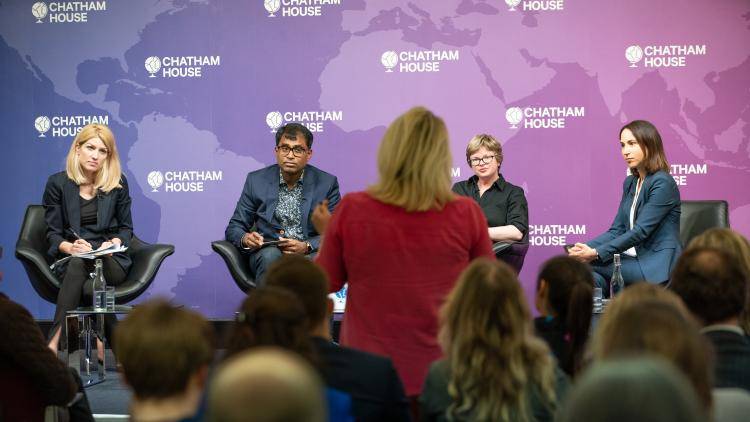
So, that’s what we’re going to discuss today, and to explore that, I’m joined by four exceptional panellists who each see the system from a different vantage point. First, our guest of honour, who – on whom this whole panel was built around, is Dr Jean Kaseya, Director General of the Africa CDC, who is leading Africa’s effort to build health sovereignty and regional manufacturing capacity for medicines. So, to my far left is Andrew Harmer, a Senior Lecturer in Global Health Policy at Queen Mary University London. So, he is an international relations expert, but also with global health policy expertise, so to bring the, kind of, geopolitics diplomacy angle to this, in addition.
On screen, you will see Jayasree Iyer. If you could raise your hand, Jay, to – thing. Yes, that’s Jay, and she is the Chief Executive Officer of the Access to Medicine Foundation. So, that is an independent outfit that is, basically, an accountability mechanism that grades the multinational pharmaceutical industry on what it does for LMICs, for access to medicine. So, they’re completely independent, a pharma industry watcher, and in the global heal – and how they behave in the global health space and what motivates and what interests them. And last, but not least, we have Dr Ngozi Erondu, who is a Chatham House Associate Fellow and Technical Director of the Global Institute for Disease Elimination in the United Arab Emirates.
So, thank you all for joining us. So, now we’re going to get started. Andrew, if I can – if I could start with you, who actually holds authority in this emerging system? I mean, for instance, states, institutions, markets, who has the authority with what’s emerging now?
Dr Andrew Harmer PhD
I think it’s a good question. It’s an interesting concept to think about in relation to AFGHS.
Emma Ross
AF – the America First Global Health Strategy?
Dr Andrew Harmer PhD
Yeah, let’s use the acronym ‘cause it’s way too long to mention now in full. Who has the authority? Well, it’s not me, I’m an Academic. Once upon a time, Academics did have some authority because – allegedly. You know, they spend a lot of time reading and writing about stuff and because of their expertise, people listen to them. The whole purpose of populism that’s coming out of the US at the moment is to undermine that sense of authority in knowledge and science. It’s fundamental and there are very good political reasons why the Trump administration is trying to do that. So, authority does not – or it’s trying to be undermined, you know, from my perspective, as people who hold knowledge. “Don’t listen to them, they’re elites and they’re not to be trusted,” but you’re asking at a broader level?
Emma Ross
Yeah, at a high le – political, let’s get all political.
Dr Andrew Harmer PhD
Yeah, so, I mean, authority is important because it implies there’s a reason. There’s a reason for an entity to have that authority, and it’s different from power. Power implies coercion and, you know, military capability. You don’t need a reason to do something if you’ve got power, but in order to have authority, you need to have a reason to do that. And it’s usually based on an agreement, a rules-based agreement. Everybody buys into it, and for that reason, you have the authority to make a decision, and I think that’s really important. It’s why international organisations have authority, and it’s why the most powerful sovereign state does not have authority, it has power. It doesn’t want authority to exist; it doesn’t want other organisations beyond it to be able to make decisions. And so, that’s – I guess, my simple answer to your question is international organisations, and ultimately, it’s because it rests on legitimacy, which we’ll come onto a bit later on, I think.
Emma Ross
Yeah, so I think that does follow on what I want to ask you, Dr Kaseya, which is, if the US and others are redefining their terms of engagement, how does that change the balance of legitimacy, as Andrew’s brought up legitimacy, and influence? And then, secondary to that is, where are the rulemaking spaces in global health today? I mean, are they at WHO, are they at WTO, regional agencies like you, corporate boardrooms?
Dr Jean Kaseya
Yeah, thank you. You know, we don’t like to talk about authority in Africa. We talk about legitimacy and we talking about influence. For us, legitimacy at a global level is sitting with the UN organisations, WHO, WTO, the UN Secretariat, when all of us, we are attending meetings, the – what we call the UN General Assembly. But, at a regional level, we are also making decisions for our countries. The African Union Assembly with Africa CDC, as you know now, we have the power to declare the public health emergency of content and security. But the influence, this is the main issue, the influence is sitting with bi or minilateral, you know, negotiations.
Emma Ross
Yeah, the minilats, yeah.
Dr Jean Kaseya
And it’s also sitting with, you know, this approach that some superpowers can have when they want to get, you know, what they want to get. This is why we are saying, in Africa, “We know what we want,” and I think we’ll discuss that when we talk about the America First Global Health Security.
Emma Ross
And has that change in the way they’re engaging, has that changed the balance of legitimacy and influence, or do you think it remains the same regardless of what this strategy or these changing – the rules of engagement in aid…?
Dr Jean Kaseya
If you are asking this question to an African leader who had to fight COVID, mpox and all other outbreaks, we say we learnt from that. Today, we are building our own institutions because there is a trust issue between Africans and others, and we want – if we – others, they want us to continue to work together, we need to sit. This is why my leaders – you saw President Ruto, Kagame, Ramaphosa and others talking about how to reform the global architecture, not only health, even financial architecture, everything. We need and we have our place, we’re what you can say.
Emma Ross
So, are you saying that the real rulemaking spaces in global health today are moving regional? You’re talking about making your own rules, do you think, you know, relative to WHO or TRIP, you know, WTO or corporate boardrooms, are you saying that’s where the rulemaking spaces are now?
Dr Jean Kaseya
Emma, you are pushing me now to talk about the new vision that Africa has.
Emma Ross
I’m going to ask you in a minute. Okay, let’s park that, let’s park that. I’m going to ask Ngozi, which rules really matter now? So, if we’re talking about the rules of the game, so which rules matter and which rules don’t really matter right now?
Dr Ngozi Erondu
Yeah, thanks, Emma. I think when we’re talking about rules, it’s thinking about types of rules, but also who is writing the rules? You know, there’s formal rules, like the WHO Pandemic Accord and the revised international health regulations, and they still matter. They represent, you know, this – they represent post-COVID-19, a, kind of, multilateral reform and co-operation, but as we can see, and as you started in your introduction, these are being sidestepped by organisa – or by countries like the US, but also by the EU, as well. So, while they – you know, they’re on paper, and a lot of countries are still collaborating and co-ordinating and trying to follow these formal rules, we know they can be sidestepped.
I think what is heavier is actually the functional rules because they really, kind of, shape the outcome. So, when we think of IMF, World Bank, you know, they don’t decide health budgets directly, but their, you know, their deficit targets, spending ceilings, debt sustainability analysis, like, they define fiscal boundaries for health investments. And so, while regions like Africa are looking towards the Lusaka Agenda, and a lot of the Global South, and they’re looking at how they can, you know, respond to this call for, you know, strengthening primary healthcare and having more domestic resource mobilisation, they don’t have the fiscal space to do so.
So, it matters, you know, that these rules, these debt – the way debt is structured, it matters when, you know, so many countries around the world, I think about 40% of countries around the world are spending more in debt service payments than they are to – than they are in their health budgets. So, those rules matter. TRIPS and the WTO still matter when we’re thinking of local manufacturing, and how these agreements continue to shape who can manufacture and trade essential medicines and health technologies.
And, you know, one thing or one player that we often don’t talk about in all of these forums are philanthropic organisations, high net worth individuals who provide funds. In 2023, the OECD estimated that almost $12 billion in development grants came from just 32 major foundations. So, they’re writing rules, as well, right? They’re shaping what is a global health problem? Wha – how do we set agendas? And sometimes this is in alignment with WHO, and sometimes this is in alignment with country priorities, but oftentimes it’s not.
So, I think we have a lot of players and a lot of rules that have historically and continue to shape global health. And for me, you know, my piece that you mentioned, when I’m really speaking to African leaders, African Governments, about – you know, it’s not just about receiving this American First strategy, it’s about how you respond. So, it’s not really just about, you know, which rules matter, but it’s also about how – who these rules serve. Most of these rules that were written were not written for countries that didn’t even have independence when a lot of these, kind of – the UN and different organisations and institutions were developed.
So, I think, you know, it’s really important for Africa and the wider Global South to scrutinise, collaborate with, in some cases, but sometimes push back, forcefully even, on these rules and on these players, because we have – if we are going to have any type of reimagining of the global health space, I think we have to rewrite a lot of rules together.
Emma Ross
Jay, the private sectors, Big Pharma, are they rulemakers? Are they rule followers? Where do they – do they fit into this part of the discussion at all? Or I can come to you later, but I just – you are nodding, and I see that maybe you have something to say about how Big Pharma fits into this.
Jayasree Iyer
Yeah, I mean, rulemaking is fragmented, as the others have spoken about. Rules are enforced locally; they’re also enforced in corporate boardrooms. So, I do want to add a reflection that, you know, markets define the level of action on access to healthcare a lot. Those who can and are willing to pay, and have a large enough and secure market, get the goods and influence global access and, at the end, they can influence and negotiate with large firms more than smaller nations, right? And so, the power of institutional investors who invest in the industries that make these rules matter a lot in how rules are actually enforced. So, it’s really important, in my view, that in healthcare, equity and access to global health is actually baked in how organisations’ mandates go about, right? So…
Emma Ross
You’re frozen. Frozen, I don’t think that’s coming back. So, I’m going to go to how this all plays out in practice, and Dr Kaseya, we’re dying to hear, you know, the African vision…
Jayasree Iyer
The attention to the…
Emma Ross
…so how is Africa reading this turbulent moment, and what’s its strategic response? What are you going to do?
Dr Jean Kaseya
For us, we see this is an opportunity. We are not crying anymore, and you saw we organised a meeting of Head of State in September in New York. We said, “What is the clear vision you want us to follow?” After COVID, we are talking about the new public health order. It was mostly a reaction to something, COVID. “Now, where do you want us to be? What will be your legacy for your grandchildren?” Then we say, “Let us talk about Africa, health, security, and sovereignty.” For those who are following me today, this is what will be out in The Lancet on Monday.
This vision is around five major pillars. First, PPPR, pandemic preparedness and response, this is our DNA. The second one is health financing, sustainable health financing, local manufacturing, and African Pooled Procurement Mechanism, because we are creating the market. The fourth one is the digital agenda, and the last one is the reform of the global health architecture, because we believe we are not invited, we are actors of this global health architecture and our voice is important. This is why we say this new vision will be translated into the financial implication of the Africa health, security and sovereignty. You will see when we’ll implement that, we’ll don’t need the ODA as we are receiving in the past, because we are addressing the inefficiencies of the African health system.
Emma Ross
Okay, it sounds – I would imagine your vision has been a little while in the making, right? There’s a lot that’s changed and transpired over the last few weeks. So, with – you know, to what extent did you already take into account this shifting donor priorities? So, what I want to know is, how do you intend to realise the vision in the midst of these shifting donor priorities and assert genuine agency? So, you’ve described the topics and the areas of priority, but how are you going to navigate what’s going on right now? And I guess if you don’t need any ODA, it doesn’t matter what donors do, right? But there are deals being made, MoUs being signed, that ha – se – would appear to have an impact, particularly on your manufacturing ambitions. How are you going to navigate this?
Dr Jean Kaseya
No. Get me well, we are not saying that Africa doesn’t need solidarity and ODA…
Emma Ross
Yeah.
Dr Jean Kaseya
…but we are saying Africa cannot continue to be dependent.
Emma Ross
Sure.
Dr Jean Kaseya
But also, let me correct something. Mostly from Western countries when people are talking, they think that ODA is the first source of [inaudible – 21:32] in Africa. No.
Emma Ross
No.
Dr Jean Kaseya
It’s the out of pocket. It means poor people paying to get access to healthcare. In some countries, I will not name countries because I’m also a political person, in some countries, it’s even 70%. It means…
Emma Ross
Hmmm hmm.
Dr Jean Kaseya
…poor people paying for 70%, ODA, government and others are coming for 30%. It’s not ODA that will correct that.
Emma Ross
Yeah.
Dr Jean Kaseya
It’s putting in place a community-based health insurance scheme supported by, you know, all of these – addressing all of these inefficiencies.
Emma Ross
So, that’s an Africa CDC vision, but how much buy-in have you got from the countries? That is a domestic politics thing, country by country. Are they willing to do that?
Dr Jean Kaseya
Africa CDC is a Pan-African organisation led by Head of State. It’s Head of – it’s an African organ so Head of State they are make…
Emma Ross
They signed up to it?
Dr Jean Kaseya
They are making decisions, they say, “This is our new vision.”
Emma Ross
Okay.
Dr Jean Kaseya
And what we are saying, you know, let me be honest and blunt, maybe, partners can make their decisions, they can change the priorities. Today, for some specific issues, they say, “We need to bring money for defence, we need to bring money for” – but us in Africa, we have also our priorities, and we are saying, “This vision that we have is led by our priorities.” We’ll continue with multilateralism because we believe on that, we’ll continue with solidarity because we believe on that, but we need first to ask ourselves, where are we going? What are we fixing? Before asking others to come. Today, you can put $200 billion in Africa, if we don’t fix inefficiencies, after five years, nothing will happen.
Emma Ross
Yeah, I see Jay nodding there. Ngozi, I want to ask you, with all of these bilateral – with major powers acting bilaterally, more so than multilaterally now, how do you think Africa can shape the rules, rather than be shaped by them? So – and what do you think of Dr Kaseya’s vision, and can we put some political reality in there? I mean, fair enough if you think – where do you think this is going and the challenges that may lie ahead?
Dr Ngozi Erondu
Yes, Emma, your voice sounds so full of, kind of, doubt and scepticism, and I can understand that, but also, I think that, yeah, I agree with Dr Kaseya, I think that there is a lot of opportunity for Africa to reclaim its agency. You know, it’s definitely an uncertain moment, but I’ve always believed, and I still believe, that global health has not – has never been charity. You know, aid has always been soft power, and we all know this, right? And, you know, I’ve talked about in the past how many of us have had careers shaped in low and middle-income countries, and we know that so much of aid stays in the countries that actually provide it, you know, with technical assistance and whatnot. So, I think it’s really important that Africa looks at this – at the America First strategy as a negotiation, right?
I think it’s important that they, kind of, set rules about, you know, how to bring in technical experts. I think that civil society and affected communities still need to be part of these conversations and set these rules, and I think that there’s an opportunity to build inflexibility into these agreements. You know, I think one of the challenging things when we’re talking about local manufacturing is that there’s still a very long way to go, right? There’s infrastructure that needs to be developed; there’s workforce that needs to be trained. And so, you know, while the America First strategy is really clear about countries having to buy US-made products and how – and that seems like it can be very disruptive, that it can really just – that the future doesn’t look like African-made products will even exist or be able to be sold in the market because they’ll be competing against, you know, more – a well-established, a probably superior, in some ways, US product, depending on, you know, what we’re talking about.
But I think that African countries, with the leadership of Africa CDC, could really look at, you know, maybe starting with US-made products in this time where we’re building up local manufacturing, but also including sunset clauses that transition procurement to local products, you know, for – we’re thinking about tests and vaccines and drugs. These things can be built into contracts, and governments can also insist that new partnerships explicitly reference national strategies, and I think this is really, really important. Global health – you know, I – and Professor, I think, Harmer, at the beginning was talking about how Academics used to be an important group, an impor – the expertise mattered. You know, just a couple of years ago – global health did not start when the recent administration started, it started many, many years ago, and a lot of – while a lot of challenges are still part of global health, a lot of progress has been really established throughout the world.
And so, we can’t just ignore, you know, health security plans, vaccination roadmaps, maternal health strategies, we can’t ignore all of these that already exist, that countries are already using. So, I think it’s really important that countries insist on these national plans to be respected and reflected in the new negotiations or in the new contracts that we’re seeing, or the MoUs, as well.
And then finally, Emily Bass, the global health Author, she talks a lot about “rewriting metrics.” I’m hearing that the America First strategy, there’s a lot of vagueness in the metrics, and, again, these metrics for many diseases, most diseases, they already exist. I think it’s really important to – you know, indicators really are what we use to tell the story. So, when you’re talking about, “Oh, Africa had a chance, Africa had an opportunity to, kind of, reshape global health,” if you have poor indicators, vague indicators, it’s going to be much easier to define failure than to define success.
So, I think it’s really important that we invest more in the robust national health information systems and really have accountable measures in place to document what is happening. Including, you know, failures of, you know, being forced American – and it’s not just America, the EU is, kind of, quietly doing this, as well, but strategies and targets, as well. When those don’t work, we need to be able to capture that and articulate it very well.
Emma Ross
So, Andrew, I wanted to ask you in what you’re thinking, what Ngozi is saying about how, from a political standpoint, how realistic is it, or what do you think – do you think that is going to be quite straightforward or a bit challenging to achieve that, say, use it as a negotiation and maybe turn the tables? How realistic – what are you – what’s your take on how this all might play out?
Dr Andrew Harmer PhD
To what’s realistic, is…?
Emma Ross
Well, as far as, in the beginning, take American products…
Dr Andrew Harmer PhD
Hmmm hmm.
Emma Ross
…to start with, and then maybe Africa can sell its products to America, or turn the tables, or be weaned off that, and to look at these deals as a negotiation. How much negotiation space do you think there is?
Dr Andrew Harmer PhD
It depends really on how dependent, I guess, one country is to another, as to whether or not they have any negotiation ability or not. I mean, if you know that there’s a lot of money riding on it, and if you don’t, basically, conform, then, you know, you’re not going to meek – meet the – you’re not going to meet the targets or the progress. I mean, this is all described in the…
Emma Ross
Yeah.
Dr Andrew Harmer PhD
…AFGHS. You know, performance metrics are very important, and if you don’t do what the United States wants you to do, as described in the bilateral agreement, you’re not going to get any more money. So, I think it’s – I think we’re be – I think there’s a very real risk of being naive here about who is in control, and I think that the United States doesn’t particularly want independence, it wants to be in the driving seat, and it wants its bilateral agreements to reflect its interests, its innovations, its products, and it doesn’t want any competition. It wants to tie this into this bilateral agreement, and I think you’re very danger of letting the fox into the hen house.
Emma Ross
Dr Kaseya, do you – what do you think, can Africa CDC play a role in mediating that, or are you talking about a bilateral agreement with the US and Africa CDC? Is that considered a bilateral? Where do you fit in to moderate them picking off country by country to go like that? What does – where do you come in?
Dr Jean Kaseya
Let me first share with colleagues that in March 2025, I flew to Washington. I met all US agencies at the State Department. I told them, “The old model of US, we don’t want to see that again in Africa,” much, I told them, “We want you to start to provide funding directly to countries and to request countries to start to co-finance.” Because…
Emma Ross
Which they have.
Dr Jean Kaseya
…the way to be out of dependency is to start to contribute.
Emma Ross
Hmmm hmm.
Dr Jean Kaseya
This is why you saw me clearly saying we are supporting, I said that, America First Global Health Strategy, because they were coming to give money to countries and to request countries, and Africa CDC was part of the discussions, I’m discussing with the high-level people in the US about it. But let me also be clear, we are supporting our local manufacturing agenda.
The second one, Africa is a partner of all continents and all countries, and the third one, yes, the philosophy is we are coming for the Compact, but this Compact will not just be for the US.
Emma Ross
Hmmm.
Dr Jean Kaseya
This Compact must be the integrated and well-costed plan at country level that will be shared with all partners, that will get domestic resources contribution from partners with a clear way to move forward, and I think this is our way to see things. To respond to your question, if we are part of that, you know what I’m saying to my countries? We’ll regionalise the bilateral agreement.
Emma Ross
Okay.
Dr Jean Kaseya
That this…
Emma Ross
You will do it.
Dr Jean Kaseya
…concept will regionalise the bilateral concept, what it means. After this first round of TRIPS, I will call for a meeting of all Ministers. I already called for a meeting three weeks ago, 16 countries. We discussed…
Emma Ross
So, you…
Dr Jean Kaseya
We had a meeting, we discussed. Now, I will call for another meeting to have a, kind of, debriefing from countries, and to discuss where they think there is maybe an issue, where they think there could be progress, and will continue. It’s our mandate as Africa CDC to support our countries, irrespective of partners or donors.
Emma Ross
And is that – part of that discussion to make sure that – well, to the extent that it’s in their interest, to sing from the same sheet so that they can’t be divide and conquer? Is that a part of it, or that’s not what you’re talking about?
Dr Jean Kaseya
What we want – you know, currently countries are negotiating individually.
Emma Ross
Individually.
Dr Jean Kaseya
They don’t know what was the discussion. Tomorrow I’m – I will be in Nigeria, I will meet Pate, he will debrief me on how it went. After Nigeria I will go to another country. But now we’ll put all of them together, “Tell us how was the discussion.”
Emma Ross
Yeah.
Dr Jean Kaseya
What are you getting from there? What are your fears?
Emma Ross
Yeah.
Dr Jean Kaseya
What do you think we as…?”
Emma Ross
Better to share that info, right.
Dr Jean Kaseya
“We can” – yes.
Emma Ross
Yeah, totally.
Dr Jean Kaseya
This is why I say…
Emma Ross
‘Cause you’re not going to reach…
Dr Jean Kaseya
…we will regionalise the bilateral.
Emma Ross
Okay, great. So, Jay, I want to bring you in here about how is Big Pharma interpreting the shifting geopolitical and the funding environment, and Africa – African – Africa CDC’s pharmaceutical manufacturing drive gaining momentum? I mean, how does pharma see it? Do they see that as a threat to their interests, an opportunity, or, you know, where are they going to play in this space? What does it mean for them?
Jayasree Iyer
Yeah, happy to answer this and hope my connection is stable. Give me a signal if it is. Yes? Okay, so most of the initiatives that the industry has been working on has historically been driven by areas where donor fund [audio cuts out – 35:32] is available across partner organisations, right? So, LMICs are then sustained. So, pharma companies look for stable and secure programmes and deals. So, recently, many companies have left the African market, consolidated their operations, several work with distributors, but since they see many gaps, we’re seeing some momentum in strengthening local production and building more resilient supply chains in the industry.
Last week, there’s a number of announcement, Sanofi working with MARBIO for vaccine production for seven different diseases. An MoU in Nigeria with Chromedix and Bayer for tech transfer, for contraceptives, and reinforcements on, you know, products for schistosomiasis working with universal corporations. So, pharma is interested, slowly, but you can see more and more companies engaging in some of the tech transfer agreements, but realise, at the end, the industry tends to be more conservative when there is pressure in major markets.
So, the level of innovation to reach patients in LMICs, the level of risk that they take, even the amount of discounts that they will be willing to give, will be impacted. And, at the end, you know, pharmaceutical companies and shareholders, you know, will themselves be put under the magnifying glass if currently they speak or invest in diversity or equity or ESG matters. So, there’s – you know, what’s happening right now is extremely bad for the pharmaceutical sector, but it also makes the industry very, very conservative in how they’re willing to play, but a few are playing and a few are not.
Emma Ross
And Dr Kaseya, do you need Big Pharma to realise your continental manufacturing ambitions or do you see them as competition? You know, what’s the relationship there that’s necessary?
Dr Jean Kaseya
You know, when I’m discussing with CEOs of Big Pharma, they are telling me two issues. The first one, the regulatory aspect, they don’t want to go to negotiate with each country, you know. And the second one, they were talking about market. We took them to listen, we went back to our Head of State, they created the African Medicine Agency. That is the continental body for the regulatory aspect. It means when we have a product, you don’t have to register that 54 times, you register that once, it will be used in Africa.
The second one, we created the African Pooled Procurement Mechanism. I’m telling them, “This is a market of 1.4 billion people, this is a market that in the next ten/15 years will be $240 billion,” and I’m telling them, “Take the opportunity to come to invest in Africa.” We are seeing so many people coming. I am – I’m in total disagreement when people say the local manufacturing in Africa is not flying, it’s not true. We have four – 547 manufacturers in Africa, and if we compare with a country like India, they have 10,000 manufacturers. It means we still have a way to grow in our local manufacturers, but we already started.
Now we are supporting countries, we had agreement with countries to supply them with African products. A country like Egypt, 97% for antibiotics they are using is coming from Egypt. Now we are taking these antibiotics to send that to other countries using the African Pooled Procurement Mechanism. Things are moving, maybe quietly, but things are moving. And we say clearly, now we have some Big Pharma,” I will not name them because we are also linked by the non-disclosure agreement, “coming to invest in Africa and making this progress in terms of local manufacturing because they see the progress we are making. I think we are so positive.
Emma Ross
Okay. Ngozi, did you want to come in on that, or should we…
Dr Ngozi Erondu
If I can…
Emma Ross
…move on?
Dr Ngozi Erondu
…come in quickly. It was on that – I can come in on that, but also something that was said earlier, but I do appreciate the Director’s remarks about, you know, we’re not starting from scratch, that there is capacity in the country. Africa CDC did a really good job of, kind of, mapping out where there’s capacity and which capacity exists. So, I think, again, we’re not starting from scratch and so it’s good to hear those remarks. But I also wanted to, kind of, go back to the Professor’s remarks about just, you know, the naiveite of insisting on, kind of, African countries approaching this as a negotiation. Of course, Africa is not a monolith, but, you know, there are some countries that will have a lot more leverage, opportunity, power to walk away, and there are other partners.
You know, I talked earlier about philanthropies, but there’s also – there’s China, and that’s a big threat to the US. And, you know, when this – when it really comes down to it, this is a strategy that is about commercial diplomacy, and Africa has commercial diplomacy, as well, they can use that, as well. They can deliberately pursue this approach by looking at, like, how it expands its economic alliances, whether it be with China, whether it be with other countries, but it could also look at south to south.
You know, Director Kaseya just talked about India, but – which is an example of a great partner, but there’s also Indonesia, there’s also Cuba. I mean, there’s other ways to do this, we don’t have to do it the same way. And every time people push back and try to do something different, when – you know, especially in the face of a Goliath like the US, it often is – it often does seem, like, naive. I think, you know, a few years ago, it would have been naive to believe that President Trump could be President of the US, but he is. So, I think that that’s why I really do insist that we do not look at this as a fait accompli. Like, there is a lot of opportunity, a lot of space to change, you know, the future. We don’t have to, kind of, accept things how it is. Thanks.
Emma Ross
Okay, thanks for that segue. I want to zero back out to, you know, the rulemaking, and go to Andrew now on what you think – and I want to hear from all of you, briefly, before we go to audience Q&A, of what are the greatest obstacles to changing the way – you know, reforming global rulemaking, changing the way this works? Yes, there’s a choice, but what are going to be the obstacles? I mean, is sovereignty the obstacle, financing, intellectual property tensions, I don’t know, geopolitical rivalry? I mean, what would – what are going to be the barriers, the obstacles, and what would it take to overcome them? So, starting with Andrew, just a small question.
Dr Andrew Harmer PhD
Yeah, no, sure. I think there’s a couple of things. One is I just want to go back to we’re talking about emerging systems and, you know, we’re talking about, you know, potential for solidarity fracturing. Just to be clear, these things are not happening, we haven’t got there yet. We’re talking about them as if they are going to happen. We don’t have to have this emerging system, we don’t have to have these bilateral agreements, we don’t have to have a threat to multilateral orga – order. So, we need to be careful about how we talk about these things and we don’t talk a reality into existence. It is still possible to say no, right? And I really hope that we do say no and that countries do not go down this bilateral route, because it…
Emma Ross
Sorry, but they are. I’m not quite with you on it’s not a reality. So, what part of not a reality are we at? These MoUs are being negotiated, multilateralism, people are walking away.
Dr Andrew Harmer PhD
Right.
Emma Ross
So, what do you mean by saying we’re talking ourselves into a potential reality that we don’t have to have?
Dr Andrew Harmer PhD
I mean, presumably…
Emma Ross
I wonder if you could be a bit…
Dr Andrew Harmer PhD
…states still have agency and they can still say no. Multilateralism requires co-operation, it requires buy-in, and states can still do that. You know, people talk about the demise of the WHO. It doesn’t have to demise; it just requires some more funding. You know, states still have agency, and so we don’t need to talk ourselves into a reality that we don’t want.
The second thing I think was talking about the elephant in the room, and the elephant in the room is the United States. So, you’re asking about any obstacle…
Emma Ross
Hmmm hmm.
Dr Andrew Harmer PhD
…I think the United States is the biggest obstacle. It has no legitimacy to describe itself as the world’s global health leader. Its representatives are – have a level of ignorance which is staggering, they’re mendacious.
Emma Ross
All opinions are one’s own.
Dr Andrew Harmer PhD
This – these are all my opinions, but they need to be said because people are not saying these things, they’re not saying them bluntly. The administration cannot look after its own population, its health system is dysfunctional, so how dare the United States say that it is “the world’s health leader”? It’s not, and no other state would want to emulate that health system. Its foreign policy is disgraceful. It has murdered and killed its way through the 20th century and is doing the same in the 21st century. Its multinational corporations are contributing to an obesity emi – epidemic to the extent that by the mid-century, 100% of Americans will be obese.
So, there is no legitimacy underpinning the United States’ claims in the AFGHS. So, if you want to know what I think is the biggest obstacle, look there, because it’s as plain as plain can be, it’s now in writing and we need to resist it.
Emma Ross
Dr Kaseya, what do you think the greatest obstacles are to reforming global rulemaking? So, I guess, to turning the vision that you have, that Africa CDC has, what are going to be the biggest obstacles to changing the way things work?
Dr Jean Kaseya
Two words.
Emma Ross
Two words?
Dr Jean Kaseya
Country sovereignty. This is the main obstacle. Why we are saying that? Now we are used to hear from some superpowers, “If this one is not my interest, I will react.”
Emma Ross
Hmmm hmm.
Dr Jean Kaseya
In Africa, we have also to talk about our interests. The response to this threat to multeral – multilateralism becomes the country’s sovereignty only. Because, you know, multilateralism means I have my sovereignty, but I take part of that to bring others to work together, but if I take back…
Emma Ross
Are you talking nationalism? Do you mean nationalism, is that really…?
Dr Jean Kaseya
Yes, nationalism, but, you know, I like to be more diplomatic and political.
Emma Ross
Yeah, well, I have to get you to be clear, ‘cause…
Dr Jean Kaseya
Because if I use the term ‘nationalism’, you know, it refers to some concept, you know.
Emma Ross
Selfish national interest over…
Dr Jean Kaseya
Okay. Let us go…
Emma Ross
…greater good, is that what you mean?
Dr Jean Kaseya
Yes.
Emma Ross
Okay.
Dr Jean Kaseya
And that one is the main issue that we have today.
Emma Ross
Yeah.
Dr Jean Kaseya
Look, when we negotiated the pandemic agreement, the international health regulation, we are together, but now we see countries divided, each of them want to do what they think is important and on their best interests. Andrew made it on – as he made it, but I think what we in Africa, we are clearly saying, how are we contributing to this negotiation, discussions that we have at global level? This is why we are requesting the reform of the global architecture.
Emma Ross
Okay, I’m going to open it up to all of you. We have quite a few questions online, but I’ll go to the room first and then I’ll take one online. Let’s take three questions to start with and see how we go. Any questions? Oh, one here, one there, and then one online, and then we’ll do next round. So, please say who you are and please make sure it’s a question, not a comment.
Henry Scarlett
Thank you. Henry Scarlett from Russell Reynolds Associates. I guess it’s a question for the whole panel and thank you to you all. I’d just be interested to hear how optimistic members of the panel are that LMICs can create more fiscal space for domestic funding of health.
Emma Ross
Okay, thanks. I’d like to ask Dr Ngozi to be the first to do that, so I don’t forget those on online.
Dr Ngozi Erondu
Emma, could you just…
Emma Ross
And then Dr Kaseya.
Dr Ngozi Erondu
…repeat the question, ‘cause I only heard the last part?
Emma Ross
How much fiscal space is there to – in Africa to be – to…?
Henry Scarlett
For domestic financing.
Emma Ross
Oh, for domestic financing for health.
Dr Ngozi Erondu
Right, hmmm, yeah, thank you for the question. Not much. I think Director Kaseya probably has the stats better than I do, but I think about 40 countries in Africa are, you know, spending more servicing debt than they can on their health budgets. You know, we all know about the Abuja Declaration, we know about all these targets to increase health spending, but it’s very difficult. Especially, you know, there was already challenges of debt across Africa, but COVID-19 made it a lot worse. And then there’s all types of, you know, relationships and, you know, infrastructure building, and that is also continuing to take up a lot of the space in African budgets to go towards health.
So, I think that, you know, we have to have, kind of, some creative solutions. A lot of innovative financing approaches have been – are being talked about, like debt swaps. There’s regional mechanisms, like Director Kaseya talked about, like the African Pooled Procurement Mechanism. There’s a lot of, kind of, different ways that we need to work together in order to provide Africans with the heal – affordable, actually free at the point of care, health that they need.
But I think that all of this doesn’t change much if these debt agreements do not change. I think a lot about, like, post-World War II and how Germany, I think, had half of their debts forgiven. Korea and Japan, in order for them to develop their infrastructure, debt repayments were put on hold. Some of these agreements, as far – as well as, you know, what Mia Mottley talks about, about just changing these rules and restructuring how Africa and other low and middle-income countries have to repay their debts, this needs to be seriously not just talked about, but acted upon. We’ve been talking about this for a long time. But it’s not just about changing that ecosystem, it’s about African countries also putting plans together, working with private individuals and developing a tax basis. You know, there’s a lot of structural reforms that need to be done in order to really provide the help that Africans need.
Emma Ross
Okay, I’ll just ask Dr Kaseya to come in, ‘cause that’s really in your bailiwick, but then we’ll go to the next question, ‘cause we want to fit in…
Dr Jean Kaseya
This one is the fundamental one but let me convince you. You have three main sources of health expenditure in Africa, out of pocket from 30 to 70%, it’s huge. Then you have ODA, from 20 to 40%, then you have the…
Emma Ross
Government.
Dr Jean Kaseya
…domestic resources, between five to 15%, but the average is 7%. Take that in mind. But when you go, you start to do a, kind of, diagnosis of what is going on in Africa, where money, the domestic fund, the budget is going. 55% for health salaries, salary for health workers, around 25% for commodities. But when we talk about human resources, the 55%, you know, the concept of ghost workers in Africa, people who don’t exist, there are studies in DRC, this is a low middle-income – a low income country, in DRC, we have studies showing that even 42% of human resources are ghost workers. And there is a report saying that this country is losing $800 million annually on ghost workers.
Emma Ross
Ghost workers?
Dr Jean Kaseya
Ghost workers.
Emma Ross
So, fake, non-existent?
Dr Jean Kaseya
Non-existent. The second one…
Emma Ross
Corruption.
Dr Jean Kaseya
…procurement. You saw what’s happened in Botswana, even the President declared a state of emergency. Middlemen requesting ten times the price of commodities, and corruption in the – this area represent around 40%. There is a report, I’m giving you fact, there is a report from SADC, if they do Pooled Procurement Mechanism, they are saving between 50 to 80%.
Emma Ross
Hmmm.
Dr Jean Kaseya
These are what we call inefficiencies. Before dreaming about other issues, let us address inefficiencies. Another inefficiency, if you ask one Minister, one African Minister, “How much do you need at annual basis for your health system?” And you have an accurate response, please come to me. Because…
Emma Ross
Yeah.
Dr Jean Kaseya
…countries have different strategic plans. If you ask them, “How much do you need for Global Fund?” They will give you, for Gavi, they will give you, but ask them for the entire health system, you don’t have an answer. We conducted a study that is showing that just having an integrated, well-costed plan is saving 25%. Now, if you ask me, “Where do you think you will start?” The answer is clear, I will not start to run to request ODA, I will start by fixing the inefficiencies of my system. First, make sure that all countries they have a integrated plan, well-costed. Second, make sure that we have the Pooled Procurement Mechanism. This is why we launched the African Pooled Procurement Mechanism, to save around 35%. Second, to digitalise the system, to cut the ghost workers. In Rwanda when they did it, they had result.
And, also, what is critical for us in Africa is to think how to align external resources under the Lusaka Agenda. You know, we cannot accept again to see donors coming and imposing without even following the vision of the government. You know, today, I’m not saying things to please people, I’m saying things with full responsibility of an African leader. And I say it clearly, I was in G20 last week, yesterday I met the UK senior officials, Ministers, I told them, “What we need is to work together to fix inefficiencies in the system, then Africa will move on.”
Emma Ross
That’s quite elegant and rousing on that. I’m going to take one from the floor and then read out one from online and see how we go. Where did I say? Oh, where did – we had a man? We’ll go here. Sorry, just for a bit of balance. Please say who you are.
Belinda Ngongo
My name is Belinda Ngongo, and I’ve worked a lot in the private sector. I’ve actually worked with – very close with Africa CDC. So, Dr Kaseya, as the leader of Africa CDC, what are some of the two concrete action you invite local NGOs, private sector, and I think private sector beyond pharma, ‘cause people talk about pharma, but there’s biotech, medtech and others, and also local institution, in the next, let’s say, si – three to six months as you’re shaping this new global health architecture? Thanks.
Emma Ross
Thank you, that’s one question, and the second question I want to add is from Simon Rushton, who is an International Relations Academic. “Some people here have – some people have talked about the end of the liberal international order as being the end of hypocrisy. How far do the panellists think the America First Global Health Strategy is a genuine departure from how global health politics previously worked, or is it just the self-interest and quid pro quos are now being more explicitly stated than they were before?” So, is it an actual genuine departure or have we just outed what’s been going on, rumbling around in the background?
So, I don’t know. Dr Kaseya, do you – actually, Jay has to leave us quite soon. Is there anything you want to come on, maybe on the second question? The first question was directed particularly Dr Kaseya. So, how genuine is – a departure is the America First strategy? Or, Jay, you’ve seen, especially from the pharmaceutical angle of what’s been going on anyway way before this. So, anything you want to add on that before you have to leave us?
Jayasree Iyer
Yeah, I mean, I think at the end of it, you know, the critical thing is that we need to find a way to balance sovereignty and solidarity, right? I mean, it’s fair that countries end up protecting their citizens and assets, but at the end, that may end up blocking equity and solidarity globally. So – and industry needs to, sort of, respond and play, and they only play when markets are stable, when there’s a co-ordinated procurement system in place, and, you know, I think some of that regulatory harmonisation activities there is really key there, in that sense. So, you know, at the end, I think we want to make sure that access, global health equity, is really baked into corporations, to organisations, and I think that’s the key to making things right at the end.
Emma Ross
So, I’ll go to Andrew, ‘cause this seems most squarely in yours, and then Dr Kaseya, on is this just unveiling what’s been going on anyway all along, or is this a genuine shift, the America First Global Health Strategy?
Dr Andrew Harmer PhD
Yes, thank you, Simon, for that question. I hope you’re enjoying the show. I mean, it’s blatant. You just – just, please just read the AFGHS document and you’ll see it. It’s – read – you don’t even have to read between the lines. Its third pillar is about American prosperity. It just wants to extract what it can get, and it wants to be…
Emma Ross
No, but it – so has America always wanted it…
Dr Andrew Harmer PhD
Yes, it has.
Emma Ross
…and now they’re being explicit, or have they decided…
Dr Andrew Harmer PhD
It…
Emma Ross
…to be like that now?
Dr Andrew Harmer PhD
No, it’s exactly – it’s worse because the liberal is dropping away. It’s not a liberal pursuit anymore, it’s a dictatorial pursuit, straight…
Emma Ross
So, is there a difference in how they’re act – going to act now than the way they did, or are they just outing themselves and there’s been no change, they’re just more honest about it? So, that’s…
Dr Andrew Harmer PhD
Oh, yes.
Emma Ross
…I think, what Simon’s asking you.
Dr Andrew Harmer PhD
I think, I mean, there’s no change in some respect, they’re still trying to do what they want to do. They don’t want other countries to be independent. They want to control countries so that they can extract their commodities. That is the main – and so that they can promote and strengthen their own corporations and products. It’s very clear in the document.
Emma Ross
So, it is going a step further than they have previously. I mean, I – Dr Kaseya, have – you know, before Trump and America First, do you remember American ODA being tied to, “Give me your minerals or don’t vote with China, otherwise you can’t have the money, or you’ve got to take our products?”
Dr Jean Kaseya
I will answer the initial question. Why I’m still supporting the vision, not the way it’s implemented now.
Emma Ross
Hmmm hmm.
Dr Jean Kaseya
You know, with what I said, I was looking for an opportunity for African countries to have one plan, and when we discussed with our American partners, they said, “We are listening and we are getting your message. Let us talk about Compact.” My dream is still, I like to be naive, my dream is still to see how we are using that as opportunity to have one plan at country level.
Emma Ross
Okay, but the question was are – is this just unveiling what they’ve been doing all along, or is this a genuine change in the way they’re engaging?
Dr Jean Kaseya
I will not use any of these words, I will just explain. Because for me, if we think countries they have an integrated plan, well-costed plan, it’s genius, because we don’t have. It’s a way to first mobilise more domestic resources on more sustainable way…
Emma Ross
Yeah.
Dr Jean Kaseya
…and also, to align external resources. If this is where we are moving, I will say de – I will say it’s genius. The way it’s implemented, as I said, I will wait…
Emma Ross
Genius or generous? You said ‘genius’?
Dr Jean Kaseya
No, genius.
Emma Ross
Genius.
Dr Jean Kaseya
I didn’t talk generous.
Emma Ross
Okay.
Dr Jean Kaseya
I’m using my own words, and so if countries, they think there are issues, as I said, I want to listen from countries, I will organise this meeting, then I’ll come back to Chatham House to discuss that. But the question that Belinda is asking, you know, in Africa, we cannot do – we cannot move on without communities. Everything start at community level and end at community level, and we are – we have a strong approach how to involve communities.
But regarding the private sector, it was a mistake, when I started my career 30 years ago, we are not talking about private sector in the health area. While we know that private sector is where money is sitting, where innovation is sitting, even the local manufacturing, if you go to a country like Singapore, the government is investing zero dollar for the local manufacturing. It’s coming from private sector. It means our role as Africa CDC, working for countries, is to create conducive environment for private sector to come to invest and to have a win-win. I think this is where we are moving at and I’m so proud to say that we have a lot of progress made in Africa, maybe we are not talking a lot about our progress, but we are making a lot of progress.
Emma Ross
Okay, thank you. Unfortunately, we’re out of time. There are quite a few more questions around, but maybe, I mean, I don’t want you to be mobbed, but I am saying if anyone has a chance to collar Dr Kaseya on his way out, you take your chances with that. I can’t say what would happen. But please join me in thanking all our panellists, Dr Ngozi online, Jay Iyer, who’s now left us, Andrew Harmer and Dr Kaseya. So, thank you very much for your insight.