Nina dos Santos
Well, ladies and gentlemen, thank you very much for being here promptly so that we can start on time. I know that some of our eminent guests have to leave sharply, within an hour, so I hope that we’re going to be able to cover a large amount of ground.
By way of introduction, my name is Nina dos Santos. I am a 20/25-year veteran Broadcaster, who for the last ten years, was an Anchor-woman at CNN and I also covered a lot of EU summits during my time, which gave me the chance to interview a fair few Prime Ministers. But very rarely do we ever get two on the same stage, in a panel this full, including a Government Minister from the United Kingdom, as well. And I think that speaks to the pull of this venerable institution, Chatham House, which has convened this crucial meeting on “The Western Balkans,” but also, the commitment of Dr Andi Hoxhaj of King’s College London, that is also supporting this event today. So, thank you very much to the team of Chatham House and also to King’s College London.
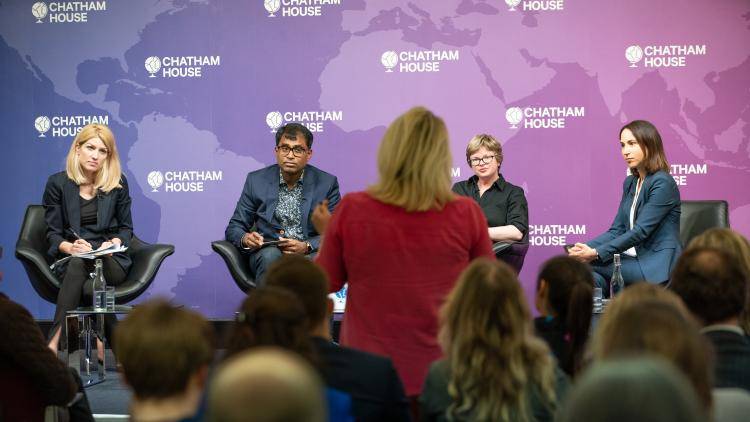
Without further ado, let me introduce our panel of eminent speakers. You may well rem – recognise quite a few of them. We have the Prime Minister of Montenegro, Milojko Spajić, with us. We also have, on my left here, the Prime Minister of Albania, Edi Rama. We have Natalie Sabanadze, who is the former Georgian Ambassador to the EU. She’s a Senior Fellow here at Chatham House at the moment. And we have Stephen Doughty, who is the UK Minister for Europe, North America and Overseas Territories. And last, but not least, we also have Dr Andi Hoxhaj, who I mentioned before, OBE, from King’s College London.
Just a little word about why we’re here today. Most of you are extremely interested in this field and will know more about it than Media Journalists like me, but we come together on the eve of the 11th edition of the Berlin Process Summit, which, of course, is going to be hosted here in the UK this week. So, it’s an exciting moment for shining a spotlight on the Western Balkans and also to take a health check on the situation vis-à-vis your relationship with the European Union, Prime Ministers, and where we head from here.
Prime Minister Spajić, let’s start with you, because you have a timeframe for joining the EU, which is a year earlier than Albania. What’s your assessment of Montenegro’s process towards that 2028 timeframe for EU accession? Is it on track?
Milojko Spajić
I think when – the first time when we announced that we were going to – we are gunning for closing all the chapters by end of 26, absolutely nobody believed us, and everybody thought that’s absolutely impossible, that’s not going to happen. And – but I think people are becoming less sceptical as the – as we deliver, as the things – you know, as the results pile up. So, I think it became a realistic goal, of course still very optimistic, but a completely realistic goal, and I think Albania’s goal, as well, for the – as a matter of fact, it became completely realistic, as well. Because Albania is progressing very fast and doing a very good job on European integration front, so I’m happy to see that and, you know, we are happy to see some other countries doing well and, like, trying their best.
And, you know, this is not really a competition, it’s not a zero-sum game. It’s, basically, that we are all going to have benefits from more people from the region joining EU, becoming part of the same club, having same values and being part of the single market. So, this is what it is. I think it’s very important that we, obviously, continue reforms. We see the European side, as well, is becoming more – increasingly focused on and to say so serious about Western Balkans really joining EU. So, we see some really tangible things happening in the region, which is really encouraging, and I’m, you know, I’m just hoping this – that it would – that it will continue in 2026, as well.
Nina dos Santos
Challenges?
Milojko Spajić
Obviously, a lot of challenges, but I mean, we are – you presented us as Prime Ministers, but, like, we are Prime Ministers of small countries. So, as the average city in the UK or, you know, the population size of, you know, half a million/600,000 and 2.8 million people, it’s, like – Albania’s still a lot larger, but, you know, still relatively small countries. And, you know, we have to stay humble and realistic, and obviously, as a small country, you are lacking people. You know, you’re – the public administration, you’re lacking HR pool, the capacities to overcome a lot of challenges, a lot of reforms that are necessary to pass and to be implemented in reality, right? So, this is absolutely the biggest challenge of small countries.
Secondly, obviously, I mean, the – there is geopolitics there, always. We know that not everybody is very happy about the fact that Montenegro, Albania and others are progressing fast towards the EU, and – you know, but obviously, they’ll be – this is normal thing, you know. Monte – Balkans was always of interest to big powers of different, you know, different conflicting interests, oftentimes. So, this is nothing new to us, but I’m very optimistic about – despite the challenges, we’re going to make it.
Nina dos Santos
Prime Minister Edi Rama, Albania has rapidly opened most EU chapters, but presumably there are still challenges that remain. Are you confident of your own target, as confident as…
Edi Rama
Listen…
Nina dos Santos
…somebody who’s aware…
Edi Rama
…we have…
Nina dos Santos
…of this?
Edi Rama
…a lot of challenges, but when we come to Britain, we feel better about our challenges, so…
Nina dos Santos
Why exactly is that?
Edi Rama
So – how do you mean, what exactly? Let – don’t bring me there now because we have, also, the Minister here, so he has enough pain. He doesn’t need more from us. No, we have challenges, of course we have challenges, but as I told you before entering the room, we are in a period where Europe is behaving very well with us. So, it’s difficult to have salty conversations. So, it’s – the risk to be boring is big and the risk to make all these young people feel like they are losing their time with us by listening to our platitudes, how Montenegro is doing great and how Albania is doing great, is big. So, what can I say is that overall, I believe, in this moment in time, we are doing better than Europe.
Nina dos Santos
Do you still have faith in the EU accession process, in the ultimate…?
Edi Rama
What do you mean I ‘still have faith’?
Nina dos Santos
Do you still – is it still an important goal for your country?
Edi Rama
Listen, we…
Nina dos Santos
Would it be transformative?
Edi Rama
I had faith when was nearly pathetic and ridiculous to have faith, but not just I. The very large majority of Albanians, more than 90% of them, they have faith in Europe and in the European Union membership. Because for us, that one is not anything else but exactly what it was for the Founding Fathers, so, to finally be in a place where we have choosen freely to be and where we are safe. So, this is, for us, a very firm belief, very firm conviction and whatever will take, we’ll be there fighting to be part of it.
Now, since the aggression of Ukraine, thanks to Vladimir Putin, Europe woke up big time and it’s not only saying how important it is geopolitically to get the Western Balkans inside, but it’s also doing its best to accelerate. So, we were there also before and we were working hard also before and we complied with the criterias to start negotiations also before, which was confirmed three times in a row by the European Commission, but we were refused. We were refused exactly because the words and the deeds were completely separate. Now Europe is fully in – on board and I hope it will continue to be so, so finally, we will achieve this goal, and we will realise this dream.
And then a new era, a new life, will start, with new challenges, of course. Challenges are always there and will never end, but at least we will overcome this incredible obstacle between us and ourselves, I say, because we belong there and we cannot stay out of that.
Nina dos Santos
Thank you very much. To the UK Minister, Stephen Doughty, obviously, the UK is hosting this Berlin Process Summit, which seems slightly odd, considering, ‘cause obviously, UK is no longer a member of the European Union. But as we just heard from the two Prime Ministers there, you know, the EU is still an objective, an important objective. What can the UK contribute to that discussion, why is it so important for the UK to have close relationships with the Western Balkans and what could be achieved this week?
Stephen Doughty MP
So, firstly, it’s a great pleasure to be with friends on the panel and also, NATO allies, and I think that in itself also shows that this is a much bigger process than just those two countries’ journeys towards the EU and whether the EU accepts and whether they choose to join is, of course, a matter for the EU and them. But Europe is larger than that, we have shared challenges, we have shared challenges on security, we have shared challenges on growth, we have shared challenges on tackling irregular migration, on dealing with serious and organised crime, on energy security, on wider peace and stability and indeed, on dealing with the influence of hostile states like Russia within our whole continent. And that’s why we wanted to host this process. It’s why we’re delighted to be doing so.
And I just came from the Foreign Minister’s part of the process in Hillsborough, in Northern Ireland, where we had truly excellent conversations, both on good neighbourly relations in the region, on peace and stability, but also on some of those other topics. And I think what I’ve felt through this process, and I’ve been along to many of the meetings over the past year a half, since I’ve become a Minister, is that it is a process of friends, it is a process of partners and it’s a process of common values and agendas, a Euro-Atlantic path, common agendas on peace and stability and security and common agendas on delivering for our citizens.
And what does this matter to the UK? Well, the Western Balkans has always mattered to the UK. We have had a unique historical role in the region, including, of course, in the 1990s and in some very, very difficult times. So, I think many British people feel deeply connected. I have members of my own family who served in the Armed Forces in the Western Balkans, but we have new challenges for the future, new opportunities, whether it’s in trade and connectivity. I think of my visit to Montenegro, where I saw incredible work going on between our law enforcement authorities on dealing with illicit smuggling into Europe, which is affecting all of us and affecting all of our countries. And the co-operation between our authorities on cracking down on those who want to do harm in both of our countries.
I think of the wonderful work we’ve done, Edi, with Albanian on a number of different topics, on growth, on migration, on so many other areas, and of course, I think of the diasporas. I think of the people who’ve chosen to make communities and homes in both countries, as well. So, I’m hugely proud of our relationship. I’m hugely proud that we’re hosting this summit and I think we’re going to come up with some really good outcomes.
Nina dos Santos
Thank you. Natalie Sabanadze, obviously as a former Georgian Ambassador to the EU, you’re privy to, you know, a really unique insight into the relationship between countries like yours, but also probably Moldova and Ukraine, which we need to talk about later on, that has aspirations to join the EU. What lessons do you think can be learnt for countries in that region from the Western Balkans’ accession targets and plans?
Natalie Sabanadze
Thank you, Nina. Since I’m no longer an Official, I think I can add some spice to the discussion. Enlargement and we see it on the example of the Western Balkans, consists of the interaction of two dimensions. One is the cri – technical criteria and this is what the two countries representing here are doing so well. They’re considered to be the frontrunners. It’s a funny word, but that’s widely used in Brussels. And then the second dimension, which is a political decision and a political will. Now, you can satisfy a criteria, and without satisfying criteria, there will not be a political decision. However, even if you do satisfy criteria, political decision is not guaranteed.
And I think it’s important to look what are the obstacles from the side of the European Union, why it has proven to be so difficult. Because this has been probably the most prolonged enlargement phase, in the case of the Western Balkans, and that has, you know, affected credibility of the enlargement process and also affected the popularity of the whole process. I think North Macedonia is probably the most striking example, where you have a real drop of support or belief that once this will be materialised. And I would highlight maybe three – there are many elements, but I would highlight three.
One is not just fatigue with enlargement, which is something that is very often referred to, but there is a degree of disappointment. Enlargement has been the most successful, or considered to be, you know, the most successful policy of the European Union. This is what allowed it to be the, kind of, normative, transformative power, but there has been growing disappointment with the results. We’ve seen some democratic backsliding among the member states and particularly at time of the height of immigration crisis, there was quite a lot of acrimony between the old and new members. And I think that marked that disappointment very clearly and affected the process.
Another is internal reform. You can’t enlarge without thinking what this would mean for the Union, and that goes beyond the famous unanimity question, which is not the same as consensus, by the way. Unanimity means that everybody has to agree, while consensus means that somebody does not have to disagree, but that is beyond that. How many Commissioners is there going to be in the Commission? How many portfolios? How the Union will be run, and finally, what it means for the domestic politics, as well. And there is a tendency, a rising populist, nationalist, many – nationalism is always there, but I wonder whether member states are actually making enough effort to make the idea of enlargement popular among the public. Because ultimately, this will require an okay at the popular level, and this is something that also needs to be addressed.
Nina dos Santos
Thank you very much. Let’s hear from our final panellist, Andi, as well. You’ve written a whole piece about this, a book, isn’t it, or a paper in particular, looking into the Berlin Process and potentially, what are your views on the shortcomings of the EU policy? Just bouncing off of what Natalie was saying, is it fatigue, is it frustration?
Dr Andi Hoxhaj OBE
Fatigue is for sure and it’s the political momentum and will. But in order to mitigate the process, or at least to offer the Western Balkans something, would make a lot of sense to give them access to the EU single market. And the best possible way, if we want to study how accession has worked so far, would be to give – once negotiation has started, to give them automatic access to the EU single market. It would allow for free trade between the candidate states, as well as the European Union, but more importantly, you will allow the institutions to start applying EU rules and legislation and not allow it, or, sort of, put the pressure once they become EU member state. So, that would really help to phase out some of the, sort of, integration process, and in particular, now that there is a lot of pressure, what’s happening with the European Union, that could really phase – some phases. So, Ukraine is looking at it similarly. What we see with Ukraine, for instance, they’re already doing that de facto, but why not offer that to the Western Balkans?
Once it come with the Berlin Process, when we look at some of the themes here, I personally would have liked to see more of an highlight on human rights issues, because when we talk about the Berlin Process and how Merkel started, that was one of the key component. And I think the UK missed the – an opportunity here because we have the 75th anniversary of the European Convention on Human Right on 4th November, and three – two out of the three political parties in the UK have already said that they want to get out of the European Convention on Human Right. So, it would have been good to see that be spotlighted, although the summit will take place tomorrow, so maybe we’ll have a look at the final declaration.
Nina dos Santos
Could I ask the Minister to respond to that?
Stephen Doughty MP
I would challenge that gently, because certainly particularly women’s rights and violence against and women and girls and sexual violence has been a key part of our Berlin Process discussions, as has been wider civil society. And in fact, we heard directly from civil society representatives and young people’s representatives, who had taken part in their own summits and brought their feedback directly to the Foreign Ministers at Hillsborough and have a seat round the table. So, I wanted to reassure you that human rights and civil society rights have absolutely been at the heart of the process.
Nina dos Santos
Let me start out by taking some questions from the audience, ‘cause I recognise we’ve got about half an hour left. Time is tight, but we will…
Edi Rama
And how – but how you plan these kind of things here in this place? Because last time I told you, when you invite people from the Balkans, you should have much more time, because we…
Nina dos Santos
Prime Minister, I understand…
Edi Rama
…have a lot…
Nina dos Santos
…you are the one who has to leave at three.
Edi Rama
…to say and we don’t like to be stopped when we talk. And now, you say we have half an hour. How is possible?
Nina dos Santos
Because I’m conscious that you have to leave at three, actually, sir.
Edi Rama
No, because you have planned like that. It’s not me, no, it’s…
Nina dos Santos
Well, let’s start up by taking some questions from the audience. Actually, I believe we do have, also, some questions from somebody who would like to answer a question firsthand. We’ll take about three at the same time, thank you.
Peter Grk
Okay, thank you very much. Peter Grk from Bled Strategic Forum. Let me try to put this diplomatically. Prime Minister Spajić, you said that there are some actors, some countries who are not very happy with the progress which was made by Montenegro and also Albania…
Milojko Spajić
Hmmm hmm.
Peter Grk
…towards European Union. We know about these countries from the East of Europe.
Milojko Spajić
Hmmm hmm.
Peter Grk
But probably there are also some countries in your neighbourhood who are not exactly joyous about how quickly Montenegro and also Albania are progressing towards European Union, and I think we all know who I’m talking about. So, between…
Edi Rama
Oh, we might know, say it, say it.
Peter Grk
Well, it’s a country north from Montenegro.
Edi Rama
Mongolia?
Peter Grk
So, basically, my question is, what do you think how this can influence your progress? Is it going to influence and if it is going, what are you going to do to mitigate the effects of this? And maybe the same question also to Prime Minister Rama, thank you.
Nina dos Santos
Please, Prime Ministers, ma…
Milojko Spajić
Thank you. I mean, you know, frankly, I would love everybody to be in the European Union. I would love everybody from the Western Balkans to be part of NATO, as well. You mentioned NATO. It’s a very important organisation that we are part of, do a lot of very important joint work that we do on a weekly basis. We – it – so, I think it’s – you know, for – that’s – I would like the Balkans to be its destiny, basically, that kind of direction and I’m sure we are going to get there sooner or later.
In terms of the – you know, it’s – some are happy or not happy, you know, you cannot make everybody happy in the world, you know. If you try to make everybody happy, you’re not going to achieve your goals and as Edi said, as well, you know, in Montenegro, in the most recent polls, I’ve seen 79% of Montenegrians want to join EU. And these – this is – these are the people that I am responsible towards, and this is what I care about, you know. Do I care about everybody’s else opinion? Yeah, that’s great, I can be polite, I can be, like British people are, very polite and, you know, smile on their remarks, but, you know, that’s their remarks, that’s their opinions. We’re going to live with these options, we’re going to survive that and that’s it, you know.
I’m – but I’m truly believing that whole Western Balkans at some point of time will be part of NATO and will be part of European Union. That’s – and that’s in the – our own interest, and I don’t think there are countries in the world as interested to see the whole region, in both NATO and EU, like two of us. We have skin in the game.
Nina dos Santos
Prime Minister Rama?
Edi Rama
No, listen, what Natalie said is something we have experienced ourselves in the sense that the process is binary. On one hand is fully technical and on the other hand is fully political. But one thing is very clear, you can – you cannot have any political support if you don’t fulfil the technicalities of the process in every stage, but you can fulfil all the technicalities in every stage and you can also face lack of political support. So, this is very clear. So – and this is what, practically, in a moment in time, made EU look like very big hypocrites vis-à-vis all of us, because what they were saying was not matched by the reality of facts and they were not delivering.
And they were not delivering because they are – because, you know, Europe is a patient with 27 Doctors. There were – they were 28, but one of the Doctors got mad and had to be – go to another cure, while the 27 have to fully agree 100%. And there – and we had, three times in a row, because of few – very few Doctors, that we were not allowed to take another step. If the – in this way, things have changed, because someone here, I don’t know who mentioned ‘frontrunners’, but I remember…
Nina dos Santos
It was Natalie.
Edi Rama
…that there were different frontrunners some years ago and Albania was nor a frontrunner or either a runner. So, now we are told to be frontrunners and I have – I tell in every occasion, “Please stop, get this word of out if,” because it fuels some resentment, you know…
Milojko Spajić
Yeah.
Edi Rama
…in others. It’s like, we’re – everyone does what has to do and then, some are in a better place in a moment in time, some are in a not so good place in a moment in time. But things change and every country should have the chance to improve and without being labelled frontrunner or backrunner, or whatever.
So, when it comes to the, you know, unhappiness, of course, you know, we are Balkans and without the jealousy, without the resentment about the other, without the, you know, the judgment of the other’s success, we would not be who we are. But the good news is that we are not alone anymore in this world, because once upon a time, we were the guys that were fighting and dividing and never, you know, finding ways to compromise within our countries and among our countries, but now it’s everywhere like this. So, now the Balkan club has become so big and the Balkanisation of British politics and of French politics and of, name it, is now fact.
So, it’s such a big and deep Balkanisation that we feel like the adults in the room, when we see how the others fight, you know, and how the others have different views, even about the boats. Some call them ‘small boats’, some call them ‘Brexit boats’ and one wonders why you left Europe. You left Europe because you wanted less boats, and you have more boats. You left Europe because you wanted more investment, you have less investment. You left Europe because you wanted more happiness, now you are depressed. So, you know, welcome to the Balkan club.
Nina dos Santos
Well, concretely, since you’ve raised that issue, even though we’re…
Edi Rama
‘Concretely’ what?
Nina dos Santos
Since we’re…
Edi Rama
What?
Nina dos Santos
…here to talk about EU – well, we were – we are here to talk about your path towards EU membership, but you raised it yourself here just now, are you somewhat frustration, Prime Minister Edi Rama…
Edi Rama
‘Frustrated’?
Nina dos Santos
…when you listen to – if you’d just let me finish – when you listen to the headlines here in the UK vis-à-vis Albania and…
Edi Rama
No, I am…
Nina dos Santos
…the role that your country could, is…
Edi Rama
Listen, I…
Nina dos Santos
…currently playing in the migration debate?
Edi Rama
Listen, I remember among many crazy, hilarious, stupid things that were said during the Brexit, or how you call – how it’s called, the leave?
Nina dos Santos
The referendum…
Edi Rama
The leave…
Nina dos Santos
…on leaving…
Edi Rama
…the leave referendum.
Nina dos Santos
…membership of…
Edi Rama
Leave referendum – was a poster with, kind of, very strange, scary birds that were coming from Albania to suck the blood of Britain. And the promise was, “Leave Europe and they will not come anymore.” So, guess what? They left Europe and Albanians became a much bigger topic, because I believe the problem is not the Albanians or is not the foreigners, or is not the migrants. The problem is how to – where to find the scapegoats for this disastrous decision to leave Europe. Is a disaster and so, I don’t feel ‘frustrated’, you said? No, I don’t feel frust – I feel sorry, very sorry, you know, and I was telling before in another meeting that when someone named Suella, Suella?
Nina dos Santos
Braverman.
Edi Rama
Suella, yes, when she came out…
Nina dos Santos
A different government.
Edi Rama
…and single out the Albanians.
Stephen Doughty MP
Different…
Edi Rama
And by the way, where is she? You know…
Stephen Doughty MP
A very good question, actually.
Edi Rama
You know, just keep it in mind, you know, don’t mess with the Albanians, because if the Albanians curse you, you just disappear. And so, I came here because I was asked to come from some very nice friends, Albanian friends here, and I felt like coming to just find her, but I found Journalists talking about her and so on. And I arrive, we go in the hotel, first thing, a young man comes towards me, and the Guards, British Guards, they try to protect me, and he said to me in Albanian, “Welcome.” I said to him, “Don’t worry, he is friend,” and he was a Waiter. And then, the morning, we get out of the hotel, and I hear, “Edi Rama, Edi Rama,” from up, and the British Guards were, like, trying to protect me. They were some Albanians in scaffold, there, they were making some – fixing the building or building or something. I said, “Don’t worry, they are friends,” you know.
And then we take the car, we go to the Commons, and there is a big guy in uniform, and he says to me in Albanian, “Welcome, Mr Prime Minister.”
Nina dos Santos
But 40%…
Edi Rama
And I…
Nina dos Santos
…of your population…
Edi Rama
They were all Albanian, so…
Nina dos Santos
…lives outside of Albania, so…
Edi Rama
No, the – my question was if you take them out, who will do these jobs? Who are the Brits, the young Brits, that will go in the scaffold, up, and will shout, “Keir, Keir”? Who are the Brits that will be the Waiters and will say, “Welcome, Mr Prime Minister”? Who are the Brits that will be taking care of your gardens, beautiful gardens, you know? So, I believe that even immigration is a totally – is a total scapegoat, you know. It’s not the migration the problem. Of course, there is the – inside this topic, the problem of irregular, illegal, whatever, and I don’t say that this is wrong, but, you know…
Nina dos Santos
Now…
Edi Rama
…it’s like I – it was leave and now it’s “Leave us, leave us, leave us,” and…
Nina dos Santos
Oh…
Edi Rama
…what you will do at the end?
Nina dos Santos
…obviously, this is…
Edi Rama
Not you, because you are, right, you’re Brazilian, I guess, no?
Nina dos Santos
No, I’m actually English and Dutch.
Edi Rama
English and Dutch, but…
Nina dos Santos
So, you see…
Edi Rama
…why you have this…
Nina dos Santos
…you never quite…
Edi Rama
…Latin name?
Nina dos Santos
You never quite know…
Edi Rama
But why you have this…?
Nina dos Santos
…who people are.
Edi Rama
But why you have this Latin name?
Nina dos Santos
Married to a Portuguese, yeah.
Edi Rama
Lucky you.
Nina dos Santos
Educated in French.
Edi Rama
Lucky you.
Nina dos Santos
There we go, just to confuse us all, very Chatham House.
Edi Rama
Lucky you that didn’t…
Nina dos Santos
We’ll take…
Edi Rama
…marry a Brit.
Nina dos Santos
…some more. Keep some hands up. I’d just like to give the Minister an opportunity…
Stephen Doughty MP
Yeah, yeah, look…
Nina dos Santos
…to respond.
Stephen Doughty MP
…look, look, I mean, Edi speaks for himself, but in terms of the point he did come to at the end about the tackling the irregular and the illegal migration, actually this is a story, I think a genuine success of co-operation between the UK and Albania in terms of reducing the number of people coming on those small boat crossings. Actually, it’s also a success of working together, the UK and the EU, in the Western Balkans. So, in terms of the number of people transiting Western Balkan routes to Europe writ large, many of whom end up at the Channel, that’s down 47%. We’ve actually got co-operation agreements now with many, many of the individual countries and there’s going to be important discussions…
Edi Rama
Needs to prosecute, yes.
Stephen Doughty MP
…on this at the summit.
Edi Rama
Yes.
Stephen Doughty MP
So, you know, the work that the UK is doing, the work that Frontex is doing, and actually, it’s one of the reasons why, as part of our new UK-EU co-operation, you know, we turned a page on a very, very difficult under this government. We have a new Security and Defence Partnership, which also focuses on irregular migration and also, one of the key topics we’re now working on with the EU is our work together in the Western Balkans. So, there is a positive story here to be told and it’s one of the reasons why we’re proud to be hosting the leaders here these days.
Nina dos Santos
Now we’ve had Peter Grk’s question. Let’s take a couple over there. I think is that Blaise…
Member
I think…
Nina dos Santos
…at the back? Thank you very much, and if we could take Blaise and then I think it’s Mr Sebastien…
Blaise Baquiche
Oh, hi there.
Nina dos Santos
…sitting…
Blaise Baquiche
I’m Blaise from The Parliament Magazine in Brussels. Question for the Prime Ministers. You might have seen this clip in Zelenskyy’s show before he became a Politician, Servant of the People, where he gets a call from Angela Merkel, who says, “You’ve, yes, you’ve passed the accession process to join the EU.” And he celebrates wildly, and then she goes, “Oh, I thought you were Montenegro.”
Edi Rama
Hmmm hmm.
Blaise Baquiche
And the serious point is this, is that Zelenskyy himself has prepa – showed he’s prepared to concede on the Common Agriculture Policy subsidy fund. He says the Ukraine doesn’t need to accept those, and he’s also prepared to concede on voting rights in the EU institutions. Are you two willing to make similar concessions to get accession over the line? Thanks.
Nina dos Santos
Okay, thank you, and if you could pass the mic.
Sébastien Maillard
…Maillard from Chatham House and the Jacques Delors Institute. Natalie mentioned the challenge for the EU to reform itself and the issue of unanimity. I wanted to ask the – both Prime Ministers, to what extent you welcome or not the idea of if you were to be member states, to drop the right to veto for a while, of an idea that is being floated right now in the accession process? Thank you.
Edi Rama
Montenegro will never give up any rights they have because they are a big country. I’m talking on behalf of Albania, which is a small country, big country in quality.
Milojko Spajić
I like that.
Edi Rama
Big quality, quality of sun, of sea, of beaches, you know.
Milojko Spajić
And a high quality because apart from Montenegrians, Serbs, Croats, Bosniaks, we do have Albanians, so beware of the Albanian curse, as well, from Monteneg – coming from Montenegro.
Nina dos Santos
Across the…
Edi Rama
That’s why they have success.
Milojko Spajić
So…
Edi Rama
They never mess with Albanians. No, I – to – now, seriously, this is something that me, personally, have touched long ago, and to the big surprise of my colleagues and to the big surprise of anyone else, I have advocated for that. I have advocated for two things. Number one, that the process could not be all or nothing. Meaning until you are a member and you are just a candidate, you have nothing. And what I want to say with that is that the coun – the member states, and I’m talking about the member states around us, they have from EU, as a contribution, around €4,500 per capita. When it comes to us, the contribution is around €160/70 per capita. So, this is impossible.
And we have advocated for that and from a push we made, we succeeded to have some ears opened and to have this new growth plan and extra money to finance the reforms and so on, which is not at all comparable with the rest, but it’s something different. Plus, what Andi mentioned, more access in the single market, the common payments, whatever it’s called, because Europe has plenty of interesting acronyms that you don’t remember, and so on.
The second is exactly that. So, there is a frustration, very clear frustration, among the European members and especially the big ones, about the equality around the table, with 27 that have to have consensus about everything. And I can imagine that when they see us, you know, they say, “Oh, my God,” you know, “we’ll have more troublemakers coming the table and suddenly saying, “No, no, no,” and veto our decisions.” Which to me, makes sense, not to veto, but to be frustrated. So, I’ve advocated since long time that getting us inside as members, with a different status, is more than welcome, you know. Meaning no right to veto, no right to vote, for as long as Europe will reform itself. I don’t know when this will happen, because this reform has been the keyword from so many decades, but as about – it’s very difficult to reform the mechanisms.
Nina dos Santos
Hmmm.
Edi Rama
So, yes, we would be – we would fully agree, because at the end I know, also, another thing, that as far as we are concerned, when it comes to aligning with the EU policy, foreign policy, we may say – we have given us – ourselves the right to say what we think, but when it’s time to decide, we are in line and we follow. We follow NA – in NATO, we follow in EU, because at the end, we are small and it’s not up to us to make the big decisions, which is good. And when there is a big fuck up, it’s not us, it’s them, and so…
Nina dos Santos
Wait.
Edi Rama
…nobody will blame us.
Nina dos Santos
Let…
Edi Rama
When there is success, we are part of the success.
Nina dos Santos
Let me…
Edi Rama
You know, this is how it goes.
Nina dos Santos
Let me interject here and just ask for Natalie’s point of view, as somebody who’s, you know, worked very closely with the EU, particularly with regards to Blaise’s interesting question there about what exactly would the EU like to see people giving up on in terms of accession plans?
Natalie Sabanadze
So, the question about joining a single market and having, basically, everything except for the voting rights, there is a model of this that already exists, and that’s called the European Economic Area.
Stephen Doughty MP
Yeah.
Natalie Sabanadze
So, the question here is – and the growth plan, in some ways, offers this, kind of, gradual…
Edi Rama
Yeah.
Natalie Sabanadze
…integration, it wants to deliver results, to move from that position of being stuck. Of course, the risk here is that you may be stuck in that, sort of, penultimate phase and never really make it.
And one point I also want to make about the giving up rights and unanimity, I think the principle of unanimity, the fact that everybody agrees, was really made for good times, and this was a very important attraction. I remember Kaja Kallas, who’s representing a small state, saying, “It’s not easy for us to give it up, because this is where we feel that this is the union, which is fundamentally non-dominating and allows everyone, no matter how big, to have a say.” However, now we are in a very difficult period and whatever is the fundamental source of attraction may be also the source of vulnerability.
Milojko Spajić
Yeah.
Natalie Sabanadze
And this is very important now to deal with this, the – as we are moving forward.
Edi Rama
Yeah.
Nina dos Santos
Very quickly.
Milojko Spajić
This is fantastic point, and I frankly agree that – or I disagree with Edi. You know, I don’t think…
Edi Rama
Well, of course, it’s quite different in Montenegro – 50:08].
Milojko Spajić
…we – yeah, we are…
Edi Rama
We’re Montenegro of…
Milojko Spajić
Mountains, yes. So, you know, I…
Edi Rama
Small but two names, Monte and Negro.
Milojko Spajić
Montenegro, yes.
Edi Rama
Yes.
Milojko Spajić
And so, we regained our independence after, you know, eight decades being part of Yugoslavia, various Yugoslavias, and we regained our independence in 2006. We are an old state, from the 19th century, from way behind that – before that, 1,000 years, etc.
Edi Rama
Older than Greeks.
Milojko Spajić
So, older than Greeks.
Edi Rama
Yeah.
Milojko Spajić
So, but jokes aside, I mean, it’s…
Edi Rama
Older than the Serbs.
Milojko Spajić
Sovereignty is very, very important to Montenegrins, and if you give up sovereignty, you ought to have some sort of control or control mechanism. You know, you give up on something so that you gain on something, right? So, unless you have this checks and balance, then it’s – it doesn’t really work out, that’s my opinion. Then it becomes something like European Economic Area, which is, like, Norway, Switzerland, Lichenstein, etc., these, kind of – and it’s totally okay, as well. I mean, this is pragmatic exchange in which you don’t need to – you don’t – you’re not forced to agree to everything that European Union does. You can – you know, you take majority of it, but you can still have some carve-outs, you can – UK is also trying to do something similar, I guess. So, I think this – you know, if this is not the first model of full membership, then it becomes something like this.
Nina dos Santos
Would…?
Milojko Spajić
And then you have to live with Montenegro being the next Switzerland in the Balkans. I don’t know if they want that.
Nina dos Santos
Let’s…
Edi Rama
They care so much about their sovereignty that they took 50m of beach from Aman Hotel and Aman shut down.
Nina dos Santos
I’m learning so much…
Edi Rama
But…
Milojko Spajić
We have now…
Nina dos Santos
…about Balkan humour and I really hear…
Edi Rama
Aman shut down.
Nina dos Santos
Prime Ministers. Let’s take some questions from the press. Is it Matt…
Matt Dathan
Yeah.
Nina dos Santos
…from The Times? Go ahead. We’ll take about three, if that’s alright, the same – two or three at the same time. Thank you.
Matt Dathan
It’s Matt Dathan from The Times. I’m sorry, this is a British focused question, I’m afraid, not EU focused. To the two Prime Ministers, correct me if you’re wrong – if I’m wrong, but neither of your countries are interested in this idea of setting up some return hubs to take rejected asylum seekers from the UK. Instead, what are you able to offer the UK in terms of the challenge that we are facing on illegal migration? And to Prime Minister Rama, you’ve had a few run-ins with Nigel Farage on social media. The bet you had with him, where I think you invited him to Albania. Has he accepted your invitation and also, if a Reform Government was in charge in the UK, would that make it easier or harder for Britain to remove, you know, migrants, you know, failed migrants – failed asylum seekers and Albanian criminals to Albania?
Nina dos Santos
Thank you very much, Matt. Didn’t realise we were going to get three questions from you in one, but let’s take another one from another – is there another member of the press there? No, okay, well, let’s just let me take a question from this gentleman over here and then we’ll come back to you. Thank you.
Gezim Hilaj
[Pause] Hi everyone, my name is Gezim, a Freelance Journalist. So, my question for the panel would be about the issues going on with the Western Balkans and especially in 2024, 22,000 migrants had been smuggled through the Western Balkans. And considering that the pro – the Berlin Process will be discussing thisish – this issue as well, do the – does the panel think that these are issues just for the Western Balkans or are also issues for the UK, as well? And do you think that the UK will be able to stop those issues going on?
And another question, it’s about the digital cameras. So, we’ve seen that the British institutions have supplied some digital cameras for the Albanian-Kosovo border. Why is Brit – why is the UK Government still supplying those materials to the Western Balkans one – Western Balkan countries? Can’t – can the Western Balkan countries, it themselves, stop those illegal migrants? Do they still need the help of the UK? And the – of course, this mean a lot of more money for the British taxpayers to be paid, as well.
Nina dos Santos
Let’s ask the Minister that last question there about why the UK is supplying cameras…
Edi Rama
What cameras do supplied? I don’t know.
Nina dos Santos
…to the – I didn’t know that, to the…
Edi Rama
Which ones?
Nina dos Santos
…Albania-Kosovo border and…
Stephen Doughty MP
I mean, I don’t know…
Nina dos Santos
…is it needed?
Stephen Doughty MP
…the specific – I mean, I’m obviously not a Home Office Minister. I don’t know the specific example you’re referring to, but in terms of practical co-operation with Balkan countries, there’s a huge amount of it, and between our law enforcement agencies and in terms of intelligence sharing. And I really welcome that co-operation that’s going on, because ultimately, it’s a challenge that affects all of us, particularly when it’s gangs and others involved in the trafficking. So – and you’ll probably be aware we’ve just launched a new sanctions regime, where we’re also targeting different individuals and organisations around the world who are involved in that smuggling and that trafficking and that vile trade. I mean, it’s impacting on all of us.
Nina dos Santos
Briefly to both Prime Ministers, Matt’s question there about ‘return hubs’, what else do you have to offer if you’re not keen on co-operating on the idea of return hubs with the United Kingdom?
Edi Rama
What do you mean what else we have to offer?
Nina dos Santos
What…
Edi Rama
We have to offer…
Nina dos Santos
…else…?
Edi Rama
…sun. You don’t have sun.
Nina dos Santos
Great food.
Edi Rama
We have to offer…
Nina dos Santos
But I mean, in terms of, sort of…
Edi Rama
…fun. You forgot…
Nina dos Santos
…strategic security…
Edi Rama
…to have fun. We have to offer beautiful beaches, hospitality, diversity, everything you are missing here.
Nina dos Santos
Which Nigel Farage…
Edi Rama
So, what else we should offer to you?
Nina dos Santos
Which Nigel Farage hasn’t yet accepted.
Edi Rama
Right?
Nina dos Santos
Which takes me to the next question, when’s he coming?
Edi Rama
No, listen, now seriously, Minister mentioned something which is fundamental and it was a fight I made for a long time with various British Prime Minister, but they changed so many Prime Ministers in a very short time, that it was impossible to follow up. And finally, we started with Rishi Sunak, and we continued with Keir and with the Labour Government, something which is fundamentally different from what has been the case for many years, which is to fight the organised crime and the trafficking networks on the ground together.
Stephen Doughty MP
Hmmm hmm.
Edi Rama
And to avoid all the bureaucratic channels of exchanging information and of waiting and of then blaming each other, and it has worked in a fantastic way.
Stephen Doughty MP
In a fantastic way.
Edi Rama
And not only it has worked in a fantastic way, but it has worked in a way that I believe it’s sustainable. So, it’s not an operation, it’s a systemic confrontation with this disease of traffic – networks that traffic people. It’s not about people coming freely here, but it’s about people being trafficked, and this is a fundamental difference.
When it comes to my dear friend, Nigel, I have invited him. He has promised, even publicly, that he will come. He asked for a date that was – that coincided with our Independence Day and I said, “It – Nigel, it’s better we find another date because then, if you come, you have to be confronted with our national hero, and you’ll look too small.” So, he will come. I believe that it’s not up to us to decide who will be elected and who will not be elected in Britain, but at the end of the day, we have seen more than once, then the business of the government is sometling – something totally something different from the poetry of the opposition. So, I don’t see any problem when it comes to co-operate with whomever and at the end, I believe that Farage is not the problem. Farage is a mirror of problems that has some theatrical capacity to be attractive, but the problems are elsewhere. So, this is my answer.
When it comes to the hubs or whatever they are called, I’ve said it and I repeat, never in Albania.
Nina dos Santos
Monte – for Montenegro, never in Montenegro either…
Milojko Spajić
I mean…
Nina dos Santos
…those hubs?
Milojko Spajić
…we are not – we – Montenegro is not part of the migrant routes…
Edi Rama
No, but you have to…
Milojko Spajić
…through the Balkans.
Edi Rama
…answer the question.
Nina dos Santos
But…
Milojko Spajić
But unfortunately…
Nina dos Santos
…is there anything…
Edi Rama
Actually, it’s not part, it’s…
Nina dos Santos
…that you can…
Milojko Spajić
I…
Edi Rama
…partly…
Nina dos Santos
…offer apart from that?
Milojko Spajić
Unfortunately, our…
Edi Rama
Rwanda is not part of the routes, by the way, but answer…
Milojko Spajić
Un…
Edi Rama
…the question.
Milojko Spajić
Unfortunately, our infrastructure is our highways and the…
Edi Rama
Yeah.
Milojko Spajić
…railway infrastructure is not good enough…
Edi Rama
Very good.
Milojko Spajić
…not the equipped enough to have – to be a part of the migrant routes. One of the reasons why we are actually not part of the migrant route. But one of the things I forgot to say to you in terms of the…
Edi Rama
But if they…
Milojko Spajić
…why…?
Edi Rama
…built for you the railway and…
Milojko Spajić
Why…
Edi Rama
…the road, you will accept to have a hub?
Milojko Spajić
Yeah, I mean, if they would – yeah, we’ll definitely accept it. If they would invest €10 billion into building…
Edi Rama
No, no…
Milojko Spajić
…railways.
Edi Rama
…they will invest whatever it takes…
Nina dos Santos
Okay, but…
Edi Rama
…not ten billion.
Milojko Spajić
So, one…
Edi Rama
So, you heard right…
Nina dos Santos
…thing about…
Edi Rama
…Montenegro accepts the hub if we do the railway.
Nina dos Santos
Says Albania.
Edi Rama
And then Nigel comes and he dug…
Nina dos Santos
Says Albania.
Edi Rama
…the railway.
Milojko Spajić
Yeah, yeah, welcome.
Nina dos Santos
“, says Albania.”
Milojko Spajić
You know, like…
Edi Rama
Own your…
Milojko Spajić
…Montenegro…
Edi Rama
…own railway, you can get it – you can get them through Balkans.
Milojko Spajić
My friend, just a second. Hundred – we are 100% CFSP aligned for 13 years, okay?
Edi Rama
What is this?
Milojko Spajić
He is also – I don’t know if he knows, but he is also aligned with CFSP for a decade…
Edi Rama
No, I don’t know…
Milojko Spajić
…probably.
Edi Rama
…what is CFSP?
Milojko Spajić
Common Foreign Policy with European Union. So, we have been – we have shown in practice that we are voting as EU is voting, even without a benefit of being a EU member state. So, suspecting on us that we will start behaving differently once we become EU member states, it doesn’t make sense, number one. Number two, for 13 years, we had six different governments with a completely…
Edi Rama
And exactly bec…
Milojko Spajić
…different majorities.
Edi Rama
But exactly because we’ll always vote like them, why we need to vote?
Milojko Spajić
But, you know, like, but we – if you pass your – if you’ve passed your sovereignty…
Edi Rama
What sovereignty?
Milojko Spajić
…that’s why – what the Estonian…
Edi Rama
What sovereignty?
Milojko Spajić
…ex-Prime Minister and Kaja Kallas…
Nina dos Santos
The…
Milojko Spajić
…current – the Commissioner for – so, what – why – what she said is, basically, true. You know, small states find safety in this, vote – you know, voting process. That you actually can vote and your vote counts. It doesn’t go against your national interests. No decision is made against, like, some critical national interests.
Nina dos Santos
But that…
Edi Rama
Don’t continue…
Milojko Spajić
It’s safety, you know.
Edi Rama
Don’t continue this…
Nina dos Santos
I…
Edi Rama
…because you’ll not be a frontrunner anymore.
Nina dos Santos
I have to say…
Milojko Spajić
I mean…
Nina dos Santos
…I would love to go to an EU summit and it’s not often that you hear Prime Ministers jovially disagree and agree.
Edi Rama
In EU summits…
Nina dos Santos
…publicly like this…
Edi Rama
In the EU summits…
Nina dos Santos
…including behind…
Edi Rama
…you’ll be…
Nina dos Santos
…the scenes in the EU.
Edi Rama
In an EU summit, you have to come when you suffer from sleep, hmmm.
Nina dos Santos
Yeah, no, I have covered a few in my time, quite a few.
Edi Rama
Yeah.
Nina dos Santos
Andi, your thoughts on where we are today as we, sort of, prepare to wrap this up. There are issues that we haven’t yet discussed with the Prime Ministers, like for instance…
Edi Rama
There are many, yeah.
Nina dos Santos
…Russian, Chinese influence…
Edi Rama
A lot…
Nina dos Santos
…in the region.
Edi Rama
…but you don’t have time.
Nina dos Santos
Apparently – I have been told by your colleagues that you will be extracted from the panel at 3:00pm, Prime Minister Rama. But if you’re willing to stay until the allocated time of 3:15, we would be delighted…
Member
Yeah.
Nina dos Santos
…to hear more, ‘cause as you can see, there are loads of questions, including many of them online.
Member
We’re near the end now, as well, 3:15
Nina dos Santos
I’ve been trying to incorporate them. But Andi, the issue of influence coming from elsewhere, if the EU itself isn’t engaged enough, isn’t keeping the process rolling enough, is that a problem? Because obviously, Russian and Chinese influence to fill the vacuum everywhere around the world is a concern.
Dr Andi Hoxhaj OBE
Well, let’s keep it a bit simple what the UK can do since the Berlin Process is in here. Now, we’ll have to, first of all, understand how China and Russian influence works. So, they work with a long-term strategy where they support individual initiatives. So, let me put it into context. In 2022, the Chevening Programme of the UK only offered four fellowships in Albania, whereas the Russian had up to 55 scholarships. Now, that’s a huge pool, if you want, for the young people. It was the same sort of numbers across the region.
Now, with the UK, what we did, in partnership with the universities, we did manage to raise some funds and now, there are 14 Fellows, so some of them are in here. So, that’s a clear indication that university partnership could do. But what that does is that you will attract more of the Western Balkan student and people to come to the EU, to come to the UK, and of course, they will have more of an affinity with the region, with the European Union, with the UK, and away from Russia. Because we are, sort of – since the war started, all of a sudden, we are asking everyone to pull away from Russia, but we forget how many decades Russia has invested in the economy, in the education, in society. So, that can’t be overturned overnight.
However, there is an opportunity now, because the EU has pulled some of its funding, especially when it comes in media spaces, in other places. The UK could potentially help, or the European Union, but it has to have a long-term strategy, so we can’t just have every three years, change the strategy and somehow, we think that the influence will be fine. Whereas in Russia, you have 20 years leadership, in China more than ten years leadership.
Nina dos Santos
And let me take – thank you very much. Let me take a couple of questions that are coming in from – we’ve got about 200 people who’ve tuned into this…
Edi Rama
You have a gentleman here, who is…
Nina dos Santos
We do, indeed, yeah, I’ll come to you…
Edi Rama
He is suffering with…
Nina dos Santos
I’ve spotted you and all of you. We’ve got a question from Suzanne Edna, who’s asking, “Could the EU’s plans to further integrate Western Balkan countries as part of future enlargement raise concerns in the UK, for instance, about a possible increase in irregular migration through transit countries?” I know that we’ve come through this, but I’ve been specifically asked to ask – to go to some of these online questions.
Stephen Doughty MP
The exact opposite. I mean, by co-ordinating and co-operating together, we’re reducing it. I mean, that’s already happened substantially, I think I said 47% down in the last two years, let alone the bilateral work that we’ve done. And that’s why we’ve identified this as a key area of co-operation with the EU, and I’ve already begun the dialogues under our new agreement that we signed in May. So, I think there’s a huge amount there that we can do together, and I think these things complement each other.
Dr Andi Hoxhaj OBE
Nina…
Nina dos Santos
Let’s see the quest…
Dr Andi Hoxhaj OBE
…if I may just add…
Nina dos Santos
Yeah.
Dr Andi Hoxhaj OBE
…to Stephen’s point. There is one really important point in this discussion when we talk about organised crime and migration that keeps coming. Now, King’s College, where I am affiliated, did a study and in London alone consumes more cocaine than Amsterdam, Barcelona and Berlin together, and in the UK, you have 3.5 million regular cannabis users. So, this is more than £10 billion industry. Now, if you want to fight that, you should address the drug consumption. Otherwise, we’re just working in circle. So, it’s the same sort of policy that Theresa May tried, Boris Johnson tried, and we are, sort of, putting money, somehow, because we want to cut the inflow, but if you do not address it through social policies…
Nina dos Santos
So, just the demand.
Dr Andi Hoxhaj OBE
…to reduce that, then you cannot sort this. Then we will always be working in circles. So, that’s got quite an important element, so also the media in the UK should put a bit of a spotlight there.
Nina dos Santos
Well, the Home Editor of The Times is sitting in the front row, so there you go, that’s for him. And we’re going to the man behind you to ask your question, thank you.
Edi Rama
Yeah.
Member
Thank you. Mr Prime Minister Rama, you are a very straightforward question, so my question will also be very straightforward. In terms of EU expansion and towards the Western Balkans, especially Albania, what happens to the question of Kosova, because the European Union has made it clear that territorial issues need to be resolved before any further succession can happen? Thank you.
Edi Rama
I don’t see a territorial issue between Kosovo and anyone else. The territory of Kosova is defined and Kosova is a republic, a new democratic state, recognised by the big powers and not yet recognised by only five countries in the European Union. So, in that regard, I don’t see the issue. On the other hand, it’s Kosova’s job to push forwards and to convince all the rest of its firm foot on the values and the principles of the democratic world and of the European Union. And in this, I – it – my opinion is very well-known that I think to be successful, Kosova has to forget to Serbia, literally forget Serbia, and deliver in all the points that are related to the EU-facilitated dialogue, independently from Serbia.
So, just comply with every point and throw the ball on the Serbian side and move forwards towards Europe by letting Europe to deal with Serbia and not let the Serbia issue become always an issue of blame between the two. This is – but this is my own humble opinion and of course, I fully respect what the elected leaders in Kosovo decide for their own people and for their own country.
Nina dos Santos
Okay, let’s take two more questions, sir, and madam over there, thank you.
Laurent
Thank you very much. My name is Laurent. I’m an Albanian. Minister, I didn’t came here by boat, I came with the Chevening Programme. I’m a Researcher in politics and I was very happy to be here and listen to the Prime Minister speak about how willing is Albania to become part of the European Union, and that we are 90% willing to become part of it. But there is a problem with Albania that a lot of young people are living in country and there is a paradox. 90% want to become part of the EU, but also, what does this mean when they are live in a country? And it’s not only a problem for our country, but it’s also a problem in the region and we’ve made great progress. Like, we make good progress. Whoever says that Albania didn’t make progress, needs to get their fact checked, but whoever says that Albania doesn’t have problems or the region doesn’t have problems, they also need to get that done.
My question is directly for both Prime Ministers. In regards to the people that are live in the country, the young people, the successful ones, do you have a strategy to tap on that power? Do you have a strategy that will make them come back in the country?
Nina dos Santos
Last question, thank you, madam.
Marika Djolai
Thank you very much. Marika Djolai, Western Balkans Analyst based in the UK. I would like to take the story back home, membership of the European Union. So, if, indeed, your two countries, Albania and Montenegro, joined the EU on schedule that you are discussing today, the other four countries are going to be left behind. Three of these countries, Serbia, Kosovo and Bosnia and Herzegovina, have been facing a very serious political crisis in the last 12 months, especially Serbia, which is – may be on the brink of a civil war. So, how do you see change in the playing field, if it changes to four plus two, and do you see either of your countries having some kind of a capacity to actually support the three that are facing problems, to resolve them? Not just for the EU membership, but, you know, crisis in some of these countries is crisis in the region. Thank you.
Nina dos Santos
Thank you. I’d like to ask the two Prime Ministers to say a final word on both those issues, brain drain and obviously…
Milojko Spajić
I…
Nina dos Santos
…as you said before.
Milojko Spajić
Wonderful – I mean, both wonderful questions and, you know, we – I’m speaking for Montenegro, but I’m sure, you know, Edi will have same stance. We are more than happy to help absolutely anybody in the region, and we are hoping that we can be a better bridge of EU towards the region, so that EU understands the region better and the region understands the EU better and that we can galvanise this process and we can instil additional trust in the process. We can try to find ways how to work around some of the very difficult problems that Edi just mentioned, you know, like some bilateral issues that are never-ending issues in the region.
And with some pragmatic, practical solutions and something, that we would really love to be somebody who is an engine of the whole of Western Balkans joining EU, versus us, like – because we are fully aware that EU is not complete without the whole Western Balkans in, and that’s what we really believe in. We think – we are not going to be fully stable countries and functionable and everything, if not everybody is in, because we – all of our neighbours – we’re not neighbouring Finland, Iceland and Norway. We are neighbouring the guys that we are neighbouring and, you know, we have to take care of them, you know. This is good neighbour policy.
And also, it’s an essence of European Union policy. You know, the reason why the six, in the beginning, Founding Fathers, got together was, a) we got so many things that were bothering us for, like, not decades, centuries before, but we have this wonderful future ahead of us. Like, why don’t we collaborate with each other? And that was like a regional collaboration first and then started expanding into Ireland collaborating with Estonia.
Nina dos Santos
Yeah.
Milojko Spajić
But in the beginning, it was the region, basically, collaborating with each other. So, that’s what we should do, as well.
And in terms of the ‘brain drain’, I think this is the question and if we get this one right, we’ll be winning elections for the next – for the decades to come. But jokes as…
Member
If they’re happy with the proposal.
Milojko Spajić
Jokes aside, I mean, we – you know, the key thing is what we believe in Montenegro, what actually has helped Montenegro truly, is income, you know, raising income levels in that, you know, sustainable way, obviously, fiscally sustainable way. Then providing for better job opportunities, connected to the innovation industries, AI, you know, and other industries that are – that people can actually relate to and can start working with. Then also, you know, finding the ways how to be accessible, how to be – you know, the infrastructure, just the basic infrastructure, such as airports, ports, highways, railways, etc. Connectivity to the rest of the world matters a lot.
Obviously, like, small things, like CEPA matter a lot, because, like, it’s so easy to transfer money now inside, out of Montenegro, Albania and rest of the world. Roaming next year, we are going to have free roaming, two of us, with the European Union and vice versa. So, these are all things that we think will make life way better in our countries and we are hoping this would, kind of, have effect of young guys coming back. I was the one, actually, I lived almost 20 years abroad and I came back to Montenegro in 2020. So, I want the people that they don’t feel it’s a sacrifice of going back to Montenegro or Albania, but they feel it makes sense for them to go back to their homeland.
Nina dos Santos
Just briefly, Prime Minister Rama.
Edi Rama
I have a different opinion in that, in the sense that I don’t see the fact that you came here to follow your path and to become better through an education process that this country can give to you as a loss for our country. It’s a benefit for our country, and we don’t live anymore in an era where things are so clearly separated. It’s much more interconnected, there is much more movement, and this is a movement that is much more visible, even within the big countries. Even within Britain, there are cities, small cities, former centres of industries and of productivity, that are practically abandoned by the young people who seek to come in London and to come now and to get everything now and so on and so forth. So, it’s an ambition.
And of course, there is not a magic key to turn it upside down and there is not a magic unda – want, also want…
Nina dos Santos
Want.
Edi Rama
…to make Albania a country where you can find the same opportunities as you find in London or in Berlin or in Paris or this or that. It’s a process. It’s a process, it’s a trajectory that every countries have gone through. We have to go through and of course, we improve and there are people – there are more people coming back today than they – there were five years ago, but still, there are more people that are leaving than people that are coming back, this is obvious. So, in that sense, I believe that we have to continue do what we are doing to improve the quality of life in the country, to raise the possibilities of getting better. Why you do this…
Nina dos Santos
Because I’m…
Edi Rama
…all the time and…?
Nina dos Santos
…just about to…
Edi Rama
I…
Nina dos Santos
We are about to…
Edi Rama
I think that…
Nina dos Santos
…rush out of time.
Edi Rama
…you are like – all the time, like you do this.
Nina dos Santos
A vulture about to pounce.
Edi Rama
Okay, so…
Nina dos Santos
Final question from me, that amalgamates some of what’s been coming…
Edi Rama
And by the way…
Nina dos Santos
…through online.
Edi Rama
…you didn’t – I want just to say one thing. He didn’t come by boat and he underlined it, I don’t know why, but our Ambassador came by boat.
Member
Good.
Nina dos Santos
Did you?
Edi Rama
And he came by boat, he’s Ambassador. You came with visa, and you are nobody. You see?
Nina dos Santos
Oh, congrat…
Edi Rama
So, people that…
Member
[Inaudible – 77:59].
Edi Rama
People – you know.
Nina dos Santos
Well, there you go.
Edi Rama
So, the boats brought a…
Nina dos Santos
Interesting.
Edi Rama
…lot of people that had dreams, ambitions and wanted to fight and are honouring the British society. So, Andi, I don’t know if he came by boat or he came with visa, but it doesn’t matter. So, what is important is that at least our community of Albanians here is giving to Britain enough for British Politicians that single out Albanian to shut it up.
Nina dos Santos
So…
Edi Rama
To shut the F up.
Nina dos Santos
Alright, so…
Edi Rama
Okay, and not mention Albanians for anything but very good reasons.
Nina dos Santos
Okay.
Edi Rama
Albanians are giving energy, are giving services, are working hard, are proud to be part of this large community of people, of this diverse society, and so, whoever touch them, should shut the F up.
Nina dos Santos
Except for me, ‘cause I’m going to ask one final…
Edi Rama
You are not…
Nina dos Santos
…question.
Edi Rama
…touching them.
Nina dos Santos
Which is for this…
Edi Rama
If you touch them, they will welcome you.
Nina dos Santos
Oh, right. I suppose the most obvious question is, is there an alternative to EU membership? Obviously, there is an administration in the United States that is quite hostile towards the EU at the moment. Do you, Prime Ministers, feel like you have to choose? Is there an alternative…
Edi Rama
Listen…
Nina dos Santos
…at all?
Edi Rama
…there is an alternative to the European Union if there is an alternative to freedom of movement, to human rights, to rule of law. Find me an alternative to these three things and I can tell you there is an alternative to European Union. Who wants freedom, all the freedoms, including a freedom of movement? Who wants the human rights to be always undisputable and who wants rule of law to be always untouchable? Has only one alternative, the European Union, okay? Until the United Kingdom will prove us wrong, but for the moment, it’s proving us…
Nina dos Santos
Well…
Edi Rama
…more than right.
Nina dos Santos
Well, we have the Berlin Process Summit for that, which I’m sure you’ll continue those discussions with, with the Minister over there.
Edi Rama
You see…
Nina dos Santos
In the mean…
Edi Rama
You see, Berlin Process is made to push countries further towards the EU and Britain insist to have Berlin Process here because they miss Europe, they miss European Union.
Nina dos Santos
Well, you can – you…
Edi Rama
They have this…
Nina dos Santos
We can miss Europe.
Edi Rama
They have this pain, and they don’t want to say it.
Stephen Doughty MP
We haven’t…
Edi Rama
So…
Stephen Doughty MP
…left Europe, Edi, as you know.
Edi Rama
Yeah, we…
Stephen Doughty MP
And we certainly haven’t left our friends in the Western Balkans.
Edi Rama
No, you have voted…
Stephen Doughty MP
But I mean, on a serious point, that is our…
Edi Rama
If you have voted…
Stephen Doughty MP
…sort of…
Edi Rama
…to leave, tell me what you have left, because you voted to leave.
Nina dos Santos
Well, on that note…
Edi Rama
So…
Nina dos Santos
…I would like…
Edi Rama
…come back.
Nina dos Santos
…to thank our Prime Ministers.
Edi Rama
And we are not going to give you our place.
Nina dos Santos
I would like to thank the…
Edi Rama
You’re going to find another one.
Nina dos Santos
Thank our Prime Ministers, Edi Rama…
Edi Rama
Thank you so much.
Nina dos Santos
…and Milojko Spajić for this spirited discussion.
Edi Rama
Thank you so much.
Nina dos Santos
Thank you, everybody. Thank you, Natalie, thank you, Minister Stephen Doughty, and Andi, who joins us here today, thank you [applause].