Bronwen Maddox
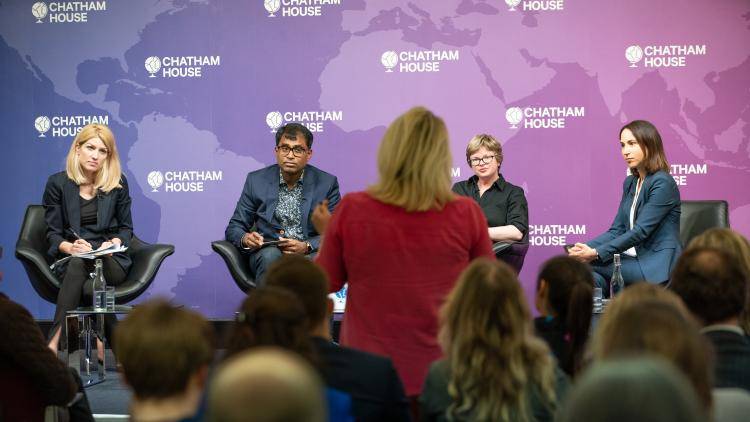
Alright, thank you, Tom, we’re good to go. Welcome, I’m Bronwen Maddox. I’m Director of Chatham House, and I’m delighted that we’re having this discussion this afternoon, this evening, if you’re in London, on “What is Trumpism?” Let me say right at the start, this is being livestreamed and recorded, and you can watch it later, forward it as you like. It is definitely on the record.
I have a great panel to discuss this with me. Online, and I don’t know if you can see on Zoom, we have Justin Logan, who’s Director of Defense and Foreign Policy Studies at the Cato Institute, he’s joining us virtually. Thank you very much, Justin. I have next to me, Peter Trubowitz, who’s one of our Associate Fellows of our US and the Americas Programme, and is – who also runs the Phelan Centre on United States Studies at the London School of Economics. We have Stephen Fidler, who’s former Bureau Chief at Large of The Wall Street Journal, and Dr Leslie Vinjamuri, who runs our US and the Americas Programme.
So we couldn’t all be in better hands for this question of “What is Trumpism?” And we’re going to talk over, is it a philosophy? Is it one person? Is it a set of actions? What are the consequences of these 99 days that we’ve had so far, and particularly, what will last of this? And, alright, we’re only 99 days in, but it still is a very live question of what is going to stick of what has been done so far and indeed, of that what might come next?
It’s become almost a commonplace to say that Trump is one of the most consequential Presidents ever. People reach for that adjective, in lieu of others they might put in there, I suspect. We’ve had obviously the shock of the tariffs and that extraordinary headiness of just – and sense of shock in many, many countries, just a few weeks ago. Whatever country you were in at the time, and Peter was in Beijing, and I was in Greece, for part of it, the shock of what was happening, and happening by the hour as tariffs got put onto countries and onto American imports, and then taken off, and then changed and so on.
And we have at the same time, the breath – the first serious breath that I can feel of a cold air around the future of the dollar, its standing in the world. It’s been one of these, sort of, hypothetical things that we could discuss in many years past of whether the dollar would hold onto its standing as the world’s reserve currency. But suddenly, the fact that the US administration was giving the world quite a lot of reasons to look for alternatives and to consider whether it wanted to keep lending money to the United States in the quantities and the rates at which it is doing it, became very live.
We’ve had obviously the questions over alliances, very, very sharply felt within Europe. But I must say, even though Europeans have winced, understandably, at some of the language that has been used about their failure to pay over the decades for their own defence, I found that not as shocking myself, or not as startling, as the President’s approach to Canada, which has helped determine the result of the election that we have seen, and indeed, the negotiations that he is holding around Ukraine and Russia. And we do have the question, then, live of whether all of this intended, Donald Trump says, to “put the squeeze on China,” in fact, is going to hand China quite an advantage, both economically and in terms of influence in the world. So, we can talk about all that.
We at Chatham House mainly do in our programme the foreign policy, but I’m sure we’re going to touch as well on some of the consequential things that these 99 days have done within the United States, on culture, on the use of the presidency and its powers and so on. So, with all that, I’m going to plunge in, and I’m going to ask them each to say, very briefly, their first reaction to this question, “What is Trumpism?” And I’m going to start with – I’m looking at you, Peter, just misleadingly, I’m going to start with Justin. Justin, welcome, what is Trumpism?
Justin Logan
Thanks very much for having me. Let me apologise for being the, sort of, Emmanuel Goldstein of this event, the face on the telescreen. Hopefully, my intervention will be somewhat less unwelcome than the Two Minutes Hate. I think when we ask what Trumpism is, there are some impulses or some biases that probably are uncontroversional – uncontroversial, the first is transactionalism. Trump talks like someone who’s been in New York business spheres for an awful long time, particularly the New York real estate community. And so, you see this transactionalism in terms of not just his entering into negotiations with both Russia and Ukraine, although somewhat independently of one another, but his entering into interactions, negotiations rather, with the Islamic Republic of Iran, which came as something of a surprise, based on the look on Benjamin Netanyahu’s face when Trump sprang that on him during a press availability in the Oval Office.
And, of course, you again see this transactionalism when it comes to his longstanding remarks vis-à-vis NATO, right? The sense that NATO isn’t paying, someone is winning and someone is losing, and that leads to the second question, which is Trump thinking in terms – in zero sum terms, right? I don’t know any Economist who has not, sort of, rendered his or her garments and said, “Why doesn’t Trump get it?” And it’s because Economists, by and large, think largely in positive sum terms. If you think about trade, if you think about any number of economic questions, right, both sides can benefit. This is anathema to Donald Trump, he doesn’t think in those terms.
And so if you combine a, sort of, transactionalism with zero sum thinking, that gives you some guidance as to what to expect in terms of policies, but not a lot. So, if you take transactionalism and zero sum thinking and apply it, for example, to the North Atlantic Treaty Organization, you could get this tr – protection racket model, where Trump says, “If you people spend 5% of your GDP on defence, we might stick around.” Or you could get a model where he says, “Look, you know, we feel like the US interest is, kind of, well protected, in terms of preventing hegemony in Europe, and so we’re going to ask Europe to take on the conventional deterrence piece on their own.”
You can see it with the Islamic Republic of Iran too. You could see anything from a major war in the Middle East to a nuclear agreement that some might say would look an awful lot like the Joint Comprehensive Plan of Action, which he’s scuttled in 2018. So, I think you can get these impulses, you can get these, sort of, heuristics or benchmarks, but they don’t illuminate the way as much as we Scholars might like them to.
Bronwen Maddox
Thank you, and I think it is absolutely justified to end up by saying this important thing that there is a great deal that we don’t know. I think ‘transactional’ obviously is a word that we hear a lot around Donald Trump, but there is the question of whether any transaction, certainly a New York property deal, but any, as Ukraine is finding at the moment, makes any sense if you can’t trust the intentions and the reliability of the counterparty. I think particularly Russia in that case, but also, in some sense, the US. Great point about economics and why it just hasn’t landed with parts of this administration. That is so interesting. Peter.
Peter Trubowitz
So, as Bronwen mentioned – well, first of all Bronwen, thank you for…
Bronwen Maddox
Oh…
Peter Trubowitz
…inviting me here, and…
Bronwen Maddox
…thank you.
Peter Trubowitz
…Leslie, as well. It’s great to be here again. So, I’m just back, from late last – late – as of late last night from Beijing, so – and my Chinese host referred to Beijing as the “epicentre of the trade war.” So, if I’m – come across as incoherent here, it’s about 1 o’clock or 2 o’clock in the morning for me. I would say there’s three things that, you know – there are many things to say or – about Trumpism and what it is. There are three things that stand out, for me, when it comes to at least Trump 2.0, and I think there’s important continuities with Trump 1.0.
One is just the sheer velocity. You know, back in December, Steve Bannon, one of the Trump whisperers and the Trump Strategist from in the White House from the first term, said, “These are going to be – these first 100 days are going to be Days of Thunder.” And if – you know, whatever else you want to say about the last three months, that prediction has held up. I mean, it has been a dizzying array of initiatives, so much so that even stuff that’s put out at one moment in a 24 – early in a 24-hour cycle is – within that cycle there’ll be two – one or two additional initiatives. I mean, it, kind of, defies standard conventional wisdom about the 24-hour cycle in news.
And so, there’s just been this tremendous speed and velocity, and I don’t think it’s – it is – some of it was, or much of it, was actually pre-planned, and some of it was certainly contained in Project 2025, even if it was the rollout was not very well choreographed, in many cases, the trade announcement of April 2nd being perhaps the most obvious example. But some of it I think actually reflects the velocity, the way that Trump has organised his presidency to deal with foreign policy. He has centralised authority with respect to foreign policy. I think the only President that has centralised it this much, in my memory, is Richard Nixon.
Donald Trump is trying to run foreign policy out of the Oval Office just like Richard Nixon did. There are some important differences, but in the sense that he’s really to my – in my way of thinking, there are really only two Foreign Policy Advisors right now and Marco Rubio is not one of them. So, Scott Bessent is one, for sure, and the other I think is the Property Developer, Steve Witkoff, who he is relying on as a Special Envoy. And what is essentially going on is he is making decisions, these are being, kind of, vetted, if you will, inside the Oval Office, but he’s not, on purpose, it seems to me, taking advantage, as many Presidents normally do, of the bureaucracy, the State Department, the Defense Department, all the – that that – the – those institutions have to offer.
And one of the things that this has led to is really a great difficulty in finding – and this goes right to the point about Trumpism, it seems to me, a consistent geopolitical through point through his actions. So, you’ve got a President who is simultaneously pursuing two grand strategies that are inconsistent and contradictory. On the one hand, a strategy of retrenchment, which is most obvious in the case of America – Trump trying to get America’s allies to pick up a larger – and friends, a larger share of the tab for their own security and defence, that’s classic retrenchment. At the same time, this is a guy that is talking about territorial expansion from Pan – the Panama Canal to Greenland, to Gaza, and Canada, as well.
Bronwen Maddox
I was going to say…
Peter Trubowitz
And, you know, so, Canada…
Bronwen Maddox
…you’re forgetting one up there, yeah.
Peter Trubowitz
…it has a – it’s a more peaceful idea of, you know, turning Canada into the 51st State. He should be careful what he wishes for, because that would be one Big Blue state. You know, and I think part of the fact that he’s running it out of the Oval Office partly explains the inconsistency.
But there’s more to it than that, and that is, I think the third point I just want to make here, which is the strategy is chaotic and inconsistent because it serves Donald Trump’s political interests. You know, the writer Jon Meacham, back in 2018, put it best, I think, when he said – he described Trump as “A great opportunist who will use whatever issue might be at hand to dominate the news and seek power.” And I think that’s exactly right, and that is why Trump is so fixated on tariffs and on alliances, because in his mind, they create limitless opportunities for him to leverage America’s enormous clout to get foreign leaders and others to do his bidding.
And, you know, the Singapore Defence Minister, Eng Hen, really captured this point back in February, when he noted how the American image, the international image of the United States, especially in his region, but beyond, had changed in recent years. “Running from,” as he put it, “from a liberator,” so that would be George W Bush, “to a great disruptor,” Trump 1.0, “to a landlord seeking rent,” Trump 2.0. And that is what I think Trumpism is really about, is accumulating power, it’s accumulating status and accumulating attention. This guy is not playing three-dimensional chess, and he’s also not engaged in domestic coalition building, and I think Republicans who think that he is have bought a pig in a poke.
For him, busting agreements, upending norms, sowing uncertainty, are the political means to the end. And what makes this, I think, so dangerous is that in helping himself, Donald Trump is actually running down the very assets that make America great, its alliances, its markets and its values. And this is a problem for the United States, but frankly, it is a problem for everybody else. As one of the Chinese intellectuals put it, that I met with, “The world is in danger of losing a powerful beacon of hope,” that is what is at risk, and I’ll leave it there.
Bronwen Maddox
Hmmm. Peter, thank you very much, “Days of Thunder,” as you said, or Steve Bannon said. And I think it – thanks for your characterisation of that, that is great. Stephen.
Stephen Fidler
Thank you. I’d echo probably quite a lot of what David has just said. I think we – what we’ve seen is a extraordinary personalisation of the presidency in ways I think that certainly I haven’t seen in my lifetime. I’m not sure what the precedent is for it. And Trump’s, one has to admit, is I think a political genius, an absolute political genius. He – his instincts are politically extremely acute. He’s remarkable in the way he can turn adversity, criticism, everything like that, to his advantage. He has an extraordinary ability in doing that. And I think that instinct, which makes him a political genius, and I think in ways that we didn’t fully understand before, when that instinct is transferred to policy, then it becomes – it’s a prescription for volatility, for uncertainty, for contradictory policies, and that’s what we’re seeing.
So, he’s an instinctive individual, but what works in politics and getting elected is not necessarily what works when you’re actually in the Oval Office and you’re trying to make things work and bend the world in your direction. And I think that there’s a big question between the distance between what he’s trying to do, and we can discuss what that is, and what actually will be the outcome of his efforts to do it. And, you know, at the moment, we have, I think, a predity – presidency that is – operates very much on his whims, if you like, his resentments, but also long held views. I mean, I don’t think – his views about tariffs are not something that he just dreamt up. He’s – since the 1980s, he’s been talking about the efficacy of tariffs…
Bronwen Maddox
Yeah.
Stephen Fidler
…and it doesn’t seem…
Bronwen Maddox
Justin is nodding. yes.
Stephen Fidler
And it’s not something that, you know, the views of Economists are really – have ever changed his minds, and, you know, we’re seeing contradictions even within the tariff policy. Is it to right the balance of payments, the current account deficit, the trade deficit, or is it to raise money? Because if you want to cut imports, and succeed in cutting imports into the United States, you’re not going to succeed in raising tax – tariff – money from tariffs to replace the taxes that you are going to lose from cutting taxes. So, there’s – you know, even in something like that, there’s an internal contradiction that – which I think is reflected across a lot of the, kind of, policy areas.
And I’d just say this, before moving – ‘cause we – it’s a question that Bronwen raised, and I think this is the most unconstrained presidency we have seen, but unconstrained for how long? In the sense that he’s almost been given free rein by the Republican Party, at the moment. It doesn’t – the Congress doesn’t seem to be, kind of, reining him in. But the volatility of his, sort of, pronouncements and policymaking is something that, sort of, could come back to bite him. And there is a view, I think, in – among some in Washington, that’s not limited to hopeful thinking Democrats, that something could hit him. Something could blow up and maybe it’s the impact on tariffs, on shelves, grocery shelves and inflation, or something like that, I don’t know. But something could bite him that could, you know, mean effectively, his unconstrained presidency doesn’t last for all that long.
Bronwen Maddox
Thank you, and we’ll come onto those questions, ‘cause, I’m going to come on and talk about what of this will last, and just – I hope we can dig into that question of support and constraint a bit more. Leslie.
Dr Leslie Vinjamuri
Yeah, I guess a couple of responses in – by way of answering the question. First of all, two things that I think are said frequently, one is that he’s a ‘political genius’, and the other one is that “There’s a certain element of truth in many of the things that he says,” and I think I want to take these two things on. He’s a political genius whose polling is at the very lowest level of any post-Cold War United States President, 41%, give or take, depending on the poll, approval and 54% disapproval, so negative 13. Who has not done any wonders for projections of growth in the US economy or in America’s allies, or increasing the general stability and sense of prosperity, growth and freedom, either in the United States or abroad. So, I’m not persuaded that he’s a political genius. Are – is there a kernel of truth in everything that he says? Sure, as there has been in pretty much every single US President throughout history, and certainly throughout post-Cold War history, and as there have been in many individuals who are good, bad or evil. So, I don’t really think the argument is very special and I think we should really interrogate it.
Second thing, what is Trump and what is Trumpism? I think that what Donald Trump has done, you know, the one good thing that is – that he’s clearly done, both in his first term and in his second term, is to call halt on just ticking the boxes and moving along in an unreflective way about America’s commitments, Europe’s commitments, investments, lack of investments, calling halt on that, kind of, way of operating. But let’s be clear, there’s something very singular about Trump which has to do with a personal style of engagement and a willingness to radically undo the boundaries of a very high bar that, quite frankly, was set by Britain, has been set by many American leaders, on dignity, decency and decorum for how you treat your own people and how you treat people beyond your borders.
And it isn’t to say that America hasn’t fallen very far short of these standards throughout its history. The standards have grown, it’s continued to fall short, but Donald Trump, I think, has given license at the highest level to a certain form of behaviour that is quite simply not decent, not dignified and not a standard that anybody in this room would, or should, be held accountable. So, I think that’s a very fundamental element of Trump, because it is unleashing and unlocking a style of political engagement beyond the man.
Second, to Peter’s point, I think it’s very important, and I would frame it in a slightly different way. It’s what you were getting at, trying to locate foreign policy in the Oval Office, pushing the boundaries of executive authority as far as he possibly can to see whether or not the courts, the people, the Congress, will push back on him and call a halt on what the Executive can do. What is the boundary of the rule of law? Will America and Americans engage in that conversation, not only on foreign policy, but clearly on all manner of domestic policy?
Third, in Trump 2.0, and this is very different from Trump 1.0, and it is the domestic story, it is a combination of going against the recent enemies, wrapped up in a broader critique, which has legitimate support, elements of legitimate support in American Society, of an anti-woke agenda. That is, you cannot tell a story about Donald Trump without talking about anti-DEI and anti-wokeism, and it’s not limited to domestic policy. It’s very much part of a foreign policy agenda, and there is an extraterritorial agen – element to the push on US Government funds for anything that’s going to be seen as part of that very liberal agenda. So, it is an attack on not only the liberal international order, it’s an attack on liberalism of a way in which it became fashion, which was resented, and has been resented, by many parts of society in the United States. And it’s many of the other things that people have said when it comes to anti-alliances and we’ll get into the foreign policy thing.
But the only final thing I’d like to say is that, you know, in Trump 1.0, we had a really intelligent conversation about Trumpism versus Trump, and I don’t think it’s the same conversation anymore, because Trump is a, sort of – you know, got a lot of different people around him. There’s been much conversation about it, the libertarians, the techno billionaires, the MAGA wing, there are all sorts of folks around him. And it used to be that Trumpism was about that core 40%, largely high school, not university educated, male, underemployed, if not unemployed, and that was what we meant when we said ‘Trumpism’, it was the hardcore of his base. Now, we’re talking about Trumpism in a very different way, and I think we should just be clear that it’s, sort of, morphed, and it – and not everybody supports, as we can see in the numbers, but also in the politics, every part of that broader agenda.
Bronwen Maddox
Leslie, thank you very much. You’ve taken us right where I hoped you would, into some of the things we hadn’t mentioned quite so much, the constitutional challenge, if you like, the pushing of the boundaries of the President’s authority that he is exploring and indeed, the cultural challenge. And I want to go on and just dig into this question of the constraints on him, including whether the support for him that there has been is going to hold up or not. Because we have various constraints, we have mentioned so far the markets, the bond markets, famously, the courts beginning to challenge some of these things, particularly on deportations, Congress, so the big test, are coming – of whether it will find more of a voice wants to find more of a voice.
But we have behind that the whole question of the nature of his popular support and whether, as you say, perhaps not big numbers historically, but still both houses of Congress, the popular vote that he got, the things that other leaders have been very respectful of when they say, “Okay, we have to acknowledge the support for Donald Trump.” And I’m also in the kernels of truth argument, I’m very, excuse me, struck by the way that European governments have responded, as well as trying to deal with the tariffs and stuff, but saying, “Oh, maybe this gives us a bit of license to talk a bit more toughly about migration, and maybe it gives us license, alright, not with a chainsaw, but to do something about the size of government, if that is our inclination. Absolutely, we have got the message about spending more on defence, and so on.”
So, I would just like to just hear the panellists fairly quickly, ‘cause I want to come to questions, just your sense of the nature of the support for Donald Trump, whether it will fade as the cost of eggs stays high, or is something really deep and a profound, you know, phenomenon in American politics of people responding to this attack on elite cultural institutions, and so on, where you think that will go. It can only be impressionistic, but I would love those impressions. Let me go back – thanks for your patience on the screen. Yeah, thank you.
Justin Logan
Sorry, I missed the call.
Peter Trubowitz
You’re up, Justin.
Bronwen Maddox
You’re on, Justin, sorry, yeah.
Justin Logan
Got it, thank you. So, I love talking about constraints. I think it’s something that Americans have gotten bad at doing, and I’d be remiss here in talking about an American President without mentioning my colleague, Gene Healy’s, work on the presidency itself. And he wrote a book a decade and a half ago, called “The Cult of the Presidency,” which talked about the extent to which Americans have elevated the institution of the presidency to this, sort of, Death Star. And for a long time, mainstream Republicans and mainstream Democrats didn’t really see any problem with this Death Star, because they didn’t like the planets that it was zapping and, you know, it wasn’t that much of a problem. But, lo and behold, you’ve turned over this Death Star to a man who you now don’t – who’s pointing it at planets that you actually like, and you’ve discovered, my goodness, this is a very dangerous thing.
So, I think the question of constraints, you know, could be political or it could be legal. But if we look for, sort of, legal and formal constraints on the President’s power, to be, sort of, optimistic, the President in his interview with The Atlantic magazine recently said – he was asked, you know, “Would you violate a Supreme Court ruling?” And he responded, sort of surprisingly to me, and said, “Oh, no, absolutely not, you know, you have to comply with what the Supreme Court says.” Okay, we’ll see, I suppose.
But the political question, as a, sort of, Neanderthal realist, I have to think that laws don’t constrain and politics do, you know, I think there is an argument that the tariff pullback was, in part, due to political blowback. But then you’ve heard in this, sort of, Kremlinology discussion, that it was, I forget whom, Bessent and someone else, who, sort of, figured out that Lutnick was not with the President, or was, sort of, like tied down somewhere else. So, they implored him, “Mr President, you know, we need a, sort of, a respite here, because the markets are really sticking it to us.”
So, the question of where Donald Trump’s pain point is, either on legal or political restrictions, is a really dire one, but it’s something that’s baked into the modern presidency, if anything, heightened by the person of Donald Trump himself. But I think the institution of the presidency has grown to be, to my mind, and I have to say this ‘cause I’m a libertarian, I guess, a, kind of, awful, terrifying institution.
Bronwen Maddox
Peter.
Peter Trubowitz
I mean, I think, first, just it bears repeating here, although it’s been said a couple of times, I mean, Donald Trump is – has lost a lot of political altitude over the past, I would say, month and half in public opinion polls. So, Leslie referred to numbers. I mean, his polling right now is lower than any President in modern times at the 100-day mark, and lower than where he was in his first term. And I think that this is – it’s significant, it’s – it is one of the constraints on him. It’s not a con – a direct constraint on Donald Trump, it’s an indirect constraint. What I mean by that is, as his numbers drop and as we get closer to the 2026 mid-terms, Republicans who are in swing states or in districts that are, you know, not like in the, you know, kind of, in the bag for Republicans, those folks are going to start to get nervous.
Bronwen Maddox
Are we close enough? I mean, we’re a year…
Peter Trubowitz
We’re…
Bronwen Maddox
…and three quarters away…
Peter Trubowitz
We’re…
Bronwen Maddox
…but these people are permanently…
Peter Trubowitz
We’re…
Bronwen Maddox
…campaigning.
Peter Trubowitz
We’re getting there, but we’re not there yet, but I think that’s a relevant factor. The other thing I think that people are not talking enough about is, and this goes to his domestic coalition, one of the things that’s different about Trump 2.0 than Trump 1.0 is where Big Tech is.
Bronwen Maddox
Hmmm.
Peter Trubowitz
So, Big Tech moved in this election, in this – you know, in 2024, from the Democratic Party to the Republican Party, at least at the very top. I don’t mean people working in a Google or, you know, in – at Apple, but, you know, at the top there was a movement. I mean, Big Tech got involved in presidential politics back in the 1990s, was aligned with the Democratic Party, aligned with Clinton first, all the way through to Obama. And it was a mixed bag in the case of Biden, and they clearly got very upset with Lina Khan and where the Biden administration was moving on regulation, so they moved.
The problem is, Big Tech and Wall Street are not very happy, obviously, about, like, the tariffs. I mean, I was struck by how quickly Musk came out, inside the administration, attacking the administration for the policies over tariffs. So, he pushed back, and of course, there were many others who pushed back. That’s a potential breach. I mean, where Musk represents, in effect, Big Tech, Bannon the core of, I would say MAGA, and those two fellows, they hate each other, they hate each other, and they represent a real potential breach…
Bronwen Maddox
Hmmm.
Peter Trubowitz
…inside the party, I would say. And so, I mean, I think that is something to keep your eyes on as we move forward.
Bronwen Maddox
By pushback from Elon Musk, you mean calling Peter Navarro ‘a moron’, for example?
Peter Trubowitz
No, no, I mean, that he did, he clearly called him ‘a moron’, but the pushback…
Bronwen Maddox
But it’s about…
Peter Trubowitz
…it was about…
Bronwen Maddox
But it was about the…
Peter Trubowitz
…tariffs.
Bronwen Maddox
Yeah, but it was – exactly, it was…
Peter Trubowitz
Yeah.
Bronwen Maddox
…about the tariffs…
Peter Trubowitz
Yeah.
Bronwen Maddox
…and Peter Navarro being the person who was saying, “These tariffs are not just a negotiating point, they are for themselves, I believe in them.
Peter Trubowitz
Right.
Bronwen Maddox
Yeah.
Peter Trubowitz
Yeah, but blaming Navarro as…
Bronwen Maddox
Yeah.
Peter Trubowitz
…opposed to Trump directly, right?
Bronwen Maddox
Yeah. Stephen, and really digging into this, I mean, I’m after, also, this question of what will stick? But the support…
Peter Trubowitz
Hmmm.
Bronwen Maddox
…the constraints on him, what might stick of this?
Stephen Fidler
Yeah, well, I mean, it’s clear, isn’t it, that within the Republican Party there is a significant base that probably will support su – Trump almost no matter what he does, and he’ll be able to keep this base, I think. And I – what that base is in terms of the overall electorate, I think it’s hard to say. I think there’s a lot of support that will flow away from him, without a doubt, as tariffs bite and the economic effects – likely economic effects of what he does starts to have an impact.
But I think the question about the party is, and indeed, the question about the party is what – the MAGA people are the ones who turn up in primaries. They’re the people that can in many ways, determine the future of Republican candidates or contenders. And it’s that I think that, sort of, provides a, sort of, counterweight, if you like, to the idea, well, his support is soft and it will decline with the economy. I mean, I think it will, but I think it’s not quite as simple as that. I think it’s – there is this base, this strong base, that will back him whatever he does, the MAGA group, and they will – they are influential, particularly in primaries. So, that Republican lawmakers are going to, sort of, bear this in mind before they go full and distance themselves too far from Trump, yeah.
Bronwen Maddox
Hmmm.
Dr Leslie Vinjamuri
Yeah, I mean, goodness, it is the question of the day, and I don’t think that anybody knows the answer. I do know that we all have agency in this and that people are calculating and making decisions. I tend to think that his numbers will continue to fall, unless he delivers more on economic growth. I think people will take a lot of the attacks on public spending, and even the tax on the government, but that if he craters the economy, it will be very devastating for his own results.
But my number one point, I think, on this would be that it does come down to alternatives. I think this is a ballot box question, quite likely, and, you know, there are two sides. Who is running against Donald Trump? Who is running against the Republicans? What do the Democrats do? What narrative do they run? Do they mobilise? Do they become effective? It is – I don’t think that the story that we often tell about his support is simply about his support. I think it was also about the American people, for a variety of reasons, not wishing to elect Kamala Harris to be President, and we know that, but we, sort of, lose sight of it as we tell the story of Donald Trump.
It is always about alternatives. People will, ultimately, look at the choices and decide on the basis of the choices. So, there’s a whole game, and we all know it, on the other side, that so far, has looked disappointing and lacklustre, you know, for very legitimate reasons, and this was a devastating loss for the Democrats, we know the story, but that is a extremely important part of the story of what happens to Donald Trump. Politics is about contestation, it’s about agency, it’s about choices, it’s dynamic. There is no teleology to this story, it’s a very dynamic space.
Bronwen Maddox
Thank you. Let’s go to questions. There’s terrific ones online already, thank you for those, and I will weave some of them in from the start. Okay, let me take a couple here, there’s someone – the first hand up, on the edge, yeah, on the aisle here. Oh, okay there’s someone else, right, go ahead. No, no, no, Nick, you have it, and then I’ll take the other person on the aisle, yeah.
Nick Westcott
Thank you, sorry, Nick Westcott, at SOAS. Is there a risk, or a potential, that by the end of this year, Trump has become effectively a lame duck President? Having driven the MAGA bus full tilt into reality, things are not going to work out. If he walks away from Ukraine, he doesn’t do a deal with Iran, he can’t take over Canada, people are going to say, “What’s he doing?”
Bronwen Maddox
Thank you, asking us to look to the end of the year, “Have we seen peak Trump?” as some people are asking. Right here.
Kirill
Yeah, thank you. So, I wanted to ask…
Bronwen Maddox
Could you say your name, please?
Kirill
My name is Kirill. I wanted to ask whether you think that part of Trumpism is, like, brooding over the Overton window? I’m, kind of, thinking with respect to Russia and Ukraine, you know, what he’s doing was unimaginable ten years ago, but now part – like, significant part of the Republican Party is supporting his more or less pro-Russian foreign policy. So, the question is, will he change American politics and discourse in American politics forever?
Bronwen Maddox
Thank you very much, and I’m going to add to that, which follows from it, one from Osama Quatrani, saying, “After 100 days, Trumpism seems to go beyond partisan politics, challenging post-World War Two diplomatic norms, disrupting alliance expectations, redefining America’s global role. In your view, does Trumpism mark a temporary shift or the beginning of a deeper generational transformation in international diplomacy and global co-operation?” So, we have Nick Westcott, end of the year, is Trump a ‘lame duck’? And then Kirill’s and Osama’s about will this change, profoundly change, America’s politics and role in the world? Stephen, let me start with you.
Stephen Fidler
On the ‘lame duck’ question, I think as Economists say, there is a, certainly a non-negligible risk that he is a lame duck by the end of the year. And I think – I mean, it – going back to his instincts is one that I – it seems to me that the economic risks that he’s undertaking are on the – are all on the downside really. I mean, if he doesn’t introduce tariffs that he says he will – if he does introduce them, that would be pretty significant and potentially disastrous, but if he doesn’t do it, the uncertainty he’s created is almost certainly going to lead to a, kind of, a halt of investment in the United States that’s already happening. So, even the, sort of, the upside is not very far up.
And then his instincts vis-à-vis the Federal Reserve seem to bring into question, it seems to me, you know, the whole question of faith and credit, full faith and credit of the United States in its debts and that kind of thing. And, you know, maybe he won’t sack Powell, I don’t think he will sack Powell, but in May 2026, he gets to nominate another Federal Reserve Governor. And I think nervousness about the questions of US debt and about the primacy of the US in the whole international system are significant and I only see the downsides there.
I mean, on the question of Russia, and I mean, he does seem – Russia does seem to loom large in his thinking, unusually large, for a, you know, a country whose economy is the size of Italy. I don’t know if there’s a – whether he’s looking at the Mercator projection or what. It’s a big – it’s a – certainly a big country. But I mean, is he thinking in terms of spheres of influence, that if Americans shouldn’t be involving themselves in, sort of, fights overseas and, you know, the Russian sphere of influence, is – legitimately, you know, includes Ukraine in his view perhaps. Certainly, it seems to in the view of some of the people around him, and I think there might be a distinction there. And he may also – he also seems genuinely sympathetic with the idea of peace, and that – in Ukraine, and that these people shouldn’t – you know, that Russians and Ukrainians shouldn’t be killing each other. So, I mean, it’s hard to, kind of, divine exactly what it means.
The question about – I mean, I do think the genie is out of the bottle. I mean, I was reading Ed Luce’s piece about Brzezinski and Kissinger the other day, and one thing one would say is Witkoff and Bessent are not Kissinger. But, you know, there’s a passing of a generation which is – which has, sort of, seen European – has seen US stability in Europe and real – and, sort of, recognised that Eur – instability in Europe is a threat to the United States. And I think there’s really a passing of the generation of people who thought like that that are not there. You know, Biden perhaps was the last President who had this, sort of, view. And I think the genie is out of the bottle now. I don’t see us going back to anything like the status quo ante.
Bronwen Maddox
Peter.
Peter Trubowitz
So, quickly, on the first question on the – on Trump as a lame duck. Well, he is talking about a third term. Now, of course, that requires a constitutional…
Bronwen Maddox
I think…
Peter Trubowitz
…amendment.
Bronwen Maddox
There’s a question online about that…
Peter Trubowitz
Or…
Bronwen Maddox
…thank you.
Peter Trubowitz
…or some cockamamie workaround, where two of his kids run for office, they get elected, he becomes Speaker of the House. Anyway, I’m not going to go down that path.
Bronwen Maddox
Do you know? That’s the only one I think…
Peter Trubowitz
But…
Bronwen Maddox
…works of all…
Peter Trubowitz
But…
Bronwen Maddox
…these scenarios, but…
Peter Trubowitz
But…
Bronwen Maddox
…we’re…
Peter Trubowitz
…I think what’s important about this is he’s clogging up the lanes right now for Republicans, you know, by not – by talking about a third term. So, there’s a real downside risk for the Republican Party, I think, in this, the longer this goes on. And we learnt that also on the democratic side, I think. Joe Biden should have pulled out after 2022 in the mid-terms. That was a perfect moment for him to step aside effectively and clear the path for some younger candidates.
On, is he changing the discourse in the United States? Yes, and I would say a perfect example of how Donald Trump has changed the discussion is over trade. The Biden administration did not pursue one trade liberalisation package, refused to do so. The tenor of the discussion, the substantive nature of it, has simply changed in the United States. You could look at other areas as well. I mean, I think it’s very clear on immigration, as well, and as Bronwen suggested, this has knock-on effects internationally, like in Europe.
On the last point on, is this forever? The first thing that is – you know, the question referred to ‘young people’. The first thing to point out here is when you look at the polls, Trump support is weakest among young people, so they’re not in the tank for Donald Trump. Now, if his efforts to rewire the world economy produce, you know, unbelievable growth in the United States and so forth, maybe you get some, kind of, long-lasting realignment out of this, but I think it’s unlikely. The United States is a deeply divided, polarised country, to this day. It is worth remembering Donald Trump won the election by 1.5% of the vote, and if you’re really counting, and you’re only counting the swing states that matter, Donald Trump won by 200,000 votes. That is not a lot in the United States, when you have 150 million plus voting.
So, the country remains divided, and if we – if you think a couple election cycles out, baby boomers will be out of the picture and younger voters will have much more of the – own much more of the franchise, and I don’t think they favour many of the policies that are, you know, being advanced right now.
Bronwen Maddox
Okay. Leslie.
Dr Leslie Vinjamuri
Yeah, I mean, on the lame duck question, I don’t think he’ll be a lame duck, because I think that he’s going to keep trying things. And you think of a lame duck as somebody who, sort of, sits on the beach, and…
Bronwen Maddox
Oh, well…
Dr Leslie Vinjamuri
Well, you know.
Bronwen Maddox
…metaphors only take you so far.
Dr Leslie Vinjamuri
I think he’s going to keep trying for things, I don’t think he’s going to get lazy. I mean, you know, this is a definitional question. But I would draw our attention to I think the fact that every post-Cold War President has had a major event, and there will be one. I mean, this is a very complex world, and Donald Trump had one, he had COVID, Biden had a couple, you know, George Bush had 9/11, Barack Obama inherited the financial crisis. This isn’t going to be just where we think it is now.
There will be something that we are not putting into the picture that will change the nature of this presidency, and it’s a little bit hard to estimate in which direction, but it will happen, and it will change the nature of our politics. I think that it’s possible that – Peter knows the numbers, he’s written books on this, he’s not wrong, but I think it’s entirely possible that by the end of these fours – four years, we’re seeing an overwhelming rejection of Donald Trump. I think that is a entirely possible scenario and we shouldn’t discount it.
In terms of what’s changed, for quite a while, I would mention one thing. I don’t disagree with what’s been said, but I think the one thing that’s probably – you know, he changed trade already, I think he’s really changed the attitude and I’m not happy about this, but the attitude towards Europe. That’s the thing that he’s really taken on and I think some of us, sort of, anticipated it. We did a lot of trips around Latin America, Asia and Europe in the run-up to the election, and we did come back thinking that Europe was in the worst position possible.
But I think that he’s really driven home the narrative that Europe is not to be assumed as having a special privileged position. And I think he’s changed – this is my read of sitting here, you know, most days, and watching the phenomenally productive energy in the United Kingdom and across Europe, I spend less time there, but considerable time, it is a phenomenal amount of energy about building in response to what’s come from the United States. So, I see this as the most productive and dynamic space in terms of what he’s actually changing that will continue past his presidency.
Bronwen Maddox
Thank you. Justin, lame duck versus instigator of profound change?
Justin Logan
Yeah, I was going to take the, sort of, what has changed? I think probably, in weird ways that we don’t fully understand yet, both political parties in the United States have been permanently changed. I mean, I remember, I’m 47, so I remember, you know, politics 20/25 years ago. If you had told me that Liz Cheney would be on the dais campaigning with a Democratic candidate for President in the Year of Our Lord 2024, I would have told you to have your head examined. But you’ve seen this democratic dalliance with any never Trump Republican. And so, I think, you know, you’re more likely to see a Pritzker-Cheney ticket on the democratic side than you are to see somebody like Liz Cheney at a position of power in the Republican Party. So, I think the Republican Party has clearly changed in ways that are a little bit less inscrutable than the ways that I think the Democratic Party has been changed permanently.
And just to go back to my, sort of, formative political memories, right? I think, you know – I remember the days when people who didn’t want to invade Iraq were called pro-Saddam. So, I’d be somewhat reticent about calling a foreign policy vis-à-vis Europe, that doesn’t want to get involved deeply in Russia’s war in Ukraine, that thinks the Europeans should lead on conventional defence in Europe, as being a ‘pro-Putin’ foreign policy. I mean, I think those – Trump is basically right on those questions. There are real risks for the United States in Ukraine and minimal benefits.
And I think that the balance of effort in the transatlantic relationship, generally, and in NATO in particular, has been a disgrace from an American point of view. If you look at the percentage of NATO GDP that the United States comprises, and the percentage of NATO defence spending that the United States comprises, notionally, those would be the same thing, but they’re not. The United States has been carrying a huge portion of the defence burden, and some of that is our own fault. We have deter – we have discouraged the Europeans from working together without us, from the Clinton administration onwards. So, I think that that ba – the basic orientation of the foreign and security policy vis-à-vis NATO that Trump has pursued is basically right.
Bronwen Maddox
Justin, I just want to pick up this point, because we’ve left the question of the relationship with Russia, sort of, dangling in this and it’s just – it flickered through this. And you said to – I think the point you’ve made, Europe has now accepted that it needs to spend more on defence. Though it could add defence against Russia, which in some ways, Putin – Trump is doing a lot to assist, talking about lifting sanctions and so on. I would just like quick interjections from the panel, or from you, about what you think is driving Trump’s attitude to Putin, in particular. I asked this question of various Ambassadors and officials in Washington last week, and it got the most consistent, “I don’t know, it is something of a mystery.” But I’m not sure everyone would accept, certainly in Ukraine, your characterisation of him just wanting to get America out. He seems to, at some points, to be going out of his way to do Putin’s favours, particularly in his characterisation of who started the conflict. Anyone else want to come in on this quickly? Peter.
Peter Trubowitz
Sure. So, two geopolitical explanations for Trump’s behaviour towards Putin and the rapprochement. So, one is the, kind of, Kissinger-Nixon in reverse, so the idea is to put Putin in play, to have leverage on Xi Jinping, going forward. I don’t think this scares the Chinese, it – maybe some, but – because they don’t think it’s very realistic. Putin can see how divided the US, is and realises that Trump probably won’t be around forever. I think most people think Xi Jin – and I suspect Putin does too, that Xi Jinping will be there for a while.
Bronwen Maddox
That appears to be the plan.
Peter Trubowitz
Yeah, so – but the alternative geopolitical explanation would be to the rap – for the rapprochement with Putin is to put the screws to Europe, and the idea here would be to force Europe to spend more on defence. Where is Europe going to spend that money? Eventually. it’ll spend it at home, but it really has to spend it buying American military equipment in the short-term. So, if you think of Trump as a, kind of, shakedown artist and so forth, you know, that’s an alternative explanation. It strikes me as, as consistent as the first one.
Bronwen Maddox
Alright, let me squeeze in two more questions. We had a, sort of, whole array. Alright, let me take the woman here and there was a gentleman in the middle, yeah, you had your hand up before and I’ll take you, as well. Those two, so, first you…
Terri Paddock
Hi.
Bronwen Maddox
…and then you, yeah, thanks.
Terri Paddock
Hi.
Bronwen Maddox
And then I’m going to take one…
Terri Paddock
My name is…
Bronwen Maddox
…one more.
Terri Paddock
…Terri Paddock. I’m a Chatham House member. We know the big ticket items from the Trump first 100 days. I’m wondering, for each of you, which is something that has gone less noticed that you worry about is going to have ongoing ramifications?
Bronwen Maddox
Okay, what’s under the radar, but we should be paying attention to? Here you go.
Member
And hello, and my name is [inaudible – 58:14]. I’m with Penguin Books. Speaking on the Putin issue, and there was a question I had earlier which was raising multipolarity, and that’s a term that I’ve heard discussed in politics since I think Biden’s campaign. On what – that topic there, ‘multipolarity’, what effect do you think that’s caused Trump’s actions and his recent actions, as far as Ukraine, Iran, and, of course, Russia?
Bronwen Maddox
Great, and by that do you mean – just hold on for a second, the way power is dispersing around the world and that…
Member
Yes.
Bronwen Maddox
…that was one of his – that that was something he was reacting to?
Member
Yes, to what extent is it affecting his actions, so…
Bronwen Maddox
Yeah.
Member
…the unipolar moment ending…
Bronwen Maddox
Okay.
Member
…is that affecting his actions we see today?
Bronwen Maddox
Really, really interesting. Thank you, and I’m going to add a third one, because I want us just to get a tiny bit more into this, from Liang Lai, who’s saying, “To what extent can Trumpism be regarded as a pushback on a progressive agenda that didn’t answer to everyone’s worries?” And we could do with, I think, a –just a flick more in the three minutes we have, on this how much is this a cultural shift within the US and a cultural protest, if you like? Let’s go really briefly on this. Justin.
Justin Logan
Thank you. I think that the pushback on progressive agenda, I would answer that at this point in American politics, you have a pro-system party and an anti- system party, and it’s pretty clear which is which. To what extent that’s a blowback against, sort of, progressivism, I’ll leave to people to talk about. I am squeamish about multipolarity. I’m enough of an IR nerd that I don’t know who all the polls are, but I think if you want to generalise it and talk about scarcity in the United States, we have north of 30 tricks – $36 trillion national debt. We’re running almost $2 trillion a year budget deficits. And I do think that the, sort of, unipolar wedding party mentality that existed 20 years ago is gone, and so we are having to be somewhat choosier about all of the things that we’re doing, both at home and domestically and – or internationally rather. And I – the less noted developments is one that I’ll shut up about and I want to think about more carefully, because I’m sure they’re out there, but we’re, sort of, sprayed with them so frequently in Washington that I don’t know which are being less noticed.
Bronwen Maddox
Hmmm. Peter.
Peter Trubowitz
On what’s flying under the radar, so I worry about what’s happening to the Department of Education and I worry a lot about what’s happening in health. So, is it under the – you know, flying under the radi – radar only? I mean, it gets attention, but given everything else that’s going on, I don’t think it’s getting the attention that it warrants. And I think, also, there’s just – I think this will now change, but the Reconciliation Bill that is going to be – that’s before Congress has not received much attention. It should over the next month or so, and this is a big deal, you know.
So – and I would just say on the multipolarity or the unipolarity question, I think Justin needs to have a word with Donald Trump, because I think Donald Trump believes, to the extent that he has a geopolitical view of the world, I believe he thinks it’s unipolar. I think he believes the US has a lot of power, it’s got the market that everybody wants, and its job, his job as President, is to leverage that. That’s what he’s done all his life, is leverage assets, and I think he believes the US has a lot to leverage, and the mistake that his predecessors made was not leveraging it. I’m not saying that’s right, but I think that’s where he is.
Bronwen Maddox
Okay, really briefly, kind of, 30 seconds.
Stephen Fidler
Yeah, under the radar, I’m not sure I – it is under the radar, but what strikes me is the extent to which the United States, which has been throughout my lifetime, a power for the most part, of stability, has become a destabilising power in the world.
Bronwen Maddox
Thanks. Leslie.
Dr Leslie Vinjamuri
Science and trust in information and facts, and an ability to discuss things from the standpoint of evidence, and more concretely, I do worry about – you know, I listened to the Bill Gates interview that Emma Tucker ran with him, where he put too – for my liking, too high of a probability on another pandemic, in a fairly short window, and I thought, God, we are not prepared.
Bronwen Maddox
Hmmm.
Dr Leslie Vinjamuri
Only to be reminded by somebody in my family in the US who said, “Oh, there will never be another lockdown in this country ever again,” which might make things better and might make things worse.
Bronwen Maddox
Hmmm. Thank you, and it’s interesting, we’re – and I would add to that, I – just an emphasis on science, I think the US’s now attack on its own science base and the link with science and universities, which has been one of the glories of the United States and given the world a lot, that is a huge regret to us all.
A lot of questions about the dollar online, Dina Mufti and others. Can I refer you to our excellent podcast last week, where David Lubin, one of our colleagues, gave a luminously clear explanation of when you should worry about the level of the dollar and when you should worry separately about the standing of the dollar. And we had a great discussion on top of that, but it answers many of the questions online. With that, we’re going to have to stop. Thank you so much for coming, thank you for terrific questions. Please thank the panel.