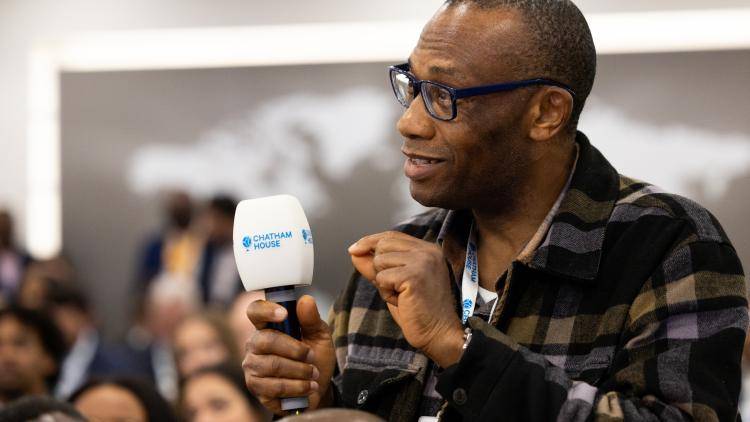
Ben Bland
Welcome, everyone who’s joining us here today at Chatham House in person and around the world online. My name is Ben Bland. I’m the Director of the Asia-Pacific Programme here at Chatham House. In a world that seems to be changing by the minute, we’ve got a great opportunity today to talk about one of the much more important long-term questions, which can’t be answered with an X or Truth Social post, and that question is, “What is China’s Vision for a New World Order?”
We know that the Chinese Communist Party wants to reshape the world so that Beijing has a much greater voice in global affairs, so that sovereignty, Trump’s liberal principles and economic ties are the primary glue of international relations, not ideological affinity. The CCP has promoted a slew of alternative institutions to achieve its aims, from the Asian Infrastructure Investment Bank, the Shanghai Cooperation Organization, to the Belt and Road, Global Development and many other initiatives. And China’s leader, Xi Jinping, has pitched himself now as a global peacemaker, from Iran and Saudi Arabia to Ukraine and Myanmar.
Donald Trump’s shift to a more unilateral, transactional and unpredictable foreign policy, to put it mildly, seems to be playing into Beijing’s hands across the Global South and even in many developed countries, and seems to be as probably doing a lot of work there. But I think it’s fair to say that Xi’s goals still remain hotly contested, partly by the US, depending on what the US is doing at any one moment. Its allies, including here in Europe, and of course, several of China’s neighbours, many of whom have their own territorial and other disputes with Beijing. China’s overseas ambitions also are constrained by the economic and other challenges it faces at home.
So, to make sense of how China sees the world today, I’m really glad to be joined by three deeply knowledgeable, well-connected and very smart Analysts. Down the line from Washington, we have Joseph Torigian, who’s Associate Pressor – Associate Professor at the School of International Service at the American University and also, a Senior Fellow at the Council on Foreign Relations. And here in London, we’re lucky to have both of our Senior Research Fellows for China, Yu Jie, and our newest member of the team, James Kynge, as well.
Just a reminder before we begin, today’s event is on the record, and it is being recorded. I’m going to ask questions for about 35 or 40 minutes to the panellists, and then we’ll open it up to your questions here in the room and online. If you’re online, please use the Q&A function on Zoom, and also, tell us your name and affiliation.
So, Joseph, I’m going to come to you first to try and get inside the head of the man who’s at the heart of this, kind of, new Chinese vision for the world, Xi Jinping. We like to think a lot about foreign policy, but when he’s lying in bed at night, what do you think Xi Jinping is worried about?
Joseph Torigian
Well, first of all, let me say what a thrill it is to join you at Chatham House. I was in London in the fall for about a month and I grew rather fond of the city, so it’s wonderful to be back, in spirit, if not physically. I don’t know what he thinks about before he goes to sleep, but I will say how he, himself, characterises what he worries about. He is remarkably frank about how he thinks about risk. He talks about it quite a bit. He describes about how easy it is that social and economic problems become political problems, how small problems become big problems. He uses phrases like “grey rhinos” and “black swans” and “butterfly effects.”
Shortly after he came to power, he gave a speech that was leaked, in which he describes how the Western powers, especially the United States, will become increasingly brazen in their attempts to constrain China because of ideological differences, because of the system’s competition, and that the danger is those forces will link up with forces at home, everything from what he describes as “weaker terrorists” to Tibetan splittists, to Lawyers. That the problem will be “if the international climate and the domestic climate,” this is the kind of language that they use, somehow “come together in a way that is surprising, that would threaten the regime.”
So, this sense of crisis, this sense of danger, is something that’s very endemic to Xi Jinping’s worldview. We can debate where that comes from. I think arguably, his personal story helps explain why he believes a strong state is so necessary. He’s someone who witnessed the Cultural Revolution, witnessed the June 4 protests, and his answer to this problem of how you keep the regime alive is you take thousands of years of traditional Chinese culture and you baptise it continuously in the legacy of his father’s generation, something that he calls ‘self-revolution’. And what that means is he believes that the people who came immediately before him gave up the ‘knife of struggle’. This is the language that they use, and that he is going to pick it back up again.
However, he also says he’s not going to restart the Cultural Revolution. He’s still going to avoid the leftism and the radicalism and the isolationism, the Cultural Revolution. And how you find that happy medium is not easy, the party has always struggled to figure out how to balance practicality, flexibility, openness, with ideology and security and zeal, and it requires a great deal of political skill and we’re watching as the Chinese try to figure that out.
Ben Bland
Well, if I had all that on my plate, I wouldn’t be sleeping very easily, that’s for sure. I mean, Yu Jie, I want you to unpick a bit how we can differentiate how Xi Jinping sees the world. ‘Cause many of the things he says and does are in line with these broader objectives of the Chinese Communist Party and there are some areas in which he’s different. So, how do you see those differences? What does he bring to China’s worldview that’s a change from previous leaders?
Yu Jie
Thank you, Ben. First of all, welcome to Chatham House. I’m so delighted to see a full room here. Secondly, to answer your question, Ben, I think let’s start with at a personal level. For any leaders in the world, I mean including Donald Trump, including Vladimir Putin, the time that – where you, kind of, shape your ideas really started from your teenager years. So, I think for Xi Jinping, the way how his worldview has been shaped, the way how the governance of the country has been shaped, is – really start from the time of when he was 14 and 15, being sended to the really deep west of China in a cave. So, he’s thinking about that sense of great self-reliance, great sense of self-survival and has that determined how he would try to run the country, as what we have seen today on the policy on scientific self-reliance and economic self-determination? So, that is one layer.
Now, how this put difference compare with the previous predec – the two predecessors, taking two examples in here? One is on Deng Xiaoping, the other one is on Jiang Zemin. Deng Xiaoping went to France at age of 17, travel all the way from the far end of the south-west of China, Sichuan, to right in the centre of the world at that time, Paris. So, embracing that sense of capitalism, you know, the modernity. So, that actually impact him later and try to present this what China need to do is to open up and reform. And equally like Jiang Zemin, interesting enough, what is the first job? Before I came here, I looked up a little bit. The first job, and he was a Technician for ice cream factory in Shanghai. So, I mean, many of them refer as Miss Ice Cream, and partially, it’s because the way he have to managing the machinery, on the one hand, but also try to work with the Westerners in Shanghai at the same time.
So, that sense of cosmopolitan work view has shaped them. So, I think this cosmopolitan work view and the vis-à-vis that gre – seeking a greater self-reliance, really put Xi Jinping quite different from two of his predecessors.
Ben Bland
And James, I know you first lived in China in the 1980s. I think you were in Beijing during the crackdown on the protests in Tiananmen Square. I mean, do you see Xi Jinping as having shifted China’s foreign policy in its view of the world, or is he in some, sort of, respects, a culmination of, you know, China’s rise and the collective will of the Chinese people and the Chinese Communist Party?
James Kynge
I think there has been a bit of a shift. I think that the noticeable trend has been a shift towards a very pronounced security mindset that permeates pretty much everything that Xi Jinping does, his worldview and the way that he orders the Chinese bureaucracy. Yu Jie just mentioned his personal experiences as a child. I would’ve thought that the privations he suffered during the Cultural Revolution would be enough to instil a, kind of, security mindset in anyone. And so, I think it is partly personal, but as Joseph said, it’s also because I think Xi Jinping sees – when he looks at the world around him, he sees a place beset with threats…
Yu Jie
Hmmm hmm.
James Kynge
…particularly from the West. And so, since he’s come to power, I think there have been a few moments, or crucial moments, where he’s re-ordered the way the Chinese bureaucracy is organised and also interacts with the rest of the world.
The most important point was in 2014, when he, basically, said that most of the agencies of government should adhere to what is called the “comprehensive national security concept.” And under that concept now, 16 ministries of government are classified as National Security Ministries, and those include things that we would probably think of as purely civilian, like food. You know, so they go right the way down the list, and I think it’s true to say that one of the most important commissions, which is headed by Xi Jinping himself, is called the “Central State Security Commission.” But there are other ministries, the Ministry of Cyber Space Administration of China, the Ministry of Science and Technology, Ministry of Information Technology, all of these ministries are classified as National Security Ministries.
So, I think that the crucial difference between Xi Jinping and the past is that China is leading in terms of its relations with the rest of the world through a security mindset and it defines economics, commercial interaction, as national security, to a much greater extent than previous leaders.
Ben Bland
So, Joseph, I want to drill a bit more deeply into the foreign policy and the view of the world specifically, then. I mean, you talked about a lot of things that, you know, the Chinese leadership might worry about, but what are China’s key objectives when it comes to foreign and international policy, would you say?
Joseph Torigian
So, at the highest level, on the ideological level, they, kind of, talk out of two sides of their mouth. So, what you will see from some parts of the government, and especially the Liaison Department, which is their institution for dealing with foreign leftist, Communist and revolutionary parties, it’s striking the kind of Marxist language that they use. They talk about how “The triumphs of China, its demonstration that there are non-Western forms of modernisation, inspire leftism throughout the world and helped reshape the balance of power between the historic struggle between capitalism and socialism.”
And as I mentioned before, Xi Jinping does believe that one of the reasons the West is trying to comprehensive encircle and constrain China is because they are unwilling to co-exist with a system that is different from their own. And Xi Jinping puts out a message that China’s system is superior. It’s superior in his mind because in the West, you have material wealth but spiritual poverty, because in capitalism, it’s the people with money who run things and that, inherently, is not something that wins the respect of your own citizenry, but also the global community. He has this idea that constitutionalism and the rule of law is actually just a way of facilitating special interest dominating. The Chinese talk about how by having a strong leader in China, you have a sense of direction. It allows you to avoid cultural battles. It allows you to avoid Politicians who just try to win easy points on each other.
And so, he is saying, essentially, that the Chinese model is at least a reference for the rest of the world, in a way that I think is very different from Western values. But what’s striking is that they also say something else, which is that it’s the West that’s ideological and not them. And this is a message that they also put out to the international community in a way that allows them to contrast themselves with what they described as “Cold War thinking, zero-sum thinking, alliance thinking,” that’s how they talk about the West. And so, it creates an inherent tension there, right, which is, well, is it an ideological contest or not?
When we saw Xi Jinping on the rostrum with Kim Jong Un and Vladimir Putin, a lot of people drew the conclusion that it was an axis of authoritarians. My understanding is that even some Chinese people thought that was a mistake because they understood that that was the conclusion that people from places like Europe would draw and that it’s not useful for China to be seen as facilitating this global authoritarian bent. And so, what I’m trying to draw out here is that there are these tensions in what they’re trying to achieve and that sometimes they talk more about one aspect and sometimes they talk about the other. But I would say that Xi Jinping does believe that by remaining as the last great Communist superpower, that is a defining feature of how he thinks about China’s place in the world and why he cares about other people paying respect and attention to what he sees as this contribution that’s world historical.
Ben Bland
And Yu Jie, if we, sort of, think about that in a more practical context, like imagine the in-tray for China’s Foreign Affairs Ministry this year, but ahead of their meetings with Xi Jinping, to, you know, discuss what they have to work on, what are the key challengers that China’s facing on the world stage right now from a Chinese perspective?
Yu Jie
Well, I think there are two things in here what we can keep in mind and two things beginning with letter ‘s’, which is stability and security. Stability in terms of that sense of se – obsession that China’s neighbourhood policy, that this is the country bearing in mind still shared borders with 14 different countries and can they handle those bordering relationship with each 14 different countries? So, that sense of obsession about the stability within the neighbourhood, I think that’s remain as the priority number one and as what we can see from the various writings and various official documents from the Chinese official sources.
Now, the second element in here I’m talking about is the security, is what James was mentioning earlier about this greater emphasis towards national security, which is very similar to United States and very similar to European Union these days. But that sense of a security is not just linked back to protect itself, but even using security as a way to make the country become even more prosperous. So, when Xi Jinping talking about national security, you should serve the purpose of economic development, that’s exactly what he’s really after. So, that is to say by using the term ‘economic security’, for example, in here, it’s really about how China can guarantee its own supply chain.
So, by the end of the last year, there was the last Poliri – Politburo meeting from 2025, there’s one very striking sentence has come out to say that “China will have to manage a even more intensed international trade conflicts,” and that was the overall assessment for Beijing for 2026. And obviously, well, I think the rest of the world worry about the supply chains that China may cut if off, but I think equally, China is worrying about its own supply chain, worrying about its own sustainability in terms of its own economic resilience. So, I think that sense of stability and security will remain as the in-tray for both Wang Yi and for Xi Jinping.
Ben Bland
And James, how far do you think this is a proactive approach to putting national security first and how much is this just reactive, this is just a reaction to US efforts to contain China, to cut off China’s access to technology, to deepen its partnerships, at least in the past, with US allies, that, sort of, hem China in at the borders?
James Kynge
Yeah, I know, Ben, you don’t like your panels too much…
Yu Jie
To…
James Kynge
…to be in…
Yu Jie
…agree with you.
James Kynge
…too much in agreement with each…
Ben Bland
Hmmm.
James Kynge
…other. But I have to say that I think the point that Yu Jie just made is absolutely key. Chi – I think this is – this has been a long run, premediated, pre-considered policy of China, going back at least 25 years. I’ll just give you a couple of bits of evidence. So, back in 2015, China came up with the Made in China 2025 plan. The whole point of the plan was to reduce China’s dependency on Western economies. So, it meant that local content, local dominance, local companies, would dominate all of the industries that were mentioned within the Made in China 2025 plan.
So, China has now reduced the Western – the previous Western chokeholds on China down to virtually nothing. There is a little bit of a chokehold when it comes to imported energy, but this is – has reduced dramatically with the rise of the deployment of Chinese renewables, solar, wind, etc. And there is a little bit of a chokehold, or a significant chokehold, in terms of iron ore. But if you’re looking at the developments recently in Guinea, where China’s just opened an enormous mined [means mine], the Simandou, I think, mine, that will drastically reduce China’s dependence on Australian iron ore going forward.
So, this has been planned for decades. At the same time, China’s chokeholds on the West have increased and this has also been premeditated. We should look at the rare earths example that blew up in Austra – in October last year, where China showed that its dominance of the rare earths supply chain can be weaponised into a very significant geopolitical tool that, basically, caused The White House to back down in its trade negotiations with China. But rare earths is by no means the only chokehold that China has on the Western world. Just consider that 70% of the precursors of every medicine used all over the world are made in China. Consider that 80% of the so-called legacy semiconductors, that’s semiconductors above the level of 14 nanometres are made in China. So, all of our cars use semiconductors that more than likely are made in China. The same with cellular modules, Si – China controls more than 70% of the global market in cellular modules. That means that every time the traffic lights go on and off when we cross the road in the UK, it’s being conducted by, more than likely, a Chinese cellular module.
So, I could go on and on and on. The point is that there’s been a huge inversion between – in terms of economic chokeholds. China has released itself from all – almost all economic chokeholds that the West had on China, and yet, China’s been building up a suite of these chokeholds on the West. This has been entirely premeditated, and it leaves the West in a very vulnerable position.
Ben Bland
Alright, I want to pivot the conversation a bit here to look at some of the, sort of, proactive external initiatives that China’s launched in the last few years and try and get a better sense of what’s behind them. I mean, Joseph, as you were saying, there’s a sense in Beijing that, you know, the world was made in a very unfair way for China and global institutions like the World Bank and the IMF and even the UN are there to, sort of, uphold US and Western interests more generally. And we know that China’s launched, you know, first the Belt and Road Initiative, and then more recently, the Global Development Initiative, Global Security, Global Civilisations Initiative and most recently, a Global Governance Initiative. What’s the intent there, Joseph? What’s China trying to achieve?
Joseph Torigian
So, you’ve referred to several different issue areas, and I think that what they’re trying to achieve and their thoughts on each of them would deserve breaking down. I think that with regards to the Bretton Woods Institutions, China still participates in them and is trying to change them from the inside, even as they’re building other institutions on the outside. And arguably, by doing that, it – each one facilitates the other and it at least creates the possibility that if the Bretton Woods Institutions don’t progress in a way that the Chinese think should, based on their growing power, that they have these other institutions in reserve.
You also mentioned those initiatives, they’re – where they’re a little amorphous, but I think essentially, what they’re about is China trying to make a case that it has its own vision for the world in a way that has people, especially from the Global South, who would find something meaningful there. And so, sometimes I think in the West, we look at that kind of language and it sounds boilerplate or it sounds like propaganda, but they do have a message, a message about economics over ideology, even though, as I said, there is an ideological element to what they’re doing, and one that criticises the West for double standards. That talks about the West as – and the United States, in particular, as a country that is no longer respecting the international order anyways.
There was a striking Xingua piece that came out a couple days ago that said that “The United States always acted in an imperialist fashion and now they’re not even” – but “they said they weren’t and now they’re not even pretending that they’re not.” And so, I think it’s part of China’s attempt to create a narrative that fits their view of the world, that allows them to win over people, not just in the international community, but can – that can demonstrate to people in China, people at home, that they have the right to be culturally confident in their country and see that they are winning in adherence to their vision for global order.
Ben Bland
Well, look, I’m a very boring Analyst because I think you always have to look at what people do more than what they say. Most Academics prefer looking at the rhetoric.
Yu Jie
Yeah.
Ben Bland
And I always say follow the money and if you do those two things, you’ll have a much better understanding of the world. But Yu Jie, isn’t this all hot air? Is there any money behind these initiatives? Are there rules, are there principles? Is China actually taking responsibility for other people’s problems? Are they leading the way or, yeah, or is this just a bunch of boilerplate languages, as James…
Yu Jie
Well…
Ben Bland
…has suggested?
Yu Jie
…certainly, you can shake the tins. So, to start with, yes, so among these four different initiatives beginning with ‘G’ and I think the – probably the most well developed and well-funded is the so-called Global Development Initiative. But I think the funding resource is only ten times less compare with the Belt and Road initiative Beijing has launched 12 years ago. I think partially, Beijing has learned a lesson that by simply just offer money through resources, it may not always guarantee to have the political return that Beijing has intended. So, I think what Beijing try to do now is trying to do it in a more smart way. That is to say building a narrative first, and to make the rest of the world, and particularly I think this would be the music for the part of the Global South, to buy into China’s ideas on the so-called Global Governance and global whatever initiative you may referring to, the four in here.
But then secondly, followed by a small amount of funding and that put together, channelling through the existing international institutions. So, primarily in here, we’re talking about all these initiatives beginning with ‘G’ and the way China has decided to populate it from, it started from the United Nations. And that is also part of a reason why China felt that exist under United Nations is absolutely vital, even for China, in order to populate this and also gaining currency on these initiatives and to make more credible. So, any single initiative within here with a G, Beijing’s seeking to have a stamp from the UN on it. So, that is one of the strategy.
But I think this is also largely to do with the reason that United Nations as a platform is the country – is an – is a platform that is one country, one vote. So, irrespective of how small or big the country it is, and the more vote that China would have, and obviously, these would adding more weight, more heft, towards Beijing.
Ben Bland
And in addition to the initiatives, China has actually been building its own rival…
Yu Jie
Hmmm.
Ben Bland
…institutions, James, if we think about things like the Shanghai Cooperation Organization that’s meant to look in, sort of, peace issues. The BRICS, thinking about economic development and the Asian Infrastructure Investment Bank, as well. I mean, what does the development of these institutions in recent years tell us about how China does global governance or global leadership in practice?
James Kynge
I mean, I think that these are, basically, the building blocks that China will try to, at some stage, join up to become the New World Order. We’re all, at the moment, prophesying the death of the current world order. Mark Carney the other day in Davos said, he – he said the current world order was ‘over’. I think that’s a gross exaggeration, but we can see that the bricks of the current world order are coming off the wall. And I think China is picking up the bricks that it wants and then putting them into its own structures and slowly building up the furniture of what it wants to be the New World Order.
And so, I think the four initiatives beginning with G are part of that. Shanghai Cooperation Organization is another part of it. The development banks that you’ve mentioned, the AA – AIIB, also the New Development Bank, that’s part of it. But I think underpinning this whole thing is China’s main offering to the world and that is the Belt and Road Initiative. We really can’t underestimate the importance of the Belt and Road Initiative. The latest numbers, which come from AidData, which I think is the best source on Chinese lending around the world, this is a consultancy based near Washington, say that from 2000 – the Year 2000 until 2024, I believe, Chinese banks lent US$2.2 trillion in development loans around the world. Most of that was to Belt and Road Initiative countries that were used to build railways and roads and factories and bridges and all this type of thing.
And so, why does China get such incredible attendance and interest in membership of these minilateral organisations like the Shanghai Cooperation Organization and the four initiatives beginning with G? The answer is that all of those countries are there for a self-interested reason. They all want to get the next loan to build the next bridge, to build the next factory, to, basically, improve their economic performance in the world. And China has exceeded every other country around the world in offering this type of assistance and importantly, delivering it on time, quickly. And so, this is China’s great offer to the world, I think.
So, at the moment, what I’d say in general is that China’s putting in place the pieces of the furniture for a New World Order, but that order is not yet made. However, there is great interest, particularly in the Global South, in being part of that order.
Ben Bland
Yeah, and we see that, obviously, from the desire to join the BRICS in…
James Kynge
Absolutely.
Ben Bland
…the first place.
Yu Jie
Yeah.
James Kynge
Yeah.
Yu Jie
I mean, can I disagree with you…
James Kynge
Sure.
Yu Jie
…on the Belt and Road Initiative? Sorry, first time disagreement…
Member
It’s your first time.
Yu Jie
…with each other. So, finally, we come to disagreement. I think that the importance of Belt and Road Initiative within China’s overall diplomatic priority has become lowered, not more. I think this is partially to do with the fact that if Beijing decided to building a more resilient economy and that would require to pivot the financial resources back home but not necessarily spending abroad, I think this is also part of reason of why we have this sibling of the Belt and Road Initiative, which is the Global Development Initiative I mentioned earlier in here.
So, I think this would potentially cause some kind of backlashes that China might have with a large number – with some members of the Global South, because I think Global – part of the Global South are quite used to consider China as being – become the last resort of lending. But what if China suddenly become looking more inward and decided not to support the Global South as how it used to be in the past, and particularly given its own domestic economic condition? And that would causing disappointment. So, as we know, once the greater expectation you have and the perhaps the lower return on investment you will receive.
So, I think that perhaps let’s putting a nuance on this. Yes, China did offer the rest of the world on the Belt and Road Initiative. However, that initiative has caused both equally the praise, as well as a very strong criticism at the same time. So, I think let’s look into this objectively and China just cannot continue to become the last resort of lending for a large part of developing world.
Ben Bland
Hmmm, but if we move beyond the material offer to the world, it’s interesting to me that Chinese leaders are increasingly pitching themselves as global peacemakers. I think it was something that China was quite reluctant to do in the past because of its own adherence to non-interference, but I think in a recent speech Wang Yi talked about China having played an active role in negotiating over Myanmar, nuclear weapons in Iran, Pakistan-India tensions, although they might disagree in New Delhi about that, Israel-Palestine, Cambodia-Thailand. It’s almost as many conflicts that China has solved as President Trump, if you listen to Wang Yi. Joseph, I mean, what – has China actually got involved deeply in these conflict situations? You know, are they really willing to take on the risks, you know, to be a peacemaker in these of the seemingly intractable issues?
Joseph Torigian
So, I think that in Venezuela and Iran there are probably voices that are expressing disappointment in the absence of China during these moments of crisis. And so, I think that for China they certainly have been on a charm offensive throughout the world, and I think that they see an opening because of choices made in Washington D.C. But the question is just how far they can get, and as James was saying, there are certain tensions that the international order is facing, but it’s still not clear just how far in a new direction we’re actually moving.
And so, for example, we see the Canadian Prime Minister visiting the United States. We know that your Prime Minister will be visiting China soon. We know that the German Chancellor will be visiting China soon. And so, there’s been this narrative of China, sort of, marching along and picking up these victories, but all of these countries still find themselves in a difficult space that they will continue to balance multiple different centres of gravity. And I think that, for example, in all of these countries, they may believe that a different kind of relationship with China will help them with economic challenges at home, but at the same time, China represents economic challenges, as well, right, by dealing with them. And I think all of these countries continue to worry about things like human rights within China, also China’s technique for projecting power within to their societies. There is, of course, these questions about how China treats its diaspora and Canada, in the UK and in other places.
And so, even if there is a shift to a more co-operative relationship with China, there’s probably some restrictions and limitations just in terms of how far they can go, also because there is the gravity of the continuing relationship with the United States in terms of politics, economics and security. And so, what I would suspect is that there is a spectrum and countries will move, sort of, back and forth in terms of how they signal their intentions with regards to Washington and Beijing and, you know, whether middle powers can work with each other. The Carney speech, essentially, was a clarion call to a, sort of, axis of middle powers, if there’s – it’s probably not the right phrase.
You know, whether the Europeans will be able to work more closely together, whether Brussels will be able to be more forceful in its dealings with both Washington and Beijing, or whether individual countries will be open to, sort of, side deals with Washington or Beijing, these are all open questions, I think. And the fact that they are open questions probably means that it’s going to be a future of turbulence, as opposed to a future of a completely different world that’s stable, I would suspect.
Ben Bland
And Joseph mentioned earlier, you know, the deepening links between China, Russia, North Korea. I think here in Europe and in Washington, sometimes, you know, these countries get lumped together with North Korea. There’s this expression ‘the CRINKs’, I think China, Russia, Iran, North Korea. I mean, Yu Jie, do you think that’s, sort of, helpful way to understand China’s role in the world through these partnerships, which they are, you know…
Yu Jie
Yeah.
Ben Bland
…as a matter of fact, deepening, both bilaterally and minilaterally, between those countries? But is this a helpful way to understand China’s relationships with Russia, Iran and North Korea?
Yu Jie
Well, it’s certainly, it’s a interesting syllable, I mean, as a pronunciation. But I think on the other hand…
Ben Bland
Sounds quite evil.
Yu Jie
Well, it’s – it just sounds, kind of like, invention of the world, let me – the invention of vocabulary. But I think on the other hand is it’s not just China has a relationship with all these countries, but I think equally, India, South Africa and Brazil equally have this in – relationship with those coun – with the so-called INK countries without C, so INK rather than…
Ben Bland
And much of…
Yu Jie
…CRINK.
Ben Bland
…South-East Asia…
Yu Jie
And much…
Ben Bland
…and South Asia.
Yu Jie
…of the South-East Asia, the area that we’re worked very closely. So, is – I think this really come to the matter when it come diplomacy. That I think many of those countries and also including the countries that we mentioned earlier, do not necessarily consider shared common value as the first principle when they come to building diplomatic relations. But instead, I think those countries are very, very much accustomed to that sense of a transactional approach, that is to say, “Well, your enemy’s enemy is my friend.” I think this – the philosophy can be as simple as that. So, I think that’s one of the reason that somehow, we’re quite misguided. If we only use the lenses of the Europe in here to very much look into a value-driven diplomacy in here and then they will find very hard to comprehend how China behave with the other countries and differently. So, I think that’s one thing.
Now, come back to the question earlier when you’re talking about would China be – assume more international responsibility? I think what we can learn is – in here, is that quite interestingly, United States is the best teacher of China for how not to become a great power. One of the key lesson I think what China have learnt from United States, is not to get involved in the conflicts that is only half-hearted understand and you get involved then. But instead, will be much preferably to stay from far and really mediate it from far. So, I think that’s a – very much the key lesson from what United States have failed to do and China pick up that.
Ben Bland
Before I come to audience questions in a second, I just want to pivot James…
Yu Jie
Yeah.
Ben Bland
…a bit to the hard security questions. We know that China is going through an unprecedented military buildup, both with the scale of its military, I think its navy now is bigger than that of the US, also the technological advancement. And we know that these military assets are often, in the first place, sort of, targeted on Taiwan and maybe the South China Sea. We had a really interesting conversation with a Chinese colleague recently, who was saying, you know, “Don’t worry about the military buildup. It’s just to secure China’s borders, nothing to see here.” I mean, where do you think China goes, you know, with this global influence, with this huge hard military power? You know, can it stop at Taiwan and the South China Sea, if it can get there, or is it just on the same trajectory as every other, you know, great power and empire before it? That once you have, you know, these global responsibilities, these global interests and military power, you’re going to end up having to deploy it all over the world, whether you like it or not?
James Kynge
So, my sense of this is that China has a fairly disciplined hierarchy of priorities, both economically and strategically. And when it comes to the top priorities strategically for China, obviously, as you’ve mentioned, Taiwan and the first island chain. And China is building up its military and its quasi-military dual use capacities to achieve its goals of reunifying with Taiwan and effectively, dominating or controlling the first island chain. That’s its first port of call.
There are, I think, credible reports that China will have nine aircraft carriers by 2035. It’s just built its third aircraft carrier. The fourth aircraft carrier, which is under construction, will be China’s first nuclear powered aircraft carrier, which means it doesn’t need to refuel. So, it can go wherever it wants anywhere in the world without having to refuel. China’s building up an incredible air force, also, and, you know, the fighter jets that can land on these aircraft carriers. And then, I don’t know if any of you saw the extraordinary deployment of the Chinese fishing fleet the other day to form, effectively, a band, or an impervious band of – in the sea, not so close to Taiwan, but close enough to make people think that maybe in the future fishing boats in China could be deployed as a dual use technology to prevent some kind of an American rescue of Taiwan, if that was to happen.
So, it’s very clear what China’s aiming at. They make no – they really make no secret of this.
Yu Jie
Yeah.
James Kynge
My sense – the other side of that is that other issues, and we’ve already mentioned some of them, I mean, things like Venezuela, are far down the list of China’s strategic priorities. And therefore, when you read something that says, “China has an all-weather strategic partnership with Venezuela,” you can be pretty much sure that that is rhetoric. The Chinese Military is not going to come in and take on the American Military over Venezuela, neither in Iran. But when it comes to core Chinese interests, the Chinese will, I think, pursue those single-mindedly.
So, you asked me to project forward. That’s a really tough thing to do, but my sense is that China will not be immune from the essential dynamic of – that has affected all…
Yu Jie
Yeah.
James Kynge
…empires in human history, which is that as your interests around the world grow…
Yu Jie
Hmmm hmm.
James Kynge
…your need to protect those interests also grow. And we shouldn’t forget that China has existing territorial claims in what is now India and most of a – well, a huge chunk of Siberia. I think everything south of the Yenisei and east of the Ob is the phrase in Siberia. So, you know, we can see the outlines of a potential increase in Chinese ambitions, territorial and otherwise, even after a day in which China may have retaken Taiwan and the first island chain.
Ben Bland
And if they want to be a hemispheric power, they know who they can emulate right now. With that, happy to take your questions, so please just pop your hand up, and then, if you have any affiliation, tell us what it is, as well as your name, please. Yeah, Isabel.
Isabel Hilton
Thank you.
Ben Bland
Just wait for the mic, as well.
Isabel Hilton
[Pause] Thank you very much. Isabel Hilton, member of Chatham House, amongst other things. A very interesting conversation. Now, I just want to pick up on a couple of things. Joseph mentioned the side deals that China would seek to make with members of the European Union. I was very struck in conversations with Senior Officials in Beijing, the degree of active hostility to the European Union, particularly the Commission, at a much higher level than I had ever encountered before, divide and rule always having been a, kind of, tactic. But this is an out to destroy kind of mission and coming partly from the regulatory power of – obviously, of the Commission and China’s need to get rid of its surplus production into advanced markets. But also, Wang Yi’s remark in the summer that “China can’t afford for Russia to lose the War in Ukraine,” which is obviously a continuing obstacle to good relations.
I just would be very interested in how you see this going and, you know, what – clearly, it has major implications in terms of global ambitions and in terms of Europe. Thank you.
Ben Bland
Yu Jie, do you want to take that?
Yu Jie
Sure. Yeah, I mean, let me take on this. I think, Isabel, your conversation with Senior Chinese Policymakers are very similar to what I had, as well. The sense of resentment and also perplexity towards Europe and also the EU in general, and how – why Europe somehow, really from the start, and almost impossible to have a conversation with China. I think that has been quite strike ever since – striking ever since Russia’s invasion of Ukraine.
I think there’s also be – big – a bigger structural issue in here about particular China’s economic model that Beijing want to run. That is to say if Beijing aiming, aspire or already become the global manufacturing power of high-end products, no longer producing toys and textiles, but instead to producing drones and semiconductors, Beijing will now having a direct competition with European economy and with European companies, and what that will led into? That will led into a mass unemployment that happen within Europe, so – and then that would let into the rise of far-right within Europe.
So, I think that’s really for Europeans, is the structural struggle that is very much in intend to have with China. And that is also partially to do with the Chinese that just simply, as I said earlier, the so-called veil – value-driven diplomacy very much stand in stark contrast with this pragmatic and transactional led approach of diplomacy. So, I think there’s two irritants within Europe and China, irrespective of what happen with United States, and that will remains to be there and is very unlikely to ease at any time soon.
Ben Bland
Okay, thanks. The gentleman here in the pink shirt.
Houman
Thank you very much. My name is Houman, I’m a PhD Researcher on Financial Crime, with focus on Russia, China and Iran. To what extent is financial crime, particularly money laundering, corruption and sanction evasions, emerging as a domain of US-China strategy competition, with direct implication for national security? Do differing approaches to financial regulations, data governance and enformes – enforcement risks, fragmenting global efforts to counter illicit finance, and what does that mean for resilience of the international financial system? Thank you.
Ben Bland
Well, I’m not sure we can go into all those details in the time we have, but yeah, who wants to take on this question about China and sanctions and the extent to which that’s part of its relationship with North Korea and Iran?
James Kynge
Yeah, I mean, I can throw out a few observations. But I certainly – I came across some interesting reports, this would be 2024, the extent of Chinese – I would say underground flows of Chinese money. There’s an excellent Researcher in the United States called Brad Setser. He estimated that illicit flows, so this is flows out of China to other countries around the world, could have been in excess of US$500 billion in 2024 alone. And this – the ways in which this money is taken out of China are very numerous. Some of it is crypto, some of it is using so-called mirror banking system. You probably know about these. But anyway, the long and short of it is that a lot of capital escapes from China every year and in the case of 2024 and Brad Setser’s estimate, that was about 500 billion.
Now, a lot of that money is used in the smuggling drug cartels in Latin America and so, therefore, we get to the issue of crime. And there’s been some excellent research done by Researchers in the United of Miami on the link between Chinese underground money and, you know, in drugs smuggling, the Sinaloa Cartel, etc. So, I think it’s a really big issue, but it’s very hard to know how to combat this type of thing. We have seen a lot of the justification for Trump’s attack on Venezuela was supposed to be counternarcotics. So, obviously, this is on the register of the United States, but I don’t think I can give answers to the other aspects of your question.
Ben Bland
I’ve got a question, I think most relevant for you, Joseph, from Īsmail Özgür Berkman. He says that “China’s not in a hurry and they’ll probably only confront the US after they have nuclear arms parity.” So, yeah, do you agree with that? Is that a, sort of, key target for China to really step up its level of confrontation, its global role? And does that, sort of, give time for the US and China and other powers in China to come to some, hopefully, more accommodative ways of working together?
Joseph Torigian
Yeah, that’s a very interesting question. It is striking that shortly after coming to power, Xi Jinping did make a decision to rapidly expand its nuclear arsenal. So, for decades, the way of thinking about the bomb in Beijing was that having a reliant secondary strike for deterrence purposes, as opposed to war fighting, would be enough. And so, as China expands its arsenal, it has raised questions about whether they might be moving towards launching and warning, whether they might be actually thinking about how to use nuclear weapons to defeat American forces, as opposed to keep American cities at risk.
And so, we don’t know exactly how or why that decision was made. I’ve heard from some people that it speaks to these broader themes that have come up during this conversation, which is that Xi Jinping is very sensitive to power and that to have that be in his pocket would create a background to enti – interaction with the United States that would facilitate whatever goals he might choose to pursue. And, you know, confrontation is a somewhat vague term. I don’t know if that refers to Taiwan or something else, but my suspicion would be that especially after looking at how Russia’s nuclear sabre-rattling during the War in Ukraine did lead to meaningful decisions and self-restriction by Washington, that they might’ve drawn certain conclusions from that.
It’s also very clear that they are expanding rapidly but facing certain challenges. We have seen these purges within the People’s Liberation Army that are curiously targeted around the Strategic Rocket Forces. But I would say that if we’re looking at Taiwan, I would suspect that the nuclear weapons side would be part of that story in terms of how comfortable he might be being more aggressive there. But I think that there are a very wide – there’s a very wide set of calculus about when they would decide to do something about Taiwan. And that my own suspicion would be that the longer they wait, the less costly it would be for them to move then. Now, of course, if there’s an accident or something like that, that changes the story, and so, that’s not a perfect answer to your question, but maybe a somewhat useful one.
Ben Bland
Great, thank you. Yeah, here, in the middle.
Yu Jie
Yeah.
Ben Bland
Just wait for the mic, please.
Lorraine O’Shea
Oh. Thank you very much, it was a really helpful and interesting talk. James, you mentioned – I’m sorry, I’m Lorraine O’Shea. I’m Lead Tech Policy for a political consultancy. James, you mentioned the, sort of, precu – sort of, thought out plans that China have, sort of, embedded since 2015, Made in China and the, sort of, economic chokeholds through selling, like, IT modules and parts of the supply chain, the semiconductors. Are the West naïve in thinking that technology and AI, there’s a race going on here, or have China already succeeded in the sense that there’s a long-term planning and they’re well ahead of the sort of planning that the UK and the US would do in such areas?
James Kynge
Thank you. Yes, I mean, I get into trouble for my views on this. I think China’s already won the tech race with the US and left Europe far behind. And I think, frankly, in Europe, we’ve been mostly asleep for the last 20 years in this regard. A lot of people disagree with me, so let me just cite a couple of pieces of evidence. If you look on the website of the ASPI, that’s a think tank in Australia, they have something called the “China Tech Tracker” and it says at the moment that China is leading the US in 66 out of 74 advanced technologies and the US is only ahead in eight.
If you look at the latest Nature Index of cited – sorry, elite papers that have cited, elite scientific papers that have been cited, China is far ahead of every other country in the world. If you look at the number of patent applications at the World Intellectual Property office of the United Nations, China has 1.8 million applications pending and the US only has 500,000. So, I think we can safely say whatever your perspective on this view is that China is at least a peer competitor of the United States, and I would say has already won, partly because of the structural underpinnings that China has, and I don’t need to go into all of those right now.
But you mentioned the AI race. It’s a fascinating thing to watch. I’m, kind of, glued to it myself. I would say, you know, the US and China’s, kind of, neck-and-neck on AI at the moment. I mean, Jensen Huang said recently that he thought China was ahead and then he retracted that the next day, he said China was ‘not quite ahead’. So, I mean, clearly, there’s a race going on and this is very much in the mind of Chinese and of Americans. But there are two big differences in the way the race is being run. The first is that most of the Chinese AI models that are doing so well, so Kimi K2, the Qwen suite from Alibaba, and some other ones, as well, they’re all open source, right? Whereas the leading American AI models are not open source.
The other crucial difference is that if you – the price of operating the Chinese models is a fraction of the price of operating the US models. So, we’re talking about 1/10th or less in terms of the million output tokens that you use to judge the cost of operating an AI model. So, this is why if, in the case of Alibaba Qwen, they’ve already got a billion customers worldwide, and that leaves the American AI models in the dirt. So, there’s a lot of interesting stuff going on there. I’m not going to call it, you know. The Americans…
Ben Bland
You already have called it, James. It’s too late.
James Kynge
The Americans…
Yu Jie
You called it, you called it.
James Kynge
If the Americans could come up with an incredible moonshot, that’s what Americans do, and they could win the whole thing, or there could be a quantum, you know, breakthrough that changes the whole model. I don’t – I’m not going to call it, but it is a fascinating thing to watch.
Ben Bland
Okay, and yeah…
Yu Jie
Hmmm.
Ben Bland
…Claire, just…
Claire Smith
Thank you so much for the fascinating panel. Claire Smith from the University of York. I’m a Senior Lecturer there in Politics and IR. I have a question specifically on Myanmar and China’s relation with Myanmar, for the panel. James, you made it very clear that China has this hierarchy of foreign policy goals and interests, and presumably, its own backyard is top priority within that, based on what you were all saying. So, my first question is, to what extent do you think China sees the crisis in Myanmar as an economic threat or challenge, or a security threat or challenge, or something else? And in relation to that, do you think if the EU, UK, US, were to increase any of their potential roles in Myanmar in any aspect of the crisis there, to what extent would China perceive that as a threat to its own interest?
James Kynge
That’s a very interesting question. I don’t know all of the answers. Maybe Yu Jie would have some reflections. But to my point – to my way of thinking, China sees Myanmar as both a big opportunity in terms of expanding its reach, you know, building infrastructure, like the ports there, the roads, and obviously, as a passageway to the sea down in that part of South-East Asia. So, that’s priority number one. It sees it as a big threat, especially in the area of fentanyl. A lot of the…
Yu Jie
Hmmm hmm.
James Kynge
…fentanyl processing goes on just across the border from China, in Myanmar. And China’s been hauled over the coals for this, primarily by the US, because of the fentanyl, you know, disaster that is afflicting the US. And so, my sense is that China has tried to control some of that – the, you know, the fentanyl lawlessness that’s going on in the Shan State there. But whether or not China would be again the idea of the EU, the UK, getting involved, I’m not sure. Do you have any perspective of…?
Yu Jie
Well, I think another strong element in here we shouldn’t be ignore, again, back to the domestic politics, back to the provincial government, largely Beijing’s Myanmar policy in the recent decade is not run by Beijing. It’s actually a feedback from Yunnan province, because that’s what’s bordering to Myanmar, back to Beijing. So, obviously, the local government have agreed to [audible – 59:08] to decide what kind of relationship that local government would like to have with Myanmar Government. So, obviously, Yunnan’s economy perhaps more integrated within that region than, for example, Beijing. So, I think that’s a very strong domestic element we shouldn’t ignore.
Secondly, I think when I said earlier about stability and security, that is also including the domestic stability and domestic security. The issue with Myanmar for China, that actually caused some kind of shockwave among China’s public because of the telecoms scam, and that was one of them – something that Beijing have to consider and is something that policymakers have to respond. And hence, this would make the space for a much fairer diplomacy at play much harder for Beijing. So, I’m actually expecting especially tightened and more strengthened policy on Myanmar from Beijing, rather than just let’s more benign and more generous one.
James Kynge
Hmmm.
Ben Bland
We’re nearly out of time in this fascinating discussion. We’ve talked about a lot of very complicated and long-term issues, so I’d like to bring it all back to a one-word answer to get to the heart of everything. So, the question I’ll ask all of you, and you can only answer with one word, is talking about the breakdown of the global order, and I agree with James, it’s breaking down, but it’s maybe not completely broken yet, is this breakdown from a Chinese perspective, more of an opportunity or a threat to its interest, in your view? So, opportunity or threat? It can’t be both because it has to be more one than the other. So, Joseph, I’m coming to you first, more of an opportunity or a threat?
Joseph Torigian
Opportunity.
Yu Jie
Threat.
Ben Bland
James?
James Kynge
Opportunity.
Ben Bland
Great.
Yu Jie
So, we disagree.
Ben Bland
Exactly.
Member
On many things.
Ben Bland
Well, I think with that, we’ve got a lot of clarity after a really interesting and wide-ranging discussion.
Member
Ben, what do you say yourself?
Ben Bland
Oh, I would say opportunity, opportunity.
Member
Do you…?
Yu Jie
[Inaudible – 60:59] priorities of…
Member
Two to one.
Member
Yeah.
Member
Disappointing.
Member
You can all, obviously, vote amongst yourselves afterwards at home and in the room, but thanks, everyone, for joining us and particularly thanks to Joseph, Yu Jie and James [applause].