Ben Bland
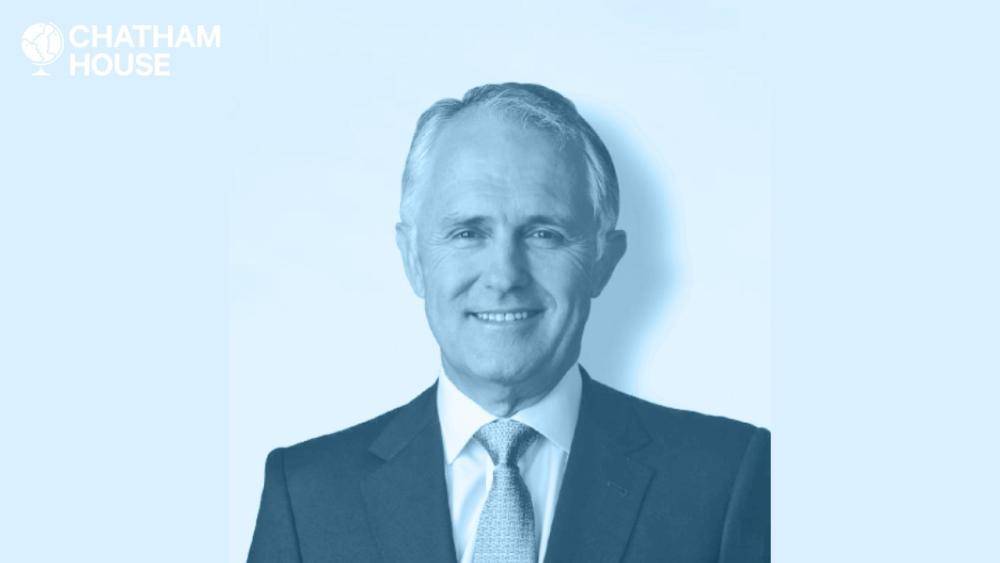
Welcome, everyone, to this discussion with Malcolm Turnbull, the Former Prime Minister of Australia. My name is Ben Bland. I’m the Director of the Asia-Pacific Programme here at Chatham House. To introduce my guest, who probably doesn’t need much of an introduction, but I’m obligated to give him one, Malcolm has had a varied and it’s fair to say high-flying career. He studied at the Universities of Sydney and Oxford, before working as a Lawyer in Australia, where he famously and successfully defended former MI5 Agent, Peter Wright, against the British Government in the Spycatcher case. I actually got that book recently in a charity shop and read it, Peter Wright’s book. It’s pretty interesting.
Hon Malcolm Turnbull AC
Hmmm, that reminds me of that great Australian Clive James poem, “My enemy’s book has been remaindered.”
Ben Bland
Yes, it was a good book that, you know.
Hon Malcolm Turnbull AC
40 years ago, this year, Lucy and I defended Peter Wright, so it was a while ago.
Ben Bland
So, yeah, he started there, then investment banking, you – launched his own firm, then joined Goldman Sachs, before entering politics in 2004 as an MP for the Liberal Party, which is the conservative, small c, party in Australia. Malcolm served as Prime Minister from 2015 to 2018, during which time it’s fair to say he had to nego – navigate a difficult relationship with your key security ally following the election of Donald Trump as President in 2016. Also had to manage ties with a more assertive China, Australia’s biggest trading partner, and you introduced new legislation at that time to tackle foreign interference, which I think the UK and others have learned from since.
In terms of the ground rules today, I’m going to ask Malcolm the questions for about 35 to 40 minutes. Then I’ll take questions from everyone in the room and online. If you’re on Zoom, please ask your questions using the Q&A function, and finally, a reminder to you, Malcolm, and everyone here, the discussion is on the record, and it is being recorded.
Let’s start with the meeting that’s happening later this week between US President…
Hon Malcolm Turnbull AC
Yeah.
Ben Bland
…Donald Trump and Xi Jinping in China. It’s often said that “If you’re not on the table, you’re on the menu,” so is that the case for the rest of us in Australia, in Europe? Are we on the menu as these two great superpower leaders meet in Beijing later this week?
Hon Malcolm Turnbull AC
Well, I think potentially, I – you know, there is a sense of a G2 developing in the world. There shouldn’t be. You know, the Europeans could certainly play a bigger role than they do, but I wouldn’t take that, you know, analogy too far. All – every country, all of the so-called middle powers, which I guess means everyone that isn’t one of the big two, or Russia, I guess, Russia seems to be in a league of its own, is, you know, is in a position to assert its own sovereignty and should do so.
Ben Bland
And what’s your sense of where US-China relations are heading under the current President of the US and also, China’s Xi Jinping?
Hon Malcolm Turnbull AC
Well, it’s very hard to say where Trump’s coming from. I mean, Kurt Campbell’s got a good piece in Foreign Affairs today, which many of you will have read, I’m sure, where he just makes the point of how unpredictable Trump is. I mean, that’s – and that’s a feature, not a bug. I mean, that’s the unpredictability is part of his strategy. I – look, I think the trade war gambit was repulsed by China because they responded with the bans on the export of magnets and rare earths, other critical minerals. So, you know, I would say it’s – look, at best, the US-China rivalry is essentially a draw, but – at that level where Trump thought he had an ace up his sleeve. The recent events in the Middle East, the Gulf of Hormuz closure, the war against Iran, all of this has certainly advantaged China, and we can’t pretend anything else.
In energy, which, you know, I’m, as you know, President of the International Hydropower Association and a number of my colleagues are here today, in the energy sector, we see this as absolutely advantaging China because it is the dominant producer of the means to generate renewable energy. I mean, the message that every country takes out of the blockage of the Straits of Hormuz is we must become less dependent on imported energy sources, you know, fossil fuels in particular. How do you do that? Well, you take Donald Trump’s advice and “Drill baby, drill,” but what if that – what if you haven’t got anything to drill into? What if it’s not – that’s not going to work for you? But nobody – everyone’s got access to sunshine, some more than others. Everyone’s got access to wind. Everyone, and we’re in the hydro business, everyone’s got access to gravity and water, pretty much.
So, you know, unless – you’re in a position to achieve a lot of energy independence with the renewables, and countries are doing that. I mean, a great example is Pakistan. You know, the – 2020, its solar power was 3% of its energy mix. Today it’s over 30%. So, if you’re talk – if you’re – and this is what everyone in the data centre business is talking about, if you’re talking about speed to power, the way you do that is with renewables plus storage, factories for short periods, pumped hydro for longer periods.
Ben Bland
I think we’re going to go into a bit more depth on China and potentially, on energy later, but I want to try and stick with the US now, ‘cause I think it’s really…
Hon Malcolm Turnbull AC
Sure.
Ben Bland
…important for us all to try and make sense of what’s going on in America, especially the extent to which, you know, these are short-term personality driven changes or something deeper.
Hon Malcolm Turnbull AC
Hmmm.
Ben Bland
I mean, starting with the personality of President Trump himself. Obviously, you had a very early phone call in his presidency that was quite difficult back then, but looking back now I think almost ten years, what’s your sense on how Donald Trump has changed as a leader and in terms of his impact on the world…
Hon Malcolm Turnbull AC
Well…
Ben Bland
…over that decade?
Hon Malcolm Turnbull AC
Well – okay, well, first time round, Trump did not expect to win the Republican nomination, and he did not expect to win the general election, and no-one else really expected him to, either, much. So, he was quite unprepared to be President. He’d had no transition team going on and he pulled together an administration which included many capable people. But they weren’t all totally 100% loyal to the Trump, you know, doctrine, whatever that is, or the Trump – I mean, again, I would say, you know, MAGA is more of – as Kurt Campbell said yesterday, as I’m just quoting his piece, “It’s more of an attitude,” you know, “than a strategy,” right? So, they weren’t rock solid Trumpites.
Second time round, he had four years to prepare. Heritage did a whole plan policy document for him, Project 25, and his team is much more cohesive as a result, because the single most important criterion for being chosen was loyalty to Trump. But he’s still the same person, so I think he’s a more – he is more capable of effect – of implementing his will, because there are not as many people, if there are any people, who are saying, “Stop, this is a mistake.” Now, you know, this – that – many – there’s certainly somebody in the administration is briefing all of that out to Jonathan Swan and Maggie Haberman in the New York Times and that piece you’ve all read, which looks like it was potentially dictated from somebody who didn’t agree with attacking Iran. But they’re not being – they’re not – he’s able to proceed without countervailing forces in the administration, and that’s the big difference, I think.
Ben Bland
And there’s been explicit talk now from several key people within the administration about rejecting the concept of a rules-based order and international governance in favour of, you know, national sovereignty and national power. I mean, how far do you think that reflects a deeper shift in the US, both within the Republican Party and potentially, within the public or the electorate at large, to a different view of how America should operate in the world in the longer-term?
Hon Malcolm Turnbull AC
Well, there’s no doubt that Trump believes might is right, okay, and he’s never made any bones about that. And I’ve had a piece in Foreign Affairs nearly a year ago now and I quoted – tweeted his which had said, you know, “My golden rule is – my rule is he who has the gold makes the rules,” right? And so, that’s Trump’s view of the world, but it’s also the view of the administrations, you know. So, this is not just Donald Trump the big ebullient Real Estate Developer taking this view. You look at the National Defense Strategy, this was a – this has come out of The Pentagon bureaucracy, it says, “The international rules-based order is a cloud-castle abstraction,” or less politely, BS.
Now, that’s amazing. You know, think of it, this is the international rules-based order that was established after the Second World War with American leadership. This was the rules-based order that America built and until very recently, was saying the maintenance of which was its single most important foreign policy goal. And so, now you have America saying, “Look, let’s forget about it, that’s BS,” and on the other hand, you’ve got Xi Jinping and Wang Yi, the Foreign Minister, saying, “The international rules-based order is vital, we have to maintain it. Multilateralism is important.” So, it’s a world turned upside in some ways, so that, you know, the great revisionist power that China was said to be is now the major power that is seeking to uphold the rules-based order.
So, hence you get the question, “What do the rest of us do?” And this is where I think it’s really important that countries like Australia and the UK, the Europeans, Canadians, of course, must stick with what – stick with those values. There’s no point us walking away from that, and Mark Carney’s speech in Davos really, you know, set that out in a very compelling and elegant – and eloquent way. It’s harder for Canada, pretty much, than any other middle power, I might add, because they’re so dependent on the US. They’ve got over 70% of their trade with the US, but nonetheless, what’s the alternative? Do you just, sort of, float along and hope that, you know, just – you’re just like mice dancing among – you know, under the feet of the elephants and hoping you don’t get squashed? You know, you’ve got to work together, and there are examples of how you can do that.
Ben Bland
Before we get to some of those examples, I just want to push a bit more on this sense of where the US is going. So, do you think this shift outlasts Trump himself, will outlast the Republican Party being in power in the US? Do you think there’s something more enduring here, or do you think, in a sense, we should be patient, wait a couple more years and see, you know, what we get in the US?
Hon Malcolm Turnbull AC
Hmmm, pretend it’s all a bad dream. Go back to sleep and it’ll all be better in the morning? I don’t think so. I think there has been a big change in America. I think America First is – has, you know, struck a chord. I think if the next President were, for example, a Democrat, and that new President stood up and said, “America is back, we’re back,” you know, as Biden did after he won in 2020, I think the rest of the world will be pretty sceptical. They’ll say, “Okay, well, we’ll wait, we’ll wait and see.”
You know, it’s a – it’s – these – you know, if you look at – yeah, a lot of what Trump did in term one, Biden did not rollback and, you know, and I think the same will happen with Trump 2. Certainly, I can’t imagine the next President is going to be as mercurial or as charismatic as Trump, ‘cause I mean, Trump has an ability unique. I’ve never known a Politician anywhere to have the ability to make his own weather as Trump does. You know, he’s – and he is – you know, his ability to move, you know, the attention of the public and the media from, you know, whatever is not working out for him to something else, is unequalled. He’s incredible like that. Can’t imagine that his successor will have that ability, but the core framework of MAGA, I think – well, you know, philosophical framework, the attitudinal framework, if you like, I think is going to still be very influential.
Hon Malcolm Turnbull AC
Hmmm.
Ben Bland
And for US allies, like Australia and the UK and our European partners, who are so deeply embedded practically, but even psychologically, in the US…
Ben Bland
…alliance system, how do we start to go about this process of diversifying away from the US, whilst still keeping the US on side as much as possible? How can we do that, ‘cause it seems pretty difficult to do both things at the same time?
Hon Malcolm Turnbull AC
Well, you know, it’s not a question of either/or. You know, I mean, people often say to Australians, you know, I just had a – say this to me when I was in office and I say it to the current Prime Minister, you know, “Well, how – what’s your choice between China and America?” Well, it’s not a choice, whereas it – we don’t have to make a choice, you know. We have our principal trading partner in China, our principal security partner in Washington. We want to be friendly with both capitals and the – you know, and we have to just manage that relationship. This is a – you know, there’s a lot of hedging going on, and I think the key messages for everyone is greater independence, greater self-reliance. And, yeah, I’ve talked about energy earlier, but the same applies, you know, for defence and, you know, other trade. You’ve got to – you’ve got – you cannot assume that the United States we were used to for many decades is going to come back to us.
And by the way, this is not a criticism of the United States. I mean, Trump says this. Just take him at his word. He says, if you read their National Defense Strategy, rea – they basically say, the United States has been providing free security to the rest of the world. It’s been taken advantage of, and the rest of the world have got to stand up and do more for themselves, okay? Well, you know, we can’t just treat that as windy rhetoric. We’ve got to assume that that – that it means something, and I think that’s the bottom line, so…
Ben Bland
Yeah, and you obviously played a role when the TPP Trade Agreement fell apart because Trump withdrew. You played a role in helping, sort of, turn it into what became the CPTPP, which is a real mouthful, so I don’t know if we can blame you for that, but as an acronym…
Hon Malcolm Turnbull AC
No, I…
Ben Bland
…it’s a bit of a pain.
Hon Malcolm Turnbull AC
…will name the guilty man.
Ben Bland
Okay.
Hon Malcolm Turnbull AC
I will name him, because he confessed. He’s – it is François Philippe Champagne.
Ben Bland
Okay.
Hon Malcolm Turnbull AC
Who was then the Canadian Trade Minister, and he actually said when he was in Sydney recently with Mark Carney, he said that, you know, that this – you know, and when we – we did keep the deal and that – I’ll just tell the story about that. So, basically, Trump pulled out, the deal was dead and in fact, look, it wasn’t just – again, this is not all Trump.
Ben Bland
No.
Hon Malcolm Turnbull AC
You know, the – I don’t – I’m not sure there were the numbers in the Senate to ratify it anyway, you know. Obama was really worried about whether it could get round.
Ben Bland
And Hillary Clinton had said she would pull out…
Hon Malcolm Turnbull AC
Yeah, exactly…
Ben Bland
…of the [inaudible – 18:33].
Hon Malcolm Turnbull AC
…exactly, but Trump was the President, so he pulled out, but it was probably dead from an American point of view anyway.
Anyway, we wanted to keep going with it. I was, you know, mocked and derided by that by my political opponent, Mr Shorten, said I was on a vanity trip – ‘vanity exercise’. Anyway, we persuaded, actually, dinner – Lucy and I had dinner at our home in early 2017 with Shinzo Abe and his wife, Akie. Shinto a good friend of – you know, sadly assassinated, as we know. But we had dinner and over that dinner, we basically, talked – persuaded Shinzo that we could keep going with the deal without the Americans, and that’s really what made it work. And then obviously, we had to persuade other members, so that’s what kept the deal going.
But as to the CP, which stands for Comprehensive and Progressive, two utterly meaningless adjectives, François Philippe said that at the very end of the negotiations – and the Canadians, by the way, were in and out and in and out, that’s another story. But we’ve actually finally got to the point with the Canadians where we said – we were calling it then the TPP11. We said, “Look, we don’t care whether it’s the TPP11 or the TPP10 at this point, we’re over it. So, you just tell us, that’s it, ‘cause we’re going on.” Anyway, thankfully, they got back on the bus.
But François Philippe said, he said, “Oh, I had orders from Ottawa. You know, I had to – they wanted me to insert these adjectives, so I raised it to and to my great relief, everybody said, “No, that’s ridiculous.” And then he said, “Then I thought well, if I get back and say I didn’t get it and they’ll say, “Did you really push for it?” So, I thought I’d better raise it again, and so I raised it again.” He said, “To my horror, everyone agreed. Everyone just went, “Oh, it’s been a long day. Yes, François Philippe, whatever, whatever, you can have it, okay.” And so, that’s why we have these – so, we lost one country and acquired two useless adjectives, yeah.
Ben Bland
And are there any lessons from that about how middle powers can co-ordinate effectively, because obviously…
Hon Malcolm Turnbull AC
Hmmm.
Ben Bland
…the rules-based order was built backed by, you know, unipolar power from the US?
Hon Malcolm Turnbull AC
Yeah.
Ben Bland
So, what did you learn from that kind of experience about how – you know, it’s one thing to talk about middle power co-operation, but actually putting it into practice, well…
Hon Malcolm Turnbull AC
Well…
Ben Bland
…is hard?
Hon Malcolm Turnbull AC
Well, I mean, we’re in a really – the TPP was a really interesting situation, ‘cause you had this big trade deal that was very ambitious and I mean, it was comprehensive and progressive, but we didn’t need to say – add that in the title. So, it was a very ambitious deal. It had been a key element in American policy. It was the key part of Obama’s so-called “Pivot to Asia,” and everyone, and as I said, assumed that when the Americans were out of it, it was dead, but we were able to keep it together. Honestly – and honestly, it – I mean, you know, there were people, countries that were worried it would offend the Americans and we just kept on saying, “Look, out of the room, out of the deal.”
And then, the other argument we used to people who worried about offending the Americans, we said, “Look, from the Americans’ point of view, if we delay this for another six months, this deal will just be a pile of diff – papers in a Lawyer’s office,” right? “They’ll be – it – all the momentum will be gone.” If we keep it going and enact it and ratify it, they’ve always got the option of rejoining in practical terms, no-one’s going to say no to them.” So, you’re effectively giving them a free option. And I remember Lucy – remember, I said this at a Governors’ Conference in Washington and made this point to them, and, you know, the whole room went, “Yeah, that’s absolutely right.” So, I think that was – that argument was a good one.
But the lesson is you can – you have – you can do things and what’s the alternative? You know, I’ve – you know, that’s the problem, the alternative is do nothing and just follow it through the social or whatever, of – you know, and be dragged along, you know, trying to hang on to the tail of the elephant as it stampedes through the jungle, you know.
Ben Bland
I think you were describing a lot of European foreign policy right now.
Hon Malcolm Turnbull AC
Yeah, but you see, the Europeans, Ben, are a classic case. I mean, the…
Ben Bland
I’m including the UK in Europe, to be plain, you know.
Hon Malcolm Turnbull AC
Well, I – yeah, I mean, I’m just – well, I won’t – I don’t want to criticise the UK. You’re very kind to have us here. But the – but just, I think the Europeans, and this was – no, I mean, this was obviously not what France is – was not what Emmanuel Macron wanted to do, but that, you know, very obsequious performance at Turnberry last year was clearly a terrible mistake. I mean, European – Europe ended up with a very asymmetric trade deal in terms of tariffs and shortly thereafter, threats to invade Greenland. So, you know, what – the point is, look, Trump is a tough guy, he’s a strong guy, he is a bully. I’m not saying that as a criticism of him. He is a bull – it’s like saying the Pope’s a Catholic, you know, that’s how he operates. He – and he wrote a book about it, okay? So, if you give into him, if you become an obsequious sycophant, then he will take advantage of that. If, on the other hand, you stand up to him, then, you know, he will negotiate.
I mean, there was a guy – I mean, some of you may remember in efference to one of our colleagues here, a great New Zealander called Samuel Chisholm, Sam Chisholm. He ran BSkyB here for quite a while, and Sam was a very colourful television – you know, I wouldn’t say he was a mogul ‘cause he never owned any of the businesses he ran, but he was a very successful guy. And Sam many years ago had an altercation with him and he said, at the end of it, he said, “I am a bully.” This is what Chisholm said. He said, “My approach is I bully everybody I can. On the rare occasions I meet people I can’t bully, I befriend them and negotiate with them.” And that – and I thought, well, that’s very honest, that’s a very honest description.
So, you know, if you want – it’s true in the playground, it’s true at the G20, it’s true at the United Nations, true at any level of life, you’ve got to stand your ground.
Ben Bland
And just to be clear, Chatham House does not endorse bullying. It’s against our corporate anti-bullying policy…
Hon Malcolm Turnbull AC
Yeah.
Ben Bland
…which you can read on our website, etc.
Hon Malcolm Turnbull AC
Yeah.
Ben Bland
And one more question about the US, before we pivot to China and energy. Just on AUKUS, which is…
Hon Malcolm Turnbull AC
Hmmm.
Ben Bland
…this deal by which Australia is working with the US and the UK to acquire nuclear powered attack submarines at a cost of upwards of US$250 billion, I mean, you’ve said that you’re worried that the AUKUS deal means that Australia will lose both security and sovereignty. So, yeah, what are you worried about with AUKUS and what should Australia be doing instead?
Hon Malcolm Turnbull AC
Well, I worry we won’t get any submarines. So, it’s, sort of, great…
Ben Bland
It’s a bit of a problem.
Hon Malcolm Turnbull AC
Yes, it is, it’s a submarine deal with no submarines, fact. So, okay, the – in a nutshell, I mean, those people who are interested in this will no doubt know what I’ve written and spoken a lot about, just to cut to the chase. The AUKUS has two pillars, pillar one which is about submarines, pillar two which is about other things. Nothing is going on with pillar two, right? No money’s been spent on it and it’s – it, you know, sa – it should be, you know, that should be good, really, US, UK and Australia, but very little is happening there. So, that’s a missed opportunity. There’s not much contention about that.
AUKUS pillar one, the Austra – what do the Americans get? They get US$3 billion from Australia to support their shipbuilding programmes. They get a naval base, submarine base, in a dockyard in Perth, of enormous value to their navy and they will – their plan is to rotate some attack submarines, Virginia-class submarines from Perth. Australia is meant to get three and possibly five Virginia-class submarines, several second-hand ones, you know, with at least 20 years’ life left and others balance being new from the US. But the US is producing – and it’s not producing enough Virginia-class submarines for their own needs and what I’m saying is absolute fact. You can read all about it for the, you know, Senate Armed Services Committee, etc. So, I’m not – this is not my opinion.
They’re not prod – they’re producing about 1.2 a year. They need to be producing two. Their goal has been to get up to two for some – quite some years, but they have not been able to lift the production rate up above 1.2. The Congress, when it authorised the AUKUS arrangement, legislated that the – no boat, submarines are called boats ,can be sold to Australia unless the President certifies that the sale of it will not degrade the undersea capabilities of the United States. And it is generally accepted, I mean, Admiral Caudle, the Chief of Naval Operations, repeated this the other day in testimony, that the Americans have to get to 2.33 boats being delivered a year for them to be able to meet Australia’s needs. They are literally – they’re, basically, producing half as many, and the first one is meant to be delivered in 2031.
So, the, you know, the – you go back five or six years, they were proposing a, sort of, gradual increase like that. Now, because it’s just bumped along the bottom, and they’ve now got the SSBNs, you know, the equiva – their Columbias, equivalent of your Dreadnoughts, to build. To get to 2.33, you’re talking about a vert – you know, a vertical take-off, which, of course, isn’t going to happen. So, I don’t think we’ll get any Virginias. I don’t think we can complain ‘cause the Americans will say, “We’ve been completely upfront with you. We’ve told you about this. You knew the risks. You took it on.” It was a terribly bad deal, really stupid deal. So, people used to say, “Oh, will Donald Trump like it?” I’ll say, “Trump will look at it and say, “Wow, how did that guy Biden do a deal as good as this? These Australians are amazing. What else can we – what, are there any more deals I can do with them? They’ve got so much money and so little sense.””
Now, the partnership with the UK is the second part of it, and that is to design and build a SSN, you know, an attack submarine, which will be, effectively, the successor to the Astute-class. Again, you know, the UK shipbuilding industry is – particularly the submarine industry, is in absolute disarray. I think of the Astute-class boats that are currently in service with the Royal Navy, there’s only one of them, HMS Anson, that can really go to sea. It is the – you know, the chances of the first of those boats being delivered, whether it’s built here or built in Adelaide, in the – you know, by 2040, is so low. I mean, it is just – so we – but think it’s a great deal for the UK. Why? Because they get lots of money from Australia.
So, essentially, I think AUKUS is a huge wealth transfer from the Australian Government to the US and the UK. America’s getting a base. We could argue that’s good for our security. You could argue it’s not. The UK is getting lots of lovely money, but I mean, again, what I’m saying about the problems with the UK submarine industrial base is not controversial. The House of Commons recently produced a report on this and they – you know, you can imagine that they were pulling their punches, because actually, you know, it’s a government-controlled committee, but you can see even there, it’s a sorry mess.
So, I’ll come up with two – what should we do? Well, we shouldn’t have cancelled the deal with France. What should the UK do? I think what the UK should do is they should go into a partnership with France. I know that’s, you know, that’s contrary to political instincts, but France, on the other hand, does have a new SSN, the Suffren-class. They are delivering a new one every 18 months to the Marine Nationale. They – it is a better size, it’s a smaller boat, but very, you know, capable. I mean, that’s got – but it’s more affordable, smaller crew and I think the – you know, if you talk about what does Europe need to do, it needs to be able to defend itself against Russia, which clearly it can if it gets its act together. An obvious solution.
If I was, you know, Keir Starmer, for example, and I wasn’t, you know, preoccupied with leadership issues, a state of mind I’m not unfamiliar with, I would be focused on getting a – doing a deal with France on submarines. And then – because what Europe needs is to have some common defence platforms, rather than, you know, everyone trying to do their own thing. So, that’s how – I’ve often said I can bore for the world on submarines, so I hope I haven’t bored you, so forgive me.
Ben Bland
And obviously, the, you know, the desire for Australia to improve its defence capabilities is, in the long-term, about China. Taking a step back, yeah, every superpower…
Hon Malcolm Turnbull AC
Hmmm.
Ben Bland
…has its own flavour, its own way of doing things. What kind of power do you think China will be in the coming years, especially, you know, in Asia, in the Indo-Pacific? How – and how will it differ from those who’ve come before it as hegemons and regional dominant powers?
Hon Malcolm Turnbull AC
Well, you know, I have – look, I don’t see China invading Australia, for a start. I think – you know, I think – I’m not lying awake at night worried about, you know, some sort of kinetic attack from China. The, you know, the Americans are obviously very concerned, have been concerned to protect Taiwan, but, you know, there is – it’s very doubt – no-one really knows where Trump is on that. He’s said conflicting things. He gave an interview with Bloomberg the year before he was re-elected President, in which he said, “Taiwan was indefensible,” okay, and then berated them for stealing America’s semiconductor industry. I mean, he might be right about the first. He’s certainly not right about the second, they didn’t steal anything.
But I think – you know, I’d – look, I mean, you don’t – the problem is you don’t know, okay? You – so, you’ve got to – your – you know, in the world of defence, we talk about, “What is a threat?” A threat is a – you go – you know this better than anyone here at Chatham House. A threat is the combination of capability and intent. Capability takes a long time to put in place. Intent can change in a heartbeat. So, you have to – you know, and from our point of view, we need to be able to defend ourselves as best we can and that means to increase the price of anybody seeking to coerce us, and that’s why you need long-range strike.
I mean, the old air-sea gap people used to talk about with Australia in the 80s, it’s not – isn’t really relevant anymore. But there is a powerful argument, for example, it’s not one I share, I think we should have submarines, but there is a powerful argument, it’s well held in the United States, and you can read about it in the Congressional Research Service’s big papers on AUKUS, that Australia should not have any submarines at all. Should rely on the Americans to do the submarining for us and instead, invest in long-range strike capabilities, long-range bombers, missiles and so forth.
So, one way or another, I mean, to sum it all up for what do small countries do? Go back to what Lee Kuan Yew said in the 60s. You know, Lee Kuan Yew quoted the Chinese Proverb, “The big fish eat the little fish and the little fish eat the shrimps,” and he said, “Well, you know, if we’re a shrimp, we’ve got to be a poisoned shrimp so that no-one wants to eat us and we’ve got to be able to combine with other shrimps and smaller fish and” – you know, “so that we can protect ourselves from the big fish.” And that’s, ultimately, what we have to do.
Ben Bland
Australia, obviously, like a lot of countries in Europe, as well, has gone through a shift in its China policy, from, sort of, a naïve optimism to, sort of, a very heavily securitised response. Do you think Australia’s got the balance about – right now with China between, you know, the economic interconnections, but also the willingness and ability to push back when, you know…
Hon Malcolm Turnbull AC
Yeah.
Ben Bland
…sovereignty and other questions are threatened?
Hon Malcolm Turnbull AC
I think the current government’s got the balance right, yeah. I – look, I thought I had the balance right when I was in government.
Ben Bland
As you would.
Hon Malcolm Turnbull AC
I would, yeah. Well, I mean, I – obviously, I wouldn’t have taken the approaches I did if I didn’t think it was right. I thought the – with respect to my successor, Mr Morrison, and his Defence Minister, Peter Dutton, I think they overdid the bellicose rhetoric. I mean, I was – you know, again, you don’t – you can be strong and take a principled position that your counterparty doesn’t like, but you don’t have to fling it in their face or be rude about it. So, for exam – and I’ll give you, again, an example of this. When we made the decision, or announced the decision, that we were not going to allow Chinese vendors, Huawei and ZTE, principally, into our 5G network, that was a decision we took on a technical basis. It was not – the Americans did not ask us to do it. In fact, we were ahead of the Americans and the UK.
And again, I won’t bore you all with that, the details of that, but when we – once we’d made that decision, we announced it in a very low-key way. We briefed Beijing a good ten days beforehand and briefed our allies well in advance. We briefed the company well in advance. So, there were absolutely no surprises, and we didn’t want anybody to be offended, and this was – we’re saying this is – “We’re not accusing you of doing anything. This is just risk management,” you know.
And that’s – so, I think the way you’ve got to deal with these issues – and I’ve had, look, I’ve had these discussions with Xi Jinping about this. You’ve got to treat – there are levels of trust, you know. There are things you would say to your wife or your husband that you wouldn’t share with your children. There are things you’d say to your children you wouldn’t say to your friends. There are things you’d say to your friends you wouldn’t say to your colleagues at work. We’ve all got diff – we treat every – in our relationship, we’ve got different layers of trust.
And so, you know, with 5G, getting back to capability and intent, do I – am I – do I lie awake? Do – does the company that dominates your 5G environment, do they have great capability to create issues for you? Yes, unquestionably. Do I worry about the malign intent of the Kingdom of Sweden vis-à-vis Ericsson? No, I don’t. I mean, the Swedes were – you know, terrorised Europe in, what, the 16th century and 17th century? But I think their days of global – seeking global domination are over, thank heavens. But am I entirely sure about China? Perhaps not so much. So, there is – you know, that’s just a risk management issue and again, depersonalise it and – but don’t, you know, don’t get sucked into that lure from right-wing media to get into China bashing. There’s no point doing that, absolutely no point.
I mean, the Americans can get away with it because, you know, they’re America. But in a country like Australia or the UK, don’t need to do that. The – you know, the China scare stuff is – you should just stay well clear of, and it was catastrophic politically for the Liberal Party, you know, at the last election. It really hurt the Liberal Party in a number of electorates where there were large Chinese communities or, you know, Australians of Chinese heritage communities, and there are a lot. I mean, in Australia’s what are we, 27 million people now? There’s at least one and a half million Australians of Chinese heritage, I mean, two of whom are two of our four grandchildren, right? So, you know, you’ve got to be, you know, a multicultural society, you’ve got to have – speak respectfully about people who have every background.
Ben Bland
I’m going to come to the audience in a second, so put your thinking caps on. The last question from me was just a follow-on, really, about energy and China’s role in, you know, new emerging…
Hon Malcolm Turnbull AC
Hmmm, right.
Ben Bland
…green technologies and renewables. Obviously, as you said earlier, one reaction to the energy crisis, you know, stemming from the Strait of Hormuz, is to double down on renewables. But we know…
Hon Malcolm Turnbull AC
Hmmm.
Ben Bland
…that China has, you know, really, the lead in terms of cost and quality…
Hon Malcolm Turnbull AC
Yeah.
Ben Bland
…across, you know, wind, solar, EVs, batteries.
Hon Malcolm Turnbull AC
Yeah.
Ben Bland
And there are plenty of people in Australia and in Europe and in the US saying, you know, “We need to worry about this. We need alternatives.” But as we face a squeeze on our energy prices and availability…
Hon Malcolm Turnbull AC
Hmmm.
Ben Bland
…kind of, what’s the greater evil, in a sense? Like, do we have to just accept China’s role in these green supply chains and go for lower cost energy, or is there something else we can do to find a more balanced approach?
Hon Malcolm Turnbull AC
Well, I mean, if you’ve got – if you’re like India and you’ve got the scale to develop your own solar panel bus – industry, as Lucy and I have visited some of the Adani Group’s solar factors in Gujarat, you can do that. I mean, are you ever going to make solar panels in Australia at a commercial scale? I doubt it. I mean, we’re more – we’re – our contribution is more likely to be in technology. In fact, the perk technow – nology which underpin – you know, was essentially, at the heart of the solar modules that are in, you know, that are in ev – pretty much every solar panel nowadays was developed at the University of New South Wales by Chinese and Australian Researchers, you know, led by Martin Green, Andrew Blakers and others. So, no, I think China is really providing the world with the opportunity to successfully address global warming, you know, and tariffs, we can do that. Americans do that. A solar panel in America costs about three and a half times what it costs in Australia because of the tariffs. Now – but peo – and people are still doing solar, still doing a lot of solar.
So – but the key thing you need is storage. Now, this is one area where hydro becomes very important, because you can buy a lot of batteries, but obviously, they don’t last forever. You know, they’ve got a limited lifespan and, you know, they’re more effective for short periods. It – pretty – every country in the world, almost without exception, can do pumped hydro. You don’t need a lot of water, and you don’t need a lot of land. You just need, effectively, a bathtub at the bottom of the hill and a bathtub at the top, and it doesn’t have to be that big. I mean, Snowy 2.0, which is a gigantic project that’s, you know, about ¾ built now in Australia, it’s got 350 gigawatt hours of storage, so it will enable it to generate 2.2 gigawatts, that’s the capacity, two hun – 2,200 megawatts, for a week without repumping. That’s a hell of a battery.
But say a smaller project, like the two that Lucy and I have been working on developing, you know, one, say a 8 million m3 reservoir on top of a hill 400m above the lower reservoir will give you 770 megawatts for ten hours, so that’s 7.7 gigawatt hours. So, it’s like a 50th of Snowy 2. But 800m3 dam, that’s 40 hectares at an average depth of 20m. 40 hectares is 100 acres. That is not a lot of real estate. I mean, in Queensland they call that a farm dam, okay? So – and, you know, the – so, there’s enormous opportunities.
I mean, Sharbini here – is here from – one of the distinguished leaders from the hydro sector, is here from a company, Sarawak Energy, it’s a big – huge hydropower producer, is pioneering floating solar. And this, you know, this is a phenomenal development, because so, if you’ve got a big reservoir and you can put a lot of solar panels, which you buy from China, fair enough, on that, that means when the sun is shining, you’re dispatching your electricity from your solar panels and you’re keeping your hydro power for the times when it is most valuable, ‘cause the great thing about hydro is you can turn it on and off. See, that’s what you need.
So, The Times here in London last week had a editorial which said, “Britain needs nuclear power to supp – backup wind.” Well, that’s rubbish. I mean, I’m not – you could argue you need nuclear power. I’m not saying you don’t, doesn’t matter, but if you want to backup wind or solar, for that matter, you need something you can turn on and off. So, a gas peaker can do it, a battery can do it, hydro can do it, but the best thing is to have something that soaks up the surplus power on a sunny day or a windy night and then plays it back into the grid when, you know, energy prices are high.
Ben Bland
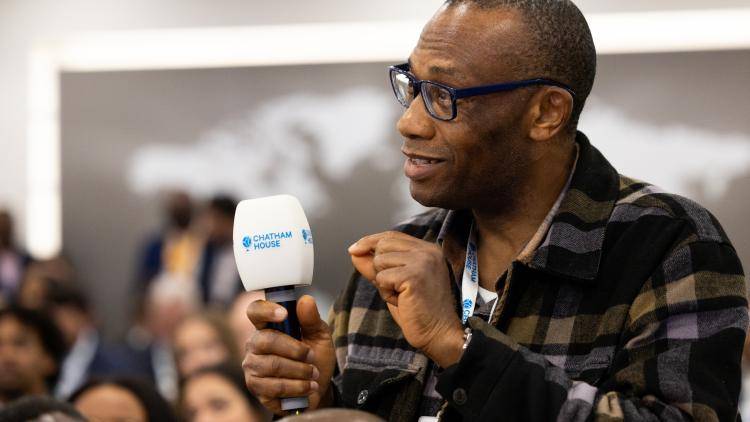
Okay. So, yeah, time for your questions. So, just raise your hand and just tell us your name and any affiliation and please, a question, not a statement. So, we’ve got one at the back there, yeah.
Kathryn Watson
Hi, thank you for that. That was really interesting. My name’s Kathryn Watson. I’m from Flint Global. You spoke about Australia and I guess other countries not having to make a binary choice between the US and China, but I feel like the US is, kind of, forcing that a bit at the moment. You know, we’ve seen the poison pills that it – clauses that it did in the trade deals with various Asian countries, to not do trade deals with China. They’ve got various rules and, like, pressure on markets to effectively block Chinese imports, and then we’ve seen China introduce its own regulations that would penalise companies that move their supply chains away from China. So, I guess my question is, do you think Australia, the UK, Europe, can continue this, sort of, hedging and balancing act, or do you think it will actually have to make a choice?
And then, you also said Australia, security the US, economics with China. What choice would Australia potentially make?
Hon Malcolm Turnbull AC
Well, we dis – we would not – we can’t make the [inaudible – 46:36] – if the Americans said, for example, you’ve got to stop exporting iron ore to China, there’s no way, no Australian government would ever agree with that. I mean, Western Australia would secede, for a start, so…
Kathryn Watson
Yeah.
Hon Malcolm Turnbull AC
…you’d have a smaller country.
No, look, I think the Americans have – in my experience, were most concerned about transshipment. So, they were concerned about – you know, if they were putting tariffs, say, on Chinese products, they were concerned about them being, you know, effectively, exported to America via Australia. So, when we – when I secured an exemption from the steel and aluminium tariffs back in whenever, 2017/18, one of the things Trump and his, you know, his colleagues, Navarro and Lighthizer in particular, were most concerned about, was transshipment. And we said, “Yeah, sure,” you know, “the only steel this exemption applies to is steel made in Australia.” But I agree, look, and it is tough and, you know, you’re going to be confronted in difficult situations, but I – yeah.
Ben Bland
Okay, yeah, at the front here.
Hon Malcolm Turnbull AC
I think it was you.
Ben Bland
Yeah.
Hon Malcolm Turnbull AC
Yeah.
Ben Bland
Yeah, we’re just waiting for the mic.
Latika Bourke
Yeah, I’m – so…
Hon Malcolm Turnbull AC
Oh, waiting for the mic.
Ben Bland
Yeah, we’re just waiting for the mic.
Latika Bourke
I’m just waiting so you can hear me.
Hon Malcolm Turnbull AC
Yeah, I know.
Ben Bland
It’s alright.
Hon Malcolm Turnbull AC
Latika, yeah.
Latika Bourke
Yeah, it’s quiet, and maybe the rest of the room. Hi, Malcolm, Latika Bourke from The Nightly. You will obviously have seen the result in the Farrer by-election and I wonder…
Hon Malcolm Turnbull AC
Hmmm hmm.
Latika Bourke
…what you make of that and if it says to you anything structural about the long-term future of conservative politics, not only in Australia, but globally and for your old party.
Hon Malcolm Turnbull AC
Well, it’s a big question. I mean, only because it covers the field, but I would say, look, I’d simply make this point, I think the Liberal Party in Australia, the larger Liberal Party, has made a very big mistake by going further and further into the, sort of, populist right-wing culture war stuff of – that, you know, does well in, you know, the Australian equivalent of GB News, which is, sort of, Sky News After Dark in Australia, that, sort of, angertainment media ecosystem. They’ve been doing – that’s been – that mood has been happening pretty much since I was defenestrated in 2018, and it’s – it intensified under Mr Dutton. And the problem is that if you – the more you move into that space occupied by the right-wing – you know, far right-wing protest party of One Nation in Australia, say Reform in the UK, the more you validate them.
Now, you know, this is the trap for the conservatives, it’s the trap for the Liberals in Australia. So, you are not going to outflank Pauline Hanson on immigration, ‘cause whatever your policy is, it’s never going to be enough. And so, I think that’s the – look, I’ve been warning, as Latika knows, Australian Journalist, a very distinguished one, I’ve been making this point for some years, but it’s – the chickens are really coming home to roost there. So, you know, you’ve got to make a case – you – again, you cannot outflank the right-wing protest party, my…
Ben Bland
I’m going to take…
Hon Malcolm Turnbull AC
On the right, hmmm.
Ben Bland
In line with that, I’m going to take a question from this centrist block here.
Hon Malcolm Turnbull AC
Yes, very good.
Ben Bland
And maybe the gentleman in the middle there.
Hon Malcolm Turnbull AC
Yeah.
Ben Bland
Yeah, with the beard.
Sofian
Hi, it’s Sofian, Chatham House Common Futures Conversation. Glad to have you. As you said, trust in the US and the Security Council will never really rebound to the same level that it was. Given that complete domestisisation of the military – of military capability is essentially impossible, do you believe in military power, military production and collaboration with Japan and Korea to a much greater degree than it is now is the only alternative, and do you think it would be worth it angering China over this?
Hon Malcolm Turnbull AC
Well, I think all the countries – I mean, there’s a lot of historic, you know, issues between South Korea and Japan, as you know. So, that’s a – not – that’s a relationship that’s not without its considerable difficulties. But the – you’re already seeing a lot closer co-operation on defence within our region. I mean, Australia is acquiring military capabilities from South Korea and of course, we’ve just signed an 11 ship, you know, deal for the Mogami frigate with Japan. So, the – there is a – the – yeah, the connections are greater, but there isn’t going to be an East Asian NATO.
You know, the – I mean, the Europeans have got the ability, if they get their act together, to defend themselves, no question about that. I mean, Russia has the GDP of Italy. It’s obviously got nuclear weapons, but the – you know, and Donald – I think it was Donald Tusk, wasn’t it, who said, you know, “Why do 500 million Europeans need 340 million Americans to defend themselves against 140 million Russians?” So, yeah, get their act together. That’s why I made the point about submarines. You know, for ex – you know, if you’re going to have – why – does it make sense for two European powers, both of which have naval nuclear propulsion, to be, you know, building their own boat, right? It makes much more sense to collaborate. France didn’t take the peace dividend, the UK did after the Cold War, and so, its nuclear deterrent and its nuclear capabilities are greater, you know, and of course, they’re sovereign.
So, yeah, I think you can do that and I mean, making yourself independent of American supply chains is something that should be a goal, and again, this is not – I’m not being anti-American or anti-Trump. I mean, JD Vance, in an interview with Politico last year, said, “de Gaulle was right.” Can you imagine what the ghosts of John F Kennedy and Lyndon Johnson were thinking then? He said, “de Gaulle was right because he insisted on France maintaining its sovereignty.” And he said, “It is not in America’s interest for the Europeans to be permanent vassals of the United States.”
So, you know, the – you know, people will say America is not a reliable – is as reliable an ally as it was. That’s true, but that’s not an accident. The Americans are saying you, our allies and partners, friends, have got to do more yourselves. And so, again, you know, we’ve got – we can’t just assume this is all an accident or a bit of windy rhetoric. So, yeah, we do have to do more to develop our own capabilities and work together with supply chains that are less likely to be subject to leverage. I mean, you know, Trump makes it very clear that he has no qualms, and great powers will do this, if you are dependent on them, your dependence becomes a liability. Again, Mark Carney’s said – made that point more eloquently than I can at Davos.
Ben Bland
Thanks. I’ll take the gentleman here on this side.
Hon Malcolm Turnbull AC
Hmmm.
Ben Bland
The far left of the room.
Hon Malcolm Turnbull AC
Oh, it’s David Crowe, another very distinguished Australian Journalist.
David Crowe
Thank you.
Hon Malcolm Turnbull AC
Just back from the Arte Biennale in Venice, where he wrote…
David Crowe
Yeah.
Hon Malcolm Turnbull AC
…couple of superb pieces.
David Crowe
Bit of a culture change now, look, but I wanted to get back to…
Ben Bland
Can you just introduce yourself, there, please?
David Crowe
Sorry, I thought – Malcolm started to do that, so I’d better finish that.
Hon Malcolm Turnbull AC
Yeah.
David Crowe
David Crowe from the City Morning Herald and The Age in Australia, and I wanted to get the conversation back to China, actually, because I wanted to mention to you, Malcolm, the G20 in China in 2016…
Hon Malcolm Turnbull AC
Yeah.
David Crowe
…where you met Xi Jinping in…
Hon Malcolm Turnbull AC
Yeah.
David Crowe
…that bilateral meeting on the sidelines of the G20. And I remember hearing at the time about those conversations and the message to Xi Jinping about, I guess, the trap he was getting into or – this was one possible way of looking at it, the trap he was getting into with the rest of the world.
Hon Malcolm Turnbull AC
This is the Thucydides Trap?
David Crowe
Yes.
Hon Malcolm Turnbull AC
Yeah, well…
David Crowe
And so, here we are ten years later to the year, that was September 2016. Do you think that the Taiwan Strait is now more dangerous, more exposed to a conflict because of what you’ve seen with Xi Jinping over the last ten years, or do you think that it’s, you know, the same now as it was then?
Hon Malcolm Turnbull AC
No, well, it – well, couple of things have changed. China’s military capabilities have been considerably enhanced, you know, through their investment. They now have a navy that is bigger than that of the United States. They’ve got a shipbuilding industry that is several hundred times bigger than the United States. The United States, of course, is dep – you know, its magazine depth has been seriously depleted in the Iranian conflict and with the support they’ve given Israel, as well. So, you know, is – ten years on, is China in a better position to forcibly take Taiwan than it was? Yeah, no question, no-one would argue with that. Is it likely to? No, I don’t think it is.
I think Ch – I think the view – my view is that Xi Jinping wants to reunite Taiwan with the mainline without force. He wants to win without fighting and I think that is quite feasible. I think that is quite feasible. I don’t – the – you know, this – Trump is not sending sig – Trump – I mean, Biden said unequivocally that Amer – this – “America” would “fight to defend Taiwan.” Trump has never said that. The only thing he’s said, as far as I’m aware, about Taiwan, was in, as I said, in that Bloomberg interview, where he said he’d thought it was ‘indefensible’, okay? He said it was “7o miles from China,” which is, sort of, more than 70 miles, but, you know, the point was nonetheless valid.
So, I, you know – and look, again, this may be a straw in the wind, but I’ll just throw this out to you as a thought. But very senior Chinese Official said to me a while ago, said, “You should never forget that every Soldier in the People’s Liberation Army is somebody’s only child.” So, just – so, that’s, you know, a conflict that could involve tens, maybe hundreds of thousands of casualties. So, you know, that’s something to reflect on. Now, you know, that may be regarded as a naïve comment, but I was struck by it.
So, I think there is every prospect of – I mean, if there hadn’t been the crackdown in Hong Kong, then Xi would be able to say, you know, we can do a one country, two systems, type of deal. The problem is that that’s no longer over time. I’m not sure how they get there, but, you know, you look at the KMT, the – this is the Kuomintang, you know, the old Chinese Nationalist Party, their, you know, their rhetoric is all about dialogue. Their leader has just been on a visit to Beijing. It’s – yeah, I don’t – I think a conflict is unlikely, but it – they – China is in a much stronger position to wage it now than it ever has been.
And again, I made this point in the piece I had in Foreign Affairs last year. I mean, if you think about a naval war in the Pacific, horrible prospect, though, that that is, and if you assu – and just assuming it doesn’t go nuclear, in which case, you know, who knows where we all end up, if we – any of us survive it. But if you have a na – conventional naval war in the Pacific and, you know, there are many losses on – to both navies, which navy will be able to replace its sunk fleet quickly? Only China. So, you know, there’s a – it’s a – you know, Trump likes to talk about who’s got the cards. I don’t think Trump imagines that he has a huge number of cards when it comes to Taiwan.
Ben Bland
I’ve got a final question just about how we can try and make sense of this very confusing…
Hon Malcolm Turnbull AC
Hmmm.
Ben Bland
…and fast-changing world. I mean, you’ve been a Lawyer, a Banker, a tech entrepreneur, a Politician. I mean, which of those lenses helps you understand the world we’re in the most and, sort of, what do you think actually is the most dangerous of all, you know, those different occupations…
Hon Malcolm Turnbull AC
Da…
Ben Bland
…and different ways of…?
Hon Malcolm Turnbull AC
Dangerous of those diff – dan – which is the most dangerous of those jobs?
Ben Bland
Dangerous way to think about the world.
Hon Malcolm Turnbull AC
Unquestionably Politician.
Ben Bland
Yeah, but which is the most dangerous way to think about the world?
Hon Malcolm Turnbull AC
Well…
Ben Bland
What’s the most helpful? Like, when you sit down, are you, sort of, going through the numbers thinking what makes a profit? Are you thinking what’s the best argument to win the case? Is it – you know, how do you actually make sense of the world, given all the different things you’ve done?
Hon Malcolm Turnbull AC
Oh, look, I think it – I think all of the – I mean, I have had a varied career. I mean, that just demonstrates, you know, I can’t hold down a job, I suppose, but the – or that I’m unemployable, but – or I get bored quickly, as one of my colleagues used to say. The – I think politics is – you know, that’s ultimately where you get – you know, because you’re dealing with these big issues. You’re dealing with issues that are, you know, at a national level or a global level. I mean, obviously, being Prime Minister of Australia is – you know, you get to sit at the same table as the G20 as the President of the United States and the President of China. But, you know, you’re – you know, they have a, you know, a role and responsibilities and capabilities that vastly out – you know, out – are outside – much larger than Australia’s, or the UK’s nowadays, [but now – 61:24].
But yes, politics, it’s a, you know, a derided profession, but nonetheless, an honourable one.
Ben Bland
Great. Well, on that happy note, we will draw things to a close. Please join me in a round of applause for Malcolm Turnbull [applause].
Hon Malcolm Turnbull AC
Yeah, thank you.
Ben Bland
Thanks, Malcolm, cheers, really good [applause].