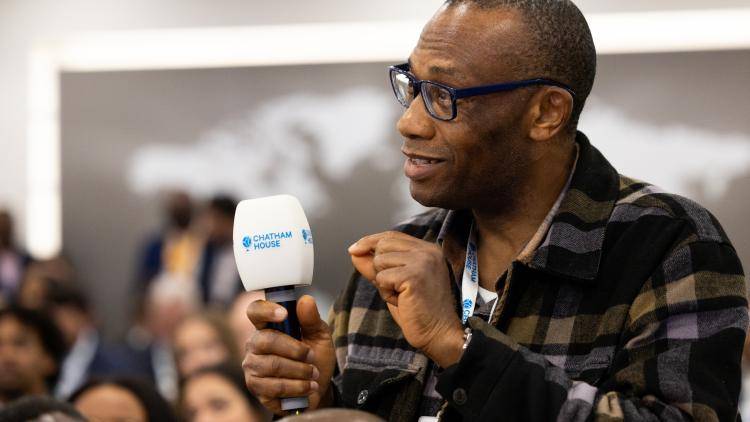
David Gunn
Hello and welcome to Chatham House. My name is David Gunn. I’m a Senior Research Fellow and I lead the Chatham House Sustainability Accelerator, and welcome to this afternoon’s panel, ‘Can cities and states lead the shift to climate resilience?’ Thank you so much for coming. Look, I know it is a very busy London Climate Action Week. You have many asks on your time. Many of you have probably been thinking which panel am I going to go to today? Some of you may have been thinking shall I just stay in the paddling pool in my house? So, thank you, we’re really grateful for you to come and confident that we will justify your decision courtesy of our excellent panellists, and just to introduce them now. Mayor Eileen Higgins, Mayor of Miami, Florida, Secretary Wade Crowfoot, California Secretary for Natural Resources, and His Excellency Prince Bassey Edet Otu, Governor of Cross River State, Nigeria. Thank you all for being here and welcome to Chatham House.
Right, a couple of really quick remarks from me and then we will jump into the discussion. We are at Chatham House, but we are not under the Chatham House Rule today. This will be on the record. Bad news, that means there will probably be no state secrets or revelations of the true source of American UFOs…
Secretary Wade Crowfoot
Hmmm.
David Gunn
…I’m guessing.
Mayor Eileen Higgins
Yeah.
David Gunn
But it does mean that you can share everything that you hear today on social media, so please do so and please tag us, send to everyone online. Structure, I’ll be offering a few framing remarks, then we’ll jump into a response from each of the panellists. I will start with a couple of questions, but at that point I would love to throw it out to the room, so please, folks who are here in-person and folks who are here online, please start thinking about what questions you would like to ask this fantastic panel.
Couple of framing remarks. We are halfway through London Climate Action Week in the hottest decade on record. I feel like this week you have probably heard a lot about climate risk already. Yes, climate change is happening more rapidly and dramatically than many of us expected. For this discussion, what I’d like to focus on is the way in that means the landscape for action is changing. Increasingly, societies must learn to balance the – dealing with the effects of climate change, as well as continuing to address its underlying causes.
We’re in a world where resilience, adaptation and mitigation are vital and intertwined issues that work together in ways that I think many of us are still beginning to get our heads around. In that context, the Accelerator often thinks about sites of transformation. Where are there places around the world where a new future can take hold? Those sites of transformation can be in sectors, but they can also be spatial and sub-national regions and cities I think are particularly interesting and close to the heart of the SA team in that regard. Close enough to real communities on the ground to see the signals and effects of climate change, small enough to move fast, big enough to matter, powerful enough to mobilise others.
And I think we’re really fortunate today to have three representatives that – of three really fascinating regions, to hear about how these dynamics play out in the real world in their territories. We’re going to use the next hour to reflect on both the similarities and the differences in their regional experiences and I’d like us to hold three broad questions in mind. One, how are regions balancing climate action with a wide range of competing priorities? None of the folks that – of this panel are only thinking about climate, so what – how do we navigate those trade-offs? Secondly, in the context of either rapidly shifting or in some instances, antagonistic politics and geopolitics, how do they protect and expand their ability to act? And finally, knowing that this is a transition where we all, kind of, need to help each other, what can other people do to help cities and regions maximise their role and their role as drivers of innovation and transformation?
So, I’m hopeful that’s the kind of conversation we might jump into today. I’m going to ask my panellists for a couple of opening remarks. We’re not going to start by talking about, kind of, COPs and fancy words like mitigation and adaptation. I’d like to start us a bit closer to the ground, and climate action and climate impacts aren’t abstract. They happen in particular places, with particular groups of humans and particular landscapes. So, I’m going to ask our panellists to help us get into that mindset by giving a quick sketch of your different regions, and Eileen, I’m going to start with you and we’ll…
Mayor Eileen Higgins
Okay.
David Gunn
…go across the line. Can I – so, two things I’d like you to do.
Mayor Eileen Higgins
Yeah.
David Gunn
One, give us a quick pen portrait of the territory that you work in. What’s the landscape? What’s it feel like? What are the people there? What do they care most about, and how does that context shape how you think about climate action and resilience?
Mayor Eileen Higgins
Yeah. Well, the city of Miami is one of the most diverse cities in America. 70% of our residents were born in another country. Many of them grew up and continue to live in houses where English is not their first language. So many speak Spanish, others speak Haitian Creole. So, we bring a mix of cultures, ideas and in many cases, people that have fled communism, fled repression or fled economic despair. We are an incredibly welcoming place, and people do feel good about moving there and living there.
But at the same time, you are in Florida, the world is getting hottar – hotter and Florida is a peninsula, it looks like a big piece of land, however, it is not. It is nothing but limestone. So, when other people think about the effects of climate and particularly in the face of rising seas, they think, well, we can build sea walls, and we can build gates and we can do this and we can do that. But in our case, the water not only comes from the sea and the bay; it can come bubbling up through the limestone. So, some of our low-income neighbourhoods are very far from the water, yet they’re not far from the water at all, because the water is beneath them.
For us, we also have an economy that has traditionally been a service sector economy, which means tourism jobs. Low wages in the United States means low or no benefits, and we are slowly adapting. We’ve been attracting a lot more tech companies, but that actually, as much as it’s bringing good jobs, has exacerbated the affordability crisis, because our population continues to make low wages and the cost of housing has skyrocketed. It’s been reported that Miami has the most unequal and unaffordable city in America. Couple that with the fact that the seas as rising, storms are getting stronger and days are getting hotter, you can see there is a lot that we confront in Miami that is not just simply how do we mitigate for climate? Because we have to mitigate for climate so Miami is a place where these immigrant families can live, work, play, raise their families and learn, but also, we need to do that affordably.
For us, the effects of the heat, in addition to being hot, manifests itself in water. We already talked about the water coming up through the limestone, the bay, the water coming up through the bay, but also the temperature of the water is outrageously hot around Miami, and we are a tourism-based economy. So, that hurts our coral reef and also, a couple of years ago, we had a very, very dramatic fish kill, where you literally could not look at a piece of water outside of our city that wasn’t just – there were just dead fish everywhere.
So, we have human impacts, we have job impacts, we have sustainability impacts and we have tourism impacts, which is the lifeblood of our economy. So, lots to work in and then, I’ll zoom up. Sure the question on your mind is, poor thing, she’s from Florida and you’ve heard about our government. I look over here at California with such jealousy, but we also are operating or navigating in a federal environment that has retreated from climate and resiliency goals. But we are in a state that is one of the most repressive around retreating in climate and resiliency goals, which means those of us that are Mayors here, we have to be a little sneakier and more creative to make sure that we’re addressing the needs of our residents.
David Gunn
Hmmm.
Secretary Wade Crowfoot
So, I come from California and feel honoured to be on the stage here at Chatham House with these eminent elected officials. California’s America’s largest state, on the edge of our continent. Both large in terms of population, 40 million people, as well as economic output. We are really fortunate that California, if measured by its GDP, would be the fourth largest economy in the entire world, and that is the result of a lot of dynamic economic growth over decades, including recently, technology and now, artificial intelligence. At the same time, much like Miami, we’re on the climate frontlines, but with a very different climate.
We have a Mediterranean climate, so we face the same environmental crises that parts of the European Mediterranean face, as well as parts of Chile, Australia and South Africa. We – about 10% of our entire state has burned, much of it through catastrophic wildfire, in the last decade. My daughter’s 11-years-old. Long before COVID, she learned how to use a mask for three summers in a row when – in order to play outside. For periods of time in Northern California, you had to wear an N95 mask.
We have had two millennial droughts in the last 15 years, so called because Scientists once thought they would happen every thousand years. That second drought, the driest three-year period in the state’s history, was followed one month later by what was likely the wettest three-week period in the state’s history, when we had nine what we call atmospheric river Pacific storms that took lives and property. And we’ve experienced working for this – in this administration, the longest, hottest heatwave in the history of the American West, which actually disrupted our energy grid in 2020. So, we’re both on the frontlines of climate change, but we’re also proud to be a state that’s really, we think, driving forward to confront climate change and to protect our people.
California has a legacy of environmental protection, in part because we experienced air quality crisis before any – really, almost anywhere else on Earth. In the 1950s, if you were living in Los Angeles, certain days you couldn’t see one block or two blocks away, because what we now as – now as smog, was so bad. As a result, we began regulating air quality even before the federal government. So, when the federal government passed our federal regulation, the Clean Air Act, they gave California the continued opportunity to set our own standards and that has created what we’ve considered a really strong foundation.
I’m really proud to work for a Governor named Gavin Newsom, who talks and is not afraid to talk about the climate crisis and what we have to do. He’s been an important counterpoint to our President. We view the topics that we’ll talk about today not only as an essential set of actions to protect our people, but an economic opportunity. We see the world moving beyond fossil fuels to clean energy and we don’t want our state or our country to be left behind, and we’re quite worried that we are. So, excited to be here today and unpack these issues.
David Gunn
Great, thanks very much. Your Excellency.
HE Prince Bassey Edet Otu
Thank you very much, Chatham House. I’m very happy to be on the panel and be addressing very distinguished gentlemen like these. I come from Nigeria and a state called Cross River State in the South-East, in the [inaudible – 14:07]. That’s where you have [the estuary – 14:09] moving into the Gulf of Guinea. Listening to my colleagues here, I think the world is becoming a global village…
Secretary Wade Crowfoot
Hmmm hmm.
Mayor Eileen Higgins
Hmmm hmm.
HE Prince Bassey Edet Otu
…because it looks like the challenges you’re facing are quite similar to some of the things that we do. The only difference is that in Cross River we retain about 50% of the tropical rainforests still in its very natural condition and we have an ecology of mangrove that is quite a huge carbon sink. But the challenges are quite huge, both in terms of energy security and trying to make sure that we embrace our climate change and actions that will actually mitigate some of the things that are coming on already.
We are about four million people in Cross River State, and the land mass is about 20 something – 22,000km, a boundary by very long coastal region that allows proper maritime or a blue economy situation. But the challenges we face is how to match actions, ‘cause as a sub-national, I’m very happy the movement from national and macroeconomic to what we have today, because we face the first – or we are impacted first, before any other and we have to move immediately to save lives and property and so on and so forth.
The flood you’ve talked about, we also experience it, not just from the rains and so on and so forth, but also some of the big dams that are in the neighbouring countries, when they open it, but we’re doing a lot to try to make sure that this is done. We have two seasons, mainly, over the year, even though the climate changes, beginning to change it. We still have a long dry season and then rain starts and takes to almost some time before the year runs out, so that it allows for good vegetation, for planting and so on. But right now it’s a bit different, in that the rain is almost taking over the whole year, which is something that was not there. We are tackling that also to see, and the water levels are rising quite fast, which is something we also have to contend with.
So, our main problems are just how to cope, to strike a proper balance in between sustaining the transition and making sure that we absorb the present shocks. We know that the sub-nationals cannot operate in isolation. It’s very clear now that we can’t operate in isolation. Since we are all facing almost the same problems and you’ve – like you’ve mentioned today, it’s one of the hottest days here, we are quite used to it in Nigeria. Do not assume it is this, but now that it is touching everywhere, I think we’re going to be quite serious about making sure that there’s actually a change.
Thank you. I think I’ll continue with that when we move into the other questions.
Secretary Wade Crowfoot
Thanks.
Mayor Eileen Higgins
Yeah.
David Gunn
Thank you. Well, actually, where you’re finishing off is a great place to, sort of, pursue the conversation and I’m going to throw it out to the three of you and whoever wants to come around. We won’t go down and up and le – the line, just jump in when you feel. Look, I – Your Excellency, you were talking there about sub-national governments can’t do things on their own and I’d love to get a sense from you at the moment about how you feel – like, how are you feeling about the agency of your particular layer of governments? Right, you – all of you exist in a stack that goes from, like, small-scale communities, city, regions, countries, multinational, multilateral fora, I – in a world that’s changing quite rapidly. So, I’m just – I’m wondering about how your sense of what you can do and how you do it is changing.
Secretary Wade Crowfoot
Well, I would share first of all, that every place on Earth has multiple levels of government, local government, regional or territorial government and national government. So much of this discussion on climate change has centred on national governments, particularly through the United Nations and that’s important and that yielded progress, the Paris Agreement. But I think we’d all agree that, you know, that climate impacts are being felt on the ground and the governments that are closest to those people being impacted, the cities and the states, are really the places where solutions can be applied.
HE Prince Bassey Edet Otu
Hmmm hmm.
Secretary Wade Crowfoot
I’ll observe that I think there hasn’t been enough emphasis on the role that sub-nationals play. We have different authorities, different budgets, it looks different in different countries, but one thing that we’re part of is these international networks. Whether it’s the Under2 Coalition or the…
Mayor Eileen Higgins
C40 or…
Secretary Wade Crowfoot
…C40, which is the largest Mayors – Climate Mayors in the world, or the Global Covenant of Mayors, or Regions4. So, there are these international networks and one of the things we’re doing this week is really here explaining the importance of sub-national leadership.
David Gunn
And just – ju – you know, when we’re – you’re in a coffee shop or in a bar and someone says, ‘Well, what can you do?’ what’s the answer?
Secretary Wade Crowfoot
Hopefully, I’m not talking about my job.
David Gunn
Okay, yeah.
Secretary Wade Crowfoot
Might I turn it over to you, Mayor?
Mayor Eileen Higgins
Yeah.
Secretary Wade Crowfoot
Yeah, no, Mayor.
Mayor Eileen Higgins
I mean, I’ll just echo what the Secretary said and even bring it into the United States of America. We have a federal government that right now, is not being helpful on climate, punto. It will change, you know, this too will pass, as they say, but in addition to C40, which is the global network of Mayors, we have our own Climate Mayors…
Secretary Wade Crowfoot
Hmmm.
Mayor Eileen Higgins
…organisation. And every week, we have some kind of technical webinar on some very specific topic, where two or three Mayors that are really in the vanguard on a particular thing, whether it’s data centres or, you know, recycling waste heat into home energy, and we can all participate and learn. And so, that’s another way, when we say sub-national governments need to work together, it doesn’t mean need to work up and down, we can work all around, and there’s a lot we can do.
I – in the state of Florida, we have a lot as local governments. I have authority over land use, permitting. I can make permitting go faster for resiliency projects or slower for other projects. So, we can put incentives in, right? I may be forbidden from requiring something, but I can say, ‘If you design your building to leave gold standards, you go to the front of the line in permitting and we waive your permitting fees,’ and that can save hundreds of thousands of dollars. We’ve done the same thing for even homeowners who want to put in hurricane windows, put in better insulation. All of those energy saving things we’re waiving permitting fees for them. So, that’s couple of thousand dollars for, sometimes, families.
We’re also able to raise our own money in different ways. For example, I told you we have a lot of flooding projects. We have about a $700 million need for flood control projects, and we put on the ballot – in order for me to issue bonds, I have to ask the residents’ permission through a ballot initiative, and we ask them and we receive their permission for $192 million for flooding protection. So, I can bond that out and that is also another interesting observation. If you look at what the top political folks are saying, they’re saying people don’t care about this, but the residents of Miami voted to take money out of their own pocket. Like, they’re not confused when they vote for a bond that it’s going to cost them $5 a month, eventually $10 a month to make sure their streets don’t flood, and they voted yes, overwhelmingly, to do that.
We can set up things like we launched a Resilience Trust Fund. Again, in – this is in a dense area of town, you can build quite big high rises, but it floods a lot. If you want double density, so it’s not double height, but you’re able to build smaller units and more of them means they make more money as developers, but you put $35,000 a unit into a resiliency trust fund. So, we’re able to implement flooding projects, parks projects, tree planting projects, through that. So, we have a lot of authority, and I try never to get depressed on climate and resiliency, because if I asked everybody in this room, they’d come up with 100 things we should be doing and no-one in this room has money to do all hundred.
So, the fact that I have a federal government and a state government saying I can’t do these 40 things, they’re not telling me we can’t work on these 60 things. So, you got to play the hand you’re dealt and work where you can and cities in America have a lot of ability to make – and that’s why three quarters of our nation’s GDP is in Climate Mayors.
David Gunn
Hmmm hmm.
Mayor Eileen Higgins
So, don’t be confused about how much we are doing on resiliency in America. We’re doing a lot. It’s just happening at the city level.
David Gunn
Great. Just a note on that, actually. On Monday, we welcomed COP30 President, André Corrêa do Lago, who was talking about exactly this point and, you know, underlying at this moment in the transition, some of the stakeholders who aren’t represented at the COPs are some of the most crucial ones. I think that balance between private sector and sub-national government are, kind of, real keynotes. Your Excellency.
HE Prince Bassey Edet Otu
Yes. Actually, I think I will support some of the issues that have been raised here, but in Cross River State, as a sub-national, even though we are confronted with all those problems and the fact that we believe that the national government should come in more, we’re doing quite a lot to mitigate the situation on ground. That’s why we owe organisations like the Under2 Coalition, Regions4 and the Governors’ Climate and Forests Task Force a lot, both in terms of gratitude for what they’re doing and what we are collaborating to do.
We’ve tried to immediately – because it’s very clear, but the direct ledge is energy security. So, we’ve tried to introduce mini-grids, microgrids and then a lot of solar situations, to make sure that we mitigate some of this, and to some extent, I think that has been done. We’ve covered, in terms of the microgrids, we’ve covered over 30 something thousand of our citizens and we’ve tried to move – in terms of the flooding, we are actually carrying out some irrigation projects to make sure, and building reservoirs, to make sure that some of these flows are not allow completely to take away people’s homes, and so on and so forth.
But it is very clear that we have to move at a speed that will make some difference, well, because we are operating in an economy which that is affecting the whole world. Nigeria is not an exception, where the calibration is taking place completely. It’s also taking place in Cross River State, which priorities have to compete with themselves to usher. But this particular one, it’s a very urgent one and we believe that we can work together as sub-nationals, knowing that our voices are being heard, to make sure that we actually have a change, because…
Mayor Eileen Higgins
Yeah.
HE Prince Bassey Edet Otu
…if we leave it to the national, the impact is right on the sub-national.
David Gunn
Hmmm hmm.
Secretary Wade Crowfoot
Hmmm hmm.
Mayor Eileen Higgins
Hmmm hmm.
HE Prince Bassey Edet Otu
So, I like what the Secretary General said yesterday. I think it’s taking a bold step, and all sub-nationals should come together and support that bold step. By that, we will be able to impress on our different national governments to change their policy and make sure that it’s going to affect them one way or the other. And it’s very clear, whether we like it or not, what is happening, that fossil fuel is on its way out and for everybody to be comforted, because whatever is done here also affects us there. What we do there also affects you. If we take away our carbon sink today, it will affect the world seriously. Yet we face serious deforestation which is due to some economic activities which people are trying to.
So, we try to take away all those actions and see how to mitigate and meet them, create an economy for them that can take their eyes off the forests and also allow the mangroves to continue to plea. But strategic states like coasts and locations is something that the world should look into, because we have to move, you know, at speed with others, and if we are to move, then we should be supported, because if we are not supported, then we begin to cut up the mangrove and cut up all those things.
Mayor Eileen Higgins
Hmmm hmm.
HE Prince Bassey Edet Otu
And we’ll all be back to square one, because what is happening now in terms of the finance structure still had a lot of issues, but that discussion is not for today. I think in day we have a particular topic for that, we look the lopsidedness and the balance, because some others that were at the forefront had done certain things to actually Cross River is going to become very developed, and if others are to follow the same technique, then the world would be worse for it. So, there has to be – we have to strike that balance. It’s clear that the climate straddles along continents and there’s nothing anybody can do. Again, we’re not a global lead, so we should be able to see how to support each other.
David Gunn
Hmmm.
HE Prince Bassey Edet Otu
The areas that we are supporting…
Mayor Eileen Higgins
Yeah.
HE Prince Bassey Edet Otu
…are some of the rainforests and some other things which we would have put down to create an economy. So, for the big, big companies that are making a lot, I think there’s need to strike a balance in that compensation so that we will be able to also move economical.
David Gunn
Hmmm, great, thank you. I’m going to ask one more question, then I’m going to throw it to the floor. So, please, bear that in mind if you’ve got things you want to ask. I want to – I’d like to take a moment to think about when things don’t go so well, if that’s okay, like, because there’s so many things, I think, that your three regions are, I think, genuinely just really inspirational around. But we’re also, we’re in an area where, like, an era of innovation, right, no-one’s ever had to – like, no human society has intentionally tried to shift its energy regime over the timescale that we’re doing. Like, there’s – many of the things that we’re facing, whether it is in energy, how to farm in a changed climate, these things are moving fast. That means that people are having to try new things.
Part of innovation is you try a lot of things, and some things work and some things don’t work. So, I’d love just a sense from each of you of, like, from the things you’ve tried, are there things that didn’t go so well but that you learned from that actually, like, that shone a light on how you might approach things differently in the future?
Secretary Wade Crowfoot
Hmmm. I mean, I don’t know if this answers your question directly, but I think there’s a, sort of, a glass half full and a glass half empty. The glass…
David Gunn
Yeah, I’ll take that.
Secretary Wade Crowfoot
…half full is, like, technology innovation is working.
David Gunn
Yeah.
Secretary Wade Crowfoot
You know, renewables are now cheaper than natural gas in many parts of the country.
HE Prince Bassey Edet Otu
Yes.
Secretary Wade Crowfoot
We’re proud of what we’re deploying on solar and wind in California, but I’ll share that the State of Texas is right there at our – right there at the dep – at the same level of deployment, not because its leaders believe in climate change, because it makes economic sense. We walked today to Chatham House by some incredibly beautifully electric vehicles. People are choosing innovative, clean, faster vehicles. I think the biggest challenge is both time, because we know science tells us that we have to move quickly, but we’re also in a moment of insecurity, energy insecurity, economic insecurity. So, even in a place like California, where we’re proud of our environmental legacy, there are real concerns about the cost of living and the price of fuel and the price of electricity. And of course, we have leaders across the world, including in our own country, that are really bent on disrupting this transition.
So, from my perspective, it’s like, how do we lean into what’s working and tell the story, and like our leaders are saying, connected to people? You know, we spend so much time in con – in events like London Climate Week in the past setting distant targets or talking about complicated graphs of emissions. I think we – and we’ve talked about moving beyond that. We have to make it matter to people, both to protect them, as we’ve heard, but also for opportunity. Less pollution, more jobs.
David Gunn
Great, thank you.
Mayor Eileen Higgins
Yeah, I mean, I’m trying to think. Obviously, for us, our streets flood and by the way, it doesn’t have to rain for it to flood, right? I told you about our limestone and rising seas. So, we have what’s called ‘sunny day flooding,’ particularly when there’s a full moon. It’s not just…
Secretary Wade Crowfoot
So, it’s a natural…
Mayor Eileen Higgins
It’s a fu…
David Gunn
Okay, yeah.
Mayor Eileen Higgins
Yes, you can’t make this up. So, I’ll tell you where the UFOs are later.
David Gunn
Yeah.
Mayor Eileen Higgins
But we have with the – and we call it king tide, so king tides are when the full moon, so they’re our roughest days. And I’ll give you a couple of examples of neighbourhoods, this is in the city of Miami Beach, that were always underwater, just completely flooded. Very, very affluent neighbourhoods, by the way, and undertook a very robust programme of road raising, right? Which means you’ve got to have, you know, different drainage systems underneath, you need to harmonise the properties. As one gets higher, how do you make sure the other one doesn’t get – doesn’t flood? And in two different neighbourhoods those projects met with a lot of resistance, and in one case, the project didn’t work very well. They had to go back in, we had to go back in and retrofit some mistakes, but today, neither of those neighbourhoods every have sunny day flooding, right?
And so, what I try to tell people is as we are adapting, ‘We are going to try things and sometimes they’re going to fail, because that’s what innovation is.
David Gunn
Hmmm.
Mayor Eileen Higgins
If we don’t try them, your streets are going to be flooded, your kids are going to be hot forever.’ We’re never going to slow down the amount of carbon we’re throwing off into the environment. And the question becomes, and this is a communications issue, bad news always seems to spread faster than good news…
David Gunn
Hmmm.
Mayor Eileen Higgins
…and so, how do you transfer the story around that this didn’t work to we were innovating to make it work and we knew it might be perfect on the first round, but it’s going to be re – perfect on the second round? So, that the story of those neighbourhoods now are they never flood, which is why you should trust us when we say we’re going to do a street raising project in your neighbourhood or we’re going to do a nors – new stormwater pump in your neighbourhood, but none of this is going to be pretty going forward. We are all going to have to adapt, right?
Mitigation I think we know what to do, but adaptation is going to be different in every single community because we’re all facing different geography and different climates and adaptation is going to require innovation and innovation doesn’t always get it right on the first time. And the private sector is used to that, but the public isn’t used to that from their governments and we have to convince them to allow us to innovate, because if you only launch things when they’re perfect, you’ll never launch anything and we don’t have the time to wait. We can’t – we have to be able to try new techniques and new tools.
David Gunn
Hmmm, thank you.
HE Prince Bassey Edet Otu
Yes, actually, for my state, I think we are already on track. We’ve refused to accept that it’s going to overpower us and we’ve put certain things…
Mayor Eileen Higgins
Hmmm hmm.
HE Prince Bassey Edet Otu
…in place to make sure that these things are taken care of. One is adaptation and by adaptation, the peculiarities, like you’ve said, are quite different in different perspectives. But we’ve made it clear to our people, areas that are prone to issues, which things like flood and so on and so forth, we immediately let them know that whatever they are putting there are quite temporary. Right now, we do need smart buildings and some other things to change that. That’s why we’ve encouraged a lot in terms of those infrastructure to go towards smart buildings, with solar panels and so on and so forth, to reduce the impact of climate change there. And we have set up some targets to meet up.
We discovered that transportation was one of the greatest emitters of carbon…
Mayor Eileen Higgins
Hmmm hmm.
HE Prince Bassey Edet Otu
…into our community and we decided to start with that, and today I think we’ve almost moved our transportation from fossil fuels to actually electric energy. We’ve tried to make sure that we move straight to the EV, which a lot of people are offering now. The government has done a lot in terms of enlightenment, in terms of training and when you want to compare, particularly with the Iran issues which we had, which the prices of – went completely beyond the roof, people decided on their own to begin to look at cheaper energy and to see how they can manage within the money they are earning monthly, and that help a lot, a lot, a lot.
So, we’ve looked into all those areas which used to cause a lot of things, like firewood. Firewood was another area that actually gave up a lot of carbons into the air. Today we are preserving it. A lot of people have changed with stoves and other things which are quite green in nature. So, we’ve supported in all those things, but it was very true that communications and enlightenment are true, particularly in the area that we do have jobs, unemployment and things like that, that are reigning, we’re trying to create an economy…
Mayor Eileen Higgins
Hmmm hmm.
HE Prince Bassey Edet Otu
…which will allow a lot of people to move from certain things that we’re doing to also move. The government is supporting in those areas very, very, very seriously, but technology is still going to be one of the greatest indices here to change – to be a game changer, so we’ve tried to up technologies within so many things that we’re doing. We’re trying to get incubations spaces all over so that our young people can be engaged in some of the activities, apart from all the other ones that are piling some carbons in our atmosphere. I think with all those, we believe that the people are beginning to be convinced.
David Gunn
Hmmm hmm.
HE Prince Bassey Edet Otu
It is time to face reality, even though we do not have all the funds to do what we are supposed to do, that we just have to start with the little that we have. So, we’re expanding our climate resilience infrastructure and nature-based submissions to measure that we mitigate some of it.
David Gunn
Thank you so much.
HE Prince Bassey Edet Otu
Thank you.
David Gunn
Right, I think we’ve got to throw it out to the floor now. Who’s got a question? We’ll see who we’ve – okay, so we’ll take – okay, so I’m going to take three at once. I’m going to – I know you’ve been at enough panels this week to know the difference between a question and a speech, so if we can keep ‘em to questions, that’d be great. So, we’re going to one here, was it, one here, one here and one here, and then, I’ll – just respond…
Mayor Eileen Higgins
Okay.
David Gunn
…as you – online, we’ll come to you afterwards and you’re behind at the moment, so online folks, couple more would be good. Come on, you can do it.
Secretary Wade Crowfoot
Uh-huh.
David Gunn
Right.
Luc Bas
Hi, I’m Luc Bas. I am now in the federal government in Belgium, running a Climate Risk Assessment Centre, but I’ve worked with the states and regions a lot in previous roles, so hence my interest. But also, the interest of our centre, because local and sub-national action is where it’s really going to happen, especially when it comes to resilience, because it’s a very local action you need to do there. I wanted to applaud the fact that you mentioned from a na – you mentioned that nature-based solutions, it should be really in the centre. There are low-cost solutions.
Mayor Eileen Higgins
Yeah.
Luc Bas
And I didn’t hear so much yet, so I would like to hear a bit more about how you see that, and the actual question, and it’ll be a short question, is how is your action on resilience, so not on energy and efficiency or not on solar renewables, but the action resilience hampered by the fact that the federal government is not supporting you? ‘Cause we try what we can to support our regions and maybe on the other side, for Nigeria, what is the federal government in Nigeria doing to support their regions specifically on resilience, so on adapting, on being more resilient to what is inevitable, unfortunately? Even if we get our goals on mitigation of right now, it’s already upon us.
David Gunn
Great, thank you. A panoply of questions to choose from.
Mayor Eileen Higgins
Yes.
David Gunn
Excellent, thank you. Second one here, hmmm hmm.
Tanya Malek
Hi, thank you so much for your time and your insights. My name is Tanya Malek. I’m a fellow Californian, actually, so very nice to see another one on the panel. I have many questions, but I’ll keep it to one, which is, are there any programmes or partnerships that you would consider a favourite or something that you are most proud of in each of your respective regions, that you have seen achieve the goals that you’re trying to achieve in terms of resilience? Thank you.
David Gunn
Great, thank you, and the third one here.
Kevin Liu
Hi, thank you guys so much for such a wonderful address. I’m Kevin Liu, Lead Representative of the University College London. Sorry, yeah, and by the way, Miami is my favourite city in the United States.
Mayor Eileen Higgins
Yeah.
Kevin Liu
So, what…
David Gunn
You can’t divide the panel like that.
Secretary Wade Crowfoot
Yeah, yeah.
Mayor Eileen Higgins
Yeah, yeah…
David Gunn
Come on.
Mayor Eileen Higgins
…of course.
Kevin Liu
Okay, so my question is for all of you guys. So, what has been the biggest challenge in implementing climate resilience projects in you guys’ area? Is that the funding, is that the political consensus or polit – or public engagement, or something else? Thank you.
David Gunn
Great, thank you. So, in reverse order, biggest challenge, the thing you are most proud of, anything more about nature-based solutions and something about the interface between your levels of government and broader ones. Like, what’s – what is hampering or accelerating it?
Mayor Eileen Higgins
Yeah.
Secretary Wade Crowfoot
I’ll take the first crack at two of the questions and maybe with one answer, which is we had a real blind spot for a long time about nature-based solutions in California.
Mayor Eileen Higgins
Hmmm hmm.
Secretary Wade Crowfoot
We focused a lot on technology, renewable energy, energy efficiency, but we forgot what we all learned in elementary school, which is plants, soils absorb carbon dioxide and release oxygen. That’s why it’s so important the carbon sink of the tropical rainforests in the African continent, in the South American continent. But in California, our nature has now become a source of emissions and not a sink. These catastrophic wildfires, the sad fact is that the catastrophic wildfires have released far more pollution than we have saved through all of our actions over the last decade.
So, for the first time, in 2022, our roadmap to carbon neutrality by 2045, which is a law, now includes a specific target for reducing emissions from our nature-based solutions. So, now we have specific land-based targets, whether it’s putting more organic soil into farmland to improve the soil but also retain carbon, or introducing indigenous practices into our forests to reduce catastrophic wildfire risk. But I’ll tell you, my favourite project is a nature-based solution project and it’s bringing back beavers in California.
Mayor Eileen Higgins
Yeah.
Secretary Wade Crowfoot
Before the Gold Rush, there was the fur rush, and beavers were made extinct in parts of California. Our Scientists believe they were not native in California and where they existed, they were a pest that could be killed. Our indigenous tribes tried to tell our agency for a very long time that beavers are native to many parts of California. They showed us pictographs, cave paintings with beaver in them. Finally, in this administration, we realised that beavers are not only native, but they’re an important nature-based solution.
Mayor Eileen Higgins
Yeah.
Secretary Wade Crowfoot
So, now we are translocating beavers into places they haven’t been in 100 years and what they do for rivers is they spread the water, they slow the water and they sink the water.
Mayor Eileen Higgins
Hmmm hmm.
Secretary Wade Crowfoot
So, now, our rivers run for longer periods of the year, which is really important for our water supply. They also create these big damp areas that serve as buffers that slow down wildfires. So, beavers are just one example and they’re free and they work 24 hours a day.
Mayor Eileen Higgins
Yeah.
Secretary Wade Crowfoot
So, just one of the many things…
Mayor Eileen Higgins
I know.
Secretary Wade Crowfoot
…that we can help nature help us.
Mayor Eileen Higgins
I know.
Member
That’s very good.
HE Prince Bassey Edet Otu
Great, thank you.
Mayor Eileen Higgins
Hmmm? Oh…
HE Prince Bassey Edet Otu
Go ahead.
Mayor Eileen Higgins
Well – yeah, you go ahead and I’ll go afterwards.
HE Prince Bassey Edet Otu
Yes, I think let me start with the one of federal government, what does it invest in all this? Actually, the Nigerian Government has an ecological fund which deals with this, but nature is still not too hostile to us. So, the challenges are not too, too pronounced in terms of the national government feeling it, but like you rightly said, its impact is directly on the sub-nationals, which are bearing the brunt for now. That’s why this battle you see here, which we tried to make sure that the sub-nationals who are bearing this brunt comes to the forefront of this. and that was the reason I thank organisations like the Under2 Coalition, Regions4 and of course, the rest, because they come – like, the mangrove, we do have two programmes that are going on under Project Mangrove. In the rainforests we have also some agencies from here who are working with our Forestry Department to make sure it’s done and we’re also doing a lot of reforestation to make sure that some of the places that were actually deforested are now replanted, to make sure those ones are done.
But beyond that, our nature-based solutions are not kickstarted hugely, like I said, but we are letting everybody, each and everyone know that there’s need to save your brother, your sister, by not doing those things that are not right. That we’ve made it very clear, and everybody knows now that carbon emission is a big problem, so everybody’s also putting efforts together to see how we can reduce it. But in order to tackle this, like I said, we do need – we can’t work in isolation, ‘cause the Nigerian population is quite huge, our lands are vast and if we are to actually make a proper move, then there’s need to invest some real capital. But I believe that as a sub-nationalist, Nigerians are coming together, the impact and pressure will be on government to make sure that they change the approach in the way and manner that it will impact the different communities.
In terms of our greatest problem to trying – in trying to balance these immediate resilient needs with long-term transition goals, the basic challenge, the basic challenge, like I’ve said, one, energy security, it’s very, very important. Without that, we cannot really attain our growth targets and when you have too many people unemployed and these other issues, then it tend to cause, also, a lot of problems. So, we believe that with blended finances, there can be some help which we – can take us really out of that. I’m very happy with my colleague here, they’ve gone quite far in terms of some of these areas, but I want to believe that each and everyone, particularly in Africa, which is still in its own natural condition, who face this particular problem. So, we do need that support because we can’t work in isolation, to see how to target these problem areas and get it sorted. It will be better – if we do that, it will be better for the whole world, not just the African continent, I think so.
David Gunn
Thank you. Mayor.
Mayor Eileen Higgins
Well, the big question about the federal government and how does that hinder us is lack of funding, right? And many climate and resiliency measures do require investment and for many years, our federal government was participating in that. But you just do – you know, it’s like anybody’s – any family, you get a little bit less, you figure out how to do with what you’ve got.
And I will say on the nature-based solutions, you know, jump – connecting to what you have been doing, we are really looking deeply at that for our parks, right? And so, we have what’s called a coastal resilience action plan, which analysed four architypes, right? We have a river and we have a bay and we have streets that end at the river, and we have parks that are along the riverside, ttreets that end at the bay and we have parks. And so, we have designed four different ways of dealing with each of those and included nature-based solutions in them.
And you asked about partnerships. For example, the Nature Conservancy is one of our great partners. Philan – as the federal government has left, sometimes philanthropy is stepping up, particularly on the design and innovation side of things. And for example, in our bay side parks, we are now deploying what we call living seawalls. They’re 3D printed concrete seawalls that use biomimicry to actually act like an actual – the ocean would look like, and it is increasing – we are seeing university studies that it’s increasing oxygen in the water, marine life in the water, making that water healthier.
But in other parts of our parks, we are using all kinds of nature-based solutions, just assuming that that park will eventually be underwater and building that in, including in some places, mangroves. But we also have heat, right, so that deals with the water, but there’s heat, and so, we’re integrating natural paths that are shaded, but also adding kayak launch ramps. So, again, if people have access to the water so that they can cool off and trying to do all these things in very holistic manners and it’s actually inclusive, ‘cause some people know we’re doing this for climate, but other people are just happy that their park’s rating better. And so, you end up having this holistic project, which it depends on who you’re talking to, you can describe it in all kinds of ways, and everybody loves it.
David Gunn
Just – great, lovely. Yeah, I – it’s so nice to hear the specifics of some of these examples, as well. Thank you, all. Right, look, we are at ten to. I’ve made a very hard promise that we will finish at – on the dot of 6 o’clock, and there’s two things I’d like to do. I’d like to do a quickfire round of online questions, then I’ve got one final thing I’d like you to respond to. So, this one I think is going to be a bit more lucky dip. There’s probably one more for each of you and maybe a, kind of, two-minute response, if that’s okay. So, Your Excellency, there’s a specific one – by the way, lots of enthusiasm online. I should also share, like, gratitude to the panel.
So, specifically, at Nigeria, ‘I’m curious about the switch to EVs in Nigeria and how that’s intercepting with the wider energy crisis, for example, the use of generation in the event of power outages. How is innovationing helping to secure this infrastructure and encouraging consumers to switch?’ So, just a little bit on that would be excellent, and then, two more questions, Mayor and Secretary, for you to choose between. One of them I think is a mitigation adaptation question. So, ‘We speak about innovation, but what about prevention and solving problems at their root causes rather than managing their consequences?’ And the final one is about collaboration between cities and academia. ‘Can you provide some thoughts about how cities can work better with academia to accelerate action?’
So, Your Excellency, shall we start with you just to give you two a moment’s thought? So, a rapid fire two-minute response on the energy crisis/EV interaction.
HE Prince Bassey Edet Otu
Yes. Actually, the switch to EV, I think it’s moving quite well, because it’s very practical what the approach has been, to introduce mini-grids, to introduce solar systems. So, we have charging stations which, of course, is run by the solar and if you can’t charge it in your house because of probably some – the power taken – the power being taken off, you can go to any of the charging stations to charge your car and it’s quite easy, or you charge your motorcycle or whatever that you’re doing.
And in terms of houses, it would have been difficult because of the grid to actually lay through lines right into our rural communities, because we have too many – we have a lot of people living in rural communities. So, what we do is we provide the mini-grid for – there’s the one for almost each house, they are the one that can take a cluster and there’s also the bigger one that can do a similar thing.
Mayor Eileen Higgins
Wow.
HE Prince Bassey Edet Otu
So, in order not to wait for the grid, which is very expensive to put up, we just switch to that and that has help – it’s helped a lot and in our budget programmes and so on and so forth. We are planning to even get more, to make sure that we get that. But it’s not sustainable in that you cannot use mini-grid to actually run big factories or big base. It’s – it can’t go. That is why we still need that basic support to build an infrastructure that can deal – large facilities that can employ a lot of people. But for now, and in terms of transportation, what’s a bit easy is we are doing microgrids individually, which is allowing that sector to move.
But whether we like it or not, this is reduce carbon emission to some stage and the fact that if you want to look at a conservation, we are doing a lot and we are just taking – if it’s what we are producing around there, we will take all of it in terms of the carbon sink. It’s the other ones that are coming from elsewhere that are giving us concern. That’s why they have to think about.
David Gunn
Yeah, yeah, lot of – thank you.
Secretary Wade Crowfoot
It…
David Gunn
Okay, so the oth…
Secretary Wade Crowfoot
I – yeah, I would just say quickly, mitigation and adaptation, it’s an and, not an or. We don’t have the luxury of choosing adaptation. It’s about protecting our people, but everything that we do to limit what we can know as greenhouse gas emissions have to have, you know, benefit that people understand. So, the switch to tran – to clean energy, yes, it’s about, you know, the atmosphere, but it’s also about clean, abundant, safe, secure energy moving forward, for somebody who might not even care about that big planetary challenge.
And then science, science obviously under attack across the world, certainly in our country. We’re – what we’re trying to do is make science more actionable. So, wherever we are in the world, connect with the Scientists around the urgency of our problems. So, a concrete example is we have a Wildfire Task Force and we’re making decisions month in and month out about both how to respond, but how to protect communities. We’ve created a permanent Scientific Advisory Committee of independent Scientists that are right there with us to actually hold us accountable for making decisions and guiding those decisions.
David Gunn
Great.
Mayor Eileen Higgins
Okay, yeah.
David Gunn
Make it timely and make it relevant, I guess.
Secretary Wade Crowfoot
Hmmm hmm.
David Gunn
Yeah, okay, great. Yeah.
Mayor Eileen Higgins
I’ll just maybe tag along on the educational collaboration, particularly with, in our case, Florida International University. They’re a key player in what I do as a locally elected official, and they are working in their research labs on things that matter to us that are practical. Number one, we have what’s called Wall of Wind. Look it up, it’s very cool. It’s literally giant, giant, giant fans that can simulate a Category 5 hurricane and what we are trying to do with them, in partnership, is to figure out how we can adjust our building codes. And so, the science is very directly what we need as a city government to say, you know what? If we get a storm coming in quicker, what are we going to do about it and how do we adjust our building codes?
They have been instrumental in helping us with these living seawalls, because sometimes you can – you’re building a seawall from scratch, and you can just 3D print it. Other times, you have a seawall that’s just fine, but it’s flat, which might protect you from the water, but it’s not good for marine life, and so they have created for us and we are putting them in our city parks along some of the rivers, tiles that adhere and are being able to do the same thing. So, lots of interesting thing and not sure how or where we’re going to get to this, but we’re doing a lot of work with clean concrete and how we can make that and integrate that, because pouring a concrete, that is a giant emitter of carbon.
David Gunn
Hmmm hmm.
Mayor Eileen Higgins
So, it’s very, very useful as a local government official to hang out in the labs at the engineering school pretty regularly.
David Gunn
Amazing, and we all have an invite, as well, I’m assuming?
Mayor Eileen Higgins
Yes, you do.
David Gunn
Yeah, yeah, great.
Mayor Eileen Higgins
Do you want to visit the Wall of Wind?
David Gunn
Yeah, yeah, yeah.
Mayor Eileen Higgins
Give me a call.
David Gunn
Oh, definitely you might look it up. It looks, like, amazing, as well. Okay, fantastic. We are four minutes to. One final question for each of you, a – just a quick one. So, a lot of – we’re very interested in the accelerator around regenerative design and bioregional design. One of the key, sort of like, mantras in that world is that we need to move to a world where materials move less and great ideas move more. So, I’d like to finish by helping good ideas move around a bit. So, my question for you, in your work in your region, what one idea have you discovered or worked with that you would like to travel far and wide?
Secretary Wade Crowfoot
Hmmm…
Mayor Eileen Higgins
Hmmm hmm.
Secretary Wade Crowfoot
…that’s a good one. Well, look, I’ll – you know, just off the top of my head, we are really proud of the growth of battery storage to help renewable energy actually go further and longer to power our grid. You know, we, like so many parts of the world, faced a situation where we have so much renewable energy that at times of the day, we’re spending a lot of money, essentially, shedding that – those electrons. Electrons were being wasted. Battery storage is a huge solution and in California, we required our private utilities that are making money from providing util – providing energy, to actually invest in battery storage. That’s driven down the price, and then China, of all governments, actually came to California to better understand how it could scale-up battery storage to ensure that its renewables could go further and less fossil fuel. So, I like that as one example that we’re exporting.
David Gunn
Great, amazing, thank you. Your Excellency.
HE Prince Bassey Edet Otu
Yes, mine would be – I think I will anchor mainly on information, because the migration between these different sectors actually requires a lot of information and enlightenment. So, one idea that I’ve seen is most of these things should be people centred. The more you carry people along, the quicker they change your habits, ‘cause some people are very habitual in their nature and character and people resist reforms in all ways, and my mind is very clear that this is something that affects almost everybody. So, you buy first their confidence and make sure that they are ready. Then the moment people are ready to follow you, because right now everybody’s impacted, so it’s quite easy to convince them that they must follow you, the moment they do, you can then bring technology of any kind. Like you have mentioned battery, like you mentioned solar, anything that’s majority of the people will buy into will be quite successful and very easy. So, I’ll pin on information and education, that two.
Mayor Eileen Higgins
Yeah.
David Gunn
Thank you. Mayor, last words.
Mayor Eileen Higgins
So, one of the things that I am very proud of in our city is our top emitter of greenhouse gases when we did our carbon inventory was actually buildings and especially commercial buildings, and so, we’ve implemented a programme where we require all buildings over 20,000 square feet to measure their energy usage and their water usage, which is actually easy because the utility company bills for them, for both those things, so you can get that very quickly. And we’re now into our third year and we’re able to report back how their building compares and what they’re spending on energy and water relative to their peers, and we are finding that they are actually making modifications to reduce whether it’s water use or electrical use. And then, what we’re doing in exchange is when they are making those changes in direct response to that report, we are waiving their permitting fees and making it faster for them to make those…
Secretary Wade Crowfoot
Oh.
Mayor Eileen Higgins
…modifications.
David Gunn
Okay, amazing, excellent. Everyone, can you please join me in thanking our fantastic panel? It’s been really good [applause]. Thank you so…