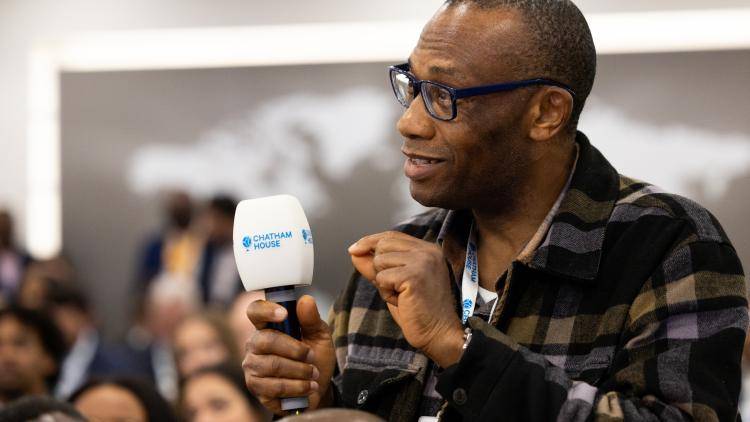
Martine Dennis
I think we’re ready to start, are we? Welcome, everybody, welcome to this Chatham House event. We’re very lucky to be joined by our two Ministers. We have Minister Yusuf Tuggar, Foreign Minister of Nigeria. We have Minister Samuel Ablakwa, Minister of Foreign Affairs for Ghana. Oops, thank you very much.
HE Samuel Okudzeto Ablakwa
Sorry.
Martine Dennis
That’s alright, it’s alright. Thank you…
HE Samuel Okudzeto Ablakwa
Let me…
Martine Dennis
…very much.
HE Samuel Okudzeto Ablakwa
…help you with that.
Martine Dennis
Oh, thank you, thank you. This is event is to discuss the response, an ECOWAS response to the conflict of – the crisis of conflict in the region and perhaps even beyond. So, we’re going to start by having a little bit of a chat with the Ministers, but we’re also going to be opening up to the floor for all of you to be participating. Give us your questions. Think about your questions. We’re also being joined online, and we’ll be trying to take those, as well. So, it’s going to be a bit of a synthesis, and please, this is all about your participation, basically.
Shall we start by – oh, the other thing I have to mention is that the Chatham House Rules, forget those. This is an open event.
HE Samuel Okudzeto Ablakwa
Hmmm.
Martine Dennis
And you can tweet, you can Instagram, you can do whatever you like, and I think the hashtag is #CHAAfrica. I think that’s it, but I’m sure that somebody – yes?
Member
CHAfrica.
Martine Dennis
CH – okay.
HE Samuel Okudzeto Ablakwa
Yeah, CHAfrica.
Martine Dennis
Alright, so, that’s the hashtag. So, please tweet away and do whatever you like. Shall we start, then, Ministers? Can I start with you, Minister Tuggar, then? Give us a – first of all, your assessment of the current situation affecting the region.
HE Ambassador Yusuf Maitama Tuggar OON
Well, a very good evening, I should say. I’m happy to see a packed room, and of course, this is an indication that there is interest in what is happening in our region. So, very encouraging, because it’s something that affects the entire planet and it’s something that requires the collaboration and participation of all countries.
Martine Dennis
Yeah.
HE Ambassador Yusuf Maitama Tuggar OON
Our region is one of the fasting growing regions in the world in terms of population growth and is also a space that has witnessed the relocation of a lot of extremist groups, where they appear to be incubating and creating lots of problems. So, the major challenge we have, first and foremost, is the proliferation of weapons, the contestations of other powers projecting in the region, as well as both exogenous and endogenous factors that have brought about all of this. I mean, I can go into more detail. I don’t know how long you want me to talk.
Martine Dennis
No, that’s absolutely fine for now. Thank you very much, and also, to you, then, Minister Ablakwa, how do you perceive it from the Ghanaian point of view? Of course, we can talk about the Accra Initiative a bit later on, but your particular point of interest will be your northern border, I’m assuming?
HE Samuel Okudzeto Ablakwa
Yes. Yeah, Martine, good evening to you. Good evening to my distinguished colleague, Minister Tuggar, and to the esteemed panel here at Chatham House. It’s such an honour to be here and let me begin by paying tribute to eight Ghanaians who were killed by extremists only a few weeks ago, sadly on Valentine’s Day. They didn’t enjoy the love of St Valentine on that day. They met the cruelty and inhumanity of these terrorists who are running amok in our region. The experts say that we have a situation where every day, there are at least eight attacks, and 44 lives are claimed by these attacks.
Martine Dennis
Is this limited to this northern…
HE Samuel Okudzeto Ablakwa
Just…
Martine Dennis
…region…
HE Samuel Okudzeto Ablakwa
Just – yes…
Martine Dennis
…bordering…
HE Samuel Okudzeto Ablakwa
…just within…
Martine Dennis
…Burkina Faso?
HE Samuel Okudzeto Ablakwa
…the Sahel, yes, just within the Sahel. And what the recent incident teaches us is that you really don’t need to have the terrorists attack your country. They don’t have to enter your jurisdiction for you to be affected. So, it’s a lesson to all of us that we really have to stem the tide and we have to neutralise these extremists.
We have a situation now where, because of the erosion in democracy, the return of coup d’états, failed states and ungoverned spaces within the region, there’s so many territories that the dividends of democracy and the presence of the state are not being felt. And that’s where these extremists, who, by the way, came down from the north, the post-Libya, Gaddafi intervention, down here. So, it’s become a haven and that is the tragedy we face now. It’s become the epicentre of global terror.
Martine Dennis
Right, so we have a comprehensive overview, then, of the situation in the region. What are the kinds of security architecture that exist at the moment that would be relevant, that can be maybe updated, revised, boosted, that could be used to combat this? Does that exist or does it require a new kind of security architecture?
HE Ambassador Yusuf Maitama Tuggar OON
They exist. These are structures that allow for the right of hot pursuit, like the Multinational Joint Task Force. We’re also in discussions with Ghana and others to convert the Accra Initiative into a Multinational Joint Task Force type structure, because historically, it’s worked. We have very complex cross-border areas where lots of countries meet. If you take the case of Nigeria and the Lake Chad region, our – we share borders with three other countries and these are countries that belong not just to ECOWAS, but also ECCAS, and so, it’s quite complex. You have the difference between Anglophone and Francophone. So, even the laws, you are looking at monist and dualist systems and so on, so it’s quite complex.
To the west of Nigeria, same thing, we have – we share borders with the Republic of Benin and Niger, and Malia is only about 300km away. So, when you have multi – the Multinational Joint Task Force and then you have other regional bodies that allow for mechanisms of frameworks that first and foremost, allow you to frame the problem correctly, because that’s very important, frame it as a regional problem, not an internal problem in your country, and then that way, you’re able to proffer the right solutions.
Martine Dennis
Okay, so we’ve mentioned the Accra initiative. Is it worth actually explaining what it is at the moment and how you hope to update it? Because there are some Analysts who suggest that it’s actually run out of steam, it’s run out of momentum, and you actually need something new to deal with this problem.
HE Samuel Okudzeto Ablakwa
Yeah, I mean, that’s a fair analysis and that’s why in January this year, we convened a Consultative Forum with all our neighbours. So, it’s a Western Africa agenda to create a new framework, because the Accra Initiative did not only run out of steam, but it became bedevilled with extreme suspicion because of the role of France and other Western partners in the regional conceptualisation of the Accra Initiative. And with the AES countries, people are turning towards Russia and the – I mean, it’s also become some ideological battle for them that they want to cut ties with France, and they do not want to have any co-operation with France. So, it’s really further muddied waters.
And so, we are now creating a new framework, we’re calling it a Coalition of the Willing, and we have the support of the African Union. We have secured the blessing of the African Union to deploy 1,600 men for hot pursuit, troops on the ground. And we just convened a meeting of all Special Envoys to the Sahel across the globe. The strategy now is to come together and with this Coalition of the Willing, pursue and neutralise these terrorists.
I must say that so far, the AES countries are beginning to realise that they can’t go alone, and perhaps some of the pledges made to them by their newfound friends, they have discovered that they probably are busy elsewhere and they are not that of a priority to them. So, they are beginning to warm up. For the first time, they are attending consultative meetings. They have received the Americans now and are willing to have security co-operation with the Americans. So, that gives us some hope that in addition to the new framework that we are putting together, the Accra Reset Initiative will help us to have a multisectoral approach.
And – but if I can quickly support my colleague on the issue of framing.
Martine Dennis
Hmmm.
HE Samuel Okudzeto Ablakwa
It’s very important. In recent times, there has been the attempt to reduce what is happening to religious warfare, and that it’s Christians who are under attack. It’s – we need to watch that because that can create its own challenges. We need everybody to be on board to tackle this trend. It is not a religious – this is just violent extremism, it’s banditry, it’s transnational crime, organised crime. And it has to be framed correctly so that we can get the support of everybody, the community leaders, Herdsmen, Chiefs, and then the parastatals to come onboard to deal with this.
Martine Dennis
Well, what’s really interesting, of course, is your description of the response coming from the AES, from Mali, Burkina Faso and Niger, in that they’re responding positively…
HE Samuel Okudzeto Ablakwa
Yeah.
Martine Dennis
…to the outreach that you’re making, you as ECOWAS countries, are making. Without their co-operation, isn’t it dead in the water, your initiative, your reset of the Accra Initiative?
HE Samuel Okudzeto Ablakwa
Absolutely, and that is why we ensured that we met with them, and President Mahama of Ghana must be commended. He took a very pragmatic approach to build rapprochement. Before he came into office, we had a stalemate, very little communication, no communication really, and there was bad blood between ECOWAS and AES. He thought that he should reset the relations, position Ghana as a bridge and begin to build some confidence. He invited them to his investiture. They all responded. He returned the favour, paid official visits, and we’ve had engagements. I just returned from Burkina Faso three weeks ago, and we’ve had a successful PJCC. We have revived in six years of no communication at all.
So, I think that the Mahama approach, the pragmatic rapprochement, is helping, and I agree with you that without their co-operation, this will not work.
Martine Dennis
And are these positive responses coming from the Sahelian Three, are they on a bilateral basis or are they on the – are they towards the regional bloc of ECOWAS? I mean, Minister Tuggar, I mean, how is Nigeria interacting with the AES?
HE Ambassador Yusuf Maitama Tuggar OON
Nigeria is interacting with them bilaterally and we did actually quite a lot when President Tinubu chaired ECOWAS, and I think we made a lot of progress. You have to bear in mind that what binds us together is not just the security. It’s not the security issues. We have sopa – we have West Africa Health Organization that was in Burkina Faso. We’ve got so many legal and regulatory frameworks that, you know, have brought us, you know, under the same, sort of, frameworks and all that.
So, it – we also have bilateral mechanisms. We have a Nigeria-Niger Joint Commission.
HE Samuel Okudzeto Ablakwa
Yeah.
HE Ambassador Yusuf Maitama Tuggar OON
It’s still working, it’s still operating. We have an Ambassador in Niamey. Nigeria is actually constructing a railroad to Maradi.
HE Samuel Okudzeto Ablakwa
Hmmm.
HE Ambassador Yusuf Maitama Tuggar OON
It’s called the Kano-Maradi railroad, and, you know, these relationships continue. And when they – when – in times of need, they turn to Nigeria…
Martine Dennis
But in…
HE Ambassador Yusuf Maitama Tuggar OON
…and we collaborate on that. I was in Burkina Faso, I met with the President of Burkina Faso, and we negotiated the release of an aircraft that was detained there, and so many things. So, it’s not that we don’t engage or we don’t interact with each other, but when it comes to certain collaborative measures or efforts towards tackling insecurity, we feel that we’re not doing enough, we could do much more. And that’s why we also have to be careful with the approach. If we’re approaching with some, sort of, framework that has been created outside of the region and trying to apply it, then I think we’re looking for trouble.
I think what has worked in our region successfully, what we’ve been able to achieve in Sierra Leone, what we’ve been able to achieve in Liberia, bringing about peace and peacebuilding successfully, things that have not actually succeeded in other parts of the world, I think we’ve done so when we have come up with our own solutions. This is why ECOMOG was so successful. It was led by forces from the region, with the support of the United Nations, with the support of, of course, other major powers.
So, that is – that should be the formula and not some, sort of, democratic peace thesis approach, where you’re bringing something from outside and trying to either change those countries or trying to do some social engineering. When you try to do that, then you end up with unconstitutional changes of government, just like we had, and then at the end of the day, you end up not solving the problem, or if you frame the problem incorrectly. When, for instance, you have clashes between Farmers and Herders in Ghana, and the report is they’re clashes between Farmers and Herders that are Ghanaian, the moment they cross the border it becomes Fulani militia in Nigeria are attacking our Farmers.
Martine Dennis
Yeah.
HE Ambassador Yusuf Maitama Tuggar OON
We have to stop this if we’re really…
Martine Dennis
Yeah.
HE Ambassador Yusuf Maitama Tuggar OON
If we’re dead serious about solving this problem.
Martine Dennis
So, self-reliance is the buzz phrade – phrase here, isn’t it? Are you going to be able to fund it, as well? Because we’re talking of estimates of up to perhaps $2 billion per year to fund this additional force of up to 5,000 troops, 2,000 in the initial instance that you’re talking about, rapid deployment. So, $2 billion, who’s going to pay for that? I would imagine we’re looking towards Nigeria, are we?
HE Ambassador Yusuf Maitama Tuggar OON
No, we’re already funding. We just need to do more, and we can’t do it on our own, and as I said, we are at the coalface, because this problem of insecurity affects the entire planet. It’s not just Africa, it’s not just – it’s not even just Europe, our neighbours to the north. It’s the entire world needs to pay attention to what is going on here.
Martine Dennis
It’s a pity, isn’t it, that the Sierra Leone’s Minister of Foreign Affairs and International Co-operation, His Excellency Timothy Musa Kabba, couldn’t actually join us? But of course, as the Chair, the Chair of ECOWAS currently, I mean, one of the main issues, one of the main priorities, must be to strengthen ECOWAS, which I would suggest was severely weakened by the departure of the Sahelian Three. Would you like to address that in his absence?
HE Samuel Okudzeto Ablakwa
Well, I think that the theory about ECOWAS having become weakened, respectfully, it’s rather exaggerated.
HE Ambassador Yusuf Maitama Tuggar OON
Absolutely. I told her…
HE Samuel Okudzeto Ablakwa
And…
HE Ambassador Yusuf Maitama Tuggar OON
…earlier.
HE Samuel Okudzeto Ablakwa
Yeah, ECOWAS…
HE Ambassador Yusuf Maitama Tuggar OON
She didn’t believe me, so she’s asking you now.
HE Samuel Okudzeto Ablakwa
So, I’m glad you have confirmation from me.
Martine Dennis
If that’s…
HE Samuel Okudzeto Ablakwa
ECOWAS is still strong, and ECOWAS is still buoyant, and we are putting together the resources. In Ghana’s budget this year, we increased our security spending. We are going to, for the first time, establish an Electronic Warfare Centre in Tamale, the capital of the northern region. We intend to improve our ISR capacity because in these matters, your ability to carry out surveillance and reconnaissance is really, really critical. We are also working with our partners. We have always made the point that this requires international co-operation. The international community should not leave this. It’s not an African problem, because terrorism taking root is a threat to the entire global community.
And we need to also remember that the challenge we face today are direct consequences of certain actions by the international community, from Afghanistan to Syria, to Libya, not having a post-Gaddafi plan, how we deal with the regime change agenda in Libya, and we’ve had to bear the brunt, you know. So, there’s a need for that international commitment, and what is going on now in the Middle East is going to further aggravate the situation. As you chase out the terrorists and dismantle those cells which you don’t want close to you, they would have to relocate. But should we allow, you know, Africa to be their safe haven where they feel safe and where they grow and decide to continue to monitor attacks, you know, on all of us?
So, an international partnership is important, and that’s why the UN Resolution which was passed recently to have UN financial support and to have UN mobilise troops, you know, to support the effort of ECOWAS and the Africa Union, must be pursued. Since the resolution, it’s just remained on paper. There hasn’t been a concrete action to let this resolution materialise on the ground.
Martine Dennis
It’s a good opportunity now, I think, to open the floor, if any of you have got some questions. Oh, I can see there’s quite a few. Great, why don’t we start with you in the front, there, please, and we’ll try – yeah, and we’ll try and take a cluster, shall we, so that we can get through as many as possible? So, there are two men in the third row and the second, thir – and alright, there are three people there. If we can have your three questions. If you could give us your designation, please, the organisation you represent. If you could keep your questions really short and snappy, I’d be very appreciative.
Ekwe Ngadi
I’ll do my best.
Martine Dennis
Thank you.
Ekwe Ngadi
Alright, hi, I am Ekwe Ngadi. I’m a PhD student at King’s College London. Welcome, Ministers. You mentioned the fact that the Accra Initiative had stalled a little bit because of the suspicion of foreign entities like France, and then later, Minister Tuggar also mentioned the importance of local solutions to our security problems. And I wanted to, you know, thread that line together and ask, to what extent do you sympathise with, you know, the Sahelian Three and their suspicion of foreign involvement or their decisions to align with other powers? And to what extent can you see that as an opportunity for resolution, and would that resolution, you know, take a rhetorical form, or will it be just…
Martine Dennis
Okay…
Ekwe Ngadi
…deeply practical?
Martine Dennis
…thank you, very good. Two more questions, then, from this little area and then, we’ll go to another side of the room.
Dr Ishaka Shitu Al-Mustapha
Thank you very much. I am Dr Ishaka Shitu Al-Mustapha, a Senior Lecturer at the Claude Littner Business School, University of West London, and a Consultant on Port Management. His Excellency Tuggar, welcome to London, again. My question is to you, Minister for Foreign Affairs. You’ve explained critical strategy Nigeria is doing alongside its partners. How can you explain the key strategy Nigeria strategic partners to confront transnational violent extremism and preventing foreign fighters from establishing a foothold in Nigerian borders?
Further, Your Excellency, empirically, a Soldier in the field shared with me that “You see them coming on with helicopters, arrive in helicopters, with food and equipment, but we do nothing, we” – they have no power. And Nigeria, to be honest with you, historically, that has been struggling to contend the regime. That’s the honest truth.
Martine Dennis
Okay…
HE Samuel Okudzeto Ablakwa
Plus…
Martine Dennis
…I think we’ve…
HE Samuel Okudzeto Ablakwa
So, what…
Martine Dennis
…got the…
HE Samuel Okudzeto Ablakwa
…are they doing…
Martine Dennis
We’ve got that point.
HE Samuel Okudzeto Ablakwa
…over…?
Martine Dennis
That’s a very good point.
HE Samuel Okudzeto Ablakwa
Thank you so much.
Martine Dennis
Could we move onto the lady behind you? And if you could be as brief as possible, please. Are you keeping up with…
HE Samuel Okudzeto Ablakwa
Yes, yes.
Martine Dennis
…these?
HE Ambassador Yusuf Maitama Tuggar OON
Yeah, we are.
Martine Dennis
These are multilayered questions.
HE Samuel Okudzeto Ablakwa
Yeah.
Chinwe Kalu-Uma
Yeah. thank you, both, Ministers. My name is Chinwe Kalu-Uma. I’m here in my capacity as a Director for the International Organisation for Peacebuilding and Social Justice, also known as PSJ UK. I have a question regarding the framework points that you both made, so I’m addressing the question at both of you. If we do not frame what is the insecurity in West Africa in some areas as religious or identify the ideology, how do we accurately solve the problem? I’ve spoken to many victims of violence and people who have lost all their family members, and they have made their accounts clear that there is a religious ideology attached to the violence.
Are the victims misrepresenting the truth, and can many things not be true at the same time? The security issues are very complex. There is, historically, been Herders-Farmer clashes, but there has also been a religious moti – religiously motivated violence within the regions, particularly Nigeria, to our Foreign Minister there, attacking both Christians and Muslims, Muslims that do not agree with certain ideologies. So, it’s okay, I believe, to have a cocktail of issues, but we must attack them all. Otherwise, we end up developing short-term solutions…
Martine Dennis
Okay, the question – well, the – if we could…
Chinwe Kalu-Uma
Yeah, sorry.
Martine Dennis
…just leave it at – with a question.
Chinwe Kalu-Uma
I had to take the opportunity.
Martine Dennis
You’re coming up with the solution…
Chinwe Kalu-Uma
So, my…
Martine Dennis
…as well.
Chinwe Kalu-Uma
…question is…
Martine Dennis
Let’s…
Chinwe Kalu-Uma
…are the victims misrepresenting the truth? Is that…
Martine Dennis
Okay, that’s a…
Chinwe Kalu-Uma
…what you believe?
Martine Dennis
…great question.
Chinwe Kalu-Uma
Thank you.
Martine Dennis
So, shall we start unpacking some of this? Minister Tuggar, you going to go first?
HE Ambassador Yusuf Maitama Tuggar OON
Okay, I think I’ll start with Chinwe’s question about the – you see, I’m not saying that the violence is not religious altogether. There is – it’s – and some of it is reli – is motivated by religion, but it does not necessarily mean that there’s a Christian gonocide – genocide going on in Nigeria.
HE Samuel Okudzeto Ablakwa
Yeah.
HE Ambassador Yusuf Maitama Tuggar OON
This is false, it’s incorrect. So, that’s why we have to be careful, and it is not confined to Nigeria. It’s a regional problem. So, that’s why, with framing, we have to be careful. We have banditry going on. We’ve got sometimes ethnic violence going on. Sometimes it’s just – it’s criminals going after communities, attacking people and so forth, but if you reduce it to the issue of religion, based on – and we’ve seen how effective some of these screwdriver salespeople – salesmen are in terms of being able to churn out figures that are picked up and then, you know, they become public convention. So, we have to be careful if we want to address the issue decisively. So, that’s for that.
In terms of the strategy, what we’re doing, this is Dr Isyaku [means Dr Ishaka], I feel that we have, in the past, had challenges because of certain measures that were taken. The Leahy Law, for instance, the effect of it, so it doesn’t matter how good your strategy, if you don’t have access to weaponry, to the equipment, then, you know, you can’t be effective. So, now we’re beginning to see a change in – an attitudinal change, and that is why we’re beginning to see results. But importantly, this right of pursuit needs to be re-established because we need countries like Niger to participate, and it’s not just Niger, it’s several other countries. And then that’s why, you know, you saw a spike in Boko Haram activities, because, you know, their – they pulled out of the MNJTF, so we need that, and for them, also, it’s an existential threat.
With [inaudible – 34:22], the AES is an integral part of, you know, providing the solution. However, they have their own reservations, they have their own domestic idiosyncrasies that perhaps are delaying them from coming on board. They have their own suspicions, also, about approach and all of that, but we can’t wait until they come on board. There are other countries that are also involved. There are other mechanisms and platforms that are already in existence that we need to cond – start tapping into. CEN-SAD is one, we’re talking about Accra Initiative converting into a menen – an MNJTF type structure. So, it’s all of these things. There’s – it’s not a one-stop solution.
HE Samuel Okudzeto Ablakwa
Yeah, so on framing, if you look at the names of our latest terrorism victims in Ghana who were killed in Burkina Faso, the town called Titao, and five Christians, three Muslims, [Bismarka Manqua – 35:31] Augustine Arthur, [Bright Asian – 35:32], Constance Nyarko, Prince Marfo, Christians. Muslims, Hamidou Mohammed, you have [Aboubacar Sidik and Fusana Yakubu– 35:43]. These terrorists didn’t ask them which religion they subscribed to. So, the point we are making is that we should be more nuanced and we should not allow those who are setting agendas, you know, who are just binary, we versus them, because we are also going to need these communities in intelligence gathering and getting them to really support our effort to identify these terrorists and to neutralise them.
So, I agree with you that many things can be right at the same time, but where there’s an oversimplification and there’s an attempt to place US setting agenda, there’s – see if there is some religious warfare, because the – some of the drivers are far from religion. Youth unemployment, which is very high on the continent. Climate change, a lot of these Cattle Herdsmen in the Lake Chad area who no longer have the, you know, fertile, you know, grazing and river bodies have dried up, are trying to annex territory, new lands and all of that. Then you also have collapse of states, democracies that have not yielded the results, and that’s where we are seeing these – the return of coup d’états. So, we need to be more nuanced and deal with this matter with all the complexities and all the different strands and layers. It is not just a simple, you know, religious matter.
The other question targeted at me about if we have sympathies for the AES countries. We have to admit that there is a genuine concern in Francophone Africa that their relations with France will have to be reset and that there’s a need for a new approach. And I think that if you listen to French foreign service officials, they have admitted that there’s a need to even, for example, look at the British approach, how the British disengage and how the Commonwealth has maintained, you know, a family of choice, family of the willing. And there’s genuine independence and sovereignty and, you know, Anglo-Saxon full countries are allowed to pursue their own paths and all of that.
Those kinds of discussions need to be held, and I think that we have to solidarize with these AES countries, because they are talking about their lived realities and how they feel, that after many decades, they have been estranged, and they do not have the liberties and the freedoms to really pursue their sovereign paths. And I think that we should not be dismissive of those concerns, but we believe that these can be resolved through dialogue. And we think that all partners should be brought on board so that – because we need everybody in resolving these challenges. And that has been the approach that we have taken in the region.
Martine Dennis
Thank you both. Let me just quickly gallop through a couple of the online questions, much of which have actually been answered, but I’ll still give them a name check for the – taking the bother to write in. Nathan Danquah, I think your questions have been answered, and he says, “Kudos to President Mahama for reaching out to the AES.” There is a message from Tim Cole, “In December, the US bombed IS militants in northern Nigeria. What would be a useful role for the US in managing security in the region?” Obviously, for you, Minister Tuggar. There is also a question there, next to Paul, and okay, so a question there from Paul and then just there, at the end of the row.
El Hadji Amadou Niang
Thank you so much. Just if you can allowed me, because I have some observation before my question.
Martine Dennis
They need to…
El Hadji Amadou Niang
My name is…
Martine Dennis
…be short.
Ambassador El Hadji Amadou Niang
Yeah, I will be not long. My name is Mr El Hadji Amadou Niang. I am former senior staff of the OAU, former senior staff of the United Nation, former Ambassador of Senegal in many strategical country. Your Excellency, thank you very much to be in front of us. Today, I strongly believe that West Africa stand at a crossroad. A crossroad where the light of hope meets the shadow of violence extremists, extreme. For years, our people have endured the fury of the armed group. They cross our border like ghost, exploiting our weakness, our absence, but their strengths do not lead solely in way solidly in weapon the field. It’s like in the vacuum we leave behind, the vacuum of states, where it should be warden of security.
Martine Dennis
Monsieur, can…
Ambassador El Hadji Amadou Niang
Yeah.
Martine Dennis
…I interrupt? Because…
Ambassador El Hadji Amadou Niang
Yeah.
Martine Dennis
…this is very poetic, I love…
Ambassador El Hadji Amadou Niang
Yeah.
Martine Dennis
…it. However, if you could just – if you could encapsulate the question.
Ambassador El Hadji Amadou Niang
And so…
Martine Dennis
Sorry.
Ambassador El Hadji Amadou Niang
…my question, I am deeply sorry because perhaps it’s due to the fact we love meritory to explain our – his late Kofi Annan with…
Martine Dennis
Your question, please, monsieur.
Ambassador El Hadji Amadou Niang
Yeah, the question. At the time when West Africa is going through trials that tests the security of our nation, the confidence of our people and the strength of our institution, have we, Your Excellency, not reached a moment of trust where history call upon us to resync with courage, vision and collectively trajectory?
Martine Dennis
Thank you, thank you…
Ambassador El Hadji Amadou Niang
So, I – yes, I finish. Is this not the moment imagined for Africa a new region of development, and perhaps to engage a blood red affliction on the future and the evolution of ECOWAS so that it may become…
Martine Dennis
Okay.
Ambassador El Hadji Amadou Niang
…more ever the architect of the security, the driving force…
Martine Dennis
I’m afraid, monsieur…
Ambassador El Hadji Amadou Niang
…of our solidarity?
Martine Dennis
…you’ve lost the audience, I’m sorry.
Ambassador El Hadji Amadou Niang
Yeah.
Martine Dennis
Thank you. Would you mind…
Ambassador El Hadji Amadou Niang
Uh-huh.
Martine Dennis
…at the end, there…?
Ambassador El Hadji Amadou Niang
Sorry.
Martine Dennis
And please, yeah, we just need questions.
Member
Okay, [inaudible – 43:12]. Don’t you think this question of capacity and capability are because Boko Haram FOB is not in Sambisa forest?
HE Samuel Okudzeto Ablakwa
Sorry?
Member
Boko Haram FOB is not Sambisa forest.
HE Samuel Okudzeto Ablakwa
Boko Haram…
Member
If it is…
HE Samuel Okudzeto Ablakwa
…is not?
Martine Dennis
In the Sambisa forest.
Member
Listen to me.
HE Samuel Okudzeto Ablakwa
The Sambisa forest, yeah.
Member
It’s not – the FOB is not Sambisa forest.
HE Samuel Okudzeto Ablakwa
Okay.
Member
FOB.
HE Samuel Okudzeto Ablakwa
Okay.
Martine Dennis
FOB, yeah.
HE Ambassador Yusuf Maitama Tuggar OON
Yeah, they could…
Member
It is under a mountain under Lake Chad, but because of corrosion in Nigerian system, Nigerian would lack the capacity to dominate those places. Don’t you think so?
Martine Dennis
Thank you, thank you very much. So, therefore, we’ve got three questions. Both of them – two of them, at least, directed to you, Minister Tuggar. You’re really earning your keep today, aren’t you?
HE Ambassador Yusuf Maitama Tuggar OON
Hmmm.
Martine Dennis
Tim Cole asked, “What role would the US – could the US take in managing security in the region?” And then we have the extensive question over there about trust and corruption coming as our last question. So, perhaps, Minister Tuggar, if you could start us off, and then, Minister Ablakwa, if you’d like to chip in, as well, help out your colleague.
HE Samuel Okudzeto Ablakwa
Sure.
HE Ambassador Yusuf Maitama Tuggar OON
Thank you very much for the questions. So, what role the US should play? I would say an indirect role, a supportive role, as opposed to taking a more direct approach that would see perhaps boots on the ground and engagement, because it’s a very complex region, and what we need is support. Nigeria and other forces in the region have shown that with the right support, with the right equipment, we’re capable of restoring a peace in our region. We’ve done it in the past. I mentioned Sierra Leone; I mentioned Liberia and what ECOMOG was able to achieve in the past. I think that is the best approach, as opposed to a more direct approach, which becomes more complex.
So, with regards to the question about do I think Nigeria is corrupt in fighting Boko Haram? No, I don’t.
Member
Oh, no, no…
HE Samuel Okudzeto Ablakwa
Flatly, I…
Member
…no, no, no, no, no.
HE Samuel Okudzeto Ablakwa
…do not think so.
Member
I said Nigeria…
HE Samuel Okudzeto Ablakwa
Hmmm.
Member
…does not have…
HE Samuel Okudzeto Ablakwa
Hmmm.
Member
…the combat capacity to dominate these countries.
Martine Dennis
Doesn’t have the combat…
Member
It’s not able to…
Martine Dennis
…capacity…
HE Ambassador Yusuf Maitama Tuggar OON
Combat ca…
Member
…to lose…
HE Ambassador Yusuf Maitama Tuggar OON
Yeah, we’ll – we – we’ll…
Member
The issue is not Sambisa forest, it’s Mandara Mountain by Lake Chad. I know the places very well.
Martine Dennis
Okay, this is location.
Member
And the questions never end…
HE Ambassador Yusuf Maitama Tuggar OON
Hmmm.
Member
…because of corruption.
Martine Dennis
Okay.
Member
They don’t…
HE Ambassador Yusuf Maitama Tuggar OON
Well, there you go. So, the…
Member
They don’t…
HE Ambassador Yusuf Maitama Tuggar OON
…corruption is you…
Member
And nothing untoward.
Martine Dennis
Okay.
Member
Do not question…
HE Ambassador Yusuf Maitama Tuggar OON
Yeah, I’m actually from North-East Nigeria, so I also…
Member
I know.
HE Ambassador Yusuf Maitama Tuggar OON
…know the place quite…
Member
Don’t tell me, I don’t need you…
HE Ambassador Yusuf Maitama Tuggar OON
Can I answer, sorry?
Member
No, go on.
HE Ambassador Yusuf Maitama Tuggar OON
I actually know the terrain, also, quite well. So, it’s difficult to just isolate the problem and just say it’s the Mandara Mountains, which is between Nigeria and Cameroon, on our side is Taraba state, and you would be looking at the old Adamawa Emirates. I think it goes beyond that, because you will find that it’s a problem, also, in terms of even the insurgency. The Ground Zero was not in the Mandara Mountains, okay? It was further to the north. It was the – Boko Haram had a high content of people from Borno states, okay, and the conflict also, it took hold in the Lake Chad region, where you have – it’s a very complex area.
You have a lake there, you have lots of islands there, you know, so it’s a region between Nigeria, Niger and Cameroon, and Chad. So, if it’s – if you are talking about Chad, you’re looking at the Lac region. If you are talking about Cameroon, you are talking about Far North. If you are talking about Niger, you’re talking about Diffa. If you’re talking about Nigeria, you’re talking about Borno, then it cascaded down, all the way to southern Borno, Biu. Then you do – you can go down to the Mandara Mountains. So, it requires – that’s just why we set up the Multinational Joint Task Force, to collectively address the issue, and it’s not the problem of one country.
And we tried that framing initially, because President Jonathan looked at it as a Nigerian problem, initially, which is why he declared a state of emergency in 18 local governments. It didn’t work. Then he declared a state of emergency in the BAY states and a few other states, including Plateau state. When I say ‘BAY’, I’m talking about Borno, Adamawa, Yobe. It didn’t work. Then there was a change of approach with France. You have to give credit to President Hollande at the time, because he invited the President of Nigeria, of Niger, of Chad, of Cameroon and Benin, and that is when we started working together on this issue of the Multinational Joint Task Force and the right of pursuit and all of that. And if you read the history, you will see that it was effective in tackling the menace of [inaudible – 48:55]. It was effective in tackling [inaudible – 49:00] in the 1930s. This is the way it’s done. So, it’s not the issue of corruption. We had the Leahy Law, we had Libya. We didn’t create Libya. It wasn’t Nigeria that led to the Libyan Civil War and so forth.
Lastly, I would respond on the issue of – what else? No, let me…
Martine Dennis
I think…
HE Ambassador Yusuf Maitama Tuggar OON
…just keep quiet for now and…
Martine Dennis
I think it was an issue of trust, which I suppose we could talk…
HE Ambassador Yusuf Maitama Tuggar OON
Yeah.
Martine Dennis
…about forever, couldn’t we? But I have a question here from Ruth McClain to Minister Ablakwa, and she is saying that she noticed that “the American surveillance drones were flown from Ghana to Nigeria in the lead up to the Christmas Day bombings.” And she’s saying, “Can you describe the security relationship between Ghana and the US? Is it changing?” she asks.
HE Samuel Okudzeto Ablakwa
Well, everybody knows that Ghana has a Defense Co-operation Agreement with the US, approved by our parliament, and not only with the US, but with many other strategic partners, including the UK, a number of Gulf states. We do these things in our strategic national interest, and we are also careful to draw the lines. And so, there’s a red line, we do not accept military bases in our country, and I’m sure that what is happening in the Middle East now vindicates Ghana’s position. We have historically, prevented Western powers from establishing military bases in our country, and I believe that those who initially were not sure why Ghana was very stand about this position, now appreciate that.
Having said that, we also take the view that any co-operation, any intervention, must be on a case-by-case basis and there has to be express approval. So, the recent attacks in Nigeria, the Nigerians will confirm to you that they invited the Americans, and they also reached out to Ghana to collaborate.
Martine Dennis
The Nigerians?
HE Samuel Okudzeto Ablakwa
Yes, both the Nigerians and the Americans. So, that’s how we are playing this out. Sovereignty has to be respected. Territorial integrity has to be respected. You must be invited and we must all agree on the scope of the intervention, because we do not want this to lead to another Venezuelan situation or some other, you know, geopolitical matter, because sovereignty is important, territorial integrity is important. We must know exactly what the scope is, what you are coming to do, the nature of the intervention, it’s very, very important. I mean, our citizens would not forgive us, and legitimately so, if we just, you know, take away their sovereignty and allow external elements to just come in and do whatever they want.
I also have to make the point about trust, good governance, it’s critical. And on a lighter note, I was expecting that as Nigeria was enumerating all the strategies, they will have added that a key strategy would be learning from Ghana how we have successfully kept the terrorists out and have never had any terrorist attack in Nigeria. I think that – in Ghana, pardon me.
HE Ambassador Yusuf Maitama Tuggar OON
Oh, you said…
Member
Ghana.
HE Samuel Okudzeto Ablakwa
In Ghana, pardon me, in Ghana.
HE Ambassador Yusuf Maitama Tuggar OON
It’s a Freudian slip; it’s a Freudian slip.
Martine Dennis
Hmmm hmm.
HE Samuel Okudzeto Ablakwa
So…
Martine Dennis
Hmmm hmm.
Member
A slip.
HE Samuel Okudzeto Ablakwa
…that shows how he wishes he – this Ghana situation was Nigeria situation. But you will have this, you’ll get to Ghana’s level.
HE Ambassador Yusuf Maitama Tuggar OON
Ah.
HE Samuel Okudzeto Ablakwa
But on a more serious note, I think that what Ghana has done very well is that the state is represented. There is no district in our country where you don’t feel the presence of the state. There’s a Police station in every community. You have amenities, you know, utilities. You have the local government structure. You have the DISECs, the District Security Councils. So, you feel there is no part of Ghana, like the Liptako Gourma area, which has become, you know, the haven for these terrorists, where you don’t find the presence of state it’s like, you know, a no-man’s area, and that’s where the terrorists then, you know, thrive.
So, we also should be learning from each other, countries that are getting it right, the right interventions, and we should not downplay the issue of corruption, of mismanagement, failed leadership. That is what is, you know, leading to weak states, weak responses, and then even coup d’états, because then the people lose confidence in democracy, which should not be the case. As President Mahama has been saying, he is determined to prove that democracy works. Democracy can produce jobs. Democracy can produce security. Democracy can create empowerment and it can keep terrorists out of your country, if you make the right investments, if you utilise resources properly, you know, in the interests of the people. And you use strategy national in – you know, national security imperatives.
So, I think that that discussion also ought to be had, and that’s why I keep saying that this is multifaceted, it’s hydra-headed, you now, it’s not just a quick fix, one framing, and then you get the results. It will not work that way.
Martine Dennis
Thank you, Minister. Now, there’s a question here in the second row and then, I was going to go to the back, where the chap has got his hand up there, and then I was going to, for the third question, was going to go online, so hold on. So, this man here and then, at the back, on – to your left, that’s it, there, thank you. So, if you could make your questions quick, then we can get through more.
HE Samuel Okudzeto Ablakwa
Yeah.
Dr Akinyemi Oyawale
Hi, Your Excellencies, I’m Dr Akinyemi Oyawale from the University of Warwick. I’m an Assistant Professor in the International Relations. I think first, I would like to side with Antonio Gramsci to say that I believe the problems, the myriad problems we have, are “morbid symptoms of an interregnum,” right? I believe that the old died, but the new cannot be born, right? And I believe – and the question I’m going to ask is, how do we rethink our relationship to life itself, our relationship…
HE Ambassador Yusuf Maitama Tuggar OON
That’s deep.
Dr Akinyemi Oyawale
…to…?
Martine Dennis
Wow.
Dr Akinyemi Oyawale
How do we rethink? Because…
HE Ambassador Yusuf Maitama Tuggar OON
That’s it.
Dr Akinyemi Oyawale
…I believe that…
Martine Dennis
Yes.
Dr Akinyemi Oyawale
…you are sitting here today representing Ghana, sitting there representing Nigeria, because of something connected to empire, right? We’re talking about uti possidetis juris, right, which said, “Okay…
Martine Dennis
Okay.
Dr Akinyemi Oyawale
…you’re gaining independence, but you have to be – you have to keep…
Martine Dennis
Could you keep this…?
Dr Akinyemi Oyawale
…those borders during…
Martine Dennis
Could you keep this…
Dr Akinyemi Oyawale
…colony, right? So, I’m just asking…
Martine Dennis
…brief?
Dr Akinyemi Oyawale
Yeah, I’ll…
Martine Dennis
The question is what?
Dr Akinyemi Oyawale
Yes, how do we rethink our relationship…
Martine Dennis
With life.
Dr Akinyemi Oyawale
…itself? Because that’s how we can think about the individual and the collective and that can help us to see things…
Martine Dennis
Okay…
Dr Akinyemi Oyawale
…differently.
Martine Dennis
…thank you.
Dr Akinyemi Oyawale
For example, our relationship…
Martine Dennis
No…
Dr Akinyemi Oyawale
…to modernity…
Martine Dennis
…we don’t…
Dr Akinyemi Oyawale
…which is central…
Martine Dennis
No, we don’t need…
Dr Akinyemi Oyawale
…subsidy in the world that…
Martine Dennis
…examples.
Dr Akinyemi Oyawale
…in the world now.
Martine Dennis
Sorry, excuse me, we don’t need examples, thank you. So, our relationship with our life, Gramsci, maybe this is a – that’s a conversation for later…
HE Samuel Okudzeto Ablakwa
Yeah.
Martine Dennis
…maybe?
HE Ambassador Yusuf Maitama Tuggar OON
I think that…
Martine Dennis
So, there’s a question at the back there. Would you mind – please…
HE Samuel Okudzeto Ablakwa
It’s a philosophy.
Martine Dennis
…less philosophy.
HE Ambassador Yusuf Maitama Tuggar OON
Need to get into the dialect…
HE Samuel Okudzeto Ablakwa
I tell you…
Martine Dennis
Less philosophy.
HE Ambassador Yusuf Maitama Tuggar OON
…dialectical side
HE Samuel Okudzeto Ablakwa
I tell you.
Martine Dennis
Thank you.
Member
No, thank you, Madame Chair, thank you, Your Excellencies. I will go straight to my questions, but I have a multiple of questions. To Minister Tuggar, I mean, most of the discussions today focus on the military approach to this crisis, but there is a reason why we have these groups operating in border regions across Africa, from the Sahel to the Lake Chad region, to Uganda, to Congo, to Mozambique, it’s because the social contract is weakest in the border regions.
HE Ambassador Yusuf Maitama Tuggar OON
Yeah.
Martine Dennis
Hmmm.
Member
What are you doing at a regional level to tackle of these institutional weaknesses and the socioeconomic issues leading young people to violence? To Minister Ablakwa, one of the issues I observed working in Muslim minority countries where this issue is imagined, in, like, Congo, Uganda, Benin, there is this tendency to generally profile the Muslim minority and to clamp down on mosques and all those. Are you aware of this tendency in Ghana and what are you doing to carry the Muslim along, rather than alienate them and push them to the violent groups? And finally…
Martine Dennis
Oh.
Member
…we know that all of the groups operating in Africa, all of them without exception, are inspired by the Sunni tradition, or the Sunni misinterpretation of Islam, and we know that if Iran falls, if the regime in Iran falls, then there will be groups interpreting or mistake – interpreting Shia Islam imagine to also start fighting for a Khalifa. Because right now they see Iran as their Khalifa and the Ayatollah as their Khalif. And if he falls, they would rise up to also demand for a Khalifa and they would fight, and we know that there is a significant Shia population in Ghana, there is a significant Shia population in Nigeria.
Martine Dennis
Right.
Member
Are you aware of this tendency, and what are you doing to stem this tide…
Martine Dennis
Thank you.
Member
…if it came?
Martine Dennis
Thank you…
Member
Thank you.
Martine Dennis
…very much. So, we have two very good questions. Can I just add…
Member
Yeah.
Martine Dennis
…a third? And Abdullahi Adam says, “Terrorism financing remains a formidable driver of insecurity in West Africa, in the Sahel. What is ECOWAS doing to ensure effective CFT in the region, particularly at the informal sector level?” So, we’re talking now much more about the drivers of insecurity, aren’t we, rather than the security responses? Who wants to go first?
HE Ambassador Yusuf Maitama Tuggar OON
I’ll go first.
Martine Dennis
Okay.
HE Ambassador Yusuf Maitama Tuggar OON
I think Dr Bulama Bukarti belongs here with us answering some of these questions, because he’s an authority on the subject, as you can…
Martine Dennis
Hmmm hmm.
HE Ambassador Yusuf Maitama Tuggar OON
…well see.
Martine Dennis
Hmmm.
HE Ambassador Yusuf Maitama Tuggar OON
But one of the things that we’ve been pushing within ECOWAS is to convert the ECOWAS Cross-Border Initiative into something much more than just delimitation of borders and delineation. Because like you rightly said, these conflicts fester in cross-border areas, and there’s a reason why that happens, because as you move away from the centre to the border, sovereignty itself weakens. So, when you have an overlap, and given the history of the delineation of borders in Africa, you can well imagine how the borders tend to be a place where criminality as a whole, you know, could just – so, what we need to do in terms of solutions, apart from the ECOWAS Cross-Border Initiatives, is for other countries in the region to do what Nigeria has done, which is to create the Border Communities Development Agency, but ours also needs to be applied for the very purpose that it was created for, because we’re not using it for that and we need to do that.
And then, we also need to learn from the European Union. The European Union has Interreg and they use it for development planning, for infrastructure. That’s why when you’re driving across borders in Europe, they’re seamless. You don’t even know that you’ve driven across a border because there’s collaborative development. So, when we do that – and then going back to what Minister Ablakwa alluded to, which is, you know, having functional local government administration, but, you know, I will differ with him when he says everything is hunky-dory in Ghana. No, it’s a – it’s the entire – we have a problem in the entire region with local government administration. Be it in communes or districts, whether it’s Francophone or Anglophone, they’re not strong enough. They’re not strong enough. The central governments tend to be strong enough, but where – and the regional governments, but when you cascade down to local government, and it’s not even just having a Police station. We all have – we have Police stations in the 774 local governments in Nigeria, administering 230 million people, I might add.
HE Samuel Okudzeto Ablakwa
Rather poorly.
HE Ambassador Yusuf Maitama Tuggar OON
Touché, but when you – it’s not enough to just have that. You also need to have democratic processes that allow for the buy-in of the people so that they trust the system. So, that’s that.
With regards to what’s happening in Iran, you are right, it’s something we need to pay very, very close attention to, because if you look at the history of the Iranian Revolution and the system, the Twelver Shia system that was put in place, the Velayat-e Faqih, or as they call it in Arabic, Wilayat al-Faqih. It’s – what has happened right now is akin to – is the equivalent of killing a Pope. So, it is going to reverberate across the planet, wherever you have…
Martine Dennis
Shia communities.
HE Ambassador Yusuf Maitama Tuggar OON
…Shia communities.
HE Samuel Okudzeto Ablakwa
Yeah.
HE Ambassador Yusuf Maitama Tuggar OON
So, it’s something to bay – pay very close attention to. And also, I would like to also, lastly, talk about the pedagogical system that existed before colonialism, that has been left out of the formal system of education that we have, which is mostly the Western system. Because there are a lot of people with knowledge but no certificates, so they’re not employable. We need to draw them in if we want to tackle this problem seriously. What ECOWAS is doing about the financing of terrorism, to counter it, to fight it, we have GIABA, and GIABA did not kick out the AES states. Even though when they left ECOWAS, if you are going to be a strict constitutionist [means constitutionalist,] then they leave the GIABA system. But that would mean that immediately, they get blacklisted and, you know, they won’t be able to – you know, Financial Action Task Force, you know, just cancels them. But we kept them in because we know how important it is in tackling terror – the financing of terrorism and illicit financing as a whole.
Martine Dennis
And Minister Ablakwa, I mean, how big is the Shia community in Ghana?
HE Samuel Okudzeto Ablakwa
Hmmm, well, quite sizeable, but again, you need to study the Ghanaian example, which is so remarkable. You have a National Chief Imam, you know, who unites everybody, and so, we downplay the sects, we downplay the sectarianism. And the National Chief Imam, you know, is revered as the leader of the Muslim community, who is always given a pride of place in national affairs. There is no national event that he is not invited, so there is inclusivity and Doc, you wanted to find out how Ghanaians are not excluding the Muslim community. Even though everybody knows that it’s a majority Christian nation…
Member
Yes.
HE Samuel Okudzeto Ablakwa
…you don’t get any sense that there is any minority group. They are very well represented. A few days ago, we had the 6th March Independence Day celebrations at the seat of government. There was a traditional prayer, a Muslim prayer, before the Christian prayer.
And so, I think that this conscious statecraft and architecture that allows for all religions, all sects, everybody to feel a part of the national construction, helps. And so, in Ghana, we don’t really have these tensions, and we don’t anticipate that what has happened in Iran, you know, is going to create faultlines. We – rather, I see that the inclusivity agenda is going to even grow stronger and we are going to be more united. We are seeing a lot of inter-marriages. There’s a recent Supreme Court decision that, you know, all religions should be allowed in our secondary schools to pray and to mingle and not to feel excluded, you know, whatsoever.
So, in Ghana, again, you have the gold standard, you know, at the risk of sounding arrogant, but that is the fact. And for those of you who may not have heard, but when our National Chief Imam attained 100 years, he went to the Catholic Church to celebrate it. It was – I mean, a lot of friends called me from other countries that, “Is this really happening or is this fake news?” I said, “No, it’s happening, he is in churches, at the Catholic Church, worshipping,” and you had the Christians, also, going to pay homage and extend their pleasantries to him. So, we have that inclusivity and again, a model that others can look up to.
On the issue of…
HE Ambassador Yusuf Maitama Tuggar OON
We have the same in Lagos…
HE Samuel Okudzeto Ablakwa
…terrorism…
HE Ambassador Yusuf Maitama Tuggar OON
…state. We have the same in Lagos state. There’s 20 million [applause] population.
Martine Dennis
Oh, okay.
HE Ambassador Yusuf Maitama Tuggar OON
Sorry.
HE Samuel Okudzeto Ablakwa
So, on the issue of terrorism financing, it’s a really important point, and we are seeing these terrorists, JNIM, ISIS, al-Qaeda of the Maghreb, and others, taking over mines. So, it’s not just money laundering, but how do we begin, as an international community, to really trace and track these minerals? Will we – will business people in London purchase any minerals from the Sahel, from West Africa, without tracing and tracking, to know where it’s coming from? If it’s from a mine controlled by a terrorist organisation, it should not be purchased, because then you are financing terrorism indirectly. So, that’s why we say that we need international, you know, co-operation so that we can really deal with these vexed issues.
Martine Dennis
Okay, I have a question from Senia Minou, directed at you, Minister Tuggar. I’m sorry, I can’t give you a break yet. What measures are you taking to reconcile with Niger and also to persuade Chad to rejoin the Multinational Joint Task Force, the MNJTF?” is one of the questions that he’s asking. And “When is the State Police going to be established, and what measures are you taking to make it inclusive, so it doesn’t become a tribal militia?” So, that’s from Sania Minou. There’s a question right at the back, the gentleman with the red hat, and a lady there, sort of, nearer the front. Is that okay with our microphone people?
Shemi
[Pause] Thank you; I’ll be very quick. My name is Shemi. I’m a Lawyer specialising in international law, based in London and New York. Given that we now, we all understand the complexity and the nuance of the situation, but it’s been happening for a very long time, isn’t it time to deal with the issue at an African Union level, such as in Somalia, with the support and the legality of the UN Security Council and the technical and military assistance of, say, NATO and the US? Thank you.
Martine Dennis
Thank you. Lady just a few rows towards the front, that’s it.
Lois
Thank you. Lois [Mentha Al-Farquhar – 71:03] from the Ministry of Defence. Two very short questions. One, what role, if at all, do you think the diaspora plays to help tackle the insecurity? And secondly, what’s your honest…
HE Ambassador Yusuf Maitama Tuggar OON
I’m sorry…
Lois
…view…?
HE Ambassador Yusuf Maitama Tuggar OON
…I missed that.
HE Samuel Okudzeto Ablakwa
Diaspora, the role of…
Lois
The diaspora.
HE Ambassador Yusuf Maitama Tuggar OON
Diaspora, okay.
Lois
Yeah, what role do they play? And what’s your honest view of Russian partnership in the region? Has it all been bad?
Martine Dennis
Okay. Shall we start with the Russian influence, has it all been bad, and then work our way back? Is that a good idea?
HE Samuel Okudzeto Ablakwa
Okay.
HE Ambassador Yusuf Maitama Tuggar OON
Yeah.
HE Samuel Okudzeto Ablakwa
Yeah. Well, let me start, because I just returned from Ukraine.
Martine Dennis
Ah.
HE Samuel Okudzeto Ablakwa
And the Russian influence, it’s more of a recent influence. Historically, the Russians unlike the European neighbours, did not take a keen interest in Africa. So, when the British, the Portuguese, the Danes, the Dutch and others, took a foray into Africa, the Russians were not interested. So, it’s more of a recent influence. The role of Wagner is clear to us that that role is diminished.
Martine Dennis
Africa Corps now, I think.
HE Samuel Okudzeto Ablakwa
It’s now Africa Corps since the death of Prigozhin. The jury is out there as to exactly what the intentions of Putin is. It’s really not clear. Some say it’s regime protection and some say they may also be interested in critical minerals. Some say that they want to fund the ideological tensions that are emerging and perhaps also support a proxy narrative from what is happening currently in Ukraine. But it remains to be seen exactly what their modus operandi and what their long-term objectives will be, but I don’t think that their influence is really great at this point. They are not sending troops. A lot of the initial claims that were made have not been met, and it looks like there has been a rethinking of how far Russia wants to go, you know, in Africa, and we are still watching that space.
On the role of the diaspora, a very important question. Our compatriots living outside the continent have a significant role to play, not just in terms of the intellectual support they can offer.
Martine Dennis
Mer – remittances.
HE Samuel Okudzeto Ablakwa
But also, with remittances…
HE Ambassador Yusuf Maitama Tuggar OON
Hmmm.
HE Samuel Okudzeto Ablakwa
…targeted at the right courses, because there’s been some research which shows that the – some of these hardliners were also receiving support from outside. And if investments can also be targeted at, for example, you know, social services, schools, you know, hospitals, and helping the state to really build strong institutions, that will be helpful.
Then the question about the role of the African Union. If I am allowed to go back to my mentor in politics, the Osagyefo Dr Kwame Nkrumah, if you reflect deeply about the state of our continent, you will say Kwame Nkrumah has been vindicated. I mean, he talked about these artificial borders, from the Berlin Conference chaired by Otto von Bismarck, and how they will not be sustainable, and they will be the drivers, you know, of conflict, of strife and all of that. So, the original vision of a real united Africa, you know, where services are integrated, where these borders, you know, don’t matter and where the people are fully integrated, where we have a common standby force, a common currency, a common central bank, in Kwame Nkrumah’s OAU, you know, speech in 1963, he well outlined his vision for the continent. We have to go back to that blueprint, really, we have to go back, because I mean, we are a continent of about 1.3 billion people, we don’t trade amongst ourselves. Intra-Africa trade is…
Martine Dennis
Minimal, yeah.
HE Samuel Okudzeto Ablakwa
…less than 18%. Travelling even from one country to the other is a nightmare. We have had to go to ITLOS again for the second time with a neighbour, the last time was with Côte d’Ivoire, this time with Togo, over maritime disputes. Yes, we also have the border organisations, the National Boundary Commission, but that’s not a solution. These are institutions that are just perpetuating the artificial borders which are so – which were so haphazardly drawn and are really at the heart of the tensions and the conflicts that we face. I mean, there are families in my region, the Volta Region, where their kitchen is in Ghana, their family firm is in Togo. You know, that’s…
Martine Dennis
Yes.
HE Samuel Okudzeto Ablakwa
…the reality. So haphazardly done, and until we go back to the Kwame Nkrumah vision for the continent and we really dismantle these borders and unite and build common African institutions…
Martine Dennis
You’ve reminded me of…
HE Samuel Okudzeto Ablakwa
…we are really not going to make any progress.
Martine Dennis
You reminded me of something Oluṣẹgun Ọbasanjọ once said to me. He said that “A woman in Nigeria will be making her soup, but she’ll send her daughter to Niger to buy salt.”
HE Samuel Okudzeto Ablakwa
Yeah.
HE Samuel Okudzeto Ablakwa
Yeah.
Martine Dennis
It’s the same…
HE Samuel Okudzeto Ablakwa
Yeah.
Martine Dennis
…for you, isn’t it, Minister…
HE Samuel Okudzeto Ablakwa
Yeah.
Martine Dennis
…Tuggar?
HE Ambassador Yusuf Maitama Tuggar OON
Yeah, yeah. So, with Russia, we’ve always maintained good relations with Russia. We also have a collaboration in defence and Nigeria’s approach, as I keep saying, is that of strategic autonomy, so we deal with all-comers. It’s not that we are averse to having support from Russia when it comes to defence, when it comes to security issues. What we stand against is for Africa to be used as a playground for mercenaries, for non-state actors, for all sorts of special forces and what have you, for contestations…
HE Samuel Okudzeto Ablakwa
Hmmm.
HE Ambassador Yusuf Maitama Tuggar OON
…of others.
HE Samuel Okudzeto Ablakwa
Hmmm hmm.
HE Ambassador Yusuf Maitama Tuggar OON
So, this is where we draw the line, but definitely, we will continue to work closely with Russia, as well as other major powers. With regards to the – okay, so…
Martine Dennis
Sorry, Minister…
HE Samuel Okudzeto Ablakwa
Diaspora…
Martine Dennis
…can I…
HE Samuel Okudzeto Ablakwa
…and the…
Martine Dennis
…direct you a little bit more…
HE Ambassador Yusuf Maitama Tuggar OON
Hmmm.
Martine Dennis
…specifically to the question about what you’re doing about bringing Niger…
HE Ambassador Yusuf Maitama Tuggar OON
Yeah.
Martine Dennis
…and Chad…?
HE Ambassador Yusuf Maitama Tuggar OON
I was just going to that.
Martine Dennis
And add…
HE Ambassador Yusuf Maitama Tuggar OON
So, what measures?
Martine Dennis
Yes.
HE Ambassador Yusuf Maitama Tuggar OON
What measures? With Niger, I actually visited Niger. We continue to talk with Niger. Even two weeks ago, or thereabouts, I had a long conversation with the Chief of Army Staff of Niger. So, it’s not that we’re not in touch with each other. We continue to talk, and I said, “We have the Nigerian-Niger Joint Commission. We – the micro diplomacy through the Nigerian-Niger Joint Commission continues,” and we continue to engage at different levels. Our militaries are engaging, the Diplomats are engaging, security agencies and so forth.
Chad, my colleague, the Minister of State, returned today from Chad. She was there for a meeting of the Lake Chad Basin Commission, and we have a new Ambassador that is going there. So, the – all of these things we see are going – it’s not static. The impression that, you know, nothing is happening between Nigeria or the other ECOWAS countries and the AES countries, or Nigeria and others, with Chad, is incorrect. We’re talking about a state visit by the President of Chad to Nigeria.
State Police, I don’t know much about what is going on there, but our system is that of a deliberative democracy. So, of course, this is something that would be keenly debated, not just at the federal – the bicameral federal legislature, but also the state legislatures, the 36 of them. And, you know, it’s all about the art of principle, the compromise, so I’m sure we’ll reach some sort of compromise. We’re such a huge country, very diverse and somehow, we manage to reach some sort of compromise, some sort of consensus, and this is something, I think that it’s important to understand about Nigeria. It’s not just about Boko Haram. No, there’s so much else going on, and, you know, we have a federal system that, as I said, at the federal level, at the state level, we’re doing very well. But when it comes down to governance at the local level, this is where we need to do more work and this is where we also need to change the ontology of nomadism or pastoralism itself, because it’s all across the region.
So, when you continue to look at nomads or pastoralists as backward or, you know, as some outdated or archaic way of life, big problem. We need to understand it much better, the same way that the Scandinavians have understood their own pastoralists, the same way that Indians have understood theirs, the same way that Europeans have understood theirs, a bit better. So, with regards to the AU, what we’re doing, AU is already providing funding, but we want to increase that, we want to step that up. This is something we’re pushing, but the AU also, you see, works through the regional economic communities. So, that’s why you have this principle of complementarity and subsidiarity. So, it cascades through those five regional economic communities.
The issue of Boundary Commission, we have one too, but that’s separate from the – it’s separate. You see, we’re talking about two different things here. You’ve got the Boundary Commission for delimitation of…
HE Samuel Okudzeto Ablakwa
Yeah, hmmm hmm.
HE Ambassador Yusuf Maitama Tuggar OON
…borders and all of that. Then you have a Border Communities Development Agency that is meant to be dedicated to the development of border communities. And if each country has that and dedicates it to infrastructure development, to providing, you know, social services and all of that, and also overlapping across borders, then we will get somewhere.
In terms of African unity, we’re already doing it. It’s the African Continental Free Trade Area. We’re putting the economy forward, business first. Let us trade with improved trade with each other. If you wou – you know, after Kwame Nkrumah came, Adebayo Adedeji, Economic Commission of Africa, ECO – Adebayo Adedeji dwelled on this subject of integrating African markets. At the time, he wasn’t listened to.
HE Samuel Okudzeto Ablakwa
Yeah.
HE Ambassador Yusuf Maitama Tuggar OON
The Berg report was pushed, and we ended up with the structural adjustment programmes that said, “No, African countries, forget about integration, forget about import substitution. Confine yourselves to producing raw materials and agricultural commodities, specialise in that, don’t bother trying to produce finished products.” But what happened there? We ended up…
HE Samuel Okudzeto Ablakwa
Yeah.
HE Ambassador Yusuf Maitama Tuggar OON
…with unfavourable terms of trade, and you continue to produce…
HE Samuel Okudzeto Ablakwa
Yeah.
HE Ambassador Yusuf Maitama Tuggar OON
…more cashew nuts to exchange for one tractor. And it just doesn’t add up because…
HE Samuel Okudzeto Ablakwa
Yeah.
HE Ambassador Yusuf Maitama Tuggar OON
…the more you have communities moving, or societies moving, from lower income to middle income, then the demand is going to be for finished products, and that’s where we need to be and that’s where we’re getting to through the AfCFTA.
Martine Dennis
Thank you very much. I think that our Honourable Ministers have really answered whether “West Africa can strengthen its collective security against violent extremism,” so a very big round of applause…
HE Samuel Okudzeto Ablakwa
Thank you.
Martine Dennis
…for Minister Tuggar [applause], Minister Ablakwa [applause].