Laurel Rapp
Good evening, and welcome to Chatham House. It’s my pleasure to kick off this evening’s discussion on some of the enduring features of US foreign policy, as we commemorate and mark the US at 250 years old. I’m Laurel Rapp. I’m the Director of the US and North America Programme here at Chatham House, and we have a really fantastic panel for you this evening joining both here from London and virtually, as well. And one of the reasons we’re doing this series, and this is the second in a four-part series of ‘America at 250: the enduring debates,’ in many ways, this moment feels quite unique in ahistoric to many of us. But for those of us who look through history, both American, European and global, we know that some of the things we’re seeing today have roots in the past and really are shaping and informing the present, as the US and the US administration is shaping its policies in new ways, and that may have clues for us as we look to the future.
And so, this is the – the first conversation we had this spring was on ‘Internationalism versus isolationism in US foreign policy.’ Tonight we will look at ‘trade versus protectionism’ over time in US foreign policy, and then we hope very much to welcome you back this autumn, in September 17th, for a discussion on ‘Separation versus consolidation [means concentration] of power,’ something that we are also tracking very closely here at the programme with what we’ve seen from recent Supreme Court cases and beyond. And then, we’ll wrap our four-part series in October, October 6th, mark your calendars, for a conversation on the ‘Values versus interests’ in US foreign policy. What has animated how Americans and US administrations over time construct and advance its foreign policy in the world?
So, it’s going to be a busy summer and autumn for us as we finish this series, as we engage all of you, as we look at the mid-terms and we’ll also be launching a major research report later this autumn and winter looking at some of these enduring features and what policymakers here in the UK and Europe should do about it. So, without further ado, I’m very pleased to introduce Max Yoeli, a Senior Research Fellow here at Chatham House, who focuses a lot on economic policy. And he has seen some of these enduring debates from his time previously at the US Department of Commerce in Washington and now brings his expertise to our stage this evening. Welcome.
Max Yoeli
Well, thank you so much, Laurel, and welcome to all of you friends and members of Chatham House for this conversation on ‘Trade versus protectionism: the US at 250.’ As a reminder, this discussion is on the record and being recorded and livestreamed. We encourage you to post using the #CH_Events and @ChathamHouse, if you’re interested, and after some opening remarks from our panellists and some discussion amongst us, we’ll open the floor and the virtual floor to questions. So, if you’re in the room and have a question, please raise your hand, stay seated and somebody will bring a microphone to you. If you’re online, just enter your question into the bottom of the Zoom feed. And as a reminder, we are on the record, meaning your question will, likewise, be on the record.
Tonight I’m joined by three speakers who know this international economic policy landscape well. All the way to my left, Heather Hurlburt is an Associate Fellow in our US and North America Programme here at Chatham House. From 2022 to 2024 she served as Chief of Staff to US Trade Representative, Katherine Tai. Next to me, Professor Stephanie Rickard is Professor of Political Economy at the London School of Economies, in the Department of Government and she also serves on the UK’s Trade and Agriculture Commission. And online is Irwin Stelzer, the US Economic and Business Columnist for the Sunday Times and an Economist and Consultant.
So, before we dive into some questions, you know, a warm welcome to all of you. We’re about 250 years and a few weeks, give or take, since the adoption of the Declaration of Independence and in this anniversary year, the only fireworks aren’t just the celebratory kind, but, you know, policy and political kind, as well, and trade, in particular, has been one of these domestic and foreign policy flashpoints in the second Trump administration. I think the specifics and the execution of some of the recent episodes are novel and I’m sure we’ll dig into that, but the questions about America’s role in the world have been alive since the founding.
You know, from Alexander Hamilton’s push to protect and bolster what he called ‘infant industries’, to the device of tariffs ahead of the Civil War and the Smoot-Hawley tariffs before the Great Depression, to the open Post World Order that the US built and then led, these trade arguments have shaped and reflected American policies and statecraft for centuries. And at their core is this contested question of self-reliance versus global integration and, you know, perhaps our panellists can tell us whether that’s a fair dichotomy or if it was ever a coherent choice. But, you know, even in the early days of the Republican, with Hamilton championing American manufacturing and Thomas Jefferson dreaming of an American Republic, you know, these have been live questions. They may not have known a world of semiconductors or electric vehicles, or, you know, export controls in the same way, but the underlying dynamics endure and can be traced throughout American history.
So, you know, I want to open the floor to our panellists to explore some of that trajectory, where it leads us today and then, where it might mean that we’re headed, both in the US and with allies and partners. So, I start with you, Heather. You know, you’re somebody who’s argued that trade has never been purely an economic question for Americans, that it’s bound up with identity, who we are, who we want to be, and that the era of US free trade leadership was really an anomaly, historically. So, I’d hope that you could make that case and hist – you know, situate it historically to help us read the current moment by where we’ve been and where we might be going.
Heather Hurlburt
Thanks, Max, and thank you so much to Chatham House for having for me for this event. I think those of us who either were educated or had the bulk of our careers in the post-Cold War era of globalisation can be forgiven for being under the impression not only that the US has always been a great promoter of free trade, but that free trade was an obvious set of economic choices based only on economic theory and rationality. And in fact, neither of those has really ever been true about US economic policy. As you said, you know, you quite rightly took us back to Hamilton and Jefferson, but of course, we can go even further and with a British audience, we’re somewhat obliged to go even further and remember that the Tea Party was about, after all, tariffs and import taxes.
And so, since the whole American project has had bound up in this very awkward way, questions of economics and questions of political [audio cuts out – 08:14] – the first instance of that, because what is it that gives colonists a unifying identity across these, you know, ethnic, regional, economic, ideological differences? The feeling that somebody else shouldn’t be keeping their money, and so, there’s this funny way that this is one of the first stirrings of a shared national identity. Then you move on, as you said, and it’s funny that already by the 1820s, when we talk about tariffs, we’re talking about nostalgia for a share – a hypothetical shared agrarian past, already in the 1820s. So, I find that very striking. If you look at Bob Lighthizer’s book, ‘No Trade is Free,’ where he is very nostalgic about the era where supposedly everything was great and a family could have a wonderful life with one, the male member of the family working a factory job, and he’s looking back towards this somewhat imagined past in the same way that we were doing in the 1820s.
Then you also – as you rightly said, we use tariffs and trade to fight out our regional and ideological issues because we flip and suddenly the South become the avatars of free trade and the North, the avatars of protection in the pre-Civil War and again in the post-Civil War, period. And interestingly, also, really nothing is new under the sun. As late as the 1890s, American Politicians were equating protectionism with patriotism. The Speaker of the House said, ‘I am an American and therefore, I am a protectionist.’ And not only that, if you were a free trader, you could be accused of being pro-British and really, because there’s nothing new under the sun, McKinley, before he was elected President, championed a tariff that some Members of Congress hoped would squeeze Canada so hard, it would agree to be annexed to the United States.
So, these questions about identity and ways that we use tariffs and economics to form or reinforce our social identity pop up again in – during the globalisation period, or in response to the globalisation period. There’s some wonderful academic research from about 15 years ago suggesting that the thing that determined Americans’ point of view on tariffs even more than whether they personally had lost a job in response to economic challenges, was their degree of comfort to American openness to other cultures. So, in our contemporary day, this question of identity has become how interpenetrated with the rest of the world do we want to be? And this co-exists somewhat uncomfortably with economic argument and helps us, I think, see a little bit that in retrospect, the 1990s were really a moment where we were at maximum comfort with our relationships with the rest of the world because we had just won the Cold War and felt this very great degree of invulnerability.
And so, looked at against that framework that isn’t purely economic, it’s a – it’s helpful to understand why support for free trade has declined over the decades since the 90s and why, as we sit in this moment, you don’t see more of a strenuous and coherent response to President Trump’s tariffs, even as they have become fairly unpopular. And we’re – so, we’re now in this interesting moment where maybe on the one hand, Americans don’t want to be defined by the tariff regime they have, but they don’t want to be defined by the 90s era globalisation free trade, either, as I think we’ll get into later. And you could – you can track that in an interesting way that matches, but also really diverges from the economic incentives, in a way that I think we’ll also get into later.
Max Yoeli
Absolutely. Thank you so much, Heather, and indeed, openness remains a livewire in American politics, not just channelled, of course, through the economic prism, but I appreciate your tracing that, you know, so much of what’s new in American politics is really old and situating this trajectory through national identity. But I also want to turn now to Irwin and look at it more through the lens of national interest. Irwin, you’re somebody who has, you know, I think shared the administration’s criticisms of the global trading order as it was and, you know, disagreed at times with the mechanisms of its execution in tackling that trading order. And I wonder if you can perhaps trace for us the more protectionist strain in American policy thought over the decades and centuries and ultimately, what justifies national interest superseding open markets and whether today’s policies meet that test for you.
Irwin Stelzer
Well, thanks for reading my columns. I’m at some disadvantage here because I think what we’re seeing now is both rooted in American history a little bit but is entirely different. Remember, Trump started with the idea that a bilateral trade deficit is a bad thing and that he was going to correct these imbalances. Now, that sounds, sort of, silly unless you realise that the imbalances resulted from currency manipulation and unfair trade practices, which got, with all respect to President Clinton, who I’d vote for today if I could, started with the WTO and giving China licence to try to hollow out American manufacturing.
That’s – that position has now evolved into a position in which we’re having transactional problems. That President Trump sees tariffs as a price to be paid for access to the huge American economy and for the national – to cover the national security costs we have incurred in defending the world. Now, I quite agree that the policy, the tariff policy, is unpopular. It’s unpopular with people who see their prices going up and it’s unpopular with our allies who see that they will have to pay for their own defence for the first time in a long time.
The net effect of all of this is that trade policy in America is now a subsidiary of national defence policy, and I think what makes it different from the – take the example provided, the North versus the South attitudes toward trade, this is, oh, I hate to use the phrase, close to an existential problem for America. I know there are – any problem you look at now is existential, but I can’t think of a better word, so I’m, sort of, stuck with it. Now, what – perhaps the best way to look at it is think of pollution, and what we try to do if imports embed pollution is to regulate or tax them. Here we have the externality of reducing our ability to defend ourselves. In other words, I’m not sure, Max, that we can say that there was this world before. I just think there’s something different about this.
Now, the – I guess the way I would put it is that in the 1980s, Trump paid the equivalent of $235,000 to run and ad in the New York Times, which I don’t think he would do today, and the Washington Post, which he certainly wouldn’t do today, and the Bo – of course, it isn’t there much, and the Boston Globe, he might find of media, but he paid to vent his anger at Japan, which he felt was taking over American jobs and so on. The enemies are the same for him, but the position – and we all think of TACO Trump, he always changes his mind. He’s not changed his mind on this in decades and decades and decades.
And I think what you have to look at if you were trying to see where American trade policy now is, is to think of it in terms of what’s going on right now, if you looked at today’s New Yo – today’s Financial Times, what China is doing with rare earths and all the metals and so on, manipulating the availability of that, depending on whether it’s used for military or non-military purposes, with its trading partners. That’s as close to existential as you can get and so, the reaction has been for Trump not only to say, ‘Oh, I’ll have a tariff here, I’ll have a tariff there,’ and I would not try to defend the coherence which you mentioned, Max. But that it is, essentially, an adversarial relationship being managed with trade as a little bit of it, with all sorts of other stuff going into it. And I’m not so sure, I’m just not sure that that’s a continuity of the past and not really a very, very different animal than the past. And as for the future, what I’m not sure of is that that will change in the foreseeable future so long as we have an adversarial relationship with China.
Max Yoeli
Thank you for that. I think the, kind of, existential [audio cuts out – 18:43] with trade or other economic tools, the whole set of economic statecraft has really been ascendent in this administration, but those that preceded it, as well. And countries, you know, rethinking what is the tool of first resort for how they deal with their adversaries or protect their position in the worlds, I guess I would pose a question of, you know, how well targeted a tool is to the outcome that it seeks to achieve.
And, you know, turning to Stephanie, why some of these tools might persist, even if they are, as Irwin alluded to, as Heather may have mentioned as well, politically unpopular, economically costly. So, you know, much of your work has dealt with the politics and distributive conflicts that underly trade policy disagreements. So, I wonder – you know, you’ve suggested that current policies won’t snap back after this administration, even if you have somebody with very different politics. I wonder how you assess those, kind of, coalitional and distributive dynamics, who stands to gain and then, what should we be watching to understand what will endure going forward?
Professor Stephanie Rickard
Yeah, thanks, Max, and thank you so much to Chatham House for having me be here today. I think the pol – it won’t snap back, but we can circle back to that, but the reason is that trade is inherently political, right? Throughout the history of the United States, trade has been political and it’s political precisely because there are distributive consequences. Within every country, there are some groups that will win from trade, some firms, some industries, some sectors that will see their profits increase, their wages increase, but there are other parts of that exact same economy that will lose from trade, that will see the – their market share shrink, that will see wages decrease, that will see jobs lost, and that’s precisely what makes trade political.
And so, it’s not the case that protectionists always win. We see variation in the average tariff rate over time in the United States. We see variation in the importance of trade over time for the United States’ economy. Post-World War II, the importance of trade for the United States’ economy tripled as a share of GDP. So, at its peak, post-World War II, we see about 30% of GDP in the United States coming from trade. So, that’s, sort of, the peak of openness in the United States, but even during this period of, sort of, peak openness, trade was still political, there was still contestation over trade. In 1962, the administration set up the Trade Adjustment Assistant [means Assistance] Act. This was an act that was explicitly designed to try to assist workers who lost their job as a result of trade. The intent of the programme was to reduce opposition to trade. It was being contested.
Fast forward to 1992. We have presidential candidate Ross Perot running on an explicitly anti-trade platform. He was vehemently opposed to NAFTA, the North American Free Trade Agreement, out of this concern that all the US manufacturers would move across the border, locate themselves in Mexico to take advantage of lower costs, while having open access to the US markets. As a candidate, he won 19% of the popular vote, right? So, trade was being contested, it was being debated, even during this period of the 1990s, when we think there’s peak globalisation, rapid increasing of trade. Fast forward to 1999, we had the infamous Battle in Seattle, where people were on the streets in Seattle protesting the World Trade Organization’s Ministerial Conference, but not just the WTO. They were protesting trade and globalisation more generally.
So, even during this period of rapid liberalisation, of rapid increase in the importance of trade for the US economy, trade was political and trade was contested, and that’s because trade creates winners and loses within every economy. Now, the losers will lobby. They will lobby for protection from lower cost imports that are hurting their industry, their job, their sectors, and they are often successful, in part because Politicians don’t want to stand over the loss of jobs. They don’t want to stand over the loss of an industry. So, often, providing protection is a vote winning strategy. There’s good evidence that the tariffs that Trump imposed during his first administration actually increased support for Republicans in areas where those industries were concentrated.
So, there’s a sense that providing protection can help win votes. So, there’s almost this electoral incentive to provide protection, even though it could potentially shrink the size of the US economy. So, potentially, protectionism is a vote winning strategy because of the distributive consequences of trade, but today we have layered on top of that the geopolitical aspect that you’ve both spoken about. So, that’s giving, sort of, extra power, extra oomph, to the demand for protection. So, now a Politician can say, ‘I’m providing protection not only to protect jobs, not only to protect this industry, but also to protect the United States,’ and I think that’s part of why we are where we are today.
Max Yoeli
This, of course, is not a theoretical issue, as we said, a few months out from mid-term elections in 2026 and as presidential aspirants on both sides of aisle begin to bring their Advisors around them and think about policy platforms and messaging. So, I do want to look ahead and think about what this means in terms of the landing zone for US policy in the interregnum and then, especially after 2028, with trade being as inherently political as it is. You know, Heather, you are somebody who is wired into the DC ecosystem, knows the temperature on trade, knows the political battles and where it might be headed, and I wonder where you see as the possible landing zone for policy after 2028. And I should add that this is a question that is very much echoed online and, you know, has Trump permanently changed the terms of trade for the USA or if Democrats win The White House, to what extent will the USA likely revert to free trade?
Heather Hurlburt
So, I agree vehemently with Stephanie that we’re not going to snap back and there are several reasons why. Rea – and reason number one is actually something that we haven’t touched on yet, which is that up to the early 1900s, the US did not have an income tax and tariffs were one of the primary means of raising money for the US Treasury. And because this is not something that was true in the lifetimes of most Americans, we have gotten used to not thinking about it or thinking about it as an illegitimate use for tariffs and that the legitimate uses for tariffs are the ones that Irwin and Stephanie mentioned related to national security or to protection of specific industries and jobs.
But in fact, our predecessors very much saw tariffs as a perfectly legitimate revenue raising strategy and there’s a really fun period in the 19th century where Democrats and Republicans are arguing about how much you should use tariffs for revenue versus how much you should use them for protection. So, my contention is that in the current moment, because of the changes to our tax structure and the skyrocketing levels of our deficit, it’s going to be very hard for any future President from any political party to forego revenue. So, we shouldn’t expect a complete and instant rollback, because that’s a political leader giving up revenue, which they’re just not going to do. So, that’s point one.
Point two is actually, Stephanie, your comment about political advantage, that we’ve seen from the Trump tariffs that there are some industries and sectors that perceive that they have benefitted, and it’s very hard and again, politically challenging, to pull that back. And in particular, because the 2028 elections will still feature the importance of a set of mid-Western states that are both economically and culturally very attached to steel, iron and auto manufacturing, those states are still culturally much more invested in protectionism. It will be interesting in the long-term outlook of the US, as post the 2030 Census, those states lose electoral votes. Electoral votes more restructure in southern and western states, that are less culturally attached to traditional manufacturing and frankly, that don’t have labour unions setting the prevailing wage and so, who are less invested in the US having higher wage manufacturing jobs, whether that takes away some of the structural support for tariffs, or political structural support for tariffs that we have.
And the third reason that I think an incoming President is going to move deliberately to take tariffs off is that they constitute a source of power and leverage, both at home for the reasons I’ve just talked about, and also abroad. And again, nobody who’s a successful Politician is going to easily give up leverage. So, you know, are we – anyone who comes after Trump, as both Irwin and Stephanie have said, is likely to settle into a more – is likely to find it advantageous to settle into a more predictable tariff routine and we may well see a shrinking and a specification back into sectors. I think there’s a really interesting question, Max, that we may come to in the Q&A about whether Congress retakes its traditional and many of us would say, legal and constitutional role, or whether it continues to cede authority to the Executive. But we’re not going back, I would say we’re not going back even to the Biden era, let along to, say, the Obama or Bush or Clinton era.
Max Yoeli
Oh, thank you for that, Heather, and – you know, both for injecting the, kind of, local economic geography, political geography of some of these tariff dynamics, but also raising the fiscal question, which I think is often underplayed in the wake of the One Big Beautiful Bill, you know, adding hugely to the US deficit and with interest expenditures, you know, I think in excess of $1 trillion annually, about the size of the US defence budget and interest rates where they are, not a small issue, certainly.
As we continue to look ahead, you know, the WTO has been invoked a few times, though perhaps less than it is normally invoked at this stage in the panel on the stage. Yeah, Stephanie, looking beyond, kind of, US unilateral policy, thinking about its engagement with the world and the future of trading multilateralism, what would you see in the post-28 period as being desirable or realistic?
Professor Stephanie Rickard
I mean, I think that the WTO’s not dead, but I think even there, even at the multilateral level, we’re not going to see a snapback, no matter who wins in 2028. I think that remember, yes, Trump did not appoint new Appellate Body members to the WTO’s final decision-making body, right, the Appellate Body, which is where you litigate a trade dispute and then, this is the last word on the trade dispute. Yes, Trump didn’t appoint new people to that body so it’s now, effectively, defunct, but neither did Biden and neither did Obama. So, trade is deeply political at the moment, but it’s not obviously partisan and so, that’s my fear is that even whoever takes over in 2028 may not recommit to multilateralism in the way that I think many allies are hoping that they will.
There’s a light, though. It’s not all doom and gloom. I think that allies are building without the United States, and I think that’s good and right. That’s what they should do. We have an alternative to the dispute process that’s not working because Trump and Obama and Biden didn’t appoint new Appellate Body Judges. We have an alternative mechanism that’s been set up by the EU, that the UK has joined, and that’s working to help resolve trade disputes. So, there’s still a very important role for multilateralism. Multilateralism is not dead. The WTO is not dead.
Max Yoeli
Irwin, Heather…
Irwin Stelzer
Max, can I…?
Max Yoeli
…would you like – please. Would you…?
Irwin Stelzer
Can I interrupt…?
Max Yoeli
You have a different view?
Irwin Stelzer
Can I interrupt this trilateral discussion?
Max Yoeli
Yeah, please.
Irwin Stelzer
You indicate that trade – that what – Trump’s views on trade are ‘economically costly’. I think if you think about national security as an externality that cannot be captured by even free markets, much less the kind of markets that existed before Trump decided to put an end to them, we’re buying national security with trade policy. That means that it is not economically costly. It doesn’t have internal winners and losers, like traditional disputes over trade, like the kind we had that I would guess, like, for a long time, especially we noticed it most in the Civil War between North and South because it was overlaid with other issues.
But I think if you view what trade is doing is buying national security, with his trade policy, it’s not so clear to me. Now, it may be because he’s not exactly, shall we say gentle, in describing what he’s doing, but I think it’s entirely possible that this trade policy, which should not be viewed as something that gee, we hope multilateralism will come back, or that it’s unpopular. I understand why it’s unpopular with the people who are getting tariffs laid against them after they had all those advantages for years and years, but I think you have to look at it as an entirely different thing and I’d – well, let me leave it at that.
Max Yoeli
Yeah, I – look, I appreciate the different perspective and the national security framing. Yeah, I do think we need to look at ultimately, somebody does pay the cost of the tariffs and whether that’s an American business or American consumer, often the case. But I wonder whether one of my panellists might be interested in contesting this framing of, you know, tariffs being worth the cost or unable to…
Irwin Stelzer
Max…
Max Yoeli
…cos it? Yeah.
Irwin Stelzer
…you’re justifying me out of my answer. American consumers op – this fight’s over what portion of it – of the tariffs get paid by American consumers. So, let’s assume all of them do. They’re buying national security with that. So, you can’t say that it is costly if they are getting something in addition to offset the tariffs that they’re paying. I mean, I’d like to frame it that way and I’d love to hear what my co-panellists have to do if you do that.
Professor Stephanie Rickard
Yeah. So, Max, this is a point that you and I have often discussed, which is there’s a lot of good economic theory that says if you’re going to use tariffs as effectively as part of industrial policy, so for example, if you’re going to use tariffs to safeguard your steel and aluminium capacity or your critical minerals capacity, or if you’re going to use tariffs to safeguard your auto industry and part of your justification for that is the national security justification that you need those plants and that knowhow to be able to build tanks, right, those are all aspects of a national security rationale for tariffs that we’ve heard, right?
The first problem is that you actually have to have an effective industrial policy that safeguards those industries and, you know, unfortunately, what we’ve seen in the Trump administration, unlike the Biden administration, I will say, is a small, if I may be allowed, a small partisan remark, is a net loss of – a continued net loss of manufacturing jobs and a lack of new investment in the kinds of hi-tech manufacturing that in theory, your national security tariffs would be – would – so, that’s my first comment, that you can’t actually do national security tariffs if you’re not doing really serious national security industrial policy.
Second point is it’s very, very hard for me to see how upping the tariff rate on the UK, for example, and other allies, helps you with national security, right? So, a hu – you know, how do the tariffs that have been imposed on India and Brazil, how does imposing tariffs on Brazil because of their internal politics? That does not help our national security in any way. So, that’s, kind of, the second concern.
Irwin Stelzer
Hmmm hmm.
Professor Stephanie Rickard
And then, the third problem, right, which gets – although I think – I disagree with you somewhat about the WTO, but on the level of multilateralism writ large, if US national security has been dependent for 80 years on strong relationships with allies and partners, you cannot go on, sort of, threatening to tariff a NATO ally at 100% or whatever it was we threatened Spain most recently, and imagine that that does not affect that ally’s willingness to partner with you on your security. So, do I, Irwin, agree with you that there’s certainly a role in thinking about US security needs, or any country’s security needs, in what its economic and trade policies? Yes. Is this what that ought to look like? No.
Irwin Stelzer
Well, but I – but leave Brazil aside, that’s disgusting, but the question of effective industrial policy, remember, this is linked to changing capitalism in a major way by taking positions in key, what are seen as key industries. The notion that somehow, this is not directed at the industries of the future is just – is not tenable. I mean, there would be no intel if Trump hadn’t decided to bail out in his own way, take 10% and make us pay in our cell phones for chips from intel that are not exactly great, but that is industrial policy. This is all linked up. Either you have the image – and by the way, the notion that our allies somehow helped defend us when they were refusing to pay their fair share of NATO strikes me as bizarre. At that point, I promise to shut up because there’s an audience out there.
Max Yoeli
But I should say that the questions of transatlantic security and burden sharing, we certainly have and will continue to take up elsewhere, but for this…
Irwin Stelzer
Hmmm.
Max Yoeli
…kind of, trade and economic focus panel, I do want to open the floor to questions, either online, where we’ve gotten a few already, or especially those in the room. So, please do raise your hand if you have one and somebody will come to you with a microphone. While you’re thinking through your questions, Stephanie, was there anything from either of those interventions that you wanted to come back on?
Professor Stephanie Rickard
I would just say I just published an article arguing strongly that these tariffs under Trump, the second Trump administration, are not industrial policy, and there are many reasons why, but I’ll just give you a few. They tend not to be targeted, right, these broad tariffs. That’s not what industrial policy looks like. Industrial policy is about reshaping the structure of your economy by helping particular sectors of industry. And so, I think the UK has a very well laid out, specified industrial strategy that works with its trade strategy. They have a purpose, a goal, a focus. That is not what these Trump 2 tariffs are.
Max Yoeli
Thank you very much and now to our audience. We have a first question here in the front row. Others, I’ll take two at a time, and then, just gentleman near the back there, as well, please. Please.
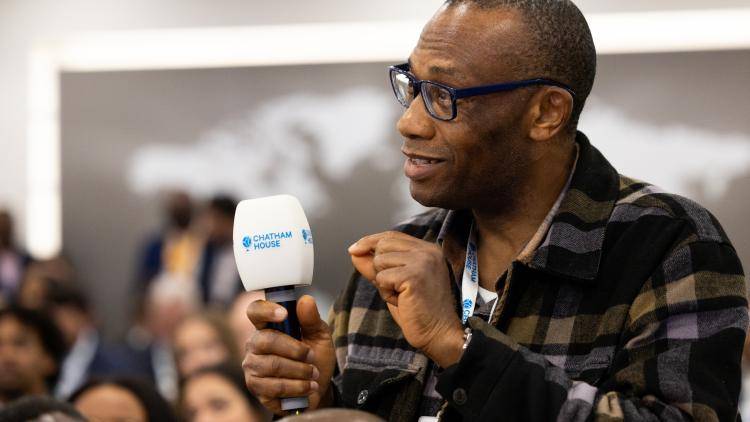
Houmann
My name is Houmann. I’m a PhD student. My research examines financial crime, sanction evasion by Russia, China and Iran. Could the more confrontational turning US economic and statecraft to tariffs, export control and financial restriction, create a paradox by incentivising rivals to develop alternative system that we can American leverage? Where is the tipping point? Thank you.
Max Yoeli
And we’ll take the second one before we come to our panellists.
Pierre
Hi, my name’s Pierre from LSE. I have a question for Stephanie. So, you mentioned trade as political because of its distributive implications for winners and losers. So, I was wondering if the solution should actually be some sort of institutional solutions to buffers and the negative impacts for losers, or is it just protectionism and does it explain the rise of social democrats, socialist democrats right now? Thank you.
Max Yoeli
Thank you very much. So, first, I guess we could go to you, Stephanie, on the question of distributional impacts. You know, if the benefits of trade aren’t being broadly shared, is there a way to intermediate that institutionally? And then after that, whoever wants to jump in on the broader question of, you know, kind of, more harder edge tools of economic statecraft, whether they are incentivising circumvention and whether, you know, there’s a similar parallel on the trade context, as well. Stephanie.
Professor Stephanie Rickard
Thank you for this excellent question. I would expect nothing less from an LSE student.
Houmann
Home team.
Professor Stephanie Rickard
I do think that part of what’s happened is an insufficient amount of compensation for people harmed by trade, peop – for people who have lost their jobs because of trade, for people who have seen their wages or their incomes decreased. The US did have this Trade Adjustment Assistance programme, which I mentioned. It’s now dead, it’s defunct. 200,000 petitions are sitting there, and they will not be processed, and it was always underfunded. There was simply not enough support to help these people who were harmed by trade recover.
The European Union has a programme called the European Globalisation Adjustment Fund. I’ve done some research there to see if that can help. It does help people get their jobs back, but it doesn’t keep them from turning against trade, and so, one of the fears here is that this anti-trade or anti-globalisation sentiment, maybe it started off because of economic interests, but now, exactly as you’ve suggested, it seems to be coupled with other things that aren’t purely going to be resolved through compensation, through support for people who’s lost their jobs. Now it seems to be connected to things like concerns about immigration, concerns about culture and so, in some of my research I’ve done, we found that this economic shock of a trade-related job loss starts – it triggers this concern about trade, but then it snowballs into these other concerns that even the best compensation programme might not be able to stop.
Max Yoeli
I really appreciate that answer because it hits on something that I think we’re beginning to think a lot about here and is, you know, permeating the political conversation in the US as well, which is AI. And I think if you replace every time you said ‘trade’ in that exchange with AI instead, we will face a lot of the same dynamics, a lot of the same, you know, frustration, insecurities, political spillover effects, unless there is a more effective set of institutional mechanisms.
Professor Stephanie Rickard
And can I just say? This EU fund that I referenced, the European Globalisation Adjustment Fund, they’ve recently extended the criteria, so it’s not just if you lost your job for a trade, it’s also if you lost your job because of AI. So, they’re…
Member
Sorry.
Professor Stephanie Rickard
…trying to get ahead of this.
Max Yoeli
And I’m sure we’ll be hearing much more about that in the months and years to come. On the economic security piece, Irwin, can I go to you on, kind of, your perception of circumvention of some of these harder edged tools as sanctions, export controls, become that, kind of, tool, first resort for policymakers?
Irwin Stelzer
I’m sure I didn’t – I’m – I fear I didn’t get the question, Max.
Max Yoeli
So, it was – the initial question was, as the US and other countries begin to use harder tools of economic…
Irwin Stelzer
Right.
Max Yoeli
…statecraft, like sanctions and expinc – export…
Irwin Stelzer
Right.
Max Yoeli
…controls, is it incentivising bad actors to find ways around them, to find new modes of engaging, of transacting, in places where those tools might not…
Irwin Stelzer
Hmmm.
Max Yoeli
…reach?
Irwin Stelzer
As an abstraction, that’s probably true, but in the reality, we’re talking here about an adversarial relationship with a great power that wants to be the greatest power. They don’t need any incentive from what we do to do what they do. They – Xi Jinping is going to control the export of materials on which he has monopoly power regardless of what anything America does. He has an objective completely apart. I mean, his economy’s taking a hit from some of this stuff and he doesn’t care. So, I – yes and I would say it’s a healthy thing, for instance, in the area of defence, that Europe has finally decided to erect alternatives to the American umbrella. I think that’s terrific, it’s good for America, it’s good for Europe, it’s good for the world, that’s fine. But the notion that somehow, something Trump is doing impels China to do what it is doing is simply just not correct.
I had one thing. I tried filling out one of those forms if you lose your job in America and you want to get it. You had to show that you lost your job because of trade. Since I didn’t have an economic – I was just doing it as an exercise, but you needed a huge economic model to answer that question. So, I’m much for these compensation programmes, but boy, they are very, very hard to craft.
Max Yoeli
So, again, hopefully some lessons in the design of the next generation. Heather, did you have anything to bring in on the…
Heather Hurlburt
Yeah.
Max Yoeli
…economic statecraft piece?
Heather Hurlburt
So, first, actually, on the trade adjustment piece, I mean, those programmes were deliberately designed that way, to be hard to use and hard to access and hard for people to get the benefits. And they fell into the debate that we’ve always had in the United States about what the role of government is in people’s economic lives. The other thing that we know about those programmes that failed is that it’s less effective to support individuals than to support communities. Because if a factory closes, and as Irwin said, we can’t even agree whether the factory closed because of trade or technology, and then not only do I lose my job in the factory, but Stephanie loses her job running a restaurant that fed workers and Max loses his job running a daycare for the workers’ children, and how do we compensate them? So, actually, the more effective models that we know about from other societies are about supporting communities, but that’s not tended to be the way and Laurel, maybe we have another session on them, maybe there’s rugged American individualism, that hasn’t tended to be the way we think about this.
On your question, you know, I think the quest – the answer is absolutely, there’s a tipping point and we won’t know it when we see it. We’ll only know it when we’re past it.
Houmann
Yeah.
Heather Hurlburt
And I can’t resist, Max, using that to bring up, there’s this fascinating bill in Congress right now which is rapidly – I guess it’s going to be the Lindsey Graham Memorial Russia Sanctions Act. But one of the things that this bill includes is that it would give the President, this President, any President, the authority to levy one 100% tariffs on the top second party or third-party importers of Russian oil and natural gas. And Max and I were looking at this just before we came down here and half of those countries are our allies. And so, there you go again, you’re putting 100% tariffs on France and Belgium, on the new government in Hungary, and again, you’re paying – you’re doing exactly what you said and you’re extending outward and outward and outward the perimeter of US economic statecraft.
So, really fascinating, fascinating moment and I think – of this question of when does the use of the tool actually create more of the thing that you were using the tool to counter?
Max Yoeli
And also, it’s that – yeah, when it comes to, sort of say, non-state actors or, like, the sanctions regimes, there’s also the question of how you’re treating your allies and partners who helped to gather the intelligence and enforce some of those measures. And yeah, to push away with one hand on trade, but then pull closer on economic security, creates a tension and dissonance that a lot of, you know, partner and ally capitals are having trouble navigating, whether here in the UK, across Europe. And perhaps some of our future questions will get to how policymakers in those places should think about the future of US trade policy and economic statecraft. But with that, I’ll go back to the floor, if there are any more questions, ideally from a more representative mix of our audience, perhaps. Gentleman in the red shirt there.
Ram
Great, thank you. I’ve actually got two questions, if that’s alright. My name is Ram. I’m a Business Consultant. But the first one is, have you mentioned that no Politician would want to give up revenue raising policies, like tariffs, so what would you expect either a Democrat President or a Republican, it being Trump or someone else, do in 2028? And the second one, which is what you just alluded to, trade is bilateral and multilateral, so even if the trade policy of the US changes, how do European, or how the Eu – allar – how do their allies approach the new trade policy? Thank you.
Max Yoeli
Thank you, and then we can take a second one, as well. Here in the front row, please.
Tanju Morgan
Thank you. Tanju Morgan, St James’s Roundtable member at Chatham House. This discussion brings to mind the conference that we just had last week around the middle powers, and I think Bronwen said if you’re not in the US or China, you’re, basically, a ‘middle power’. So, when we think about the trade, the tariffs and what other countries we alluded to, what would you suggest their response to this potential tipping point that we’re talking about?
Max Yoeli
Thank you very much. So, we have, you know, the post-28 question, which we’ve discussed a bit, but if there’s anything to add, and then, really, this question of partners and allies, how they should be thinking about post-28 trade policy and especially these middle powers, whether it’s, kind of, Mark Carney’s band of like-minded nations or other formulations. But in these capitals around the world, how should they be looking at and thinking about the US? Stephanie, could I start with you, perhaps?
Professor Stephanie Rickard
Hmmm, sure. I think it is just shocking when you go to Geneva, or you go to another capital, to see the absolute erosion of trust. I mean, this is the lowest trust environment I’ve certainly ever seen and Diplomats that have longer careers than I have, have ever seen. And so, once trust is lost, it’s really hard to rebuild and so, I think that’s the big challenge, certainly at the WTO, but in – even in terms of bilateral relationships. I mean, there’s just this uncertainty, this lack of trust. I mean, what do you do as a business? I don’t know because you don’t know what your tariff’s going to be tomorrow. So, I think that, hopefully, in 2028, that can change. Even if we don’t snap back to a, sort of, multilateral rainbow world, at least there could be certainty and that might be helpful.
I think the middle powers should build without the US, move forward, right? And I think that that is happening slowly, slowly, slowly, but I think now, certainly at the WTO, you see more movement from the EU, from the UK. Even, sort of, Japan and Korea are coming aboard and saying, ‘We have to move forward. Even if the US is not with us right now, we can’t just let the multilateral trading system stop – cease to function.’ If the WTO ceased to function today, the global economy would shrink by 5%. So, people have an incentive not to let that happen. So, I think the middle powers work together where they can and continue to build without the US.
Max Yoeli
Irwin or Heather, do either of you want to come in on these questions?
Irwin Stelzer
Well, I – you know, I agree with all of that, but I just wonder, take the example of America objecting to another pipeline selling Russian gas into Europe at a time when America have really very, very important expenditures in connection with the defence of Europe. Do you think it should not be allowed to say, ‘Hey, if you guys want to keep sending money to Russia for their gas, we’re not so sure we want to keep defending you to the extent we are’? In other words, this is this question of whether this leads to, and I think it does, it leads to intervention in the domestic policy of your trading partners, who are also your security partners.
And I don’t know how – I don’t like it, but on the other hand, I could understand the feeling that you want some secondary consequences. Do you want people to – right now, America is at war with Iran. People who are buying Iranian oil and financing the Iranian closure of the Strait should be subject to some American reaction, I think.
Max Yoeli
So, I guess just to turn the frame round, though, if you accept that’s the US position and you’re sitting in one of these – you know, in Brussels, Paris, London, wherever, you know, how should you be thinking about US policy, then? What…
Irwin Stelzer
Right.
Max Yoeli
…policy changes does it counsel in your capital? And, you know, Heather, as somebody who has, you know, heard from some of these policymakers first hand over the years, I wonder if you have any suggestions for them.
Heather Hurlburt
Yeah, so three really quick points. First of all, I can’t resist pointing out, I’m afraid, that actually President Trump was financing the purchases of Iranian oil up until last week. So, well, consistency’s a little difficult.
Irwin Stelzer
Hmmm.
Heather Hurlburt
To your question, whoever the next President is, she or he will seek to rationalise the tariffs and figure out what they can get in exchange for taking some of them off in an organised way. And that creates an opportunity for middle powers, which brings us to your question and middle powers could be organising themselves to think about when a future administration comes and says, ‘We’d like to have a more predictable and somewhat more trust-based,’ you know, depending on who the President is and what they think they’re trying to do, ‘what do other powers say we want in exchange for that?’
My view is a little different from Stephanies, that on the one hand, the core standards that underly the WTO and that allow the whole world to get involved in trade are really important and we urgently need not to lose those. It’s very hard for me to see the WTO being an effective forum for much of anything in the near to medium future, and so, I hope that other powers will also think about how to create fora and places to talk with Washington about trade and about a rationalised and somewhat more calm future for trade that doesn’t require trying to arm wrestle Washington back into WTO compliance, which for reasons I’ve already mentioned, I think is a political impossibility in the medium-term.
Max Yoeli
Thank you, Heather. We have just about five or six minutes left, so I will take one more round of questions in the room, add one or two from online and give our panellists that last word. So, here please and then, the Director of the US and North America Programme, her privilege for the last question.
Richard Castle IV
My name is Richard Castle. I’m a Head of Legal of Lim Miliband. My question concerns the 250-year anniversary of United States of America after the Declaration of Independence, and it seems that the United States of America was built as New England and it applies British Freemason, British architecture, but also British values. So, now, after World War II, there was the emphasis on the leadership of the United States of America in the world and that continuation of the British tradition onto America has evolved. So, what I’m asking is from the panel there, what is your opinion in terms of the values system of New England as it has evolved now in this 250-year anniversary of United States of America?
Max Yoeli
It’s a very interesting question, perhaps slightly beyond our scope here, but it can be channelled into our topic, perhaps, if our panellists are feeling particularly limber and Laurel, our Director of the US and North America Programme, your question, please.
Laurel Rapp
Thank you, Max, and to all of you for joining us this evening. We’ve talked a lot about different economic tools, but we haven’t talked about the primacy of the dollar. Can you…
Max Yoeli
Uh-huh.
Laurel Rapp
…kind of, predict out a little bit where we will be a decade from now? And this gets to questions about sanctions and use of tariffs and evasion. Where is – should we be looking at that as an updated assumption, or do we – do you think the assumptions we have about the primary of the dollar likely remaining for the near to mid-term, do you think those are sound?
Max Yoeli
So, we have these two questions. I will add a third from online. ‘Should tariffs be used as a political weapon by world superpowers regardless of how it affects the citizens of the victim country?’ So, we have the importation of British values through the American to today, how that might frame the economic conversation. We have the feature of the dollar in, you know…
Irwin Stelzer
Ah, ah, ah, ah.
Max Yoeli
…a world of stablecoins and other currency shifts and then the question of harming those who are targeted with tariffs. Irwin, I’ll start with you and give each of our panellists a minute or two for a final word. Any of those threads you’d like to pick up?
Irwin Stelzer
Well, we’ve imported lots of British values re: the Declaration of Independence and the Constitution and we must – that must be the frontline of defence against Trump that we stand for. As for the dollar, it will remain, I think, the world currency, with maybe, let’s say, 1% less of world trade, but it – so long as China insists of manipulating its currency, there’s not a feasible alternative to the US dollar.
Max Yoeli
Stephanie.
Professor Stephanie Rickard
I actually completely agree with that. I think that this is such an important point that we hadn’t talked about, so thank you for reminding us. As long as the dollar is king, which it will remain for the short to medium-term, I’d say ten years out, yes, I mean, that that just underlays all of the conversations that we have about trade and economic exchange. And I don’t think that’ll change in a big way any time soon, absolutely.
Heather Hurlburt
So, I’ll be a little contrarian, just for fun, and in a funny way, actually this does go to your question, because it is no longer a consensus across American society that the dollar being the global reserve currency is a good thing. And this is shocking and surprising to people who grew up in foreign policy and international affairs and who grew up with the idea that the US had inherited the mantle of global leadership from Britain and should continue to exercise it. But there is a strong, I’d say a strong minority of American thought now that says actually, we would be better off economically and we would be better off socially if the dollar were just another currency. And so, there, I’m 5% down, rather than 1%, and I also think, you know, Irwin, you said something really important that one of the reasons there’s no alternative…
Irwin Stelzer
I bet it’s…
Heather Hurlburt
…to the dollar is the perceived strength of the rule of law around business in the United States, as opposed to the perceived strength around the rule of law in China. And this actually lets us come back to the last question about are we using tariffs in ways that are not just unjust, but are also potentially not within the rule of law? And are we slipping into a system where we are undercutting our own rule of law by our desire to use economic tools for political purposes? And the idea of that forming a ba – a negative feedback loop with the dollar, to me, underlies the significance of the threat and why it would be good to get back behind some very clear and some benchmarks for tariffs that also involve the legislative branch and the constitutional role that our founders foresaw. that tariffs and economics could be morally slippery and therefore, there should be whole of society engagement rather than the unitary executive.
Max Yoeli
Yeah, I think it’s a really important note to end on, the institutional and separation of powers landscape on which these political and policy fights take place. Yeah, the long-term erosion or shifts there can have long-lasting effects beyond any single episode that may not be visible for years or decades but are immensely important.
So, that – thank you so much to all of you for joining us in the room and online. My thanks to our panellists, and please do join us in the weeks and months ahead. September 17th, as we talked about, ‘Separation versus concentration of powers.’ October 6th on ‘Interest versus values in US foreign policy’ and then looking ahead to convenings around the mid-terms and some, you know, writing and thinking around the post-2028 landscape. So, there’s so many wonderful points tonight on the erosion of trust, the stickiness of politics around trade and tariffs and ultimately, that trade is inherently political and something we will all watch closely into November and beyond. So, Stephanie, Heather, Irwin, thank you so much for your time and thank you to all of you for being with us [applause].
Irwin Stelzer
Yeah, thank you, I just…