|
|
|
|
|
|---|
|
Uzbekistan
|
1,284
|
Of which hydro
|
967
|
|
Turkmenistan
|
1,184
|
Thermal
|
40
|
|
Iran
|
827
|
|
|
|
Tajikistan
|
471
|
|
|
Note: As of 2015, Afghanistan had installed hydropower capacity of 254 MW and 312 MW of thermal capacity. The thermal plants are primarily diesel-powered, and hence expensive to operate.
Source: World Bank (2018), Afghanistan Renewable Energy Development Issues and Options.
Much of Afghanistan’s hydropower infrastructure has been damaged by conflict; and attempts to renovate or build new infrastructure have riled downstream neighbours, which have benefited from increased water supply owing to disrupted upstream water storage. The rest of domestically sourced power comes from fossil fuels from two oil-fired power stations near Kabul (two gas-powered power stations are planned) and renewables.
According to the Ministry of Water and Energy, Afghanistan has the potential to produce 222,000 MW of electricity from solar, 68,000 MW from wind, 23,000 MW from water (though some estimates are higher) and 4,000 MW from biomass annually.
A number of off-grid renewable energy projects are being developed across Afghanistan. UNDP alone has implemented several projects across the country providing clean energy to more than 500,000 people. For instance, the Kabul suburb of Sang-e-Nawishta is powered by two wind turbines. In total, UNDP has implemented 100 small solar projects, 44 biogas plants and 240 micro-hydropower projects.
Afghanistan has the potential to produce 222,000 MW of electricity from solar, 68,000 MW from wind, 23,000 MW from water and 4,000 MW from biomass annually.
However, potential consumption is much higher than current production. Central Asian power exports to Afghanistan are significant and growing. In 2015/16, Afghanistan imported a total of 3,767 MW of electricity from its Central Asian neighbours and Iran (see table below). Demand for energy in Afghanistan is likely to increase considerably as the country continues to experience a high rate of population growth and growing urbanization – not least because of internal displacements.
The system of power trading operated between the Central Asian Republics during the Soviet period (known as the Central Asia Power System – CAPS) offered a good example of benefit-sharing, with 83 power stations across Central Asia producing 25,000 MW. During the winter, Kirghizia (now Kyrgyzstan) and Tajikistan stored water in reservoirs and imported power and fuel from Kazakhstan, Turkmenistan and Uzbekistan. In the summer months, Kirghizia and Tajikistan provided water for irrigation to Kazakhstan and Uzbekistan, along with electricity generated by hydropower.
Following the dissolution of the Soviet Union, CAPS gradually disintegrated, with Uzbekistan and Kazakhstan eventually pulling out in the late 2000s. The single central management system collapsed, and technical problems, coupled with the desire of the newly independent Central Asian republics to promote a sense of nationalism and self-reliance, led to the rise of autarchic systems.
Rebuilding a similar regional power-trading system that includes Afghanistan – which at present can only play one of two roles, that of downstream consumer, or that of conduit – appears challenging. Yet Afghanistan is becoming a significant consumer of Central Asian power. In part Afghanistan has benefited from its neighbours’ historical experience of CAPS, receiving some of their surplus resulting from the break-up of the system. Some steps are being taken to reintegrate the power systems of Central Asia, and in November 2017 it was announced that the Uzbek and Tajik energy grids were to merge. As the tendency shifts away from autarchy and back towards cooperation, it will be imperative that Afghanistan (and the countries of South Asia) become an integral part of the resultant mechanism. There is a risk that cross-border engagement is conceived in zero-sum terms whereby, for instance, energy is exported to Afghanistan at the expense of another country. Building a more multilateral energy grid reduces this risk, and counters the risk that importing power from one country creates a vulnerability to political shifts in the upstream producer.
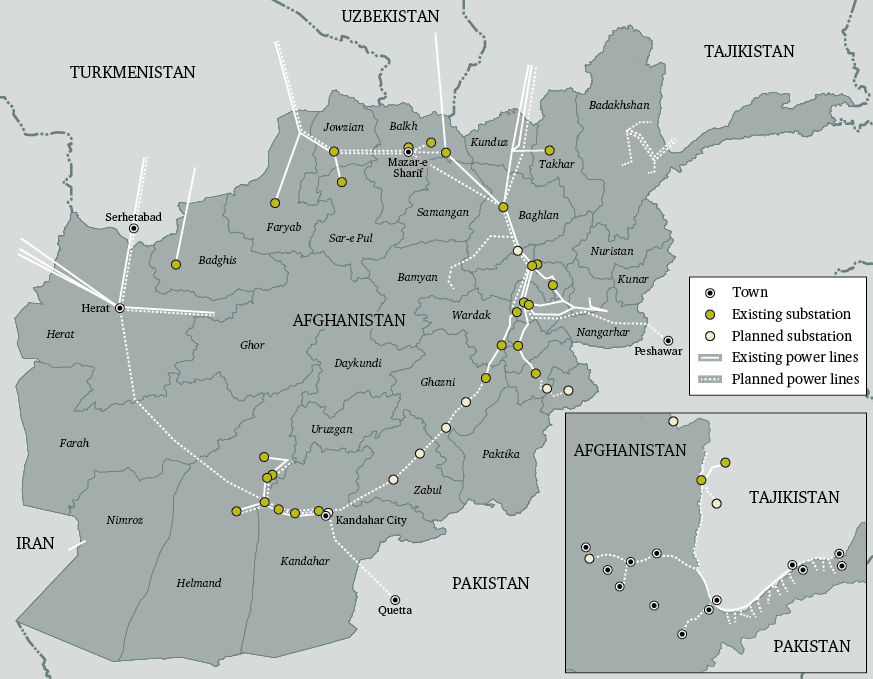
Uzbekistan is currently the largest provider of electricity to Afghanistan. A 440-km high-voltage transmission line connecting the two countries was completed in 2008, linking Kabul and five Afghan provinces with Uzbekistan. By 2011 the line had a capacity of nearly 300 MW. Uzbek power supplies have been reliable, though there are commercial reasons for this. The collapse of CAPS meant that Uzbekistan had a certain amount of surplus power available to export, while Afghanistan had few alternative suppliers during winter. This enabled Uzbekistan to charge a high rate for power supplies – around $0.10 per kilowatt hour (kWh), or roughly double the rate charged by Tajikistan and Turkmenistan.
However, in 2018 the cost of Uzbek electricity was lowered to $0.05 per kWh, bringing it in line with its neighbours. Uzbekistan’s state-run power company, Uzbekenergo, has also begun building a 260-km transmission line between Surkhan in Uzbekistan and the Afghan town of Pul-e-Khumri (to connect with the Indian-constructed line running from the latter to Kabul). This will enable a significant expansion of Uzbek power exports, and could potentially be extended to Pakistan. The project may also enable the electrification of the railway connecting Hairatan, in Balkh province and on the border with Uzbekistan, with the provincial capital of Mazar-i-Sharif, reducing transport costs on that route.
Tajikistan’s exports complement those of Uzbekistan. Most of its energy comes from hydropower – the country is home to 4 per cent of potential global hydropower. This potential includes the massive Roghun hydropower project, which could generate 3,600 MW. However, it was bitterly opposed by Islam Karimov, the former Uzbek president. The current Uzbek government has not clarified its stance towards Roghun. Peak supply in Tajikistan is reached in summer, although in the winter months Tajikistan experiences energy shortages. Were intra-Central Asian power trade to be revived in the absence of expanded power generation capacity, Tajik and Uzbek exports to Afghanistan could be jeopardized.
Were intra-Central Asian power trade to be revived in the absence of expanded power generation capacity, Tajik and Uzbek exports to Afghanistan could be jeopardized.
Turkmenistan has the world’s sixth largest gas reserves, and has invested heavily in gas-fired power stations, enabling it to export power to Afghanistan as well as Iran. Turkmenistan is connected to Afghanistan by existing transmission lines between Ymamnazar, on its southeastern border, and the Afghan town of Andkhoy (in Faryab province); and between Serhetabat, in the extreme south of Turkmenistan, and Herat, Afghanistan’s third largest city. However, these cables are not able to deliver the 300 MW exports agreed under the Asian Development Bank’s (ADB) TUTAP Power Interconnection Framework. In 2018 work started on a high-voltage transmission line which would enable Turkmen exports to Afghanistan to increase substantially – and potentially to overtake those of Uzbekistan.
The break-up of CAPS, and the subsequent desire of the Central Asian countries to be self-sufficient, have led energy exports to be seen as providing leverage, while energy imports create vulnerabilities. Given the necessity of energy security for economic stability, there is a need to develop a sense of co-dependency, rather than the current patron-client relationships that exist, to a greater or lesser extent, in each case.
Large-scale projects also face security threats. For instance, in early 2018 the Taliban attacked the transmission lines connecting Uzbekistan and Tajikistan to Kabul four times within a one-month period. While such attacks, and the resultant damage to infrastructure, are routinely claimed by and blamed on the Taliban, some hold that beneficiaries of the status quo – in particular diesel ‘mafias’ selling fuel for small generators – could have been to blame.
Two of the long-awaited megaprojects are gradually coming to fruition, enabled in part by the increased interconnectedness of Afghanistan’s electricity grid. In February 2018 a framework agreement was signed for the TAP Power Interconnection Project. The first phase will use infrastructure constructed as part of the TUTAP Power Interconnection Project, enabling power to be exported from Turkmenistan to Afghanistan and Pakistan. This is due to be completed by 2021. The second phase, scheduled for completion the following year, will transfer power from Turkmenistan into Herat, Kandahar, and through Spin Boldak (all in Afghanistan); and to Chaman and Quetta in the Pakistani province of Balochistan. In total, around 500 km of transmission lines will be constructed, enabling up to 4,000 MW of power to be exported to Afghanistan and Pakistan. This project will help facilitate the TAP project.
These projects will then link into the Central Asia–South Asia power project (CASA-1000) by transferring any surplus power in winter. CASA-1000 is predicated on the fact that Central Asia has a power surplus in summer, when the countries of South Asia have power shortages.
Substantial efforts – both internally and through these large-scale projects – are being directed at connecting Afghanistan’s grid with those in neighbouring countries, so that Afghanistan can act as the conduit between Central and South Asia. At the same time, Afghanistan’s mountainous terrain provides ample scope for the development of off-grid electricity, as do several of the more remote areas bordering Afghanistan, such as Gorno-Badakhshan Autonomous Oblast, officially called the Viloyati Mukhtori Kuhistoni Badakhshan (Kuhistoni Badakhshan Autonomous Region, or VMKB), in southwestern Tajikistan.