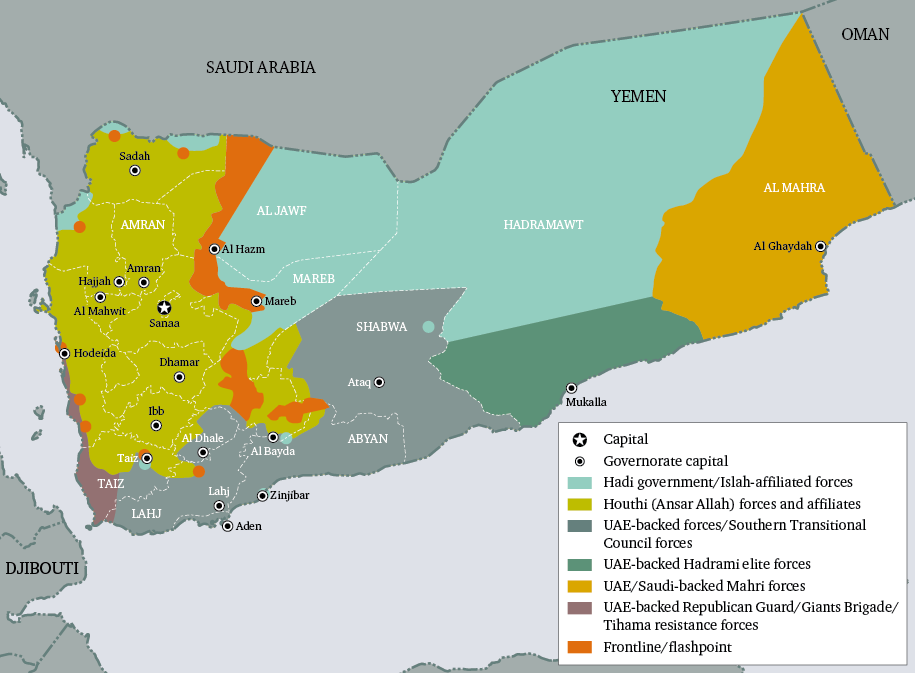
Total and partial collapses of state structures are a familiar problem in the international state system. Where they occur, internationally recognized (de jure) states with formal borders and governments lack de facto statehood, being insufficiently able to perform the functions conventionally expected of a state. Often, governance vacuums in such settings are filled by alternative/informal actors that perform state-like functions in place of, or alongside, official institutions. In these contexts, basic services are provided at least in part by political opposition networks, local communities and ethnic or sectarian-based identity groups (including, for example in the Middle East, by Salafi-jihadi groups). As a result, the distinction between formal and informal actors in the state is blurred, as too are the lines between the formal, informal and illicit economies.
Dealing with these hybrid political orders and their many problems – from insecurity to corruption, political violence and poverty – is one of the most vexing dilemmas in contemporary state-building. The improvised, irregular patterns of governance that have emerged in response to institutional breakdown and conflict are also the very factors that confound reform.
The failure over the years of international policymaking to stabilize states such as Iraq and Yemen – the two countries on which this paper focuses – illustrates this contradiction. Part of the problem is an assumed binary distinction between state failure and success. The distinction is evident in the loaded vocabulary of ‘fragile’, ‘failing’ and ‘failed’ states that has long pervaded the state-building debate.
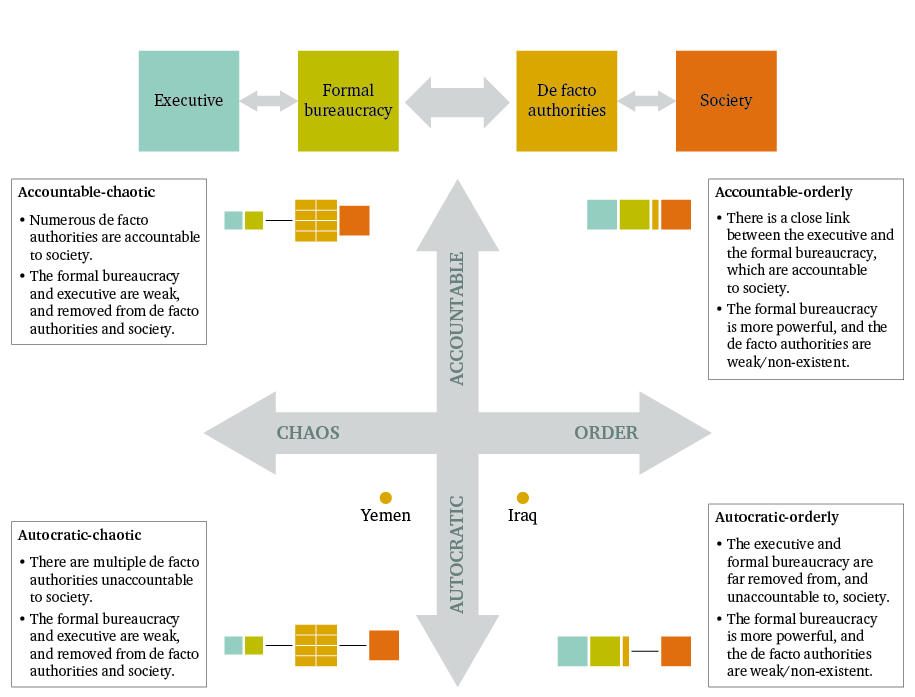
This paper avoids these terms, instead using the idea of a spectrum between chaos and order to provide a framework for understanding. We emphasize from the outset that ‘chaos’ and ‘order’ themselves elude rigid definition, and that our analysis explicitly questions conventional interpretation. (To give one example, recent Chatham House research has characterized Yemen as a ‘chaos state’ – yet this term was deliberately chosen to convey the paradox of a political order that is at once highly fragmented yet more functional and organized than might be supposed.)
But policymakers mistakenly view countries such as Iraq and Yemen – marred by cycles of violent conflict and ineffective governance – as almost entirely chaotic. On the surface, the state in these settings may indeed appear diminished and dysfunctional when compared to an imagined, idealized form of the ‘orderly state’, often assumed in the West to be the natural organizing principle of modern society and a precondition for international security and stability. This ‘orderly state’ is a construct centred around an internationally recognized government that provides a range of public goods and basic services – electricity, water, healthcare, education etc. – via a well-run bureaucracy. International policymakers typically also assume that fostering such a context will help the state develop attributes such as the rule of law and democratic accountability.
This paper argues that such a binary approach is unrealistic. States, from the most stable, advanced democracies to so-called developing countries ravaged by conflict and insecurity, actually lie somewhere along a spectrum between ‘relatively more chaotic’ and ‘relatively more orderly’. No state is entirely chaotic or orderly (the notional extremes on the scale exist in the abstract). Even those that display many features of chaos – as in Iraq and Yemen – contain pockets of order that are all too often overlooked. Moreover, what at first appears as chaos can be understood as part of an ongoing – albeit fragmentary and stalled – transformation, during which the social and political status quo is adjusting to shifts in the relative legitimacy, capabilities and power of different actors. At times, international policymakers are responsible for stalling such transformations by supporting their preferred leaders and resisting emerging leaders, causing unpredictable flux and competition.
The need for a new approach to state-building
For some, the state is an elusive concept. Yet one structural definition has prevailed in academic literature and mainstream policy analysis: Max Weber’s definition of a state as a fixed territorial entity, ruled by a central authority with a monopoly over the legitimate means of violence. The Weberian ideal of the state has become the dominant template for Western policymakers. From the second half of the 20th century to the present, we have seen a growing interest from Western governments, as well as global institutions such as the UN, in the stabilization and support of weak, fragmented and conflict-ridden states, which are deemed security threats. Policymakers and officials have tended to adopt a rigid, technocratic approach to state-building, rooted in the idea that external actors can confer statehood through the construction of institutions that resemble their own (or at least are imagined to do so), using a Weberian security-first approach.
As a result, state-building has tended to focus on identifying nominally ‘legitimate’ political elites to act as the executive, often using election results as a proxy for legitimacy. It has emphasized efforts to enhance the capabilities of the institutions of state through the engagement of select elite intermediaries in official positions, and through capacity development among the official bureaucracy and state workers underneath this elite.
Such an approach is often inherently paradoxical: having accepted that a state is weak, failing or failed, external actors seek to bolster the position of the very actors that have overseen national-level failures, in the hope that, with the right support and training, they will produce different outcomes. At times, emerging actors that play substantive informal roles in the political economy are at odds with the preferred nominees of international policymakers, who then seek to maintain the old order but in doing so undermine prospects for stabilization and organic transformation of the state. In other words, those who actually hold power on the ground are excluded from proposed settlements, and violent political contestation often resumes.
A multi-layered state
This paper proposes a conceptual model for understanding contexts (such as in Iraq and Yemen) where state institutions, including the military and security services, are weakened or have limited geographical jurisdiction. It rests on the argument that, on closer inspection, many of the basic functional elements of the state are present in such countries/contexts, but not as part of a coherent, centralized system.
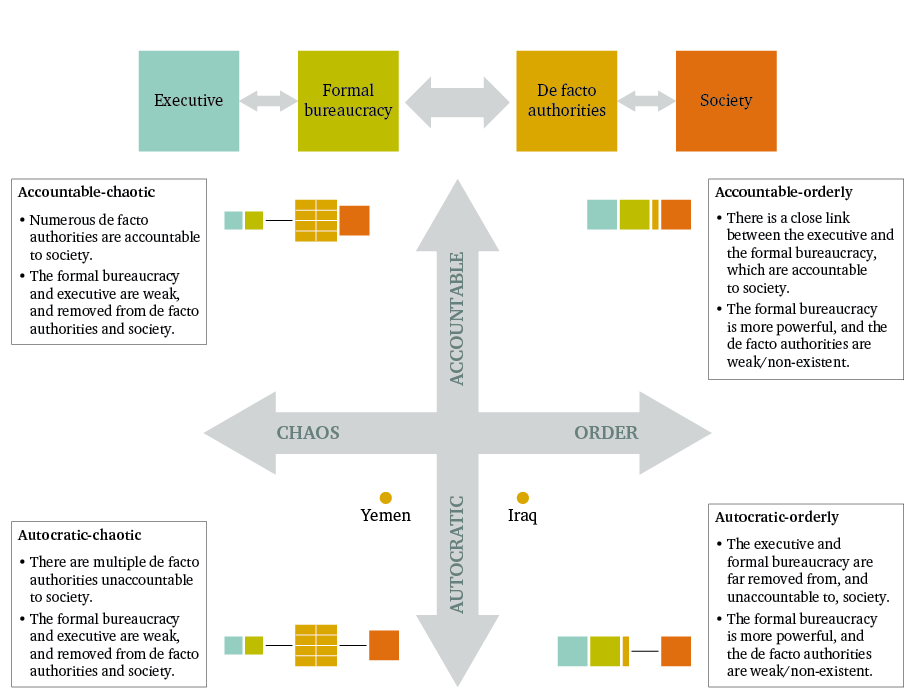
Our model is built on the premise that four categories of human capital form the state: the executive, the formal bureaucracy, de facto authorities and society at large (see Figure 1). Of these, the paper focuses in particular on the executive, the formal bureaucracy and the de facto authorities (with society serving as the end-user in this process). And, as will be further discussed below, it identifies the principal opportunity for more effective policy intervention in better integration and coordination between the two ‘middle’ layers in this model.
The executive is the most visible actor in any state structure. It consists of members of the political elite who have been selected/elected, or who have forced their way into overseeing the day-to-day management of the state.
The formal bureaucracy is made up of technocrats with the skills and know-how to turn policy into programmatic plans. The integrity and effectiveness of such actors reflect the long-term health of state institutions. The bureaucracy plays an important role in sustaining the executive: either by helping to build its legitimacy through policies that benefit society, or by wielding the power of the armed and security services to prevent any challenge to the executive. The bureaucracy consists of the human capital that underpins institutions. In the idealized orderly state, it is staffed by dispassionate professionals. However, in more chaotic states, it is more likely to contain political appointees and/or cronies, who reduce its efficacy.
In states closer to the chaos end of the spectrum, de facto authorities, or doers, emerge and grow in power to make things happen on the ground. While often invisible to foreign policymakers, they form the clearest manifestation of statehood to society at large. Among these de facto actors, non-state military/security implementers (i.e. militias) can use their local capacity and influence to challenge the executive, in effect encircling and seizing control of official institutions. This in turn enables de facto authorities to control the resources and revenues associated with the formal state.
The key to our understanding of these hybrid/fragmented political orders is the gap in legitimacy, capability and power (see below for definitions) between the formal bureaucracy and the de facto authorities. A formal bureaucracy may enjoy recognition that a de facto authority does not, but without the ability to achieve impact on the ground it is in effect carrying out its functions in name alone. Equally, a de facto authority may be politically or tactically resourceful and functionally effective, but without the status of its formal counterpart the opportunities to have its role institutionalized in a reformed state are often impeded. Both conditions diminish prospects for effective state-building. In short, the wider the gap between the formal bureaucracy and de facto authorities, and the deeper the competition between constituencies, the more the state slides towards the chaos end of the spectrum outlined above. Moving along the spectrum towards a more orderly state requires connectivity and cooperation between the formal bureaucracy and the de facto authorities – and, in time, a merger of the two types of actor.