4.3 Bridging the investment gap
Workplace and CSR programmes have important limits. The communities most severely affected by malnutrition may lie beyond the reach of companies, particularly MNCs. Many such communities will be marginalized, with workers engaged in the informal economy and populations living in settings too fragile for large-scale business investment. Research has found that children of temporary or migrant workers are particularly exposed to a poor food and nutrition environment, while the highest rates of childhood stunting are found in Burundi, Eritrea, Timor-Leste, Papua New Guinea and Niger, countries ranked as having among the least competitive business environments in the world.
Underinvestment has hampered progress towards achieving the World Health Assembly targets and broader nutrition targets included under SDG 2. In 2017, the World Bank issued a warning that committed spending on nutrition interventions falls far short of the $7 billion-a-year additional investment required to meet the World Health Assembly targets on childhood stunting and wasting, exclusive breastfeeding and anaemia in women (targets which in 2015 were integrated into SDG 2 but which retain their 2025 deadline). Five years into the 10-year window for achieving the nutrition targets, the annual requirement for additional investment is now over $9 billion.
Overall, just over 1 per cent of spending on official development assistance (ODA) goes to tackling undernutrition, and the total annual amount devoted to this area has increased only minimally since 2013. Obesity in low- and middle-income countries has been largely overlooked in ODA spending. Nutrition also accounts for a very low share of domestic government expenditure in high-burden countries, including those across sub-Saharan Africa and South Asia: just 0.1 per cent in these countries, according to a World Bank estimate. While philanthropic foundations such as the Bill & Melinda Gates Foundation and the Children’s Investment Fund Foundation have contributed significant sums, the majority of nutrition financing continues to come from a handful of international donors.
Just over 1 per cent of spending on official development assistance goes to tackling undernutrition, and the total annual amount devoted to this area has increased only minimally since 2013
The full and transparent payment of taxes should be the first priority for companies looking to contribute to improved nutrition; tax avoidance deprives governments of revenue needed to support national development programmes and deliver basic services, including clean water and healthcare. Beyond this, blended funding mechanisms and development impact bonds offer a means for companies from all sectors to demonstrate a material contribution to improved nutrition, either in their countries of operation or among vulnerable populations, without taking responsibility for the design or implementation of specific nutrition programmes. The Power of Nutrition, a charitable foundation established in 2015 following the first Nutrition for Growth Summit (which took place in 2013), is an example of a blended financing mechanism for mobilizing private-sector investment in national programmes to tackle childhood undernutrition. The Power of Nutrition commits to doubling corporate contributions using donor or philanthropic funds and then doubling these amounts again with public and/or private funding raised by the implementing partners, thus acting as a ‘catalyst’ for investment in nutrition.
Public–private partnerships and enterprises offer a further channel for private-sector investment in nutrition and nutrition-sensitive interventions, though there exist a number of sensitivities to be navigated. Under the Nutrition for Growth (N4G) framework to guide pledges and commitments, companies and investors are encouraged to ‘provide innovative private-sector financing to deliver integrated essential nutrition actions in country health plans’, and there already exist a wealth of examples of such arrangements targeting the double burden of malnutrition.
4.4 Company action to date
In order to gauge the level and nature of action on nutrition already being taken by MNCs, we undertook a review of a sample of 180 companies and the information they publish on their websites. Our sample included the top five companies for each sector listed in the Fortune Global 500, and the top 100 non-financial transnational companies by foreign assets as compiled by the UN Conference on Trade and Development (UNCTAD). We reviewed all reports and literature available on the selected companies’ websites, and in particular material relating to corporate sustainability, workplace benefits and services, and supply chain governance.
In addition to looking for initiatives with a specific nutrition focus (for example, nutrition training or the development of nutritional products), we identified initiatives with a nutrition component (such as well-being programmes that include activities centred on healthy eating) and those with the potential to have positive indirect impacts on nutrition (such as WASH programmes).
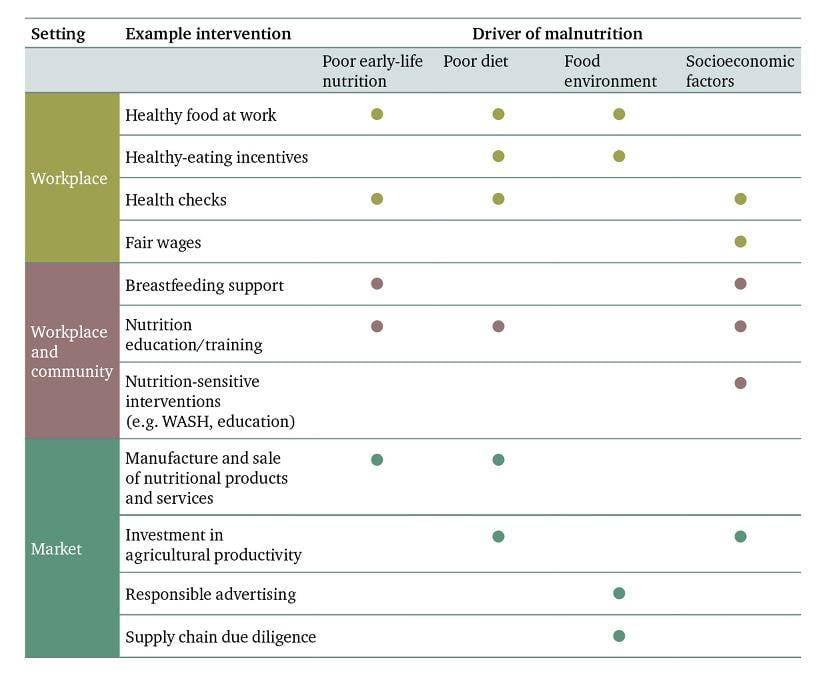
Below we present an overview of the nutrition-related activities on which the companies sampled report (Table 2), before discussing these in more detail.