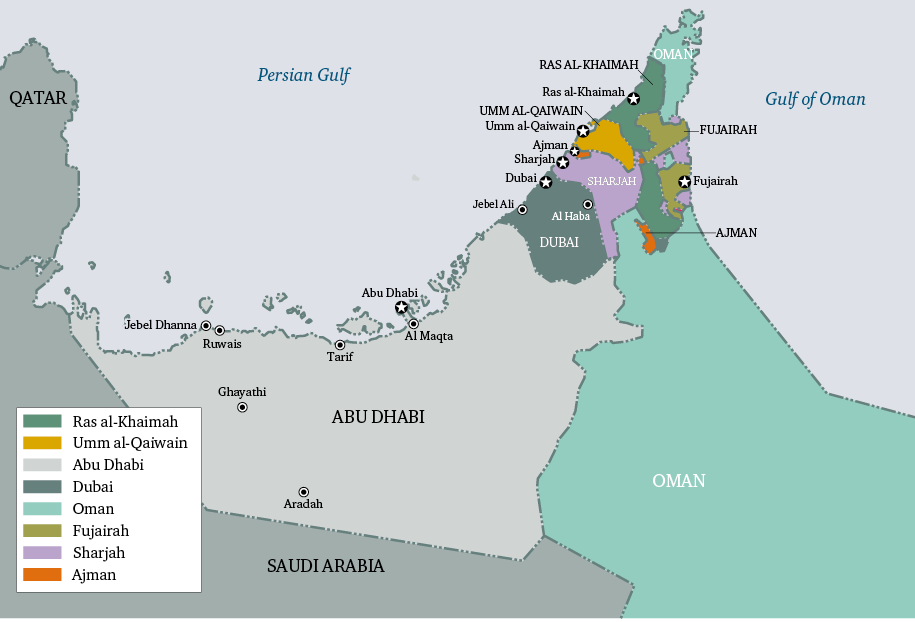
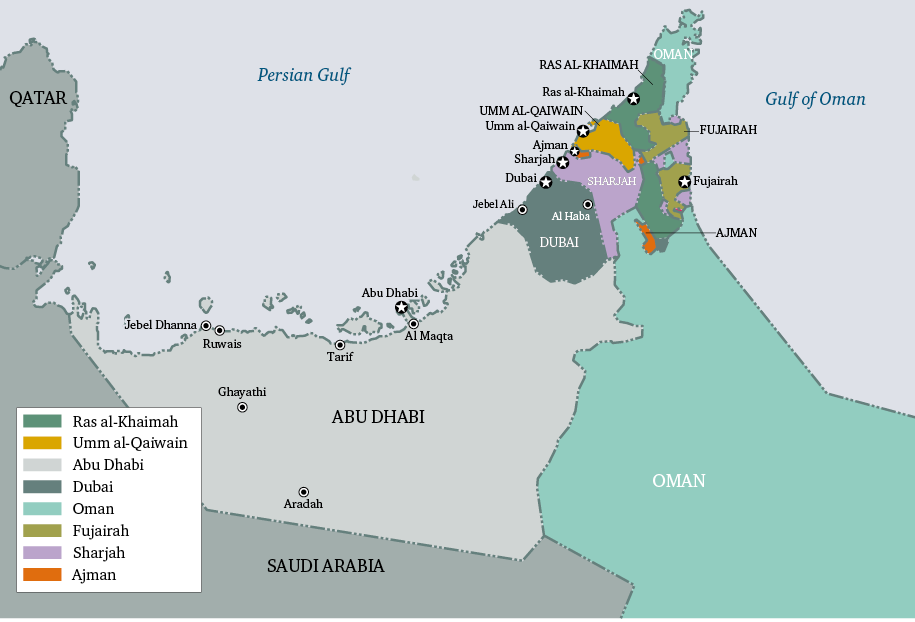
Expansionist and more powerful, Saudi Arabia and Iran were the main strategic risks to the UAE, led by the president and architect of the federation, Sheikh Zayed bin Sultan al-Nahyan. The repercussions of the so-called ‘Buraimi dispute’ of 1950–61 – a struggle between Abu Dhabi, Oman and Saudi Arabia over territory in the west of Abu Dhabi – endured. Saudi Arabia, viewed as an emerging, expansionist power, refused to recognize the UAE until the dispute, and other outstanding boundary issues, were eventually settled in 1974. To the south, Iran seized the islands of Abu Musa and the Greater and Lesser Tunbs, claimed by Ras al-Khaimah and Sharjah, in 1971 just as British forces were departing the area. A legacy of British imperial influence and long-running internecine border disputes, meanwhile, are two Omani enclaves within the UAE’s borders; as well as an enclave-within-an-enclave, territory belonging to Sharjah that sits within an Omani enclave in turn encircled by the emirates of Fujairah, Ras al-Khaimah and Sharjah. The Islamic Revolution in Iran in 1979, and the seizure of the Grand Mosque in Mecca the same year, led to fears among the Gulf monarchies that their rule could be overturned not just by the Arab nationalism and socialism they had battled in previous decades, but also by political Islamism.
The Islamic Revolution in Iran in 1979, and the seizure of the Grand Mosque in Mecca the same year, led to fears among the Gulf monarchies that their rule could be overturned not just by the Arab nationalism and socialism they had battled in previous decades, but also by political Islamism.
In an interview published in 2009, Zaki Nusseibeh, for many years the translator for Sheikh Zayed bin Sultan al-Nahyan – who was emir of Abu Dhabi from 1966 and president of the UAE from 1971 until his death in 2004 – noted:
From the time of the establishment of the UAE until his death in 2004, Sheikh Zayed, an iconic figure in the UAE and across the region, spearheaded the federation’s approach to international relations, although many emirates maintained their own links with other countries of the region. As recalled by officials and business figures who worked with him, Sheikh Zayed’s approach to foreign policy was in large part driven by a mix of idealism and pragmatism. Zayed aspired to promote a form of Arab nationalism through multilateral organizations similar to the UAE’s own federation like the Arab League and later the Gulf Cooperation Council (GCC).